MORPHOLOGY OF FLOWERING PLANTS
CHAPTER-5
CLASS-XI
BY- MS BINODINI DASH
PGT(BIOLOGY)
DAV PUBLIC SCHOOL, UNIT-8,
BHUBANESWAR
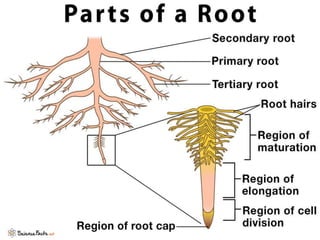
THE ROOT
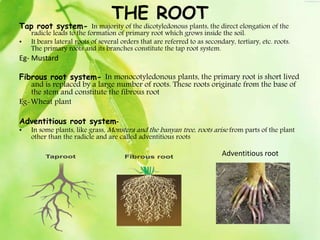
Tap root system- In majority of the dicotyledonous plants, the direct elongation of the
radicle leads to the formation of primary root which grows inside the soil.
• It bears lateral roots of several orders that are referred to as secondary, tertiary, etc. roots.
The primary roots and its branches constitute the tap root system.
Eg- Mustard
Fibrous root system- In monocotyledonous plants, the primary root is short lived
and is replaced by a large number of roots. These roots originate from the base of
the stem and constitute the fibrous root
Eg-Wheat plant
Adventitious root system-
• In some plants, like grass, Monstera and the banyan tree, roots arise from parts of the plant
other than the radicle and are called adventitious roots
Adventitious root
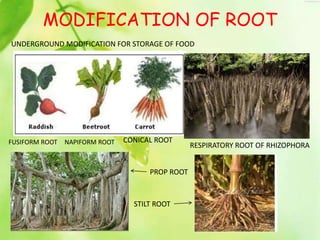
MODIFICATION OF ROOT
UNDERGROUND MODIFICATION FOR STORAGE OF FOOD
FUSIFORM ROOT NAPIFORM ROOT CONICAL ROOT
RESPIRATORY ROOT OF RHIZOPHORA
PROP ROOT
STILT ROOT
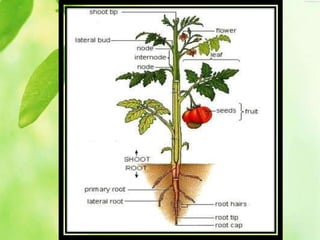
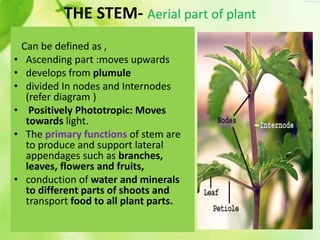
THE STEM- Aerial part of plant
Can be defined as ,
• Ascending part :moves upwards
• develops from plumule
• divided In nodes and Internodes
(refer diagram )
• Positively Phototropic: Moves
towards light.
• The primary functions of stem are
to produce and support lateral
appendages such as branches,
leaves, flowers and fruits,
• conduction of water and minerals
to different parts of shoots and
transport food to all plant parts.
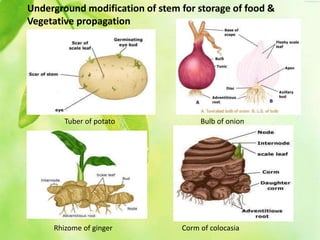
Underground modification of stem for storage of food &
Vegetative propagation
Tuber of potato Bulb of onion
Rhizome of ginger Corm of colocasia
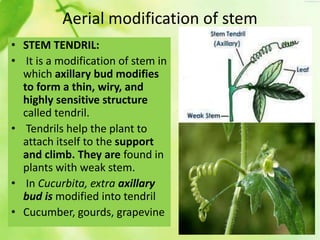
Aerial modification of stem
• STEM TENDRIL:
• It is a modification of stem in
which axillary bud modifies
to form a thin, wiry, and
highly sensitive structure
called tendril.
• Tendrils help the plant to
attach itself to the support
and climb. They are found in
plants with weak stem.
• In Cucurbita, extra axillary
bud is modified into tendril
• Cucumber, gourds, grapevine
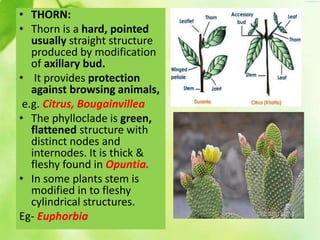
• THORN:
• Thorn is a hard, pointed
usually straight structure
produced by modification
of axillary bud.
• It provides protection
against browsing animals,
e.g. Citrus, Bougainvillea
• The phylloclade is green,
flattened structure with
distinct nodes and
internodes. It is thick &
fleshy found in Opuntia.
• In some plants stem is
modified in to fleshy
cylindrical structures.
Eg- Euphorbia
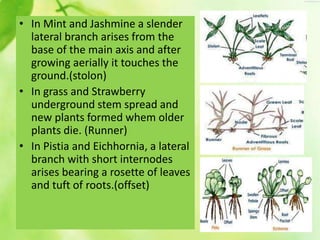
• In Mint and Jashmine a slender
lateral branch arises from the
base of the main axis and after
growing aerially it touches the
ground.(stolon)
• In grass and Strawberry
underground stem spread and
new plants formed whem older
plants die. (Runner)
• In Pistia and Eichhornia, a lateral
branch with short internodes
arises bearing a rosette of leaves
and tuft of roots.(offset)
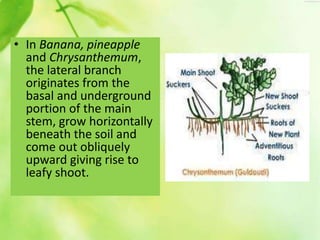
• In Banana, pineapple
and Chrysanthemum,
the lateral branch
originates from the
basal and underground
portion of the main
stem, grow horizontally
beneath the soil and
come out obliquely
upward giving rise to
leafy shoot.
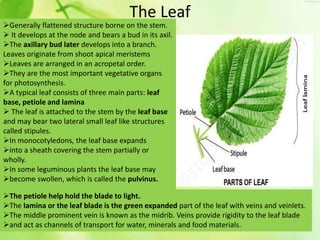
The Leaf
Generally flattened structure borne on the stem.
 It develops at the node and bears a bud in its axil.
The axillary bud later develops into a branch.
Leaves originate from shoot apical meristems
Leaves are arranged in an acropetal order.
They are the most important vegetative organs
for photosynthesis.
A typical leaf consists of three main parts: leaf
base, petiole and lamina
 The leaf is attached to the stem by the leaf base
and may bear two lateral small leaf like structures
called stipules.
In monocotyledons, the leaf base expands
into a sheath covering the stem partially or
wholly.
In some leguminous plants the leaf base may
become swollen, which is called the pulvinus.
The petiole help hold the blade to light.
The lamina or the leaf blade is the green expanded part of the leaf with veins and veinlets.
The middle prominent vein is known as the midrib. Veins provide rigidity to the leaf blade
and act as channels of transport for water, minerals and food materials.
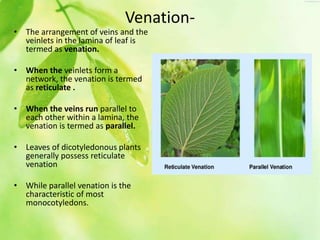
Venation-
• The arrangement of veins and the
veinlets in the lamina of leaf is
termed as venation.
• When the veinlets form a
network, the venation is termed
as reticulate .
• When the veins run parallel to
each other within a lamina, the
venation is termed as parallel.
• Leaves of dicotyledonous plants
generally possess reticulate
venation
• While parallel venation is the
characteristic of most
monocotyledons.
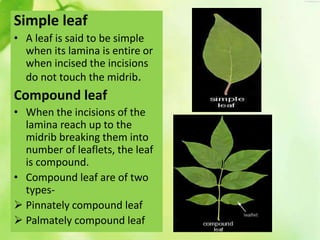
Simple leaf
• A leaf is said to be simple
when its lamina is entire or
when incised the incisions
do not touch the midrib.
Compound leaf
• When the incisions of the
lamina reach up to the
midrib breaking them into
number of leaflets, the leaf
is compound.
• Compound leaf are of two
types-
 Pinnately compound leaf
 Palmately compound leaf
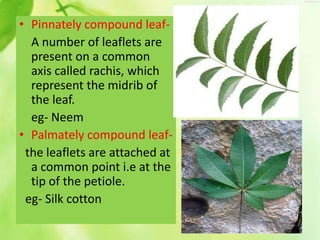
• Pinnately compound leaf-
A number of leaflets are
present on a common
axis called rachis, which
represent the midrib of
the leaf.
eg- Neem
• Palmately compound leaf-
the leaflets are attached at
a common point i.e at the
tip of the petiole.
eg- Silk cotton
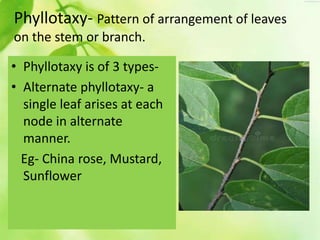
Phyllotaxy- Pattern of arrangement of leaves
on the stem or branch.
• Phyllotaxy is of 3 types-
• Alternate phyllotaxy- a
single leaf arises at each
node in alternate
manner.
Eg- China rose, Mustard,
Sunflower
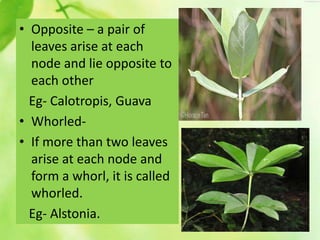
• Opposite – a pair of
leaves arise at each
node and lie opposite to
each other
Eg- Calotropis, Guava
• Whorled-
• If more than two leaves
arise at each node and
form a whorl, it is called
whorled.
Eg- Alstonia.
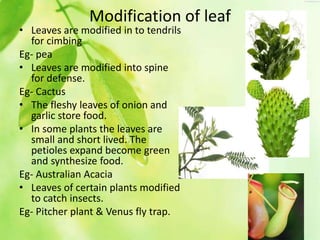
Modification of leaf
• Leaves are modified in to tendrils
for cimbing
Eg- pea
• Leaves are modified into spine
for defense.
Eg- Cactus
• The fleshy leaves of onion and
garlic store food.
• In some plants the leaves are
small and short lived. The
petioles expand become green
and synthesize food.
Eg- Australian Acacia
• Leaves of certain plants modified
to catch insects.
Eg- Pitcher plant & Venus fly trap.
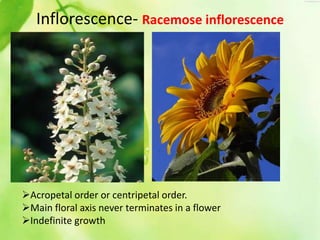
Inflorescence- Racemose inflorescence
Acropetal order or centripetal order.
Main floral axis never terminates in a flower
Indefinite growth
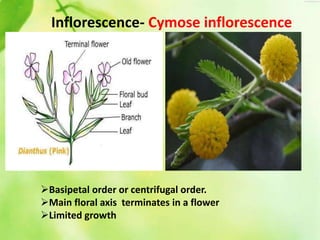
Inflorescence- Cymose inflorescence
Basipetal order or centrifugal order.
Main floral axis terminates in a flower
Limited growth
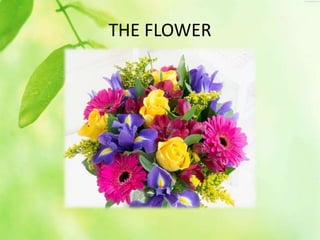
THE FLOWER
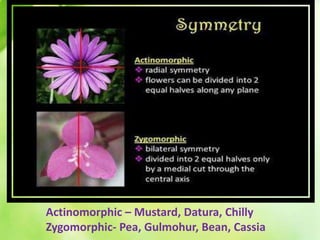
Actinomorphic – Mustard, Datura, Chilly
Zygomorphic- Pea, Gulmohur, Bean, Cassia
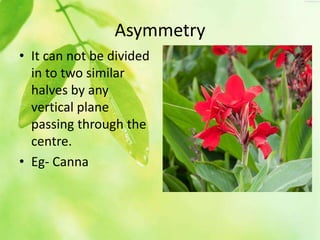
Asymmetry
• It can not be divided
in to two similar
halves by any
vertical plane
passing through the
centre.
• Eg- Canna
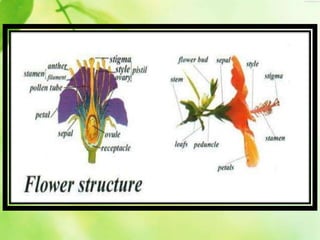
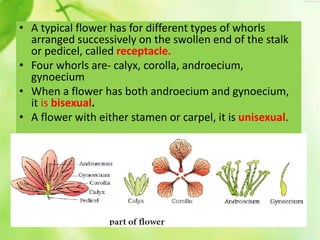
• A typical flower has for different types of whorls
arranged successively on the swollen end of the stalk
or pedicel, called receptacle.
• Four whorls are- calyx, corolla, androecium,
gynoecium
• When a flower has both androecium and gynoecium,
it is bisexual.
• A flower with either stamen or carpel, it is unisexual.
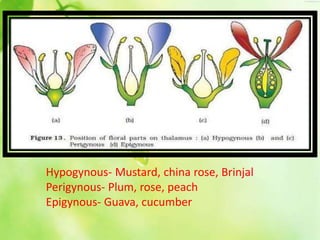
Hypogynous- Mustard, china rose, Brinjal
Perigynous- Plum, rose, peach
Epigynous- Guava, cucumber
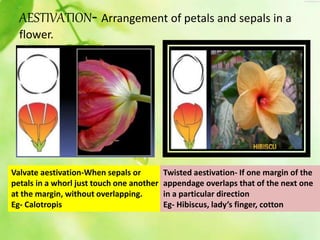
AESTIVATION- Arrangement of petals and sepals in a
flower.
Valvate aestivation-When sepals or
petals in a whorl just touch one another
at the margin, without overlapping.
Eg- Calotropis
Twisted aestivation- If one margin of the
appendage overlaps that of the next one
in a particular direction
Eg- Hibiscus, lady’s finger, cotton
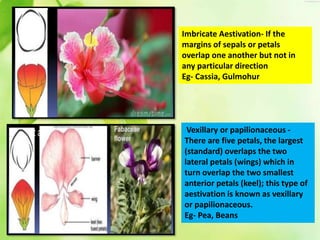
Imbricate Aestivation- If the
margins of sepals or petals
overlap one another but not in
any particular direction
Eg- Cassia, Gulmohur
Vexillary or papilionaceous -
There are five petals, the largest
(standard) overlaps the two
lateral petals (wings) which in
turn overlap the two smallest
anterior petals (keel); this type of
aestivation is known as vexillary
or papilionaceous.
Eg- Pea, Beans
Androecium
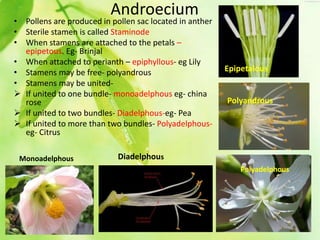
• Pollens are produced in pollen sac located in anther
• Sterile stamen is called Staminode
• When stamens are attached to the petals –
epipetous. Eg- Brinjal
• When attached to perianth – epiphyllous- eg Lily
• Stamens may be free- polyandrous
• Stamens may be united-
 If united to one bundle- monoadelphous eg- china
rose
 If united to two bundles- Diadelphous-eg- Pea
 If united to more than two bundles- Polyadelphous-
eg- Citrus
Epipetalous
Polyandrous
Monoadelphous Diadelphous
Polyadelphous
Gynoecium-
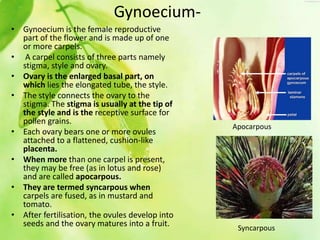
• Gynoecium is the female reproductive
part of the flower and is made up of one
or more carpels.
• A carpel consists of three parts namely
stigma, style and ovary.
• Ovary is the enlarged basal part, on
which lies the elongated tube, the style.
• The style connects the ovary to the
stigma. The stigma is usually at the tip of
the style and is the receptive surface for
pollen grains.
• Each ovary bears one or more ovules
attached to a flattened, cushion-like
placenta.
• When more than one carpel is present,
they may be free (as in lotus and rose)
and are called apocarpous.
• They are termed syncarpous when
carpels are fused, as in mustard and
tomato.
• After fertilisation, the ovules develop into
seeds and the ovary matures into a fruit.
Apocarpous
Syncarpous
Placentation –
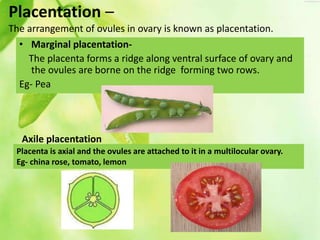
The arrangement of ovules in ovary is known as placentation.
• Marginal placentation-
The placenta forms a ridge along ventral surface of ovary and
the ovules are borne on the ridge forming two rows.
Eg- Pea
Axile placentation
Placenta is axial and the ovules are attached to it in a multilocular ovary.
Eg- china rose, tomato, lemon
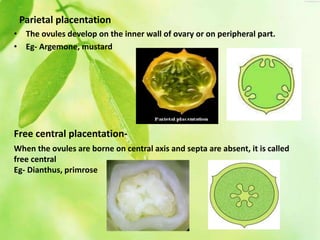
Parietal placentation
• The ovules develop on the inner wall of ovary or on peripheral part.
• Eg- Argemone, mustard
Free central placentation-
When the ovules are borne on central axis and septa are absent, it is called
free central
Eg- Dianthus, primrose
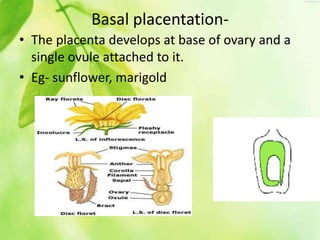
Basal placentation-
• The placenta develops at base of ovary and a
single ovule attached to it.
• Eg- sunflower, marigold
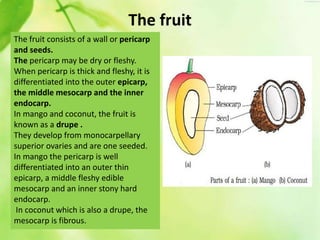
The fruit
The fruit consists of a wall or pericarp
and seeds.
The pericarp may be dry or fleshy.
When pericarp is thick and fleshy, it is
differentiated into the outer epicarp,
the middle mesocarp and the inner
endocarp.
In mango and coconut, the fruit is
known as a drupe .
They develop from monocarpellary
superior ovaries and are one seeded.
In mango the pericarp is well
differentiated into an outer thin
epicarp, a middle fleshy edible
mesocarp and an inner stony hard
endocarp.
In coconut which is also a drupe, the
mesocarp is fibrous.
The seed
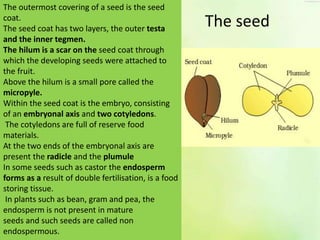
The outermost covering of a seed is the seed
coat.
The seed coat has two layers, the outer testa
and the inner tegmen.
The hilum is a scar on the seed coat through
which the developing seeds were attached to
the fruit.
Above the hilum is a small pore called the
micropyle.
Within the seed coat is the embryo, consisting
of an embryonal axis and two cotyledons.
The cotyledons are full of reserve food
materials.
At the two ends of the embryonal axis are
present the radicle and the plumule
In some seeds such as castor the endosperm
forms as a result of double fertilisation, is a food
storing tissue.
In plants such as bean, gram and pea, the
endosperm is not present in mature
seeds and such seeds are called non
endospermous.
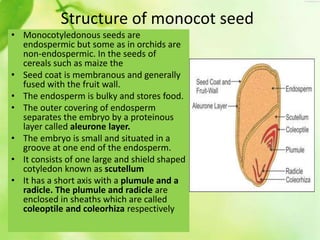
Structure of monocot seed
• Monocotyledonous seeds are
endospermic but some as in orchids are
non-endospermic. In the seeds of
cereals such as maize the
• Seed coat is membranous and generally
fused with the fruit wall.
• The endosperm is bulky and stores food.
• The outer covering of endosperm
separates the embryo by a proteinous
layer called aleurone layer.
• The embryo is small and situated in a
groove at one end of the endosperm.
• It consists of one large and shield shaped
cotyledon known as scutellum
• It has a short axis with a plumule and a
radicle. The plumule and radicle are
enclosed in sheaths which are called
coleoptile and coleorhiza respectively
SEMI-TECHNICAL DESCRIPTION OF A TYPICAL
FLOWERING PLANT
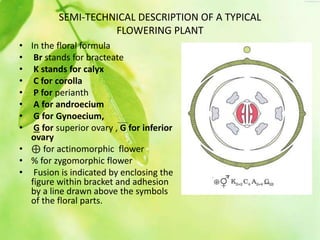
• In the floral formula
• Br stands for bracteate
• K stands for calyx
• C for corolla
• P for perianth
• A for androecium
• G for Gynoecium,
• G for superior ovary , G for inferior
ovary
• ⊕ for actinomorphic flower
• % for zygomorphic flower
• Fusion is indicated by enclosing the
figure within bracket and adhesion
by a line drawn above the symbols
of the floral parts.
Family Fabaceae
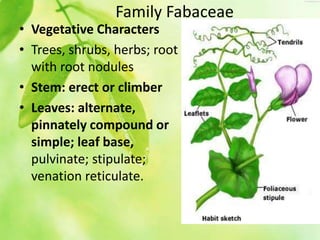
• Vegetative Characters
• Trees, shrubs, herbs; root
with root nodules
• Stem: erect or climber
• Leaves: alternate,
pinnately compound or
simple; leaf base,
pulvinate; stipulate;
venation reticulate.
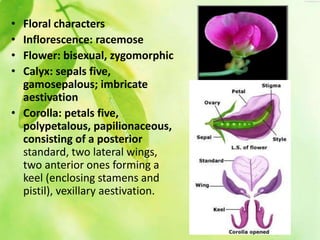
• Floral characters
• Inflorescence: racemose
• Flower: bisexual, zygomorphic
• Calyx: sepals five,
gamosepalous; imbricate
aestivation
• Corolla: petals five,
polypetalous, papilionaceous,
consisting of a posterior
standard, two lateral wings,
two anterior ones forming a
keel (enclosing stamens and
pistil), vexillary aestivation.
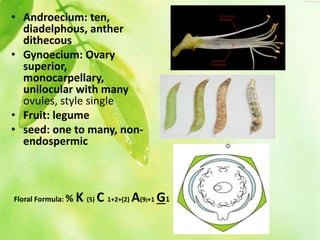
• Androecium: ten,
diadelphous, anther
dithecous
• Gynoecium: Ovary
superior,
monocarpellary,
unilocular with many
ovules, style single
• Fruit: legume
• seed: one to many, non-
endospermic
Floral Formula: % K (5) C 1+2+(2) A(9)+1 G1
• Pulses-Gram, Arhar, Sem, Moong, Soyabean
• Edible oil- Soyabean, Ground nut
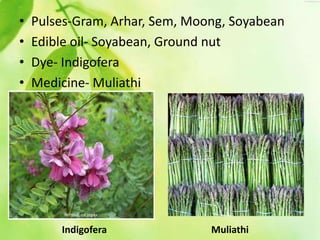
• Dye- Indigofera
• Medicine- Muliathi
Indigofera Muliathi
• Fibres- Sunhemp
• Fodder- Sesbania, Trifolium
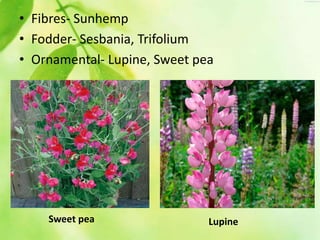
• Ornamental- Lupine, Sweet pea
LupineSweet pea
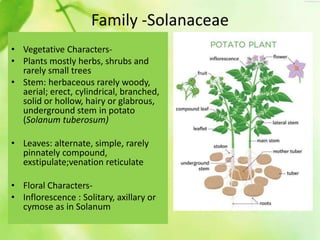
Family -Solanaceae
• Vegetative Characters-
• Plants mostly herbs, shrubs and
rarely small trees
• Stem: herbaceous rarely woody,
aerial; erect, cylindrical, branched,
solid or hollow, hairy or glabrous,
underground stem in potato
(Solanum tuberosum)
• Leaves: alternate, simple, rarely
pinnately compound,
exstipulate;venation reticulate
• Floral Characters-
• Inflorescence : Solitary, axillary or
cymose as in Solanum
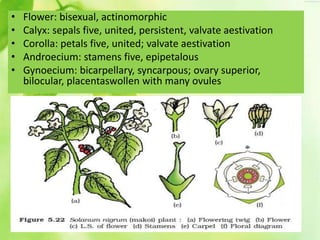
• Flower: bisexual, actinomorphic
• Calyx: sepals five, united, persistent, valvate aestivation
• Corolla: petals five, united; valvate aestivation
• Androecium: stamens five, epipetalous
• Gynoecium: bicarpellary, syncarpous; ovary superior,
bilocular, placentaswollen with many ovules
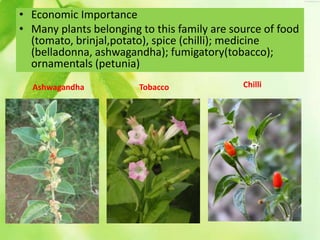
• Economic Importance
• Many plants belonging to this family are source of food
(tomato, brinjal,potato), spice (chilli); medicine
(belladonna, ashwagandha); fumigatory(tobacco);
ornamentals (petunia)
ChilliTobaccoAshwagandha
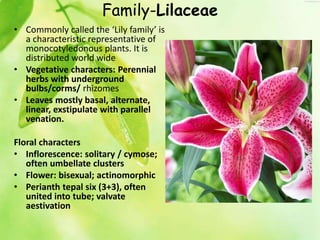
Family-Lilaceae
• Commonly called the ‘Lily family’ is
a characteristic representative of
monocotyledonous plants. It is
distributed world wide
• Vegetative characters: Perennial
herbs with underground
bulbs/corms/ rhizomes
• Leaves mostly basal, alternate,
linear, exstipulate with parallel
venation.
Floral characters
• Inflorescence: solitary / cymose;
often umbellate clusters
• Flower: bisexual; actinomorphic
• Perianth tepal six (3+3), often
united into tube; valvate
aestivation
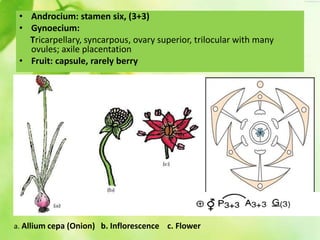
• Androcium: stamen six, (3+3)
• Gynoecium:
Tricarpellary, syncarpous, ovary superior, trilocular with many
ovules; axile placentation
• Fruit: capsule, rarely berry
a. Allium cepa (Onion) b. Inflorescence c. Flower
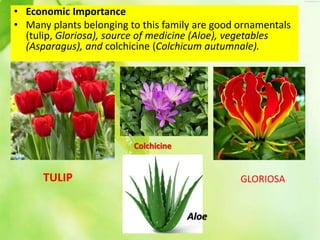
• Economic Importance
• Many plants belonging to this family are good ornamentals
(tulip, Gloriosa), source of medicine (Aloe), vegetables
(Asparagus), and colchicine (Colchicum autumnale).
TULIP GLORIOSA
Colchicine
Aloe
THANK YOU