Business
Research Methods
William Emory
Chapter 10:
Observation Methods
1
“YOU SEE, BUT YOU
DO NOT OBSERVE.”
Sherlock Holmes
Scientific Observation Is
Systematic
2
Observation
• Besides collecting data visually,
observation involves listening, reading
smelling & touching i.e using 05 senses.
• Observation includes full range of
monitoring behavioral & non-behavioral
activities & conditions.
3
Types of observation
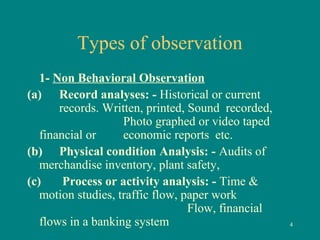
1- Non Behavioral Observation
(a) Record analyses: - Historical or current
records. Written, printed, Sound recorded,
Photo graphed or video taped
financial or economic reports etc.
(b) Physical condition Analysis: - Audits of
merchandise inventory, plant safety,
(c) Process or activity analysis: - Time &
motion studies, traffic flow, paper work
Flow, financial
flows in a banking system 4
Types of observation
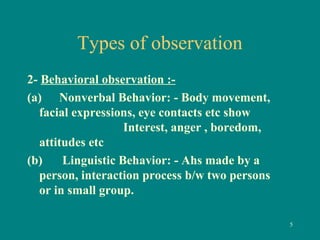
2- Behavioral observation :-
(a) Nonverbal Behavior: - Body movement,
facial expressions, eye contacts etc show
Interest, anger , boredom,
attitudes etc
(b) Linguistic Behavior: - Ahs made by a
person, interaction process b/w two persons
or in small group.
5
Types of observation
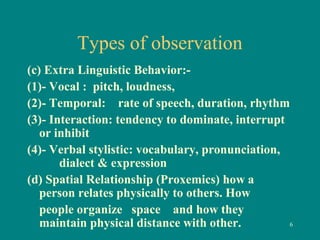
(c) Extra Linguistic Behavior:-
(1)- Vocal : pitch, loudness,
(2)- Temporal: rate of speech, duration, rhythm
(3)- Interaction: tendency to dominate, interrupt
or inhibit
(4)- Verbal stylistic: vocabulary, pronunciation,
dialect & expression
(d) Spatial Relationship (Proxemics) how a
person relates physically to others. How
people organize space and how they
maintain physical distance with other. 6
The Observer – Subject
Relationship
Relationship b/w observes subject may be viewed
from three perspectives
1- Directress Of Observation.
• Direct observation: - When observer is
physically present & personally monitors.
Free to shift place, focus unexpected changes but
can be bore & fatigued.
• Indirect observation: - Recording is done by
mechanical, photographic or electronic
means. It is less biased, more accurate, record
kept.
7
The Observer – Subject
Relationship
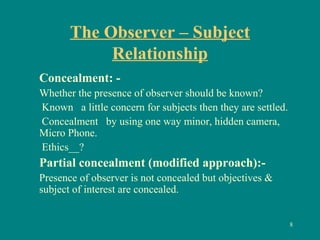
Concealment: -
Whether the presence of observer should be known?
Known a little concern for subjects then they are settled.
Concealment by using one way minor, hidden camera,
Micro Phone.
Ethics__?
Partial concealment (modified approach):-
Presence of observer is not concealed but objectives &
subject of interest are concealed.
8
The Observer – Subject
Relationship
• Participation
Participant observer: - Here an observer enters
work setting by becoming part of
Work team. Some time known to some or all
members. And other times concealed. Recording
can interfere with participation and participation
with observer.
e.g.: to know group dynamic
Non – participant observer: Collecting needed
data without becoming part of work.
9
Conducting an observational study
• Type of observational study:
1-Simple observation / unstructured obs.
Studies.
2- Systematic or structured observation
10
Observer training
• Observer should be trained to concentrate, observe and
remember. Observe should not be so attractive that he
catches the attractive of others
Experienced___ or inexperienced observer
Observes mostly feel fatigue , halo effect, observer drift.
Observer trials can be used for selection.
Data collection
Data collection plan specifies details of task it generally
tells the questions of who, what, when and how.
who are the targets. What qualities a subject to be
observed each subject should meet a criterion?
What?
Sampling the elements and unit of analyses it is done by
event- time dimension and “act term”
Event – sampling: Researcher selects behaviors to be
observed.
11
Advantages & Disadvantages
• Advantages of observation
• Data are generally recordable.
• Easy to note the effects of environment (cold…)
• Easy to study certain group (like children)
• Disadvantages
• Generally physical presence is must
• Slow and tedious and expensive
• Observer fatigue
• Moods and feeling though can be captured but cognitive
thought process can’t be Observed
• Observer training
12
Sources of bias
• Recording errors, memory lapses, errors in
interpreting the activities , behaviors
• use of several observers reduces validity
• observer fatigue , bore due to long time.
13

Ch10 observation

  • 1.
  • 2.
    “YOU SEE, BUTYOU DO NOT OBSERVE.” Sherlock Holmes Scientific Observation Is Systematic 2
  • 3.
    Observation • Besides collectingdata visually, observation involves listening, reading smelling & touching i.e using 05 senses. • Observation includes full range of monitoring behavioral & non-behavioral activities & conditions. 3
  • 4.
    Types of observation 1-Non Behavioral Observation (a) Record analyses: - Historical or current records. Written, printed, Sound recorded, Photo graphed or video taped financial or economic reports etc. (b) Physical condition Analysis: - Audits of merchandise inventory, plant safety, (c) Process or activity analysis: - Time & motion studies, traffic flow, paper work Flow, financial flows in a banking system 4
  • 5.
    Types of observation 2-Behavioral observation :- (a) Nonverbal Behavior: - Body movement, facial expressions, eye contacts etc show Interest, anger , boredom, attitudes etc (b) Linguistic Behavior: - Ahs made by a person, interaction process b/w two persons or in small group. 5
  • 6.
    Types of observation (c)Extra Linguistic Behavior:- (1)- Vocal : pitch, loudness, (2)- Temporal: rate of speech, duration, rhythm (3)- Interaction: tendency to dominate, interrupt or inhibit (4)- Verbal stylistic: vocabulary, pronunciation, dialect & expression (d) Spatial Relationship (Proxemics) how a person relates physically to others. How people organize space and how they maintain physical distance with other. 6
  • 7.
    The Observer –Subject Relationship Relationship b/w observes subject may be viewed from three perspectives 1- Directress Of Observation. • Direct observation: - When observer is physically present & personally monitors. Free to shift place, focus unexpected changes but can be bore & fatigued. • Indirect observation: - Recording is done by mechanical, photographic or electronic means. It is less biased, more accurate, record kept. 7
  • 8.
    The Observer –Subject Relationship Concealment: - Whether the presence of observer should be known? Known a little concern for subjects then they are settled. Concealment by using one way minor, hidden camera, Micro Phone. Ethics__? Partial concealment (modified approach):- Presence of observer is not concealed but objectives & subject of interest are concealed. 8
  • 9.
    The Observer –Subject Relationship • Participation Participant observer: - Here an observer enters work setting by becoming part of Work team. Some time known to some or all members. And other times concealed. Recording can interfere with participation and participation with observer. e.g.: to know group dynamic Non – participant observer: Collecting needed data without becoming part of work. 9
  • 10.
    Conducting an observationalstudy • Type of observational study: 1-Simple observation / unstructured obs. Studies. 2- Systematic or structured observation 10
  • 11.
    Observer training • Observershould be trained to concentrate, observe and remember. Observe should not be so attractive that he catches the attractive of others Experienced___ or inexperienced observer Observes mostly feel fatigue , halo effect, observer drift. Observer trials can be used for selection. Data collection Data collection plan specifies details of task it generally tells the questions of who, what, when and how. who are the targets. What qualities a subject to be observed each subject should meet a criterion? What? Sampling the elements and unit of analyses it is done by event- time dimension and “act term” Event – sampling: Researcher selects behaviors to be observed. 11
  • 12.
    Advantages & Disadvantages •Advantages of observation • Data are generally recordable. • Easy to note the effects of environment (cold…) • Easy to study certain group (like children) • Disadvantages • Generally physical presence is must • Slow and tedious and expensive • Observer fatigue • Moods and feeling though can be captured but cognitive thought process can’t be Observed • Observer training 12
  • 13.
    Sources of bias •Recording errors, memory lapses, errors in interpreting the activities , behaviors • use of several observers reduces validity • observer fatigue , bore due to long time. 13