- Anurag Kumar Deb
Roll no. 6
What is “Sampling”?
Source:Internet
Sampling is defined as the selection of
some part of an aggregate or totality on the
basis of which a judgement or inference
about the aggregate or totality is made.
It is the process of obtaining information
about an entire population by examining
only a part of it.
The process of selecting population from
the sample is called sampling.
Why Sampling?
Sampling is done usually because it is impossible
to test every single individual in the population. It
is also done to save time, money and effort while
conducting the research.
Advantages: Disadvantages:
 Time Saving.
 Economical
 Accuracy
 Covers large Size of
population.
 Biasedness.
 Need for Specialised
Knowledge.
 Selection of true
representative sample.
Sampling Types:
Probability Sample: Non Probability Sample:
 It is a method of Random
sampling where all
individuals in the population
have an equal chance of being
selected.
 It is a method where random
selection and method are not
based on the rationale of
probability theory.
Types
Simple Random Sampling:
 Simple random Sampling is a technique of probability
sampling where all the population has an equal chance
of being selected.
 In this sampling the selection is free from bias.
 Eg. Suppose a company like Amul want to check the
response of his product(e.g. Amul Lassi) in the market
, then they can go with this technique. Let say they
visited our university and there are 3000 students
from which they select 300 students randomly by a
table of randomly generated numbers.
Systematic random Sampling:
 Systematic random Sampling is a technique where
there is a gap between each selected unit in the
sample. It follows a calculation to be very précised.
 E.g.: In our MBA department ,student strength is 50
and Professor want a sample of 5 group then
50/5=10.Then our Professor will be taking every 10th
student from the group. For instance in this case they
are Roll no. 10,20,30,40,50.
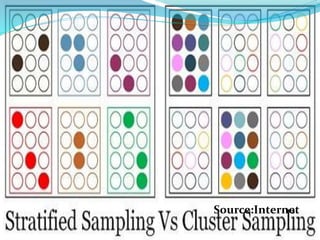
Stratified Random Sampling:
 Stratified Random Sampling is a technique where the
population is firstly divided into strata's and a sample
is selected from each stratum.
 The subgroups that has been made should have similar
characteristics.
 Eg. If we are making strata’s in our MBA department
then it can be of (Male And Female),(B.Sc, B.Tech,
B.Com ,BCA,BBA) etc and picking samples from each
strata's then it is Stratified Sampling.
Cluster Sampling:
 Cluster Sampling is the process of randomly selecting
“Intact Groups”, not individuals, within the defined
population sharing similar characteristics.
 Clusters are location within which an intact group of
members of the population can be found.
 It is one of the best technique to use when populations
are large and spread over a large Geographic Region.
 Examples:
Neighbourhood, schools,classrooms
Source:Internet
Quota Random Sampling:
 It is a technique where the sample frame is already
decided and the sample is just selected to meet these
characteristics.
 Eg. While doing MBA there comes an offer by TATA
Group that they will be hiring 40% Male and 60%
Female for a particular job (total vacancy is 10 i.e. 4
Male and 6 Female , but in our department there are
50 students so the random selection should be such
that which meets the above mentioned criteria.
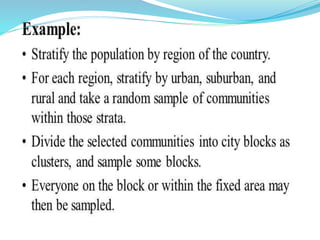
Multi Stage Random Sampling:
 In simple words it is a complex form of Cluster
Sampling where we use a variety of Sampling methods
together.
 Sampling Scheme that combines several methods are
called Multi Stage Random Sampling.
 This sampling technique is more accurate than cluster
sampling for same sample size because the sample gets
more filtration over stages.
Types
Convenience Sampling:
 A convenience Sampling is simply one where the units
are selected for inclusion in the sample are easiest to
access.
 In simple words, it’s a non probability sampling tool
which picks up the sample that are close to hand.
 E.g.: Suppose we are asked to visit shops and to do
research on smokers and non smokers of Silchar and if
we visit shops ,only near to my house then it will fall
under Convenience sampling.
Snowball Sampling:
 This technique is particularly appropriate when the
population you are interested in is hidden and/or hard
to reach.
 These include populations such as drug addict,
homeless people, criminals etc.
 E.g.: Suppose in CID, the senior officer gets a trace
about the criminal and he asks his subordinate to join
the link and catch the other criminal associated with
the case. This type of sampling is snowball sampling.
Important Issues:
Sampling Error:
 The chance occurrence that a randomly selected
Sample is not a representative of the population due
to errors inherent in sampling technique.
 Sampling error is maximum when one take small
sample size.
 Small Sample size- Greater Sampling Error
Big Sample Size- Lesser chance of Sampling Error.
Sampling Bias:
In statistics, sampling bias is a bias in which a sample
is collected in such a way that some members of the
intended population have a lower sampling
probability than others. It results in a biased sample, a
non-random sample of a population (or non-human
factors) in which all individuals, or instances, were not
equally likely to have been selected.

Sampling (Types and Meaning)

  • 1.
    - Anurag KumarDeb Roll no. 6
  • 2.
  • 3.
    Sampling is definedas the selection of some part of an aggregate or totality on the basis of which a judgement or inference about the aggregate or totality is made. It is the process of obtaining information about an entire population by examining only a part of it. The process of selecting population from the sample is called sampling.
  • 4.
    Why Sampling? Sampling isdone usually because it is impossible to test every single individual in the population. It is also done to save time, money and effort while conducting the research.
  • 5.
    Advantages: Disadvantages:  TimeSaving.  Economical  Accuracy  Covers large Size of population.  Biasedness.  Need for Specialised Knowledge.  Selection of true representative sample.
  • 6.
    Sampling Types: Probability Sample:Non Probability Sample:  It is a method of Random sampling where all individuals in the population have an equal chance of being selected.  It is a method where random selection and method are not based on the rationale of probability theory.
  • 7.
  • 8.
    Simple Random Sampling: Simple random Sampling is a technique of probability sampling where all the population has an equal chance of being selected.  In this sampling the selection is free from bias.  Eg. Suppose a company like Amul want to check the response of his product(e.g. Amul Lassi) in the market , then they can go with this technique. Let say they visited our university and there are 3000 students from which they select 300 students randomly by a table of randomly generated numbers.
  • 9.
    Systematic random Sampling: Systematic random Sampling is a technique where there is a gap between each selected unit in the sample. It follows a calculation to be very précised.  E.g.: In our MBA department ,student strength is 50 and Professor want a sample of 5 group then 50/5=10.Then our Professor will be taking every 10th student from the group. For instance in this case they are Roll no. 10,20,30,40,50.
  • 10.
    Stratified Random Sampling: Stratified Random Sampling is a technique where the population is firstly divided into strata's and a sample is selected from each stratum.  The subgroups that has been made should have similar characteristics.  Eg. If we are making strata’s in our MBA department then it can be of (Male And Female),(B.Sc, B.Tech, B.Com ,BCA,BBA) etc and picking samples from each strata's then it is Stratified Sampling.
  • 11.
    Cluster Sampling:  ClusterSampling is the process of randomly selecting “Intact Groups”, not individuals, within the defined population sharing similar characteristics.  Clusters are location within which an intact group of members of the population can be found.  It is one of the best technique to use when populations are large and spread over a large Geographic Region.  Examples: Neighbourhood, schools,classrooms
  • 12.
  • 13.
    Quota Random Sampling: It is a technique where the sample frame is already decided and the sample is just selected to meet these characteristics.  Eg. While doing MBA there comes an offer by TATA Group that they will be hiring 40% Male and 60% Female for a particular job (total vacancy is 10 i.e. 4 Male and 6 Female , but in our department there are 50 students so the random selection should be such that which meets the above mentioned criteria.
  • 14.
    Multi Stage RandomSampling:  In simple words it is a complex form of Cluster Sampling where we use a variety of Sampling methods together.  Sampling Scheme that combines several methods are called Multi Stage Random Sampling.  This sampling technique is more accurate than cluster sampling for same sample size because the sample gets more filtration over stages.
  • 16.
  • 17.
    Convenience Sampling:  Aconvenience Sampling is simply one where the units are selected for inclusion in the sample are easiest to access.  In simple words, it’s a non probability sampling tool which picks up the sample that are close to hand.  E.g.: Suppose we are asked to visit shops and to do research on smokers and non smokers of Silchar and if we visit shops ,only near to my house then it will fall under Convenience sampling.
  • 18.
    Snowball Sampling:  Thistechnique is particularly appropriate when the population you are interested in is hidden and/or hard to reach.  These include populations such as drug addict, homeless people, criminals etc.  E.g.: Suppose in CID, the senior officer gets a trace about the criminal and he asks his subordinate to join the link and catch the other criminal associated with the case. This type of sampling is snowball sampling.
  • 19.
    Important Issues: Sampling Error: The chance occurrence that a randomly selected Sample is not a representative of the population due to errors inherent in sampling technique.  Sampling error is maximum when one take small sample size.  Small Sample size- Greater Sampling Error Big Sample Size- Lesser chance of Sampling Error.
  • 20.
    Sampling Bias: In statistics,sampling bias is a bias in which a sample is collected in such a way that some members of the intended population have a lower sampling probability than others. It results in a biased sample, a non-random sample of a population (or non-human factors) in which all individuals, or instances, were not equally likely to have been selected.