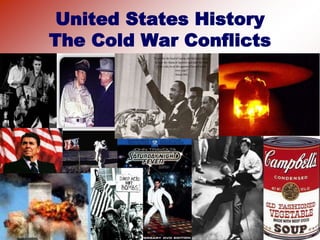
United States History
The Cold War Conflicts
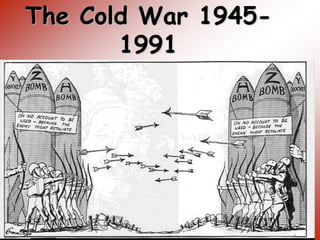
The Cold War 1945-
1991
Cold War Begins
– a non-military battle of
diplomacy and
propaganda between
the United States and
Soviet Union
– Lasted from 1945-1990
– led to “hot” wars around globe
in Korea, Vietnam
- Many of the smaller wars were
called proxy wars because the
U.S. and U.S.S.R. never fought
face to face
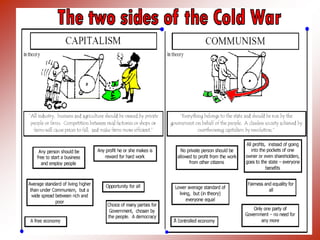
U.S. vs. USSR (Soviet
Union)
U.S. U.S.S.R
Capitalism Communism
Private property State owns
Democratic Totalitarian
The Ideological Struggle
Soviet &
Eastern Bloc
Nations
[“Iron Curtain”]
US & the
Western
Democracies
GOAL  spread
world-wide
Communism
GOAL 
“Containment” of
Communism & the
eventual collapse of
the Communist world.
[George Kennan]
METHODOLOGIES:
 Espionage [KGB vs. CIA]
 Arms Race [nuclear escalation]
 Ideological Competition for the minds and hearts
of Third World peoples [Communist govt. &
command economy vs. democratic govt. & capitalist
economy]  “proxy wars”
 Bi-Polarization of Europe [NATO vs. Warsaw Pact]
The “Iron Curtain”
From Stettin in the Balkans, to Trieste in the
Adriatic, an iron curtain has descended across the
Continent. Behind that line lies the ancient
capitals of Central and Eastern Europe.
-- Sir Winston Churchill, 1946
FIGHTING COMMUNISM
CONTAINMENT POLICY: The U.S.
would work to stop the spread of
communism.
1. Truman Doctrine
2. Marshall Plan
3. NATO and other alliances
4. The Truman Doctrine &
Domino Theory
Truman Doctrine: U.S. would aid
countries around the world who
are fighting communism (like
Greece and Turkey).
Domino Theory: If the U.S. doesn’t
fight communism, then
countries will fall to communism
like dominos.
The ‘Truman Doctrine’
• Truman had been horrified at the pre-
war Allied policy of appeasement and
was determined to stand up to any Soviet
intimidation.
The Truman Doctrine in March 1947
promised that the USA “would support
free peoples who are resisting
subjugation by armed minorities or
by outside pressures”.
• Triggered by British inability to hold the
line in Greece, it was followed by aid to
Greece and Turkey, and also money to
help capitalists to stop communists in
Italy and France.
It signalled the end of “isolationst”
policies.
The Marshall Plan 1948
• Plan to aid Europe—
in ruins
– Prevent countries
from falling to
communists
– Aid American
business
• $17 billion to 16
countries in Europe
(not Soviet Union)
The ‘Marshall Plan’
• The Marshall Plan offered huge sums to
enable the economies of Europe to rebuild
after World War II, and, by generating
prosperity, to reject the appeal of
Communism.
The Soviet Union (USSR) prevented Eastern
European countries from receiving American
money.
NATO vs. WARSAW PACT
North Atlantic Treaty
Organization: defense
alliance among U.S. and
Europe against the
Soviet Union. Still
exists.
Warsaw Pact: Defense
alliance among Soviet
Union and its satellite
governments in Eastern
Europe.
North Atlantic Treaty Organization
(1949)
 United States
 Belgium
 Britain
 Canada
 Denmark
 France
 Iceland
 Italy
 Luxemburg
 Netherlands
 Norway
 Portugal
 1952: Greece &
Turkey
 1955: West Germany
 1983: Spain
Warsaw Pact (1955)
} U. S. S. R.
} Albania
} Bulgaria
} Czechoslovakia
} East Germany
} Hungary
} Poland
} Rumania
Postwar Germany
• Nuremburg Trials for war crimes
• Divided into 4 zones:
– West Germany – U.S., Britain, and
France
– East Germany- Soviets
– Capitol city of Berlin divided into 4
zones (in East Germany)
• Berlin Airlift: In 1948-49, the U.S.
and Europe flew food and
supplies to save West Berlin,
until Soviets reopened roads.
Improve your knowledge
• The Russians took very high casualties to
capture Berlin in May 1945. They spent the
early occupation trying to take over all zones
of the city but were stopped by German
democrats such as Willy Brandt and Konrad
Adenauer. Reluctantly the Russians had to
admit the Americans, French and British to
their respective zones.
Iron Curtain –
A term used by
Winston Churchill
to describe the
separating of
Those communist
lands of East
Europe from the
West.
Berlin Blockade & Airlift (1948-49)
Berlin
• West Berlin, was an outpost of Western
democracy and economic success deep within
the communist zone – like a capitalist island
within communist East Germany
• The Berlin Blockade was an attempt to
starve West Berlin into submitting [giving up]
to the communists
• The Allied [western powers] airlift signalled the
West’s determination to use all resources to
defend Berlin.
It was felt by both sides that Berlin could act as
the trigger for general war between capitalist
and communist countries
Post War Japan:
• U.S. occupied – under
General MacArthur
– New constitution
– Democracy with Emperor as
figurehead
– Rebuild economy
– Abolished army and navy
• Tokyo trials convicted war
criminals
The Red Scare
• Intense fear of Communists taking
over U.S.
– China became a Communist country
in 1949.
– Soviets developed an atomic bomb
in 1949.
– Rosenbergs convicted of selling
atomic secrets to Soviet Union.
Executed 1953.
McCarthyism
• In 1950, Republican Senator
Joseph McCarthy of Wisconsin
claimed that he had “lists” of
communists in the U.S.
government.
• Falsely accused hundreds of
people of being active
Communists, ruining lives.
• When hearings were televised,
people saw that McCarthy was
wrongly accusing many people.
• Censured (punished) by Senate.
Korean War
[1950-1953]
Korean War
[1950-1953]
Syngman Rhee
Kim Il-Sung
“Domino Theory”
• U.S. General Douglas MacArthur led the U.N. force,
approximately 80% of which were U.S. soldiers.
MacArthur
at Inch'on
landing
Korean War, 1950-53
• Divided north and south at 38th
parallel at end of WWII.
• In 1950, Communist North
Korea invaded South Korea.
• The U.S. and United Nations,
aided the South; China aided
the North Koreans.
• Treaty signed in 1953, keeping
dividing line at 38th parallel
(still today).
• 33,000 American soldiers died,
100,000 wounded.
The Shifting Map of Korea
[1950-1953]
Ending the War:
• President Truman disagreed with MacArthur about attacking
China.
• Gen. MacArthur wanted to attack China with support of
Chinese nationalists.
• U.N. troops regained South Korea by March of 1951.
• Truman fired MacArthur for defying him by publicly
taunting and threatening the Chinese.
• In July of 1953, the Korean War ended
Space Race
• Began when Soviets beat the
U.S. into space
– Soviet satellite Sputnik launched in
1957
– Explorer I, the first U.S. satellite,
was launched in 1958.
• The National Defense Act of
1958 approved federal funding
of education in math, science
and foreign languages.
• Reforms in education –
The Arms Race:
A “Missile Gap?”
} The Soviet Union
exploded its first
A-bomb in 1949.
} Now there were
two nuclear
superpowers!
Nuclear Arms Race
• Hydrogen bomb
invented – both U.S.
and Soviets had them
• 1,000 times more
powerful than atomic
bomb—vaporized an
island.
• Dangers of fallout and
radiation
• Many built
bomb shelters!!
Improve your knowledge
• The nuclear bomb gave America a lead
which was expected to last at least 5
years. The rapid Russian development of
nuclear technology, helped by the work of
the “atom spies” was a shock.
Significantly, Russia hurriedly declared
war against Japan at the beginning of
August 1945 and rushed to advance into
Asia to stake out a position for the post-
war settlement. This helped make both the
Korean and Vietnamese conflicts more
likely.
National Defense Budget [1940-1964]
Premier Nikita Khrushchev
About the capitalist
states, it doesn't
depend on you
whether we
(Soviet Union) exist.
If you don't like us,
don't accept our
invitations, and don't
invite us to come
to see you. Whether
you like it our not, history is on our
side. We will bury you. -- 1956
De-Stalinization
Program
An Historic Irony: Sergei
Khrushchev, American Citizen
Who buried who?
Mao’s Revolution: 1949
Who lost China?
Growing Interest in China
Nationalists
Led by Chiang Kai-shek
Communists
Led by Mao Zedong
People’s Republic of China:
• In the 1940’s, China was embroiled in a civil war.
• The U.S. gave the Chiang Kai-shek millions of dollars, but
the communists won the war.
• China
became a
communist
country,
and
Chiang
Kai-shek
and his
forces fled
to Taiwan.
Nixon-Khrushchev
“Kitchen Debate”
(1959)
Cold War --->
Tensions
<--- Technology
& Affluence
U-2 Spy Incident (1960)
Col. Francis Gary
Powers’ plane was
shot down over Soviet
airspace.
Paris, 1961
Khrushchev & JFK meet to discuss Berlin and
nuclear proliferation. Khrushchev thinks that
JFK is young, inexperienced, and can be rolled.
The Berlin Wall Goes Up (1961)
Checkpoint
Charlie
Ich bin ein Berliner!
(1963)
President Kennedy
tells Berliners
that the West is
with them!
Khruschev Embraces Castro,
1961
Bay of Pigs Debacle (1961)
Cuban Missile Crisis (1962)
We went eyeball-to-eyeball with the
Russians, and the other man blinked!
Cuban Missile Crisis (1962)
Vietnam War: 1965-1973

Cold war Overview

  • 1.
    United States History TheCold War Conflicts
  • 2.
    The Cold War1945- 1991
  • 3.
    Cold War Begins –a non-military battle of diplomacy and propaganda between the United States and Soviet Union – Lasted from 1945-1990 – led to “hot” wars around globe in Korea, Vietnam - Many of the smaller wars were called proxy wars because the U.S. and U.S.S.R. never fought face to face
  • 4.
    U.S. vs. USSR(Soviet Union) U.S. U.S.S.R Capitalism Communism Private property State owns Democratic Totalitarian
  • 6.
    The Ideological Struggle Soviet& Eastern Bloc Nations [“Iron Curtain”] US & the Western Democracies GOAL  spread world-wide Communism GOAL  “Containment” of Communism & the eventual collapse of the Communist world. [George Kennan] METHODOLOGIES:  Espionage [KGB vs. CIA]  Arms Race [nuclear escalation]  Ideological Competition for the minds and hearts of Third World peoples [Communist govt. & command economy vs. democratic govt. & capitalist economy]  “proxy wars”  Bi-Polarization of Europe [NATO vs. Warsaw Pact]
  • 7.
    The “Iron Curtain” FromStettin in the Balkans, to Trieste in the Adriatic, an iron curtain has descended across the Continent. Behind that line lies the ancient capitals of Central and Eastern Europe. -- Sir Winston Churchill, 1946
  • 8.
    FIGHTING COMMUNISM CONTAINMENT POLICY:The U.S. would work to stop the spread of communism. 1. Truman Doctrine 2. Marshall Plan 3. NATO and other alliances
  • 9.
    4. The TrumanDoctrine & Domino Theory Truman Doctrine: U.S. would aid countries around the world who are fighting communism (like Greece and Turkey). Domino Theory: If the U.S. doesn’t fight communism, then countries will fall to communism like dominos.
  • 10.
    The ‘Truman Doctrine’ •Truman had been horrified at the pre- war Allied policy of appeasement and was determined to stand up to any Soviet intimidation. The Truman Doctrine in March 1947 promised that the USA “would support free peoples who are resisting subjugation by armed minorities or by outside pressures”. • Triggered by British inability to hold the line in Greece, it was followed by aid to Greece and Turkey, and also money to help capitalists to stop communists in Italy and France. It signalled the end of “isolationst” policies.
  • 11.
    The Marshall Plan1948 • Plan to aid Europe— in ruins – Prevent countries from falling to communists – Aid American business • $17 billion to 16 countries in Europe (not Soviet Union)
  • 12.
    The ‘Marshall Plan’ •The Marshall Plan offered huge sums to enable the economies of Europe to rebuild after World War II, and, by generating prosperity, to reject the appeal of Communism. The Soviet Union (USSR) prevented Eastern European countries from receiving American money.
  • 13.
    NATO vs. WARSAWPACT North Atlantic Treaty Organization: defense alliance among U.S. and Europe against the Soviet Union. Still exists. Warsaw Pact: Defense alliance among Soviet Union and its satellite governments in Eastern Europe.
  • 14.
    North Atlantic TreatyOrganization (1949)  United States  Belgium  Britain  Canada  Denmark  France  Iceland  Italy  Luxemburg  Netherlands  Norway  Portugal  1952: Greece & Turkey  1955: West Germany  1983: Spain
  • 15.
    Warsaw Pact (1955) }U. S. S. R. } Albania } Bulgaria } Czechoslovakia } East Germany } Hungary } Poland } Rumania
  • 16.
    Postwar Germany • NuremburgTrials for war crimes • Divided into 4 zones: – West Germany – U.S., Britain, and France – East Germany- Soviets – Capitol city of Berlin divided into 4 zones (in East Germany) • Berlin Airlift: In 1948-49, the U.S. and Europe flew food and supplies to save West Berlin, until Soviets reopened roads.
  • 18.
    Improve your knowledge •The Russians took very high casualties to capture Berlin in May 1945. They spent the early occupation trying to take over all zones of the city but were stopped by German democrats such as Willy Brandt and Konrad Adenauer. Reluctantly the Russians had to admit the Americans, French and British to their respective zones.
  • 19.
    Iron Curtain – Aterm used by Winston Churchill to describe the separating of Those communist lands of East Europe from the West.
  • 20.
    Berlin Blockade &Airlift (1948-49)
  • 21.
    Berlin • West Berlin,was an outpost of Western democracy and economic success deep within the communist zone – like a capitalist island within communist East Germany • The Berlin Blockade was an attempt to starve West Berlin into submitting [giving up] to the communists • The Allied [western powers] airlift signalled the West’s determination to use all resources to defend Berlin. It was felt by both sides that Berlin could act as the trigger for general war between capitalist and communist countries
  • 22.
    Post War Japan: •U.S. occupied – under General MacArthur – New constitution – Democracy with Emperor as figurehead – Rebuild economy – Abolished army and navy • Tokyo trials convicted war criminals
  • 23.
    The Red Scare •Intense fear of Communists taking over U.S. – China became a Communist country in 1949. – Soviets developed an atomic bomb in 1949. – Rosenbergs convicted of selling atomic secrets to Soviet Union. Executed 1953.
  • 24.
    McCarthyism • In 1950,Republican Senator Joseph McCarthy of Wisconsin claimed that he had “lists” of communists in the U.S. government. • Falsely accused hundreds of people of being active Communists, ruining lives. • When hearings were televised, people saw that McCarthy was wrongly accusing many people. • Censured (punished) by Senate.
  • 25.
  • 26.
    Korean War [1950-1953] Syngman Rhee KimIl-Sung “Domino Theory”
  • 27.
    • U.S. GeneralDouglas MacArthur led the U.N. force, approximately 80% of which were U.S. soldiers. MacArthur at Inch'on landing
  • 28.
    Korean War, 1950-53 •Divided north and south at 38th parallel at end of WWII. • In 1950, Communist North Korea invaded South Korea. • The U.S. and United Nations, aided the South; China aided the North Koreans. • Treaty signed in 1953, keeping dividing line at 38th parallel (still today). • 33,000 American soldiers died, 100,000 wounded.
  • 29.
    The Shifting Mapof Korea [1950-1953]
  • 30.
    Ending the War: •President Truman disagreed with MacArthur about attacking China. • Gen. MacArthur wanted to attack China with support of Chinese nationalists. • U.N. troops regained South Korea by March of 1951.
  • 31.
    • Truman firedMacArthur for defying him by publicly taunting and threatening the Chinese.
  • 32.
    • In Julyof 1953, the Korean War ended
  • 33.
    Space Race • Beganwhen Soviets beat the U.S. into space – Soviet satellite Sputnik launched in 1957 – Explorer I, the first U.S. satellite, was launched in 1958. • The National Defense Act of 1958 approved federal funding of education in math, science and foreign languages. • Reforms in education –
  • 34.
    The Arms Race: A“Missile Gap?” } The Soviet Union exploded its first A-bomb in 1949. } Now there were two nuclear superpowers!
  • 35.
    Nuclear Arms Race •Hydrogen bomb invented – both U.S. and Soviets had them • 1,000 times more powerful than atomic bomb—vaporized an island. • Dangers of fallout and radiation • Many built bomb shelters!!
  • 36.
    Improve your knowledge •The nuclear bomb gave America a lead which was expected to last at least 5 years. The rapid Russian development of nuclear technology, helped by the work of the “atom spies” was a shock. Significantly, Russia hurriedly declared war against Japan at the beginning of August 1945 and rushed to advance into Asia to stake out a position for the post- war settlement. This helped make both the Korean and Vietnamese conflicts more likely.
  • 37.
  • 38.
    Premier Nikita Khrushchev Aboutthe capitalist states, it doesn't depend on you whether we (Soviet Union) exist. If you don't like us, don't accept our invitations, and don't invite us to come to see you. Whether you like it our not, history is on our side. We will bury you. -- 1956 De-Stalinization Program
  • 39.
    An Historic Irony:Sergei Khrushchev, American Citizen Who buried who?
  • 40.
  • 41.
    Growing Interest inChina Nationalists Led by Chiang Kai-shek Communists Led by Mao Zedong People’s Republic of China: • In the 1940’s, China was embroiled in a civil war.
  • 42.
    • The U.S.gave the Chiang Kai-shek millions of dollars, but the communists won the war.
  • 43.
  • 44.
    Nixon-Khrushchev “Kitchen Debate” (1959) Cold War---> Tensions <--- Technology & Affluence
  • 45.
    U-2 Spy Incident(1960) Col. Francis Gary Powers’ plane was shot down over Soviet airspace.
  • 46.
    Paris, 1961 Khrushchev &JFK meet to discuss Berlin and nuclear proliferation. Khrushchev thinks that JFK is young, inexperienced, and can be rolled.
  • 47.
    The Berlin WallGoes Up (1961) Checkpoint Charlie
  • 48.
    Ich bin einBerliner! (1963) President Kennedy tells Berliners that the West is with them!
  • 49.
  • 50.
    Bay of PigsDebacle (1961)
  • 51.
  • 52.
    Cuban Missile Crisis(1962) We went eyeball-to-eyeball with the Russians, and the other man blinked!
  • 53.
  • 54.