




English
Teaching/Learning
Methodology
WHAT YOU SHOULD KNOW ABOUT TEACHING ENGLISH (AS A
FOREIGN LANGUAGE)
THE VERY BASICS.
1
Reference Books
 Techniques and Principles in Language Teaching, Diane Larsen-
Freeman, Oxford University Press.
 Principles of Language Learning and Teaching, H. Douglas Brown,
Prentice Hall Regents.
 Teaching by Principles, H. Douglas Brown, Prentice Hall Regents.
 Approaches and Methods in Language Teaching, Jack C. Richards
& Theordore S. Rodgers, Cambridge University Press.
 An introduction to Second Language Acquisition Research. Diane
Larsen-Freeman & Michael H. Long.
 The Practice of English Language Teaching, Jeremy Harmer,
Longman, Ltd.
 Teaching English as a Second or Foreign Language.
 Celce-Murcia, M. H&H
 Second Language Teaching & Learning. David Nunan. (1995). H& H.
2
Research findings on Learning a
Language
(a) Adults and adolescents can acquire a L2
(b) The learners create concepts with the same systematic
errors as the child learning the L1
(d) Practice doesn’t make perfect
(e) Knowing a linguistic rule doesn’t mean knowing how to use it
(f) Isolated explicit error correction is usually ineffective
(g) More adult learners fossilize
(h) One cannot achieve native-like command of a L2
in one hour a day
(i) A meaningful context is paramount.
3
Advantages children benefit from in
learning a foreign language:
 Children’s greater potential for developing accurate
pronunciation, accent and fluency before puberty
 Children’s favorable attitude towards a language and its
culture, either their mother tongue or a second language.
 Children’s less mental barriers of learning than adults
 Children’s learning two languages simultaneously without
suffering from inter-lingual interference
 Listening along with speaking, a preliminary and preferable
role in the natural order of language acquisition for
children
4
What is a “good” English
learner/teacher?
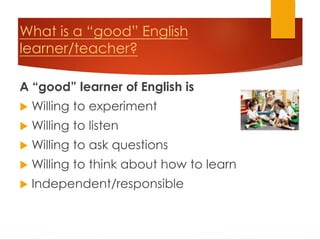
A “good” learner of English is
 Willing to experiment
 Willing to listen
 Willing to ask questions
 Willing to think about how to learn
 Independent/responsible
5
What is a “good” English teacher?
According to Brown (2001)
i) technical knowledge—understanding linguistics; grasping basic
principles of language learning and teaching; language proficiencies
in speaking, reading, writing and listening; knowledge about language
learning process through one’s own experience; understanding the
relationship between culture and language and knowledge of latest
development of language teaching and learning.
6
 Deductive learning of grammar— is an
approach to language learning in which
learners are taught rules and given specific
information about a language. They then
apply these rules when they use the
language.
7
 Inductive learning— is an approach to
language learning in which learners are not
taught grammatical or other types of rules
directly but are left to discover or induce
rules from their experience of using the
language.
8
 Performance and competence
Performance-- a person’s actual use of
language;
Competence-- a person’s knowledge of a
language
9
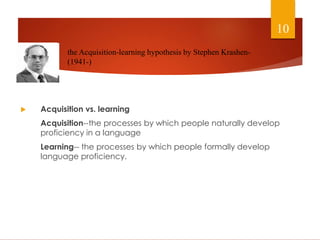
 Acquisition vs. learning
Acquisition--the processes by which people naturally develop
proficiency in a language
Learning-- the processes by which people formally develop
language proficiency.
10
the Acquisition-learning hypothesis by Stephen Krashen-
(1941-)
11
 bottom-up processing vs. top-down processing
Top-down processing—a way in which humans
analyze and process language as part of the
process of comprehension and learning by
making use of previous knowledge (higher-level
knowledge) in analyzing and processing
information which is received such as one’s
expectations, experience, schemata in reading
the text.
Bottom-up processing— a way making use
principally of information which is already
present in the data (words, sentences, etc.) such
as understanding a text mainly by analyzing the
words and sentences in the text itself.
 Teacher-centered vs. learner-centered teaching
Teacher-centered (fronted) teaching— a
teaching style in which instruction is closely
managed and controlled by the teacher
Learner-centered teaching— methods of
teaching which emphasizes the active role of
students in learning, tries to give learners more
control over what and how they learn and
encourages learners to take more responsibility
for their own learning. It is encouraged by many
current teaching approaches.
12
 Target language vs. native
language
Target language—the language
which a person is learning
Native language— a first language
or mother tongue/motherese which
is acquired first.
13
Form vs. function
 Form— the physical characteristics of a thing->
in language use, a linguistic form is like the
imperative
 Function— a linguistic form can perform a
variety of different functions:
Come here for a drink-> invitation
Watch out-> warning
Turn left at the corner-> direction
Pass the salt-> request
14

ESL Methodology

  • 1.
    English Teaching/Learning Methodology WHAT YOU SHOULDKNOW ABOUT TEACHING ENGLISH (AS A FOREIGN LANGUAGE) THE VERY BASICS. 1
  • 2.
    Reference Books  Techniquesand Principles in Language Teaching, Diane Larsen- Freeman, Oxford University Press.  Principles of Language Learning and Teaching, H. Douglas Brown, Prentice Hall Regents.  Teaching by Principles, H. Douglas Brown, Prentice Hall Regents.  Approaches and Methods in Language Teaching, Jack C. Richards & Theordore S. Rodgers, Cambridge University Press.  An introduction to Second Language Acquisition Research. Diane Larsen-Freeman & Michael H. Long.  The Practice of English Language Teaching, Jeremy Harmer, Longman, Ltd.  Teaching English as a Second or Foreign Language.  Celce-Murcia, M. H&H  Second Language Teaching & Learning. David Nunan. (1995). H& H. 2
  • 3.
    Research findings onLearning a Language (a) Adults and adolescents can acquire a L2 (b) The learners create concepts with the same systematic errors as the child learning the L1 (d) Practice doesn’t make perfect (e) Knowing a linguistic rule doesn’t mean knowing how to use it (f) Isolated explicit error correction is usually ineffective (g) More adult learners fossilize (h) One cannot achieve native-like command of a L2 in one hour a day (i) A meaningful context is paramount. 3
  • 4.
    Advantages children benefitfrom in learning a foreign language:  Children’s greater potential for developing accurate pronunciation, accent and fluency before puberty  Children’s favorable attitude towards a language and its culture, either their mother tongue or a second language.  Children’s less mental barriers of learning than adults  Children’s learning two languages simultaneously without suffering from inter-lingual interference  Listening along with speaking, a preliminary and preferable role in the natural order of language acquisition for children 4
  • 5.
    What is a“good” English learner/teacher? A “good” learner of English is  Willing to experiment  Willing to listen  Willing to ask questions  Willing to think about how to learn  Independent/responsible 5
  • 6.
    What is a“good” English teacher? According to Brown (2001) i) technical knowledge—understanding linguistics; grasping basic principles of language learning and teaching; language proficiencies in speaking, reading, writing and listening; knowledge about language learning process through one’s own experience; understanding the relationship between culture and language and knowledge of latest development of language teaching and learning. 6
  • 7.
     Deductive learningof grammar— is an approach to language learning in which learners are taught rules and given specific information about a language. They then apply these rules when they use the language. 7
  • 8.
     Inductive learning—is an approach to language learning in which learners are not taught grammatical or other types of rules directly but are left to discover or induce rules from their experience of using the language. 8
  • 9.
     Performance andcompetence Performance-- a person’s actual use of language; Competence-- a person’s knowledge of a language 9
  • 10.
     Acquisition vs.learning Acquisition--the processes by which people naturally develop proficiency in a language Learning-- the processes by which people formally develop language proficiency. 10 the Acquisition-learning hypothesis by Stephen Krashen- (1941-)
  • 11.
    11  bottom-up processingvs. top-down processing Top-down processing—a way in which humans analyze and process language as part of the process of comprehension and learning by making use of previous knowledge (higher-level knowledge) in analyzing and processing information which is received such as one’s expectations, experience, schemata in reading the text. Bottom-up processing— a way making use principally of information which is already present in the data (words, sentences, etc.) such as understanding a text mainly by analyzing the words and sentences in the text itself.
  • 12.
     Teacher-centered vs.learner-centered teaching Teacher-centered (fronted) teaching— a teaching style in which instruction is closely managed and controlled by the teacher Learner-centered teaching— methods of teaching which emphasizes the active role of students in learning, tries to give learners more control over what and how they learn and encourages learners to take more responsibility for their own learning. It is encouraged by many current teaching approaches. 12
  • 13.
     Target languagevs. native language Target language—the language which a person is learning Native language— a first language or mother tongue/motherese which is acquired first. 13
  • 14.
    Form vs. function Form— the physical characteristics of a thing-> in language use, a linguistic form is like the imperative  Function— a linguistic form can perform a variety of different functions: Come here for a drink-> invitation Watch out-> warning Turn left at the corner-> direction Pass the salt-> request 14