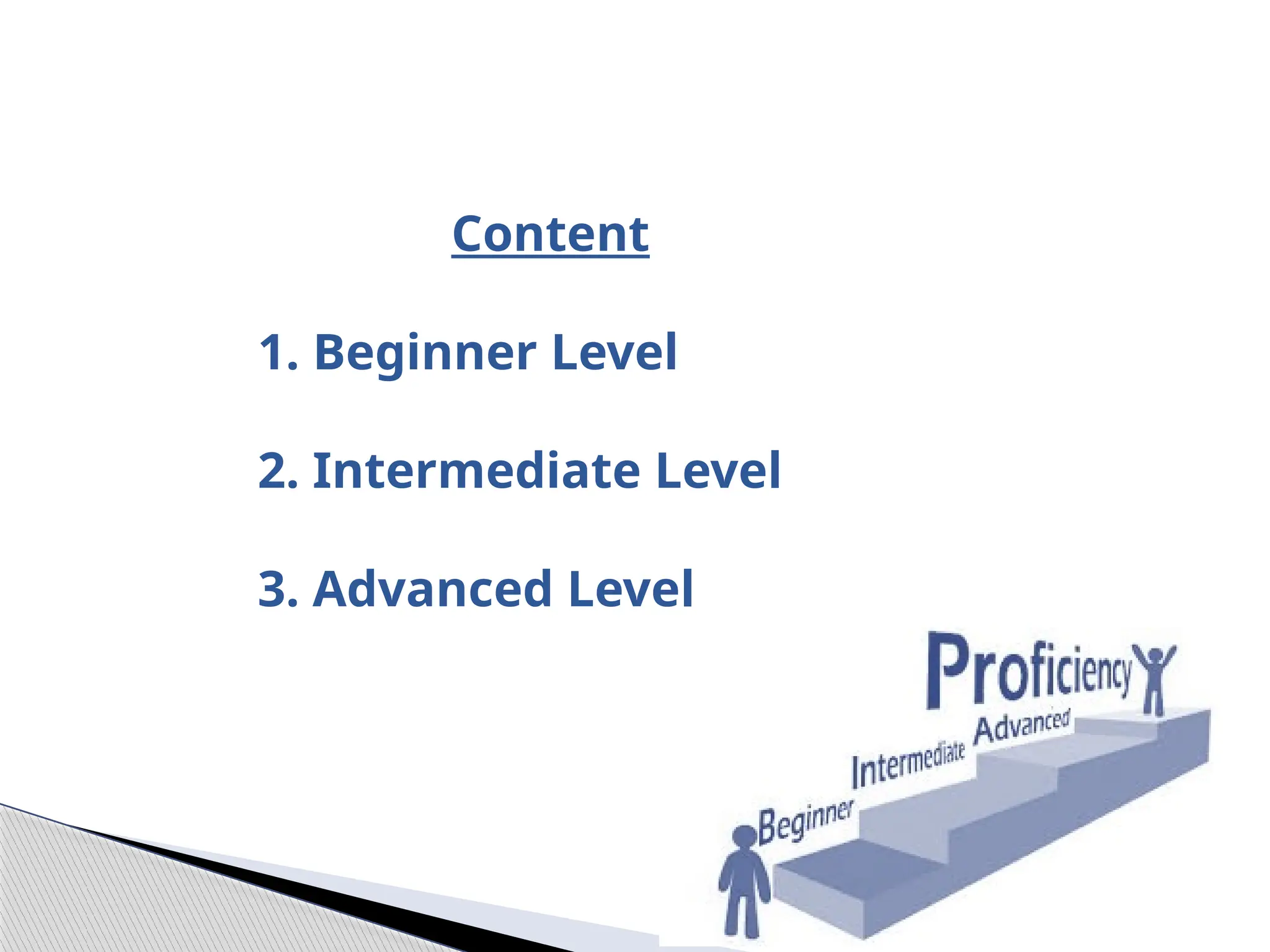
Beginner Level
1. Strategiesfor Expanding Basic Vocabulary
2. Effective Practice and Memory
Techniques
3. Applying Vocabulary in Real-Life Contexts
5.
Beginner Level
Strategies forExpanding Basic Vocabulary
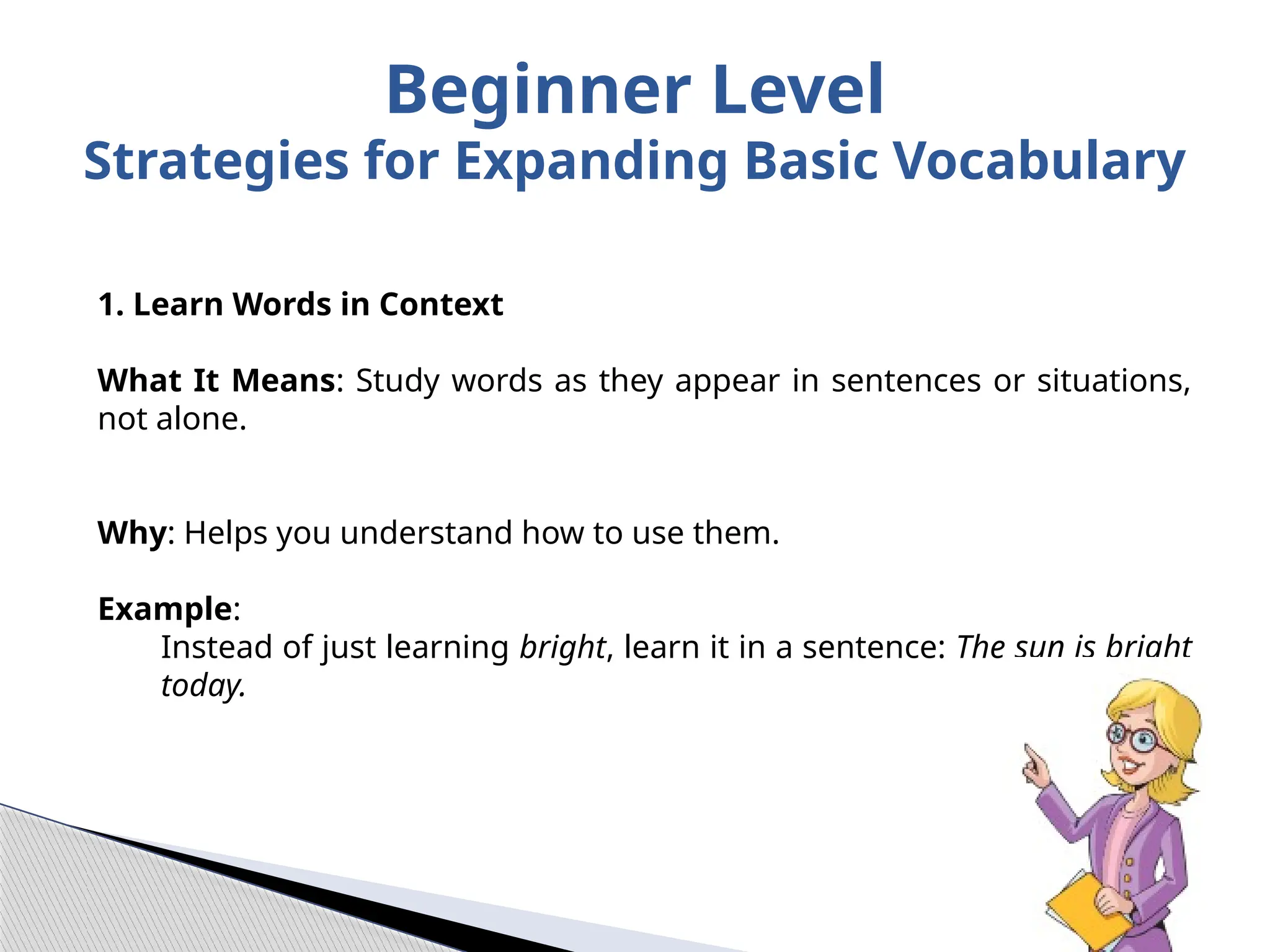
1. Learn Words in Context
What It Means: Study words as they appear in sentences or situations,
not alone.
Why: Helps you understand how to use them.
Example:
Instead of just learning bright, learn it in a sentence: The sun is bright
today.
6.
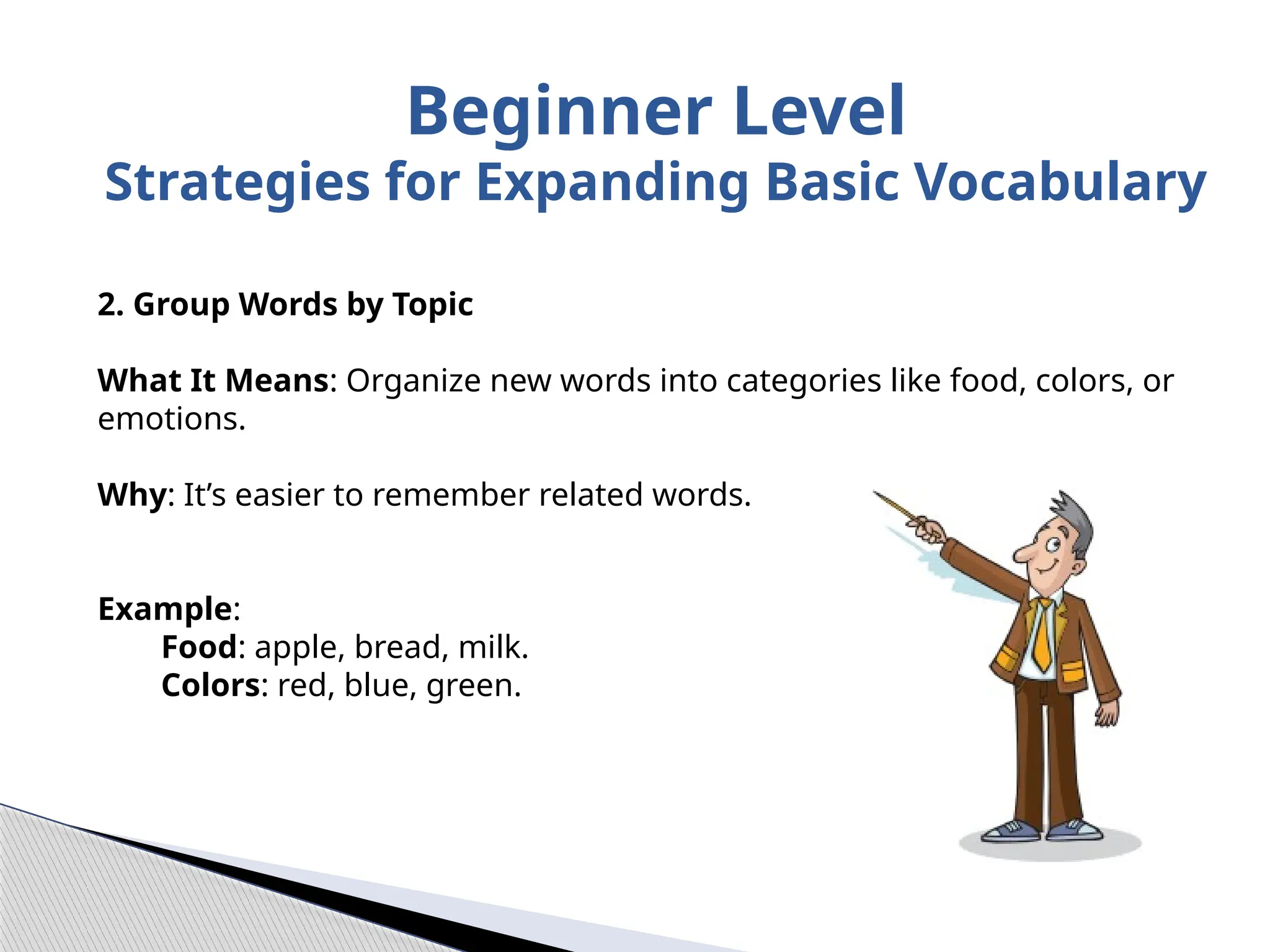
2. Group Wordsby Topic
What It Means: Organize new words into categories like food, colors, or
emotions.
Why: It’s easier to remember related words.
Example:
Food: apple, bread, milk.
Colors: red, blue, green.
Beginner Level
Strategies for Expanding Basic Vocabulary
7.
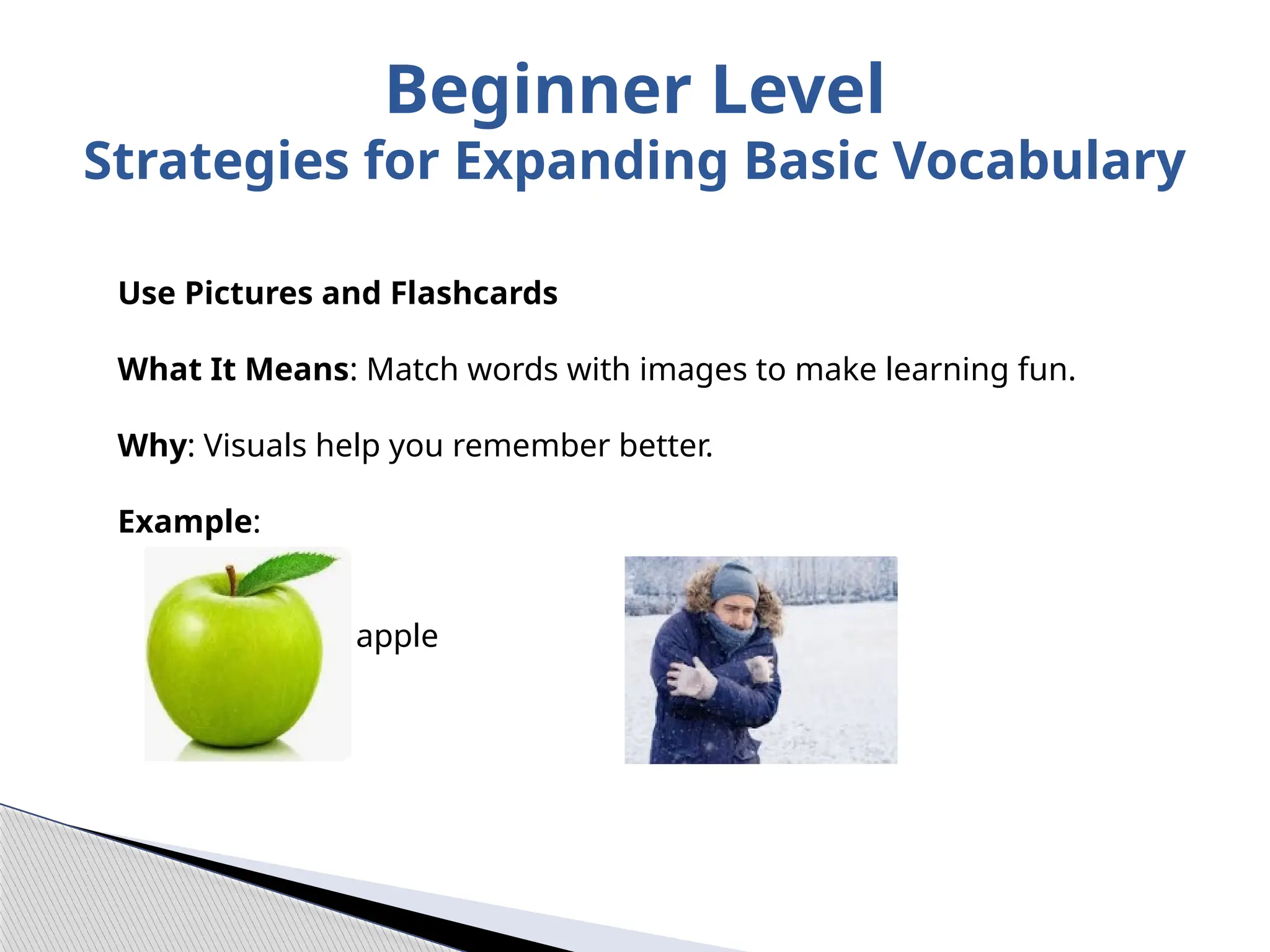
Use Pictures andFlashcards
What It Means: Match words with images to make learning fun.
Why: Visuals help you remember better.
Example:
= apple = cold
Beginner Level
Strategies for Expanding Basic Vocabulary
8.
Practice Daily
What ItMeans: Learn a few new words every day.
Why: Consistency helps you remember.
Example:
Learn 5 words today: walk, talk, play, happy, water.
Beginner Level
Strategies for Expanding Basic Vocabulary
9.
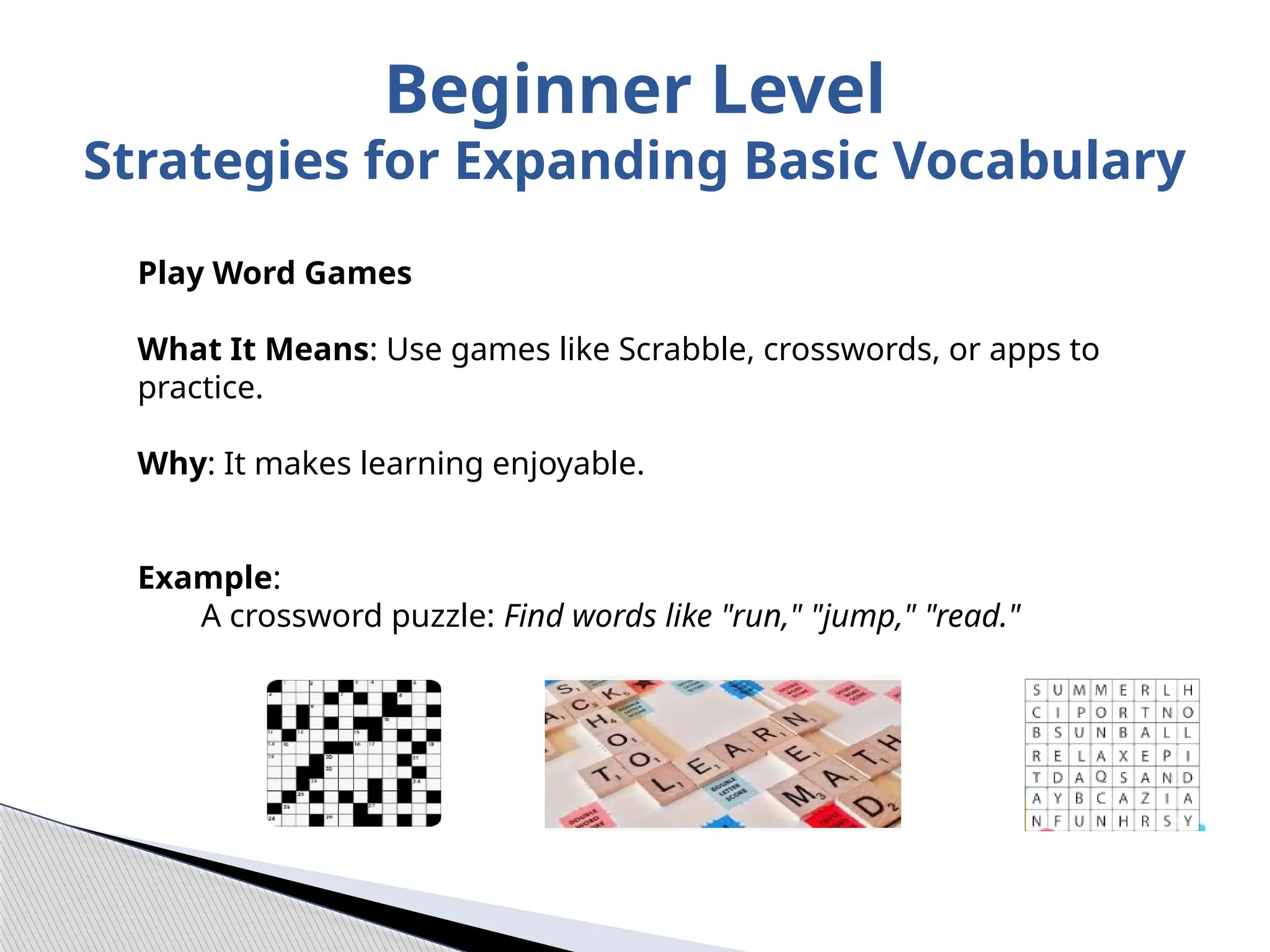
Play Word Games
WhatIt Means: Use games like Scrabble, crosswords, or apps to
practice.
Why: It makes learning enjoyable.
Example:
A crossword puzzle: Find words like "run," "jump," "read."
Beginner Level
Strategies for Expanding Basic Vocabulary
10.
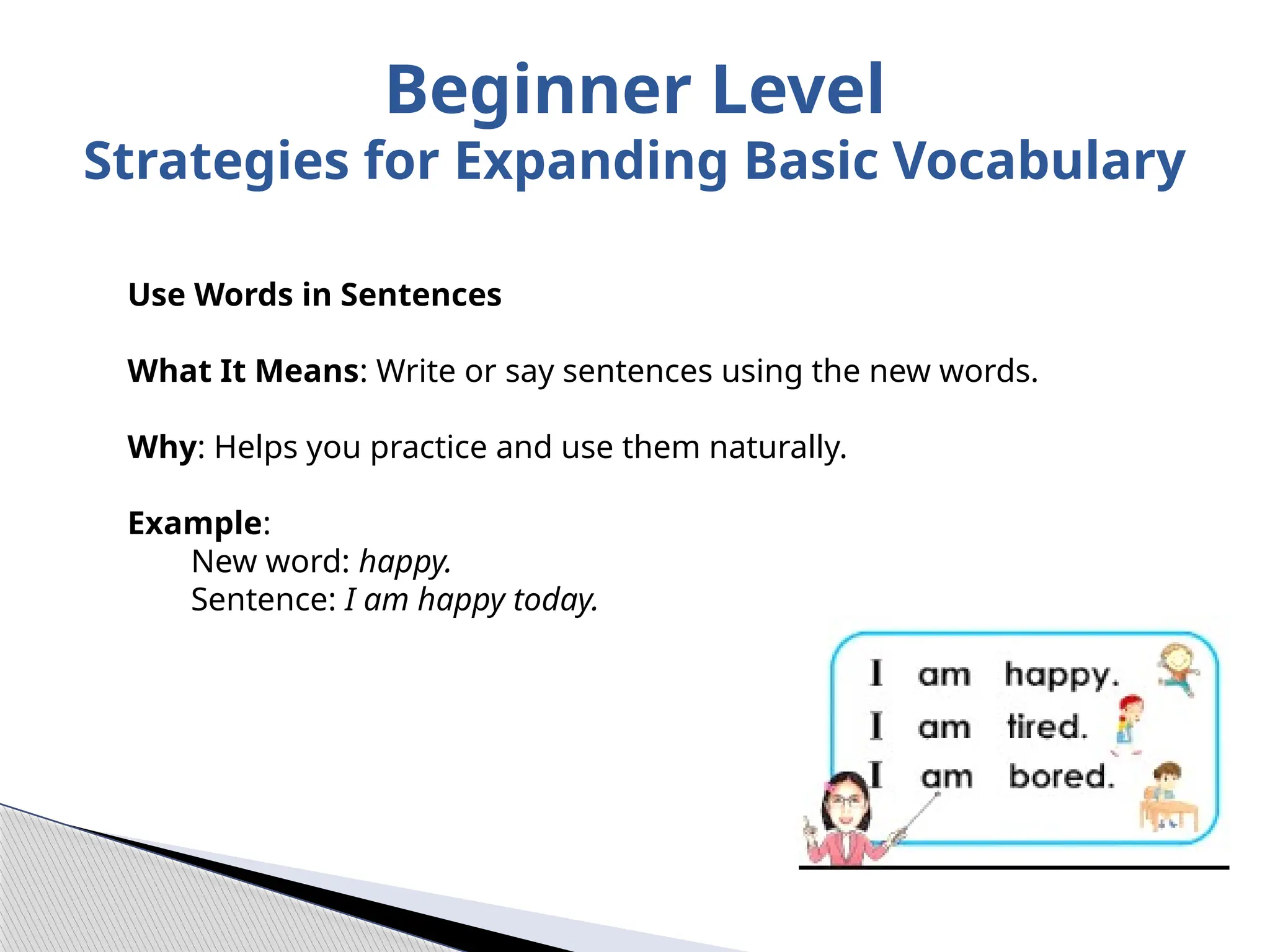
Use Words inSentences
What It Means: Write or say sentences using the new words.
Why: Helps you practice and use them naturally.
Example:
New word: happy.
Sentence: I am happy today.
Beginner Level
Strategies for Expanding Basic Vocabulary
11.
Repeat and Review
WhatIt Means: Go back and review old words regularly.
Why: Repetition strengthens memory.
Example:
If you learned walk last week, use it in sentences again:
I walk to school every day.
Beginner Level
Strategies for Expanding Basic Vocabulary
12.
Beginner Level
Effective Practiceand Memory Techniques
Use Spaced Repetition
What It Means: Review words multiple times, but with gaps in between.
Why: Helps move words from short-term to long-term memory.
Example:
Day 1: Learn cat, dog, bird.
Day 3: Review them again.
Day 7: Test yourself on the same words.
13.
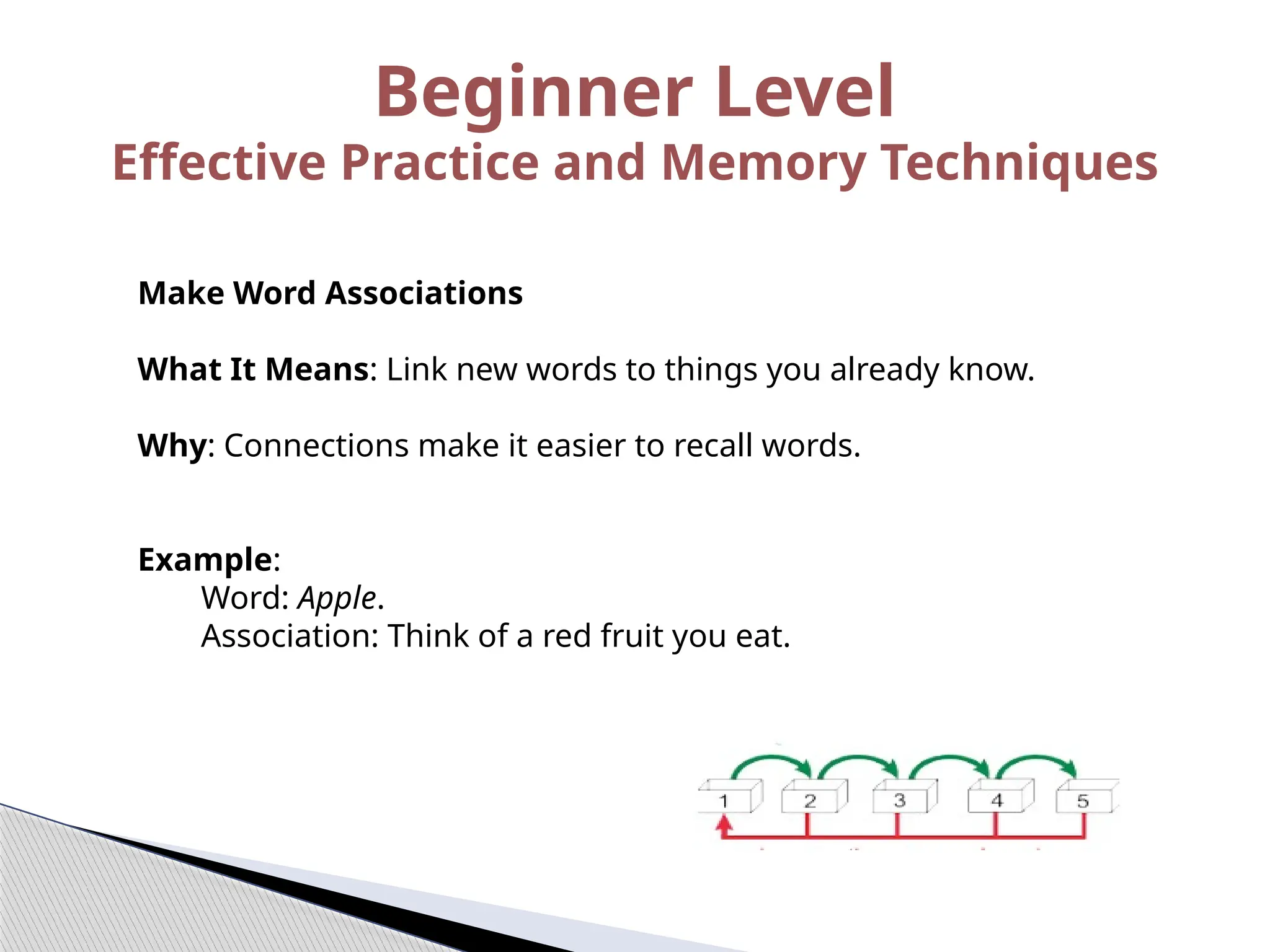
Make Word Associations
WhatIt Means: Link new words to things you already know.
Why: Connections make it easier to recall words.
Example:
Word: Apple.
Association: Think of a red fruit you eat.
Beginner Level
Effective Practice and Memory Techniques
14.
Create Mental cues
WhatIt Means: Use tricks like rhymes, acronyms, or stories to
remember words.
Why: Makes learning fun and memorable.
Example:
Word: Big.
Mental cue: "Big elephants are giants."
Beginner Level
Effective Practice and Memory Techniques
15.
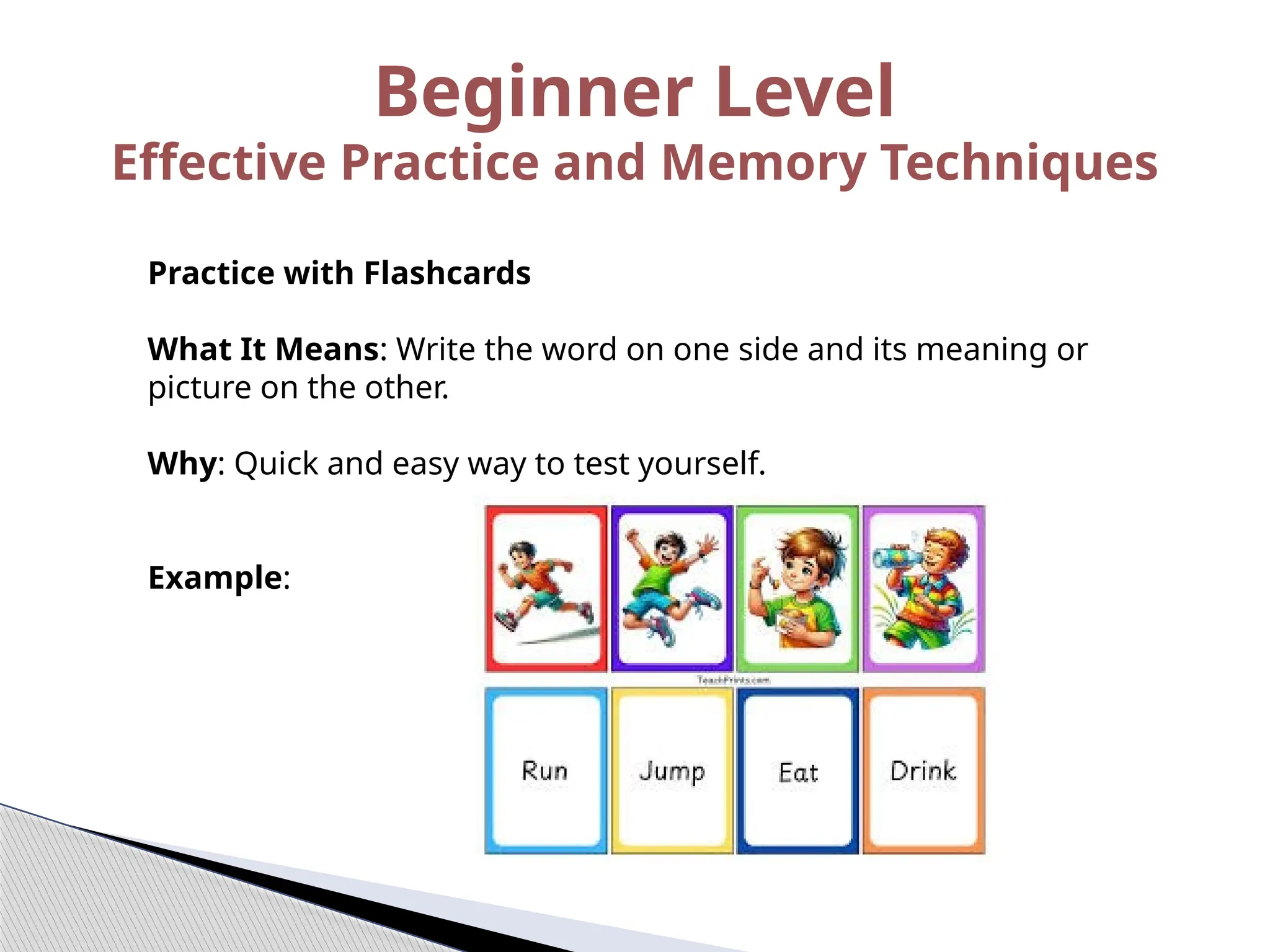
Practice with Flashcards
WhatIt Means: Write the word on one side and its meaning or
picture on the other.
Why: Quick and easy way to test yourself.
Example:
Beginner Level
Effective Practice and Memory Techniques
16.
Test Yourself Regularly
WhatIt Means: Quiz yourself on what you’ve learned.
Why: Helps you check what you remember.
Example:
Word: Run.
Test: "What does run mean?
Can you use it in a sentence?"
Beginner Level
Effective Practice and Memory Techniques
17.
Use New Wordsin Daily Life
What It Means: Practice speaking or writing with the words you
learn.
Why: Using words helps them stick.
Example:
New word: Jump.
Sentence: I jump every morning during exercise.
Beginner Level
Effective Practice and Memory Techniques
18.
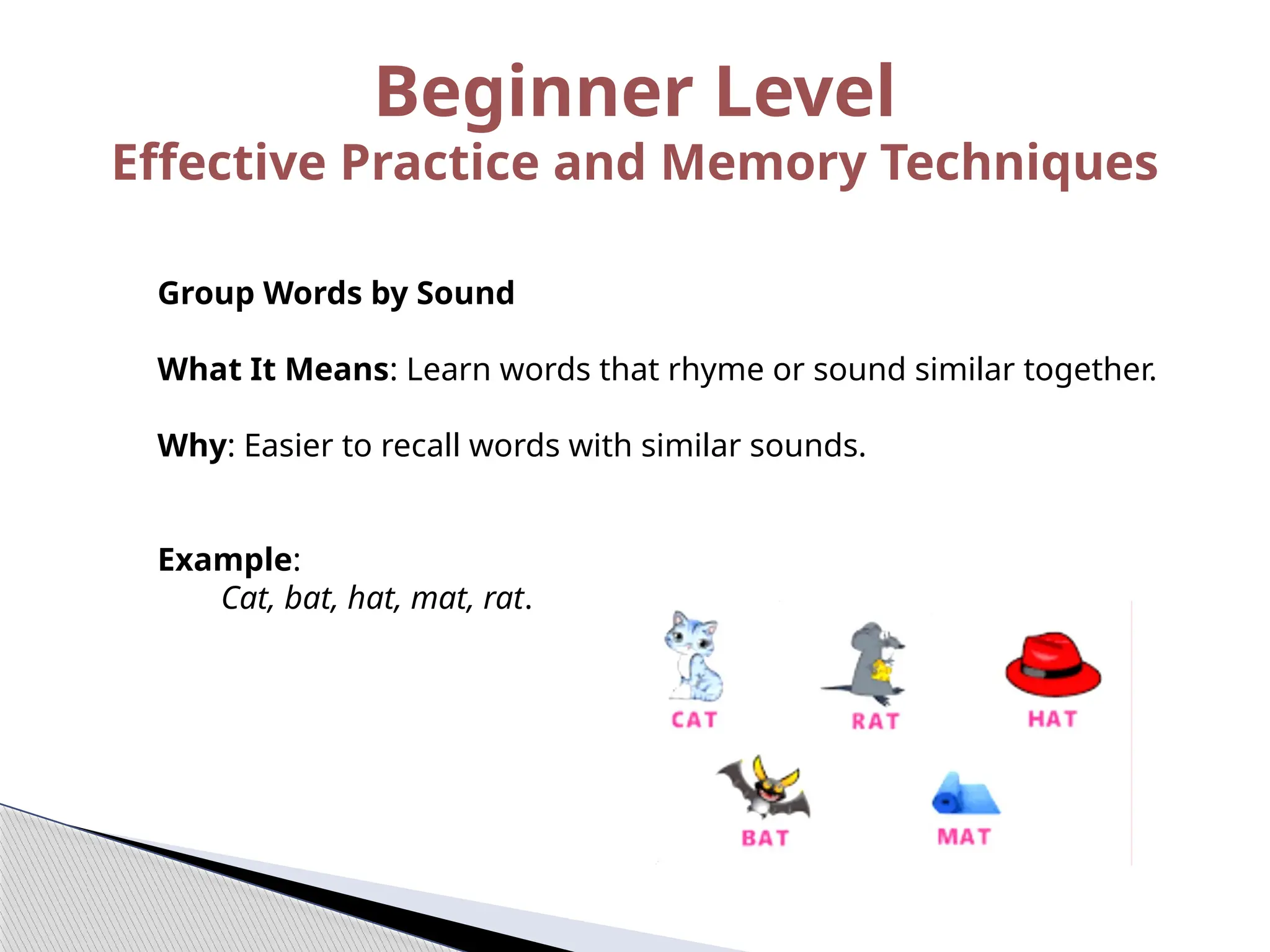
Group Words bySound
What It Means: Learn words that rhyme or sound similar together.
Why: Easier to recall words with similar sounds.
Example:
Cat, bat, hat, mat, rat.
Beginner Level
Effective Practice and Memory Techniques
19.
Beginner Level
Applying Vocabularyin Real-Life Contexts
Practice Speaking in Simple Conversations
What It Means: Use new words when talking to friends or family.
Why: Speaking helps you remember and use words naturally.
Example:
New word: delicious.
Conversation: “This pizza is delicious!”
20.
Write Short Sentencesor Notes
What It Means: Write sentences or messages using your
vocabulary.
Why: Writing helps reinforce word usage.
Example:
New word: excited.
Sentence: “I am excited about the weekend.”
Beginner Level
Applying Vocabulary in Real-Life Contexts
21.
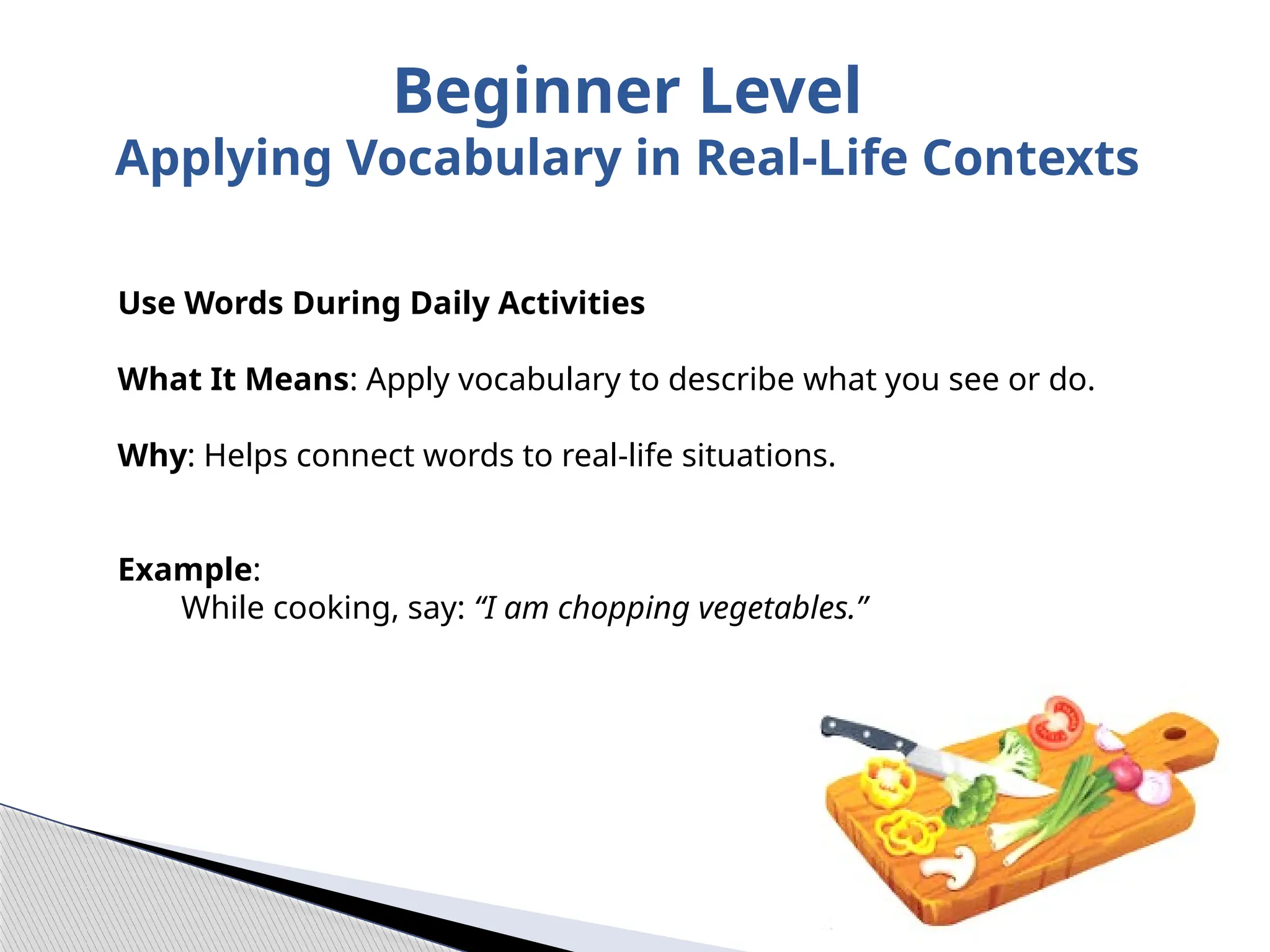
Use Words DuringDaily Activities
What It Means: Apply vocabulary to describe what you see or do.
Why: Helps connect words to real-life situations.
Example:
While cooking, say: “I am chopping vegetables.”
Beginner Level
Applying Vocabulary in Real-Life Contexts
22.
Play Role-Playing Games
WhatIt Means: Act out situations like shopping or traveling.
Why: Mimics real-life conversations.
Example:
Role-play: Ordering at a restaurant:
“Can I have a salad, please?”
Beginner Level
Applying Vocabulary in Real-Life Contexts
23.
Practice Listening andResponding
What It Means: Listen to people or recordings and respond
using vocabulary.
Why: Improves comprehension and speaking skills.
Example:
Listen: “How are you?”
Respond: “I am feeling happy today.”
Beginner Level
Applying Vocabulary in Real-Life Contexts
24.
Use Vocabulary Appsand Tools
What It Means: Practice vocabulary through interactive activities.
Why: Makes learning fun and practical.
Example:
App: Chatgpt
Task: Translate “I am reading a book” into English.
Beginner Level
Applying Vocabulary in Real-Life Contexts
25.
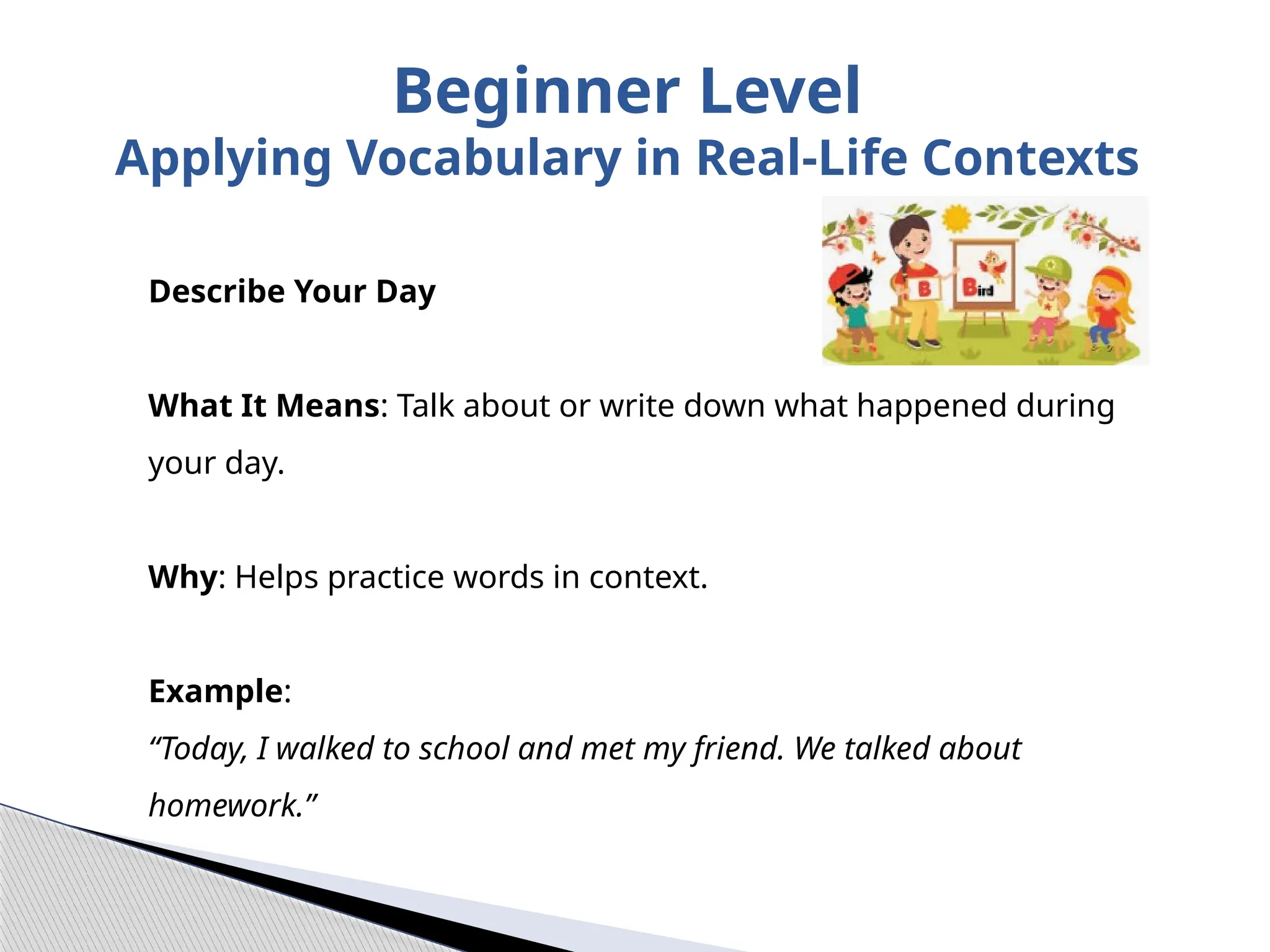
Describe Your Day
WhatIt Means: Talk about or write down what happened during
your day.
Why: Helps practice words in context.
Example:
“Today, I walked to school and met my friend. We talked about
homework.”
Beginner Level
Applying Vocabulary in Real-Life Contexts
26.
Summary
Strategies for ExpandingBasic Vocabulary:
1. Learn words through sentences, topics, and pictures.
2. Practice daily, play games, and review regularly.
3. Use words in writing and speaking to make them stick!
Effective Practice and Memory Techniques
1. Review words regularly with spaced repetition and flashcards.
2. Use mental cues, associations, and daily practice to make words
memorable.
3. Quiz yourself often and use new words in sentences.
Applying Vocabulary in Communication and Real-Life Contexts
1. Use vocabulary in conversations, notes, and daily descriptions.
2. Practice real-life scenarios like shopping or asking questions.
3. Listening, writing, and role-playing make vocabulary more useful in
everyday life.
27.
Intermediate Level
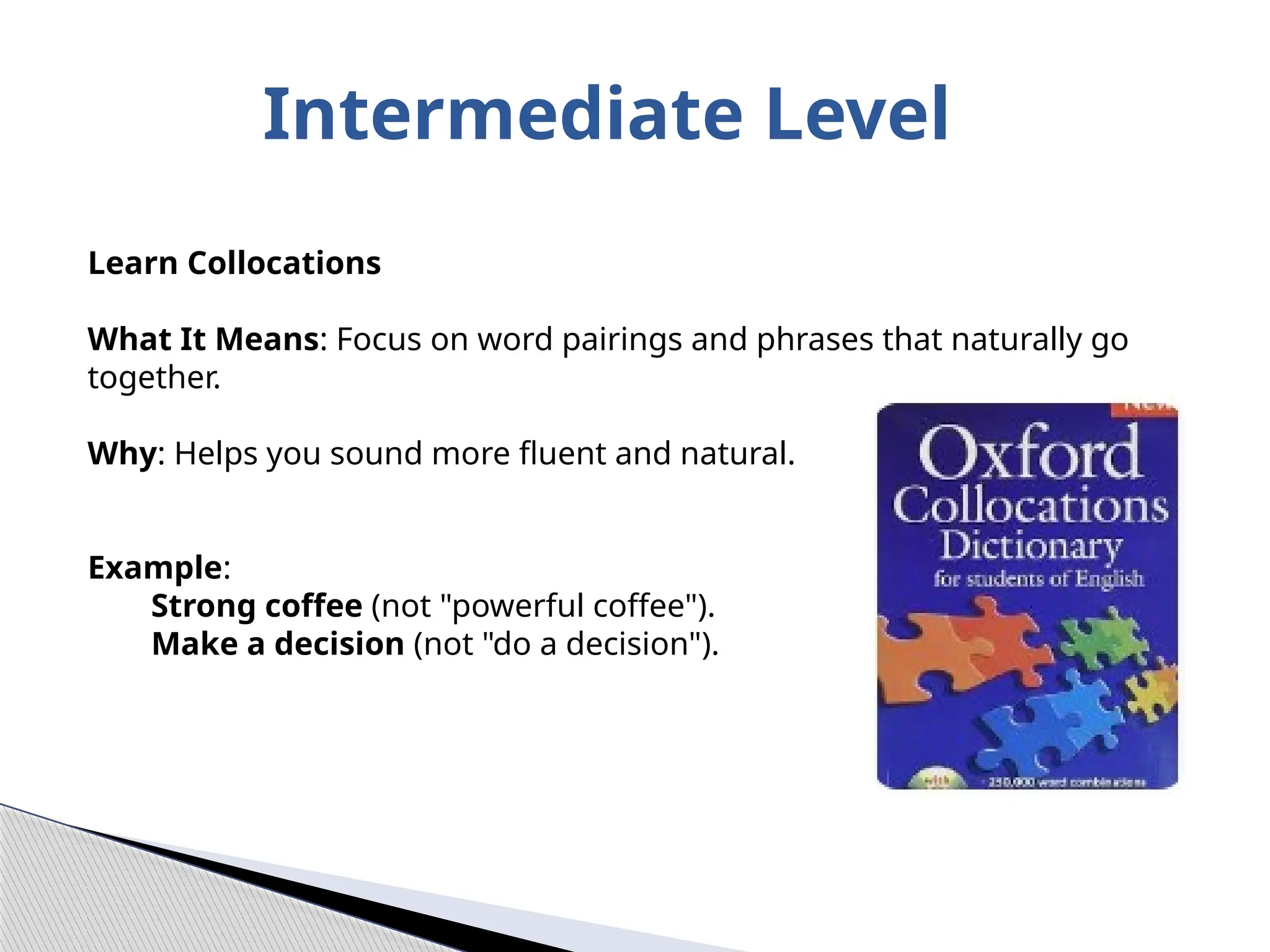
Learn Collocations
WhatIt Means: Focus on word pairings and phrases that naturally go
together.
Why: Helps you sound more fluent and natural.
Example:
Strong coffee (not "powerful coffee").
Make a decision (not "do a decision").
28.
Intermediate Level
Study Synonymsand Antonyms
What It Means: Learn multiple words with similar or opposite
meanings.
Why: Improves word choice and variety in communication.
Example:
Synonym for "happy": joyful.
Antonym for "happy": sad.
29.
Intermediate Level
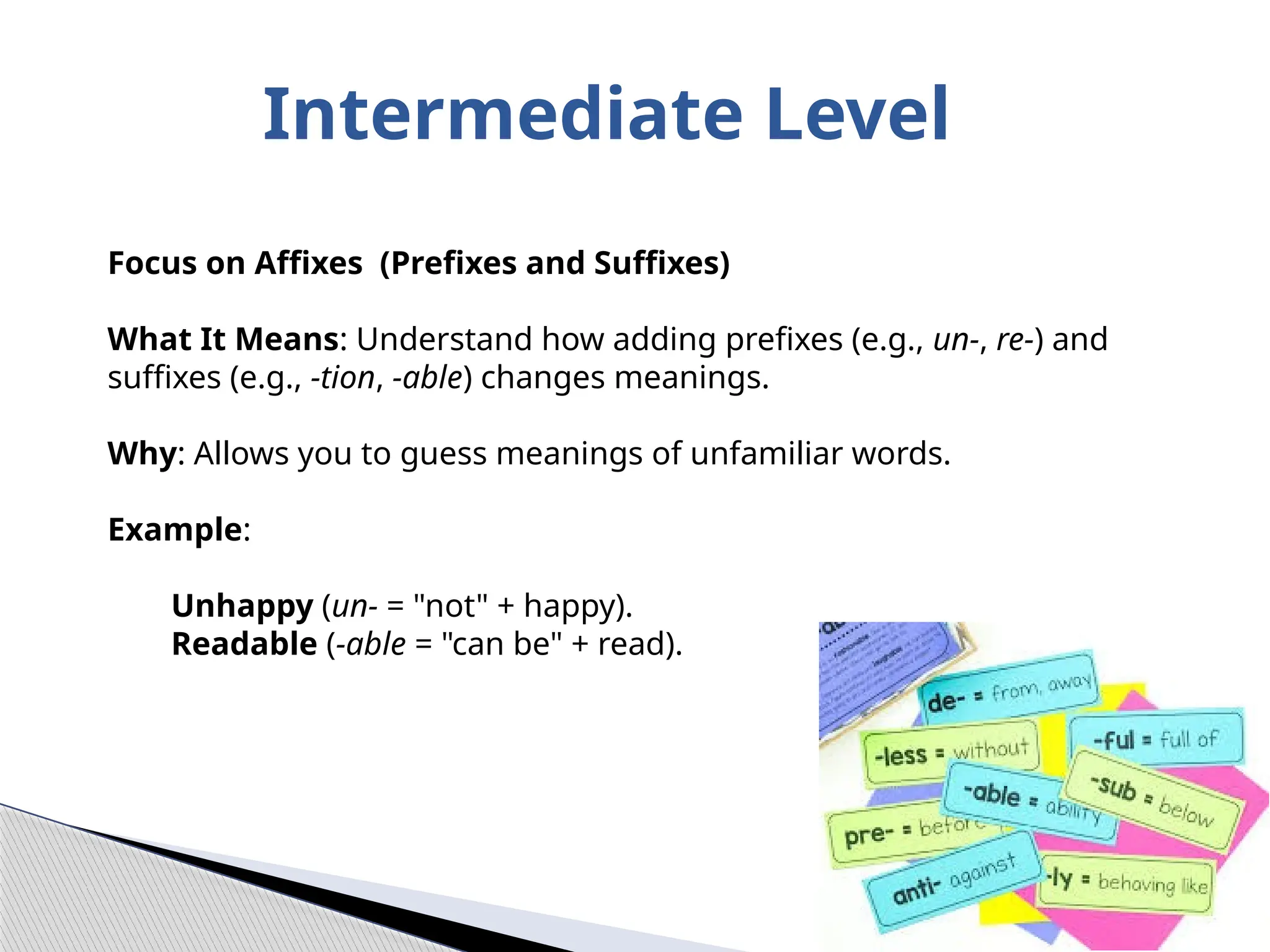
Focus onAffixes (Prefixes and Suffixes)
What It Means: Understand how adding prefixes (e.g., un-, re-) and
suffixes (e.g., -tion, -able) changes meanings.
Why: Allows you to guess meanings of unfamiliar words.
Example:
Unhappy (un- = "not" + happy).
Readable (-able = "can be" + read).
30.
Intermediate Level
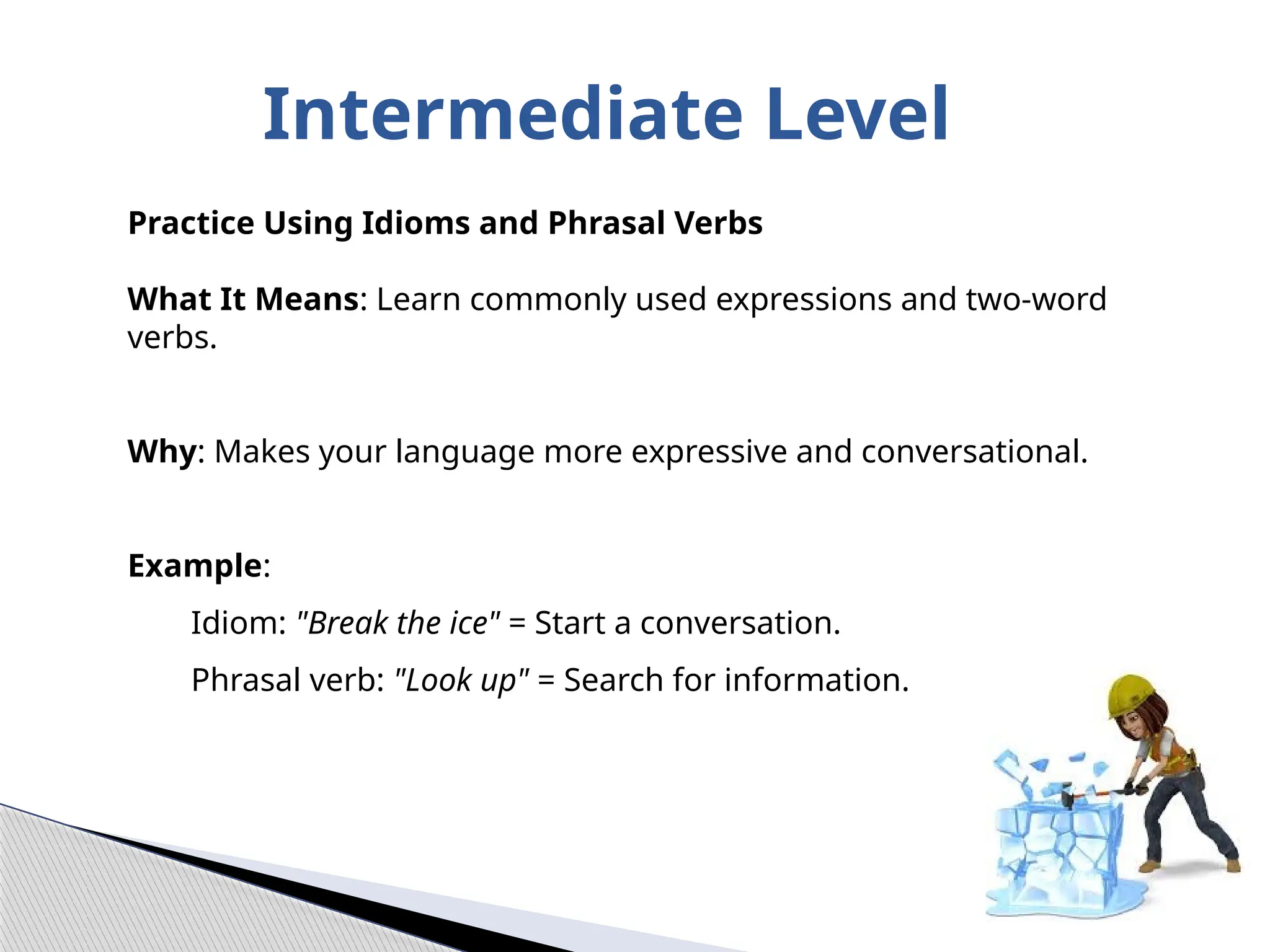
Practice UsingIdioms and Phrasal Verbs
What It Means: Learn commonly used expressions and two-word
verbs.
Why: Makes your language more expressive and conversational.
Example:
Idiom: "Break the ice" = Start a conversation.
Phrasal verb: "Look up" = Search for information.
31.
Intermediate Level
Explore SpecializedVocabulary
What It Means: Learn words specific to topics like technology,
travel, or business.
Why: Helps in professional or academic contexts.
Example:
Technology: Algorithm, interface, database.
Travel: Heritage site, Guided tour, destination.
32.
Intermediate Level
Use AdvancedReading Material
What It Means: Read books, articles, or essays with slightly
challenging vocabulary.
Why: Exposes you to advanced words in context.
Example:
Read a news article about climate change to learn words
like sustainable, emission, renewable.
33.
Intermediate Level
Listen toAdvanced Podcasts or Speeches
What It Means: Focus on audio content with rich vocabulary.
Why: Improves listening comprehension and introduces new
words in context.
Example:
Podcast: TED Talks on topics like innovation or education.
34.
Intermediate Level
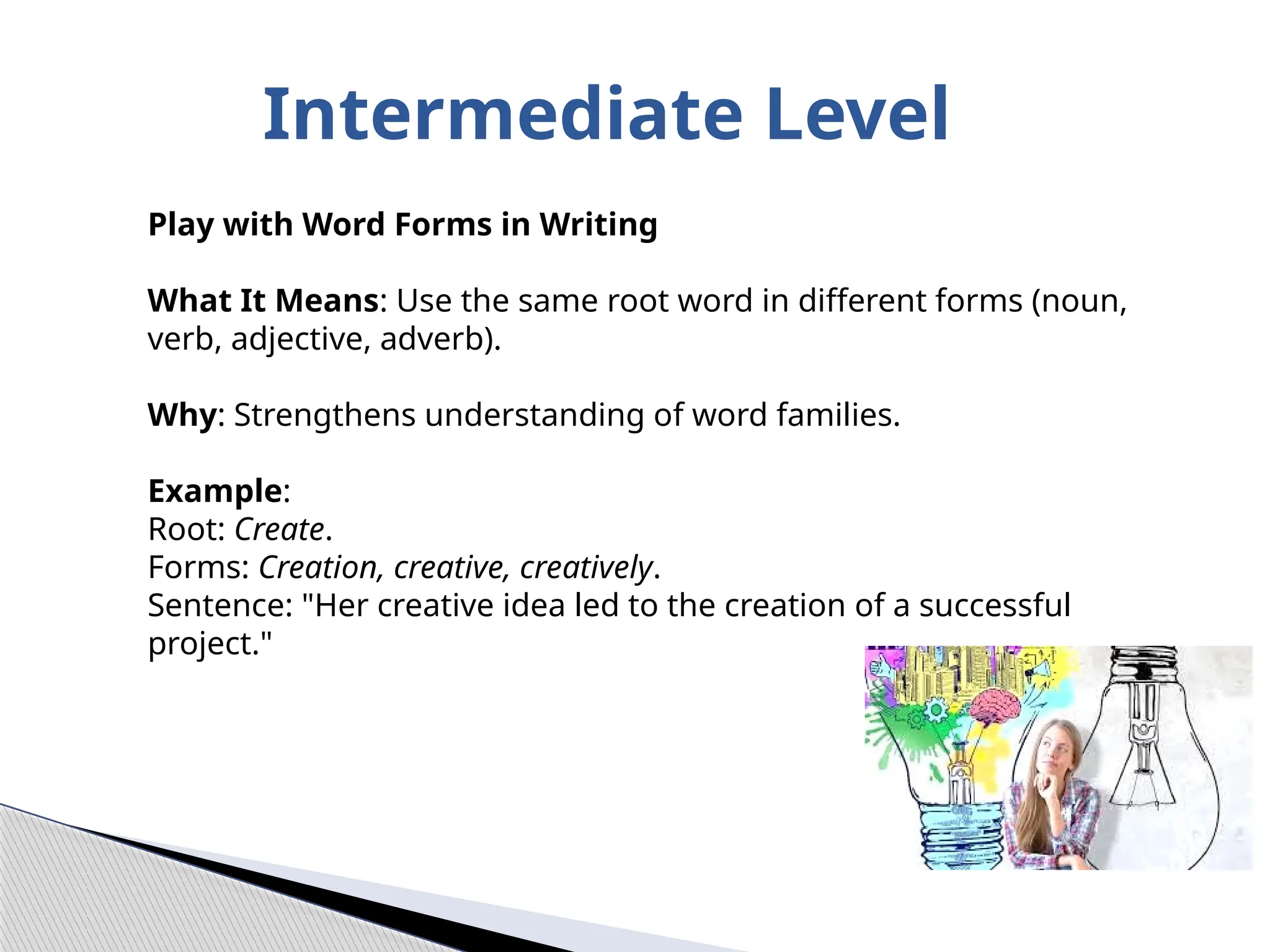
Play withWord Forms in Writing
What It Means: Use the same root word in different forms (noun,
verb, adjective, adverb).
Why: Strengthens understanding of word families.
Example:
Root: Create.
Forms: Creation, creative, creatively.
Sentence: "Her creative idea led to the creation of a successful
project."
35.
Intermediate Level
Develop Vocabularythrough Debate and Discussion
What It Means: Engage in discussions on interesting topics
using advanced words.
Why: Encourages active recall and practical usage.
Example:
Debate Topic: "Should social media be regulated?"
Use words like privacy, accountability, regulation.
36.
Summary
1. Explore collocations,idioms, and specialized words.
2. Read advanced materials and practice writing with varied
word forms.
3. Use discussions, podcasts, and journaling for successful
learning.
37.
Advanced Level
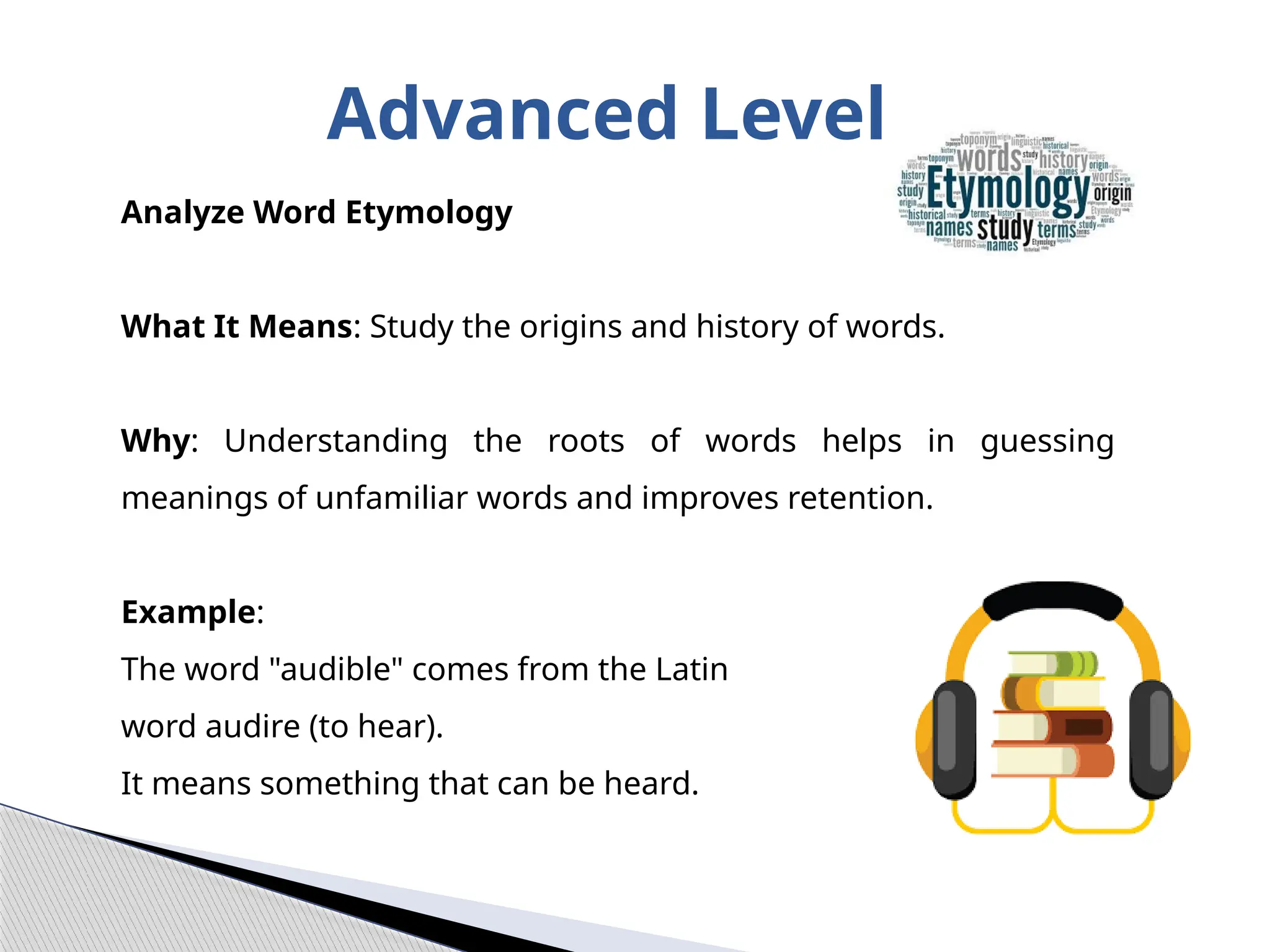
Analyze WordEtymology
What It Means: Study the origins and history of words.
Why: Understanding the roots of words helps in guessing
meanings of unfamiliar words and improves retention.
Example:
The word "audible" comes from the Latin
word audire (to hear).
It means something that can be heard.
38.
Advanced Level
Read AcademicJournals and Research Papers
What It Means: Engage with specialized texts in your field of
interest.
Why: These sources introduce highly specific vocabulary and
formal language used in professional contexts.
Example:
Words like quantitative, methodology, hypothesis, empirical are
common in academic writing.
39.
Advanced Level
Study ContextualUsage and Register
What It Means: Learn how to adjust your vocabulary based on
the formality of the situation.
Why: Mastering different registers (formal, informal, academic,
etc.) helps you use the appropriate language for various
contexts.
Example:
Formal: "I am deeply appreciative of your support."
Informal: "Thanks a lot for your help!"
40.
Advanced Level
Use Vocabularyin Persuasive Writing
What It Means: Practice writing essays, opinion pieces, or
arguments using advanced vocabulary to persuade or inform.
Why: Persuasive writing challenges you to use a variety of
vocabulary effectively to communicate your point.
Example:
Use words like compelling, unequivocal, irrefutable, assertive in
an argumentative essay.
41.
Advanced Level
Integrate Vocabularyinto Creative Writing
What It Means: Use advanced vocabulary in short stories, poetry,
or fictional works.
Why: Creative writing helps you stretch your imagination and
experiment with new words in varied contexts.
Example: Write a description of a scene using sophisticated
adjectives:
“The ethereal glow of the moon cast an ominous shadow across the
desolate landscape”.
Meaning: "The soft light of the moon created a dark shadow over
the empty land."
42.
Summary
1. Study wordorigins and understand their history to grasp
their full meaning.
2. Read academic texts to expose yourself to formal,
technical vocabulary.
3. Practice with advanced synonyms and explore key
differences between similar words.
4. Play with words through creative methods like wordplay,
writing, and multilingual exploration.