Researched and Compiled by:
Jefferson B. Fernandez
May 24, 2018
Some Takeaways from the
following Books:
Make it Stick: The Surprising
Science of Successful Learning
How We Learn: The Surprising
Truth About When, Where and
Why It Happens
Assimilative Memory or, How to
Attend and Never Forget
 Cognitive Psychology- is the basic science of
understanding how the mind works, conducting empirical
research into how people perceive, remember and think.
 Premise: a.) Learning is deeper and more durable when it's
effortful. Learning that's easy is like writing in sand, here
today and gone tomorrow.
 b.)All new learning requires a foundation of prior
knowledge
 c.) Learning is stronger when it matters, when the abstract
is made concrete and personal;.
 d.) Distractions can aid learning. Napping does too.
Quitting before a project is done: not all bad, as an
almost done project lingers in memory far longer that
one that is completed. Taking a test on a subject before
you know anything about it improves subsequent
learning
 e.) mastery requires both the possession of ready
knowledge and the conceptual understanding of how
to use it.
The Forgetting Curve
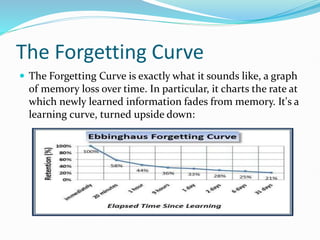
 The Forgetting Curve is exactly what it sounds like, a graph
of memory loss over time. In particular, it charts the rate at
which newly learned information fades from memory. It's a
learning curve, turned upside down:
Law of Disuse
 American Education researcher Edward Thorndike
turned Ebbinghaus' curve into a "law" of learning. He
called it the Law of Disuse, which asserted that
learned information, without continued use, decays
from memory entirely- i.e., use it or lose it.
 Forgetting enables and deepens learning, by filtering
out distracting information and by allowing some
breakdown that, after reuse, drives retrieval and
storage strength higher than they were originally ____
 Thus forgetting is critical to the learning of new skills
and to the preservation and reacquisition of old ones.
On Rereading and Massed Practice
 Rereading text and massed practice of a skill or new
knowledge are by far the preferred study strategies of
learners of all stripes, but they're also among the least
productive.
 Rereading has three strikes against it. It is time-consuming.
It doesn't result in durable memory. And it often involves a
kind of unwitting self-deception, as growing familiarity
with the text comes to feel like mastery of the content
 Rising familiarity with a text and fluency in reading can
create an illusion of mastery (illusions of knowing).
 They tend not to know what they don't know; when
put to the test, they find they cannot recall the critical
ideas or apply them in a new context. Likewise, when
they've reread their lecture notes and texts to the point
of fluency, their fluency gives them the false sense that
they're in possession of the underlying content,
principles, and implications that constitute real
learning, confident that they can recall than at a
moment's notice.
 It makes sense to reread a text once if there's been a
meaningful lapse of time since the first reading, but
doing multiple readings in close succession is a time-
consuming study strategy that yields negligible
benefits at the expense of much more effective
strategies that take less time.
Mastery
 Mastery in any field, from cooking to chess to brain
surgery, is a gradual accretion of knowledge,
conceptual understanding, judgment, and skill. These
are the fruits of variety in the practice of new skills,
and of striving, reflection, and mental rehearsal.
Active-Retrieval
 One of the most striking research findings is the power
of active retrieval-testing-to strengthen memory, and
that the more effortful the retrieval, the stronger the
benefit.
 The act of retrieving learning from memory has two
profound benefits:
 One, it tells you what you know and don't know, and
therefore where to focus further study to improve the areas
where you're weak. Two, recalling what you have learned
causes your brain to reconsolidate the memory, which
strengthens its connections to what you already know and
makes it easier for you to recall in the future. In effect,
retrieval-testing-interrupts forgetting
 Various forms of retrieval practice, such as low-stakes
quizzing and self-testing, spacing out practice, interleaving
the practice of different but related topics or skills, trying
to solve a problem before being taught the solution,
distilling the underlying principles or rules that
differentiate types of problems, and so on.
The Effective Methods
1. Recall/retrieve; Spaced-out practice/rehearsal;
interval recall
 Aristotle wrote, "exercise in repeatedly recalling a
thing strengthens memory."
 Retrieval ties the knot for memory. Repeated retrieval
snugs it up and adds a loop to make it fast.
 When retrieval practice is spaced, allowing some
forgetting to occur between tests, it leads to stronger
long-term retention than when it is massed
(crammed).
 To be most effective, retrieval must be repeated again
and again, in spaced out sessions so that recall, rather
than becoming mindless recitation, requires some
cognitive effort. Repeat recall in the brain and to
strengthen and multiply the neural notes by which the
knowledge can later be retrieved.
Effortful Retrieval
 Effortful retrieval makes for stronger learning and
retention. We're easily seduced into believing that
learning is better when it's easier, but the research
shows the opposite: When the mind has to work,
learning sticks better. The greater the effort to retrieve
learning, provided you succeed, the more that learning
is strengthened by retrieval. After an initial test,
delaying subsequent retrieval practice is more potent
for reinforcing retention than immediate practice,
because delayed retrieval requires more effort.
Cramming vs Spaced Retrieval
 In 1978, researchers found that massed studying
(cramming) leads to a higher score on an immediate
test but results in faster forgetting compared to
practicing retrieval. In a second test two days after an
initial test, the crammers had forgotten 50 % of what
they had been able to recall on the initial test, while
those who had spent the same period practicing
retrieval instead of studying had forgotten only 13% of
the information…
How?
 it's best to review the material one or two days after
initial study; then a week later; then about a month
later. After that, the intervals are longer. Let's say 15
days, that's our window. For convenience, let's give
ourselves 9 hours total study time for that exam. The
optimal schedule is the following: 3 hours on Day 1; 3
hours on Day 8 and 3 hours on Day 14, give or take a
day. In each study session, we're reviewing the same
material. On Day 15, according to the spacing effect,
we'll do at least as well on the exam, compared to 9
hours of cramming.
 The payoff is that we will retain that vocabulary for
much longer, many months in this example. We'll do
far better on any subsequent tests, like at the
beginning of the following semester. And we'll do far
better than cramming, if the exam is delayed a few
days. We've learned at least as much, in the same
amount of time- and it sticks. Again cramming works
fine in a pinch, it just doesn't last. Spacing does.
2.) Interleaved Study/Practice
 Interleaving- a cognitive science word, and it simply
means mixing related but distinct material during
study
 The mixing of items, skills, or concepts during practice
over the longer terms, seems to help us not only to see
the distinctions between them but also to achieve a
clearer grasp of each one individually. The hardest
faith is abandoning our primal faith in repetition.
 It's not that repetitive practice is bad. We all need a
certain amount of it to become familiar with any new
skill or material. But repetition creates a powerful
illusion. Skills improve quickly and then plateau. By
contrast, varied practice produces a lower apparent
rate of improvement in each single practice session but
a greater accumulation of skill and learning over time.
In the long term, repeated practice on one skill slows
us down.
Advantage of Interleaving
 Developing discriminations Skills- Compared to mass
practice, a significant advantage of interleaving and
variation is that they help us learn better how to assess
context and discriminate between problems, selecting
and applying the correct solution from a range of
possibilities.
 In interleaving, you don't move from a complete practice set of
one topic to another, you switch before each practice is complete.
A friend of ours describes his own experience with this: "I go to a
hockey class and we're learning skating skills, puck handling,
shooting, and I notice that I got frustrated because we do a little
bit of skating and just when I think I'm getting it, we go to stick
handling, and I go home frustrated, saying, ‘Why doesn't this
guys keep letting us do those these things until we get it?" This is
actually the rare coach who understands that it's more effective
to distribute practice across these different skills than polish
each one in turn. The athlete gets frustrated because learning's
not proceeding quickly, but the next week he will be better at all
aspects, the skating, the puckhandling, and so on, that if he'd
dedicated each session to polishing one skill.
 Varied practice is more effective than the focused kind,
because it forces us to internalize general rules of
motor adjustment that apply to any hittable target.
Bean Bug Study
 Bean Bug Study: Each child had six practice sessions,
taking 24 shots every time. One group practiced on
one target, a bull's eye that was just 3 feet away. The
other group practiced on two targets, one that was 2
feet away and another that was 4 feet away, alternating
their shots. That was the only difference
 The winner? Team Random, by a long shot. It scored
an average of 18, followed by the serial group, at 14. The
blocked practicers, who'd focused on one served at a
time, did the worst- 12
 Interfering with concentrated or repetitive practice
forces people to make continual adjustments, they
reasoned, building a general dexterity that, in turn,
sharpens each specific skill. Which, by the way, is
exactly what the bean bag study concluded.
 We found that interleaving paintings by different
artists were more effective than massing all of an
artist's paintings together.
 The mixed-study group got nearly 65% of the artists
correct, and the blocked group only 50%
Geometry Test
 Geometry Test: The only difference was the order:
sequential in one group and mixed in the other. The next
day the children took a test, which included one each type
of problem. Sure enough, those in the mixed-study-
interleaved-group did better, and it wasn't close: 77 to 38%
 Mixed-up practice doesn't just build overall dexterity and
prompt active discrimination. It helps prepare us for life's
curve balls, literal and figurative
 OVERLEARNING: Don't practice until you get it right.
Practice until you can't get it wrong.
3.) Generation
 Generation – The act of trying to answer a question or
attempting to solve a problem rather than being presented
with the information or the solution.
 Trying to come up with an answer rather than having it
presented to you, or trying to solve a problem before
belong shown the solution, leads to better learning and
longer retention of the correct answer or solution, even
when your attempted response is wrong, so long as
corrective feed back is provided.
 Answering does not only measure what you remember, it
increases overall retention.
Ration: Reading and Reciting
 Is there an ideal ratio between reading
(comprehending) and reciting (rehearsing)?
-Ans. Spend the first one-third (1/3) of your time
reading, and the remaining two-thirds (2/3) recalling
from memory.
4.) Elaboration
 Elaboration – improves your mastery of new material
and multiplies the mental cues available to you for
later recall and application for it. E.g. relating the
material to what you already know, explaining it to
somebody else in your own words, or explaining how it
relates to your life outside of class.
 Elaboration is the process of giving new material
meaning by expressing it in your own words and
connecting it with what you already know. The more
you can explain about the way your new learning
relates to your prior knowledge, the stronger your
grasp of the new learning will be, and the more
connections you create that will help you remember it
later.
5.) Reflection
 Reflection – is a combination of retrieval practice and
elaboration that adds layers to learning and strengthen
skills.
 Reflection is the act of taking a few minutes to review
what has been learned in a recent class or experience
and asking questions about it/those.
6.) Calibration
 Calibration – is the act of aligning your judgments of
what you knew and don't know with objective
feedback so as to avoid being carried off by the
illusions of mastery that catch many learners by
surprise at test time.
On Environment: Venue and Noise
(includes music)
 A simple change in venue improved retrieval strength
(memory) by 40%. Or as the authors put it, the
experiment "showed strong recall improvement with a
variation of environmental context."
 Of these who studied and tested in the same
condition, the silence-silence group did the worst.
They recalled, on average about half the words that the
jazz-jazz or classical-classical groups did (11 vs 20).
 Having something going on in the study environment
like music is better than nothing (so much for the
sanctity of the quiet study room).
 Each alteration of the routine further enriches the
skills being rehearsed, making them sharper and more
accessible for a longer period of time. This kind of
experimenting itself reinforces learning, and makes
what you know increasingly independent of your
surroundings.
The Role of Incubation in Problem
Solving:
 Scientists have a method of stepping back to see the
bigger picture, one they use when trying to make sense
of a large number of varied results. The idea is to
"pool" all the findings, positive and negative, and
determine what the bulk of evidence is saying. It's
called meta-analysis.
 For math or spatial problems, like the Pencil Problem,
people benefit from any of these three; it doesn't seem to
matter which you choose. (Incubation breaks- 3 categories:
One was relaxing like lying on a couch, listening to music.
Another was mildly active, like surfing the internet. The
third was highly engaging, like writing a short essay or
digging into other homework.) For linguistic problems like
RAT puzzles or anagrams, on the other hand, breaks
consisting of mild activity- video games, solitaire, TTV-
seem to work best.
 They also emphasized that people don't benefit from an
incubation break unless they have reached an impasse.
Quitting Before You're Ahead- The
Accumulating Gifts of Percolation
 Perhaps unfinished jobs or goals linger in memory
longer than finished ones- if nothing else, Zeigarnik
now had her research project- She put the question
more specifically: What's the difference in memory
between an interrupted activity and an uninterrupted
one?
 Zeigarnik's studies on interruption revealed a couple
of the mind's intrinsic biases, or built-in instincts
when it comes to goals: the first is that the act of
starting work on an assignment often gives that job the
psychological weight of a goal, even when it's
meaningless.
 The second is that interrupting yourself when
absorbed in an assignment extends its life in memory
and – according to her experiments – pushes it to the
top of your mental to do list.
 The first element of percolation, then, is that
supposed enemy of learning- interruption.
 Quitting before I'm ahead doesn't put the project into
sleep; it keeps it awake. That's Phase 1, and it initiates
Phase 2. The period of gathering string, of casual data
collecting. Phase 3 is listening to what I think about all
those incoming bits and pieces. Percolation depends on all
three elements, and in that order.
 What does this mean for a learning strategy? It suggests
that we should start to work large projects as soon as
possible and stop when we get stuck, with the confidence
that we are initiating percolation, not quitting.
You Snooze, You Win
 X X X The other theory is that sleep's primary purpose is
memory consolidation. Learning.
 The group that studied in the evening and took the test the
next morning after a good night's sleep- the "sleep group"
as they were called- scored 93% on the most distantly
related pair, i.e. the hardest question. The group that
studied in the morning and took the test in the evening,
without having slept- the "wake group"- scored 69%. A full
24-hours later, each student took the test yet again, and the
sleep group's advantage had increased to the most distantly
related pairs. That's a large difference on the hardest
questions- 35%
 The preponderance of evidence to date finds that sleep
improves retention and comprehension of what was
studied the day before.
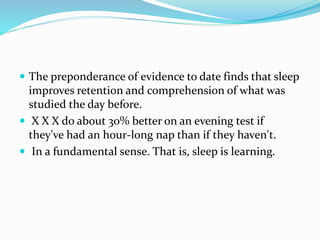
 X X X do about 30% better on an evening test if
they've had an hour-long nap than if they haven't.
 In a fundamental sense. That is, sleep is learning.
Assimilative Memory or, How to
Attend and Never Forget by A.
Loisette
 Fundamental Principles: Attention- It is the will
directing the activity of the intellect into some
particular channel and keeping it there.
 Thinking- It consists in finding relations between the
objects of thought with an immediate awareness of
those relations.
 Sensuous Memory- It is learning through relations- by
thinking- from grasping the ideas or thoughts- the
meaning and the comprehension of the subject matter.
This mode of learning promotes attention and
prevents mind-wandering.
Three (3) laws of Memory or of
Thinking:
 1.) Inclusion- indicates that there is an overlapping of
meaning between 2 words, or that there is prominent
idea or sound that belongs to both alike, or that a
similar fact or property belongs to 2 events or things
as, to enumerate a few classes.
Examples of this Law of Inclusion:
 Whole and part- (Forest, Trees), (Air, Oxygen),
(House, Parlor)
 Genus and Species- (Dog, Retriever), (Fish, Salmon),
(Plant, Rosemary)
 Abstract and Concrete- (Lion, Strong), (Eagle, Swift),
(Courage, Hero)
 Similarity of Sound- (Emperor, Empty), (Salvation,
Salamander), (Top, Topsy)
Exclusion
2.) Exclusion- means Antithesis. One word excludes
the other, or both words relate to one and the same
thing but occupy opposite positions in regard to it as
(Riches, Poverty), (Hot, Cold), (Old, Young), (Life,
Death), (Love, Hate), (Peace, War).
Concurrence
 3.) Concurrence- is the sequence or coexistence of
impressions or ideas that have been either accidentally
or causally together. (gravitation, Newton, Apple),
(Columbus, America), (Socrates, Hemlock), (Job,
Patience)
 Numeric Thinking: Fujiyama, a volcano of Japan, is 12,
365 feet high- the height of this mountain is expressed
in the number of months and days of the year.
The End! Thank
You!

The-Science-of-Learning-updated presentation

  • 1.
    Researched and Compiledby: Jefferson B. Fernandez May 24, 2018
  • 2.
    Some Takeaways fromthe following Books: Make it Stick: The Surprising Science of Successful Learning How We Learn: The Surprising Truth About When, Where and Why It Happens Assimilative Memory or, How to Attend and Never Forget
  • 3.
     Cognitive Psychology-is the basic science of understanding how the mind works, conducting empirical research into how people perceive, remember and think.  Premise: a.) Learning is deeper and more durable when it's effortful. Learning that's easy is like writing in sand, here today and gone tomorrow.  b.)All new learning requires a foundation of prior knowledge  c.) Learning is stronger when it matters, when the abstract is made concrete and personal;.
  • 4.
     d.) Distractionscan aid learning. Napping does too. Quitting before a project is done: not all bad, as an almost done project lingers in memory far longer that one that is completed. Taking a test on a subject before you know anything about it improves subsequent learning  e.) mastery requires both the possession of ready knowledge and the conceptual understanding of how to use it.
  • 5.
    The Forgetting Curve The Forgetting Curve is exactly what it sounds like, a graph of memory loss over time. In particular, it charts the rate at which newly learned information fades from memory. It's a learning curve, turned upside down:
  • 6.
    Law of Disuse American Education researcher Edward Thorndike turned Ebbinghaus' curve into a "law" of learning. He called it the Law of Disuse, which asserted that learned information, without continued use, decays from memory entirely- i.e., use it or lose it.  Forgetting enables and deepens learning, by filtering out distracting information and by allowing some breakdown that, after reuse, drives retrieval and storage strength higher than they were originally ____  Thus forgetting is critical to the learning of new skills and to the preservation and reacquisition of old ones.
  • 7.
    On Rereading andMassed Practice  Rereading text and massed practice of a skill or new knowledge are by far the preferred study strategies of learners of all stripes, but they're also among the least productive.  Rereading has three strikes against it. It is time-consuming. It doesn't result in durable memory. And it often involves a kind of unwitting self-deception, as growing familiarity with the text comes to feel like mastery of the content  Rising familiarity with a text and fluency in reading can create an illusion of mastery (illusions of knowing).
  • 8.
     They tendnot to know what they don't know; when put to the test, they find they cannot recall the critical ideas or apply them in a new context. Likewise, when they've reread their lecture notes and texts to the point of fluency, their fluency gives them the false sense that they're in possession of the underlying content, principles, and implications that constitute real learning, confident that they can recall than at a moment's notice.
  • 9.
     It makessense to reread a text once if there's been a meaningful lapse of time since the first reading, but doing multiple readings in close succession is a time- consuming study strategy that yields negligible benefits at the expense of much more effective strategies that take less time.
  • 10.
    Mastery  Mastery inany field, from cooking to chess to brain surgery, is a gradual accretion of knowledge, conceptual understanding, judgment, and skill. These are the fruits of variety in the practice of new skills, and of striving, reflection, and mental rehearsal.
  • 11.
    Active-Retrieval  One ofthe most striking research findings is the power of active retrieval-testing-to strengthen memory, and that the more effortful the retrieval, the stronger the benefit.  The act of retrieving learning from memory has two profound benefits:
  • 12.
     One, ittells you what you know and don't know, and therefore where to focus further study to improve the areas where you're weak. Two, recalling what you have learned causes your brain to reconsolidate the memory, which strengthens its connections to what you already know and makes it easier for you to recall in the future. In effect, retrieval-testing-interrupts forgetting  Various forms of retrieval practice, such as low-stakes quizzing and self-testing, spacing out practice, interleaving the practice of different but related topics or skills, trying to solve a problem before being taught the solution, distilling the underlying principles or rules that differentiate types of problems, and so on.
  • 13.
    The Effective Methods 1.Recall/retrieve; Spaced-out practice/rehearsal; interval recall  Aristotle wrote, "exercise in repeatedly recalling a thing strengthens memory."  Retrieval ties the knot for memory. Repeated retrieval snugs it up and adds a loop to make it fast.
  • 14.
     When retrievalpractice is spaced, allowing some forgetting to occur between tests, it leads to stronger long-term retention than when it is massed (crammed).  To be most effective, retrieval must be repeated again and again, in spaced out sessions so that recall, rather than becoming mindless recitation, requires some cognitive effort. Repeat recall in the brain and to strengthen and multiply the neural notes by which the knowledge can later be retrieved.
  • 15.
    Effortful Retrieval  Effortfulretrieval makes for stronger learning and retention. We're easily seduced into believing that learning is better when it's easier, but the research shows the opposite: When the mind has to work, learning sticks better. The greater the effort to retrieve learning, provided you succeed, the more that learning is strengthened by retrieval. After an initial test, delaying subsequent retrieval practice is more potent for reinforcing retention than immediate practice, because delayed retrieval requires more effort.
  • 16.
    Cramming vs SpacedRetrieval  In 1978, researchers found that massed studying (cramming) leads to a higher score on an immediate test but results in faster forgetting compared to practicing retrieval. In a second test two days after an initial test, the crammers had forgotten 50 % of what they had been able to recall on the initial test, while those who had spent the same period practicing retrieval instead of studying had forgotten only 13% of the information…
  • 17.
    How?  it's bestto review the material one or two days after initial study; then a week later; then about a month later. After that, the intervals are longer. Let's say 15 days, that's our window. For convenience, let's give ourselves 9 hours total study time for that exam. The optimal schedule is the following: 3 hours on Day 1; 3 hours on Day 8 and 3 hours on Day 14, give or take a day. In each study session, we're reviewing the same material. On Day 15, according to the spacing effect, we'll do at least as well on the exam, compared to 9 hours of cramming.
  • 18.
     The payoffis that we will retain that vocabulary for much longer, many months in this example. We'll do far better on any subsequent tests, like at the beginning of the following semester. And we'll do far better than cramming, if the exam is delayed a few days. We've learned at least as much, in the same amount of time- and it sticks. Again cramming works fine in a pinch, it just doesn't last. Spacing does.
  • 19.
    2.) Interleaved Study/Practice Interleaving- a cognitive science word, and it simply means mixing related but distinct material during study  The mixing of items, skills, or concepts during practice over the longer terms, seems to help us not only to see the distinctions between them but also to achieve a clearer grasp of each one individually. The hardest faith is abandoning our primal faith in repetition.
  • 20.
     It's notthat repetitive practice is bad. We all need a certain amount of it to become familiar with any new skill or material. But repetition creates a powerful illusion. Skills improve quickly and then plateau. By contrast, varied practice produces a lower apparent rate of improvement in each single practice session but a greater accumulation of skill and learning over time. In the long term, repeated practice on one skill slows us down.
  • 21.
    Advantage of Interleaving Developing discriminations Skills- Compared to mass practice, a significant advantage of interleaving and variation is that they help us learn better how to assess context and discriminate between problems, selecting and applying the correct solution from a range of possibilities.
  • 22.
     In interleaving,you don't move from a complete practice set of one topic to another, you switch before each practice is complete. A friend of ours describes his own experience with this: "I go to a hockey class and we're learning skating skills, puck handling, shooting, and I notice that I got frustrated because we do a little bit of skating and just when I think I'm getting it, we go to stick handling, and I go home frustrated, saying, ‘Why doesn't this guys keep letting us do those these things until we get it?" This is actually the rare coach who understands that it's more effective to distribute practice across these different skills than polish each one in turn. The athlete gets frustrated because learning's not proceeding quickly, but the next week he will be better at all aspects, the skating, the puckhandling, and so on, that if he'd dedicated each session to polishing one skill.
  • 23.
     Varied practiceis more effective than the focused kind, because it forces us to internalize general rules of motor adjustment that apply to any hittable target.
  • 24.
    Bean Bug Study Bean Bug Study: Each child had six practice sessions, taking 24 shots every time. One group practiced on one target, a bull's eye that was just 3 feet away. The other group practiced on two targets, one that was 2 feet away and another that was 4 feet away, alternating their shots. That was the only difference  The winner? Team Random, by a long shot. It scored an average of 18, followed by the serial group, at 14. The blocked practicers, who'd focused on one served at a time, did the worst- 12
  • 25.
     Interfering withconcentrated or repetitive practice forces people to make continual adjustments, they reasoned, building a general dexterity that, in turn, sharpens each specific skill. Which, by the way, is exactly what the bean bag study concluded.  We found that interleaving paintings by different artists were more effective than massing all of an artist's paintings together.  The mixed-study group got nearly 65% of the artists correct, and the blocked group only 50%
  • 26.
    Geometry Test  GeometryTest: The only difference was the order: sequential in one group and mixed in the other. The next day the children took a test, which included one each type of problem. Sure enough, those in the mixed-study- interleaved-group did better, and it wasn't close: 77 to 38%  Mixed-up practice doesn't just build overall dexterity and prompt active discrimination. It helps prepare us for life's curve balls, literal and figurative  OVERLEARNING: Don't practice until you get it right. Practice until you can't get it wrong.
  • 27.
    3.) Generation  Generation– The act of trying to answer a question or attempting to solve a problem rather than being presented with the information or the solution.  Trying to come up with an answer rather than having it presented to you, or trying to solve a problem before belong shown the solution, leads to better learning and longer retention of the correct answer or solution, even when your attempted response is wrong, so long as corrective feed back is provided.  Answering does not only measure what you remember, it increases overall retention.
  • 28.
    Ration: Reading andReciting  Is there an ideal ratio between reading (comprehending) and reciting (rehearsing)? -Ans. Spend the first one-third (1/3) of your time reading, and the remaining two-thirds (2/3) recalling from memory.
  • 29.
    4.) Elaboration  Elaboration– improves your mastery of new material and multiplies the mental cues available to you for later recall and application for it. E.g. relating the material to what you already know, explaining it to somebody else in your own words, or explaining how it relates to your life outside of class.
  • 30.
     Elaboration isthe process of giving new material meaning by expressing it in your own words and connecting it with what you already know. The more you can explain about the way your new learning relates to your prior knowledge, the stronger your grasp of the new learning will be, and the more connections you create that will help you remember it later.
  • 31.
    5.) Reflection  Reflection– is a combination of retrieval practice and elaboration that adds layers to learning and strengthen skills.  Reflection is the act of taking a few minutes to review what has been learned in a recent class or experience and asking questions about it/those.
  • 32.
    6.) Calibration  Calibration– is the act of aligning your judgments of what you knew and don't know with objective feedback so as to avoid being carried off by the illusions of mastery that catch many learners by surprise at test time.
  • 33.
    On Environment: Venueand Noise (includes music)  A simple change in venue improved retrieval strength (memory) by 40%. Or as the authors put it, the experiment "showed strong recall improvement with a variation of environmental context."  Of these who studied and tested in the same condition, the silence-silence group did the worst. They recalled, on average about half the words that the jazz-jazz or classical-classical groups did (11 vs 20).
  • 34.
     Having somethinggoing on in the study environment like music is better than nothing (so much for the sanctity of the quiet study room).  Each alteration of the routine further enriches the skills being rehearsed, making them sharper and more accessible for a longer period of time. This kind of experimenting itself reinforces learning, and makes what you know increasingly independent of your surroundings.
  • 35.
    The Role ofIncubation in Problem Solving:  Scientists have a method of stepping back to see the bigger picture, one they use when trying to make sense of a large number of varied results. The idea is to "pool" all the findings, positive and negative, and determine what the bulk of evidence is saying. It's called meta-analysis.
  • 36.
     For mathor spatial problems, like the Pencil Problem, people benefit from any of these three; it doesn't seem to matter which you choose. (Incubation breaks- 3 categories: One was relaxing like lying on a couch, listening to music. Another was mildly active, like surfing the internet. The third was highly engaging, like writing a short essay or digging into other homework.) For linguistic problems like RAT puzzles or anagrams, on the other hand, breaks consisting of mild activity- video games, solitaire, TTV- seem to work best.  They also emphasized that people don't benefit from an incubation break unless they have reached an impasse.
  • 37.
    Quitting Before You'reAhead- The Accumulating Gifts of Percolation  Perhaps unfinished jobs or goals linger in memory longer than finished ones- if nothing else, Zeigarnik now had her research project- She put the question more specifically: What's the difference in memory between an interrupted activity and an uninterrupted one?
  • 38.
     Zeigarnik's studieson interruption revealed a couple of the mind's intrinsic biases, or built-in instincts when it comes to goals: the first is that the act of starting work on an assignment often gives that job the psychological weight of a goal, even when it's meaningless.
  • 39.
     The secondis that interrupting yourself when absorbed in an assignment extends its life in memory and – according to her experiments – pushes it to the top of your mental to do list.  The first element of percolation, then, is that supposed enemy of learning- interruption.
  • 40.
     Quitting beforeI'm ahead doesn't put the project into sleep; it keeps it awake. That's Phase 1, and it initiates Phase 2. The period of gathering string, of casual data collecting. Phase 3 is listening to what I think about all those incoming bits and pieces. Percolation depends on all three elements, and in that order.  What does this mean for a learning strategy? It suggests that we should start to work large projects as soon as possible and stop when we get stuck, with the confidence that we are initiating percolation, not quitting.
  • 41.
    You Snooze, YouWin  X X X The other theory is that sleep's primary purpose is memory consolidation. Learning.  The group that studied in the evening and took the test the next morning after a good night's sleep- the "sleep group" as they were called- scored 93% on the most distantly related pair, i.e. the hardest question. The group that studied in the morning and took the test in the evening, without having slept- the "wake group"- scored 69%. A full 24-hours later, each student took the test yet again, and the sleep group's advantage had increased to the most distantly related pairs. That's a large difference on the hardest questions- 35%
  • 42.
     The preponderanceof evidence to date finds that sleep improves retention and comprehension of what was studied the day before.  X X X do about 30% better on an evening test if they've had an hour-long nap than if they haven't.  In a fundamental sense. That is, sleep is learning.
  • 43.
    Assimilative Memory or,How to Attend and Never Forget by A. Loisette  Fundamental Principles: Attention- It is the will directing the activity of the intellect into some particular channel and keeping it there.  Thinking- It consists in finding relations between the objects of thought with an immediate awareness of those relations.  Sensuous Memory- It is learning through relations- by thinking- from grasping the ideas or thoughts- the meaning and the comprehension of the subject matter. This mode of learning promotes attention and prevents mind-wandering.
  • 44.
    Three (3) lawsof Memory or of Thinking:  1.) Inclusion- indicates that there is an overlapping of meaning between 2 words, or that there is prominent idea or sound that belongs to both alike, or that a similar fact or property belongs to 2 events or things as, to enumerate a few classes.
  • 45.
    Examples of thisLaw of Inclusion:  Whole and part- (Forest, Trees), (Air, Oxygen), (House, Parlor)  Genus and Species- (Dog, Retriever), (Fish, Salmon), (Plant, Rosemary)  Abstract and Concrete- (Lion, Strong), (Eagle, Swift), (Courage, Hero)  Similarity of Sound- (Emperor, Empty), (Salvation, Salamander), (Top, Topsy)
  • 46.
    Exclusion 2.) Exclusion- meansAntithesis. One word excludes the other, or both words relate to one and the same thing but occupy opposite positions in regard to it as (Riches, Poverty), (Hot, Cold), (Old, Young), (Life, Death), (Love, Hate), (Peace, War).
  • 47.
    Concurrence  3.) Concurrence-is the sequence or coexistence of impressions or ideas that have been either accidentally or causally together. (gravitation, Newton, Apple), (Columbus, America), (Socrates, Hemlock), (Job, Patience)  Numeric Thinking: Fujiyama, a volcano of Japan, is 12, 365 feet high- the height of this mountain is expressed in the number of months and days of the year.
  • 48.