Cognitive Learning Theory


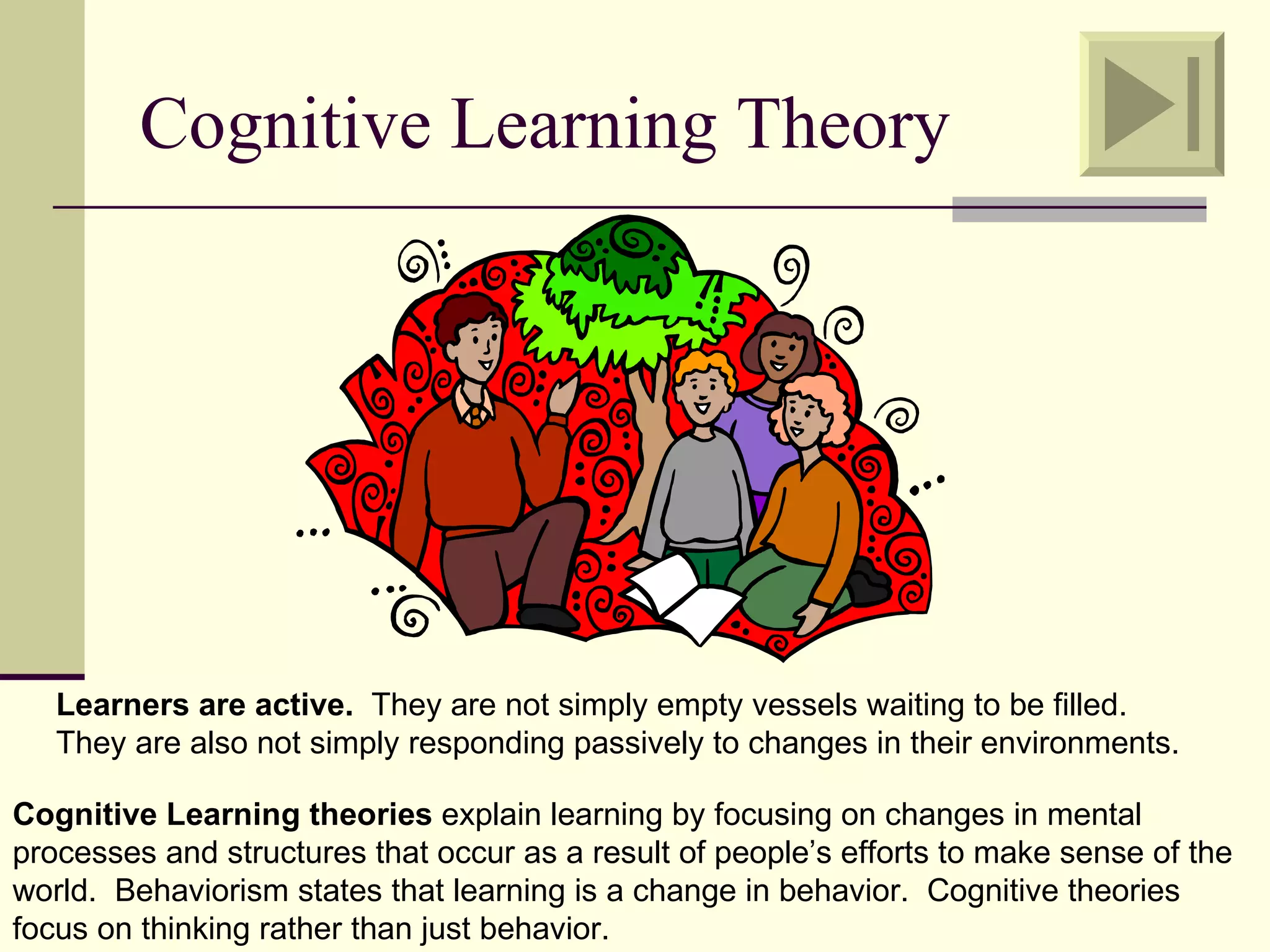
   Learners are active. They are not simply empty vessels waiting to be filled.
   They are also not simply responding passively to changes in their environments.

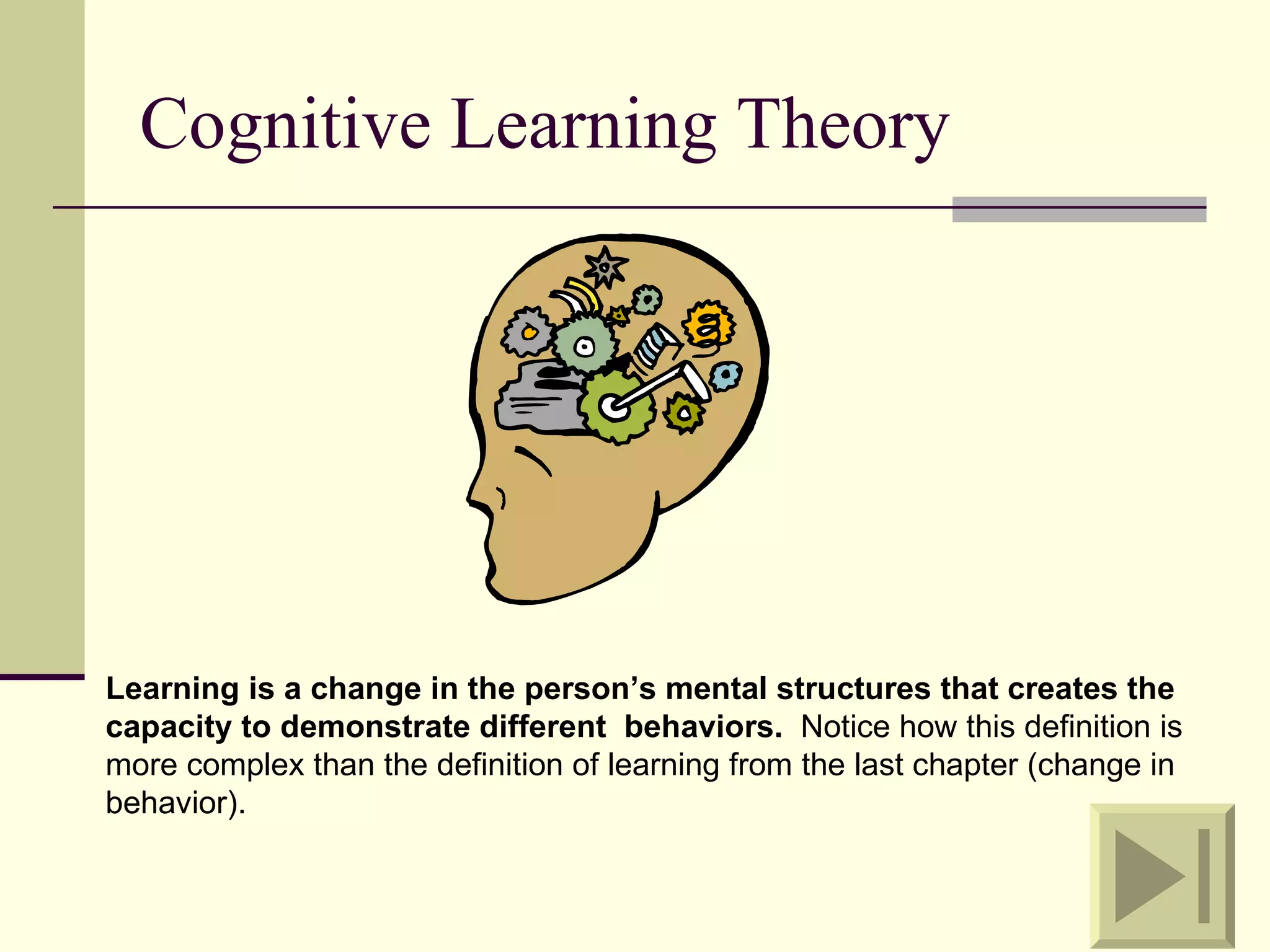
Cognitive Learning theories explain learning by focusing on changes in mental
processes and structures that occur as a result of people’s efforts to make sense of the
world. Behaviorism states that learning is a change in behavior. Cognitive theories
focus on thinking rather than just behavior.
Cognitive Learning Theory


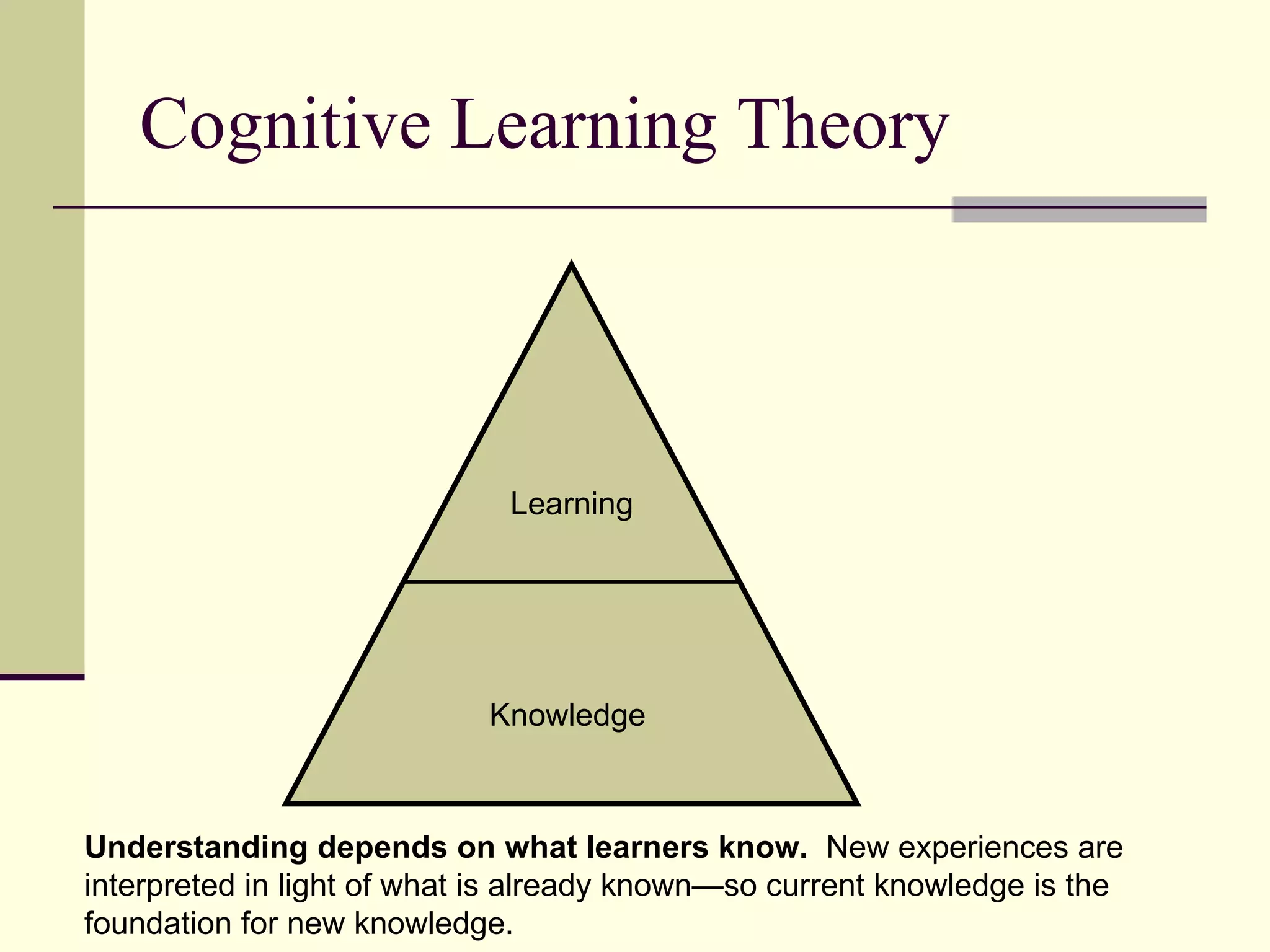
                             Learning


                            Knowledge


Understanding depends on what learners know. New experiences are
interpreted in light of what is already known—so current knowledge is the
foundation for new knowledge.
Cognitive Learning Theory


Learners construct understanding—they don’t simply remember
what the teacher says. They relate what they are learning to what
they already know and they try to make sense of it.
Two types of knowledge
 Domain-specific knowledge: information that
  is useful in a particular situation or that
  applies mainly to one specific topic.
 General knowledge: information that is useful
  in many different kinds of tasks; information
  that applies to many situations.
Cognitive Learning Theory


Learning is a change in the person’s mental structures that creates the
capacity to demonstrate different behaviors. Notice how this definition is
more complex than the definition of learning from the last chapter (change in
behavior).
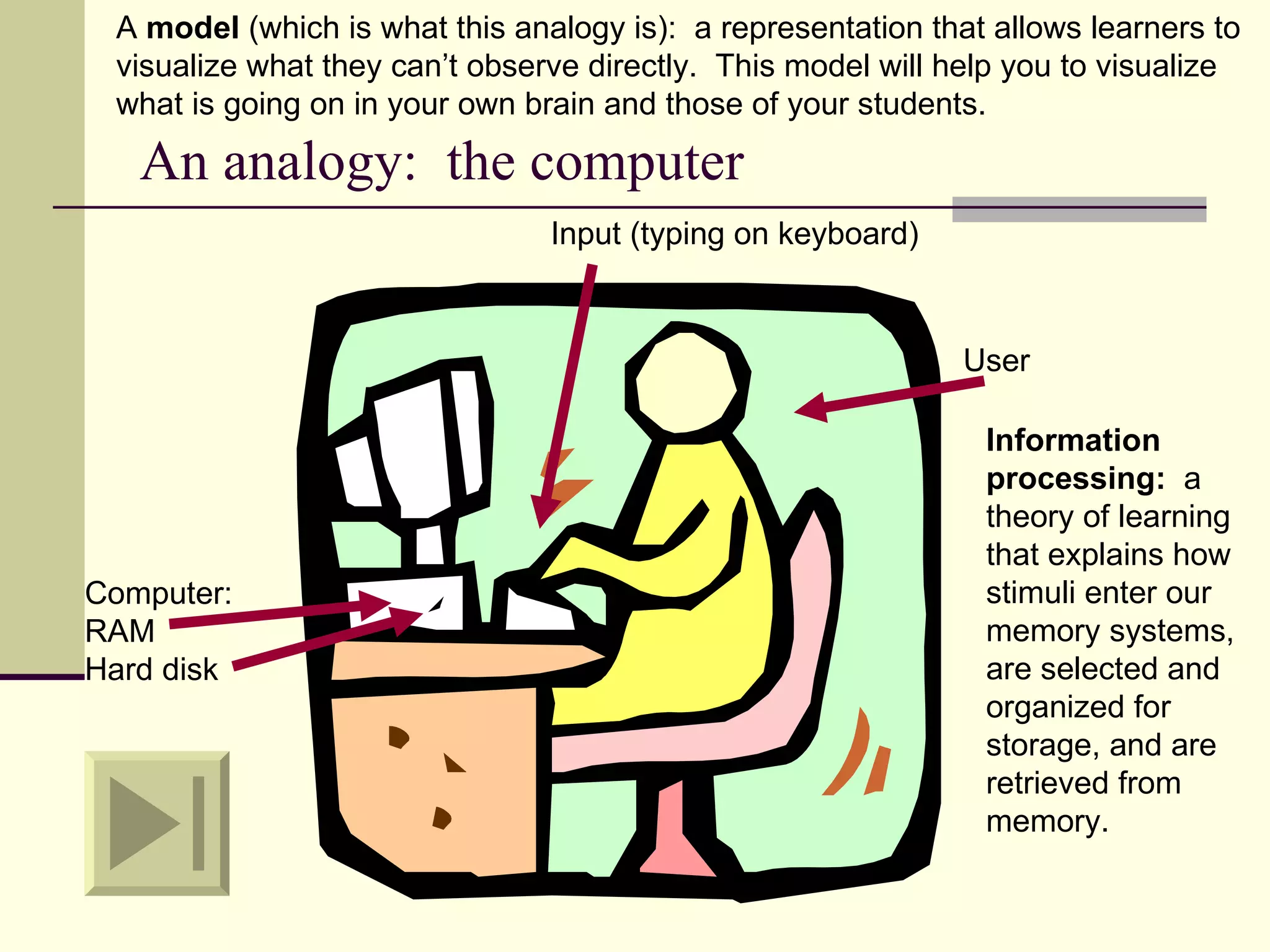
A model (which is what this analogy is): a representation that allows learners to
 visualize what they can’t observe directly. This model will help you to visualize
 what is going on in your own brain and those of your students.

   An analogy: the computer
                                Input (typing on keyboard)


                                                              User

                                                               Information
                                                               processing: a
                                                               theory of learning
                                                               that explains how
Computer:                                                      stimuli enter our
RAM                                                            memory systems,
Hard disk                                                      are selected and
                                                               organized for
                                                               storage, and are
                                                               retrieved from
                                                               memory.
3 components of information
processing model
 Information stores: repositories that hold information,
  like a computer’s RAM and hard drive. Information
  stores in the information processing model are
  sensory memory (no real computer analogy), working
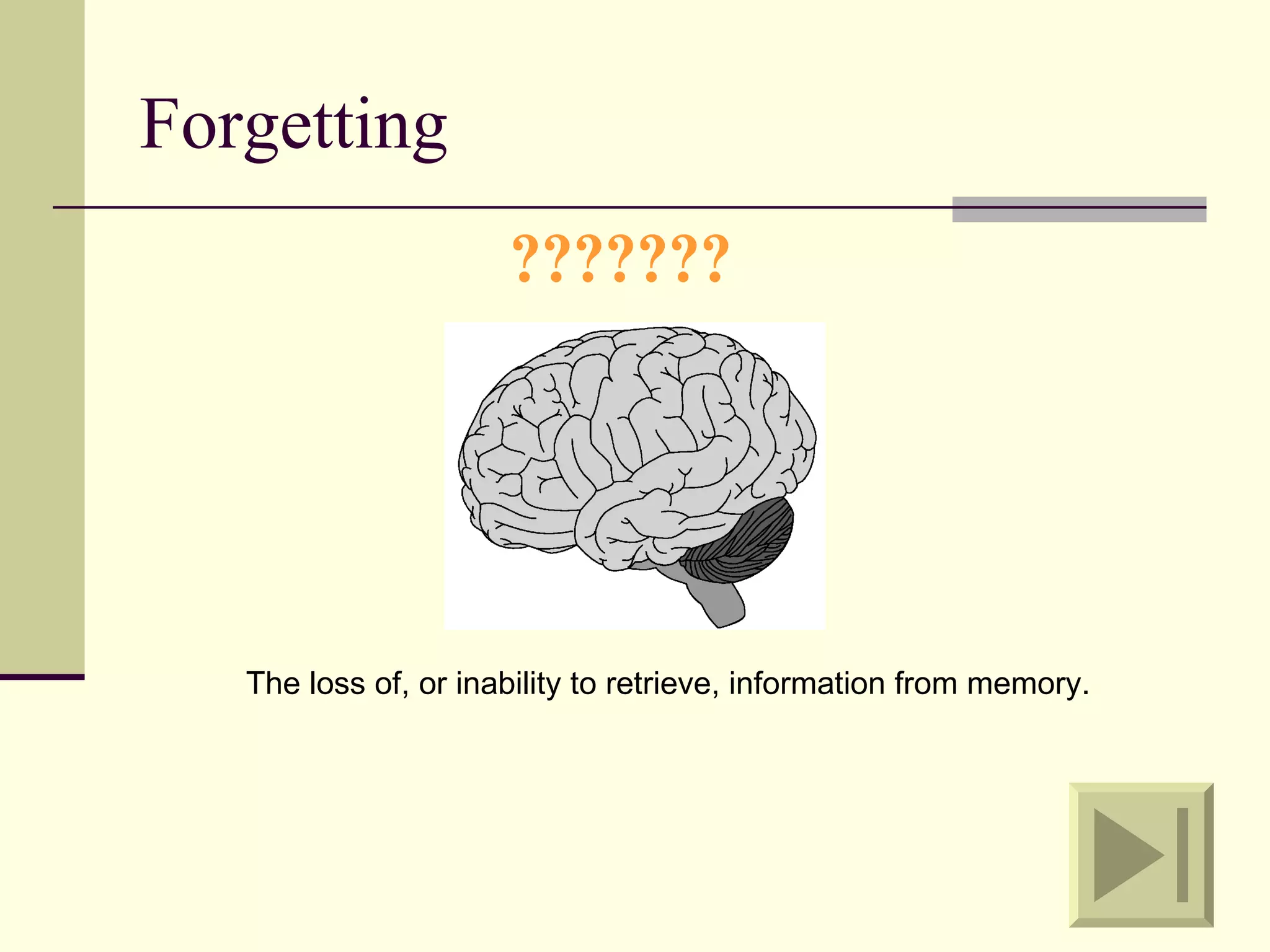
  memory (like RAM), and long term memory (like hard
  drive).
 Cognitive processes: intellectual actions that
  transform information and move it from one store to
  another. Includes attention, perception, rehearsal,
  encoding, and retrieval. Like software in computers.
 Metacognition: awareness of and control over one’s
  own cognitive processes.
Sensory Memory
The information store that briefly holds stimuli from the environment until they can
be processed.


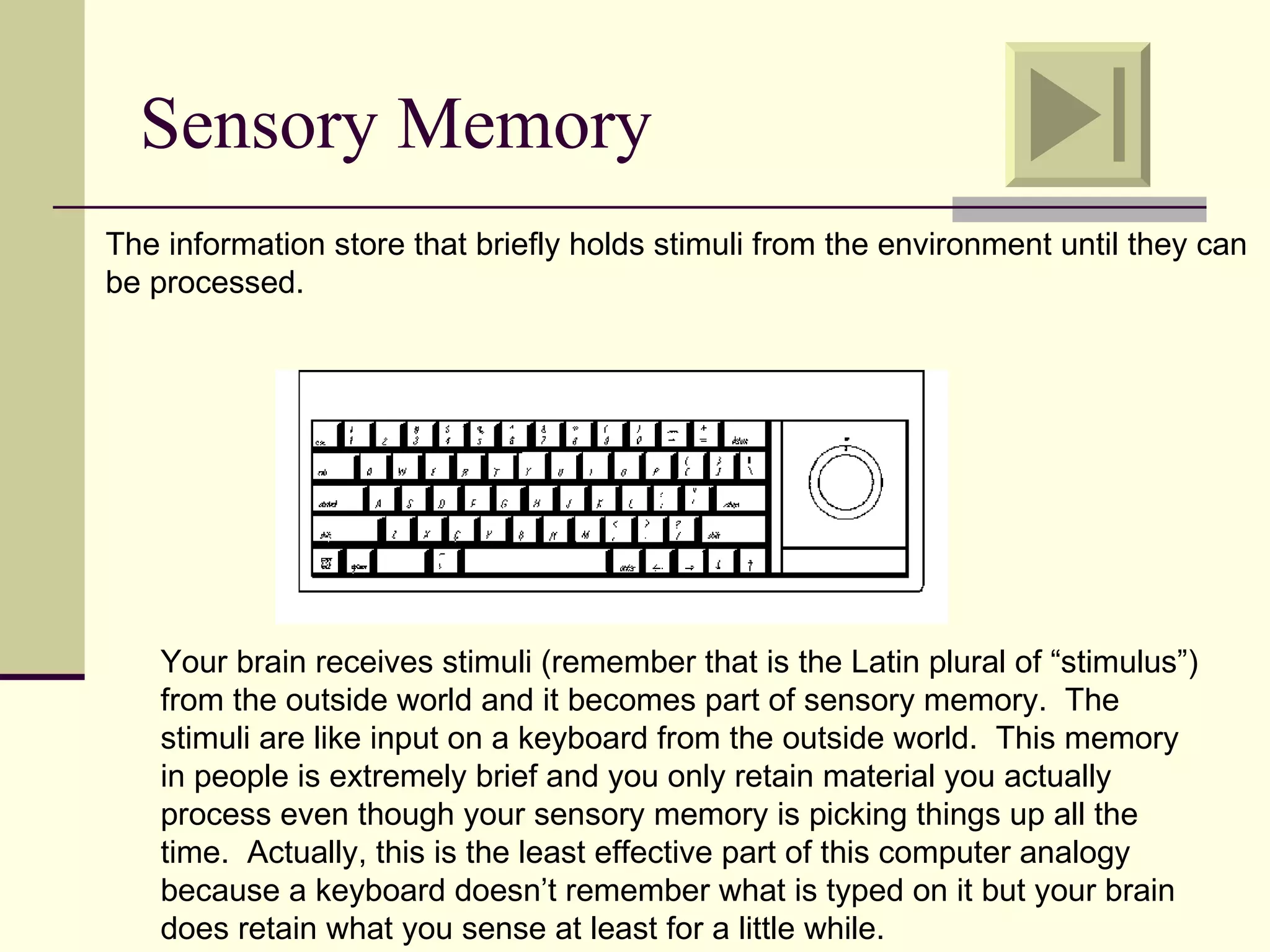
    Your brain receives stimuli (remember that is the Latin plural of “stimulus”)
    from the outside world and it becomes part of sensory memory. The
    stimuli are like input on a keyboard from the outside world. This memory
    in people is extremely brief and you only retain material you actually
    process even though your sensory memory is picking things up all the
    time. Actually, this is the least effective part of this computer analogy
    because a keyboard doesn’t remember what is typed on it but your brain
    does retain what you sense at least for a little while.
Perception
 The process of detecting and assigning
  meaning to that which is sensed.
Perception


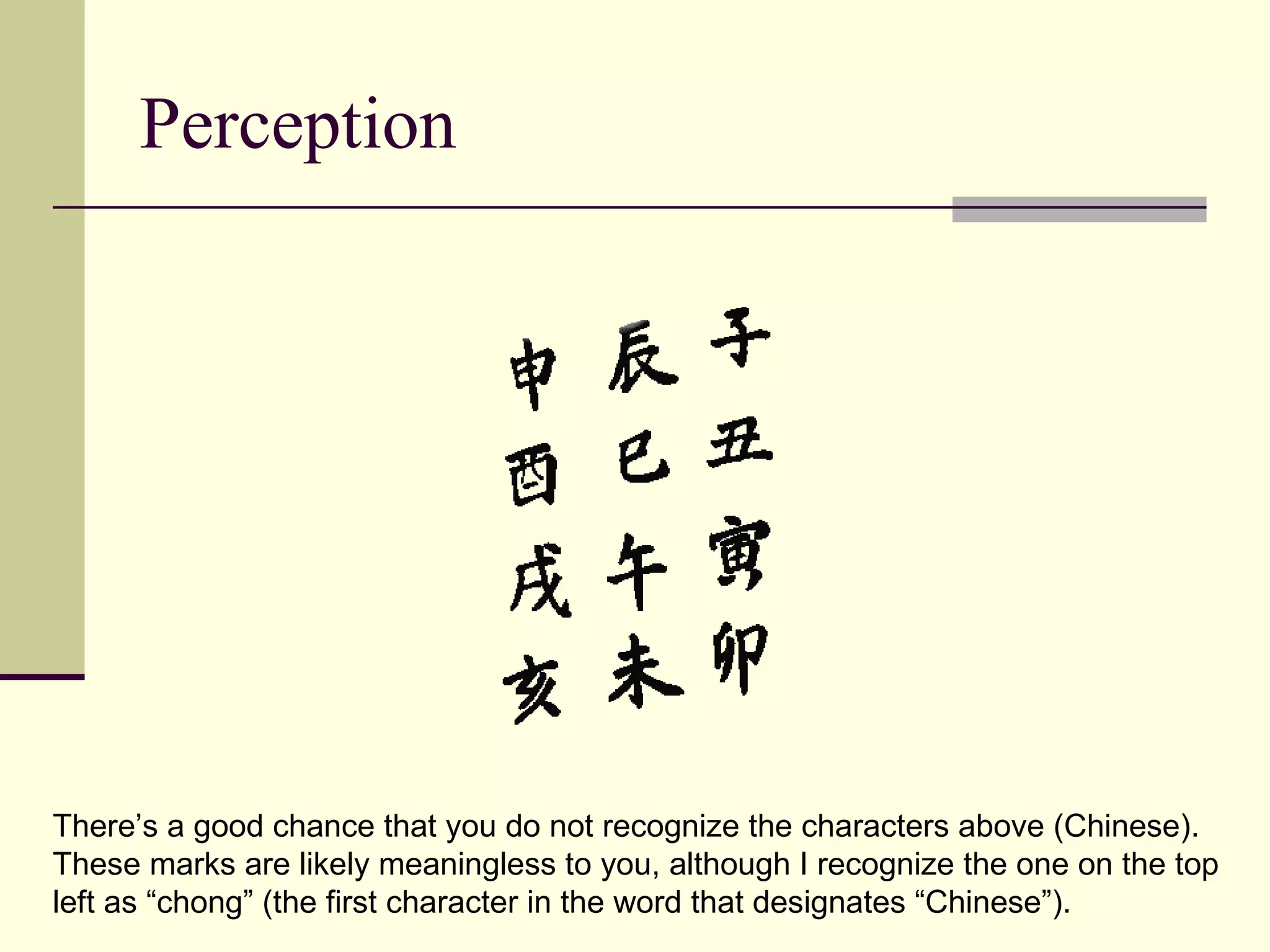
There’s a good chance that you do not recognize the characters above (Chinese).
These marks are likely meaningless to you, although I recognize the one on the top
left as “chong” (the first character in the word that designates “Chinese”).
Perception
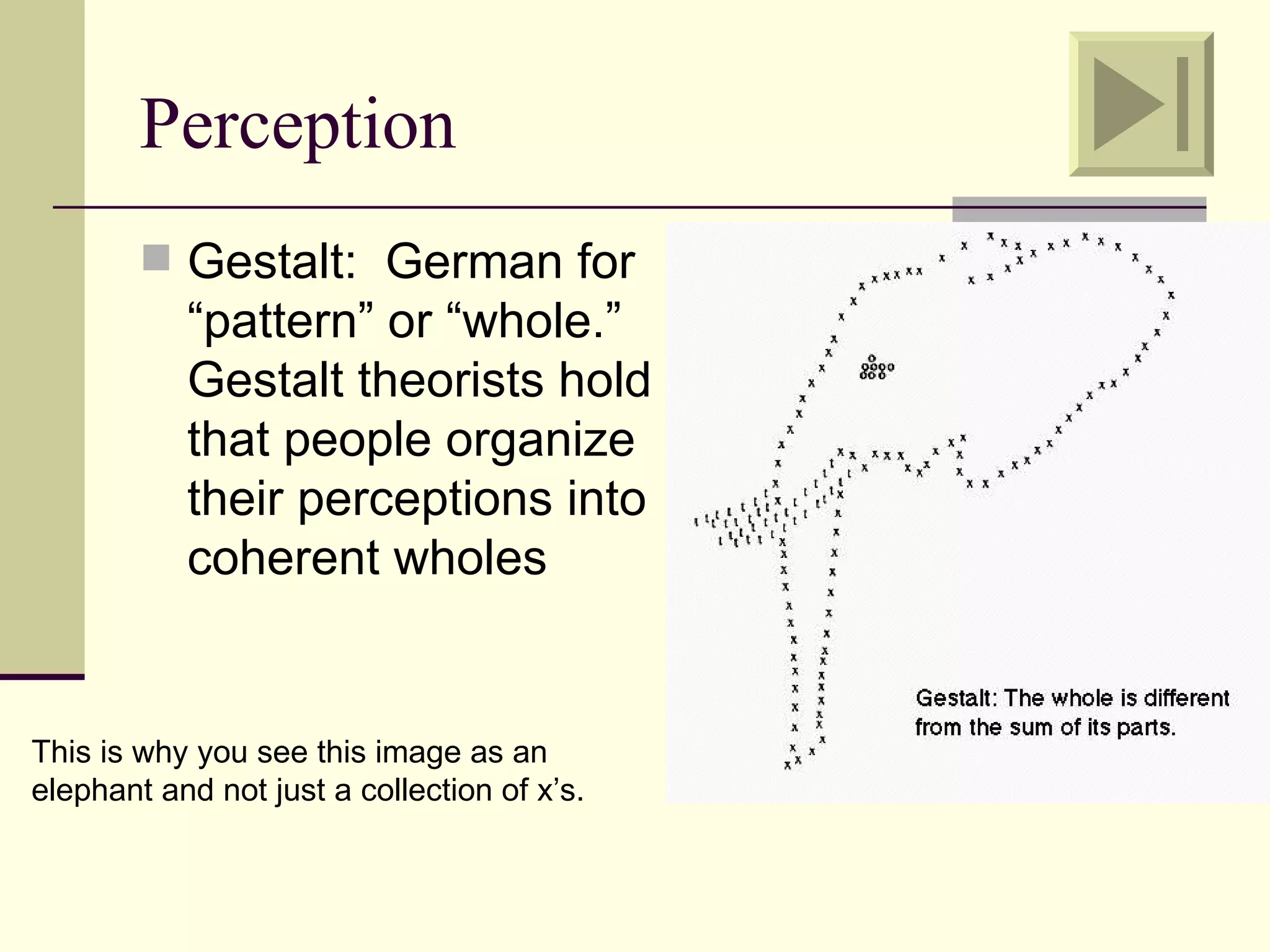
         Gestalt: German for
           “pattern” or “whole.”
           Gestalt theorists hold
           that people organize
           their perceptions into
           coherent wholes


This is why you see this image as an
elephant and not just a collection of x’s.
Prototype: a best example or best representative

Perception                   of a category.


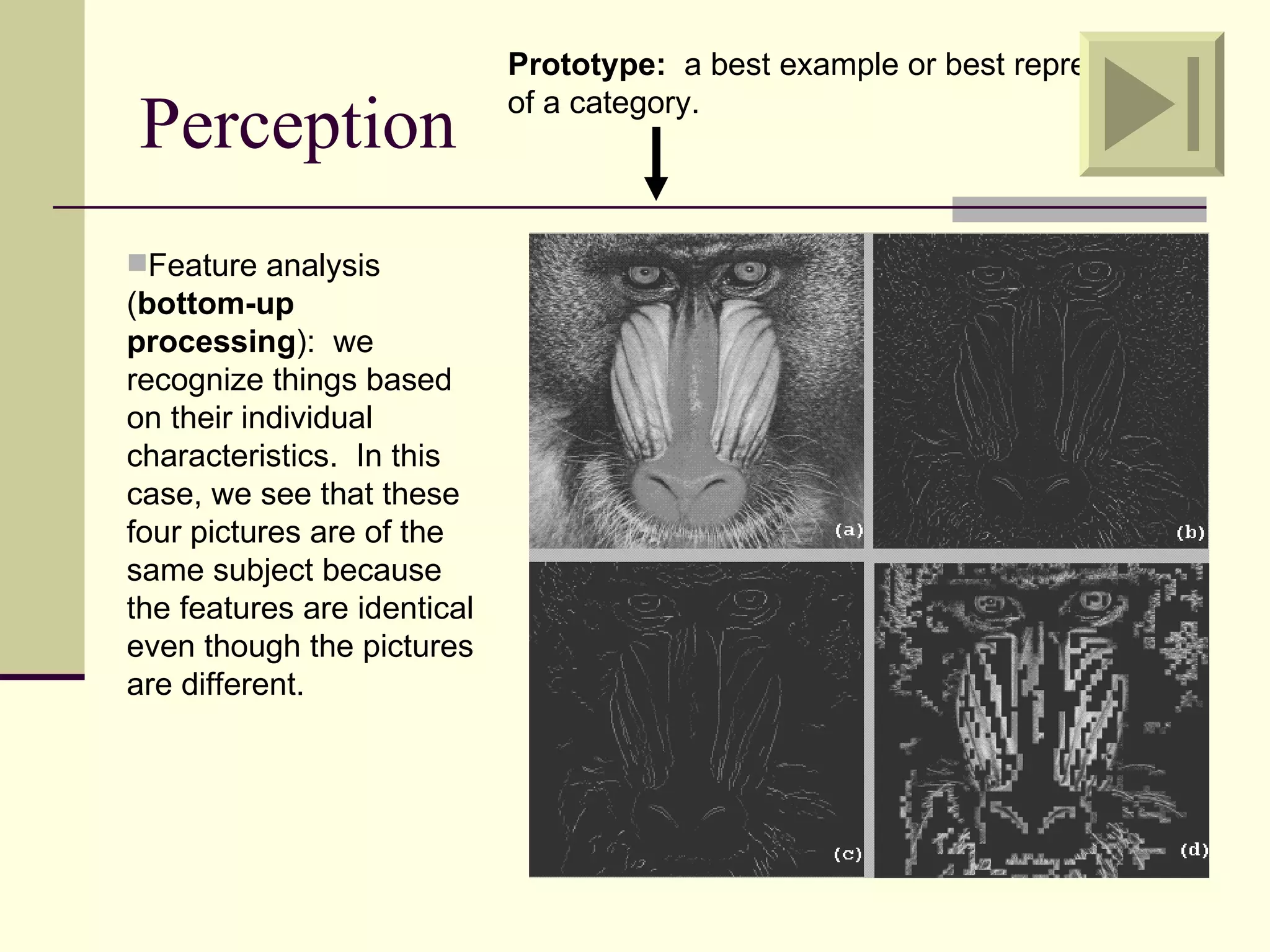
Feature analysis
(bottom-up
processing): we
recognize things based
on their individual
characteristics. In this
case, we see that these
four pictures are of the
same subject because
the features are identical
even though the pictures
are different.
Perception

   Top-down
   processing:
   perceiving based on
   the content and the
   patterns you expect
   to occur in that
   situation.

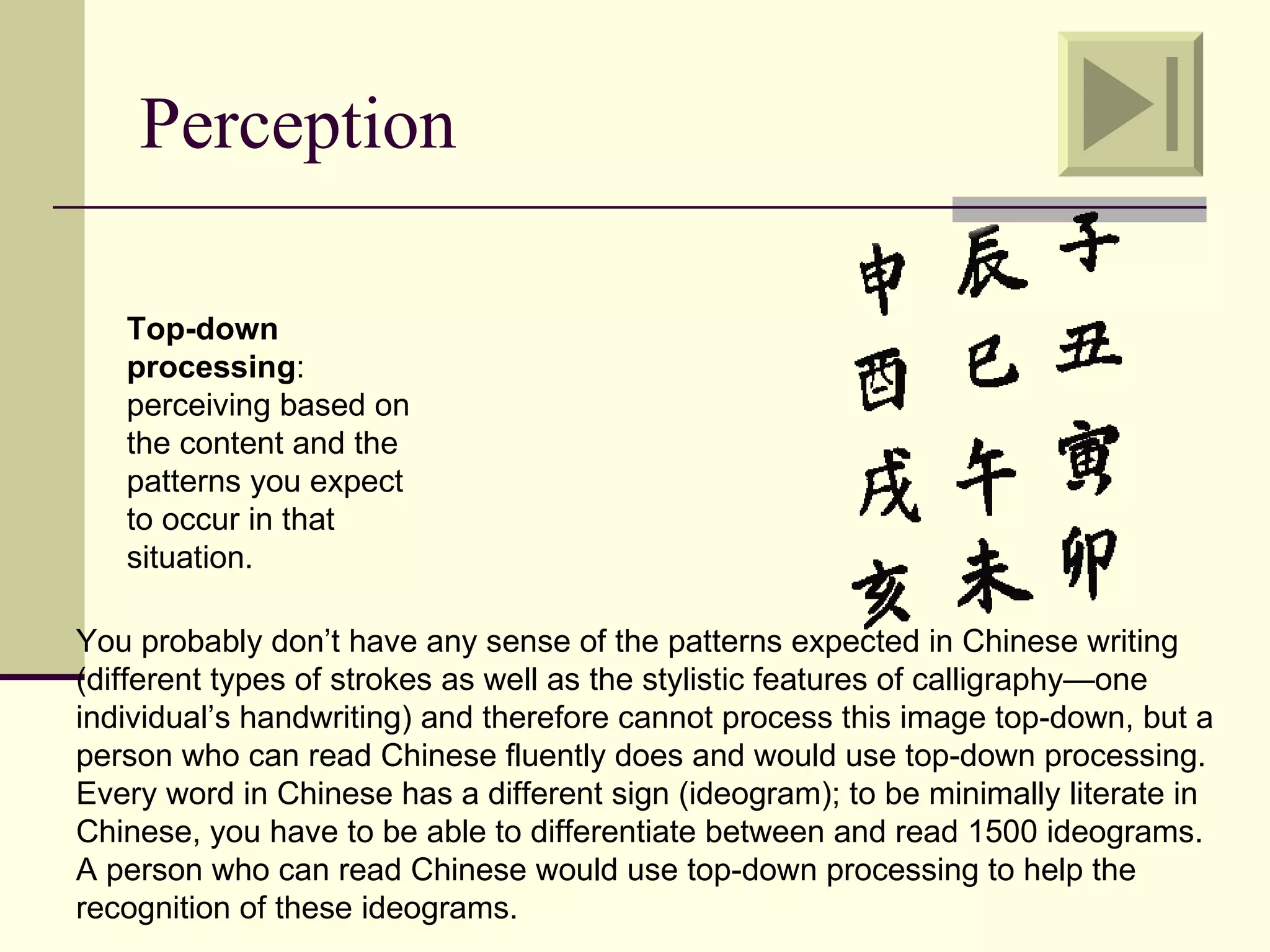
You probably don’t have any sense of the patterns expected in Chinese writing
(different types of strokes as well as the stylistic features of calligraphy—one
individual’s handwriting) and therefore cannot process this image top-down, but a
person who can read Chinese fluently does and would use top-down processing.
Every word in Chinese has a different sign (ideogram); to be minimally literate in
Chinese, you have to be able to differentiate between and read 1500 ideograms.
A person who can read Chinese would use top-down processing to help the
recognition of these ideograms.
Perception
 Attention: focus on a stimulus.
 If you don’t pay attention to something, you
  will not perceive it.


                          This is why editing your own writing is so
                          difficult—Gestalt theory says that you will
                          see the whole even if the whole is not
                          really there. You’ll miss the missing words
                          and therefore not pay attention to what is
                          really on the page.
Perception
 Automaticity: the ability to perform thoroughly
  learned tasks without much mental effort
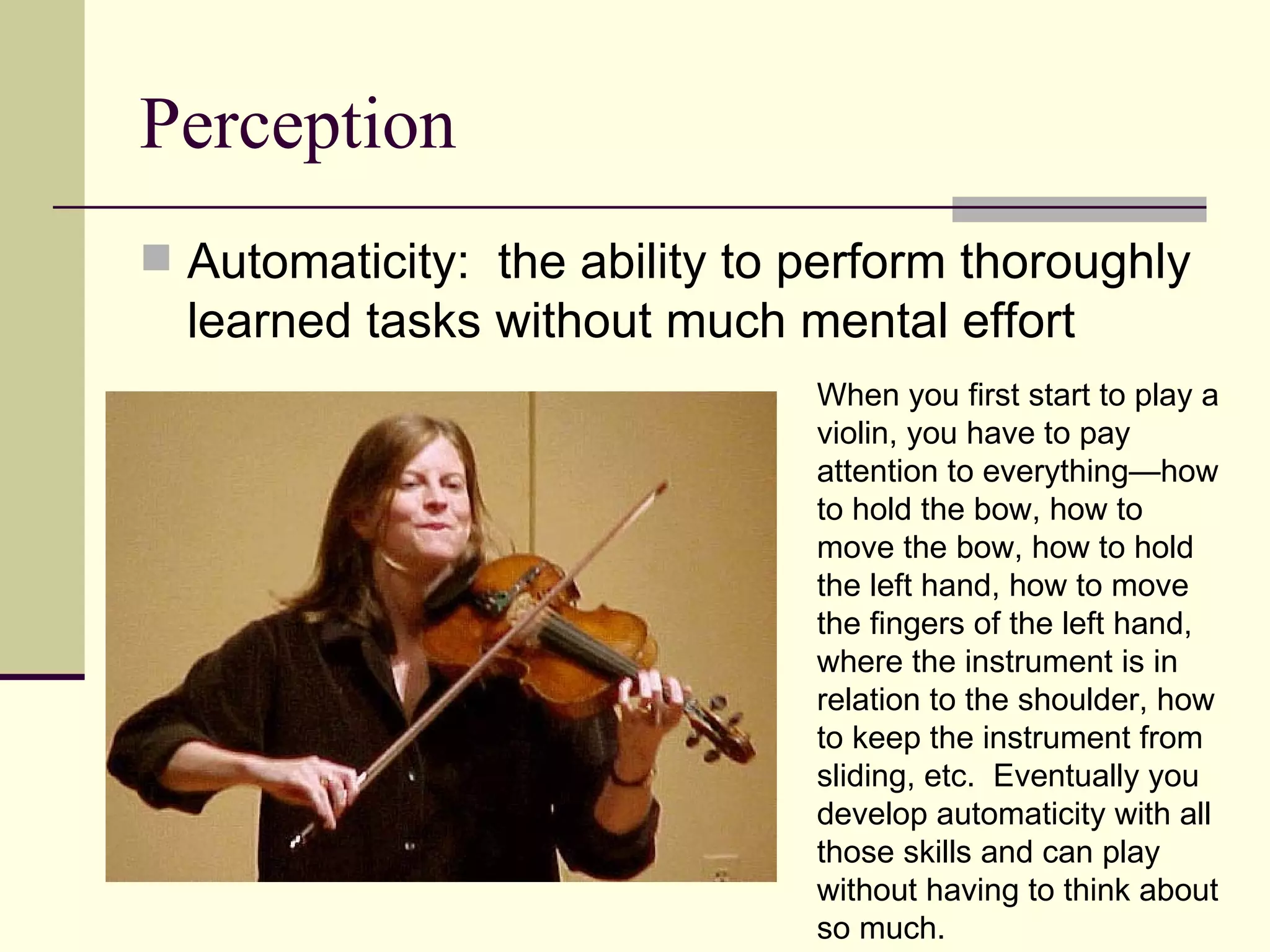
                               When you first start to play a
                               violin, you have to pay
                               attention to everything—how
                               to hold the bow, how to
                               move the bow, how to hold
                               the left hand, how to move
                               the fingers of the left hand,
                               where the instrument is in
                               relation to the shoulder, how
                               to keep the instrument from
                               sliding, etc. Eventually you
                               develop automaticity with all
                               those skills and can play
                               without having to think about
                               so much.
Working memory is the store that holds information as a person processes it. It
      is conscious and deliberate.

        Working Memory


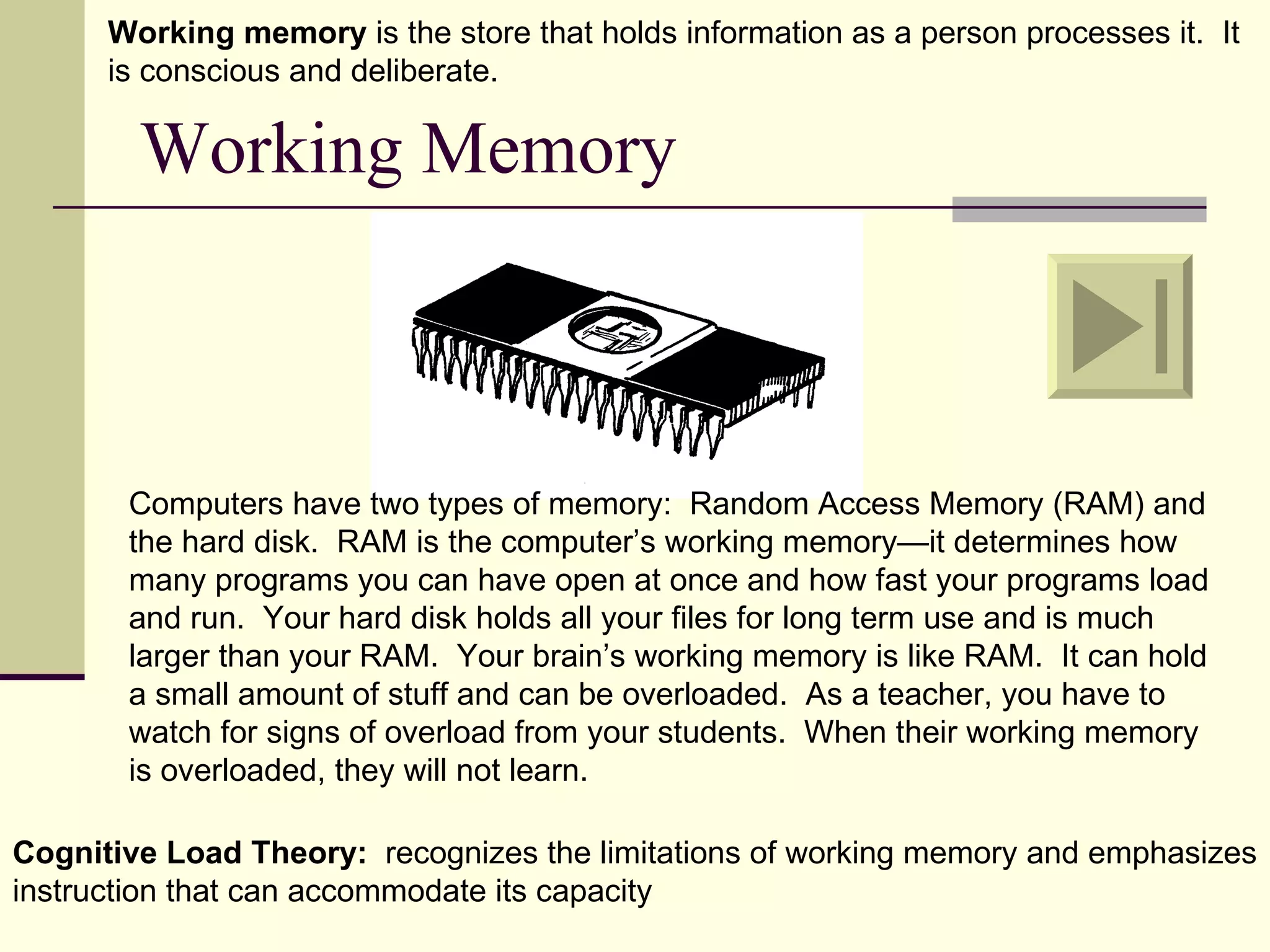
       Computers have two types of memory: Random Access Memory (RAM) and
       the hard disk. RAM is the computer’s working memory—it determines how
       many programs you can have open at once and how fast your programs load
       and run. Your hard disk holds all your files for long term use and is much
       larger than your RAM. Your brain’s working memory is like RAM. It can hold
       a small amount of stuff and can be overloaded. As a teacher, you have to
       watch for signs of overload from your students. When their working memory
       is overloaded, they will not learn.

Cognitive Load Theory: recognizes the limitations of working memory and emphasizes
instruction that can accommodate its capacity
Short-term memory
 Component of memory system that holds
  information for about 20 seconds.
 Part of working memory.
Working memory: three parts
 Central executive: the part of working
  memory that is responsible for monitoring and
  directing attention and other mental
  resources.
 Phonological loop: part of working memory.
  A memory rehearsal system for verbal and
  sound information of about 1.5-2 seconds.
 Visuospatial sketchpad: part of working
  memory. A holding system for visual and
  spatial information.
  The working memory holds about 20 seconds’ worth of material.
Working memory: retaining
information
 Maintenance rehearsal: keeping information
  in working memory by repeating it to yourself.
 Elaborative rehearsal: keeping information in
  working memory by associating it with
  something else you already knew
 Chunking: grouping individual bits of
  information into meaningful larger units.
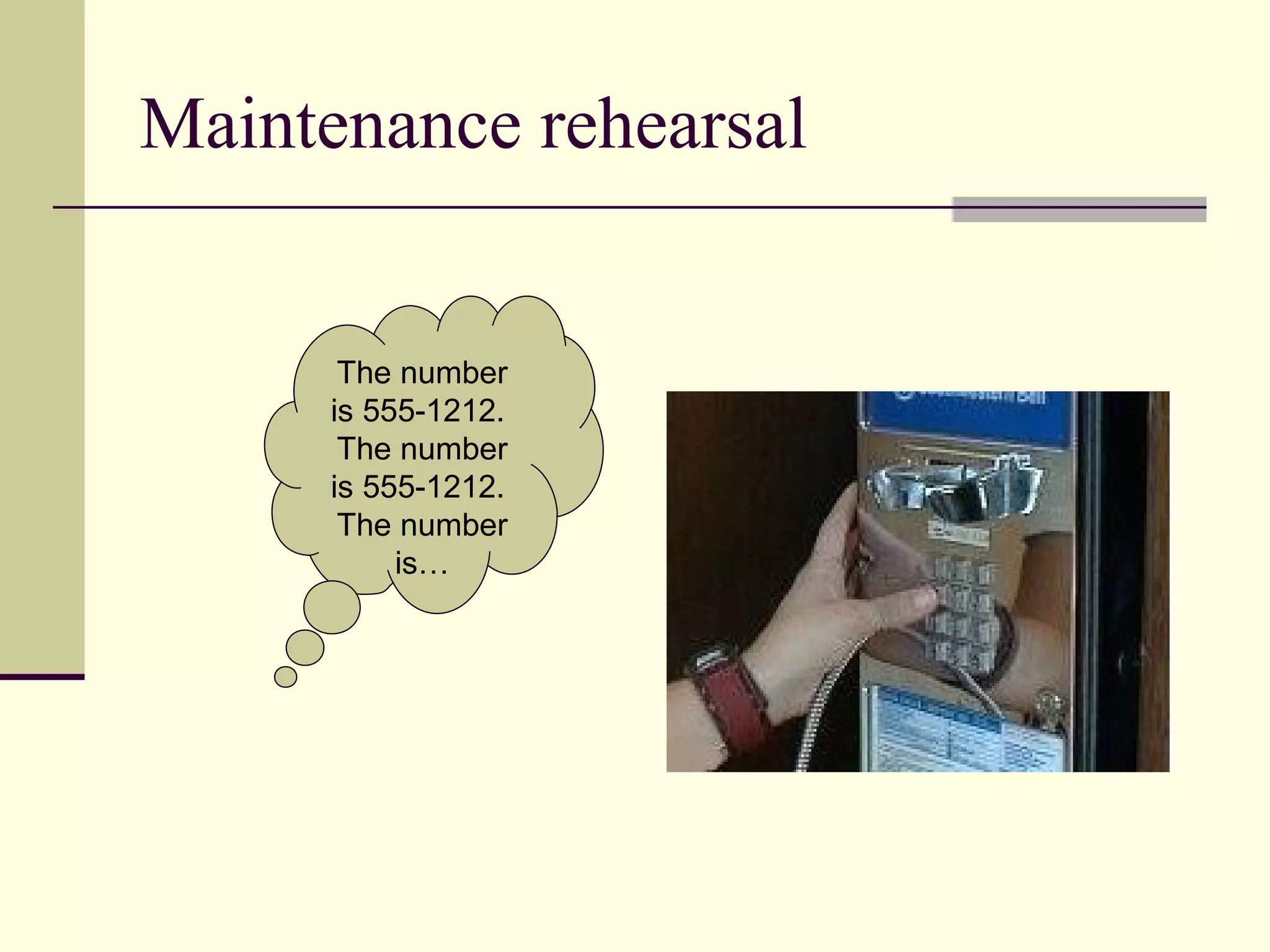
Maintenance rehearsal


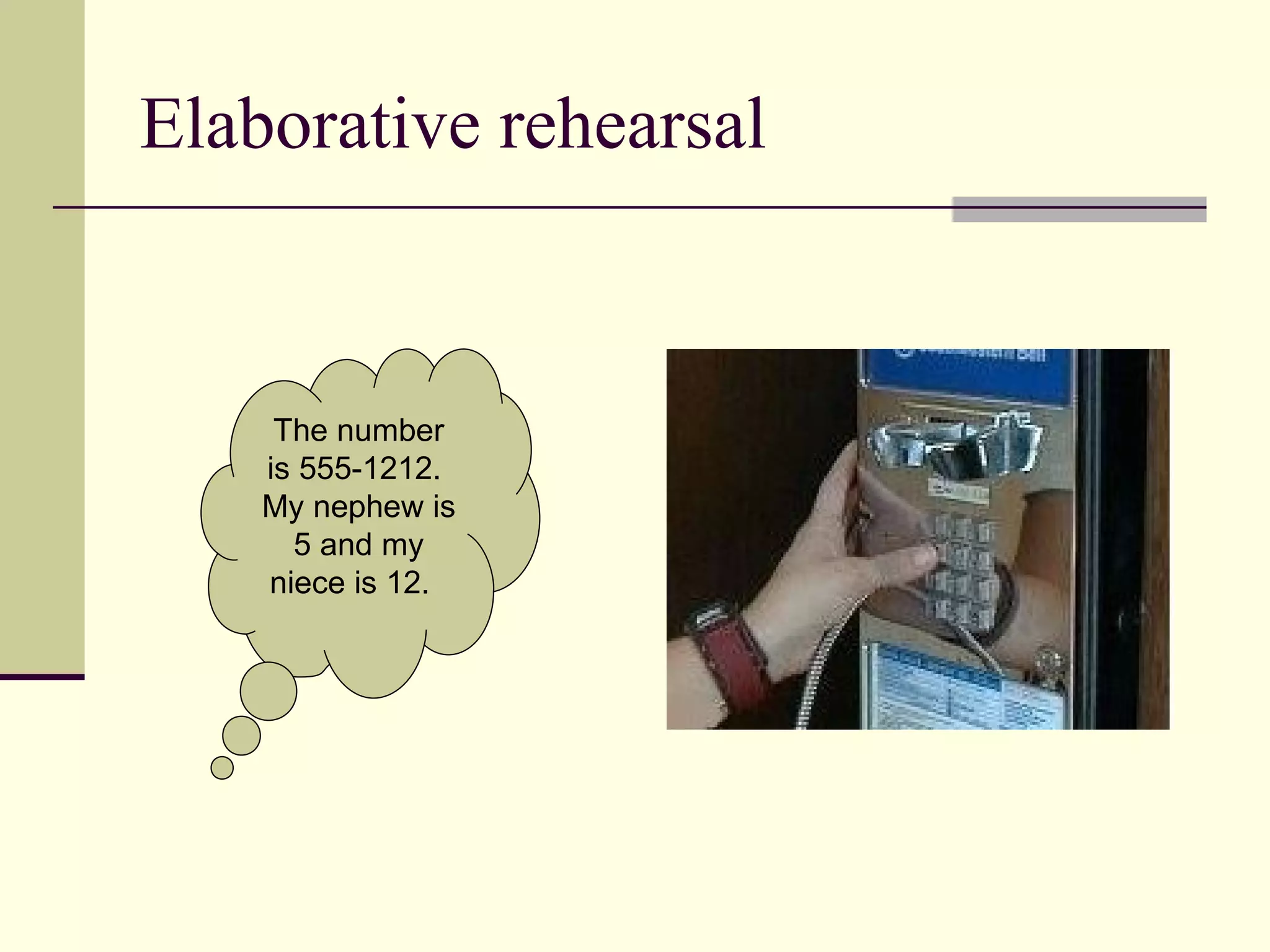
       The number
      is 555-1212.
       The number
      is 555-1212.
       The number
           is…
Elaborative rehearsal


     The number
    is 555-1212.
    My nephew is
      5 and my
    niece is 12.
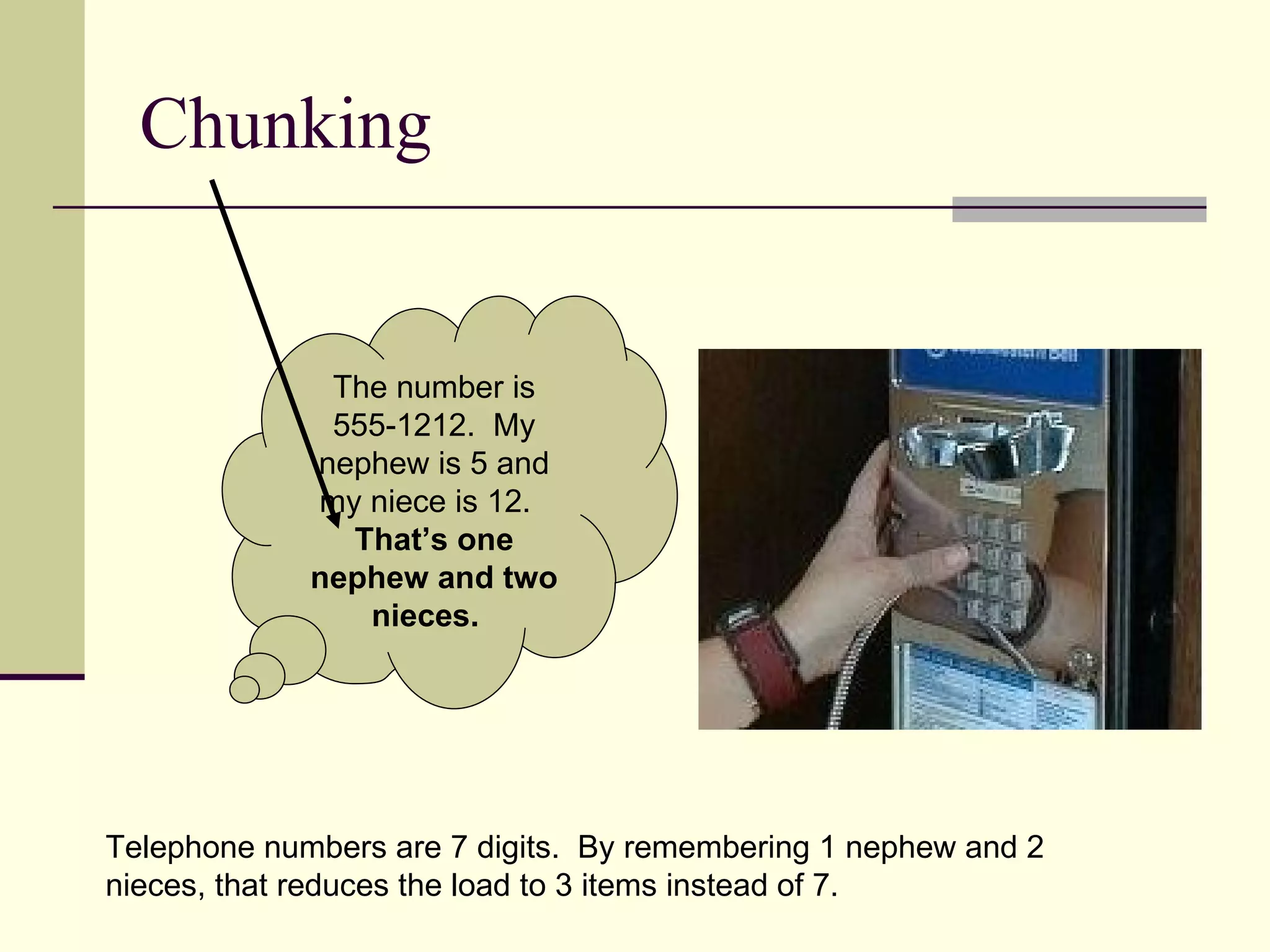
Chunking


              The number is
              555-1212. My
             nephew is 5 and
             my niece is 12.
               That’s one
             nephew and two
                nieces.


Telephone numbers are 7 digits. By remembering 1 nephew and 2
nieces, that reduces the load to 3 items instead of 7.
Forgetting
 We lose memory through interference
  (remembering other things) and through
  decay (the weakening and fading of
  memories with the passage of time).
Working memory in the classroom
 Tasks that are difficult require a lot of working memory,
  the way large programs on your computer use a lot of
  RAM.
 In school we often ask students to do two tasks at a
  time: to read AND to learn the material being read, to
  write AND to be able to represent knowledge through
  that writing. If a student is an able reader and writer, this
  is no problem. If a student struggles with any aspect of
  reading and writing, the other task (the learning or the
  representation of knowledge) will suffer because too
  much of the student’s working memory is being devoted
  to reading and writing.
 In this situation, if you want the student to learn, it is
  better to separate the tasks. Have the student listen to
  the text instead of reading or have the student dictate a
  text instead of writing.
Working memory: strategies for
 maximizing it
Chunking is the process of mentally combining separate items into larger, more
meaningful units.


Chunking:
When you send a file through the internet, you use a program that compresses
the information to a more manageable size. Your brain does this with
information in working memory by “chunking” or putting several bits of
information together so that only one total thing has to be remembered. In order
to do this, look for patterns. For instance, if you hear E, G, B, your mind should
chunk this into an e minor chord. If you hear seven digits, you can chunk them
into a group of three and a group of four, like a telephone number.
Working memory: strategies
 Automaticity: the use of mental operations
  that can be performed with little awareness or
  conscious effort.
 There are computer programs called
  “macros” which allow you to accomplish a
  task with fewer keystrokes. Your brain does
  this through practice: eventually a task takes
  little conscious effort.
 When you first drive a car, everything takes a
  huge amount of thinking. With practice, most
  driving procedures become automatic.
Working memory: strategies
 Dual processing: the way two parts, a visual and an
  auditory component, work together in working
  memory.
 Some computers can do two things at once. So can
  your brain. When information comes in two channels
  (e.g., your eyes, your ears, your fingers, etc.), your
  brain uses information from both sources to enhance
  working memory.
 This is why it is better to give students information in
  BOTH visual and auditory forms.
Long term working memory: holds the strategies for pulling
information from long-term memory into working memory.

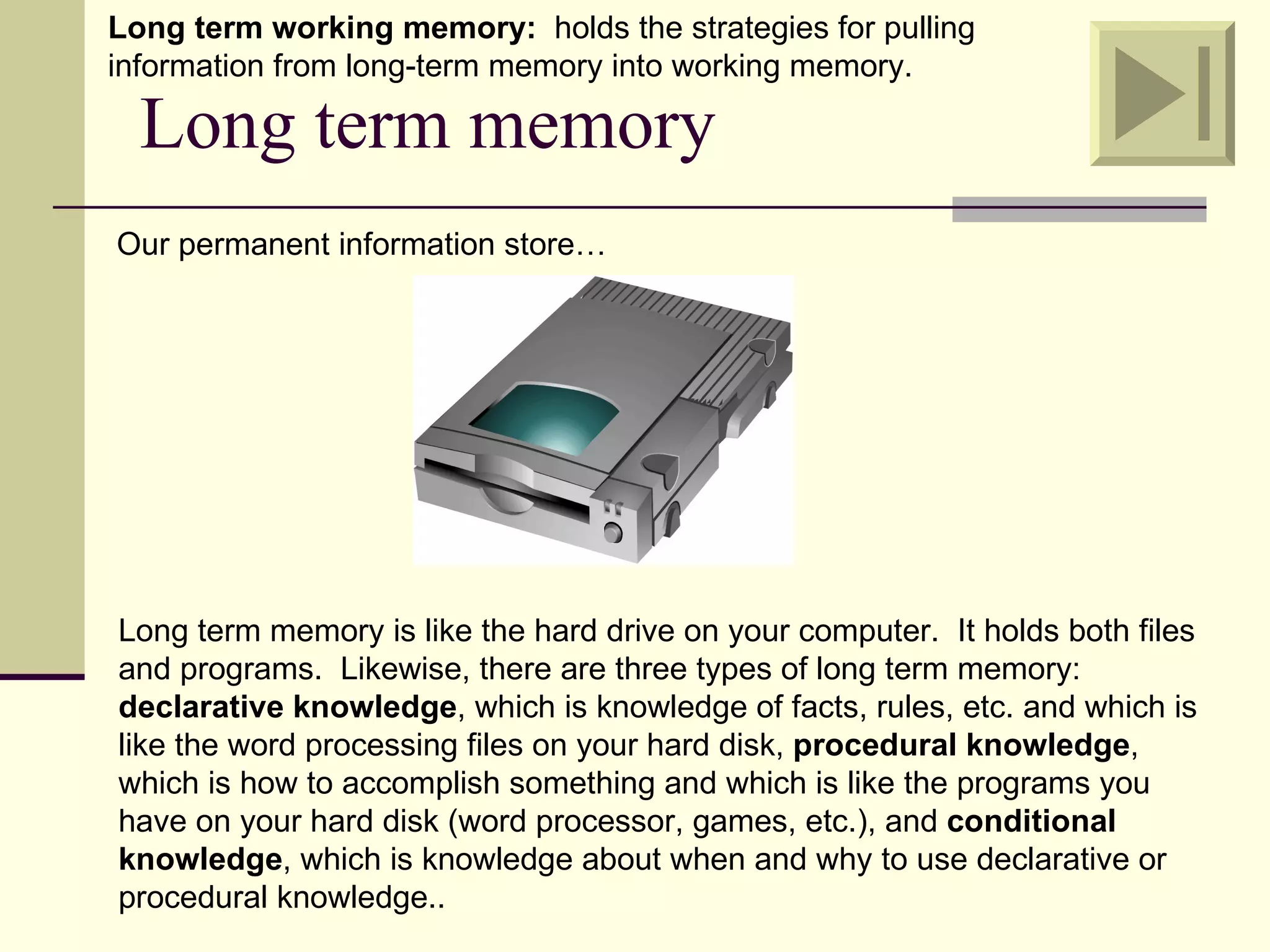
  Long term memory
Our permanent information store…


Long term memory is like the hard drive on your computer. It holds both files
and programs. Likewise, there are three types of long term memory:
declarative knowledge, which is knowledge of facts, rules, etc. and which is
like the word processing files on your hard disk, procedural knowledge,
which is how to accomplish something and which is like the programs you
have on your hard disk (word processor, games, etc.), and conditional
knowledge, which is knowledge about when and why to use declarative or
procedural knowledge..
In other words…
 Our long term memory has information on
  stuff, how to do stuff, and under which
  conditions we are going to use which type of
  knowledge.

 Isn’t this amazing????
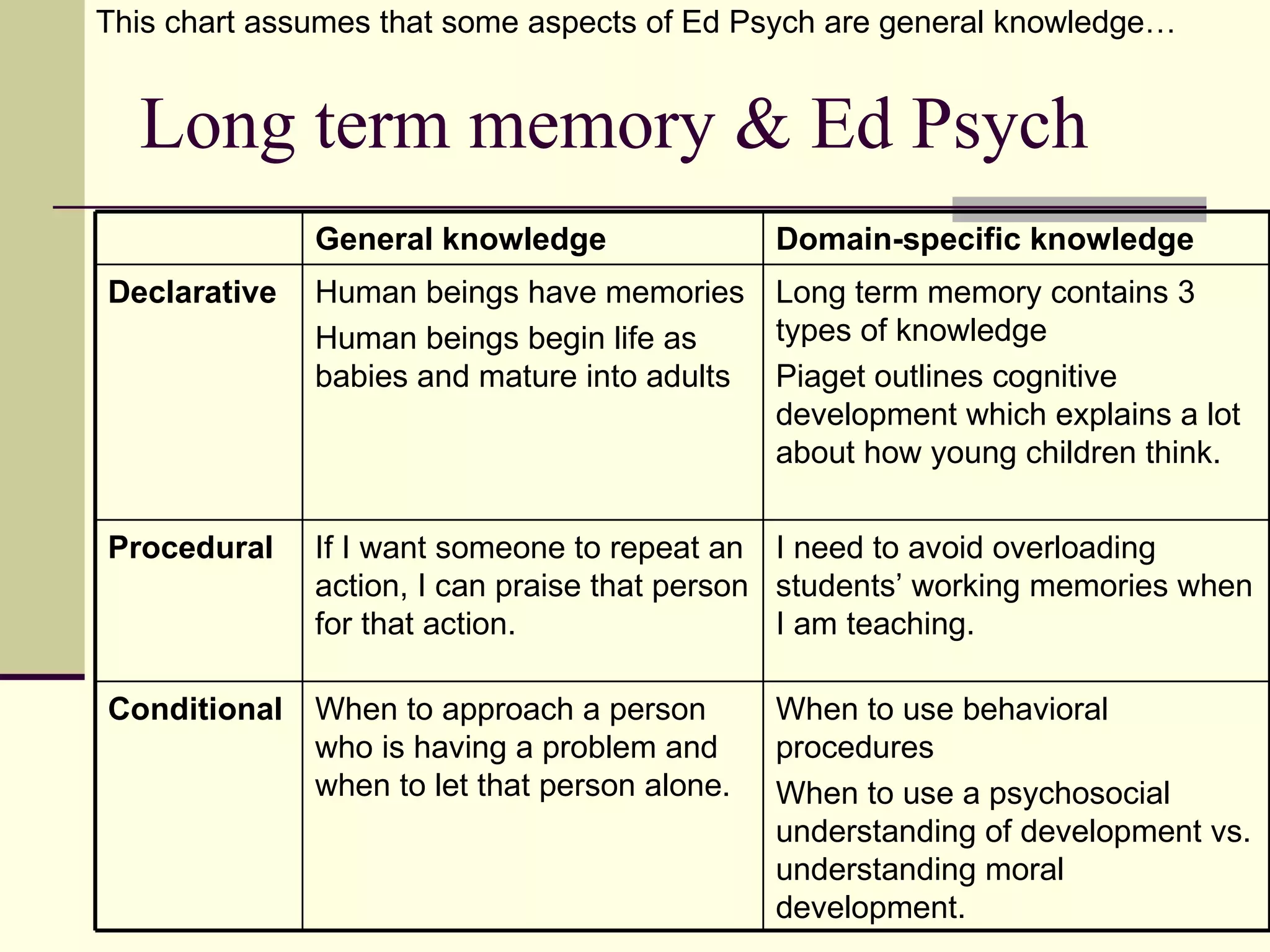
This chart assumes that some aspects of Ed Psych are general knowledge…


  Long term memory & Ed Psych
              General knowledge                Domain-specific knowledge
Declarative   Human beings have memories Long term memory contains 3
              Human beings begin life as    types of knowledge
              babies and mature into adults Piaget outlines cognitive
                                            development which explains a lot
                                            about how young children think.


Procedural    If I want someone to repeat an I need to avoid overloading
              action, I can praise that person students’ working memories when
              for that action.                 I am teaching.

Conditional   When to approach a person        When to use behavioral
              who is having a problem and      procedures
              when to let that person alone.   When to use a psychosocial
                                               understanding of development vs.
                                               understanding moral
                                               development.
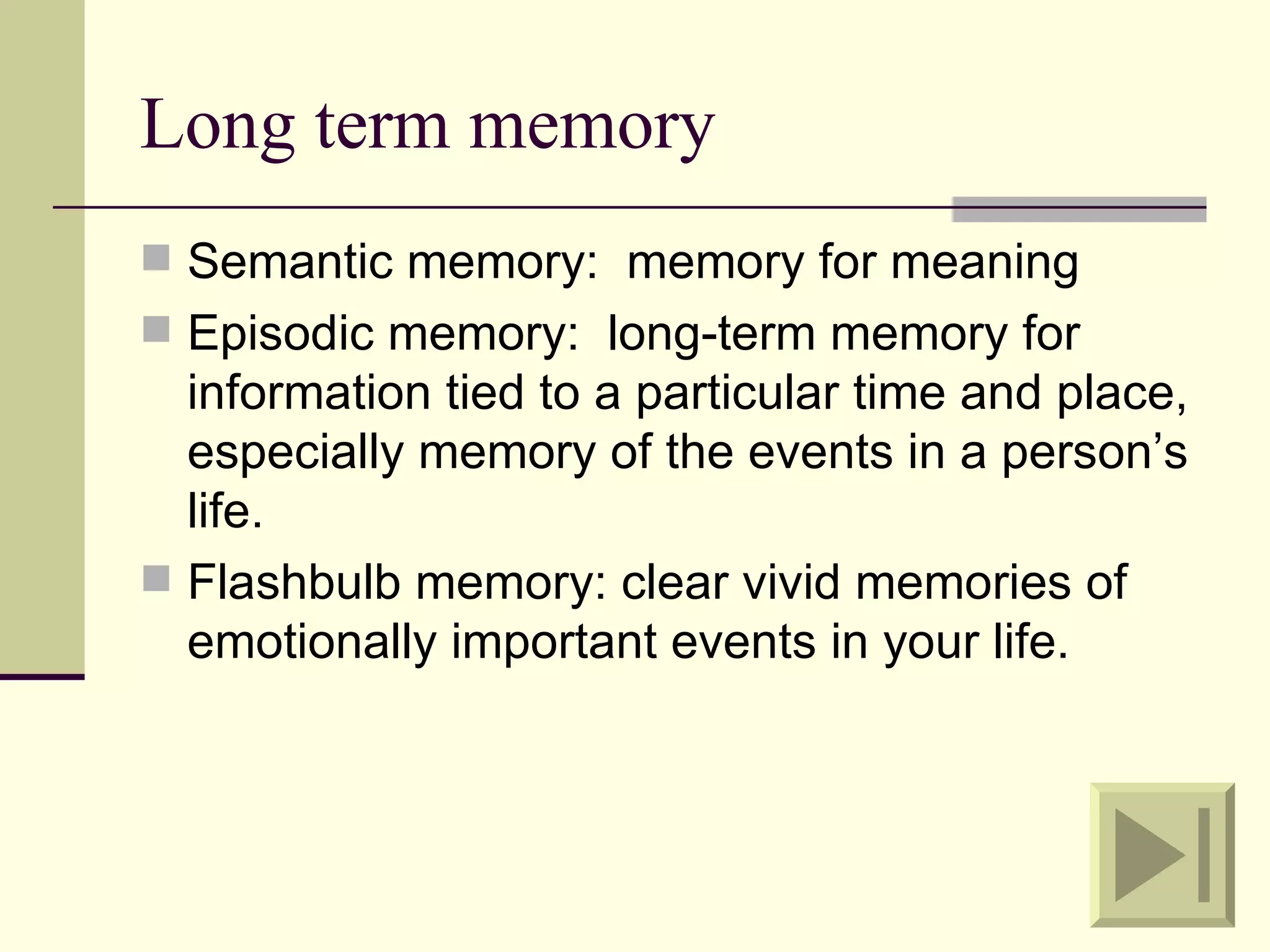
Knowledge that is both verbal and visual is easiest to learn, hence these power
   points.

      Long term memory: contents


          Words…                      and               Images

Explicit memory: long-term memories that involve deliberate or conscious recall.
Implicit memory: knowledge that we are not conscious of recalling but influences
our behavior or thought without our awareness.
Long term memory
 Semantic memory: memory for meaning
 Episodic memory: long-term memory for
  information tied to a particular time and place,
  especially memory of the events in a person’s
  life.
 Flashbulb memory: clear vivid memories of
  emotionally important events in your life.
Long term memory: semantic memory
Things can make meaning in several ways:
 Propositions and propositional networks
 Images
 Schemas
Propositions
 This is the smallest unit of factual meaning—
  that can be judged as true or false.
 Propositional network: set of interconnected
  concepts and relationships in which long-term
  knowledge is held.
Images
 Representations based on the physical
  attributes—the appearance—of information.
Schema              Organized networks of information.


On the computer, you organize your data in files. You might have a folder for
each class you are taking with word processing documents for those classes
inside. Your brain organizes declarative knowledge by schema. You have
schema for everything you do, from driving a car to reading for college, from
playing a musical instrument to eating with a fork vs. eating with chopsticks.
The material in Piaget in Chapter Two mentions “schemes” which are
understandings of the world. They are altered when the child encounters
something that doesn’t fit within the schemes (accommodation and
assimilation).

    Story grammar: schema representations for texts and stories.

         Scripts: schema representations for events.
Schema


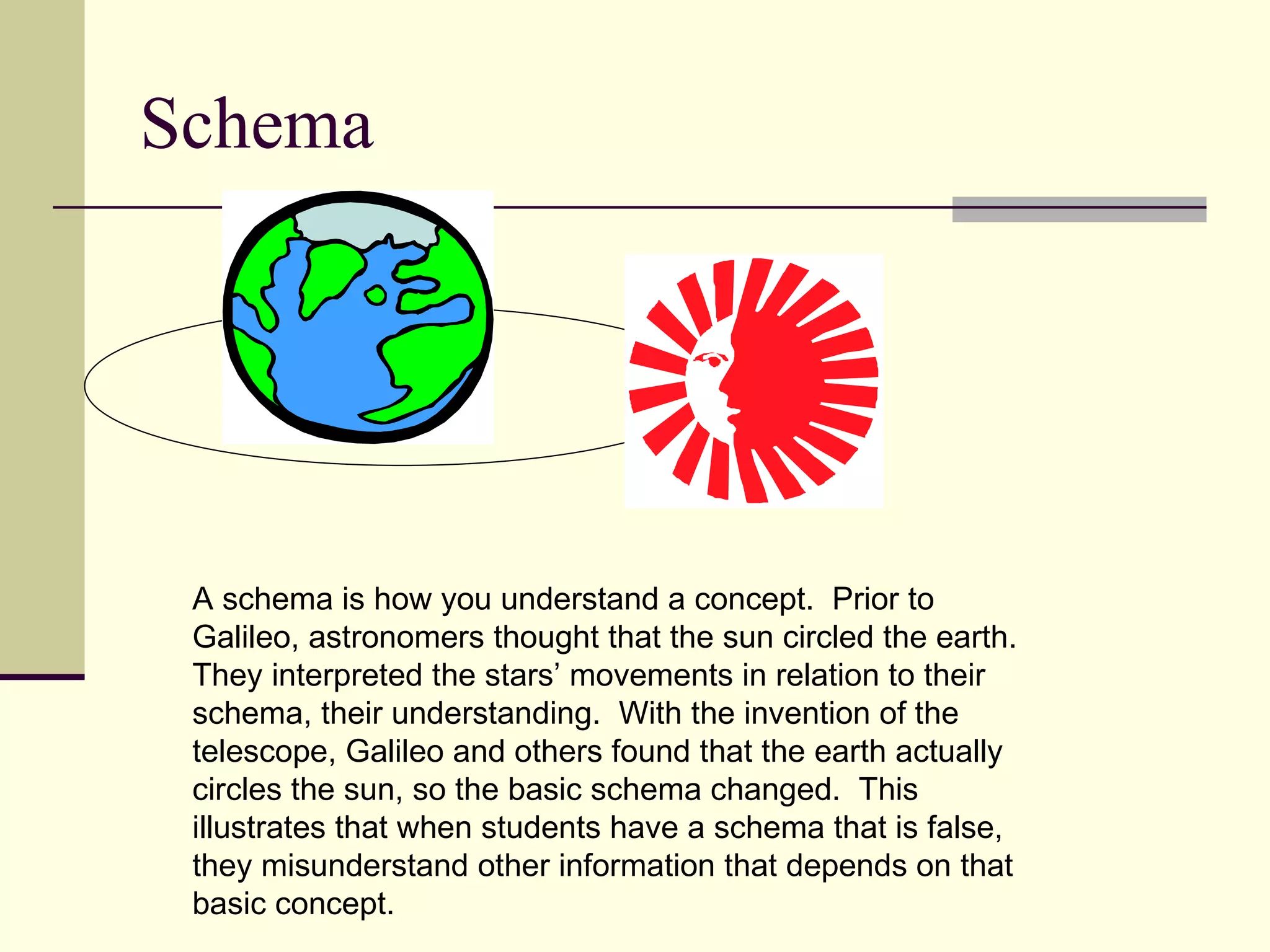
 A schema is how you understand a concept. Prior to
 Galileo, astronomers thought that the sun circled the earth.
 They interpreted the stars’ movements in relation to their
 schema, their understanding. With the invention of the
 telescope, Galileo and others found that the earth actually
 circles the sun, so the basic schema changed. This
 illustrates that when students have a schema that is false,
 they misunderstand other information that depends on that
 basic concept.
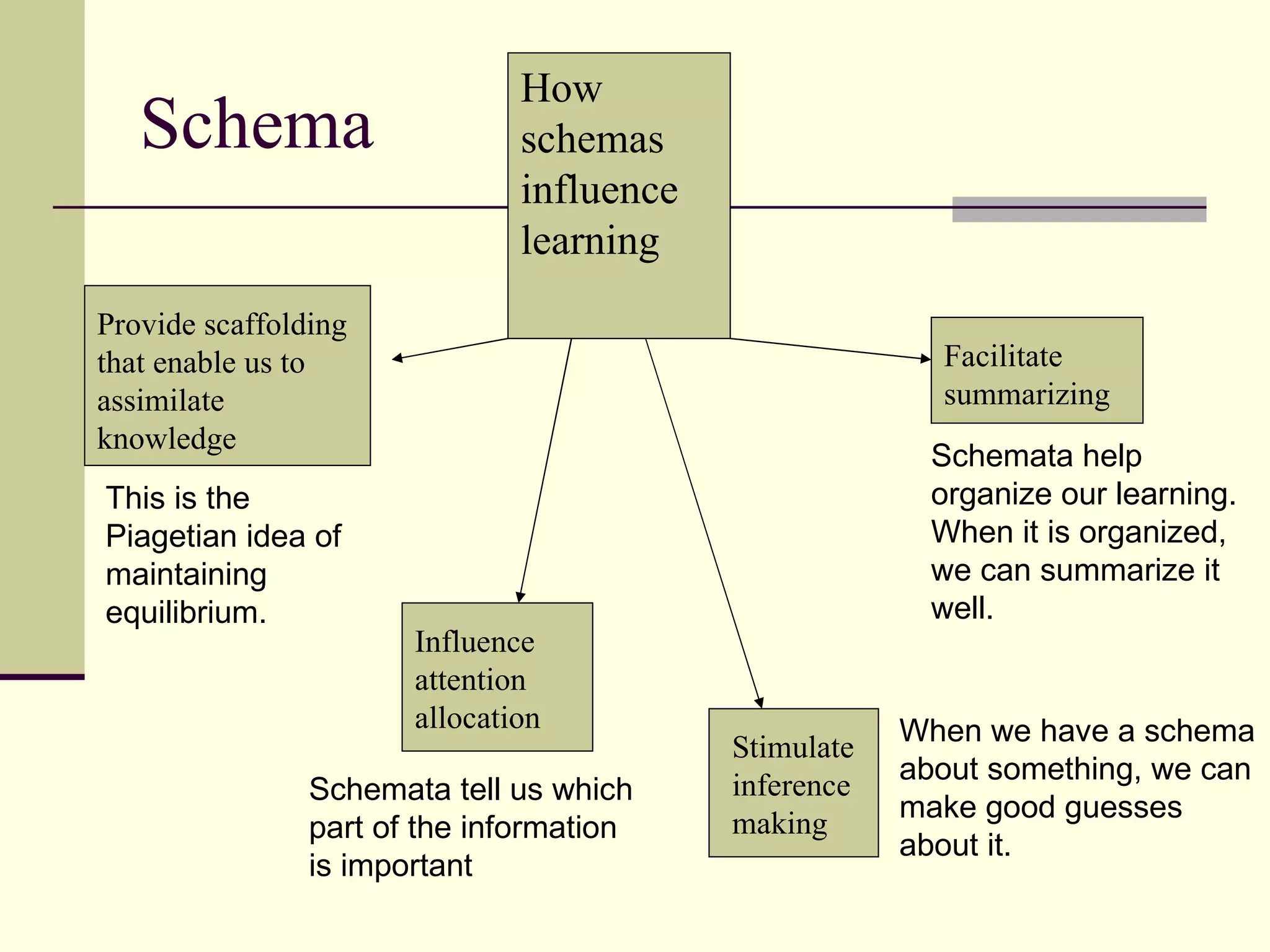
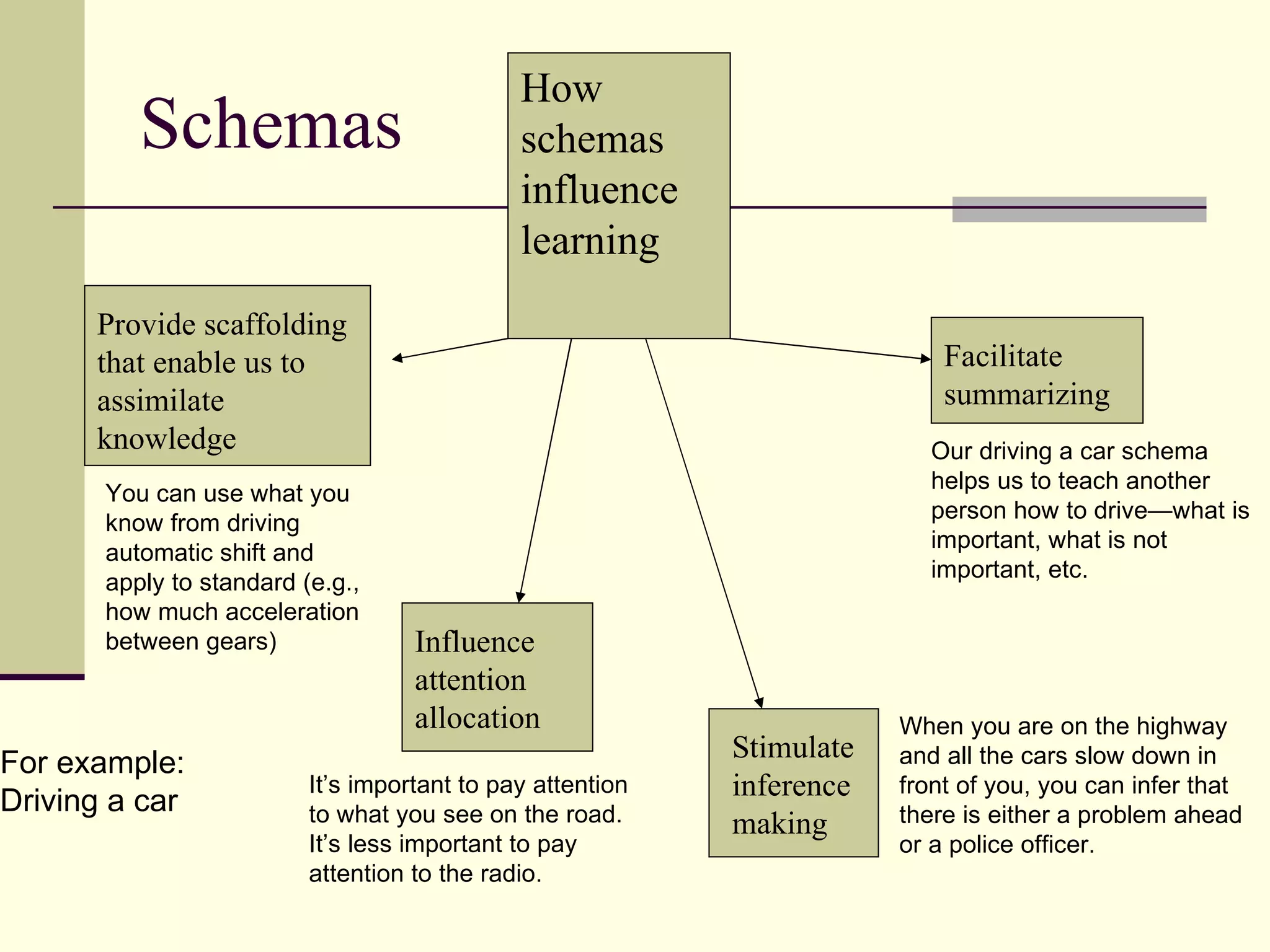
How
   Schema                      schemas
                               influence
                               learning
Provide scaffolding
that enable us to                                        Facilitate
assimilate                                               summarizing
knowledge
                                                         Schemata help
This is the                                              organize our learning.
Piagetian idea of                                        When it is organized,
maintaining                                              we can summarize it
equilibrium.                                             well.
                       Influence
                       attention
                       allocation                      When we have a schema
                                           Stimulate
                                                       about something, we can
                Schemata tell us which     inference
                                                       make good guesses
                part of the information    making
                                                       about it.
                is important
How
          Schemas                             schemas
                                              influence
                                              learning
      Provide scaffolding
      that enable us to                                                     Facilitate
      assimilate                                                            summarizing
      knowledge                                                           Our driving a car schema
                                                                          helps us to teach another
       You can use what you
                                                                          person how to drive—what is
       know from driving
                                                                          important, what is not
       automatic shift and
                                                                          important, etc.
       apply to standard (e.g.,
       how much acceleration
       between gears)               Influence
                                    attention
                                    allocation                          When you are on the highway
For example:                                                Stimulate   and all the cars slow down in
Driving a car
                          It’s important to pay attention   inference   front of you, you can infer that
                          to what you see on the road.      making      there is either a problem ahead
                          It’s less important to pay                    or a police officer.
                          attention to the radio.
Schemas
 Not only do you need to know what your
  students’ schemas are, but you also need to
  show how the new concept you are teaching
  fits into knowledge (schemas) students
  already have. Behaviorism taught us to teach
  in parts and later put them into wholes. But
  students need to have a sense of the whole
  (schema) so they can make sense of the part
  that you are teaching.
Episodic memory
 Long-term memory of information tied to a
  particular time and place, especially memory
  of the events in a person’s life.
Flashbulb memory


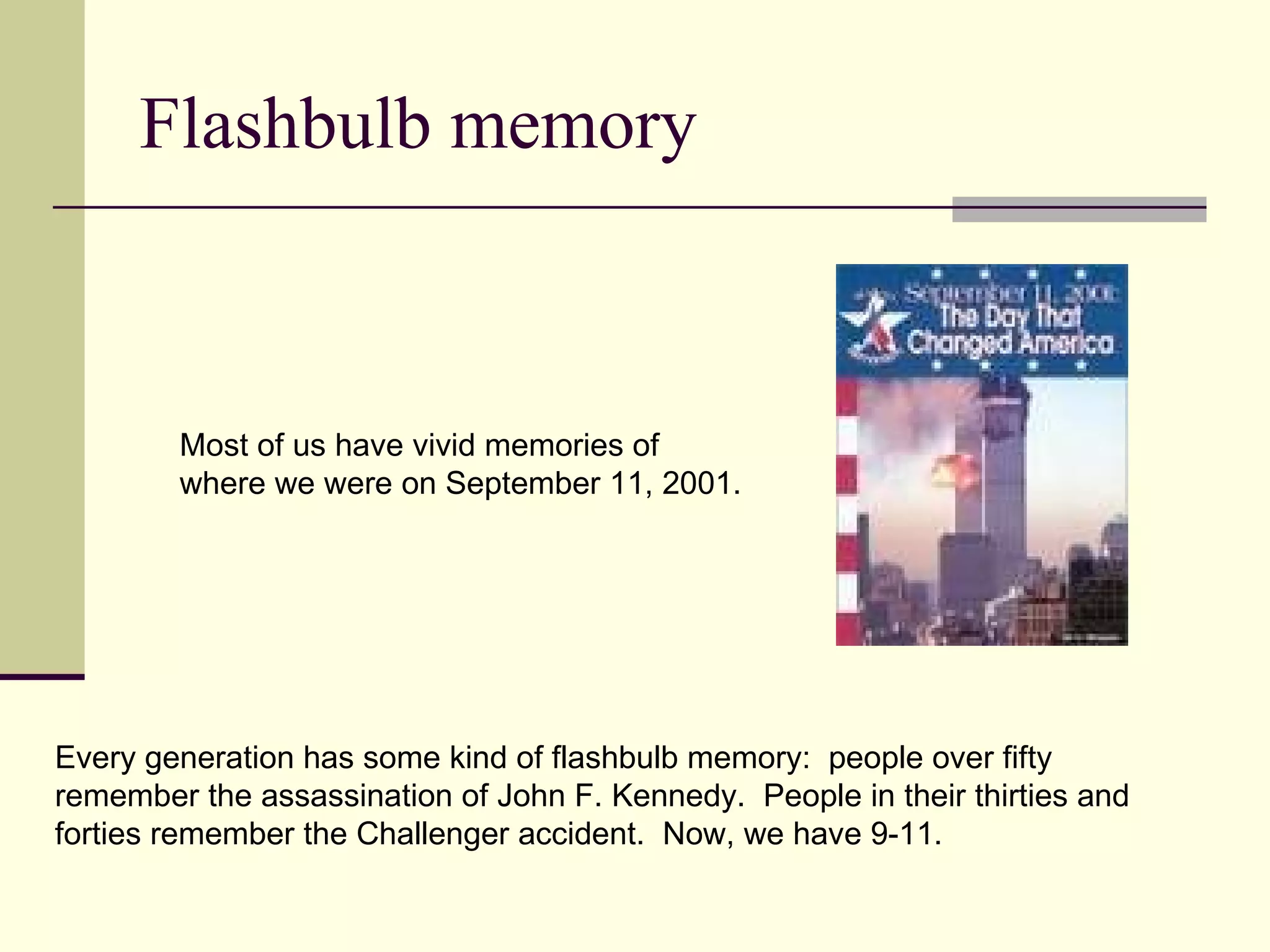
        Most of us have vivid memories of
        where we were on September 11, 2001.


Every generation has some kind of flashbulb memory: people over fifty
remember the assassination of John F. Kennedy. People in their thirties and
forties remember the Challenger accident. Now, we have 9-11.
This is stuff in long-term memory that you may not be aware of.


  Implicit memories
   Classical conditioning—the association of a strong
    feeling with something because of experience. Part
    of long term memory.
   Procedural memory—long term memory for how to
    do things.
   Productions—the contents of procedural memory;
    rules about what actions to take, given certain
    conditions.
   Priming effects—activating a concept in memory or
    the spread of activation from one concept to another.
Storing and retrieving information in
long-term memory
 Elaboration
 Organization
 Context
Elaboration
 Adding and extending meaning by connecting new
  information to existing knowledge.
  How easy would it be to memorize the following concepts without some kind
  of elaboration? (and yet, how often do we ask students to learn something
  with no connection to what they already know?)

 Synecdoche is a type of metaphor in which the part stands for the whole,
 the whole for a part, the genus for the species, the species for the genus,
 the material for the thing made, or in short, any portion, section, or main
 quality for the whole or the thing itself (or vice versa).
 Eponym substitutes for a particular attribute the name of a famous person
 recognized for that attribute.
 Anaphora is the repetition of the same word or words at the beginning of
 successive phrases, clauses, or sentences, commonly in conjunction with
 climax and with parallelism
http://www.virtualsalt.com/rhetoric.htm
Organization
Ordered and logical network of relations.


In other words, it’s a lot easier to learn something that is presented in an
orderly, logical way than to try and learn something where facts seem to be
presented completely randomly.
Context

The physical or emotional backdrop associated with an event.


Years from now, as you remember Educational Psychology concepts, you
may find yourself remembering the room you were studying in or this
classroom.
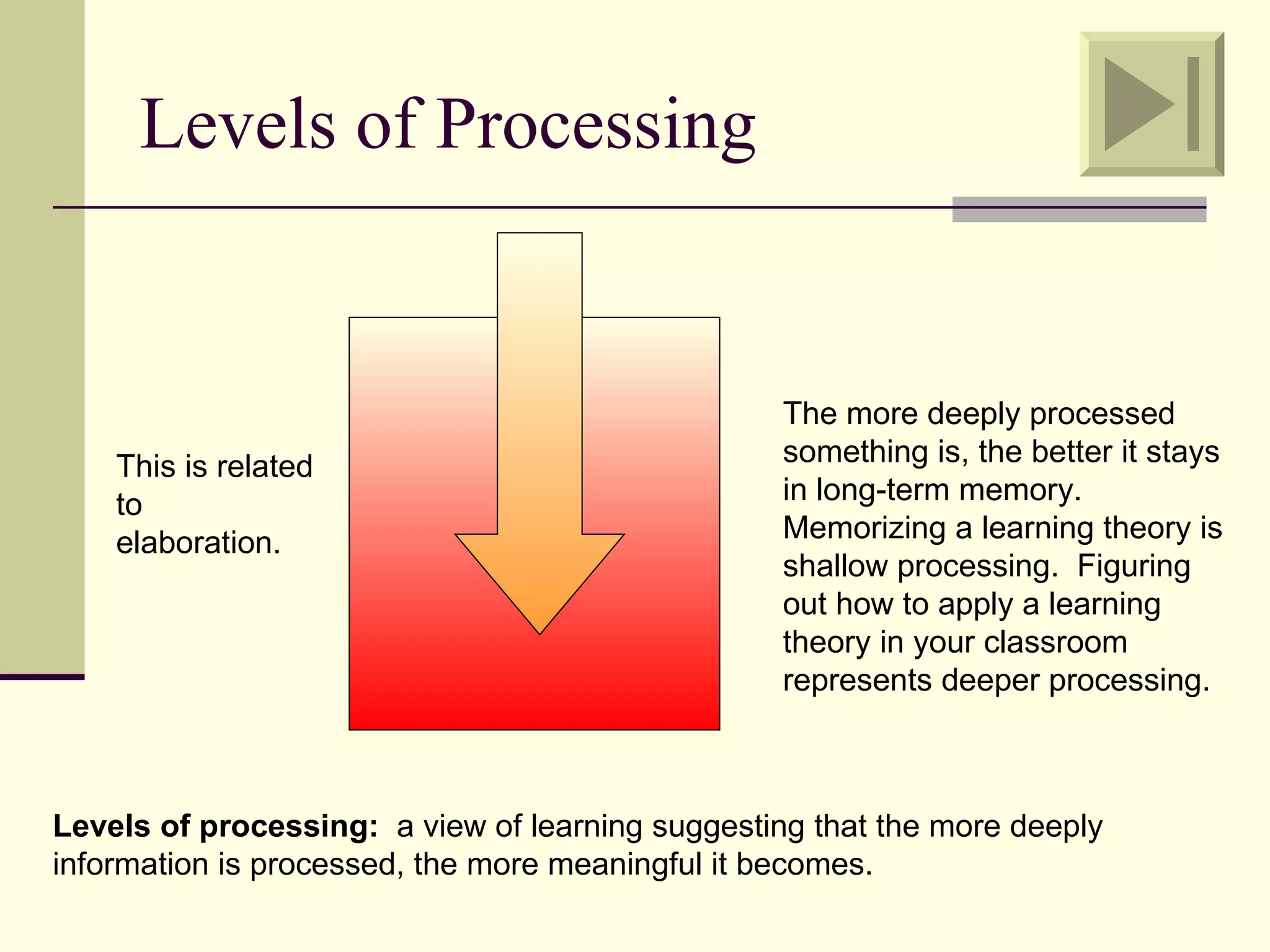
Levels of Processing


                                                  The more deeply processed
    This is related                               something is, the better it stays
    to                                            in long-term memory.
    elaboration.                                  Memorizing a learning theory is
                                                  shallow processing. Figuring
                                                  out how to apply a learning
                                                  theory in your classroom
                                                  represents deeper processing.


Levels of processing: a view of learning suggesting that the more deeply
information is processed, the more meaningful it becomes.
Retrieving information
 Have you ever used the search function on
  your computer to try to find a file you know is
  SOMEWHERE?
 Retrieving information from your long term
  memory involves a similar search…


 Retrieval: process of searching for and
  finding information in long-term memory.
Spreading activation
 Retrieval of pieces of information based on
  their relatedness to one another.
  Remembering one bit of information activates
  (stimulates) recall of associated information.
 If you have ever figured out a second exam
  question from having answered a first exam
  question, then you have experienced this—
  working on one thing leads you to remember
  related information.
Reconstruction
 Recreating information by using memories,
  expectations, logic, and existing knowledge.
 Sometimes reconstructed memories are not
  accurate, as studies have shown.
 (However, this is also a good strategy for test-
  taking—seeing if you can reconstruct
  information you have forgotten, based on
  what you know and logic).
Forgetting
                      ???????


   The loss of, or inability to retrieve, information from memory.
Forgetting as Interference


The loss of information because something learned before or after detracts from
understanding—something interferes with remembering.
Retrieval—pulling information from long-term memory into working memory for
      further processing.

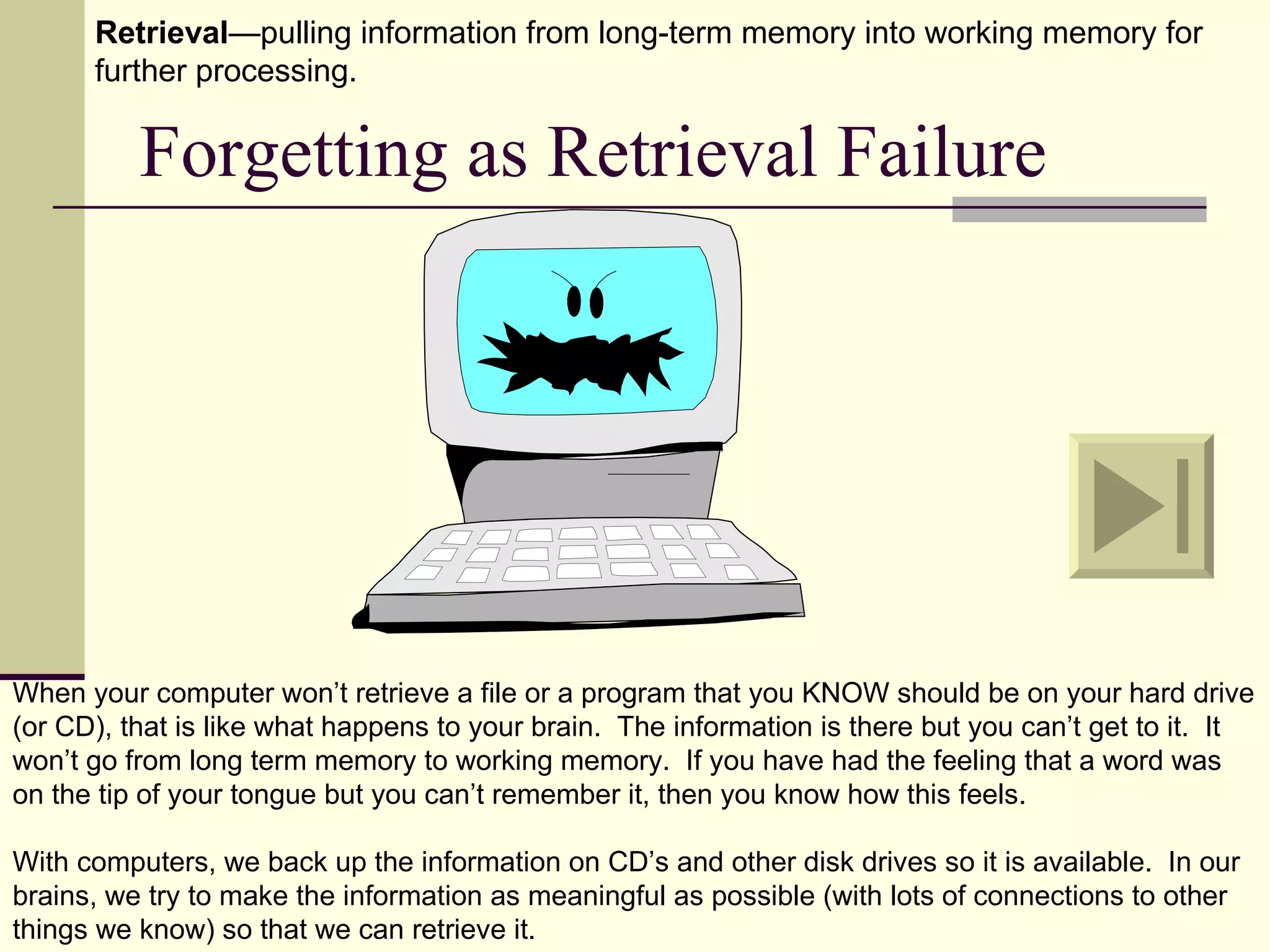
          Forgetting as Retrieval Failure


When your computer won’t retrieve a file or a program that you KNOW should be on your hard drive
(or CD), that is like what happens to your brain. The information is there but you can’t get to it. It
won’t go from long term memory to working memory. If you have had the feeling that a word was
on the tip of your tongue but you can’t remember it, then you know how this feels.

With computers, we back up the information on CD’s and other disk drives so it is available. In our
brains, we try to make the information as meaningful as possible (with lots of connections to other
things we know) so that we can retrieve it.
Developing procedural knowledge
 Declarative stage: students have knowledge
  ABOUT the procedure—they know what they
  are supposed to do but they don’t have
  experience.
 Associative stage: students can perform the
  task, but only with a lot of thinking about it.
 Automatic stage: students can perform the
  process without thinking about it.
Can you think of an example of your own learning in relation to this idea?

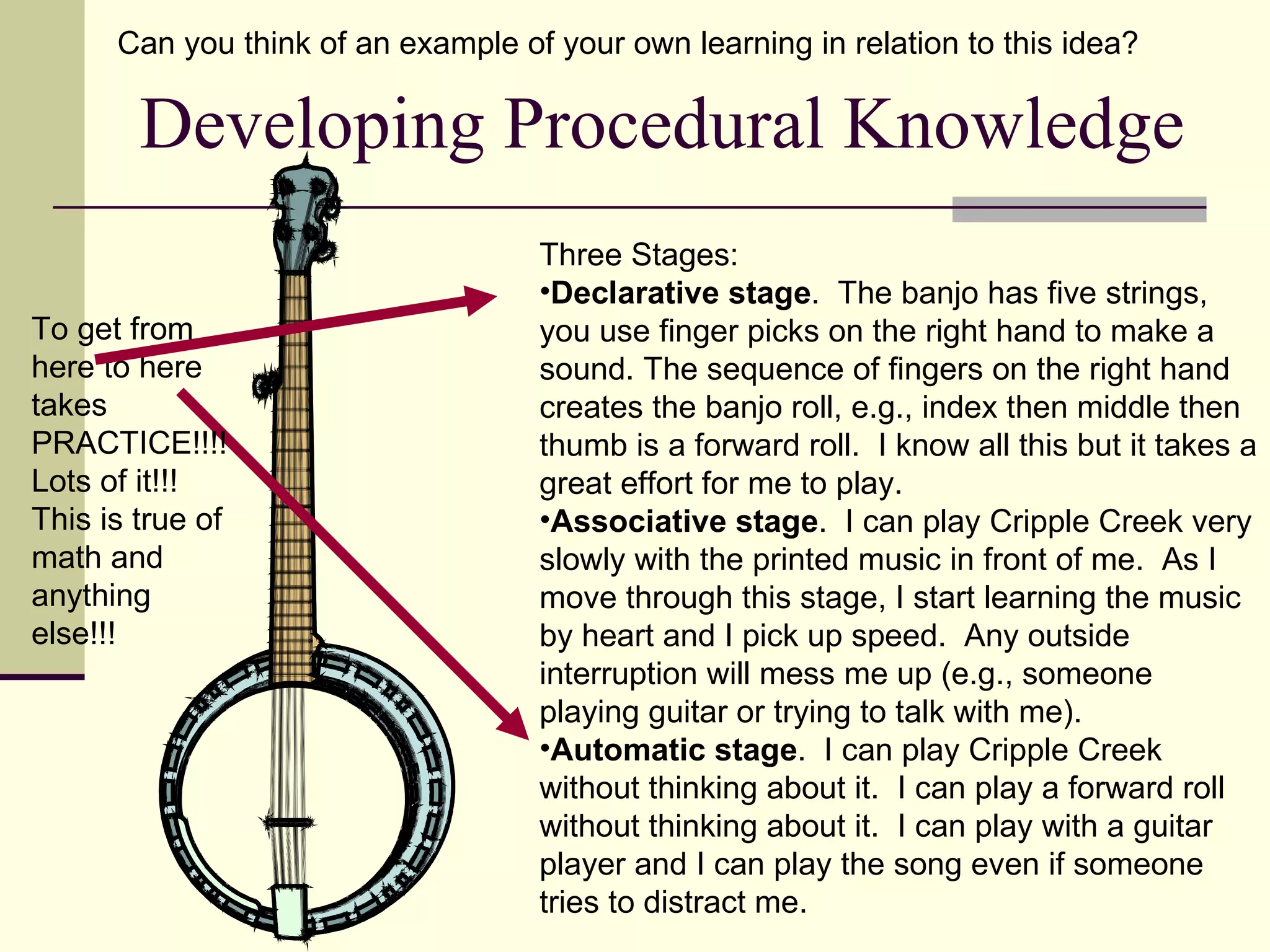
        Developing Procedural Knowledge
                                    Three Stages:
                                    •Declarative stage. The banjo has five strings,
To get from                         you use finger picks on the right hand to make a
here to here                        sound. The sequence of fingers on the right hand
takes                               creates the banjo roll, e.g., index then middle then
PRACTICE!!!!                        thumb is a forward roll. I know all this but it takes a
Lots of it!!!                       great effort for me to play.
This is true of                     •Associative stage. I can play Cripple Creek very
math and                            slowly with the printed music in front of me. As I
anything                            move through this stage, I start learning the music
else!!!                             by heart and I pick up speed. Any outside
                                    interruption will mess me up (e.g., someone
                                    playing guitar or trying to talk with me).
                                    •Automatic stage. I can play Cripple Creek
                                    without thinking about it. I can play a forward roll
                                    without thinking about it. I can play with a guitar
                                    player and I can play the song even if someone
                                    tries to distract me.
Implications
 You need to be aware of where your students are in
  the process of developing procedural knowledge. For
  example, in using the keyboard on a computer, you
  will have students in all three stages. For students in
  the declarative or associative stages, the keyboard
  takes a lot of thought to use, so they will not be as
  fluent in their writing. You can imagine that when a
  student is “hunting and pecking,” they are more likely
  to choose short words and sentences because the
  process of typing is so difficult. Students in the
  automatic stage will be able to use the keyboard with
  ease and it will not get in the way of them expressing
  themselves.
Implications
 Further, when you are teaching procedural
  knowledge, you need to create opportunities
  for students to practice their skills regularly.
  This might be time in class on a regular basis
  or it might be homework.
Cognitive Processes
   Attention
   Perception
   Rehearsal
   Encoding
   Retrieval


What do you think these processes might be? In other words, I’m asking you to
activate your schema about thinking prior to reading this part of the book.
Attention


                  The process of consciously focusing on a stimulus.


As a teacher, you will want your students to focus on what you are doing. If you are
boring, they won’t. The younger they are, the more annoying to you will be their
choice of activity when they are not focusing on you. Older students might doze or
whisper to each other. Younger students might get up and move around the room.
How to get their attention
     Demonstrations
     Discrepant events (surprises)
     Charts
     Pictures
     Problems
     Thought-provoking questions
     Emphasis
     Using their names


In your experience, what techniques have teachers used to get student attention?
Perception


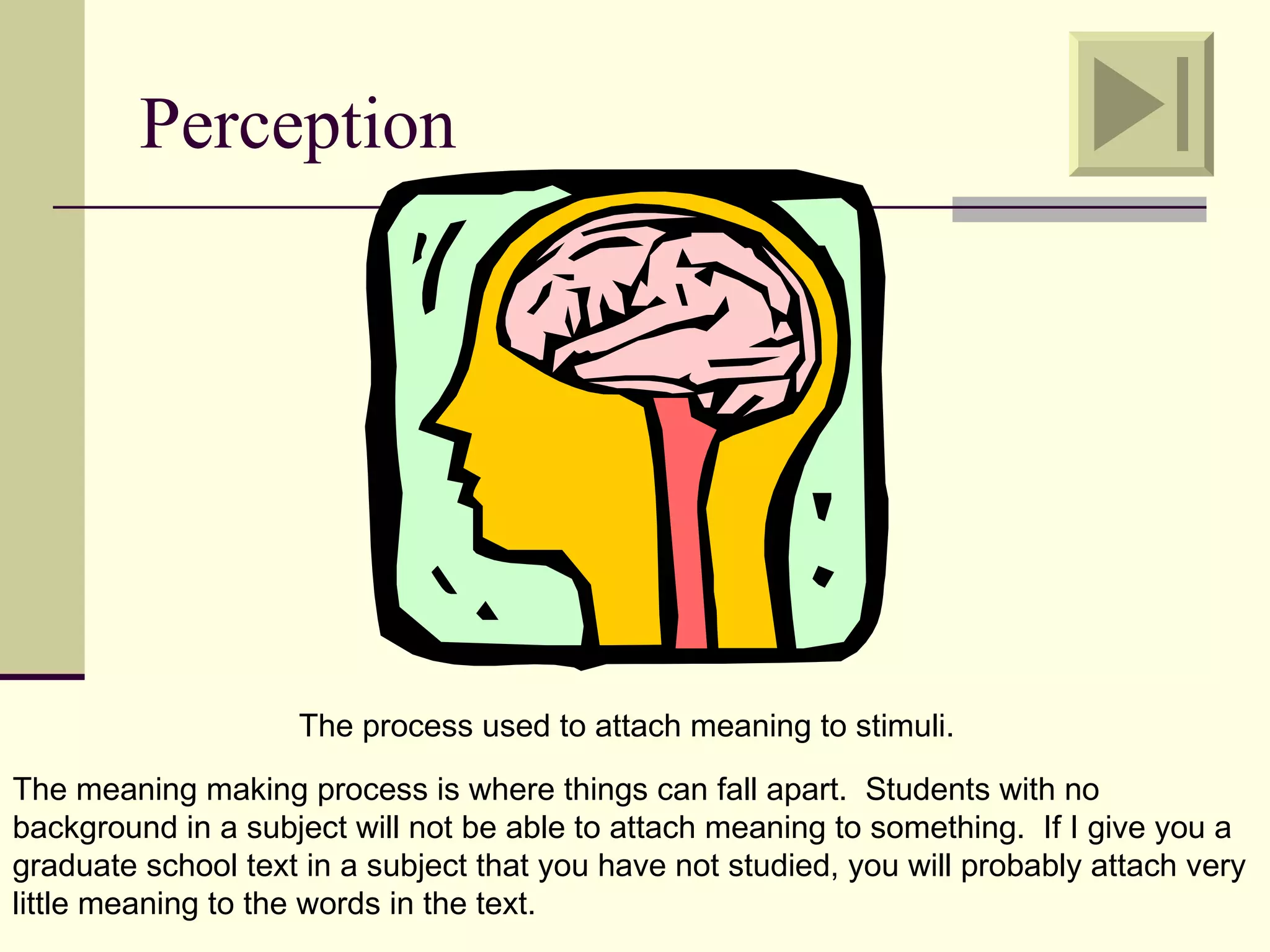
                    The process used to attach meaning to stimuli.

The meaning making process is where things can fall apart. Students with no
background in a subject will not be able to attach meaning to something. If I give you a
graduate school text in a subject that you have not studied, you will probably attach very
little meaning to the words in the text.
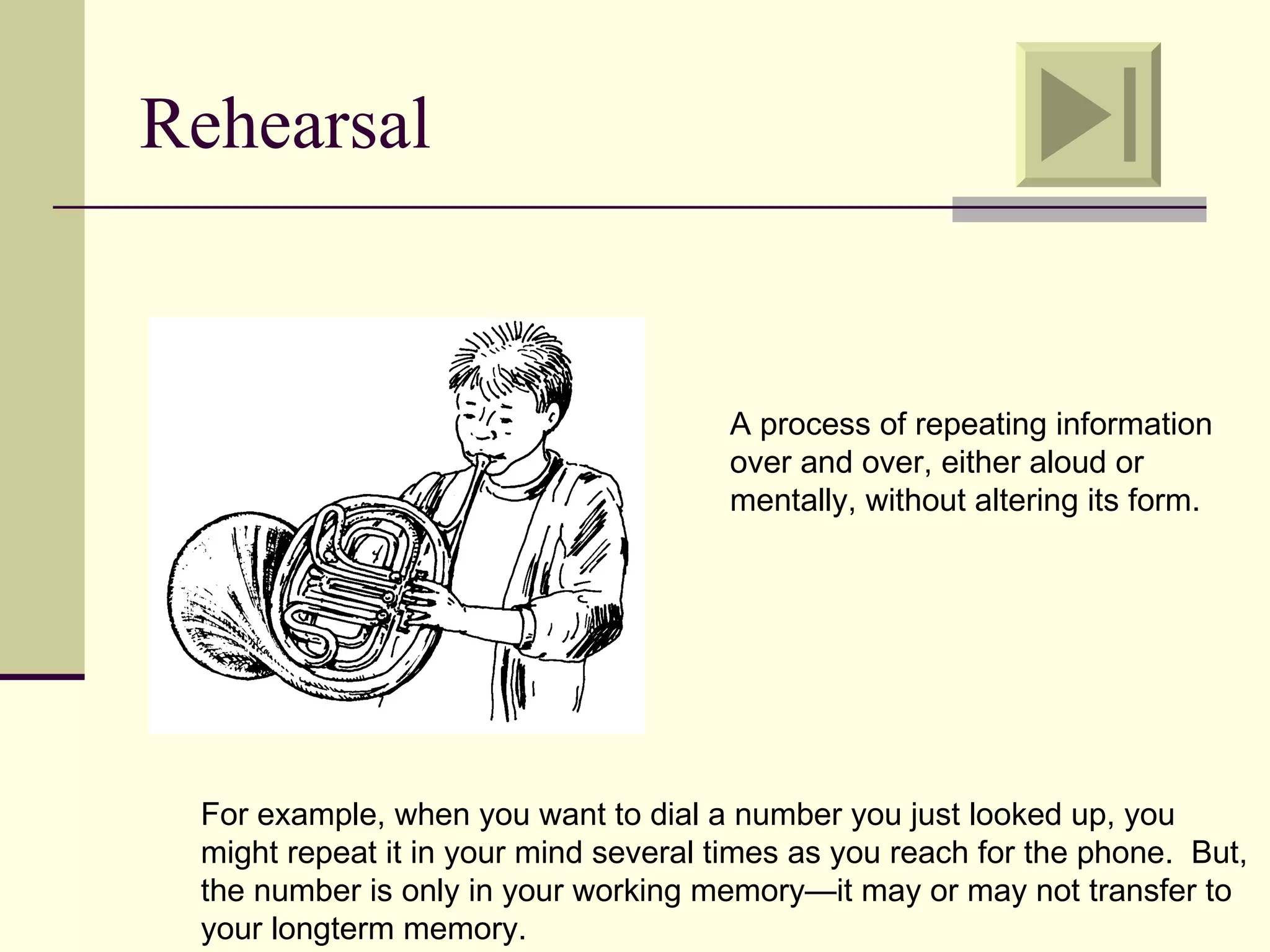
Rehearsal


                                      A process of repeating information
                                      over and over, either aloud or
                                      mentally, without altering its form.


 For example, when you want to dial a number you just looked up, you
 might repeat it in your mind several times as you reach for the phone. But,
 the number is only in your working memory—it may or may not transfer to
 your longterm memory.
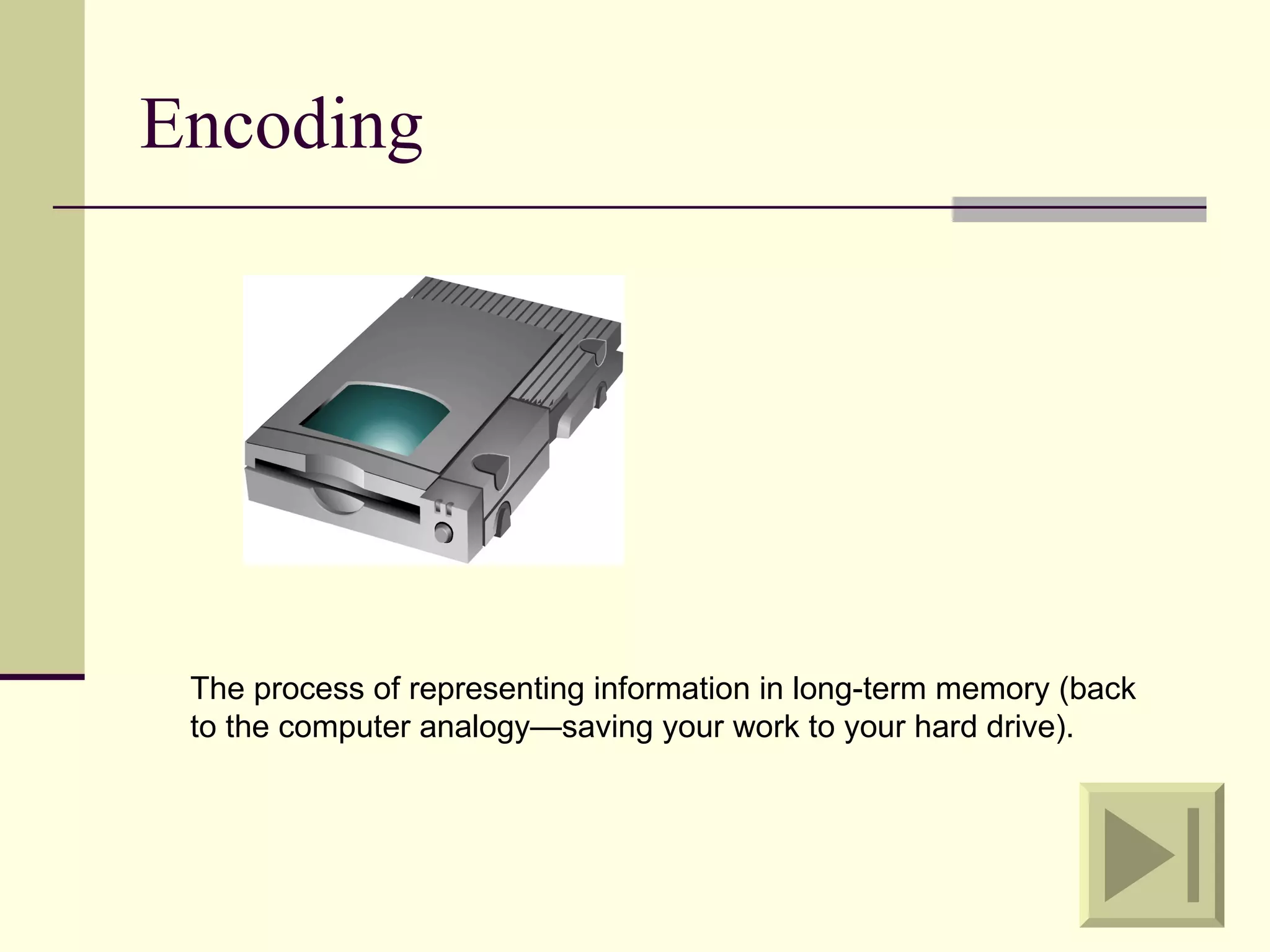
Encoding


 The process of representing information in long-term memory (back
 to the computer analogy—saving your work to your hard drive).
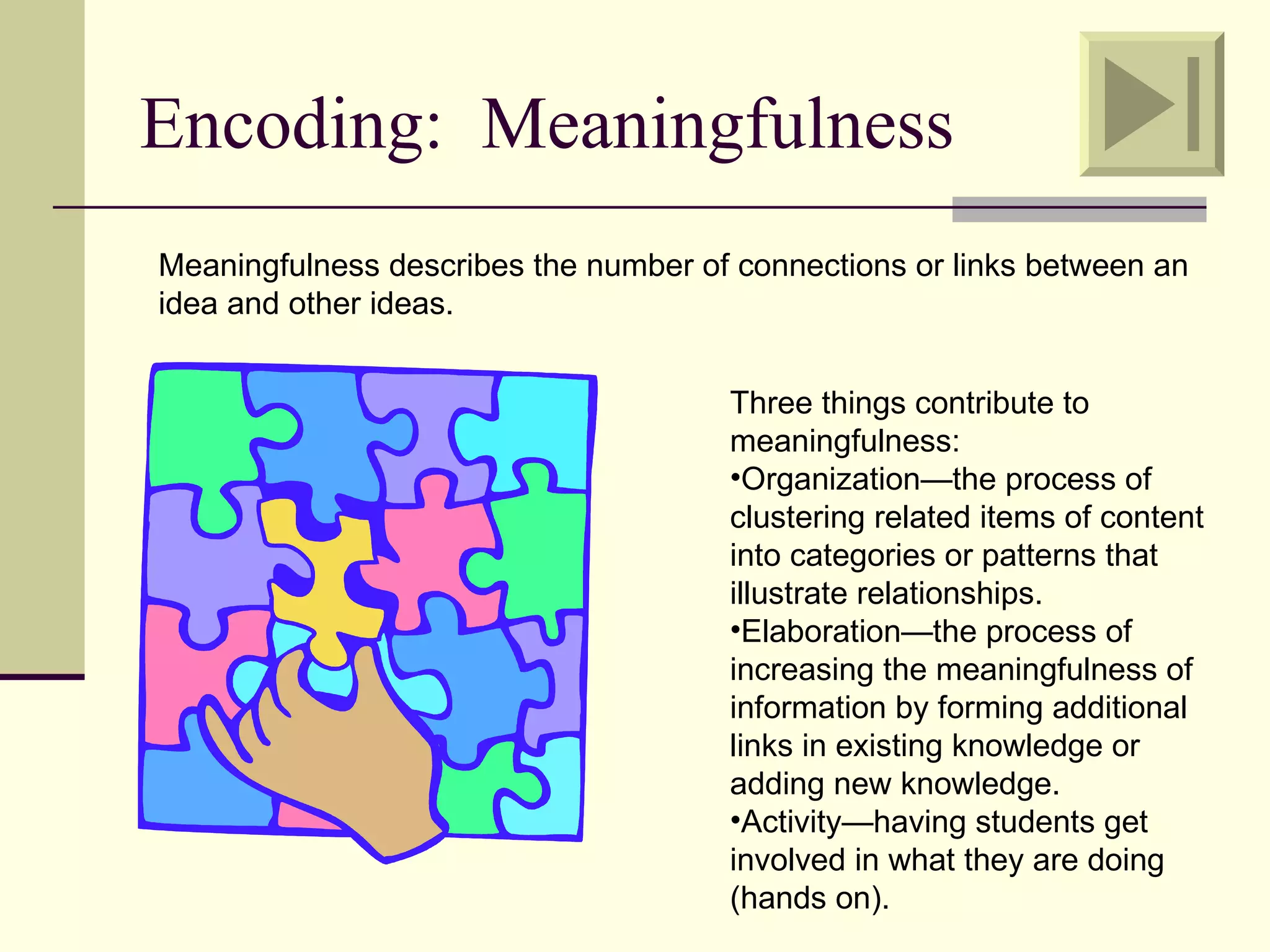
Encoding: Meaningfulness
Meaningfulness describes the number of connections or links between an
idea and other ideas.


                                      Three things contribute to
                                      meaningfulness:
                                      •Organization—the process of
                                      clustering related items of content
                                      into categories or patterns that
                                      illustrate relationships.
                                      •Elaboration—the process of
                                      increasing the meaningfulness of
                                      information by forming additional
                                      links in existing knowledge or
                                      adding new knowledge.
                                      •Activity—having students get
                                      involved in what they are doing
                                      (hands on).
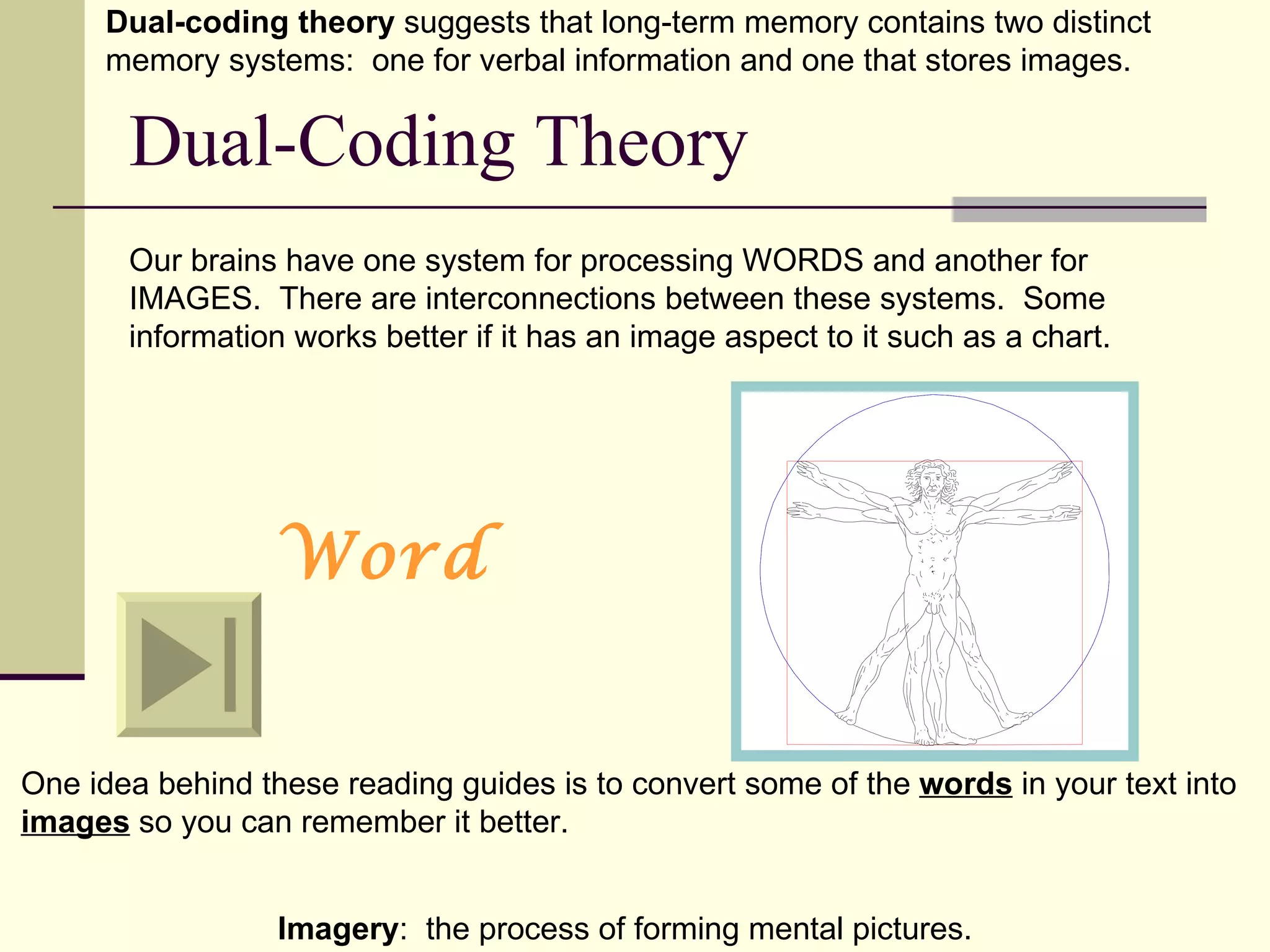
Dual-coding theory suggests that long-term memory contains two distinct
     memory systems: one for verbal information and one that stores images.

       Dual-Coding Theory
       Our brains have one system for processing WORDS and another for
       IMAGES. There are interconnections between these systems. Some
       information works better if it has an image aspect to it such as a chart.


                  Word


One idea behind these reading guides is to convert some of the words in your text into
images so you can remember it better.


                  Imagery: the process of forming mental pictures.
Elaboration
 Provide examples
 Form analogies (relationships that are similar
  in some but not all respects)
 Use mnemonic devices which link knowledge
  to be learned to familiar information.
Mnemonics: techniques for remembering; also the art of memory

Mnemonics
 Loci-method: technique of associating items with
    specific places.
   Peg-type mnemonics: systems of associating items
    with cue words.
   Acronym: technique for remembering names,
    phrases, or steps by using the first letter of each word
    to form a new, memorable word.
   Chain mnemonics: memory strategies that associate
    one element in a series with the next element.
   Keyword method: system of associating new words
    or concepts with similar-sounding cue words and
    images.
Examples of mnemonics
  Big Elephants Always Die Gracefully Crawling
     Forward (BEADGCF, order of the flats)
    Don’t Play Lousy Music At Inter-Lochen (Dorian,
     Phrygian, Lydian, Mixolydian, Aeolian, Ionian,
     Lochrian, the modes)
    George Eats Old Grey Rats And Paints Houses
     Yellow (GEOGRAPHY)
    Mother Always Takes Her Enemies Mush And
     Turnips In Cole Slaw (MATHEMATICS)
    My Very Educated Mother Just Served Us Nine
     Pickles (the planets)

The only problem is: how can you remember how to spell “mnemonic”?
Rote memorization
 Remembering information by repetition
  without necessarily understanding the
  meaning of the information.
 Serial-position effect: the tendency to
  remember the beginning and the end but not
  the middle of a list.
 Part learning: breaking a list of rote learning
  items into shorter lists.
Rote memorization
 To a person who struggles with learning, a
  large “thing” to memorize, whether a poem or
  the times tables, is overwhelming.
 Help students break the task down into
  manageable parts.
 Do a lot of follow through so that students
  learn an important lesson: large things are
  accomplished by doing a small part each day.
Practice
 Distributed practice: practice in brief periods
  with rest intervals.
 Massed practice: practice for a single
  extended period.

  Massed practice is essentially cramming.
  Distributed practice is more likely to result in
  success, however, it takes some maturity to
  be able to do a little bit each day. Help your
  students to learn this important lesson.
Activity
 The more active you are in learning, the more
  material you will encode in your long term
  memory.
 Just scanning through a text while watching
  television is not being active.
 Doing worksheets is probably not being very
  active in learning.
 Think about how you can be active in your
  learning and how you can help students to be
  active in their learning.
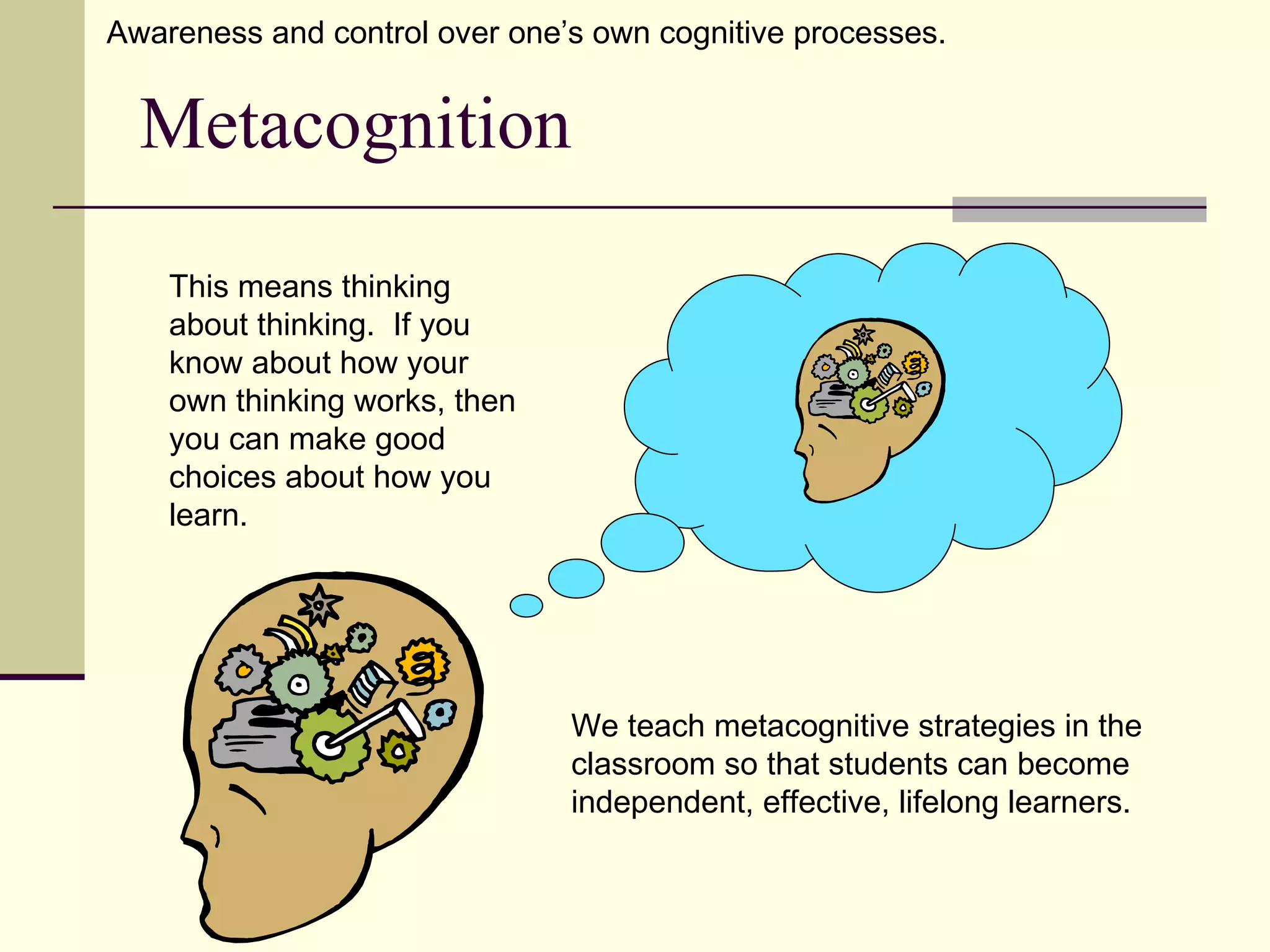
Awareness and control over one’s own cognitive processes.


  Metacognition

    This means thinking
    about thinking. If you
    know about how your
    own thinking works, then
    you can make good
    choices about how you
    learn.


                               We teach metacognitive strategies in the
                               classroom so that students can become
                               independent, effective, lifelong learners.
Meta-attention


These are the strategies you use to help you to pay attention. Although you
may not have been formally taught these strategies, you might find that teaching
attention strategies to your students will help them to be better learners.
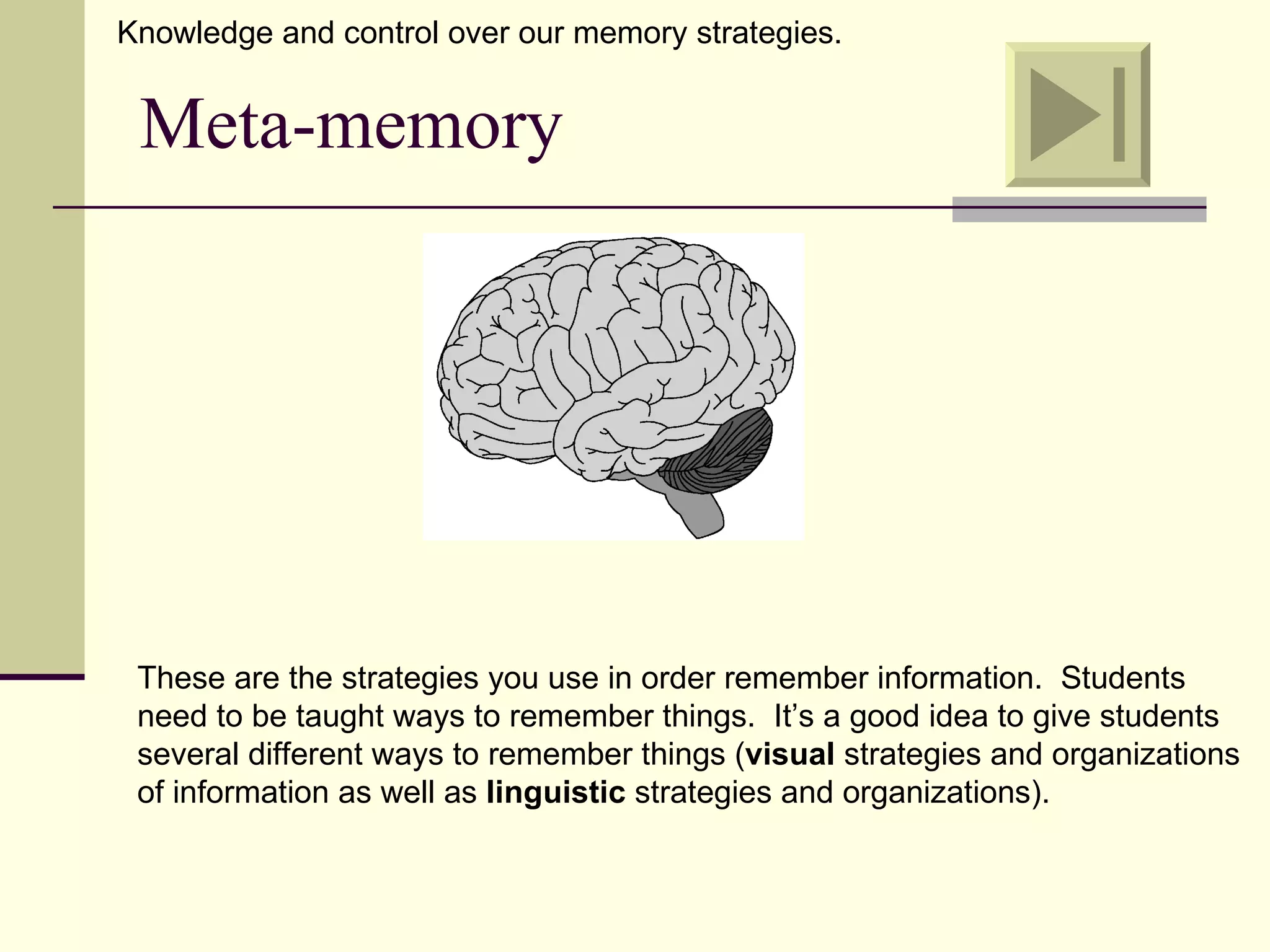
Knowledge and control over our memory strategies.


 Meta-memory


 These are the strategies you use in order remember information. Students
 need to be taught ways to remember things. It’s a good idea to give students
 several different ways to remember things (visual strategies and organizations
 of information as well as linguistic strategies and organizations).
Developing metacognition
 Use strategies—plans for accomplishing
  specific learning goals
 Meta-attention strategies—help children to
  LEARN to pay attention. Directly teach these
  skills.
 Metamemory strategies—don’t just ask
  students to memorize something. Find out
  what they know about HOW to memorize and
  help them add to their strategic choices.
Diversity


   Each person’s cognition is different because people bring different
   experiences to learning. You need to make sure that everyone ends
   up “on the same page” even if they didn’t start there.
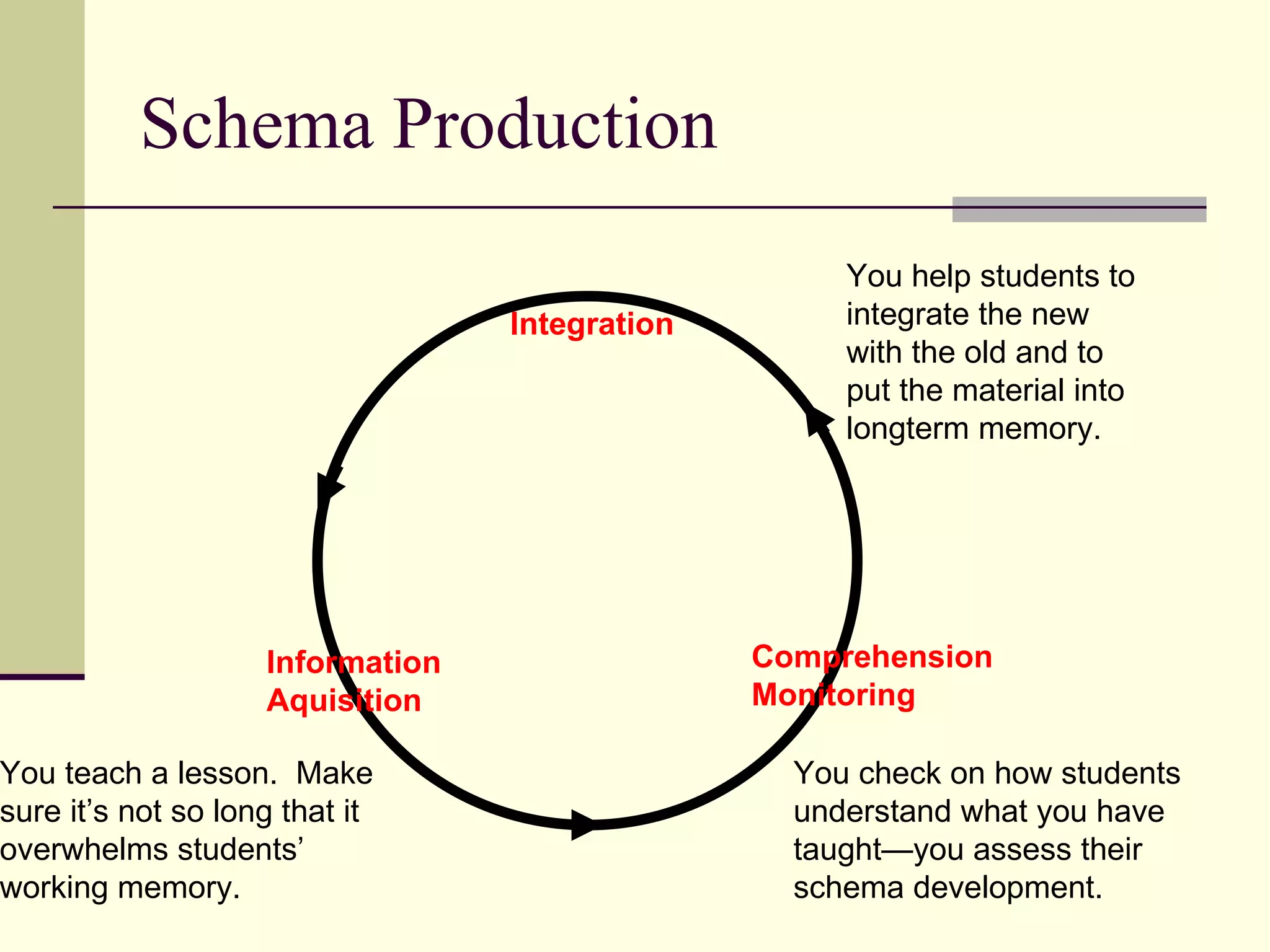
Schema Production
                                                     You help students to
                                  Integration        integrate the new
                                                     with the old and to
                                                     put the material into
                                                     longterm memory.


                    Information                 Comprehension
                    Aquisition                  Monitoring

You teach a lesson. Make                          You check on how students
sure it’s not so long that it                     understand what you have
overwhelms students’                              taught—you assess their
working memory.                                   schema development.
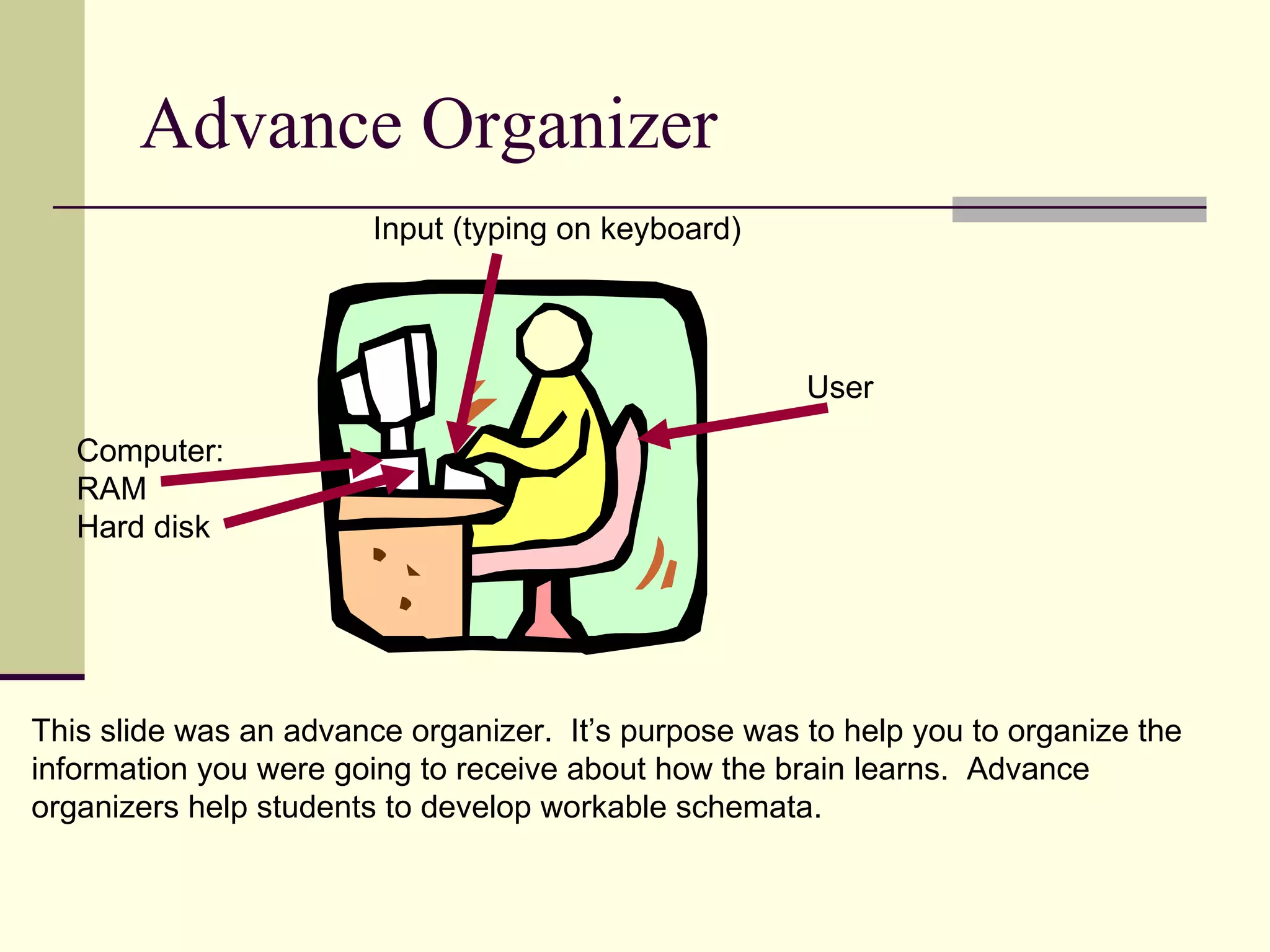
Advance Organizer
                        Input (typing on keyboard)


                                                      User

   Computer:
   RAM
   Hard disk


This slide was an advance organizer. It’s purpose was to help you to organize the
information you were going to receive about how the brain learns. Advance
organizers help students to develop workable schemata.
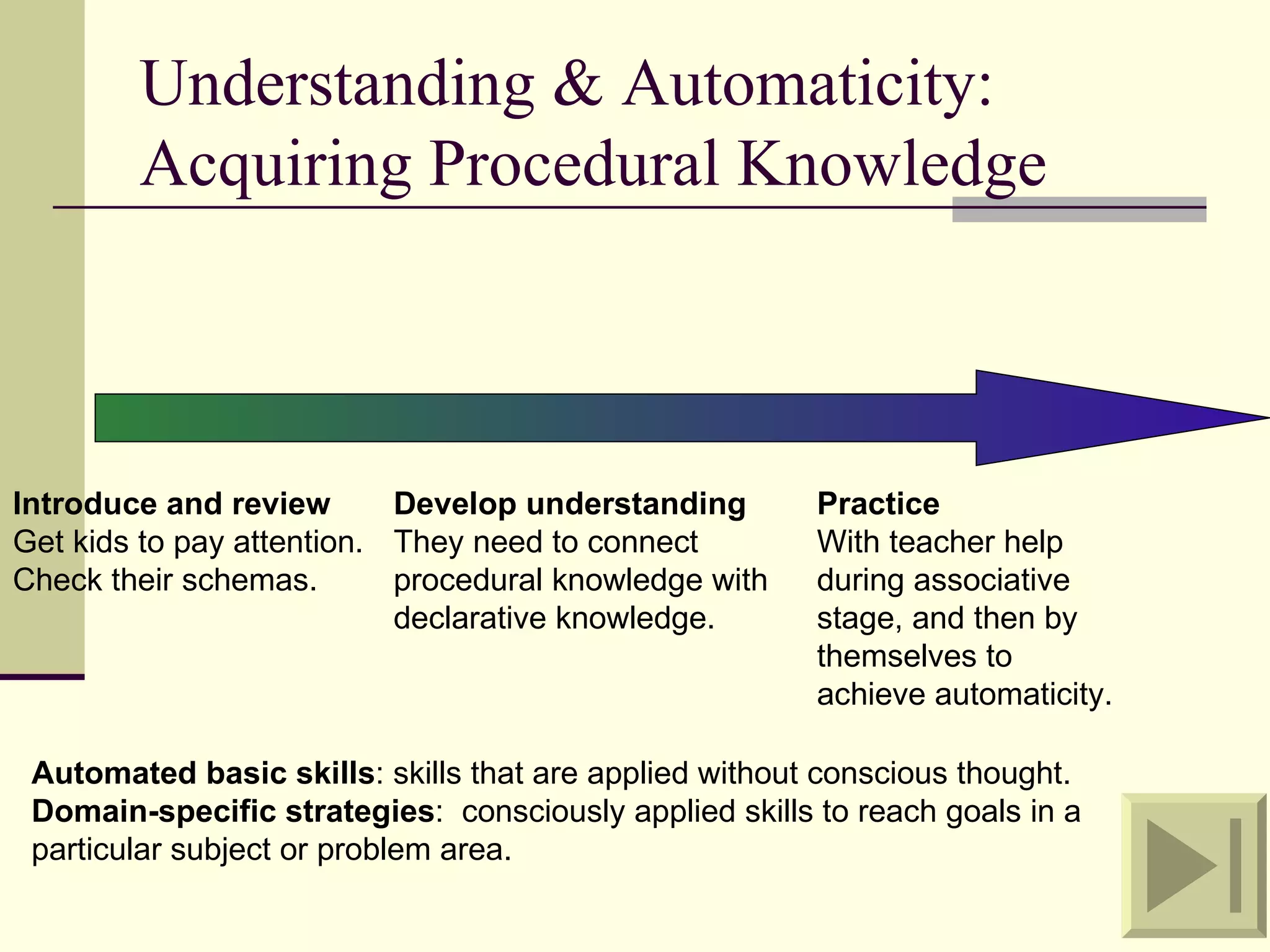
Understanding & Automaticity:
        Acquiring Procedural Knowledge


Introduce and review       Develop understanding        Practice
Get kids to pay attention. They need to connect         With teacher help
Check their schemas.       procedural knowledge with    during associative
                           declarative knowledge.       stage, and then by
                                                        themselves to
                                                        achieve automaticity.

 Automated basic skills: skills that are applied without conscious thought.
 Domain-specific strategies: consciously applied skills to reach goals in a
 particular subject or problem area.
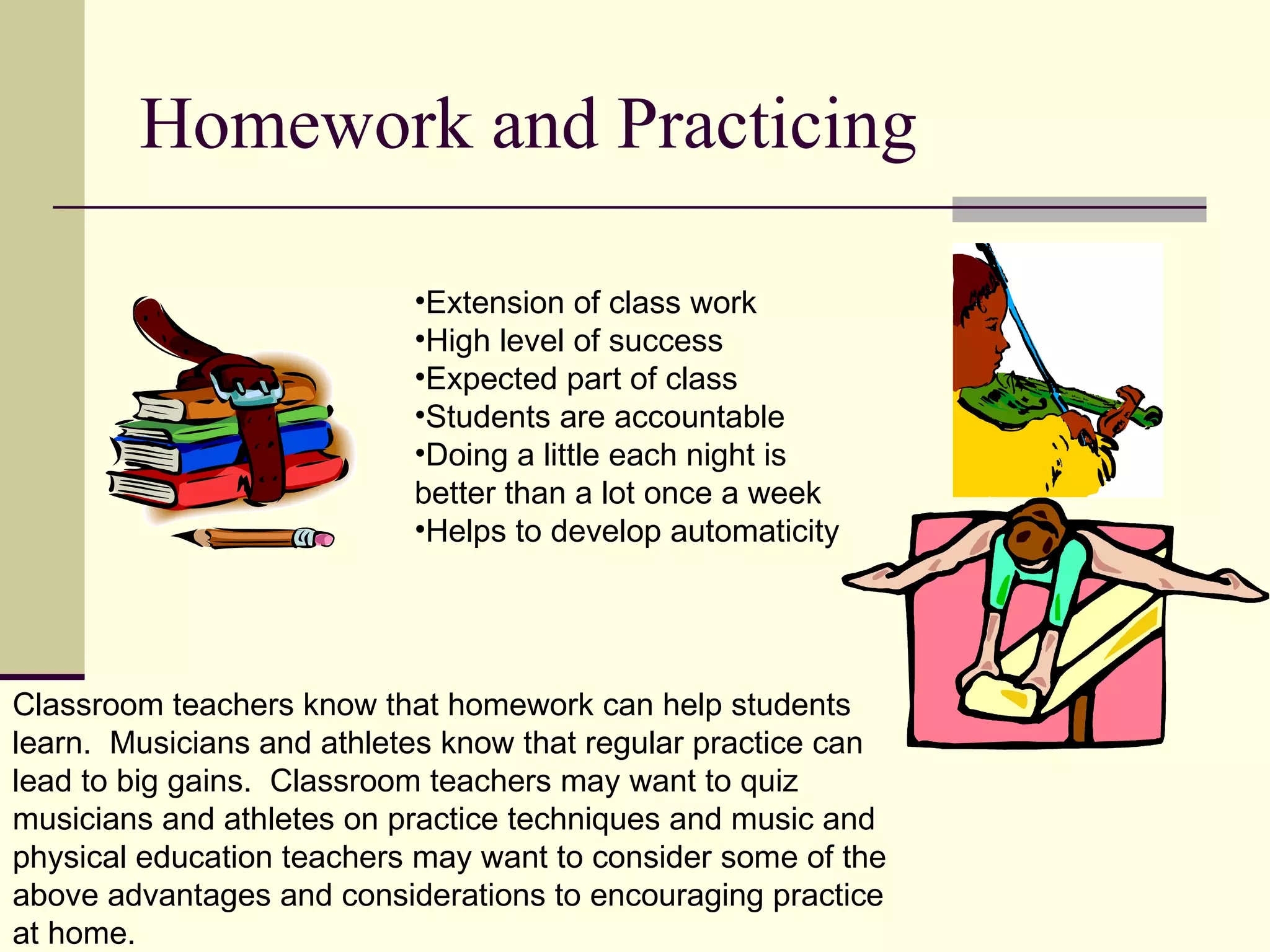
Homework and Practicing

                           •Extension of class work
                           •High level of success
                           •Expected part of class
                           •Students are accountable
                           •Doing a little each night is
                           better than a lot once a week
                           •Helps to develop automaticity


Classroom teachers know that homework can help students
learn. Musicians and athletes know that regular practice can
lead to big gains. Classroom teachers may want to quiz
musicians and athletes on practice techniques and music and
physical education teachers may want to consider some of the
above advantages and considerations to encouraging practice
at home.
Assessment
 We use assessment to figure out if how we
  are teaching is working with our students.
 Be sure there is instructional alignment: the
  match between goals, learning activities, and
  assessment. Otherwise, you don’t know if
  what you are doing is working.
Diversity
 Development: people develop at different times, so
  some students’ ability to use working memory will be
  more mature than that of other students the same
  age.
 Individual differences: people are different in terms
  of their working memory spans.
 People’s background knowledge makes a large
  difference in their learning. If they have a lot of
  background knowledge related to school subjects,
  they will learn those school subjects more easily. If
  they don’t, then you as a teacher may need to
  provide opportunities for students to develop that
  background knowledge.
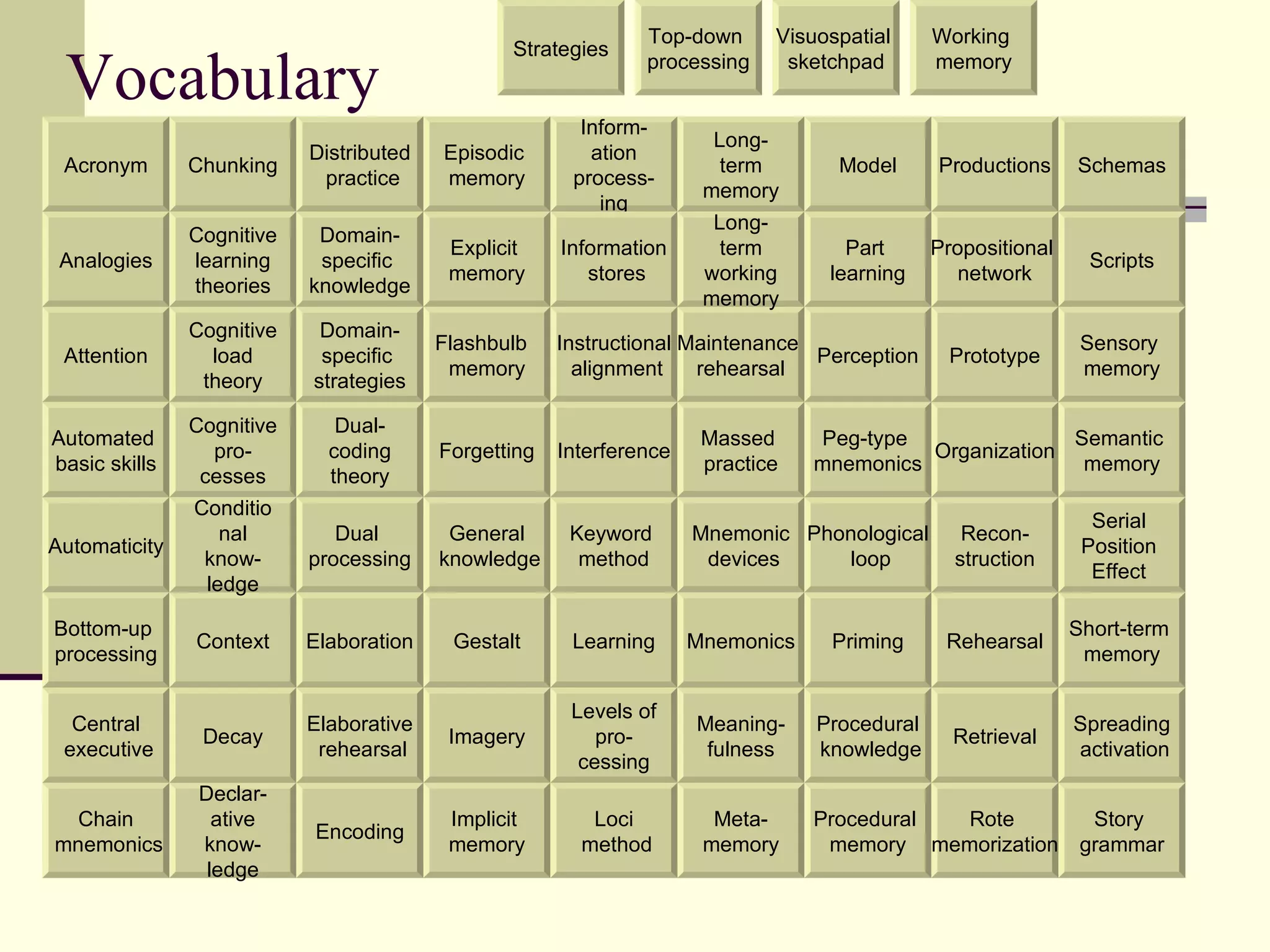
Top-down      Visuospatial     Working
                                                Strategies

 Vocabulary                                                    processing     sketchpad       memory


                                                        Inform-
                                                                       Long-
                           Distributed   Episodic        ation
 Acronym       Chunking                                                 term       Model      Productions     Schemas
                            practice     memory        process-
                                                                      memory
                                                          ing
                                                                       Long-
               Cognitive    Domain-
                                          Explicit    Information       term        Part      Propositional
 Analogies     learning     specific                                                                            Scripts
                                          memory         stores       working     learning       network
               theories    knowledge
                                                                      memory
               Cognitive    Domain-
                                         Flashbulb    Instructional Maintenance                                Sensory
 Attention       load       specific                                            Perception     Prototype
                                          memory        alignment    rehearsal                                 memory
                theory     strategies

               Cognitive      Dual-
Automated                                                             Massed     Peg-type               Semantic
                 pro-        coding      Forgetting   Interference                         Organization
basic skills                                                          practice   mnemonics               memory
                cesses       theory
               Conditio
                                                                                                                Serial
                  nal         Dual        General      Keyword       Mnemonic Phonological       Recon-
Automaticity                                                                                                   Position
                know-      processing    knowledge      method        devices    loop           struction
                                                                                                                Effect
                ledge

Bottom-up                                                                                                     Short-term
               Context     Elaboration    Gestalt      Learning      Mnemonics    Priming      Rehearsal
processing                                                                                                     memory

                                                       Levels of
  Central                  Elaborative                               Meaning-    Procedural                   Spreading
                Decay                     Imagery         pro-                                  Retrieval
 executive                  rehearsal                                 fulness    knowledge                    activation
                                                        cessing
                Declar-
 Chain            ative                   Implicit       Loci          Meta-     Procedural Rote                Story
                           Encoding
mnemonics       know-                     memory        method        memory      memory memorization          grammar
                 ledge

Cognitive (1)

  • 1.
    Cognitive Learning Theory Learners are active. They are not simply empty vessels waiting to be filled. They are also not simply responding passively to changes in their environments. Cognitive Learning theories explain learning by focusing on changes in mental processes and structures that occur as a result of people’s efforts to make sense of the world. Behaviorism states that learning is a change in behavior. Cognitive theories focus on thinking rather than just behavior.
  • 2.
    Cognitive Learning Theory Learning Knowledge Understanding depends on what learners know. New experiences are interpreted in light of what is already known—so current knowledge is the foundation for new knowledge.
  • 3.
    Cognitive Learning Theory Learnersconstruct understanding—they don’t simply remember what the teacher says. They relate what they are learning to what they already know and they try to make sense of it.
  • 4.
    Two types ofknowledge  Domain-specific knowledge: information that is useful in a particular situation or that applies mainly to one specific topic.  General knowledge: information that is useful in many different kinds of tasks; information that applies to many situations.
  • 5.
    Cognitive Learning Theory Learningis a change in the person’s mental structures that creates the capacity to demonstrate different behaviors. Notice how this definition is more complex than the definition of learning from the last chapter (change in behavior).
  • 6.
    A model (whichis what this analogy is): a representation that allows learners to visualize what they can’t observe directly. This model will help you to visualize what is going on in your own brain and those of your students. An analogy: the computer Input (typing on keyboard) User Information processing: a theory of learning that explains how Computer: stimuli enter our RAM memory systems, Hard disk are selected and organized for storage, and are retrieved from memory.
  • 7.
    3 components ofinformation processing model  Information stores: repositories that hold information, like a computer’s RAM and hard drive. Information stores in the information processing model are sensory memory (no real computer analogy), working memory (like RAM), and long term memory (like hard drive).  Cognitive processes: intellectual actions that transform information and move it from one store to another. Includes attention, perception, rehearsal, encoding, and retrieval. Like software in computers.  Metacognition: awareness of and control over one’s own cognitive processes.
  • 8.
    Sensory Memory The informationstore that briefly holds stimuli from the environment until they can be processed. Your brain receives stimuli (remember that is the Latin plural of “stimulus”) from the outside world and it becomes part of sensory memory. The stimuli are like input on a keyboard from the outside world. This memory in people is extremely brief and you only retain material you actually process even though your sensory memory is picking things up all the time. Actually, this is the least effective part of this computer analogy because a keyboard doesn’t remember what is typed on it but your brain does retain what you sense at least for a little while.
  • 9.
    Perception  The processof detecting and assigning meaning to that which is sensed.
  • 10.
    Perception There’s a goodchance that you do not recognize the characters above (Chinese). These marks are likely meaningless to you, although I recognize the one on the top left as “chong” (the first character in the word that designates “Chinese”).
  • 11.
    Perception  Gestalt: German for “pattern” or “whole.” Gestalt theorists hold that people organize their perceptions into coherent wholes This is why you see this image as an elephant and not just a collection of x’s.
  • 12.
    Prototype: a bestexample or best representative Perception of a category. Feature analysis (bottom-up processing): we recognize things based on their individual characteristics. In this case, we see that these four pictures are of the same subject because the features are identical even though the pictures are different.
  • 13.
    Perception Top-down processing: perceiving based on the content and the patterns you expect to occur in that situation. You probably don’t have any sense of the patterns expected in Chinese writing (different types of strokes as well as the stylistic features of calligraphy—one individual’s handwriting) and therefore cannot process this image top-down, but a person who can read Chinese fluently does and would use top-down processing. Every word in Chinese has a different sign (ideogram); to be minimally literate in Chinese, you have to be able to differentiate between and read 1500 ideograms. A person who can read Chinese would use top-down processing to help the recognition of these ideograms.
  • 14.
    Perception  Attention: focuson a stimulus.  If you don’t pay attention to something, you will not perceive it. This is why editing your own writing is so difficult—Gestalt theory says that you will see the whole even if the whole is not really there. You’ll miss the missing words and therefore not pay attention to what is really on the page.
  • 15.
    Perception  Automaticity: theability to perform thoroughly learned tasks without much mental effort When you first start to play a violin, you have to pay attention to everything—how to hold the bow, how to move the bow, how to hold the left hand, how to move the fingers of the left hand, where the instrument is in relation to the shoulder, how to keep the instrument from sliding, etc. Eventually you develop automaticity with all those skills and can play without having to think about so much.
  • 16.
    Working memory isthe store that holds information as a person processes it. It is conscious and deliberate. Working Memory Computers have two types of memory: Random Access Memory (RAM) and the hard disk. RAM is the computer’s working memory—it determines how many programs you can have open at once and how fast your programs load and run. Your hard disk holds all your files for long term use and is much larger than your RAM. Your brain’s working memory is like RAM. It can hold a small amount of stuff and can be overloaded. As a teacher, you have to watch for signs of overload from your students. When their working memory is overloaded, they will not learn. Cognitive Load Theory: recognizes the limitations of working memory and emphasizes instruction that can accommodate its capacity
  • 17.
    Short-term memory  Componentof memory system that holds information for about 20 seconds.  Part of working memory.
  • 18.
    Working memory: threeparts  Central executive: the part of working memory that is responsible for monitoring and directing attention and other mental resources.  Phonological loop: part of working memory. A memory rehearsal system for verbal and sound information of about 1.5-2 seconds.  Visuospatial sketchpad: part of working memory. A holding system for visual and spatial information. The working memory holds about 20 seconds’ worth of material.
  • 19.
    Working memory: retaining information Maintenance rehearsal: keeping information in working memory by repeating it to yourself.  Elaborative rehearsal: keeping information in working memory by associating it with something else you already knew  Chunking: grouping individual bits of information into meaningful larger units.
  • 20.
    Maintenance rehearsal The number is 555-1212. The number is 555-1212. The number is…
  • 21.
    Elaborative rehearsal The number is 555-1212. My nephew is 5 and my niece is 12.
  • 22.
    Chunking The number is 555-1212. My nephew is 5 and my niece is 12. That’s one nephew and two nieces. Telephone numbers are 7 digits. By remembering 1 nephew and 2 nieces, that reduces the load to 3 items instead of 7.
  • 23.
    Forgetting  We losememory through interference (remembering other things) and through decay (the weakening and fading of memories with the passage of time).
  • 24.
    Working memory inthe classroom  Tasks that are difficult require a lot of working memory, the way large programs on your computer use a lot of RAM.  In school we often ask students to do two tasks at a time: to read AND to learn the material being read, to write AND to be able to represent knowledge through that writing. If a student is an able reader and writer, this is no problem. If a student struggles with any aspect of reading and writing, the other task (the learning or the representation of knowledge) will suffer because too much of the student’s working memory is being devoted to reading and writing.  In this situation, if you want the student to learn, it is better to separate the tasks. Have the student listen to the text instead of reading or have the student dictate a text instead of writing.
  • 25.
    Working memory: strategiesfor maximizing it Chunking is the process of mentally combining separate items into larger, more meaningful units. Chunking: When you send a file through the internet, you use a program that compresses the information to a more manageable size. Your brain does this with information in working memory by “chunking” or putting several bits of information together so that only one total thing has to be remembered. In order to do this, look for patterns. For instance, if you hear E, G, B, your mind should chunk this into an e minor chord. If you hear seven digits, you can chunk them into a group of three and a group of four, like a telephone number.
  • 26.
    Working memory: strategies Automaticity: the use of mental operations that can be performed with little awareness or conscious effort.  There are computer programs called “macros” which allow you to accomplish a task with fewer keystrokes. Your brain does this through practice: eventually a task takes little conscious effort.  When you first drive a car, everything takes a huge amount of thinking. With practice, most driving procedures become automatic.
  • 27.
    Working memory: strategies Dual processing: the way two parts, a visual and an auditory component, work together in working memory.  Some computers can do two things at once. So can your brain. When information comes in two channels (e.g., your eyes, your ears, your fingers, etc.), your brain uses information from both sources to enhance working memory.  This is why it is better to give students information in BOTH visual and auditory forms.
  • 28.
    Long term workingmemory: holds the strategies for pulling information from long-term memory into working memory. Long term memory Our permanent information store… Long term memory is like the hard drive on your computer. It holds both files and programs. Likewise, there are three types of long term memory: declarative knowledge, which is knowledge of facts, rules, etc. and which is like the word processing files on your hard disk, procedural knowledge, which is how to accomplish something and which is like the programs you have on your hard disk (word processor, games, etc.), and conditional knowledge, which is knowledge about when and why to use declarative or procedural knowledge..
  • 29.
    In other words… Our long term memory has information on stuff, how to do stuff, and under which conditions we are going to use which type of knowledge.  Isn’t this amazing????
  • 30.
    This chart assumesthat some aspects of Ed Psych are general knowledge… Long term memory & Ed Psych General knowledge Domain-specific knowledge Declarative Human beings have memories Long term memory contains 3 Human beings begin life as types of knowledge babies and mature into adults Piaget outlines cognitive development which explains a lot about how young children think. Procedural If I want someone to repeat an I need to avoid overloading action, I can praise that person students’ working memories when for that action. I am teaching. Conditional When to approach a person When to use behavioral who is having a problem and procedures when to let that person alone. When to use a psychosocial understanding of development vs. understanding moral development.
  • 31.
    Knowledge that isboth verbal and visual is easiest to learn, hence these power points. Long term memory: contents Words… and Images Explicit memory: long-term memories that involve deliberate or conscious recall. Implicit memory: knowledge that we are not conscious of recalling but influences our behavior or thought without our awareness.
  • 32.
    Long term memory Semantic memory: memory for meaning  Episodic memory: long-term memory for information tied to a particular time and place, especially memory of the events in a person’s life.  Flashbulb memory: clear vivid memories of emotionally important events in your life.
  • 33.
    Long term memory:semantic memory Things can make meaning in several ways:  Propositions and propositional networks  Images  Schemas
  • 34.
    Propositions  This isthe smallest unit of factual meaning— that can be judged as true or false.  Propositional network: set of interconnected concepts and relationships in which long-term knowledge is held.
  • 35.
    Images  Representations basedon the physical attributes—the appearance—of information.
  • 36.
    Schema Organized networks of information. On the computer, you organize your data in files. You might have a folder for each class you are taking with word processing documents for those classes inside. Your brain organizes declarative knowledge by schema. You have schema for everything you do, from driving a car to reading for college, from playing a musical instrument to eating with a fork vs. eating with chopsticks. The material in Piaget in Chapter Two mentions “schemes” which are understandings of the world. They are altered when the child encounters something that doesn’t fit within the schemes (accommodation and assimilation). Story grammar: schema representations for texts and stories. Scripts: schema representations for events.
  • 37.
    Schema A schemais how you understand a concept. Prior to Galileo, astronomers thought that the sun circled the earth. They interpreted the stars’ movements in relation to their schema, their understanding. With the invention of the telescope, Galileo and others found that the earth actually circles the sun, so the basic schema changed. This illustrates that when students have a schema that is false, they misunderstand other information that depends on that basic concept.
  • 38.
    How Schema schemas influence learning Provide scaffolding that enable us to Facilitate assimilate summarizing knowledge Schemata help This is the organize our learning. Piagetian idea of When it is organized, maintaining we can summarize it equilibrium. well. Influence attention allocation When we have a schema Stimulate about something, we can Schemata tell us which inference make good guesses part of the information making about it. is important
  • 39.
    How Schemas schemas influence learning Provide scaffolding that enable us to Facilitate assimilate summarizing knowledge Our driving a car schema helps us to teach another You can use what you person how to drive—what is know from driving important, what is not automatic shift and important, etc. apply to standard (e.g., how much acceleration between gears) Influence attention allocation When you are on the highway For example: Stimulate and all the cars slow down in Driving a car It’s important to pay attention inference front of you, you can infer that to what you see on the road. making there is either a problem ahead It’s less important to pay or a police officer. attention to the radio.
  • 40.
    Schemas  Not onlydo you need to know what your students’ schemas are, but you also need to show how the new concept you are teaching fits into knowledge (schemas) students already have. Behaviorism taught us to teach in parts and later put them into wholes. But students need to have a sense of the whole (schema) so they can make sense of the part that you are teaching.
  • 41.
    Episodic memory  Long-termmemory of information tied to a particular time and place, especially memory of the events in a person’s life.
  • 42.
    Flashbulb memory Most of us have vivid memories of where we were on September 11, 2001. Every generation has some kind of flashbulb memory: people over fifty remember the assassination of John F. Kennedy. People in their thirties and forties remember the Challenger accident. Now, we have 9-11.
  • 43.
    This is stuffin long-term memory that you may not be aware of. Implicit memories  Classical conditioning—the association of a strong feeling with something because of experience. Part of long term memory.  Procedural memory—long term memory for how to do things.  Productions—the contents of procedural memory; rules about what actions to take, given certain conditions.  Priming effects—activating a concept in memory or the spread of activation from one concept to another.
  • 44.
    Storing and retrievinginformation in long-term memory  Elaboration  Organization  Context
  • 45.
    Elaboration  Adding andextending meaning by connecting new information to existing knowledge. How easy would it be to memorize the following concepts without some kind of elaboration? (and yet, how often do we ask students to learn something with no connection to what they already know?) Synecdoche is a type of metaphor in which the part stands for the whole, the whole for a part, the genus for the species, the species for the genus, the material for the thing made, or in short, any portion, section, or main quality for the whole or the thing itself (or vice versa). Eponym substitutes for a particular attribute the name of a famous person recognized for that attribute. Anaphora is the repetition of the same word or words at the beginning of successive phrases, clauses, or sentences, commonly in conjunction with climax and with parallelism http://www.virtualsalt.com/rhetoric.htm
  • 46.
    Organization Ordered and logicalnetwork of relations. In other words, it’s a lot easier to learn something that is presented in an orderly, logical way than to try and learn something where facts seem to be presented completely randomly.
  • 47.
    Context The physical oremotional backdrop associated with an event. Years from now, as you remember Educational Psychology concepts, you may find yourself remembering the room you were studying in or this classroom.
  • 48.
    Levels of Processing The more deeply processed This is related something is, the better it stays to in long-term memory. elaboration. Memorizing a learning theory is shallow processing. Figuring out how to apply a learning theory in your classroom represents deeper processing. Levels of processing: a view of learning suggesting that the more deeply information is processed, the more meaningful it becomes.
  • 49.
    Retrieving information  Haveyou ever used the search function on your computer to try to find a file you know is SOMEWHERE?  Retrieving information from your long term memory involves a similar search…  Retrieval: process of searching for and finding information in long-term memory.
  • 50.
    Spreading activation  Retrievalof pieces of information based on their relatedness to one another. Remembering one bit of information activates (stimulates) recall of associated information.  If you have ever figured out a second exam question from having answered a first exam question, then you have experienced this— working on one thing leads you to remember related information.
  • 51.
    Reconstruction  Recreating informationby using memories, expectations, logic, and existing knowledge.  Sometimes reconstructed memories are not accurate, as studies have shown.  (However, this is also a good strategy for test- taking—seeing if you can reconstruct information you have forgotten, based on what you know and logic).
  • 52.
    Forgetting ??????? The loss of, or inability to retrieve, information from memory.
  • 53.
    Forgetting as Interference Theloss of information because something learned before or after detracts from understanding—something interferes with remembering.
  • 54.
    Retrieval—pulling information fromlong-term memory into working memory for further processing. Forgetting as Retrieval Failure When your computer won’t retrieve a file or a program that you KNOW should be on your hard drive (or CD), that is like what happens to your brain. The information is there but you can’t get to it. It won’t go from long term memory to working memory. If you have had the feeling that a word was on the tip of your tongue but you can’t remember it, then you know how this feels. With computers, we back up the information on CD’s and other disk drives so it is available. In our brains, we try to make the information as meaningful as possible (with lots of connections to other things we know) so that we can retrieve it.
  • 55.
    Developing procedural knowledge Declarative stage: students have knowledge ABOUT the procedure—they know what they are supposed to do but they don’t have experience.  Associative stage: students can perform the task, but only with a lot of thinking about it.  Automatic stage: students can perform the process without thinking about it.
  • 56.
    Can you thinkof an example of your own learning in relation to this idea? Developing Procedural Knowledge Three Stages: •Declarative stage. The banjo has five strings, To get from you use finger picks on the right hand to make a here to here sound. The sequence of fingers on the right hand takes creates the banjo roll, e.g., index then middle then PRACTICE!!!! thumb is a forward roll. I know all this but it takes a Lots of it!!! great effort for me to play. This is true of •Associative stage. I can play Cripple Creek very math and slowly with the printed music in front of me. As I anything move through this stage, I start learning the music else!!! by heart and I pick up speed. Any outside interruption will mess me up (e.g., someone playing guitar or trying to talk with me). •Automatic stage. I can play Cripple Creek without thinking about it. I can play a forward roll without thinking about it. I can play with a guitar player and I can play the song even if someone tries to distract me.
  • 57.
    Implications  You needto be aware of where your students are in the process of developing procedural knowledge. For example, in using the keyboard on a computer, you will have students in all three stages. For students in the declarative or associative stages, the keyboard takes a lot of thought to use, so they will not be as fluent in their writing. You can imagine that when a student is “hunting and pecking,” they are more likely to choose short words and sentences because the process of typing is so difficult. Students in the automatic stage will be able to use the keyboard with ease and it will not get in the way of them expressing themselves.
  • 58.
    Implications  Further, whenyou are teaching procedural knowledge, you need to create opportunities for students to practice their skills regularly. This might be time in class on a regular basis or it might be homework.
  • 59.
    Cognitive Processes  Attention  Perception  Rehearsal  Encoding  Retrieval What do you think these processes might be? In other words, I’m asking you to activate your schema about thinking prior to reading this part of the book.
  • 60.
    Attention The process of consciously focusing on a stimulus. As a teacher, you will want your students to focus on what you are doing. If you are boring, they won’t. The younger they are, the more annoying to you will be their choice of activity when they are not focusing on you. Older students might doze or whisper to each other. Younger students might get up and move around the room.
  • 61.
    How to gettheir attention  Demonstrations  Discrepant events (surprises)  Charts  Pictures  Problems  Thought-provoking questions  Emphasis  Using their names In your experience, what techniques have teachers used to get student attention?
  • 62.
    Perception The process used to attach meaning to stimuli. The meaning making process is where things can fall apart. Students with no background in a subject will not be able to attach meaning to something. If I give you a graduate school text in a subject that you have not studied, you will probably attach very little meaning to the words in the text.
  • 63.
    Rehearsal A process of repeating information over and over, either aloud or mentally, without altering its form. For example, when you want to dial a number you just looked up, you might repeat it in your mind several times as you reach for the phone. But, the number is only in your working memory—it may or may not transfer to your longterm memory.
  • 64.
    Encoding The processof representing information in long-term memory (back to the computer analogy—saving your work to your hard drive).
  • 65.
    Encoding: Meaningfulness Meaningfulness describesthe number of connections or links between an idea and other ideas. Three things contribute to meaningfulness: •Organization—the process of clustering related items of content into categories or patterns that illustrate relationships. •Elaboration—the process of increasing the meaningfulness of information by forming additional links in existing knowledge or adding new knowledge. •Activity—having students get involved in what they are doing (hands on).
  • 66.
    Dual-coding theory suggeststhat long-term memory contains two distinct memory systems: one for verbal information and one that stores images. Dual-Coding Theory Our brains have one system for processing WORDS and another for IMAGES. There are interconnections between these systems. Some information works better if it has an image aspect to it such as a chart. Word One idea behind these reading guides is to convert some of the words in your text into images so you can remember it better. Imagery: the process of forming mental pictures.
  • 67.
    Elaboration  Provide examples Form analogies (relationships that are similar in some but not all respects)  Use mnemonic devices which link knowledge to be learned to familiar information.
  • 68.
    Mnemonics: techniques forremembering; also the art of memory Mnemonics  Loci-method: technique of associating items with specific places.  Peg-type mnemonics: systems of associating items with cue words.  Acronym: technique for remembering names, phrases, or steps by using the first letter of each word to form a new, memorable word.  Chain mnemonics: memory strategies that associate one element in a series with the next element.  Keyword method: system of associating new words or concepts with similar-sounding cue words and images.
  • 69.
    Examples of mnemonics  Big Elephants Always Die Gracefully Crawling Forward (BEADGCF, order of the flats)  Don’t Play Lousy Music At Inter-Lochen (Dorian, Phrygian, Lydian, Mixolydian, Aeolian, Ionian, Lochrian, the modes)  George Eats Old Grey Rats And Paints Houses Yellow (GEOGRAPHY)  Mother Always Takes Her Enemies Mush And Turnips In Cole Slaw (MATHEMATICS)  My Very Educated Mother Just Served Us Nine Pickles (the planets) The only problem is: how can you remember how to spell “mnemonic”?
  • 70.
    Rote memorization  Rememberinginformation by repetition without necessarily understanding the meaning of the information.  Serial-position effect: the tendency to remember the beginning and the end but not the middle of a list.  Part learning: breaking a list of rote learning items into shorter lists.
  • 71.
    Rote memorization  Toa person who struggles with learning, a large “thing” to memorize, whether a poem or the times tables, is overwhelming.  Help students break the task down into manageable parts.  Do a lot of follow through so that students learn an important lesson: large things are accomplished by doing a small part each day.
  • 72.
    Practice  Distributed practice:practice in brief periods with rest intervals.  Massed practice: practice for a single extended period. Massed practice is essentially cramming. Distributed practice is more likely to result in success, however, it takes some maturity to be able to do a little bit each day. Help your students to learn this important lesson.
  • 73.
    Activity  The moreactive you are in learning, the more material you will encode in your long term memory.  Just scanning through a text while watching television is not being active.  Doing worksheets is probably not being very active in learning.  Think about how you can be active in your learning and how you can help students to be active in their learning.
  • 74.
    Awareness and controlover one’s own cognitive processes. Metacognition This means thinking about thinking. If you know about how your own thinking works, then you can make good choices about how you learn. We teach metacognitive strategies in the classroom so that students can become independent, effective, lifelong learners.
  • 75.
    Meta-attention These are thestrategies you use to help you to pay attention. Although you may not have been formally taught these strategies, you might find that teaching attention strategies to your students will help them to be better learners.
  • 76.
    Knowledge and controlover our memory strategies. Meta-memory These are the strategies you use in order remember information. Students need to be taught ways to remember things. It’s a good idea to give students several different ways to remember things (visual strategies and organizations of information as well as linguistic strategies and organizations).
  • 77.
    Developing metacognition  Usestrategies—plans for accomplishing specific learning goals  Meta-attention strategies—help children to LEARN to pay attention. Directly teach these skills.  Metamemory strategies—don’t just ask students to memorize something. Find out what they know about HOW to memorize and help them add to their strategic choices.
  • 78.
    Diversity Each person’s cognition is different because people bring different experiences to learning. You need to make sure that everyone ends up “on the same page” even if they didn’t start there.
  • 79.
    Schema Production You help students to Integration integrate the new with the old and to put the material into longterm memory. Information Comprehension Aquisition Monitoring You teach a lesson. Make You check on how students sure it’s not so long that it understand what you have overwhelms students’ taught—you assess their working memory. schema development.
  • 80.
    Advance Organizer Input (typing on keyboard) User Computer: RAM Hard disk This slide was an advance organizer. It’s purpose was to help you to organize the information you were going to receive about how the brain learns. Advance organizers help students to develop workable schemata.
  • 81.
    Understanding & Automaticity: Acquiring Procedural Knowledge Introduce and review Develop understanding Practice Get kids to pay attention. They need to connect With teacher help Check their schemas. procedural knowledge with during associative declarative knowledge. stage, and then by themselves to achieve automaticity. Automated basic skills: skills that are applied without conscious thought. Domain-specific strategies: consciously applied skills to reach goals in a particular subject or problem area.
  • 82.
    Homework and Practicing •Extension of class work •High level of success •Expected part of class •Students are accountable •Doing a little each night is better than a lot once a week •Helps to develop automaticity Classroom teachers know that homework can help students learn. Musicians and athletes know that regular practice can lead to big gains. Classroom teachers may want to quiz musicians and athletes on practice techniques and music and physical education teachers may want to consider some of the above advantages and considerations to encouraging practice at home.
  • 83.
    Assessment  We useassessment to figure out if how we are teaching is working with our students.  Be sure there is instructional alignment: the match between goals, learning activities, and assessment. Otherwise, you don’t know if what you are doing is working.
  • 84.
    Diversity  Development: peopledevelop at different times, so some students’ ability to use working memory will be more mature than that of other students the same age.  Individual differences: people are different in terms of their working memory spans.  People’s background knowledge makes a large difference in their learning. If they have a lot of background knowledge related to school subjects, they will learn those school subjects more easily. If they don’t, then you as a teacher may need to provide opportunities for students to develop that background knowledge.
  • 85.
    Top-down Visuospatial Working Strategies Vocabulary processing sketchpad memory Inform- Long- Distributed Episodic ation Acronym Chunking term Model Productions Schemas practice memory process- memory ing Long- Cognitive Domain- Explicit Information term Part Propositional Analogies learning specific Scripts memory stores working learning network theories knowledge memory Cognitive Domain- Flashbulb Instructional Maintenance Sensory Attention load specific Perception Prototype memory alignment rehearsal memory theory strategies Cognitive Dual- Automated Massed Peg-type Semantic pro- coding Forgetting Interference Organization basic skills practice mnemonics memory cesses theory Conditio Serial nal Dual General Keyword Mnemonic Phonological Recon- Automaticity Position know- processing knowledge method devices loop struction Effect ledge Bottom-up Short-term Context Elaboration Gestalt Learning Mnemonics Priming Rehearsal processing memory Levels of Central Elaborative Meaning- Procedural Spreading Decay Imagery pro- Retrieval executive rehearsal fulness knowledge activation cessing Declar- Chain ative Implicit Loci Meta- Procedural Rote Story Encoding mnemonics know- memory method memory memory memorization grammar ledge