What Cognitive Neuroscience
Can Do for English Professors
Amanda Preston, MA
English & Developmental English Professor, Eastfield College
Applied Cognition & Neuroscience Graduate Student, UT Dallas
Brain & Behavioral Science: A Brief Address
▪ How and where language processing works in the brain
▪ Language development & higher cognitive functions
▪ Memory and attention systems
▪ Problem solving mental confusion
▪ Analogical priming—teaching versus telling
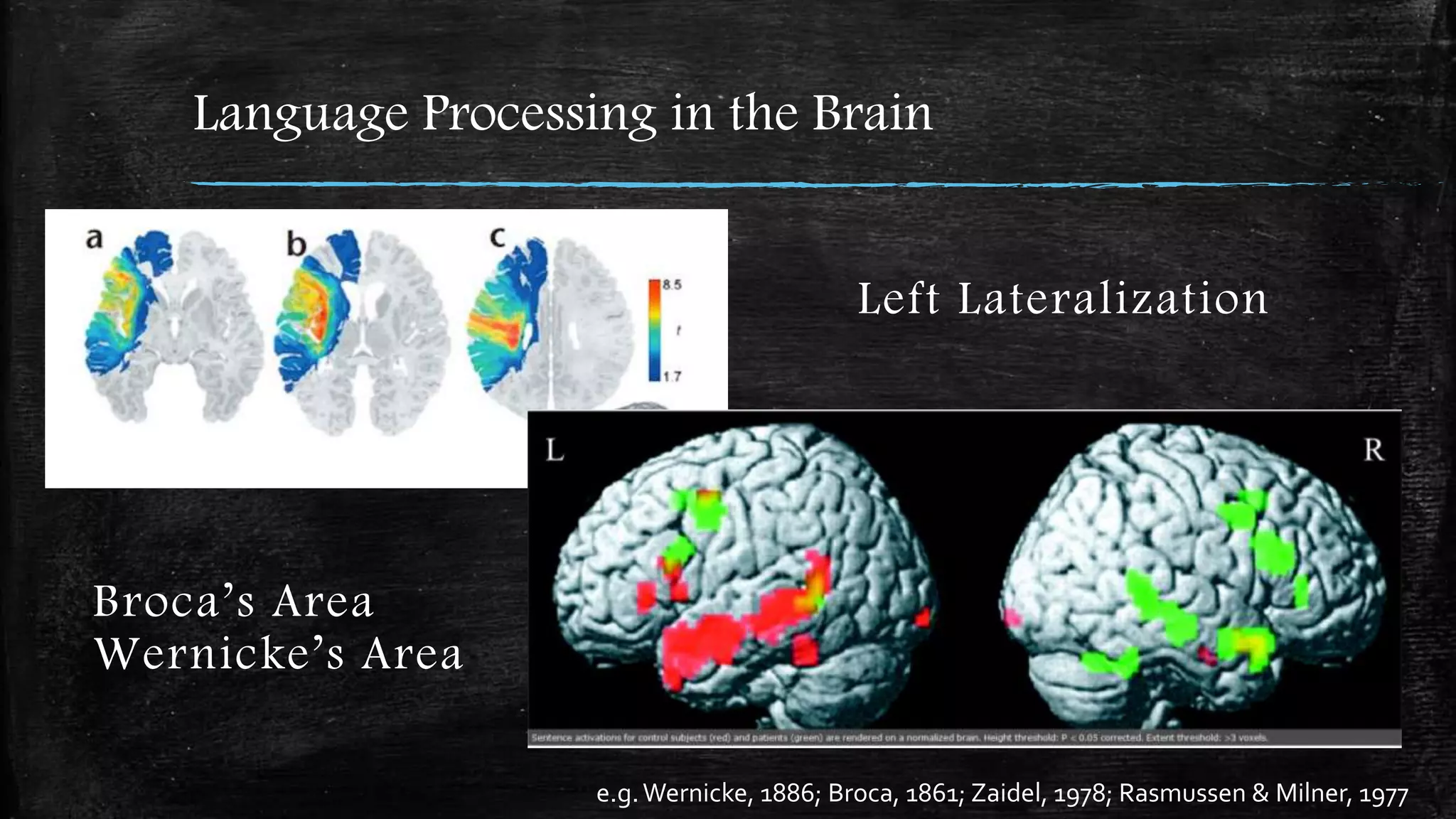
Language Processing in the Brain
e.g.Wernicke, 1886; Broca, 1861; Zaidel, 1978; Rasmussen & Milner, 1977
Broca’s Area
Wernicke’s Area
Left Lateralization
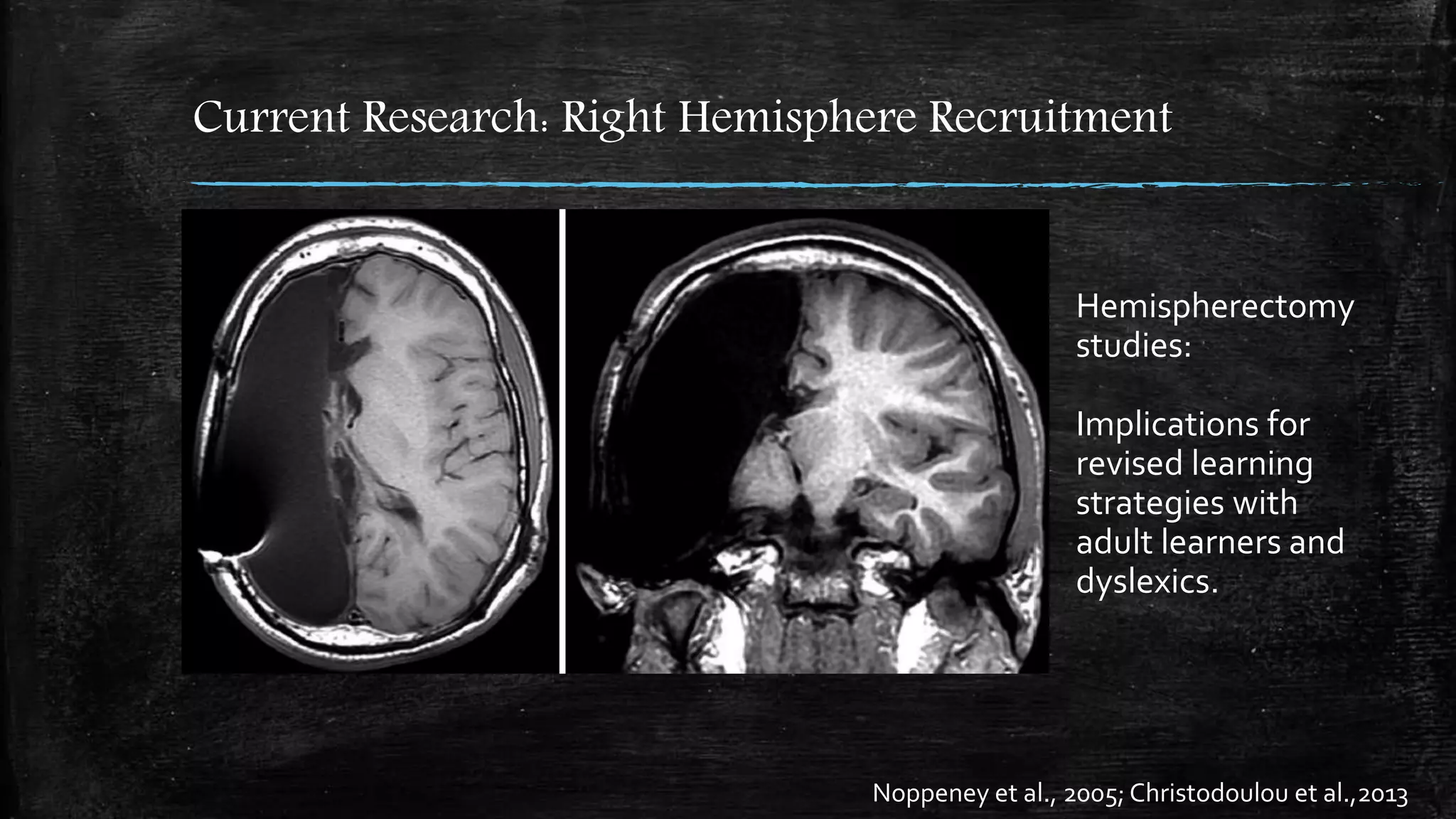
Current Research: Right Hemisphere Recruitment
Noppeney et al., 2005; Christodoulou et al.,2013
Hemispherectomy
studies:
Implications for
revised learning
strategies with
adult learners and
dyslexics.
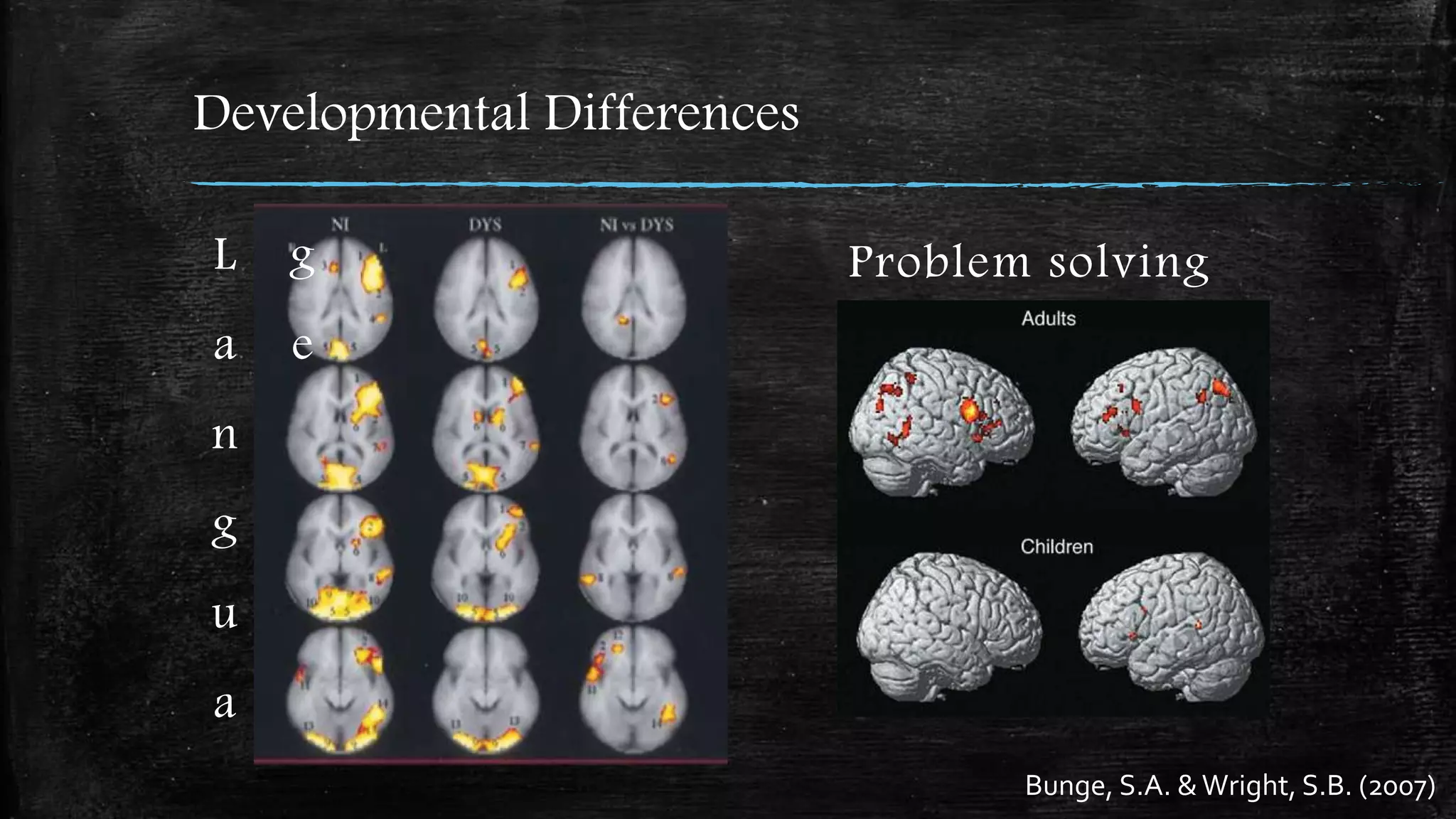
Developmental Differences
Bunge, S.A. &Wright, S.B. (2007)
Problem solvingL
a
n
g
u
a
g
e
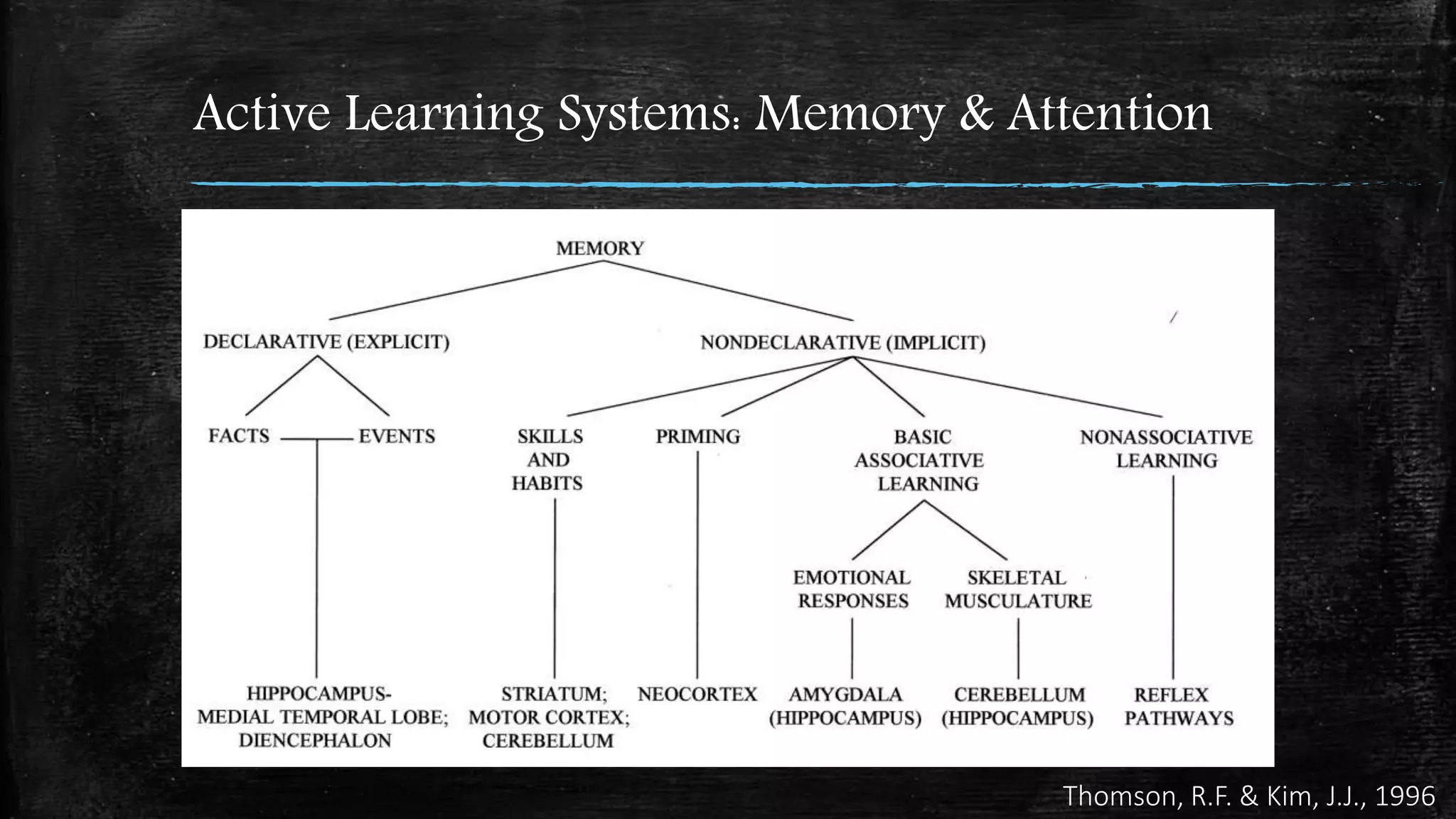
Active Learning Systems: Memory & Attention
Thomson, R.F. & Kim, J.J., 1996
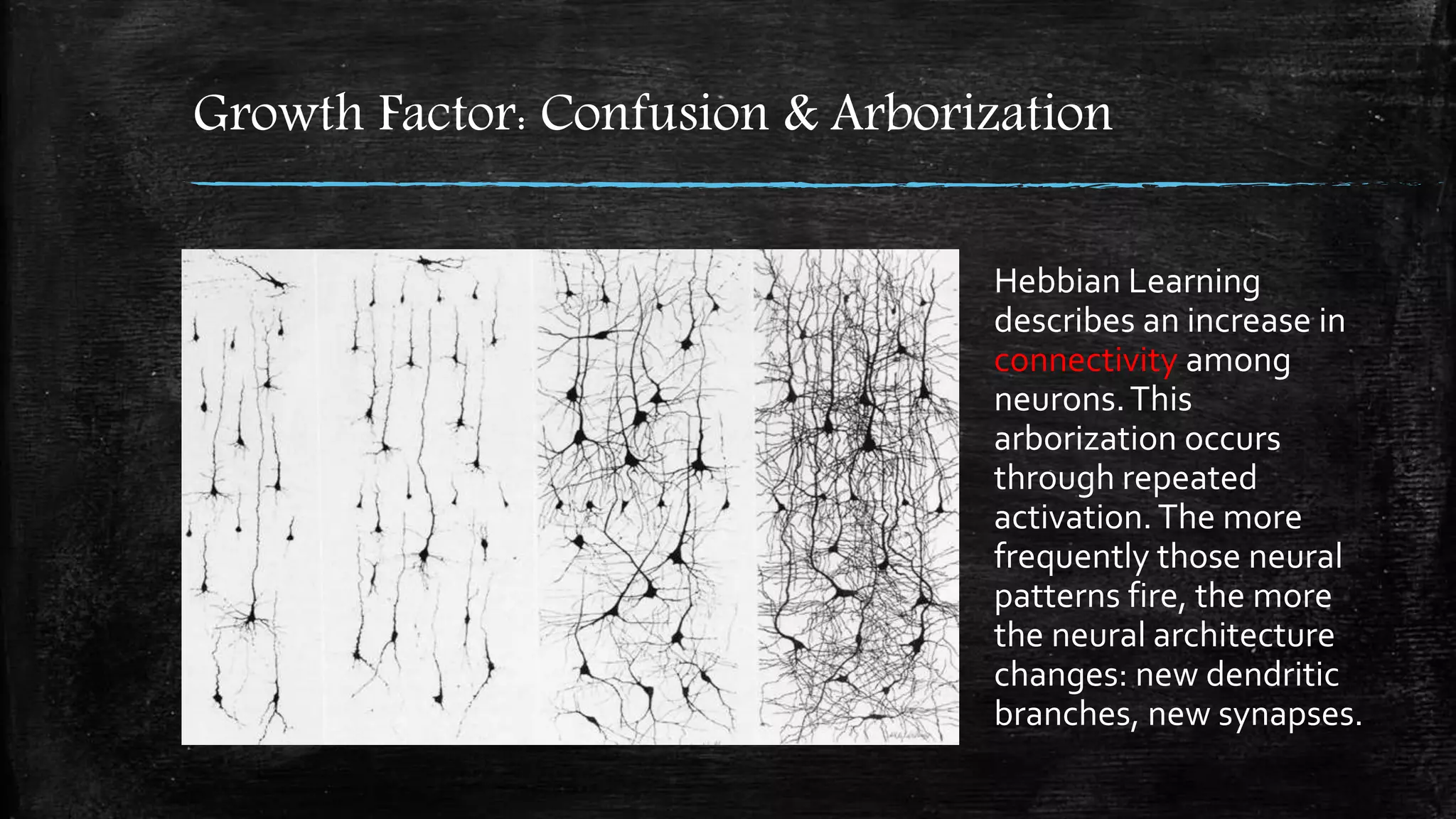
Growth Factor: Confusion & Arborization
Hebbian Learning
describes an increase in
connectivity among
neurons.This
arborization occurs
through repeated
activation.The more
frequently those neural
patterns fire, the more
the neural architecture
changes: new dendritic
branches, new synapses.
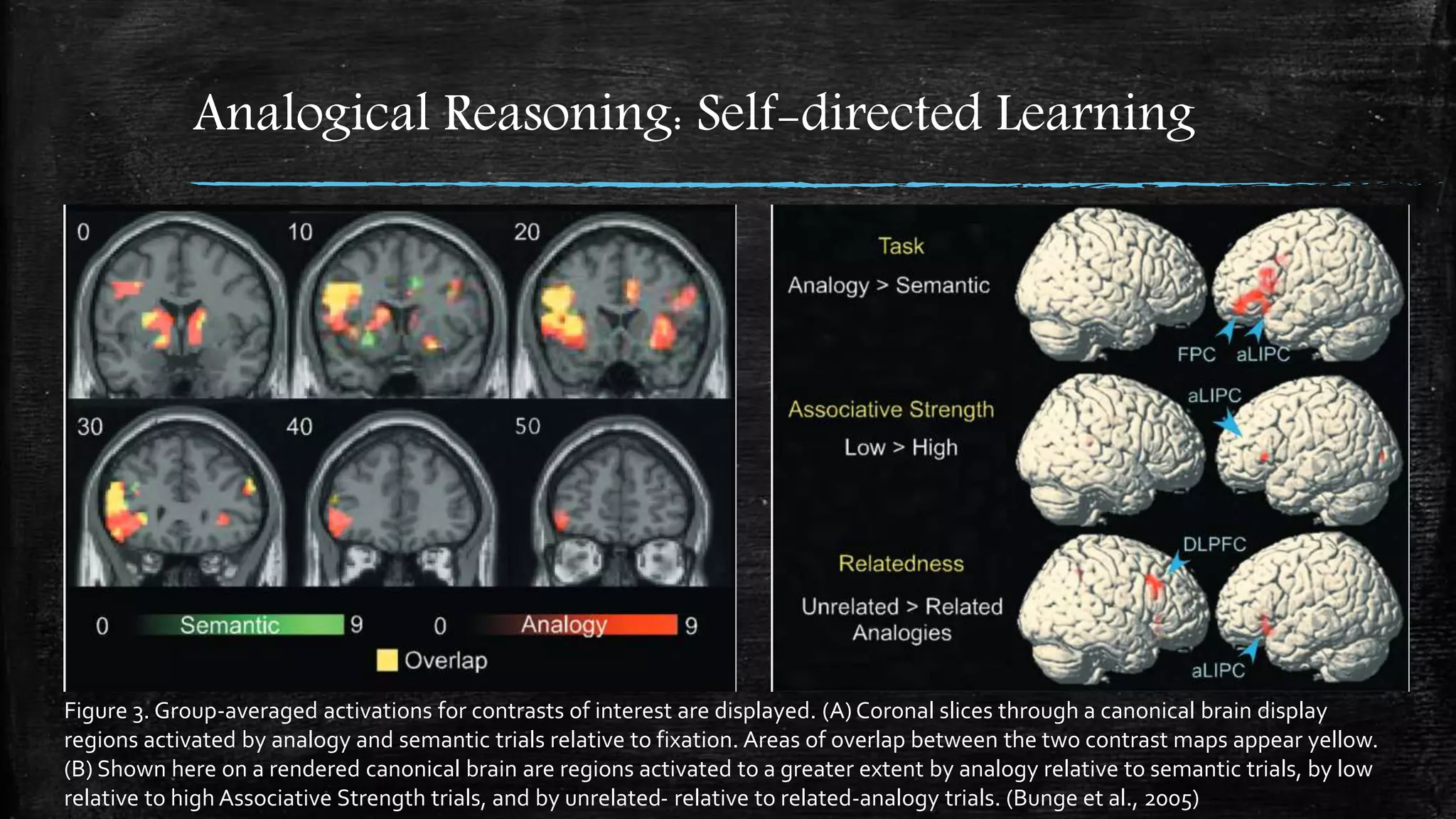
Analogical Reasoning: Self-directed Learning
Figure 3. Group-averaged activations for contrasts of interest are displayed. (A) Coronal slices through a canonical brain display
regions activated by analogy and semantic trials relative to fixation. Areas of overlap between the two contrast maps appear yellow.
(B) Shown here on a rendered canonical brain are regions activated to a greater extent by analogy relative to semantic trials, by low
relative to high Associative Strength trials, and by unrelated- relative to related-analogy trials. (Bunge et al., 2005)
Classroom Implementation Strategies
From theoretical models to instructional practice
Thought Experiment #1
Instructions:
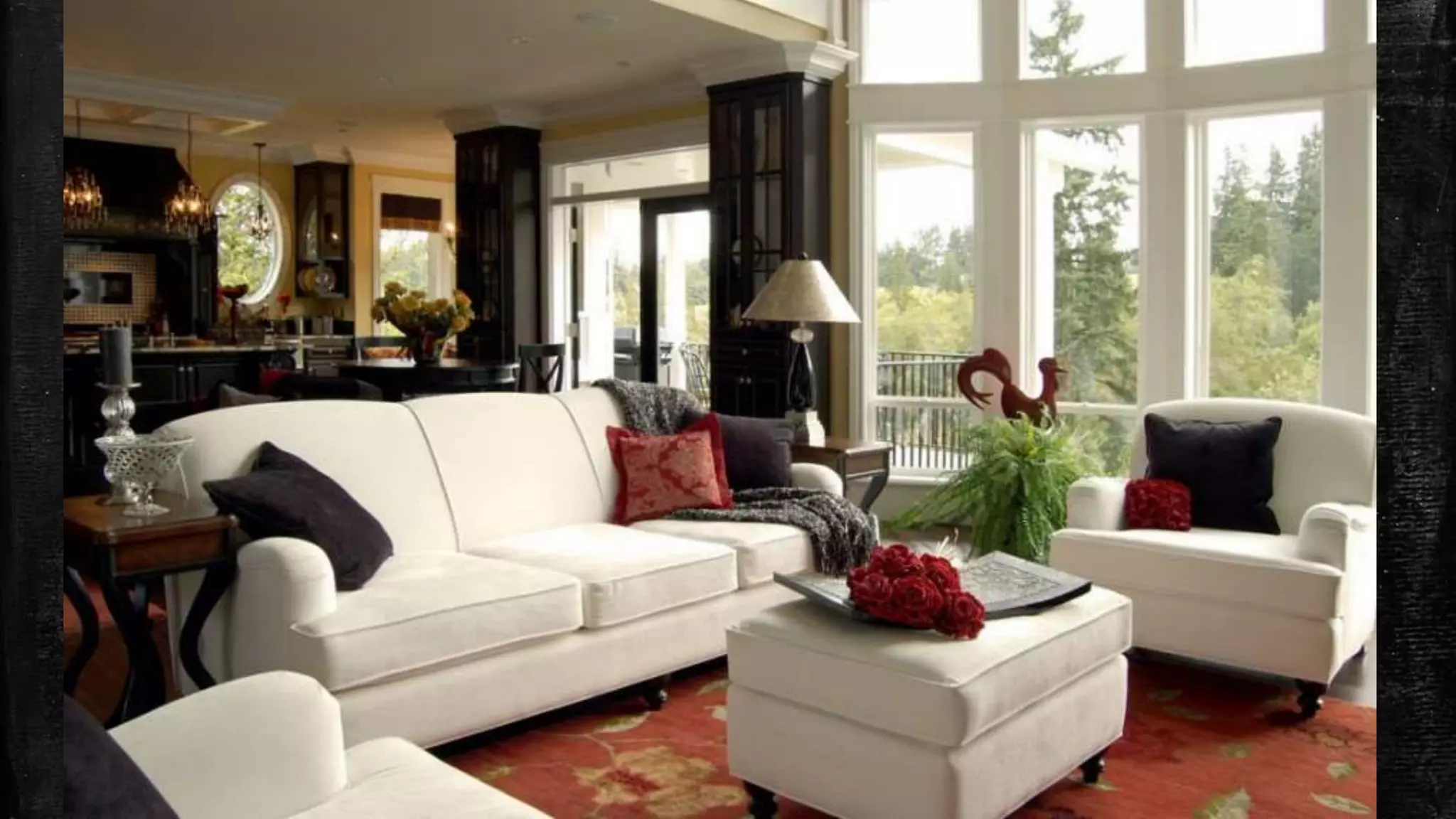
– 30 seconds to study the image
– Do not write anything down
– Count backwards from 98 by sevens
– Write down all the items you recall
There will be a
quiz!
Thought Experiment #1
Instructions:
– Count backwards from 98 by sevens
– Once you reach zero, write down everything you remember
How well do you know the
text?
Thought Experiment #1
A few simple comprehension questions after a first read of the text:
▪ How many windows are there?
▪ What animal is in the room?
▪ What color are the flowers on the table?
▪ Where do you think this house is? (what’s outside?)
▪ How many lamps are in the room?
▪ What shape is the window on the back kitchen wall?
▪ What color is the fireplace?
The Living Room
▪ Cognitive Models
– False memories
– Focus of attention
– Task SwitchingCost
– STM v. LTM
▪ Pedagogical Foci
– Description
– Attention to details
– (re) Reading a text
– Test-taking strategies
Thought Experiment #2
Instructions:
– Observe the image closely
– Count the number of triangles
– You many write on the sheet provided
– You have to be able to show how you found each triangle
– You will have three minutes
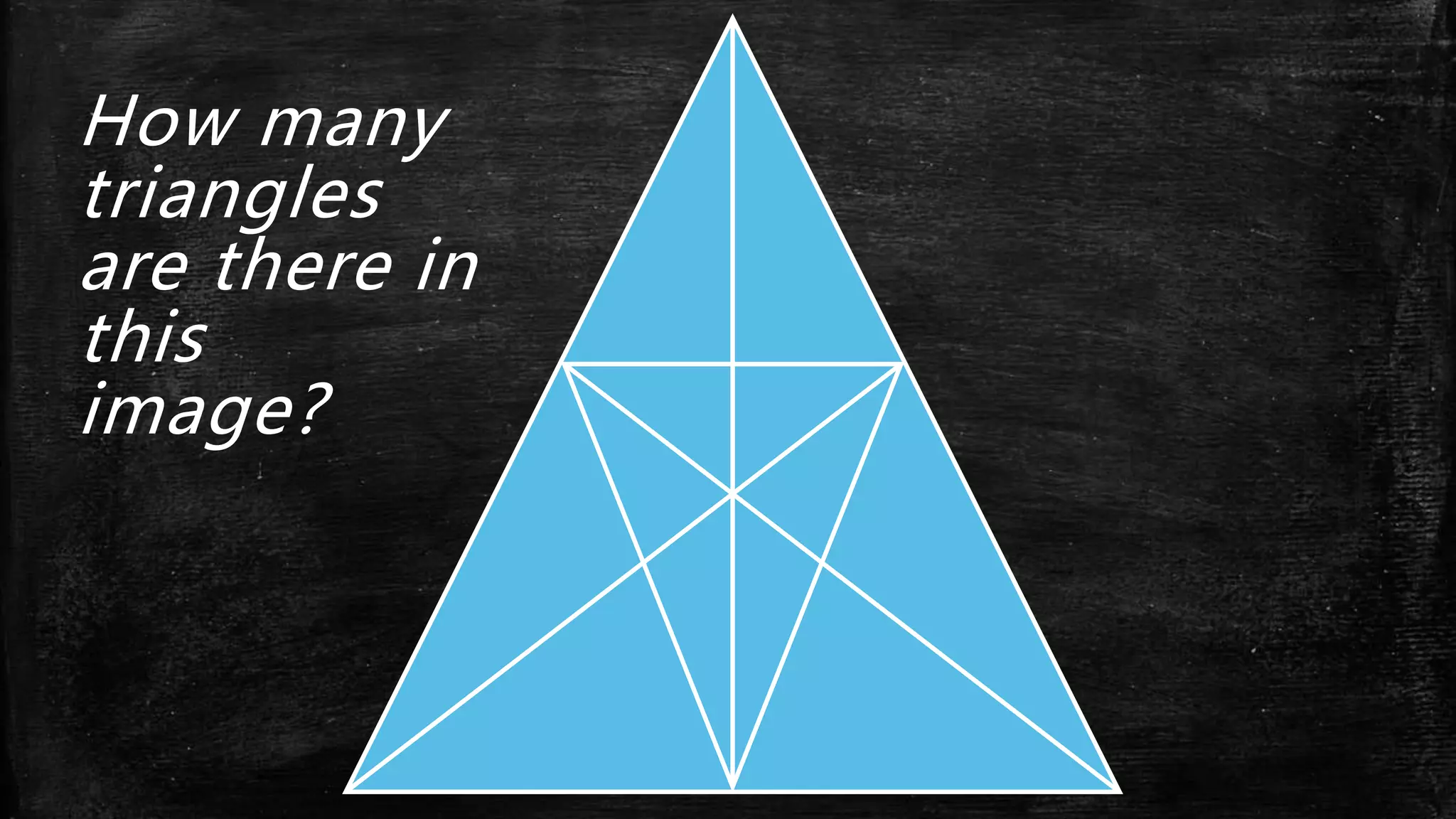
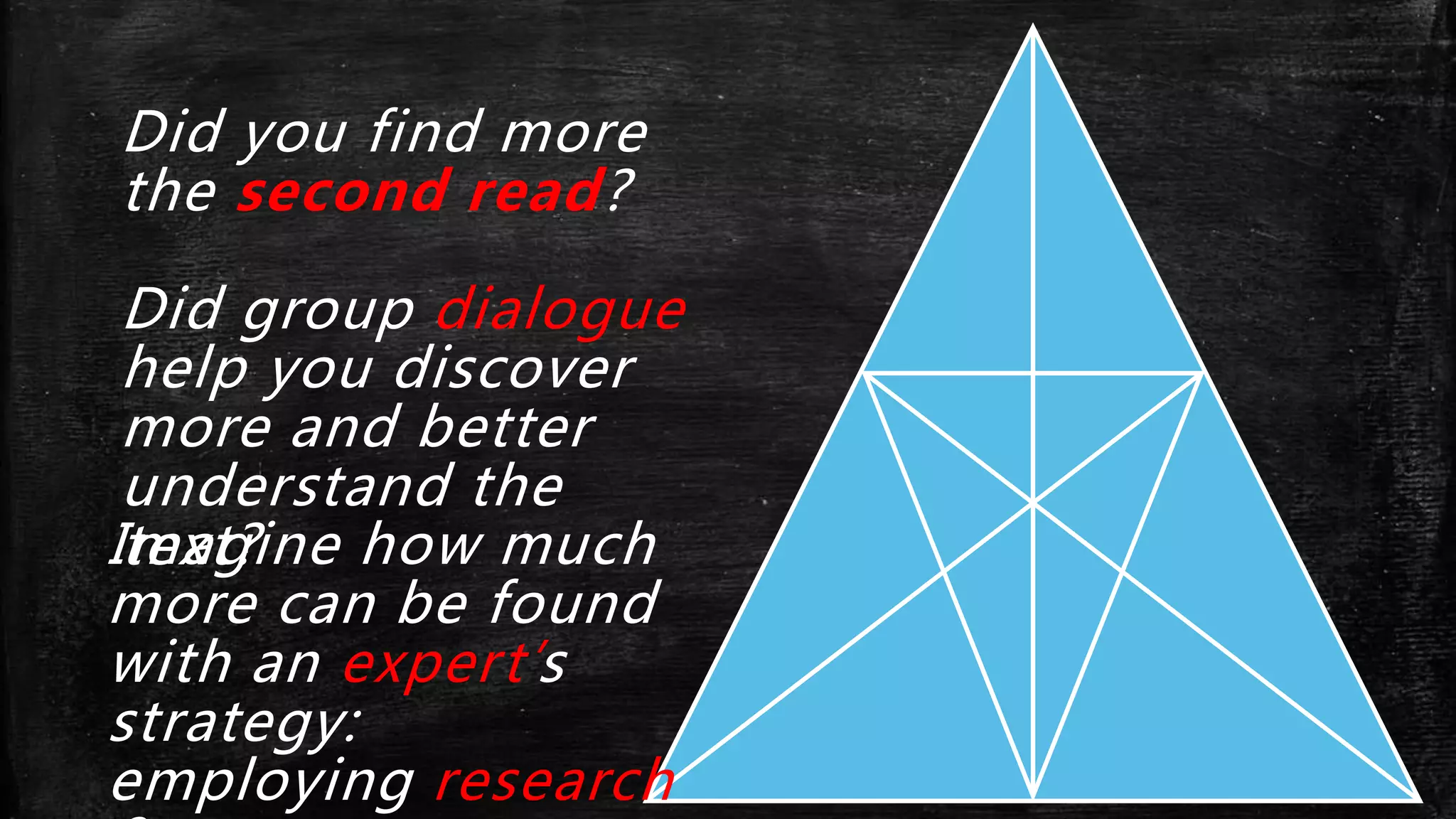
How many
triangles
are there in
this
image?
Thought Experiment #2.2
Instructions: try it again in groups
– Write down the number of triangles in the image
– Use the second sheet provided if necessary
– All group members must be able to show how to find all
counted triangles—be able to prove it!
– You will have three minutes
Did you find more
the second read?
Did group dialogue
help you discover
more and better
understand the
text?Imagine how much

more can be found
with an expert’s
strategy:
employing research
The Triangle
▪ Cognitive Models
– Focus of attention
– Working memory
– Semantic comprehension
▪ Pedagogical Foci
– Close reading
– Iterative reading
– Multiple perspectives
– Teaching as learning
– Dialogue as discovery
Thought Experiment #3
Instructions:
– This is a competition. (against?)
– Only the group that gets the most correct receives a prize
– I will only give instructions once: all questions thereafter will
be answered with the same question
– Consider the story being told: Why this story & right now?
– You will have five minutes to complete the task
“The Parable of the Onion”
a revised version from Dostoevsky’s
The Brothers Karamazov
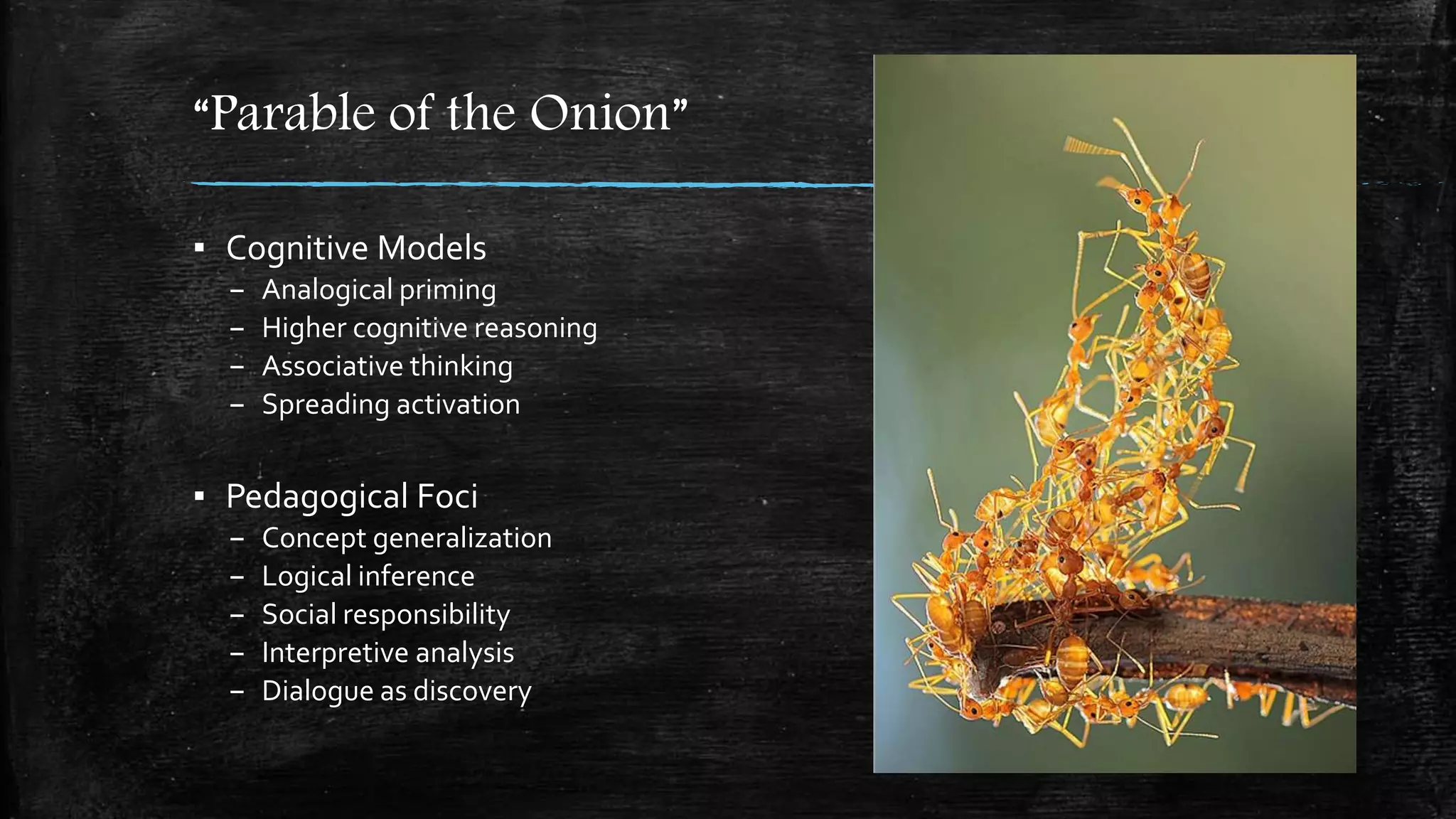
“Parable of the Onion”
▪ Cognitive Models
– Analogical priming
– Higher cognitive reasoning
– Associative thinking
– Spreading activation
▪ Pedagogical Foci
– Concept generalization
– Logical inference
– Social responsibility
– Interpretive analysis
– Dialogue as discovery
Thought Experiment #4
Instructions:
– Assess your knowledge: “confidence level”
▪ Rate from 1 (no confidence) to 10 (certainty)
– Describe & define in detail what a zipper is & how it works
as if you are tasked with explaining it for an encyclopedia
– You have three minutes
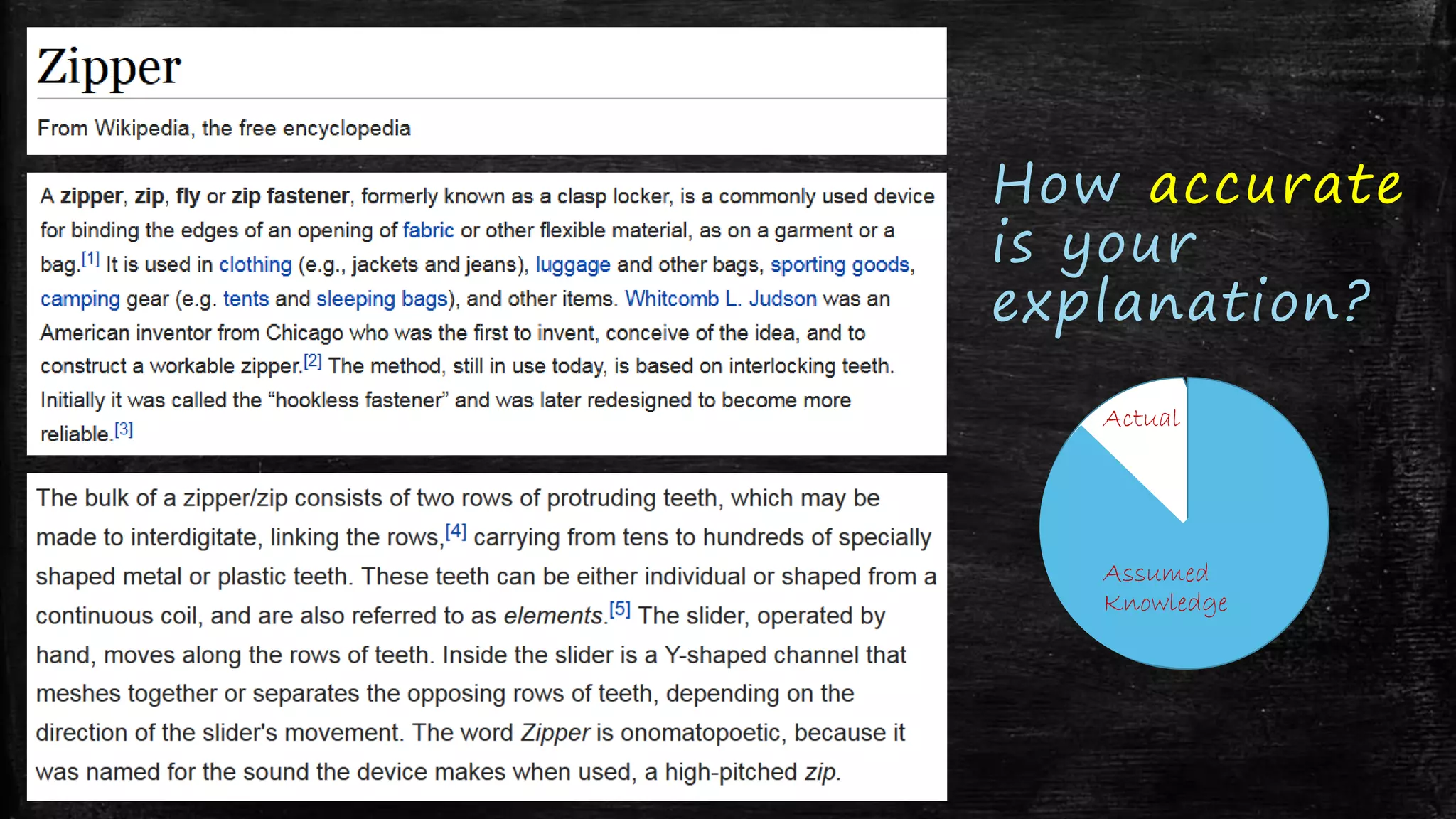
How accurate
is your
explanation?
Actual
Assumed
Knowledge
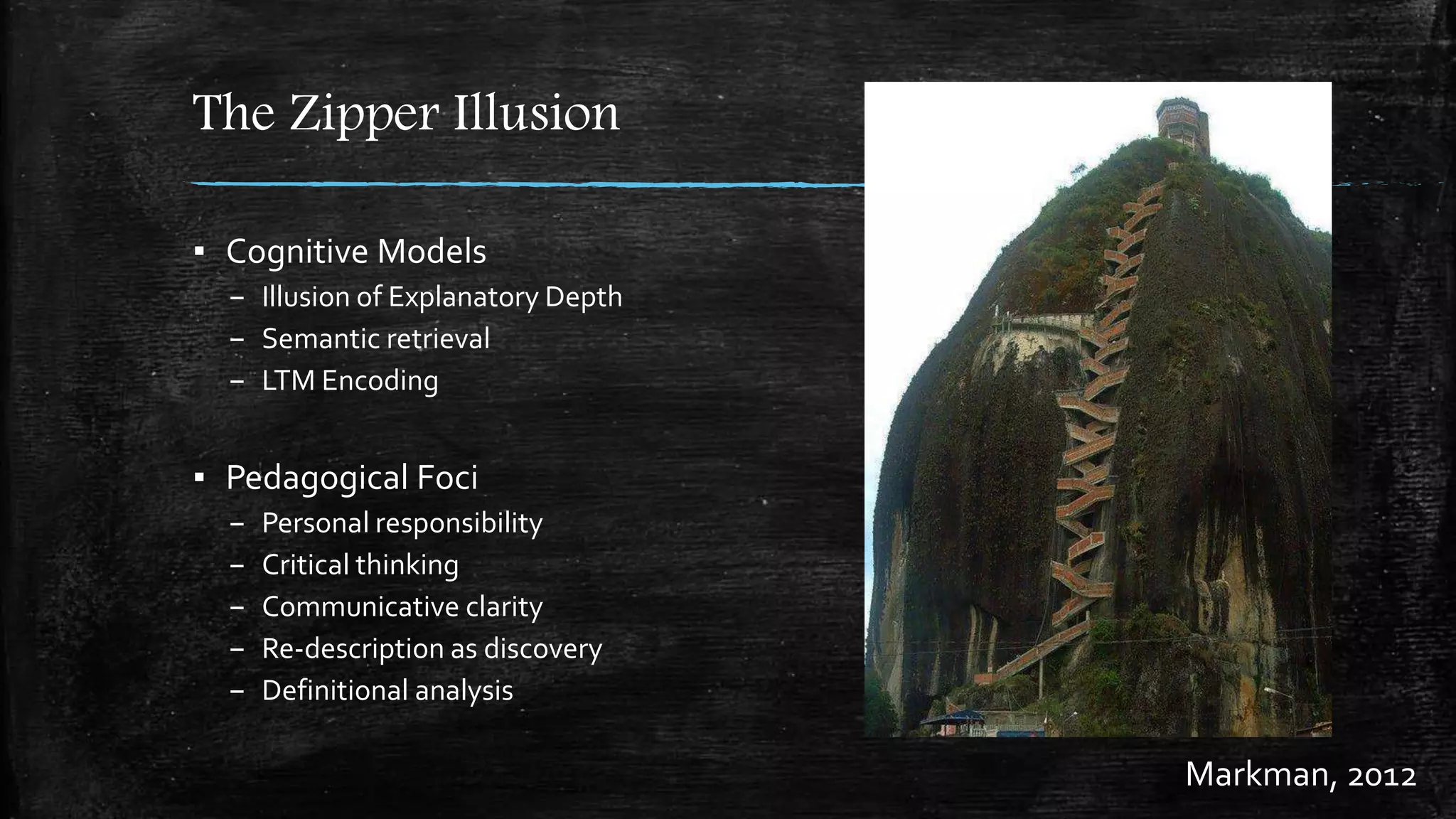
The Zipper Illusion
▪ Cognitive Models
– Illusion of Explanatory Depth
– Semantic retrieval
– LTM Encoding
▪ Pedagogical Foci
– Personal responsibility
– Critical thinking
– Communicative clarity
– Re-description as discovery
– Definitional analysis
Markman, 2012
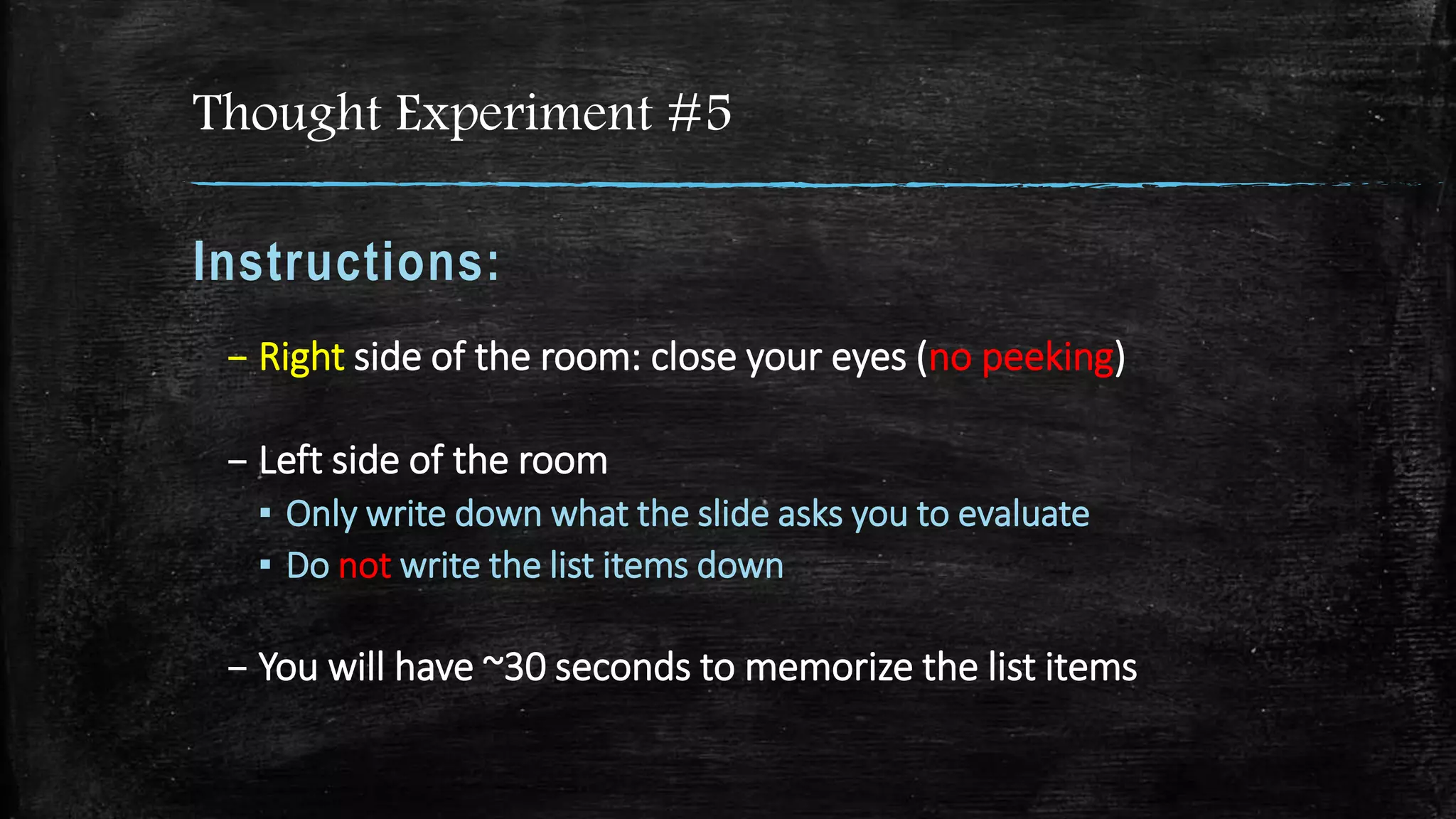
Thought Experiment #5
Instructions:
– Left side of the room: close your eyes (no peeking)
– Right side of the room
▪ Only write down what the slide asks you to evaluate
▪ Do not write the list items down
– You will have ~30 seconds to memorize the list items
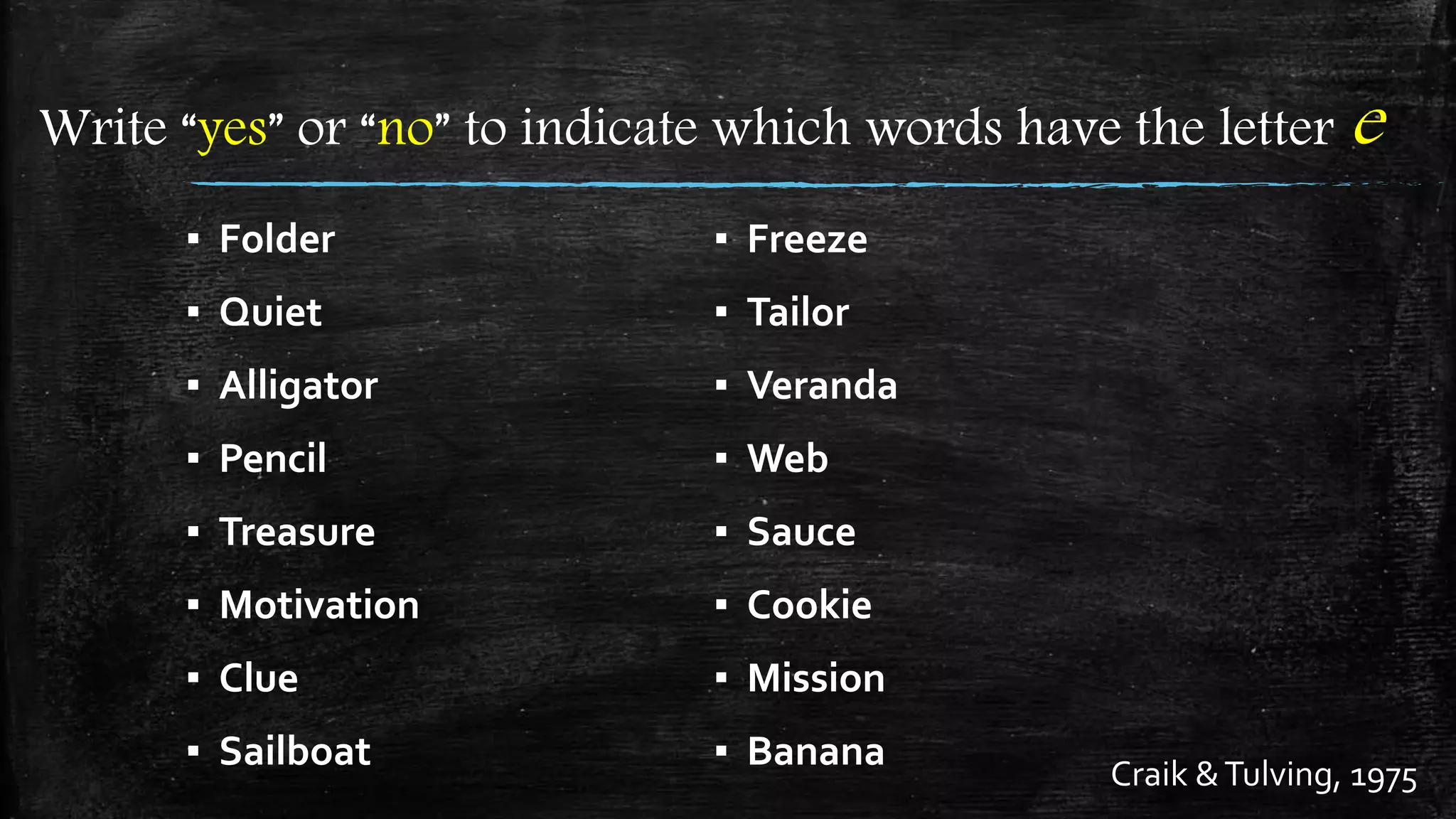
Write “yes” or “no” to indicate which words have the letter e
▪ Folder
▪ Quiet
▪ Alligator
▪ Pencil
▪ Treasure
▪ Motivation
▪ Clue
▪ Sailboat Craik &Tulving, 1975
▪ Freeze
▪ Tailor
▪ Veranda
▪ Web
▪ Sauce
▪ Cookie
▪ Mission
▪ Banana
Thought Experiment #5
Instructions:
Write down as many items
as you can remember
Thought Experiment #5
Instructions:
– Right side of the room: close your eyes (no peeking)
– Left side of the room
▪ Only write down what the slide asks you to evaluate
▪ Do not write the list items down
– You will have ~30 seconds to memorize the list items
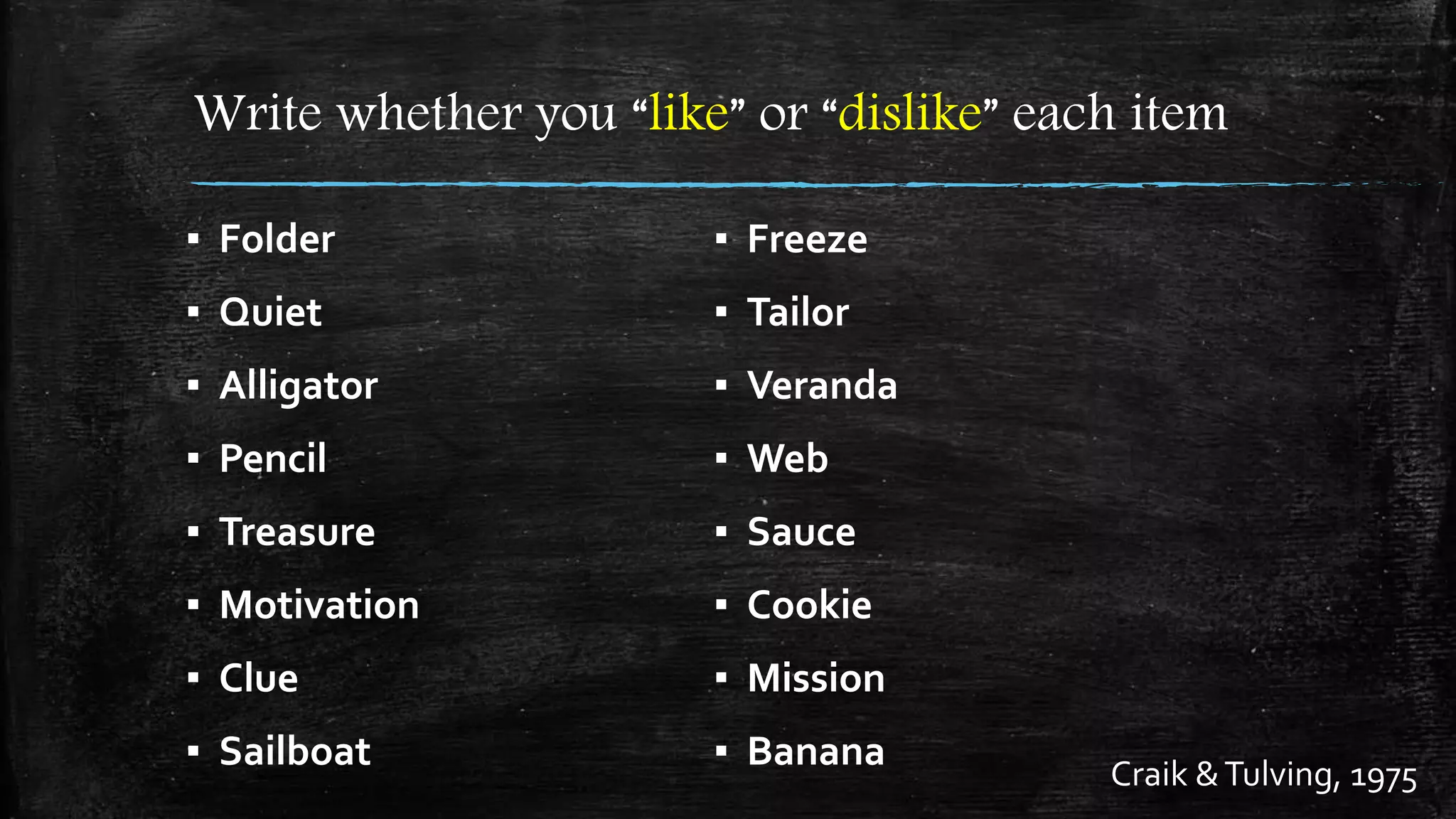
Write whether you “like” or “dislike” each item
▪ Folder
▪ Quiet
▪ Alligator
▪ Pencil
▪ Treasure
▪ Motivation
▪ Clue
▪ Sailboat
▪ Freeze
▪ Tailor
▪ Veranda
▪ Web
▪ Sauce
▪ Cookie
▪ Mission
▪ Banana Craik &Tulving, 1975
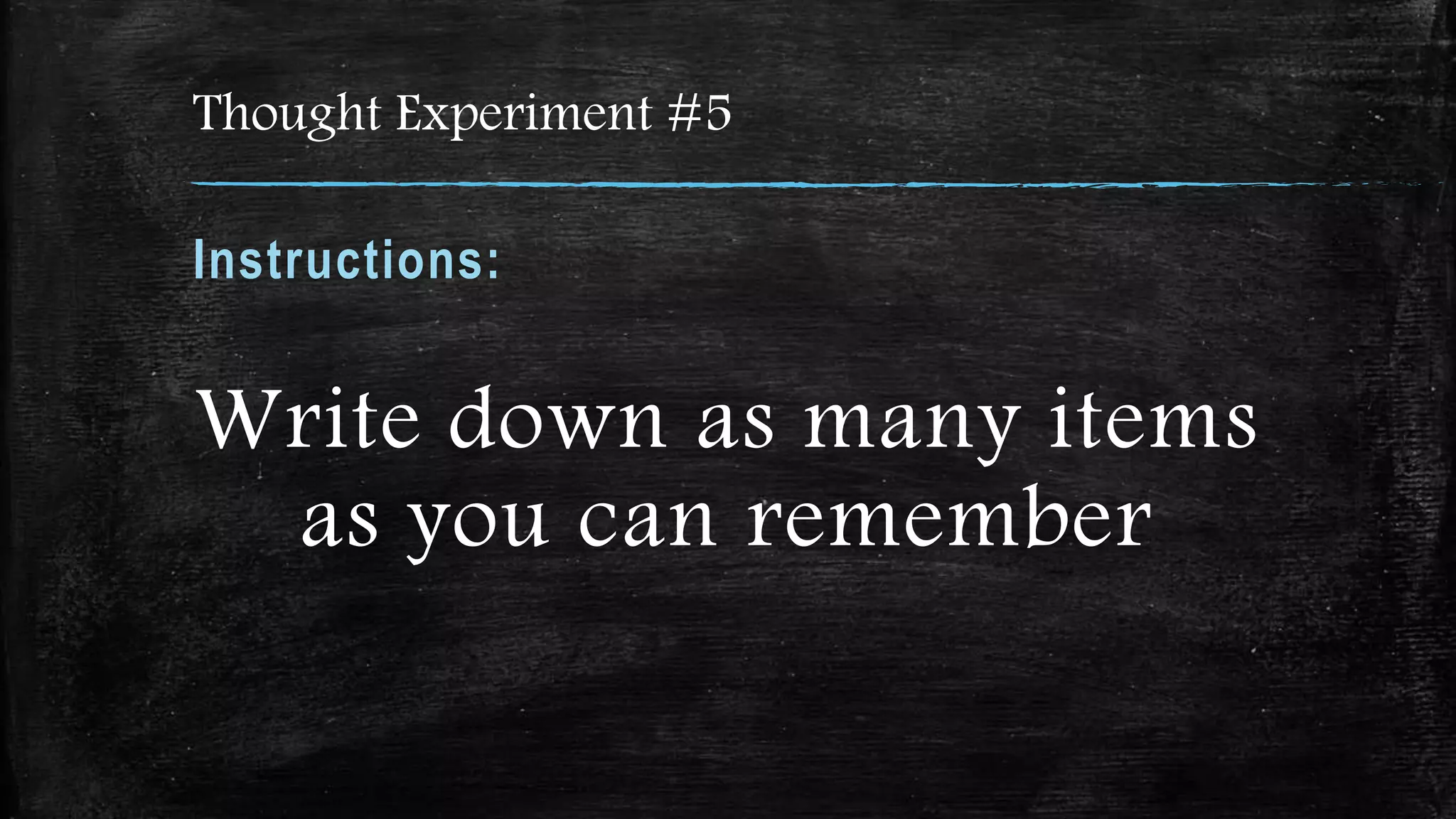
Thought Experiment #5
Instructions:
Write down as many items
as you can remember
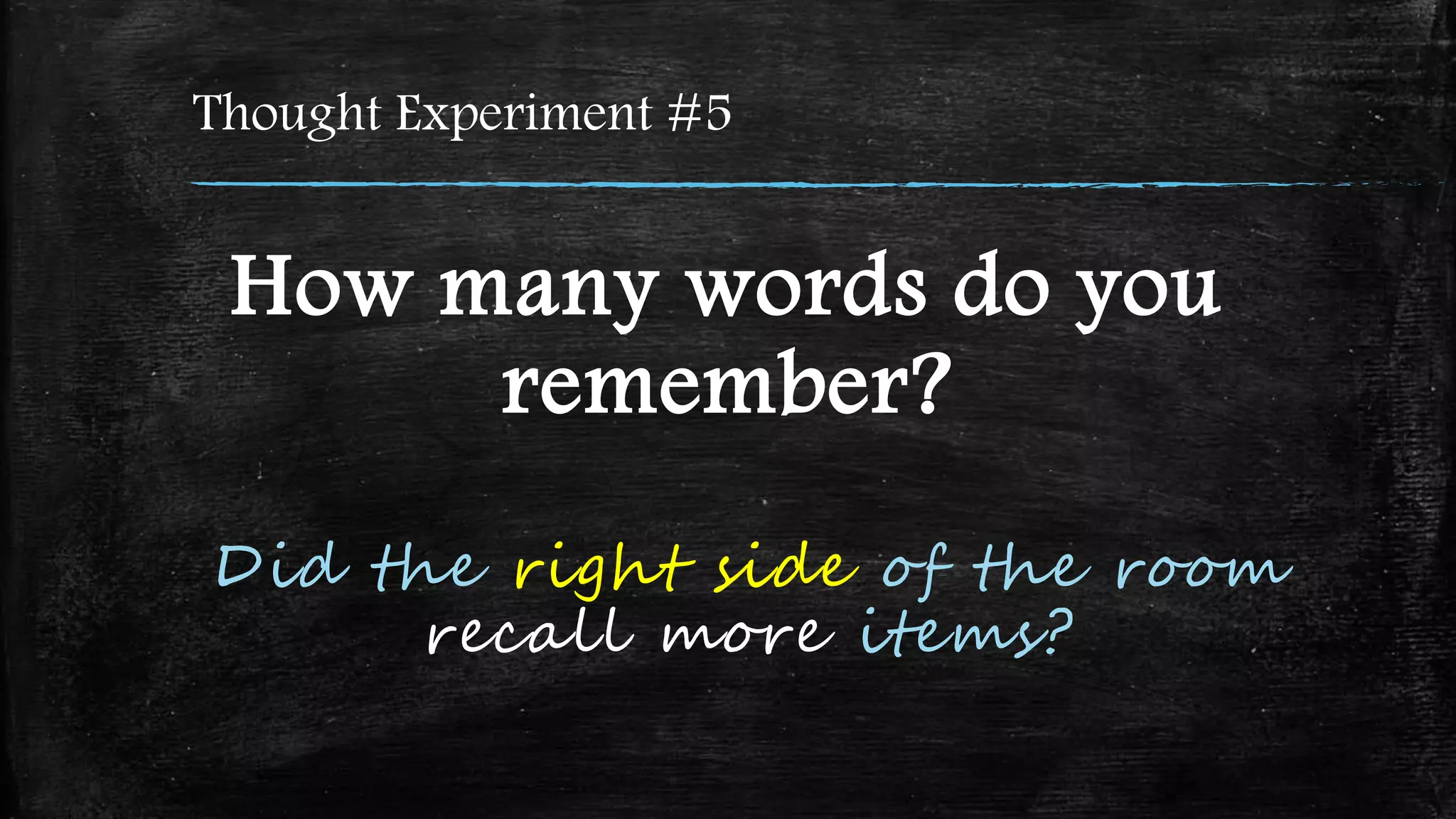
Thought Experiment #5
How many words do you
remember?
Did the right side of the room
recall more items?
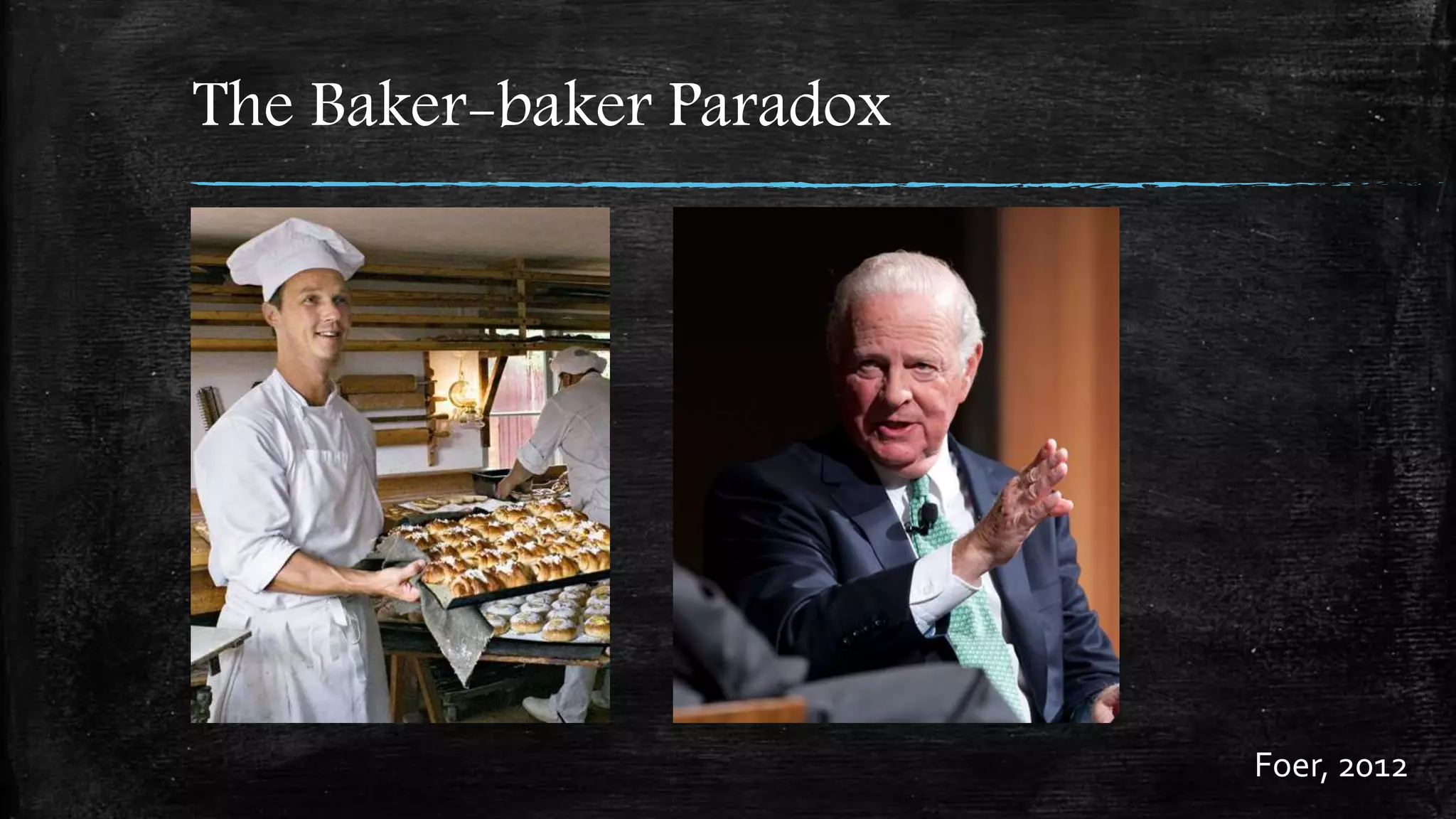
The Baker-baker Paradox
Foer, 2012
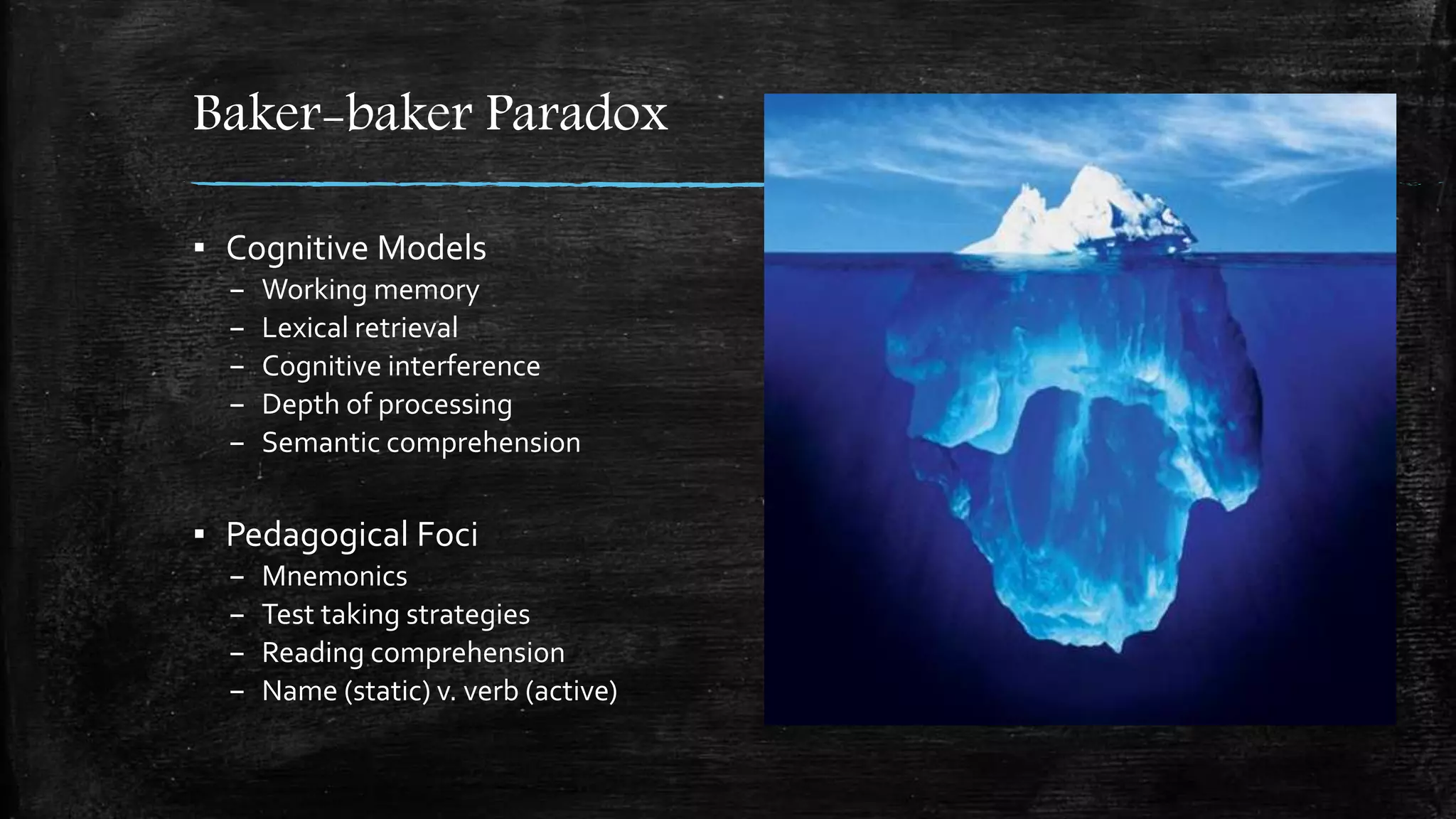
Baker-baker Paradox
▪ Cognitive Models
– Working memory
– Lexical retrieval
– Cognitive interference
– Depth of processing
– Semantic comprehension
▪ Pedagogical Foci
– Mnemonics
– Test taking strategies
– Reading comprehension
– Name (static) v. verb (active)
Other Brain & Behavioral Informed Strategies
Rule of Threes (Markman, 2012)
End Summaries (Markman, 2012)
Testing Effects (Godden & Baddeley, 1975; Reodriger
& Karpicke, 2006a & 2006b)
Transfer Appropriate Processing (Morris et al.,
1977)
Spreading Activation Theory (Collins & Loftus, 1975)
Expanding Retrieval (Landauer,T. K. & Bjork, R. A. ,
1978)
Take Away: Employ Experimentation
Much research already exists about how separate brain
systems/modules operate.To benefit, we need to know it.
▪ Doing so means that by staying informed, reading about findings,
and identifying models that predictably describe optimal cognitive
function in learning and memory, teachers can turn experiment
methods from studies into types of lesson plans & activities.
By doing this, there is more overlap between what we know works
and what we need students to know. Let the science work for you.
Questions?
Contact information: AmandaPreston@dcccd.edu
Website: http://thepoetsglass.com
Twitter: @thepoetsglass Facebook: Ms.Amanda.Preston
References
Bunge, S.A. & Wright, S.B. (2007) Neurodevelopmental changes in working memory and cognitive control.
Current Opinion in Neurobiology, 17(2): 243-50.
Bunge S.A., Wendelken C., Badre D., Wagner A.D. (2005) Analogical reasoning and prefrontal cortex: evidence for
separable retrieval and integration mechanisms. Cereb Cortex. 2005 Mar;15(3):239-49. Epub 2004 Jul 6.
Christodoulou, J.A. “The Neuroscience of Reading: Using Research to Understand Reading Development and
Difficulties.” Focused, Organized Minds: Using Brain Science to Engage Attention in a Distracted World. Fall
Conference: Boston, Nov. 2014. Learning & the Brain Society.
Christodoulou, J.A., Walker, L.M., Del Tufo, S.N., Katzir, T., Gabrieli, J.D.E., Whitfield-Gabrieli, S., & Chang, B.S.
(2012) Abnormal structural and functional connectivity in gray matter heterotopia. Epilepsia, 53(6): 1024-32.
Collins, Allan M.; Loftus, Elizabeth F., "A spreading-activation theory of semantic processing", Psychological
Review. 1975 Nov Vol 82(6) 407-428.
Craik, Fergus I. M.& Tulving, Endel (1975). "Depth of processing and the retention of words in episodic memory"
(PDF). Journal of Experimental Psychology: General 104 (3): 268–294. doi:10.1037/0096-3445.104.3.268.
Foerde, K., Race, E., Verfaellie, M., & Shohamy, D. (2013) A Role for the Medial Temporal Lobe in Feedback-Driven
Learning: Evidence from Amnesia. The Journal for Neuroscience, 33(13): 5698-704.
References
Gabrieli, J.D.E., Christodoulou, J.A., O’Loughlin, T., & Eddy, M. (2010) The reading brain. In D. Sousa (Ed.), Mind,
Brain, and Education: Neuroscience implications for the classroom. Bloomington, IN; Solution Tree Press.
Godden, D; Baddeley, A. (1975). "Context dependent memory in two natural environments". British Journal of
Psychology 66 (3): 325–331. doi:10.1111/j.2044-8295.1975.tb01468.x
Markman, A. (2012) Smart Thinking. London, England: Perigee Book.
Thomson, R.F. & Kim, J.J. (1996) A tentative taxonomy of long-term memory and associated brain structures.
Memory systems in the brain and localization of a memory. Epub. PNASUSA 93(24).
Morris, C. D.; Bransford, J. D.; Franks, J. J. (1977). "Levels of processing versus transfer appropriate processing".
Journal of Verbal Learning and Verbal Behavior 16: 519–533. doi:10.1016/s0022-5371(77)80016-9
Roediger, H. L., & Karpicke, J. D. (2006a). The power of testing memory: Basic research and implications for
educational practice. Perspectives on Psychological Science, 1, 181–210.
Roediger, H. L., & Karpicke, J. D. (2006b). Test-enhanced learning: Taking memory tests improves long-term
retention. Psychological Science, 17, 249–55.
Landauer, T. K., & Bjork, R. A. (1978). Optimum rehearsal patterns and name learning. In M. M. Gruneberg, P. E.
Morris, & R. N. Sykes (Eds.), Practical aspects of memory, 625–632). London: Academic Press.

What cognitive neuroscience can do for English professors

  • 1.
    What Cognitive Neuroscience CanDo for English Professors Amanda Preston, MA English & Developmental English Professor, Eastfield College Applied Cognition & Neuroscience Graduate Student, UT Dallas
  • 2.
    Brain & BehavioralScience: A Brief Address ▪ How and where language processing works in the brain ▪ Language development & higher cognitive functions ▪ Memory and attention systems ▪ Problem solving mental confusion ▪ Analogical priming—teaching versus telling
  • 3.
    Language Processing inthe Brain e.g.Wernicke, 1886; Broca, 1861; Zaidel, 1978; Rasmussen & Milner, 1977 Broca’s Area Wernicke’s Area Left Lateralization
  • 4.
    Current Research: RightHemisphere Recruitment Noppeney et al., 2005; Christodoulou et al.,2013 Hemispherectomy studies: Implications for revised learning strategies with adult learners and dyslexics.
  • 5.
    Developmental Differences Bunge, S.A.&Wright, S.B. (2007) Problem solvingL a n g u a g e
  • 6.
    Active Learning Systems:Memory & Attention Thomson, R.F. & Kim, J.J., 1996
  • 7.
    Growth Factor: Confusion& Arborization Hebbian Learning describes an increase in connectivity among neurons.This arborization occurs through repeated activation.The more frequently those neural patterns fire, the more the neural architecture changes: new dendritic branches, new synapses.
  • 8.
    Analogical Reasoning: Self-directedLearning Figure 3. Group-averaged activations for contrasts of interest are displayed. (A) Coronal slices through a canonical brain display regions activated by analogy and semantic trials relative to fixation. Areas of overlap between the two contrast maps appear yellow. (B) Shown here on a rendered canonical brain are regions activated to a greater extent by analogy relative to semantic trials, by low relative to high Associative Strength trials, and by unrelated- relative to related-analogy trials. (Bunge et al., 2005)
  • 9.
    Classroom Implementation Strategies Fromtheoretical models to instructional practice
  • 10.
    Thought Experiment #1 Instructions: –30 seconds to study the image – Do not write anything down – Count backwards from 98 by sevens – Write down all the items you recall There will be a quiz!
  • 12.
    Thought Experiment #1 Instructions: –Count backwards from 98 by sevens – Once you reach zero, write down everything you remember How well do you know the text?
  • 13.
    Thought Experiment #1 Afew simple comprehension questions after a first read of the text: ▪ How many windows are there? ▪ What animal is in the room? ▪ What color are the flowers on the table? ▪ Where do you think this house is? (what’s outside?) ▪ How many lamps are in the room? ▪ What shape is the window on the back kitchen wall? ▪ What color is the fireplace?
  • 14.
    The Living Room ▪Cognitive Models – False memories – Focus of attention – Task SwitchingCost – STM v. LTM ▪ Pedagogical Foci – Description – Attention to details – (re) Reading a text – Test-taking strategies
  • 15.
    Thought Experiment #2 Instructions: –Observe the image closely – Count the number of triangles – You many write on the sheet provided – You have to be able to show how you found each triangle – You will have three minutes
  • 16.
  • 17.
    Thought Experiment #2.2 Instructions:try it again in groups – Write down the number of triangles in the image – Use the second sheet provided if necessary – All group members must be able to show how to find all counted triangles—be able to prove it! – You will have three minutes
  • 18.
    Did you findmore the second read? Did group dialogue help you discover more and better understand the text?Imagine how much more can be found with an expert’s strategy: employing research
  • 19.
    The Triangle ▪ CognitiveModels – Focus of attention – Working memory – Semantic comprehension ▪ Pedagogical Foci – Close reading – Iterative reading – Multiple perspectives – Teaching as learning – Dialogue as discovery
  • 20.
    Thought Experiment #3 Instructions: –This is a competition. (against?) – Only the group that gets the most correct receives a prize – I will only give instructions once: all questions thereafter will be answered with the same question – Consider the story being told: Why this story & right now? – You will have five minutes to complete the task
  • 21.
    “The Parable ofthe Onion” a revised version from Dostoevsky’s The Brothers Karamazov
  • 22.
    “Parable of theOnion” ▪ Cognitive Models – Analogical priming – Higher cognitive reasoning – Associative thinking – Spreading activation ▪ Pedagogical Foci – Concept generalization – Logical inference – Social responsibility – Interpretive analysis – Dialogue as discovery
  • 23.
    Thought Experiment #4 Instructions: –Assess your knowledge: “confidence level” ▪ Rate from 1 (no confidence) to 10 (certainty) – Describe & define in detail what a zipper is & how it works as if you are tasked with explaining it for an encyclopedia – You have three minutes
  • 24.
  • 25.
    The Zipper Illusion ▪Cognitive Models – Illusion of Explanatory Depth – Semantic retrieval – LTM Encoding ▪ Pedagogical Foci – Personal responsibility – Critical thinking – Communicative clarity – Re-description as discovery – Definitional analysis Markman, 2012
  • 26.
    Thought Experiment #5 Instructions: –Left side of the room: close your eyes (no peeking) – Right side of the room ▪ Only write down what the slide asks you to evaluate ▪ Do not write the list items down – You will have ~30 seconds to memorize the list items
  • 27.
    Write “yes” or“no” to indicate which words have the letter e ▪ Folder ▪ Quiet ▪ Alligator ▪ Pencil ▪ Treasure ▪ Motivation ▪ Clue ▪ Sailboat Craik &Tulving, 1975 ▪ Freeze ▪ Tailor ▪ Veranda ▪ Web ▪ Sauce ▪ Cookie ▪ Mission ▪ Banana
  • 28.
    Thought Experiment #5 Instructions: Writedown as many items as you can remember
  • 29.
    Thought Experiment #5 Instructions: –Right side of the room: close your eyes (no peeking) – Left side of the room ▪ Only write down what the slide asks you to evaluate ▪ Do not write the list items down – You will have ~30 seconds to memorize the list items
  • 30.
    Write whether you“like” or “dislike” each item ▪ Folder ▪ Quiet ▪ Alligator ▪ Pencil ▪ Treasure ▪ Motivation ▪ Clue ▪ Sailboat ▪ Freeze ▪ Tailor ▪ Veranda ▪ Web ▪ Sauce ▪ Cookie ▪ Mission ▪ Banana Craik &Tulving, 1975
  • 31.
    Thought Experiment #5 Instructions: Writedown as many items as you can remember
  • 32.
    Thought Experiment #5 Howmany words do you remember? Did the right side of the room recall more items?
  • 33.
  • 34.
    Baker-baker Paradox ▪ CognitiveModels – Working memory – Lexical retrieval – Cognitive interference – Depth of processing – Semantic comprehension ▪ Pedagogical Foci – Mnemonics – Test taking strategies – Reading comprehension – Name (static) v. verb (active)
  • 35.
    Other Brain &Behavioral Informed Strategies Rule of Threes (Markman, 2012) End Summaries (Markman, 2012) Testing Effects (Godden & Baddeley, 1975; Reodriger & Karpicke, 2006a & 2006b) Transfer Appropriate Processing (Morris et al., 1977) Spreading Activation Theory (Collins & Loftus, 1975) Expanding Retrieval (Landauer,T. K. & Bjork, R. A. , 1978)
  • 36.
    Take Away: EmployExperimentation Much research already exists about how separate brain systems/modules operate.To benefit, we need to know it. ▪ Doing so means that by staying informed, reading about findings, and identifying models that predictably describe optimal cognitive function in learning and memory, teachers can turn experiment methods from studies into types of lesson plans & activities. By doing this, there is more overlap between what we know works and what we need students to know. Let the science work for you.
  • 37.
    Questions? Contact information: AmandaPreston@dcccd.edu Website:http://thepoetsglass.com Twitter: @thepoetsglass Facebook: Ms.Amanda.Preston
  • 38.
    References Bunge, S.A. &Wright, S.B. (2007) Neurodevelopmental changes in working memory and cognitive control. Current Opinion in Neurobiology, 17(2): 243-50. Bunge S.A., Wendelken C., Badre D., Wagner A.D. (2005) Analogical reasoning and prefrontal cortex: evidence for separable retrieval and integration mechanisms. Cereb Cortex. 2005 Mar;15(3):239-49. Epub 2004 Jul 6. Christodoulou, J.A. “The Neuroscience of Reading: Using Research to Understand Reading Development and Difficulties.” Focused, Organized Minds: Using Brain Science to Engage Attention in a Distracted World. Fall Conference: Boston, Nov. 2014. Learning & the Brain Society. Christodoulou, J.A., Walker, L.M., Del Tufo, S.N., Katzir, T., Gabrieli, J.D.E., Whitfield-Gabrieli, S., & Chang, B.S. (2012) Abnormal structural and functional connectivity in gray matter heterotopia. Epilepsia, 53(6): 1024-32. Collins, Allan M.; Loftus, Elizabeth F., "A spreading-activation theory of semantic processing", Psychological Review. 1975 Nov Vol 82(6) 407-428. Craik, Fergus I. M.& Tulving, Endel (1975). "Depth of processing and the retention of words in episodic memory" (PDF). Journal of Experimental Psychology: General 104 (3): 268–294. doi:10.1037/0096-3445.104.3.268. Foerde, K., Race, E., Verfaellie, M., & Shohamy, D. (2013) A Role for the Medial Temporal Lobe in Feedback-Driven Learning: Evidence from Amnesia. The Journal for Neuroscience, 33(13): 5698-704.
  • 39.
    References Gabrieli, J.D.E., Christodoulou,J.A., O’Loughlin, T., & Eddy, M. (2010) The reading brain. In D. Sousa (Ed.), Mind, Brain, and Education: Neuroscience implications for the classroom. Bloomington, IN; Solution Tree Press. Godden, D; Baddeley, A. (1975). "Context dependent memory in two natural environments". British Journal of Psychology 66 (3): 325–331. doi:10.1111/j.2044-8295.1975.tb01468.x Markman, A. (2012) Smart Thinking. London, England: Perigee Book. Thomson, R.F. & Kim, J.J. (1996) A tentative taxonomy of long-term memory and associated brain structures. Memory systems in the brain and localization of a memory. Epub. PNASUSA 93(24). Morris, C. D.; Bransford, J. D.; Franks, J. J. (1977). "Levels of processing versus transfer appropriate processing". Journal of Verbal Learning and Verbal Behavior 16: 519–533. doi:10.1016/s0022-5371(77)80016-9 Roediger, H. L., & Karpicke, J. D. (2006a). The power of testing memory: Basic research and implications for educational practice. Perspectives on Psychological Science, 1, 181–210. Roediger, H. L., & Karpicke, J. D. (2006b). Test-enhanced learning: Taking memory tests improves long-term retention. Psychological Science, 17, 249–55. Landauer, T. K., & Bjork, R. A. (1978). Optimum rehearsal patterns and name learning. In M. M. Gruneberg, P. E. Morris, & R. N. Sykes (Eds.), Practical aspects of memory, 625–632). London: Academic Press.