Adapted from Michigan State University College
of Osteopathic Medicine
Human
Memory
Types of Memory
LongTerm
ShortTerm
Sensory
• Myth: When a teacher says, “don’t memorize this,”
it means stop paying attention because this won’t be
on the exam…
• Reality check: WRONG! This is an unfortunate and
all-too-common source of teacher-student
miscommunication. What they almost always mean
is that you should understand it, not just memorize
it for later regurgitation. More than likely, it will be
on the exam!
Mythbusters
BUILDING A
MEMORY
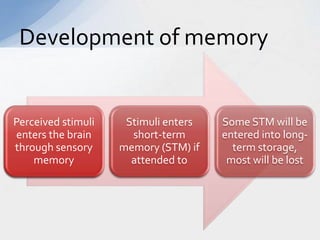
Perceived stimuli
enters the brain
through sensory
memory
Stimuli enters
short-term
memory (STM) if
attended to
Some STM will be
entered into long-
term storage,
most will be lost
Development of memory
IMPROVING LONG-
TERM MEMORY
RETENTION AND
RECALL
• Remembering involves replicating a pattern of
neural activity. This is accomplished by the
“strength” of neural connections.
• Use study methods that produce deep learning and
doesn’t just scratch the surface like memorization.
*Remember: memorizing and learning are NOT
synonymous.
Study Tips
Make sense of new information and develop an organizational
scheme/framework. Information you understand rarely needs to be
memorized
Link new
information to
things you
already know
("elaborative
rehearsal")
Deep Learning
• Actively participate in your own learning
(“generation effect”)
Retention and recall are improved when you actively
participate in the creation of your own knowledge.
Deep Learning
• Whenever possible, study in an environment that
is similar to the testing environment (“state- &
context dependent memory”)
Recall is enhanced when the environmental context is similar
during both the encoding (learning) and recall phases, and is one
reason why studying in a quiet place is generally preferable to a
noisy one.
Deep Learning
• Spread studying out over several days, rather
than cramming (“distributed effort”)
Example: It is more effective to spend time studying 10 hours with
5 2-hour sessions, or even 2 5-hour sessions, spread out over two
or more days, than it is to spend one marathon 10-hour session.
Deep Learning
• Avoid multitasking when learning difficult or
dense material.
Research has found that although multitasking does not impact
recall, it is extremely detrimental to the encoding process.
Multitasking divides attention, takes up valuable short-term
memory space, and negatively impacts on LTM formation.
Deep Learning
• Review information you’re trying to memorize
right before you go to sleep.
Deep sleep plays an important role in memory consolidation. This
is a good time to spend a few minutes reviewing a chart or going
through some flashcards. To further enhance your memory, try to
recall the information shortly after you wake up.
Deep Learning
What are the take home messages?
" Pay attention to the learning task at hand
and avoid distractions
" Get 7-8 hours of quality sleep on a regular
basis
" Incorporate “active recall” into your study
plan
" Deliberately link new information to
existing knowledge
" Adopt a deep approach to learning
Take Home Messages
USEFUL RESOURCES RELATED TO MEMORY AND LEARNING
• Memory http://www.human-memory.net/index.html
Memory Techniques:
http://www.mindtools.com/pages/main/newMN_ISS.htm#me
m
How to Improve Your Memory:
http://www.helpguide.org/life/improving_memory.htm
• Enhancing Memory
http://www.sparknotes.com/psychology/psych101/memory/se
ction4.rhtml
• Memory Curve
http://www.com.msu.edu/Students/Academic_Development/
memory_curve.pdf
• Optimal Memory Curve
http://www.com.msu.edu/Students/Academic_Development/o
ptimal_memory_curve.pdf
• http://com.msu.edu/Students/Academic_Guidance/long_term
_retention_recall.pdf
Sources

Human memory

  • 1.
    Adapted from MichiganState University College of Osteopathic Medicine Human Memory
  • 2.
  • 3.
    • Myth: Whena teacher says, “don’t memorize this,” it means stop paying attention because this won’t be on the exam… • Reality check: WRONG! This is an unfortunate and all-too-common source of teacher-student miscommunication. What they almost always mean is that you should understand it, not just memorize it for later regurgitation. More than likely, it will be on the exam! Mythbusters
  • 4.
  • 5.
    Perceived stimuli enters thebrain through sensory memory Stimuli enters short-term memory (STM) if attended to Some STM will be entered into long- term storage, most will be lost Development of memory
  • 6.
  • 7.
    • Remembering involvesreplicating a pattern of neural activity. This is accomplished by the “strength” of neural connections. • Use study methods that produce deep learning and doesn’t just scratch the surface like memorization. *Remember: memorizing and learning are NOT synonymous. Study Tips
  • 8.
    Make sense ofnew information and develop an organizational scheme/framework. Information you understand rarely needs to be memorized Link new information to things you already know ("elaborative rehearsal") Deep Learning
  • 9.
    • Actively participatein your own learning (“generation effect”) Retention and recall are improved when you actively participate in the creation of your own knowledge. Deep Learning
  • 10.
    • Whenever possible,study in an environment that is similar to the testing environment (“state- & context dependent memory”) Recall is enhanced when the environmental context is similar during both the encoding (learning) and recall phases, and is one reason why studying in a quiet place is generally preferable to a noisy one. Deep Learning
  • 11.
    • Spread studyingout over several days, rather than cramming (“distributed effort”) Example: It is more effective to spend time studying 10 hours with 5 2-hour sessions, or even 2 5-hour sessions, spread out over two or more days, than it is to spend one marathon 10-hour session. Deep Learning
  • 12.
    • Avoid multitaskingwhen learning difficult or dense material. Research has found that although multitasking does not impact recall, it is extremely detrimental to the encoding process. Multitasking divides attention, takes up valuable short-term memory space, and negatively impacts on LTM formation. Deep Learning
  • 13.
    • Review informationyou’re trying to memorize right before you go to sleep. Deep sleep plays an important role in memory consolidation. This is a good time to spend a few minutes reviewing a chart or going through some flashcards. To further enhance your memory, try to recall the information shortly after you wake up. Deep Learning
  • 14.
    What are thetake home messages? " Pay attention to the learning task at hand and avoid distractions " Get 7-8 hours of quality sleep on a regular basis " Incorporate “active recall” into your study plan " Deliberately link new information to existing knowledge " Adopt a deep approach to learning Take Home Messages
  • 15.
    USEFUL RESOURCES RELATEDTO MEMORY AND LEARNING • Memory http://www.human-memory.net/index.html Memory Techniques: http://www.mindtools.com/pages/main/newMN_ISS.htm#me m How to Improve Your Memory: http://www.helpguide.org/life/improving_memory.htm • Enhancing Memory http://www.sparknotes.com/psychology/psych101/memory/se ction4.rhtml • Memory Curve http://www.com.msu.edu/Students/Academic_Development/ memory_curve.pdf • Optimal Memory Curve http://www.com.msu.edu/Students/Academic_Development/o ptimal_memory_curve.pdf • http://com.msu.edu/Students/Academic_Guidance/long_term _retention_recall.pdf Sources