

PRESENTED BY-KARISHMA SINGH
Unit -3 COGNITIVE PROCESS
Introduction
 The term cognition is used to refer processing
of information . In psychology it refer to
mental function / mental processes that
includes understanding making judgement
and taking decision .
Attention
 We are all familiar with the announcement
that starts with “your attention please”
before giving information at railways stations
and airports .We also use the termAttention
in our day today conversation.
Definition of attention
 a/c to collins and driver – as “selective activity
of consciousness”
 a/c to ross – the process of getting an object
of thoughts clearly before the mind”
 Dumyille – attention is the concentration of
consciousness upon one object rather than
upon another .
 These definition help us to understand that :
it’s a process , helps in awareness our
environment and its selective .
Characteristics of attention
 Selective mental activity
 Constantly shifts from object to another
 Focusing of cousciousness or particular object
Types/ varieties of
attention
 Voluntary (volitional )
 Involuntary ( non volitional )
 Habitual attending ( which we attend not
because of external compelling but because
of internal drives ,motives ,attitudes etc)
Cont…
 Volitional attention – its two types –
 implicit volitional attention – a single act of
will is responsible for arousing attention .
 Explicit volitional attention – attention is
obtained by repeated acts of will .
Cont…
 Invoulntary attention –with or without
making conscious effort on our part .for e.g
we give involunatry attention to loud sound
,bright light and strong odour.
 It is of two type : enforced and spontaneous
Uses of attention
 Provides strength and ability to continue the
task of cognitive function
 Helps in better organization of the perceptual
fields fro maximum clarity and understanding
 Mental alertness and preparedness .
 Provide deeper concentration .
Factors influencing or
determinants of attention
 Internal factors – which are present in the
individual and they can be subjective
 External factors –which are present in
enviroment
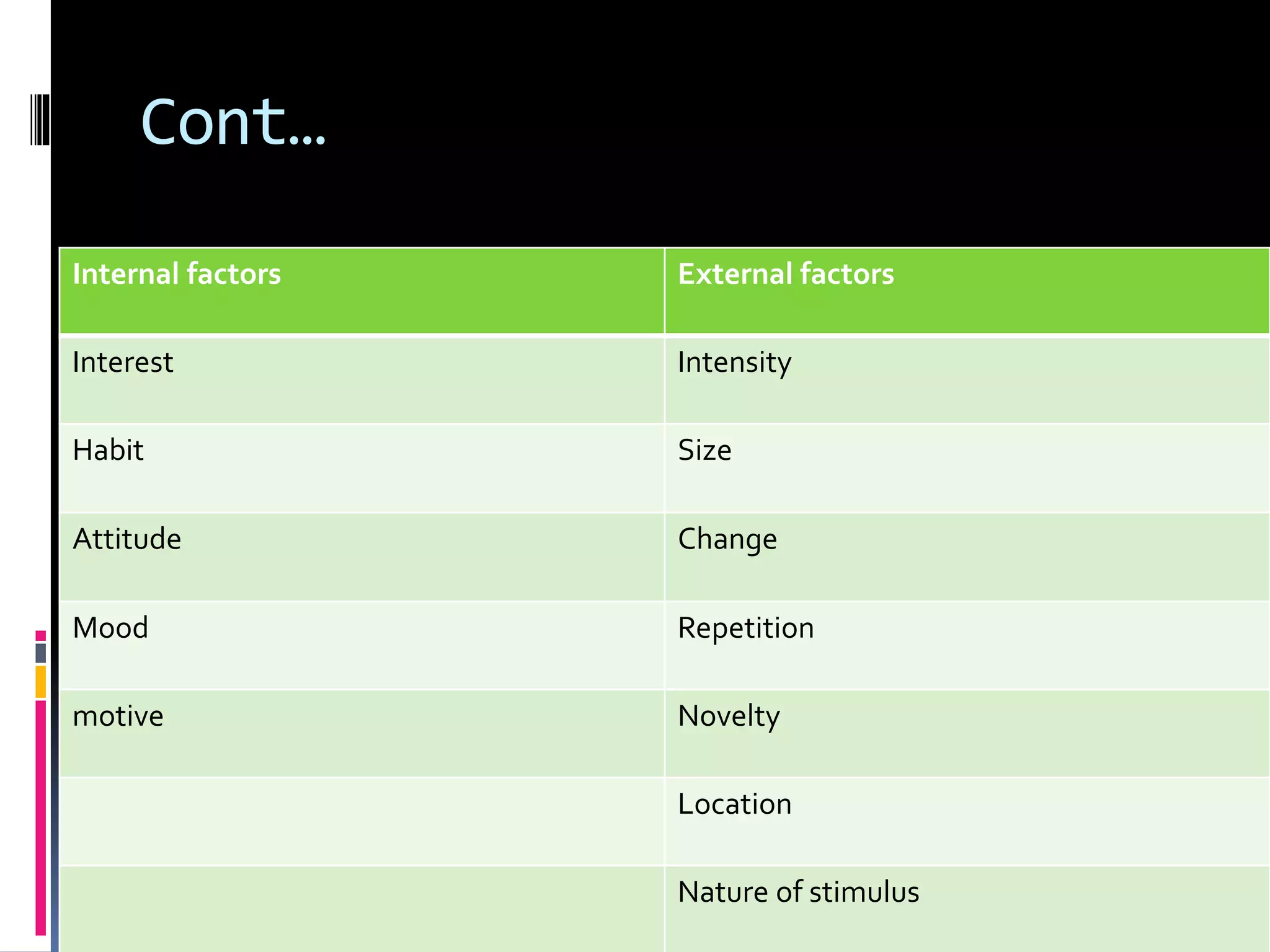
Cont…
Internal factors External factors
Interest Intensity
Habit Size
Attitude Change
Mood Repetition
motive Novelty
Location
Nature of stimulus
Duration and degree of
attention
 We have experienced that we cannot attend
to a certain stimulus for a long time . Our
attention is greatly affected by and
distributed among the stimulus around us.
Span of attention
 Span of visual attention
 Span of auditory attention
Cont…
 Duration of attention
 Shifting attention
 Division of attention
Importance of attention in
nursing profession
 It helps in mental alertness and preparedness
.
 It helps on focusing consciousness
 It create maximum clarity
 Provides strength and ability
Perception(initial response)
 Perception is the interpretation of sensory
stimuli ,which reach the sense organs and the
brain.
 Perception is very essential to deal with the
world around us as it influences our memory
,thinking ,reasoning and emotions etc.
Definition of perception
 A/c toWundt- perception is a complex mental
product of sensation images , feelings and
effect of past experience and learning .
 Or it can be define as – a mental process in
which sensory cues and relevant past
experience organize together to give us
meaningfulness to the perceived object .
Nature of perception
 Perception is a process
 Perception is an information extractor: –
 Perception is preparation to response
 Perception involves sensation
 Perception provides organization
 Perception is highly individualistics in nature
Principle of perception
 Principle of figure –ground relationship –in it
figure is perception in relationship to its
background .
Cont…
 Principle of grouping –perceiving things as
together while others as separate ,it helps in
improving our knowledge ,and also in
developing concepts . It depends
proximity/nearness ,similarity/ likeness ,
inclusiveness , continuity , closure ,simplicity.
 Principle of simplicity
 Principle of contour
 Principle of context
 Principle of adaptability
Factors influencing
perception
 Sense organs
 Brains
 Memory images of the past experience
 Personal interests and mind set
 Acquired interests
 Needs and desires.
Errors in perception
 Illusion –(mistaken perception )
 Hallucination (sensory perception in absence
of stimuli)
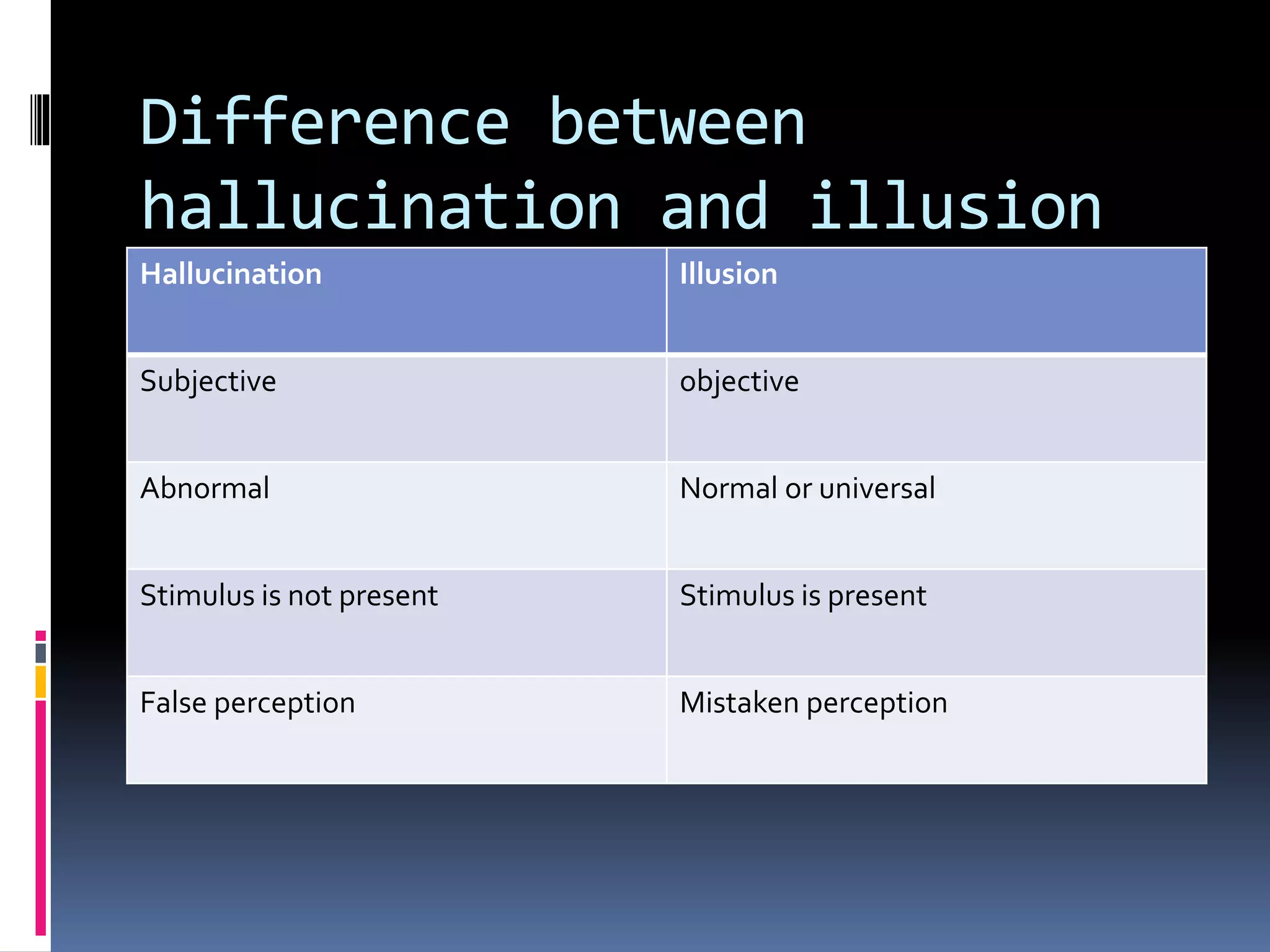
Difference between
hallucination and illusion
Hallucination Illusion
Subjective objective
Abnormal Normal or universal
Stimulus is not present Stimulus is present
False perception Mistaken perception
Causes for inaccurate
perception
 Defective functioning of sense organs
 Inadequate stimulus
 Too many stimuli at one time
 Poor health
 Limited attention
 Figure merges in the ground
 Guidance
Nursing implication
 It is important to provide quality care to
patient.
 It prevents accidents and incidents of harmful
to the patients .
 All types of false perception ,illusion should
be avoided by her.
Learning
 The most important characteristics of human
being is their capacity to learn .Though
learning we have seen change in our own
behavior . Learning is a process of mastery of
unfamiliar material ,which helps us to modify
behavior.
Definition of learning
 a/c to Murphy – the term learning covers
every modification in behavior to meet
environment requirements .
 a/c to Kimble – learning is relatively
permanent change in behavioral potentiality
that occurs as a result of reinforced practice.
Nature of learning
 It’s a process and not a product
 It involves al those experiences and trainings
of an individual .
 Learning prepares an individual for the
necessary adjustment and adaptation.
 Learning helps in the proper growth and
development.
 Learning helps in the balanced development
of personality .
Learning process
 Perception learning – sense perception , the
individual receive information from sense
organs and interpets them in the light of
previous experience .
 Conceptual learning - learning implies the
individual starts thinking in abstract .
 Association learning – mental picture of
previous observation .
Cont…
 Appreciational learning – realted to our
feelings .
 Attitudinal learning- it depends upon attitude
of mind
Steps in learning process
 A motive or drive.
 An attractive goal
 A block to the attainment of the goal .
Types of learning
 Conditioning learning
 Verbal learning
 Motor learning
 Concept learning
 Problem solving learning
 Attitude learning
 Serial learning
Purpose of learning
 Acquiring of learning
 Acquiring skills
 Acquiring attitudes and ideals
Factors influencing learning
 The learner whose behavior is to be modified
 Modification in learner’s behavior
 Deals with success and failure of learner’s
Factors associated to
learner
 Learner’s physical health
 Learner’s mental health
 Basic potential of the learner
 The level of motivation
 Goals of life
 Readiness and will power
 Maturation
 Age
 Emotions
 sex
Theories of learning
 Trial and error theory learning
 Learning conditioning
 Theory of operant conditioning
 Theory of insightful learning
 Cognitive theory of learning
Theories of learning
 Trial and errors theory of learning -
Nursing implication of
learning
 Learning is fundamental to the development
and modification of behavior.
 It increase productivity
 Nurse must have well defined purpose and
goals in all learning
Thinking
 Thinking is mental activity that goes on in the
brain when a person in processing
information –organizing it and
communicating it to others .The quality of
human life and the welfare and progress of
the human race depend to a large extent on
our capacity to think .
Meaning of thinking
 ‘Climer’ states that thinking is a problem –
solving process in which people use symbols
in place of overt activity .
 ‘Warren’ –states that thinking is an activity
concerning ideas .
 Thus the activity of thinking originates from
some problem and involves the response of
the individual to this problem .
Nature of thinking
 Thinking is an activity concerning ideas .
 Thinking is a cognitive activity .
 It is form of information processing .
 It’s a problem solving behavior .
 Its goal directed .
 It’s a process of mental exploration .sss
Condition favorable for
thinking
 Interest and attention
 Strong motivation
 Alertness and flexibility
 Time limit should not be rigid
 Wide range of wisdom
 Incubation .
Factors which hinders
thinking
 Emotions
 Suggestions
 Supervision
 Prejudice
Types of thinking
 Perceptual or concrete thinking
 Conceptual or abstract thinking
 Creative thinking
 Logical thinking
 Problem solving
 Convergent
Intelligence
 Intelligence is the ability to understand the
world ,think rationally or logically ,and use of
resources effectively when faced with
challenges or problems.
 Intelligence comes from latin verb
‘intelligence’ which means to understand .
Defintion
 Intelligence is an inferred characteristics of an
individual ,usually defined as the ability to
profit from experience ,accquire knowledge
,think abstractly ,or to adapt to changes in
enviroments .
 A/cWells Intelligence is the property of
recombining our behavior pattern so as to act
better in a novel situation .
Types of intelligence
 Analytical intelligence
 Creative intelligence
 Practical intelligence
 a/c to Sternberg’sTriarchic theory of human
intelligence .
Factors affecting
intelligence
 Biological factors
 Enviromental factors
 Ethical issues .
Cognitive process
Cognitive process

Cognitive process

  • 1.
  • 2.
    Introduction  The termcognition is used to refer processing of information . In psychology it refer to mental function / mental processes that includes understanding making judgement and taking decision .
  • 3.
    Attention  We areall familiar with the announcement that starts with “your attention please” before giving information at railways stations and airports .We also use the termAttention in our day today conversation.
  • 4.
    Definition of attention a/c to collins and driver – as “selective activity of consciousness”  a/c to ross – the process of getting an object of thoughts clearly before the mind”  Dumyille – attention is the concentration of consciousness upon one object rather than upon another .  These definition help us to understand that : it’s a process , helps in awareness our environment and its selective .
  • 5.
    Characteristics of attention Selective mental activity  Constantly shifts from object to another  Focusing of cousciousness or particular object
  • 6.
    Types/ varieties of attention Voluntary (volitional )  Involuntary ( non volitional )  Habitual attending ( which we attend not because of external compelling but because of internal drives ,motives ,attitudes etc)
  • 7.
    Cont…  Volitional attention– its two types –  implicit volitional attention – a single act of will is responsible for arousing attention .  Explicit volitional attention – attention is obtained by repeated acts of will .
  • 8.
    Cont…  Invoulntary attention–with or without making conscious effort on our part .for e.g we give involunatry attention to loud sound ,bright light and strong odour.  It is of two type : enforced and spontaneous
  • 9.
    Uses of attention Provides strength and ability to continue the task of cognitive function  Helps in better organization of the perceptual fields fro maximum clarity and understanding  Mental alertness and preparedness .  Provide deeper concentration .
  • 10.
    Factors influencing or determinantsof attention  Internal factors – which are present in the individual and they can be subjective  External factors –which are present in enviroment
  • 11.
    Cont… Internal factors Externalfactors Interest Intensity Habit Size Attitude Change Mood Repetition motive Novelty Location Nature of stimulus
  • 12.
    Duration and degreeof attention  We have experienced that we cannot attend to a certain stimulus for a long time . Our attention is greatly affected by and distributed among the stimulus around us.
  • 13.
    Span of attention Span of visual attention  Span of auditory attention
  • 14.
    Cont…  Duration ofattention  Shifting attention  Division of attention
  • 15.
    Importance of attentionin nursing profession  It helps in mental alertness and preparedness .  It helps on focusing consciousness  It create maximum clarity  Provides strength and ability
  • 16.
    Perception(initial response)  Perceptionis the interpretation of sensory stimuli ,which reach the sense organs and the brain.  Perception is very essential to deal with the world around us as it influences our memory ,thinking ,reasoning and emotions etc.
  • 17.
    Definition of perception A/c toWundt- perception is a complex mental product of sensation images , feelings and effect of past experience and learning .  Or it can be define as – a mental process in which sensory cues and relevant past experience organize together to give us meaningfulness to the perceived object .
  • 18.
    Nature of perception Perception is a process  Perception is an information extractor: –  Perception is preparation to response  Perception involves sensation  Perception provides organization  Perception is highly individualistics in nature
  • 19.
    Principle of perception Principle of figure –ground relationship –in it figure is perception in relationship to its background .
  • 20.
    Cont…  Principle ofgrouping –perceiving things as together while others as separate ,it helps in improving our knowledge ,and also in developing concepts . It depends proximity/nearness ,similarity/ likeness , inclusiveness , continuity , closure ,simplicity.  Principle of simplicity  Principle of contour  Principle of context  Principle of adaptability
  • 21.
    Factors influencing perception  Senseorgans  Brains  Memory images of the past experience  Personal interests and mind set  Acquired interests  Needs and desires.
  • 22.
    Errors in perception Illusion –(mistaken perception )  Hallucination (sensory perception in absence of stimuli)
  • 23.
    Difference between hallucination andillusion Hallucination Illusion Subjective objective Abnormal Normal or universal Stimulus is not present Stimulus is present False perception Mistaken perception
  • 24.
    Causes for inaccurate perception Defective functioning of sense organs  Inadequate stimulus  Too many stimuli at one time  Poor health  Limited attention  Figure merges in the ground  Guidance
  • 25.
    Nursing implication  Itis important to provide quality care to patient.  It prevents accidents and incidents of harmful to the patients .  All types of false perception ,illusion should be avoided by her.
  • 26.
    Learning  The mostimportant characteristics of human being is their capacity to learn .Though learning we have seen change in our own behavior . Learning is a process of mastery of unfamiliar material ,which helps us to modify behavior.
  • 27.
    Definition of learning a/c to Murphy – the term learning covers every modification in behavior to meet environment requirements .  a/c to Kimble – learning is relatively permanent change in behavioral potentiality that occurs as a result of reinforced practice.
  • 28.
    Nature of learning It’s a process and not a product  It involves al those experiences and trainings of an individual .  Learning prepares an individual for the necessary adjustment and adaptation.  Learning helps in the proper growth and development.  Learning helps in the balanced development of personality .
  • 29.
    Learning process  Perceptionlearning – sense perception , the individual receive information from sense organs and interpets them in the light of previous experience .  Conceptual learning - learning implies the individual starts thinking in abstract .  Association learning – mental picture of previous observation .
  • 30.
    Cont…  Appreciational learning– realted to our feelings .  Attitudinal learning- it depends upon attitude of mind
  • 31.
    Steps in learningprocess  A motive or drive.  An attractive goal  A block to the attainment of the goal .
  • 32.
    Types of learning Conditioning learning  Verbal learning  Motor learning  Concept learning  Problem solving learning  Attitude learning  Serial learning
  • 33.
    Purpose of learning Acquiring of learning  Acquiring skills  Acquiring attitudes and ideals
  • 34.
    Factors influencing learning The learner whose behavior is to be modified  Modification in learner’s behavior  Deals with success and failure of learner’s
  • 35.
    Factors associated to learner Learner’s physical health  Learner’s mental health  Basic potential of the learner  The level of motivation  Goals of life  Readiness and will power  Maturation  Age  Emotions  sex
  • 36.
    Theories of learning Trial and error theory learning  Learning conditioning  Theory of operant conditioning  Theory of insightful learning  Cognitive theory of learning
  • 37.
    Theories of learning Trial and errors theory of learning -
  • 38.
    Nursing implication of learning Learning is fundamental to the development and modification of behavior.  It increase productivity  Nurse must have well defined purpose and goals in all learning
  • 39.
    Thinking  Thinking ismental activity that goes on in the brain when a person in processing information –organizing it and communicating it to others .The quality of human life and the welfare and progress of the human race depend to a large extent on our capacity to think .
  • 40.
    Meaning of thinking ‘Climer’ states that thinking is a problem – solving process in which people use symbols in place of overt activity .  ‘Warren’ –states that thinking is an activity concerning ideas .  Thus the activity of thinking originates from some problem and involves the response of the individual to this problem .
  • 41.
    Nature of thinking Thinking is an activity concerning ideas .  Thinking is a cognitive activity .  It is form of information processing .  It’s a problem solving behavior .  Its goal directed .  It’s a process of mental exploration .sss
  • 42.
    Condition favorable for thinking Interest and attention  Strong motivation  Alertness and flexibility  Time limit should not be rigid  Wide range of wisdom  Incubation .
  • 43.
    Factors which hinders thinking Emotions  Suggestions  Supervision  Prejudice
  • 44.
    Types of thinking Perceptual or concrete thinking  Conceptual or abstract thinking  Creative thinking  Logical thinking  Problem solving  Convergent
  • 45.
    Intelligence  Intelligence isthe ability to understand the world ,think rationally or logically ,and use of resources effectively when faced with challenges or problems.  Intelligence comes from latin verb ‘intelligence’ which means to understand .
  • 46.
    Defintion  Intelligence isan inferred characteristics of an individual ,usually defined as the ability to profit from experience ,accquire knowledge ,think abstractly ,or to adapt to changes in enviroments .  A/cWells Intelligence is the property of recombining our behavior pattern so as to act better in a novel situation .
  • 47.
    Types of intelligence Analytical intelligence  Creative intelligence  Practical intelligence  a/c to Sternberg’sTriarchic theory of human intelligence .
  • 48.
    Factors affecting intelligence  Biologicalfactors  Enviromental factors  Ethical issues .