S.
N
O
ASSESSME
NT
NURSIN
G
DIAGNO
SIS
NURSIN
G
GOAL
NURSING
PLANNING
NURSING
IMPLIMENTATION
EVALUAT
ION
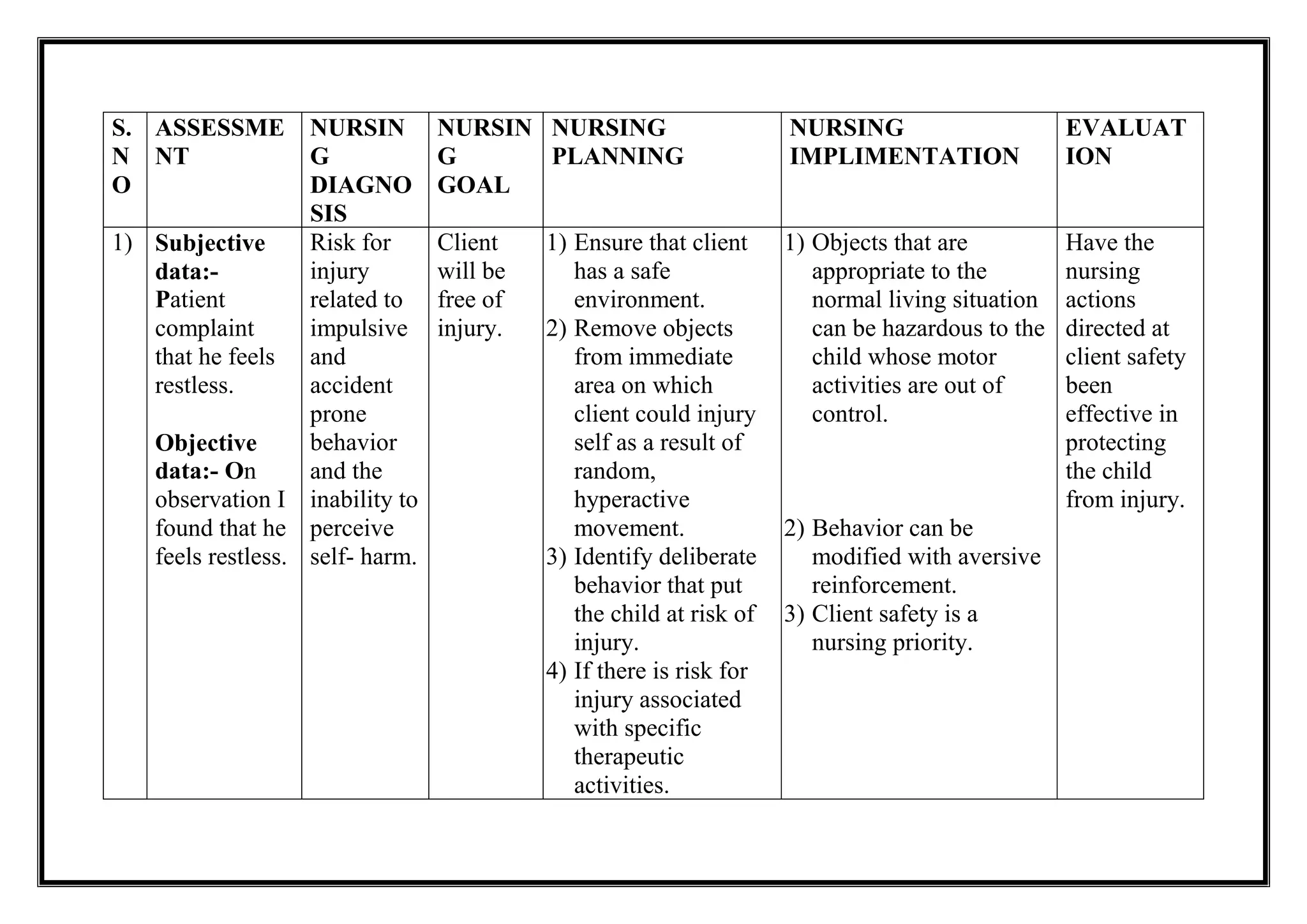
1) Subjective
data:-
Patient
complaint
that he feels
restless.
Objective
data:- On
observation I
found that he
feels restless.
Risk for
injury
related to
impulsive
and
accident
prone
behavior
and the
inability to
perceive
self- harm.
Client
will be
free of
injury.
1) Ensure that client
has a safe
environment.
2) Remove objects
from immediate
area on which
client could injury
self as a result of
random,
hyperactive
movement.
3) Identify deliberate
behavior that put
the child at risk of
injury.
4) If there is risk for
injury associated
with specific
therapeutic
activities.
1) Objects that are
appropriate to the
normal living situation
can be hazardous to the
child whose motor
activities are out of
control.
2) Behavior can be
modified with aversive
reinforcement.
3) Client safety is a
nursing priority.
Have the
nursing
actions
directed at
client safety
been
effective in
protecting
the child
from injury.
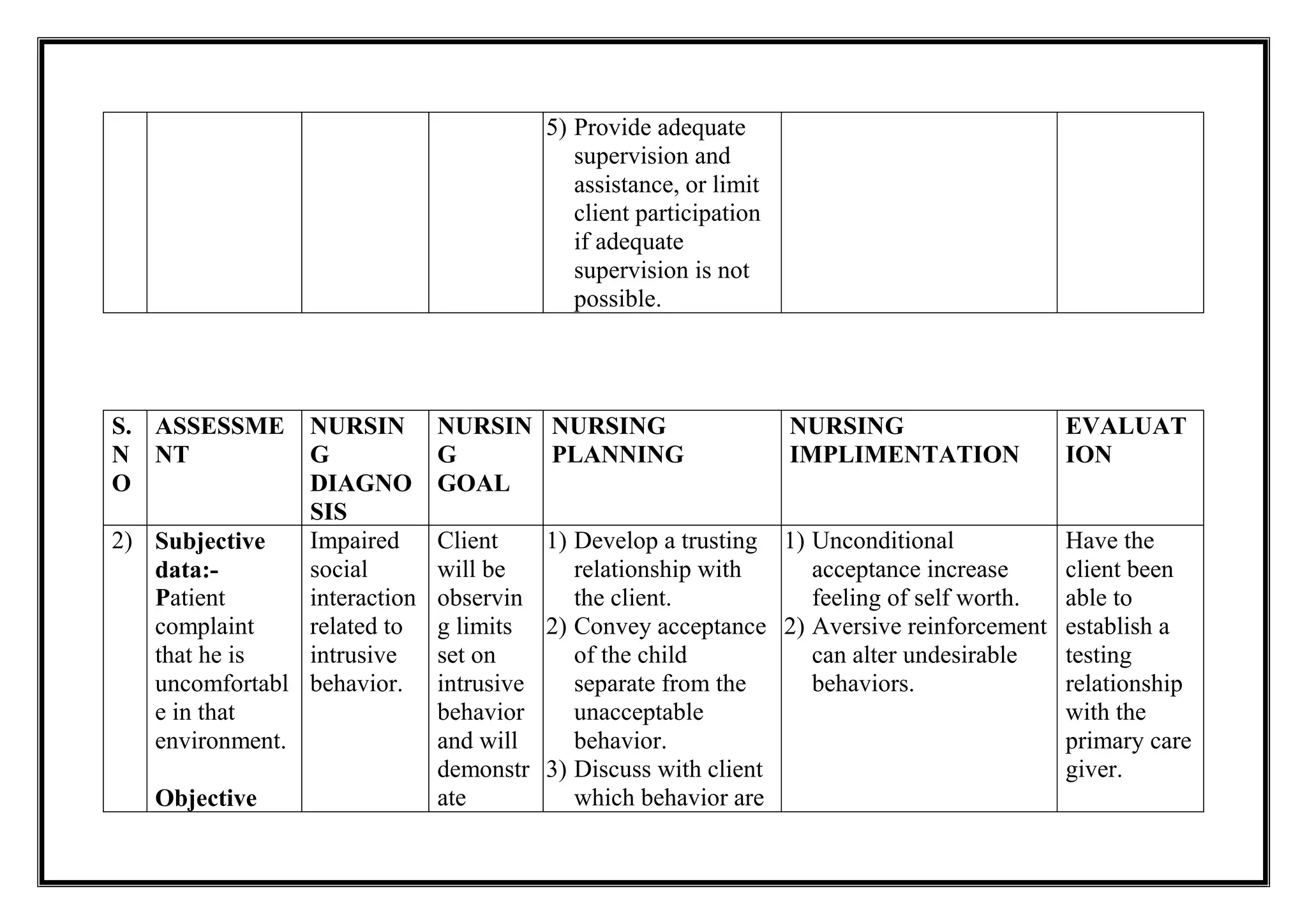
5) Provide adequate
supervision and
assistance, or limit
client participation
if adequate
supervision is not
possible.
S.
N
O
ASSESSME
NT
NURSIN
G
DIAGNO
SIS
NURSIN
G
GOAL
NURSING
PLANNING
NURSING
IMPLIMENTATION
EVALUAT
ION
2) Subjective
data:-
Patient
complaint
that he is
uncomfortabl
e in that
environment.
Objective
Impaired
social
interaction
related to
intrusive
behavior.
Client
will be
observin
g limits
set on
intrusive
behavior
and will
demonstr
ate
1) Develop a trusting
relationship with
the client.
2) Convey acceptance
of the child
separate from the
unacceptable
behavior.
3) Discuss with client
which behavior are
1) Unconditional
acceptance increase
feeling of self worth.
2) Aversive reinforcement
can alter undesirable
behaviors.
Have the
client been
able to
establish a
testing
relationship
with the
primary care
giver.
data:- On
observation I
found that he
feels irritable
in that
environment.
ability to
increase
appropria
tely with
others.
acceptable and not
acceptable.
4) Describe in a
matter of fact
manner the
consequences of
unacceptable
behavior.
5) Provide group
situations for client.
3) Appropriate social
behavior is often
learned from the
positive and negative
feedback of peers.
S.
N
O
ASSESSME
NT
NURSIN
G
DIAGNO
SIS
NURSIN
G
GOAL
NURSING
PLANNING
NURSING
IMPLIMENTATION
EVALUAT
ION
3) Subjective
data:-
Patient
complaint
that he is
Low self
esteem
related to
dysfunctio
nal family
Client
will
demonstr
ate
increased
1) Ensure the goal is
realistic.
2) Plan activities that
provide
1) Unrealistic goals set
client up for failure,
which diminishes self
esteem.
2) Success enhances self
Have the
client able to
verbalize
positive
statements
having head
ache.
Objective
data:- On
observation I
found that
client is
having fever.
system
and
negative
feedback.
feeling of
self
worth by
verbalizi
ng
positive
statement
about self
and
exhibitin
g fever
demandi
ng
behavior.
opportunities for
success.
3) Convey
unconditional
acceptance and
positive regard.
4) Offer recognition
of successful
endeavors and
positive
reinforcement for
attempts made.
5) Give immediate
positive feedback
for acceptable
behavior.
esteem.
3) Affirmation of client as
worthwhile human
being may increase self
esteem.
4) Positive reinforcement
enhances self esteem
and may increases the
desired behaviors.
about self.
S.
N
ASSESSME
NT
NURSIN
G
NURSIN
G
NURSING
PLANNING
NURSING
IMPLIMENTATION
EVALUAT
ION
O DIAGNO
SIS
GOAL
4) Subjective
data:-
Patient
complaint
that he is
uncomfortabl
e and lost
reality.
Objective
data:- On
observation I
found that he
feels irritable
in that
environment
and lost
reality.
Altered
thought
process
evidenced
by
perceptual
disturbanc
e like
hallucinati
ons,
delusions,
loss of
reality,
autism and
associate
problems.
Client
will be
able to
improve
his
thought
process,
lives in
reality
and
enjoys
productiv
e life.
1) Accept the client as
he is.
2) Approach the client
calmly, gently,
focus on current
behavior establish
therapeutic
relationship with
the client.
3) Motivate the client
to talk about real
events and present
situation.
4) Explore the
feelings of the
client related to
anxiety or
frustration.
5) Discourage long
discussions related
to irrational
thinking & arguing
1) Client must understand
that you do not view
the idea as real.
2) Decrease client
suspiciousness.
3) Discussions that focus
on the false ideas are
purposeless & useless
and even may
aggravate the
psychosis.
4) Arguing or denying the
belief serves no useful
purpose, as delusional
ideas are not eliminated
by this approach and
the development of
trusting relationship
may be impaired.
Have the
client
involve in
interpersonal
activities or
actual
situation.
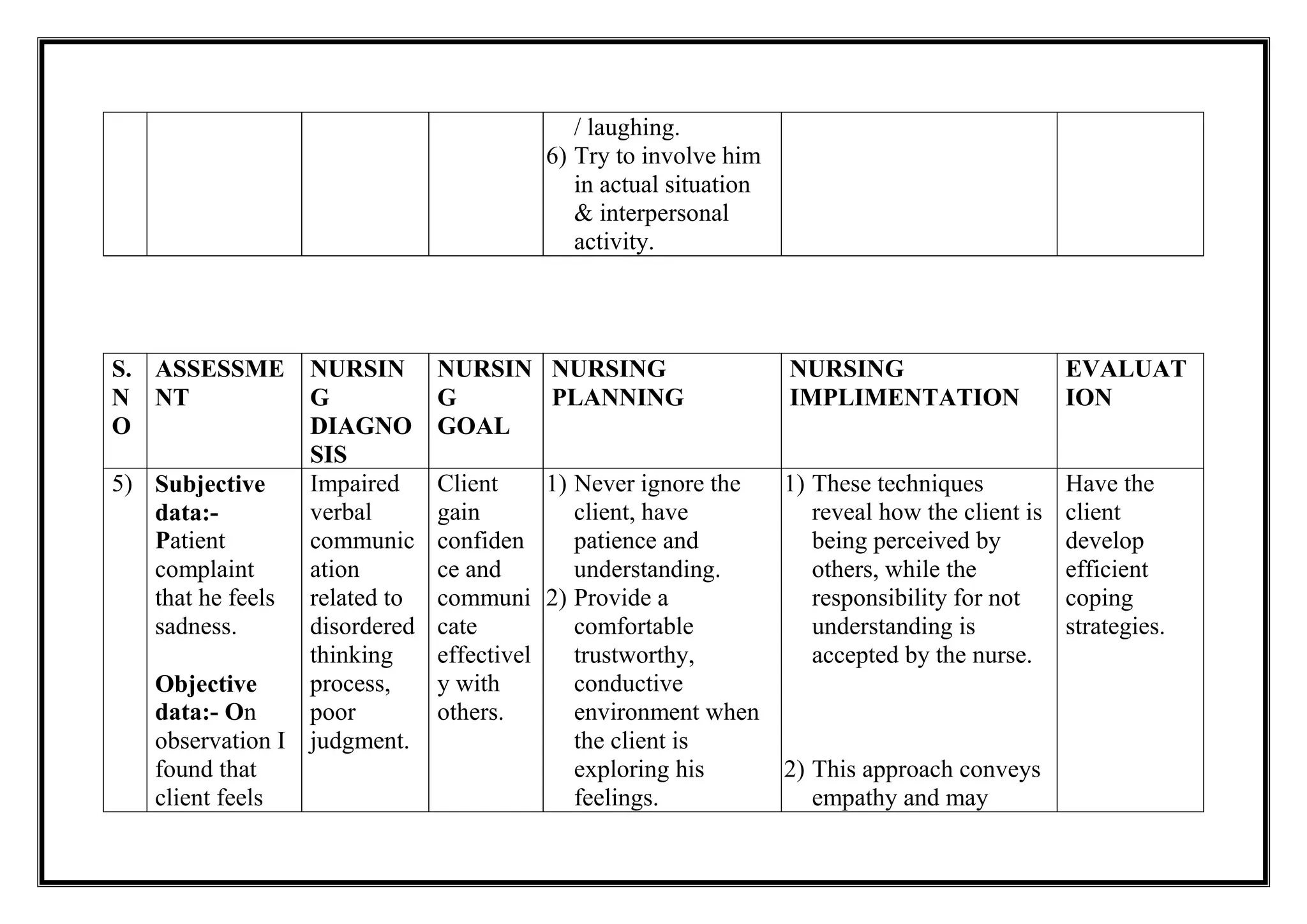
/ laughing.
6) Try to involve him
in actual situation
& interpersonal
activity.
S.
N
O
ASSESSME
NT
NURSIN
G
DIAGNO
SIS
NURSIN
G
GOAL
NURSING
PLANNING
NURSING
IMPLIMENTATION
EVALUAT
ION
5) Subjective
data:-
Patient
complaint
that he feels
sadness.
Objective
data:- On
observation I
found that
client feels
Impaired
verbal
communic
ation
related to
disordered
thinking
process,
poor
judgment.
Client
gain
confiden
ce and
communi
cate
effectivel
y with
others.
1) Never ignore the
client, have
patience and
understanding.
2) Provide a
comfortable
trustworthy,
conductive
environment when
the client is
exploring his
feelings.
1) These techniques
reveal how the client is
being perceived by
others, while the
responsibility for not
understanding is
accepted by the nurse.
2) This approach conveys
empathy and may
Have the
client
develop
efficient
coping
strategies.
poor
judgment.
3) Encourage the
client to verbalize
openly at his own
pace, ventilate his
feelings.
4) Encourage the
client to develop
efficient coping
strategies.
5) Utilize role model
approach in
communicating &
positive
unconditional
friendly regard.
encourage the client to
disclose painful issues.
3) Client comfort and
safety are nursing
priorities.
S.
N
O
ASSESSME
NT
NURSIN
G
DIAGNO
SIS
NURSIN
G
GOAL
NURSING
PLANNING
NURSING
IMPLIMENTATION
EVALUAT
ION
6) Subjective
data:-
Self care
deficit
Meet the
total need
1) Provide assistance
with self care needs
1) Independent
accomplishment and
Have the
client
Patient
complained
that he is not
interested in
self care
activities.
Objective
data:- On
observation I
found that
client is not
interested in
self care
activities.
related to
withdrawa
l and
cognitive
impairmen
t and
perceptual
disturbanc
es.
of the
client, if
the client
is
severely
withdraw
n and
care of
his
activities.
as required. Some
clients who are
severely withdrawn
may require total
care.
2) Encourage client to
perform
independently as
many activities
provide positive
reinforcement.
3) Use concrete
communication to
show what is
expected.
4) If toileting needs
are not being met,
establish a
structured schedule
for the client.
positive reinforcement
enhance self esteem
and promote repetition
of desirable behavior.
2) Because concrete
thinking prevails,
explanations must be
provided at the client’s
concrete level of
comprehension.
3) This technique may be
helpful with the client
who is suspicious that
he or she is being
poisoned with food or
medication.
become
interested in
self care
activities.
S.
N
ASSESSME
NT
NURSIN
G
NURSIN
G
NURSING
PLANNING
NURSING
IMPLIMENTATION
EVALUAT
ION
O DIAGNO
SIS
GOAL
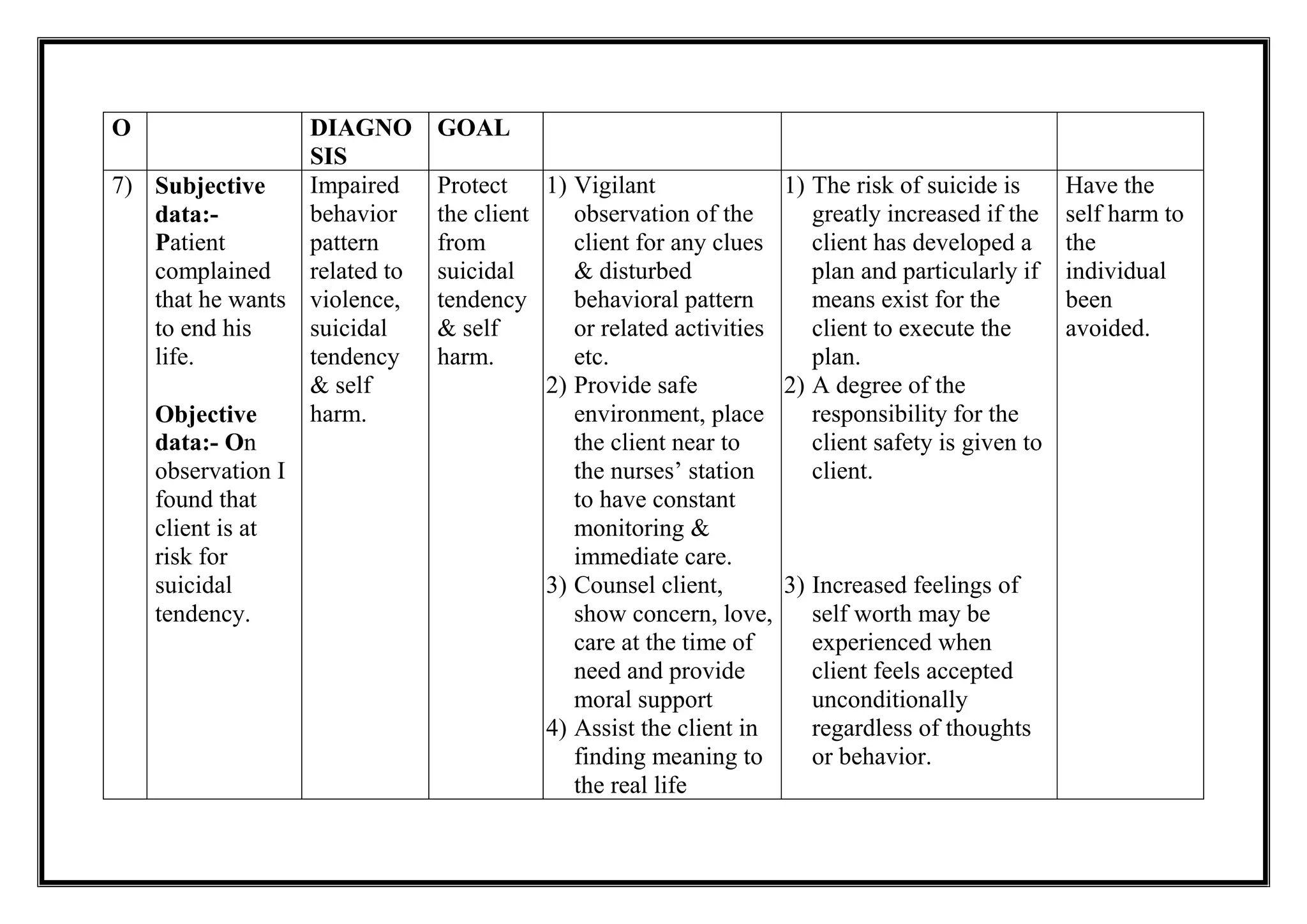
7) Subjective
data:-
Patient
complained
that he wants
to end his
life.
Objective
data:- On
observation I
found that
client is at
risk for
suicidal
tendency.
Impaired
behavior
pattern
related to
violence,
suicidal
tendency
& self
harm.
Protect
the client
from
suicidal
tendency
& self
harm.
1) Vigilant
observation of the
client for any clues
& disturbed
behavioral pattern
or related activities
etc.
2) Provide safe
environment, place
the client near to
the nurses’ station
to have constant
monitoring &
immediate care.
3) Counsel client,
show concern, love,
care at the time of
need and provide
moral support
4) Assist the client in
finding meaning to
the real life
1) The risk of suicide is
greatly increased if the
client has developed a
plan and particularly if
means exist for the
client to execute the
plan.
2) A degree of the
responsibility for the
client safety is given to
client.
3) Increased feelings of
self worth may be
experienced when
client feels accepted
unconditionally
regardless of thoughts
or behavior.
Have the
self harm to
the
individual
been
avoided.
situation & teach
coping strategies.
S.
N
O
ASSESSME
NT
NURSIN
G
DIAGNO
SIS
NURSIN
G
GOAL
NURSING
PLANNING
NURSING
IMPLIMENTATION
EVALUAT
ION
8) Subjective
data:-
Patient
complained
that he is
lacking
confidence.
Objective
data:- On
observation I
found that
failure in
Alteration
in the self
esteem,
self
confidence
to
strengthen
clients ego
process.
Develop
adequate
coping
strategies
to enjoy
the life
situations
.
1) Permit the client to
take decisions and
perform the
activities without
any assistance
effectively.
2) Provide related
resources to gain
confidence through
interaction.
3) Discourage the
client to have the
thoughts which
1) Preventing saving up to
overdose or discarding
and not taking.
2) Prevents staff
surveillance from
becoming predictable.
3) To be aware of client’s
location is important,
especially when staff is
busy, unavailable less
observable.
Have the
client
express
feelings and
behavior
associated
with each
stage of
grieving
process and
recognize
own position
in the
achieving
goals.
hampers his growth
and efficiency.
4) Provide conductive
environment,
repeated
opportunities to
expose themselves
to stressors.
process.
S.
N
O
ASSESSME
NT
NURSIN
G
DIAGNO
SIS
NURSIN
G
GOAL
NURSING
PLANNING
NURSING
IMPLIMENTATION
EVALUAT
ION
9) Subjective
data:-
Patient
complaint
that
He is not able
to memories
his past &
give
Alteration
in
attention
giving &
memories
the past
related to
impaired
memory
Improve
clients
attention
span &
adjust to
memory
changes.
1) Provide activities
of his/ her choice
so that the patient
can attend and
complete them.
2) Provide an
appropriate
opportunity to do
the task which he
1) Client may gets
irritated because he/
she is not able to recall
immediate & recent
event, but remote
memory is intact.
Have the
patient tries
to
concentrate
on the work
which he
had been
doing.
attention.
Objective
data:- On
observation I
found that
client is not
able to give
attention &
memories the
past.
function. may be doing for
many times.
3) Help relatives not
to get irritated if the
patent is not able to
inform them about
a telephonic
message or what
the doctor told. He
may not be able to
recall.
4) However he may
be able to tell what
the doctor told him
at the time of
admission.
2) Feels inadequate in
front of relatives &
friends.

care plan3.doc (mental health nursing) nursing diagnosis

  • 1.
    S. N O ASSESSME NT NURSIN G DIAGNO SIS NURSIN G GOAL NURSING PLANNING NURSING IMPLIMENTATION EVALUAT ION 1) Subjective data:- Patient complaint that hefeels restless. Objective data:- On observation I found that he feels restless. Risk for injury related to impulsive and accident prone behavior and the inability to perceive self- harm. Client will be free of injury. 1) Ensure that client has a safe environment. 2) Remove objects from immediate area on which client could injury self as a result of random, hyperactive movement. 3) Identify deliberate behavior that put the child at risk of injury. 4) If there is risk for injury associated with specific therapeutic activities. 1) Objects that are appropriate to the normal living situation can be hazardous to the child whose motor activities are out of control. 2) Behavior can be modified with aversive reinforcement. 3) Client safety is a nursing priority. Have the nursing actions directed at client safety been effective in protecting the child from injury.
  • 2.
    5) Provide adequate supervisionand assistance, or limit client participation if adequate supervision is not possible. S. N O ASSESSME NT NURSIN G DIAGNO SIS NURSIN G GOAL NURSING PLANNING NURSING IMPLIMENTATION EVALUAT ION 2) Subjective data:- Patient complaint that he is uncomfortabl e in that environment. Objective Impaired social interaction related to intrusive behavior. Client will be observin g limits set on intrusive behavior and will demonstr ate 1) Develop a trusting relationship with the client. 2) Convey acceptance of the child separate from the unacceptable behavior. 3) Discuss with client which behavior are 1) Unconditional acceptance increase feeling of self worth. 2) Aversive reinforcement can alter undesirable behaviors. Have the client been able to establish a testing relationship with the primary care giver.
  • 3.
    data:- On observation I foundthat he feels irritable in that environment. ability to increase appropria tely with others. acceptable and not acceptable. 4) Describe in a matter of fact manner the consequences of unacceptable behavior. 5) Provide group situations for client. 3) Appropriate social behavior is often learned from the positive and negative feedback of peers. S. N O ASSESSME NT NURSIN G DIAGNO SIS NURSIN G GOAL NURSING PLANNING NURSING IMPLIMENTATION EVALUAT ION 3) Subjective data:- Patient complaint that he is Low self esteem related to dysfunctio nal family Client will demonstr ate increased 1) Ensure the goal is realistic. 2) Plan activities that provide 1) Unrealistic goals set client up for failure, which diminishes self esteem. 2) Success enhances self Have the client able to verbalize positive statements
  • 4.
    having head ache. Objective data:- On observationI found that client is having fever. system and negative feedback. feeling of self worth by verbalizi ng positive statement about self and exhibitin g fever demandi ng behavior. opportunities for success. 3) Convey unconditional acceptance and positive regard. 4) Offer recognition of successful endeavors and positive reinforcement for attempts made. 5) Give immediate positive feedback for acceptable behavior. esteem. 3) Affirmation of client as worthwhile human being may increase self esteem. 4) Positive reinforcement enhances self esteem and may increases the desired behaviors. about self. S. N ASSESSME NT NURSIN G NURSIN G NURSING PLANNING NURSING IMPLIMENTATION EVALUAT ION
  • 5.
    O DIAGNO SIS GOAL 4) Subjective data:- Patient complaint thathe is uncomfortabl e and lost reality. Objective data:- On observation I found that he feels irritable in that environment and lost reality. Altered thought process evidenced by perceptual disturbanc e like hallucinati ons, delusions, loss of reality, autism and associate problems. Client will be able to improve his thought process, lives in reality and enjoys productiv e life. 1) Accept the client as he is. 2) Approach the client calmly, gently, focus on current behavior establish therapeutic relationship with the client. 3) Motivate the client to talk about real events and present situation. 4) Explore the feelings of the client related to anxiety or frustration. 5) Discourage long discussions related to irrational thinking & arguing 1) Client must understand that you do not view the idea as real. 2) Decrease client suspiciousness. 3) Discussions that focus on the false ideas are purposeless & useless and even may aggravate the psychosis. 4) Arguing or denying the belief serves no useful purpose, as delusional ideas are not eliminated by this approach and the development of trusting relationship may be impaired. Have the client involve in interpersonal activities or actual situation.
  • 6.
    / laughing. 6) Tryto involve him in actual situation & interpersonal activity. S. N O ASSESSME NT NURSIN G DIAGNO SIS NURSIN G GOAL NURSING PLANNING NURSING IMPLIMENTATION EVALUAT ION 5) Subjective data:- Patient complaint that he feels sadness. Objective data:- On observation I found that client feels Impaired verbal communic ation related to disordered thinking process, poor judgment. Client gain confiden ce and communi cate effectivel y with others. 1) Never ignore the client, have patience and understanding. 2) Provide a comfortable trustworthy, conductive environment when the client is exploring his feelings. 1) These techniques reveal how the client is being perceived by others, while the responsibility for not understanding is accepted by the nurse. 2) This approach conveys empathy and may Have the client develop efficient coping strategies.
  • 7.
    poor judgment. 3) Encourage the clientto verbalize openly at his own pace, ventilate his feelings. 4) Encourage the client to develop efficient coping strategies. 5) Utilize role model approach in communicating & positive unconditional friendly regard. encourage the client to disclose painful issues. 3) Client comfort and safety are nursing priorities. S. N O ASSESSME NT NURSIN G DIAGNO SIS NURSIN G GOAL NURSING PLANNING NURSING IMPLIMENTATION EVALUAT ION 6) Subjective data:- Self care deficit Meet the total need 1) Provide assistance with self care needs 1) Independent accomplishment and Have the client
  • 8.
    Patient complained that he isnot interested in self care activities. Objective data:- On observation I found that client is not interested in self care activities. related to withdrawa l and cognitive impairmen t and perceptual disturbanc es. of the client, if the client is severely withdraw n and care of his activities. as required. Some clients who are severely withdrawn may require total care. 2) Encourage client to perform independently as many activities provide positive reinforcement. 3) Use concrete communication to show what is expected. 4) If toileting needs are not being met, establish a structured schedule for the client. positive reinforcement enhance self esteem and promote repetition of desirable behavior. 2) Because concrete thinking prevails, explanations must be provided at the client’s concrete level of comprehension. 3) This technique may be helpful with the client who is suspicious that he or she is being poisoned with food or medication. become interested in self care activities. S. N ASSESSME NT NURSIN G NURSIN G NURSING PLANNING NURSING IMPLIMENTATION EVALUAT ION
  • 9.
    O DIAGNO SIS GOAL 7) Subjective data:- Patient complained thathe wants to end his life. Objective data:- On observation I found that client is at risk for suicidal tendency. Impaired behavior pattern related to violence, suicidal tendency & self harm. Protect the client from suicidal tendency & self harm. 1) Vigilant observation of the client for any clues & disturbed behavioral pattern or related activities etc. 2) Provide safe environment, place the client near to the nurses’ station to have constant monitoring & immediate care. 3) Counsel client, show concern, love, care at the time of need and provide moral support 4) Assist the client in finding meaning to the real life 1) The risk of suicide is greatly increased if the client has developed a plan and particularly if means exist for the client to execute the plan. 2) A degree of the responsibility for the client safety is given to client. 3) Increased feelings of self worth may be experienced when client feels accepted unconditionally regardless of thoughts or behavior. Have the self harm to the individual been avoided.
  • 10.
    situation & teach copingstrategies. S. N O ASSESSME NT NURSIN G DIAGNO SIS NURSIN G GOAL NURSING PLANNING NURSING IMPLIMENTATION EVALUAT ION 8) Subjective data:- Patient complained that he is lacking confidence. Objective data:- On observation I found that failure in Alteration in the self esteem, self confidence to strengthen clients ego process. Develop adequate coping strategies to enjoy the life situations . 1) Permit the client to take decisions and perform the activities without any assistance effectively. 2) Provide related resources to gain confidence through interaction. 3) Discourage the client to have the thoughts which 1) Preventing saving up to overdose or discarding and not taking. 2) Prevents staff surveillance from becoming predictable. 3) To be aware of client’s location is important, especially when staff is busy, unavailable less observable. Have the client express feelings and behavior associated with each stage of grieving process and recognize own position in the
  • 11.
    achieving goals. hampers his growth andefficiency. 4) Provide conductive environment, repeated opportunities to expose themselves to stressors. process. S. N O ASSESSME NT NURSIN G DIAGNO SIS NURSIN G GOAL NURSING PLANNING NURSING IMPLIMENTATION EVALUAT ION 9) Subjective data:- Patient complaint that He is not able to memories his past & give Alteration in attention giving & memories the past related to impaired memory Improve clients attention span & adjust to memory changes. 1) Provide activities of his/ her choice so that the patient can attend and complete them. 2) Provide an appropriate opportunity to do the task which he 1) Client may gets irritated because he/ she is not able to recall immediate & recent event, but remote memory is intact. Have the patient tries to concentrate on the work which he had been doing.
  • 12.
    attention. Objective data:- On observation I foundthat client is not able to give attention & memories the past. function. may be doing for many times. 3) Help relatives not to get irritated if the patent is not able to inform them about a telephonic message or what the doctor told. He may not be able to recall. 4) However he may be able to tell what the doctor told him at the time of admission. 2) Feels inadequate in front of relatives & friends.