S.No Time Specific
objective
Content Teaching
activity
Learning
activity
A.V.AIDS evaluation
1 3min To introduce
about the
depression
Introduction-Depression is a
common reaction to events that seen
overwhelming or negative
.Depression ,an extreme feeling of
sadness ,despair ,dejection ,lack of
worth ,or emptiness,affects millions
of Americans a year .The signs and
symptoms of depression and the
severity of the problem vary with the
client and the significance of the
precipitating event. Emotional
symptoms can include feelings of
tiredness ,sadness ,emptiness or
numbness . Behavioral signs of
depression include feelings of
tiredness ,sadness ,emptiness or
numbness. Behavioral signs of
depression include irritability
,inability to concentrate ,difficulty
making decisions,loss of sexual desire
,crying ,sleep disturbances ,and social
withdrawal .Physical signs of
depression may include loss of
appetite ,weight loss,constipation
,headache ,and dizziness .Many
people experience short periods of
depression in response to
overwhelming stressful events ,such
as the death of a loved one or loss of a
job ;prolonged depression ,however is
a cause for concern and may require
treatment.
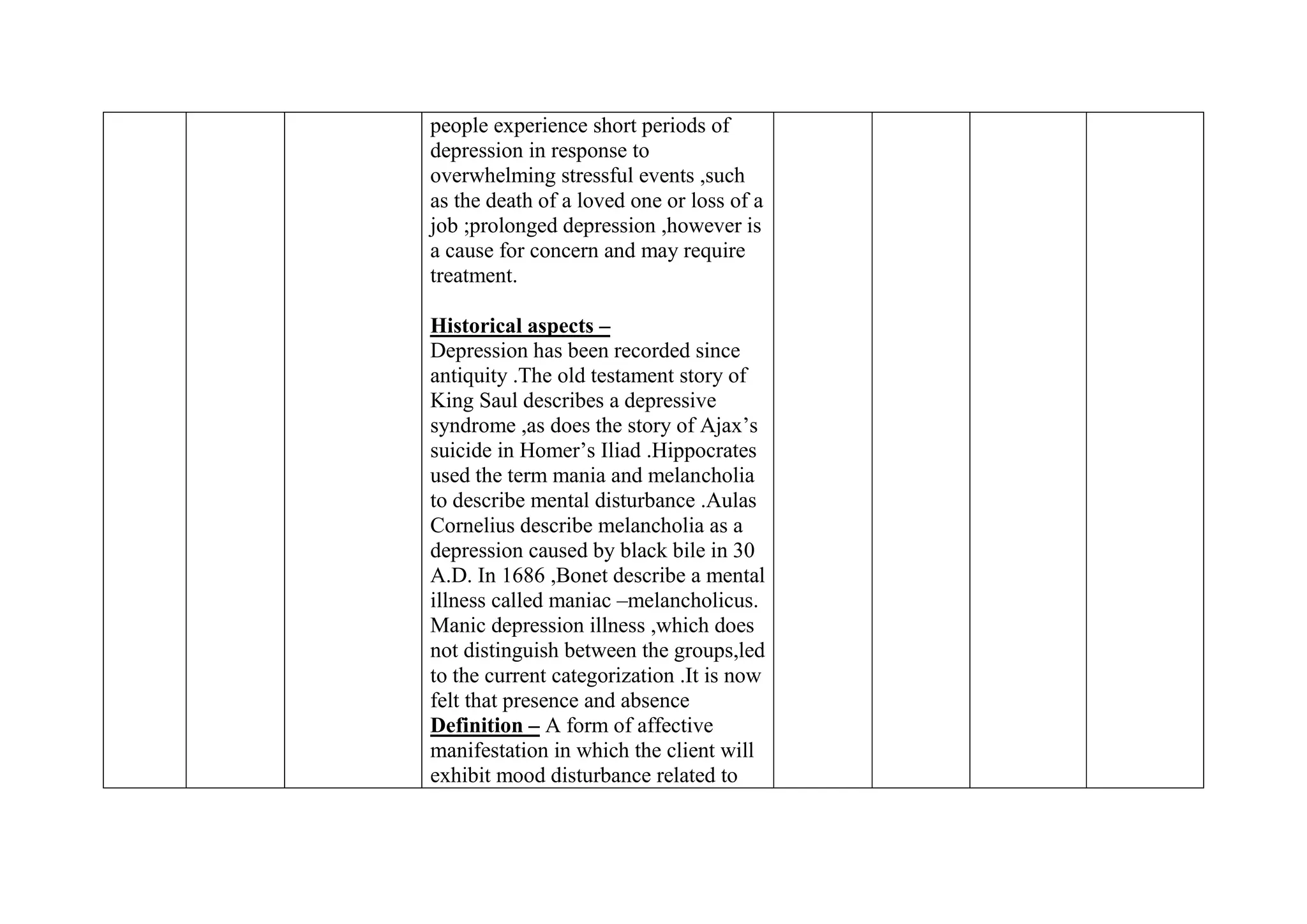
Historical aspects –
Depression has been recorded since
antiquity .The old testament story of
King Saul describes a depressive
syndrome ,as does the story of Ajax’s
suicide in Homer’s Iliad .Hippocrates
used the term mania and melancholia
to describe mental disturbance .Aulas
Cornelius describe melancholia as a
depression caused by black bile in 30
A.D. In 1686 ,Bonet describe a mental
illness called maniac –melancholicus.
Manic depression illness ,which does
not distinguish between the groups,led
to the current categorization .It is now
felt that presence and absence
Definition – A form of affective
manifestation in which the client will
exhibit mood disturbance related to
self and his environment .
Depressive episodes – the classical
symptoms in depression are:
Depressed mood –ranges from mild
,acute or severe depression.
Epidemiology-Major depressive
disorder is more prevalent than
bipolar disorders.
Incidence and prevalence –
Studies in Great Britain ,the United
States ,and the Scandinavian countries
indicate that the risk of developing
these severe disorders,ranges from
0.6% - 25.0% over the course of life
time.Life time risk forbipolar disorder
ranges from 0.6 % to 2 % in both
male and female .
Clinical manifestation :
a) Mild depression – rigid
,sensitive to criticism ,fatigue
,flattened of mood ,blunt affect
,dullness ,sad ,anxious ,empty
mood ,physical complaints with
no organic cause ,blue spells
,lacks confidence in himself
,lack of interest in activities
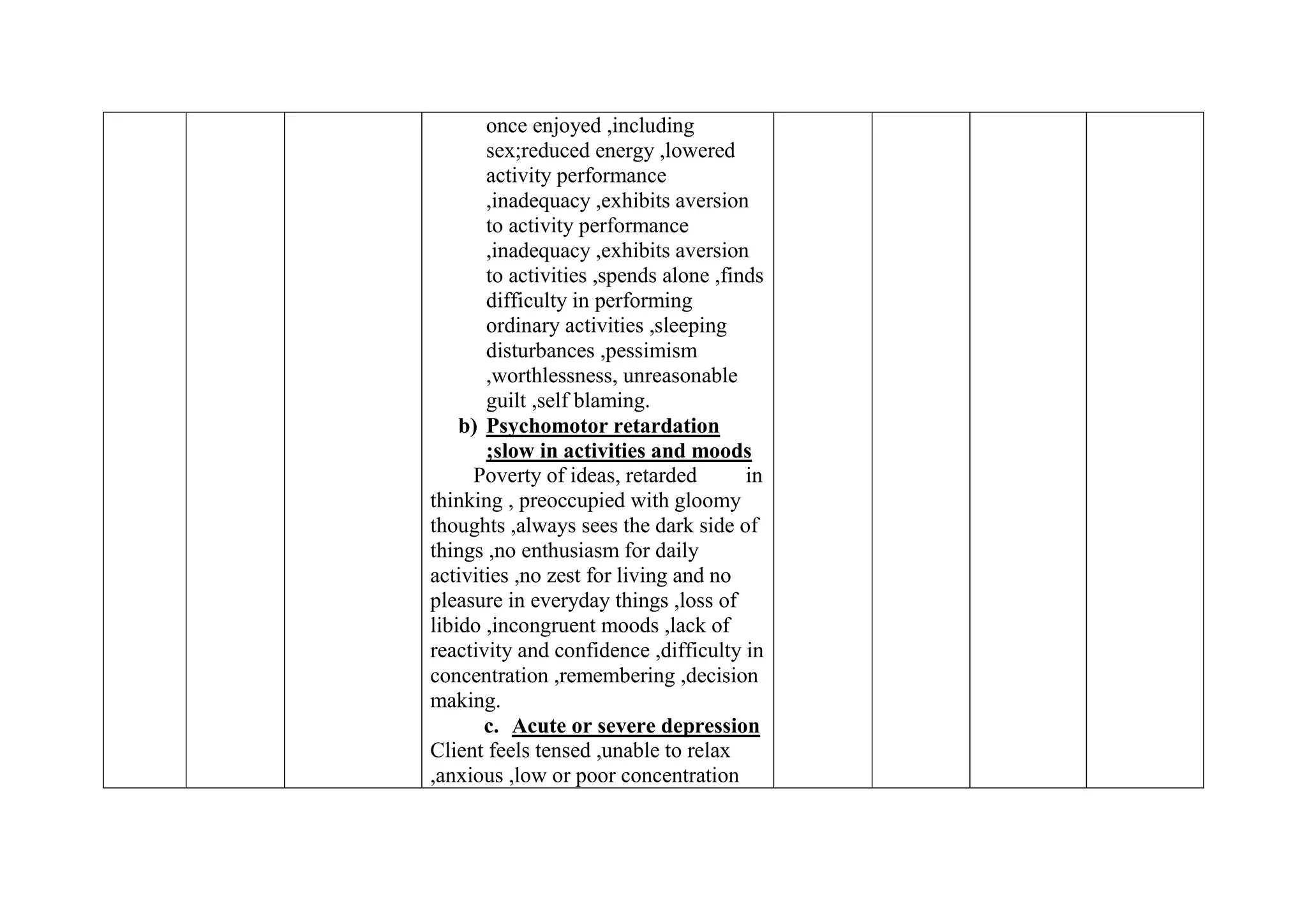
once enjoyed ,including
sex;reduced energy ,lowered
activity performance
,inadequacy ,exhibits aversion
to activity performance
,inadequacy ,exhibits aversion
to activities ,spends alone ,finds
difficulty in performing
ordinary activities ,sleeping
disturbances ,pessimism
,worthlessness, unreasonable
guilt ,self blaming.
b) Psychomotor retardation
;slow in activities and moods
Poverty of ideas, retarded in
thinking , preoccupied with gloomy
thoughts ,always sees the dark side of
things ,no enthusiasm for daily
activities ,no zest for living and no
pleasure in everyday things ,loss of
libido ,incongruent moods ,lack of
reactivity and confidence ,difficulty in
concentration ,remembering ,decision
making.
c. Acute or severe depression
Client feels tensed ,unable to relax
,anxious ,low or poor concentration
,lack of attention ,poor memory
,guilty ,inadequacy feelings ,loss of
energy ,tired ,exhausted ,vague
feeling of bodyaches ,severe headache
,GIT manifestation ,stopped posture
,dryness of mouth and etc.
d. Depressive stupor
Intensive form in which the client will
have acute dementia ,mute ,clouded
sensorium ,preoccupied mind
,hallucinations ,depersonalization
,derealization , delusion,progresses
into death.
Diagnosis :
A depressive episode is diagnosed if
five or more of these symptoms
persist most of the day ,nearly every ,
for a period of 2 weeks or longer .
Treatment :
1) Pharmacotherapy –
antidepressants
Tricyclic antidepressants –
Imipramine 75 -300 mg/day
Or
Monoamino reuptake inhibitors –
Amitriptyline 75 -300 mg/day
Mechanism of action
 Increase catecholamine level in
the brain
 TCAs block the reuptake of
norepinephrine or serotonin at
the nerve terminals and
increase its level at the
receptors site .2-3 weeks will
be taken to decrease the
depressive symptoms ; weight
gain .
 MAOs degrade the
catecholamine after reuptake
and increases brain amine level
5-10 days it will take to bring
down depressive symptoms
will take to bring amine level 5-
10 days it will take to bring
down depressive symptoms .
 SSRIs act by inhibiting the
reuptake of serotonin and
increase its level at receptors
site.
Side effects
 Anticholenergic reaction : dry
mouth ,constipation ,distress
,mydraisis ,urinary retention
,blurred vision ,delirium .
 Sexual dysfunction : impaired
ejaculation ,priapism
,impotence .
 CNS effects : fine tremors
,sedation ,extra pyramidal
symptoms,withdrawal
syndrome ,seizures
,precipitation of mania
reflecting bipolar illness.
 Cardiovascular effects :postural
or orthostatic hypotension
,palpitation.
2) ELECTROCONVULSIVE
THERAPY
ECT is indicated to have rapid action
and remission of symptoms .In major
depression cases it will be given as
initial treatment and fosters
antidepressant action .
3) PSYCHOTHERAPEUTIC
APPROACH
SUPPORTIVE PSYCHOTHERAPY
Client will be guided for regularity of
schedules and fixation of
appointments . Various
psychotherapeutic processes like
ventilation ,reassurance and relaxation
technique guidance ,counselling
,education sessions will be planned to
improve the morale and support to the
client .Discourage the client ,not to
expose to major changes ,if they are
prone for depression .
PSYCHOANALYSIS
Free association or word association ,
motivation ,guidance and counselling
techniques are used to have stabilized
environment ,to maintain self esteem
to resolve emotional conflicts ,to
improve self –esteem and insight , to
reduce depressive symptoms ,to
prevent acute episode .
GROUP THERAPY
In mild depression cases group
therapy is helpful to overcome
negative feelings and to develop good
interpersonal skills ,by enhancing
emotional growth and support .
INTERPERSONAL THERAPY
It improves social functioning
,resolves psychosocial conflicts
,explores precipitants predisposing
MDP.
FAMILY THERAPY
Provides support ,reduces the
depressive symptoms relapses
occurrence ,resolves interpersonal and
familial disputes or conflicts or
problems .
MARTIAL THERAPY
To resolve marital conflicts
,interpersonal ,emotional conflicts
among the couple and within the
family cohesiveness ,counsellors will
give intensive advice to both partners.
BEHAVIOUR THERAPY
Learning principles, varied
techniques like social skill training ,
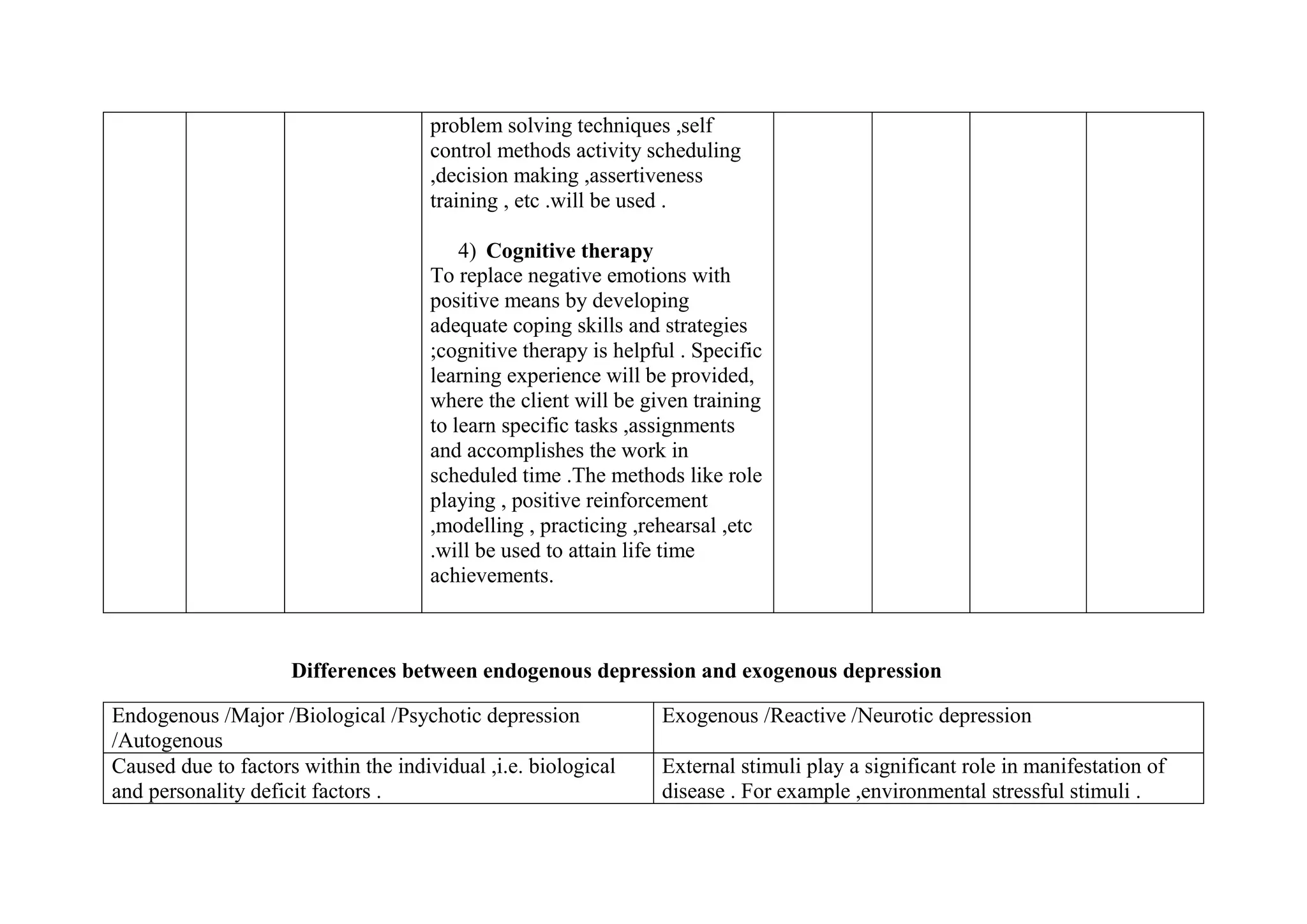
problem solving techniques ,self
control methods activity scheduling
,decision making ,assertiveness
training , etc .will be used .
4) Cognitive therapy
To replace negative emotions with
positive means by developing
adequate coping skills and strategies
;cognitive therapy is helpful . Specific
learning experience will be provided,
where the client will be given training
to learn specific tasks ,assignments
and accomplishes the work in
scheduled time .The methods like role
playing , positive reinforcement
,modelling , practicing ,rehearsal ,etc
.will be used to attain life time
achievements.
Differences between endogenous depression and exogenous depression
Endogenous /Major /Biological /Psychotic depression
/Autogenous
Exogenous /Reactive /Neurotic depression
Caused due to factors within the individual ,i.e. biological
and personality deficit factors .
External stimuli play a significant role in manifestation of
disease . For example ,environmental stressful stimuli .
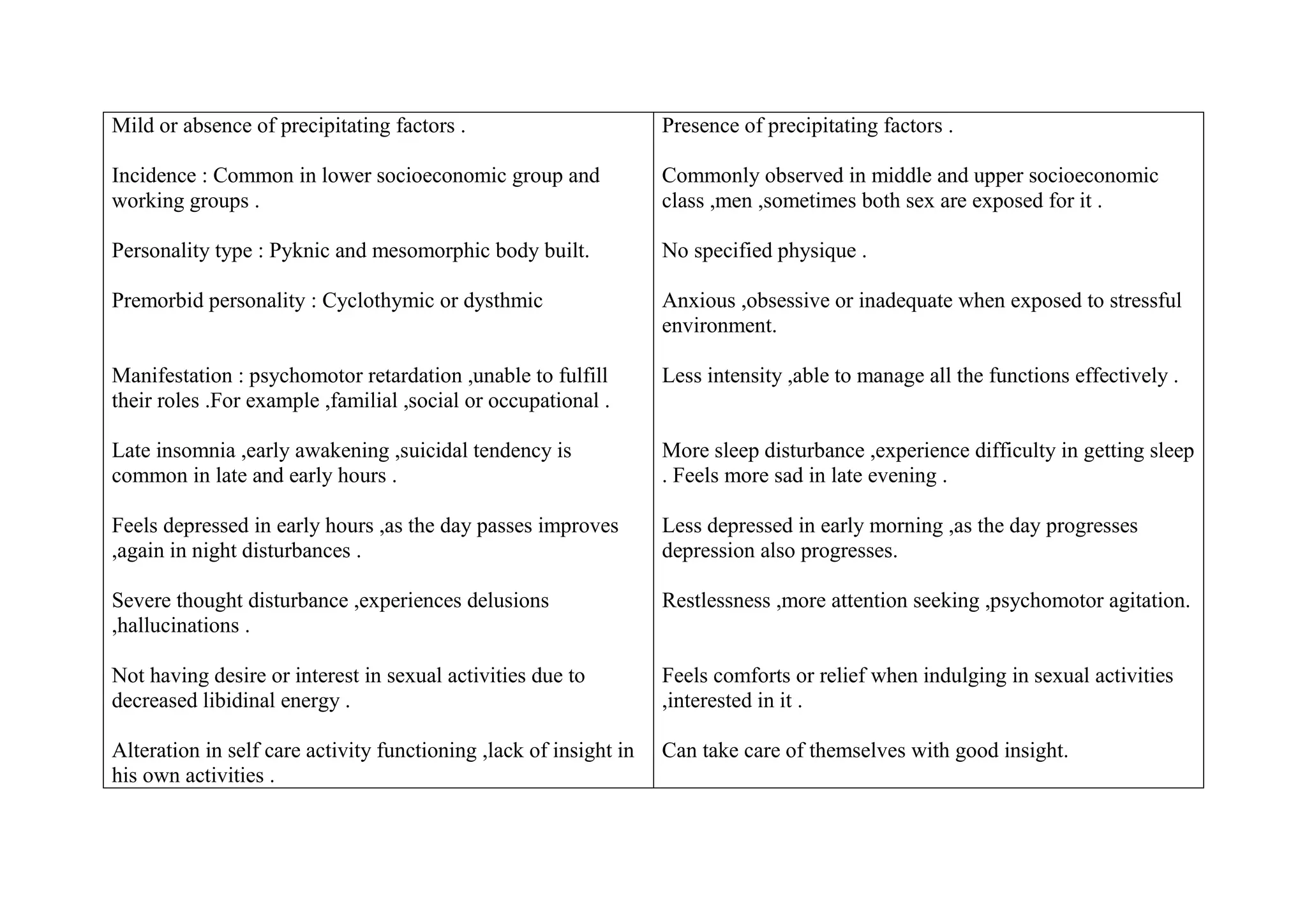
Mild or absence of precipitating factors .
Incidence : Common in lower socioeconomic group and
working groups .
Personality type : Pyknic and mesomorphic body built.
Premorbid personality : Cyclothymic or dysthmic
Manifestation : psychomotor retardation ,unable to fulfill
their roles .For example ,familial ,social or occupational .
Late insomnia ,early awakening ,suicidal tendency is
common in late and early hours .
Feels depressed in early hours ,as the day passes improves
,again in night disturbances .
Severe thought disturbance ,experiences delusions
,hallucinations .
Not having desire or interest in sexual activities due to
decreased libidinal energy .
Alteration in self care activity functioning ,lack of insight in
his own activities .
Presence of precipitating factors .
Commonly observed in middle and upper socioeconomic
class ,men ,sometimes both sex are exposed for it .
No specified physique .
Anxious ,obsessive or inadequate when exposed to stressful
environment.
Less intensity ,able to manage all the functions effectively .
More sleep disturbance ,experience difficulty in getting sleep
. Feels more sad in late evening .
Less depressed in early morning ,as the day progresses
depression also progresses.
Restlessness ,more attention seeking ,psychomotor agitation.
Feels comforts or relief when indulging in sexual activities
,interested in it .
Can take care of themselves with good insight.
Diagnosis
Needs good insight and skillful in psychoanalysis technique
to identify the cause
Psychoanalysis
Interview
Keen observation
Process recording
Therapy
Electro –convulsive therapy
Drug therapy
For example , mood stabilizers ,antidepressants ;and
psychotics ,benzodiazepines
Prognosis
Relapses are common
Explorational skills are required to identify the cause
Interview and observation
Psychotherapy
Social therapy
Drug therapy.for example ,antimanics ,mileu therapy
Relapses are uncommon
NURSING MANAGEMENT OF A CLIENT WITH DEPRESSION
I . Nursing assessment
Obtain the general history of the client both from the client (primary source )and from other reliable source (significant
people like family members,close friend ; secondary sources like previous records)
a. General or demographic information : age ,sex ,health status,nativity /residence ,date of admission.
b. Socio –economics history :
i. Education :educational status ,pattern of education,scholastic environment and any difficulties experienced ,any
history of repeated failures;scholastic upheavels .
ii. Occupation :age at which he started responsibilities and earning ,type of job ,work ,cultural pattern ,schedule
and work environment ,stress associated with it.
iii. Economy : financial status ,type of class , financial stability ,commitments ,experiencing difficulty in meeting
economic needs .
iv. Martial history : married ,single ,widowed ,married but staying alone ,amrital relationship with family
,involvement interaction within family ,involvement of family members ,provision or level of moral support
,pattern of family living conditions .
c. Past medical history : number of episodes ,type of depression experienced ,place and type of treatment obtained
,history of hospitalization ,pattern of manifestation ,duration ,courses of prognosis and recovery .
d. Present medical history : manifestation ,duration ,associated conditions .Type of illness,effect of disorder on other
people ,performance of social activities ,clues of deterioration ,seeking assistance ,type of activities ,and behaviour
during sickness .Assess the effects of disorder over the client ,his family and their social environment .
Physical examination of client to exclude any physical illness,environmental surroundings safety .
Nursing diagnosis Goal Interventions
High risk for violence
related to suicidal
tendency .
Protect the client from
suicidal tendency and self
harm.
 Vigilant observation of the client for any clues
(active or passive )and disturbed behavioural pattern
or related activities ,etc is required .
 Provide safe environment,pace the patient near to the
nurses station to have constant monitoring and
immediate care .
 Remove all potentially harmfully objects in the
client’s unit or near to the client’s surroundings.
 Administer the medications as prescribed ,observe for
side effects specifically extra pyramidal symptoms
and if any observed ,report immediately .
 Counsel the client ,show concern ,love ,care at the
time of need , discuss in detail with the client,provide
moral support .
 Never allow the client to be alone ,if provision is
there ,permit the relative to stay near to the client or
one –to –one observation may be needed .
 Encourage the client to ventilate the feelings or
emotional openly .
 Emphasize positive attitude ;needed observational
skills ,pros and cons pattern ,related to suicidal plans.
 Establish and maintain positive contracts ,counsel the
client frequently ,provide guidance and support .
 Assist the client in finding meaning to the real life
situation and teach coping strategies .
 Encourage the family to provide support and to
Alteration in mood pattern
related to reduced self
esteem ,self concept
,guilty feelings.
Client will be able to
express positive aspects of
life and tries to adopt new
coping strategies to uplift
him which will enhance
the self concept .
inform pleasant events to the client ;need of his
presence or his company .
 Educate the client to gain deeper insight in his own
behaviour ,new ways of problem solving techniques .
 Accept the client as he is .
 Spend some time leisurely with the client ,express
concern ,support ,well wishes ,etc .
 Encourage the client to verbalize /ventilate his
feelings openly ,never pass any comments or disturb
the process of ventilation .
 Motivate the client to perform the activities in which
he is confident ,appreciate or give reward for his self
accomplishment ,provide assistance whenever needed
.
 Emphasize the client to participate in group activities
.
 Inform the client about the progress made in
accomplishing the activities ,which enhances self
confidence .
 Involve the family members to provide support
,concern and not to make the client to undergo or
experience difficulty in situations .
 Assist the client to enjoy satisfaction and meaning to
life .
 Motivate the client to appreciate areas of change and
Ego deficit related to lack
of confidence ,repeated
failure in achieving goals .
Variation in life style
pattern due to defective
coping strategies or lack
of control over any type of
life tragedies or situations
.
Raise the self –esteem ,self
confidence to strenghthen
client’s ego processes.
Develop adequate coping
strategies to enjoy the life
situations.
provide needed guidance and assistance.
 Permit the client to take decision and perform the
activities without any assistance effectively .
 Provide related resources to gain confidence through
interaction .
 Discourage the client to have the thoughts which
hampers his growth and efficieny .
 Provide conducive environment ,repeated
opportunities to expose themselves to stressors .
 Explain the reasons for the changed situation .
 Educate the client to utilize adoptive coping
strategies ,assertive techniques to enhance the ego
strengthening.
 According to the situation,use either positive or
negative reinforcement techniques and other
behaviour modification techniques to face the reality
.
 Encourage the client to take decisions and set
realistic goals and work for its achievement .
 Motivate the client to express his inabilities.
 Teach new coping strategies skills ,allow them to
Inappropriate expression
of emotional feelings due
to emotional upset .
Altered attention and
concentration due to
thought disturbances.
Client will be able to
verbalize his feelings and
diverts his mind in
constructive .
participate in group activities,where they can interact
and share their feelings and listens to others.
 Assist the client to facilitate catharsis process and
ventilate his feelings .
 Assess the extent of depressive feelings ,secondary
gains and its effects over the life .
 Motivate the client to participate in group therapy
and its process;to develop the ability to observe ,how
the other clients are ventilating their experiences and
adapting coping strategies by utilizing the resources
 Allow the client to participate in social activities
whereby he can divert his mind and learn to utilize
varied techniques to attack the problem .
 Identify the areas of interest and if it is desirable
,encourage him to perform it effectively ,e.g. allow
the client in playing games and sports and achieving
skills and mastery over it .
 Help the client to frankly discuss his feelings ;ask the
client not to hesitate to ask for assistance to achieve
skills in it.
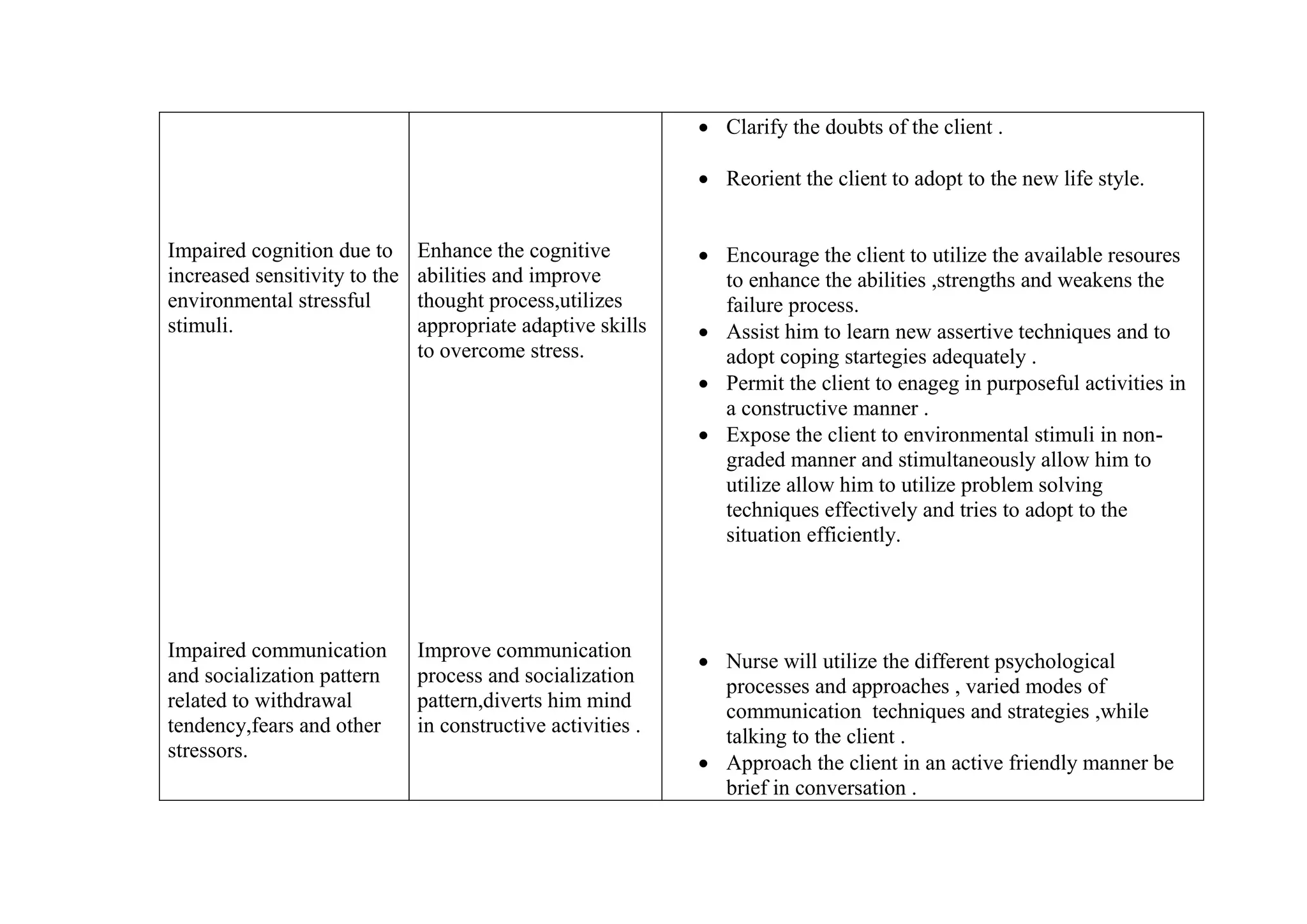
Impaired cognition due to
increased sensitivity to the
environmental stressful
stimuli.
Impaired communication
and socialization pattern
related to withdrawal
tendency,fears and other
stressors.
Enhance the cognitive
abilities and improve
thought process,utilizes
appropriate adaptive skills
to overcome stress.
Improve communication
process and socialization
pattern,diverts him mind
in constructive activities .
 Clarify the doubts of the client .
 Reorient the client to adopt to the new life style.
 Encourage the client to utilize the available resoures
to enhance the abilities ,strengths and weakens the
failure process.
 Assist him to learn new assertive techniques and to
adopt coping startegies adequately .
 Permit the client to enageg in purposeful activities in
a constructive manner .
 Expose the client to environmental stimuli in non-
graded manner and stimultaneously allow him to
utilize allow him to utilize problem solving
techniques effectively and tries to adopt to the
situation efficiently.
 Nurse will utilize the different psychological
processes and approaches , varied modes of
communication techniques and strategies ,while
talking to the client .
 Approach the client in an active friendly manner be
brief in conversation .
 Motivate the client to respond adequately .
 Nurse will act as an active listener ,good supporter
,guide ,motivator and an effective communicator .
 Educate the client appropriate communication
techniques to converse or interact efficiently with
others .
 Explain the client ,how failures will help the
individual to develop ‘will power’ and ‘efficiently in
making efforts’ and strategies to overcome the
deficiencies .
 Accept the client’s inner feelings and narrate the
related events ,how others have gone though the same
pattern in their life situations and methods adopted to
achieve their goals.
 Observe the non –verbal communication pattern and
the method of interaction of the client .
 Motivate the client to observe the social situations
thoroughly ,where he has to participate in social
activities which enhances socialization process and
self confidence .
 Help the client to identify and approach significant
members either from family or friends to have
situational support and for establishing good
interpersonal relationship.
CONCULSION -Depression is a common reaction to events that seen overwhelming or negative .Depression ,an
extreme feeling of sadness ,despair ,dejection ,lack of worth ,or emptiness,affects millions of Americans a year .The
signs and symptoms of depression and the severity of the problem vary with the client and the significance of the
precipitating event. Emotional symptoms can include feelings of tiredness ,sadness ,emptiness or numbness .
Behavioral signs of depression include feelings of tiredness ,sadness ,emptiness or numbness

depression.docx lesson plan (define,classification ,C/m and management)

  • 1.
    S.No Time Specific objective ContentTeaching activity Learning activity A.V.AIDS evaluation 1 3min To introduce about the depression Introduction-Depression is a common reaction to events that seen overwhelming or negative .Depression ,an extreme feeling of sadness ,despair ,dejection ,lack of worth ,or emptiness,affects millions of Americans a year .The signs and symptoms of depression and the severity of the problem vary with the client and the significance of the precipitating event. Emotional symptoms can include feelings of tiredness ,sadness ,emptiness or numbness . Behavioral signs of depression include feelings of tiredness ,sadness ,emptiness or numbness. Behavioral signs of depression include irritability ,inability to concentrate ,difficulty making decisions,loss of sexual desire ,crying ,sleep disturbances ,and social withdrawal .Physical signs of depression may include loss of appetite ,weight loss,constipation ,headache ,and dizziness .Many
  • 2.
    people experience shortperiods of depression in response to overwhelming stressful events ,such as the death of a loved one or loss of a job ;prolonged depression ,however is a cause for concern and may require treatment. Historical aspects – Depression has been recorded since antiquity .The old testament story of King Saul describes a depressive syndrome ,as does the story of Ajax’s suicide in Homer’s Iliad .Hippocrates used the term mania and melancholia to describe mental disturbance .Aulas Cornelius describe melancholia as a depression caused by black bile in 30 A.D. In 1686 ,Bonet describe a mental illness called maniac –melancholicus. Manic depression illness ,which does not distinguish between the groups,led to the current categorization .It is now felt that presence and absence Definition – A form of affective manifestation in which the client will exhibit mood disturbance related to
  • 3.
    self and hisenvironment . Depressive episodes – the classical symptoms in depression are: Depressed mood –ranges from mild ,acute or severe depression. Epidemiology-Major depressive disorder is more prevalent than bipolar disorders. Incidence and prevalence – Studies in Great Britain ,the United States ,and the Scandinavian countries indicate that the risk of developing these severe disorders,ranges from 0.6% - 25.0% over the course of life time.Life time risk forbipolar disorder ranges from 0.6 % to 2 % in both male and female . Clinical manifestation : a) Mild depression – rigid ,sensitive to criticism ,fatigue ,flattened of mood ,blunt affect ,dullness ,sad ,anxious ,empty mood ,physical complaints with no organic cause ,blue spells ,lacks confidence in himself ,lack of interest in activities
  • 4.
    once enjoyed ,including sex;reducedenergy ,lowered activity performance ,inadequacy ,exhibits aversion to activity performance ,inadequacy ,exhibits aversion to activities ,spends alone ,finds difficulty in performing ordinary activities ,sleeping disturbances ,pessimism ,worthlessness, unreasonable guilt ,self blaming. b) Psychomotor retardation ;slow in activities and moods Poverty of ideas, retarded in thinking , preoccupied with gloomy thoughts ,always sees the dark side of things ,no enthusiasm for daily activities ,no zest for living and no pleasure in everyday things ,loss of libido ,incongruent moods ,lack of reactivity and confidence ,difficulty in concentration ,remembering ,decision making. c. Acute or severe depression Client feels tensed ,unable to relax ,anxious ,low or poor concentration
  • 5.
    ,lack of attention,poor memory ,guilty ,inadequacy feelings ,loss of energy ,tired ,exhausted ,vague feeling of bodyaches ,severe headache ,GIT manifestation ,stopped posture ,dryness of mouth and etc. d. Depressive stupor Intensive form in which the client will have acute dementia ,mute ,clouded sensorium ,preoccupied mind ,hallucinations ,depersonalization ,derealization , delusion,progresses into death. Diagnosis : A depressive episode is diagnosed if five or more of these symptoms persist most of the day ,nearly every , for a period of 2 weeks or longer . Treatment : 1) Pharmacotherapy – antidepressants Tricyclic antidepressants – Imipramine 75 -300 mg/day Or Monoamino reuptake inhibitors – Amitriptyline 75 -300 mg/day Mechanism of action
  • 6.
     Increase catecholaminelevel in the brain  TCAs block the reuptake of norepinephrine or serotonin at the nerve terminals and increase its level at the receptors site .2-3 weeks will be taken to decrease the depressive symptoms ; weight gain .  MAOs degrade the catecholamine after reuptake and increases brain amine level 5-10 days it will take to bring down depressive symptoms will take to bring amine level 5- 10 days it will take to bring down depressive symptoms .  SSRIs act by inhibiting the reuptake of serotonin and increase its level at receptors site. Side effects  Anticholenergic reaction : dry mouth ,constipation ,distress ,mydraisis ,urinary retention ,blurred vision ,delirium .
  • 7.
     Sexual dysfunction: impaired ejaculation ,priapism ,impotence .  CNS effects : fine tremors ,sedation ,extra pyramidal symptoms,withdrawal syndrome ,seizures ,precipitation of mania reflecting bipolar illness.  Cardiovascular effects :postural or orthostatic hypotension ,palpitation. 2) ELECTROCONVULSIVE THERAPY ECT is indicated to have rapid action and remission of symptoms .In major depression cases it will be given as initial treatment and fosters antidepressant action . 3) PSYCHOTHERAPEUTIC APPROACH SUPPORTIVE PSYCHOTHERAPY Client will be guided for regularity of schedules and fixation of appointments . Various psychotherapeutic processes like
  • 8.
    ventilation ,reassurance andrelaxation technique guidance ,counselling ,education sessions will be planned to improve the morale and support to the client .Discourage the client ,not to expose to major changes ,if they are prone for depression . PSYCHOANALYSIS Free association or word association , motivation ,guidance and counselling techniques are used to have stabilized environment ,to maintain self esteem to resolve emotional conflicts ,to improve self –esteem and insight , to reduce depressive symptoms ,to prevent acute episode . GROUP THERAPY In mild depression cases group therapy is helpful to overcome negative feelings and to develop good interpersonal skills ,by enhancing emotional growth and support .
  • 9.
    INTERPERSONAL THERAPY It improvessocial functioning ,resolves psychosocial conflicts ,explores precipitants predisposing MDP. FAMILY THERAPY Provides support ,reduces the depressive symptoms relapses occurrence ,resolves interpersonal and familial disputes or conflicts or problems . MARTIAL THERAPY To resolve marital conflicts ,interpersonal ,emotional conflicts among the couple and within the family cohesiveness ,counsellors will give intensive advice to both partners. BEHAVIOUR THERAPY Learning principles, varied techniques like social skill training ,
  • 10.
    problem solving techniques,self control methods activity scheduling ,decision making ,assertiveness training , etc .will be used . 4) Cognitive therapy To replace negative emotions with positive means by developing adequate coping skills and strategies ;cognitive therapy is helpful . Specific learning experience will be provided, where the client will be given training to learn specific tasks ,assignments and accomplishes the work in scheduled time .The methods like role playing , positive reinforcement ,modelling , practicing ,rehearsal ,etc .will be used to attain life time achievements. Differences between endogenous depression and exogenous depression Endogenous /Major /Biological /Psychotic depression /Autogenous Exogenous /Reactive /Neurotic depression Caused due to factors within the individual ,i.e. biological and personality deficit factors . External stimuli play a significant role in manifestation of disease . For example ,environmental stressful stimuli .
  • 11.
    Mild or absenceof precipitating factors . Incidence : Common in lower socioeconomic group and working groups . Personality type : Pyknic and mesomorphic body built. Premorbid personality : Cyclothymic or dysthmic Manifestation : psychomotor retardation ,unable to fulfill their roles .For example ,familial ,social or occupational . Late insomnia ,early awakening ,suicidal tendency is common in late and early hours . Feels depressed in early hours ,as the day passes improves ,again in night disturbances . Severe thought disturbance ,experiences delusions ,hallucinations . Not having desire or interest in sexual activities due to decreased libidinal energy . Alteration in self care activity functioning ,lack of insight in his own activities . Presence of precipitating factors . Commonly observed in middle and upper socioeconomic class ,men ,sometimes both sex are exposed for it . No specified physique . Anxious ,obsessive or inadequate when exposed to stressful environment. Less intensity ,able to manage all the functions effectively . More sleep disturbance ,experience difficulty in getting sleep . Feels more sad in late evening . Less depressed in early morning ,as the day progresses depression also progresses. Restlessness ,more attention seeking ,psychomotor agitation. Feels comforts or relief when indulging in sexual activities ,interested in it . Can take care of themselves with good insight.
  • 12.
    Diagnosis Needs good insightand skillful in psychoanalysis technique to identify the cause Psychoanalysis Interview Keen observation Process recording Therapy Electro –convulsive therapy Drug therapy For example , mood stabilizers ,antidepressants ;and psychotics ,benzodiazepines Prognosis Relapses are common Explorational skills are required to identify the cause Interview and observation Psychotherapy Social therapy Drug therapy.for example ,antimanics ,mileu therapy Relapses are uncommon
  • 13.
    NURSING MANAGEMENT OFA CLIENT WITH DEPRESSION I . Nursing assessment Obtain the general history of the client both from the client (primary source )and from other reliable source (significant people like family members,close friend ; secondary sources like previous records) a. General or demographic information : age ,sex ,health status,nativity /residence ,date of admission. b. Socio –economics history : i. Education :educational status ,pattern of education,scholastic environment and any difficulties experienced ,any history of repeated failures;scholastic upheavels . ii. Occupation :age at which he started responsibilities and earning ,type of job ,work ,cultural pattern ,schedule and work environment ,stress associated with it. iii. Economy : financial status ,type of class , financial stability ,commitments ,experiencing difficulty in meeting economic needs . iv. Martial history : married ,single ,widowed ,married but staying alone ,amrital relationship with family ,involvement interaction within family ,involvement of family members ,provision or level of moral support ,pattern of family living conditions . c. Past medical history : number of episodes ,type of depression experienced ,place and type of treatment obtained ,history of hospitalization ,pattern of manifestation ,duration ,courses of prognosis and recovery . d. Present medical history : manifestation ,duration ,associated conditions .Type of illness,effect of disorder on other people ,performance of social activities ,clues of deterioration ,seeking assistance ,type of activities ,and behaviour during sickness .Assess the effects of disorder over the client ,his family and their social environment . Physical examination of client to exclude any physical illness,environmental surroundings safety .
  • 14.
    Nursing diagnosis GoalInterventions High risk for violence related to suicidal tendency . Protect the client from suicidal tendency and self harm.  Vigilant observation of the client for any clues (active or passive )and disturbed behavioural pattern or related activities ,etc is required .  Provide safe environment,pace the patient near to the nurses station to have constant monitoring and immediate care .  Remove all potentially harmfully objects in the client’s unit or near to the client’s surroundings.  Administer the medications as prescribed ,observe for side effects specifically extra pyramidal symptoms and if any observed ,report immediately .  Counsel the client ,show concern ,love ,care at the time of need , discuss in detail with the client,provide moral support .  Never allow the client to be alone ,if provision is there ,permit the relative to stay near to the client or one –to –one observation may be needed .  Encourage the client to ventilate the feelings or emotional openly .  Emphasize positive attitude ;needed observational skills ,pros and cons pattern ,related to suicidal plans.  Establish and maintain positive contracts ,counsel the client frequently ,provide guidance and support .  Assist the client in finding meaning to the real life situation and teach coping strategies .  Encourage the family to provide support and to
  • 15.
    Alteration in moodpattern related to reduced self esteem ,self concept ,guilty feelings. Client will be able to express positive aspects of life and tries to adopt new coping strategies to uplift him which will enhance the self concept . inform pleasant events to the client ;need of his presence or his company .  Educate the client to gain deeper insight in his own behaviour ,new ways of problem solving techniques .  Accept the client as he is .  Spend some time leisurely with the client ,express concern ,support ,well wishes ,etc .  Encourage the client to verbalize /ventilate his feelings openly ,never pass any comments or disturb the process of ventilation .  Motivate the client to perform the activities in which he is confident ,appreciate or give reward for his self accomplishment ,provide assistance whenever needed .  Emphasize the client to participate in group activities .  Inform the client about the progress made in accomplishing the activities ,which enhances self confidence .  Involve the family members to provide support ,concern and not to make the client to undergo or experience difficulty in situations .  Assist the client to enjoy satisfaction and meaning to life .  Motivate the client to appreciate areas of change and
  • 16.
    Ego deficit relatedto lack of confidence ,repeated failure in achieving goals . Variation in life style pattern due to defective coping strategies or lack of control over any type of life tragedies or situations . Raise the self –esteem ,self confidence to strenghthen client’s ego processes. Develop adequate coping strategies to enjoy the life situations. provide needed guidance and assistance.  Permit the client to take decision and perform the activities without any assistance effectively .  Provide related resources to gain confidence through interaction .  Discourage the client to have the thoughts which hampers his growth and efficieny .  Provide conducive environment ,repeated opportunities to expose themselves to stressors .  Explain the reasons for the changed situation .  Educate the client to utilize adoptive coping strategies ,assertive techniques to enhance the ego strengthening.  According to the situation,use either positive or negative reinforcement techniques and other behaviour modification techniques to face the reality .  Encourage the client to take decisions and set realistic goals and work for its achievement .  Motivate the client to express his inabilities.  Teach new coping strategies skills ,allow them to
  • 17.
    Inappropriate expression of emotionalfeelings due to emotional upset . Altered attention and concentration due to thought disturbances. Client will be able to verbalize his feelings and diverts his mind in constructive . participate in group activities,where they can interact and share their feelings and listens to others.  Assist the client to facilitate catharsis process and ventilate his feelings .  Assess the extent of depressive feelings ,secondary gains and its effects over the life .  Motivate the client to participate in group therapy and its process;to develop the ability to observe ,how the other clients are ventilating their experiences and adapting coping strategies by utilizing the resources  Allow the client to participate in social activities whereby he can divert his mind and learn to utilize varied techniques to attack the problem .  Identify the areas of interest and if it is desirable ,encourage him to perform it effectively ,e.g. allow the client in playing games and sports and achieving skills and mastery over it .  Help the client to frankly discuss his feelings ;ask the client not to hesitate to ask for assistance to achieve skills in it.
  • 18.
    Impaired cognition dueto increased sensitivity to the environmental stressful stimuli. Impaired communication and socialization pattern related to withdrawal tendency,fears and other stressors. Enhance the cognitive abilities and improve thought process,utilizes appropriate adaptive skills to overcome stress. Improve communication process and socialization pattern,diverts him mind in constructive activities .  Clarify the doubts of the client .  Reorient the client to adopt to the new life style.  Encourage the client to utilize the available resoures to enhance the abilities ,strengths and weakens the failure process.  Assist him to learn new assertive techniques and to adopt coping startegies adequately .  Permit the client to enageg in purposeful activities in a constructive manner .  Expose the client to environmental stimuli in non- graded manner and stimultaneously allow him to utilize allow him to utilize problem solving techniques effectively and tries to adopt to the situation efficiently.  Nurse will utilize the different psychological processes and approaches , varied modes of communication techniques and strategies ,while talking to the client .  Approach the client in an active friendly manner be brief in conversation .
  • 19.
     Motivate theclient to respond adequately .  Nurse will act as an active listener ,good supporter ,guide ,motivator and an effective communicator .  Educate the client appropriate communication techniques to converse or interact efficiently with others .  Explain the client ,how failures will help the individual to develop ‘will power’ and ‘efficiently in making efforts’ and strategies to overcome the deficiencies .  Accept the client’s inner feelings and narrate the related events ,how others have gone though the same pattern in their life situations and methods adopted to achieve their goals.  Observe the non –verbal communication pattern and the method of interaction of the client .  Motivate the client to observe the social situations thoroughly ,where he has to participate in social activities which enhances socialization process and self confidence .  Help the client to identify and approach significant members either from family or friends to have situational support and for establishing good interpersonal relationship.
  • 20.
    CONCULSION -Depression isa common reaction to events that seen overwhelming or negative .Depression ,an extreme feeling of sadness ,despair ,dejection ,lack of worth ,or emptiness,affects millions of Americans a year .The signs and symptoms of depression and the severity of the problem vary with the client and the significance of the precipitating event. Emotional symptoms can include feelings of tiredness ,sadness ,emptiness or numbness . Behavioral signs of depression include feelings of tiredness ,sadness ,emptiness or numbness