S.
N
O
.
ASSESSMENT DIAGNOSIS GOALNURSING PLANNING NURSING
INTERVENTION
EVALUATION
1. Subjective
data:-
Patient
complains that
he is restless.
Objective
data;-
On observation
I found that he
feels restless.
Risk for
injury related
to impulsive
and accident
prone
behaviour
and inability
to perceive
harm.
Client will
be free of
injury.
1. Ensure that client
has a safe
environment.
2. Remove objects
from immediate area
on which client could
injury self as a result of
random, hyperactive
movement.
3. Identify deliberate
behaviour that puts the
client at risk
4. If there is risk for
injury, associate with
specific therapeutic
activities
5. Provide adequate
supervision and
assistance, or limit
client participation if
adequate supervision
is not possible.
1. Objects that are
appropriate to the
normal living situations
can be hazardous to
the client whose motor
activities are out of
control.
2. Behaviour can be
modified with aversive
reinforcement.
3. Client safety is a
nursing priority.
Have the
nursing
actions
directed at
client safety
been effective
in protecting
the client from
injury.
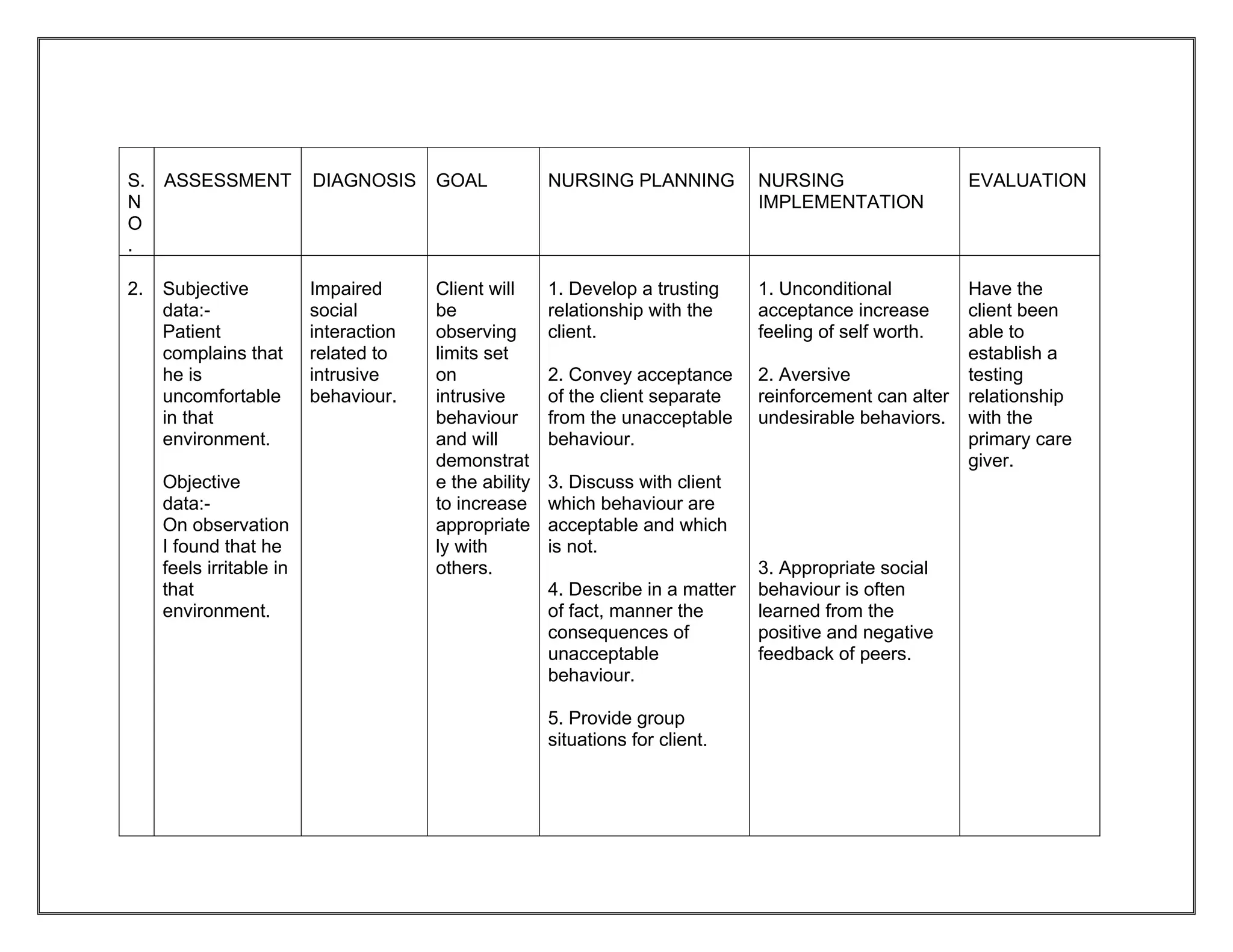
2.
S.
N
O
.
ASSESSMENT DIAGNOSIS GOALNURSING PLANNING NURSING
IMPLEMENTATION
EVALUATION
2. Subjective
data:-
Patient
complains that
he is
uncomfortable
in that
environment.
Objective
data:-
On observation
I found that he
feels irritable in
that
environment.
Impaired
social
interaction
related to
intrusive
behaviour.
Client will
be
observing
limits set
on
intrusive
behaviour
and will
demonstrat
e the ability
to increase
appropriate
ly with
others.
1. Develop a trusting
relationship with the
client.
2. Convey acceptance
of the client separate
from the unacceptable
behaviour.
3. Discuss with client
which behaviour are
acceptable and which
is not.
4. Describe in a matter
of fact, manner the
consequences of
unacceptable
behaviour.
5. Provide group
situations for client.
1. Unconditional
acceptance increase
feeling of self worth.
2. Aversive
reinforcement can alter
undesirable behaviors.
3. Appropriate social
behaviour is often
learned from the
positive and negative
feedback of peers.
Have the
client been
able to
establish a
testing
relationship
with the
primary care
giver.
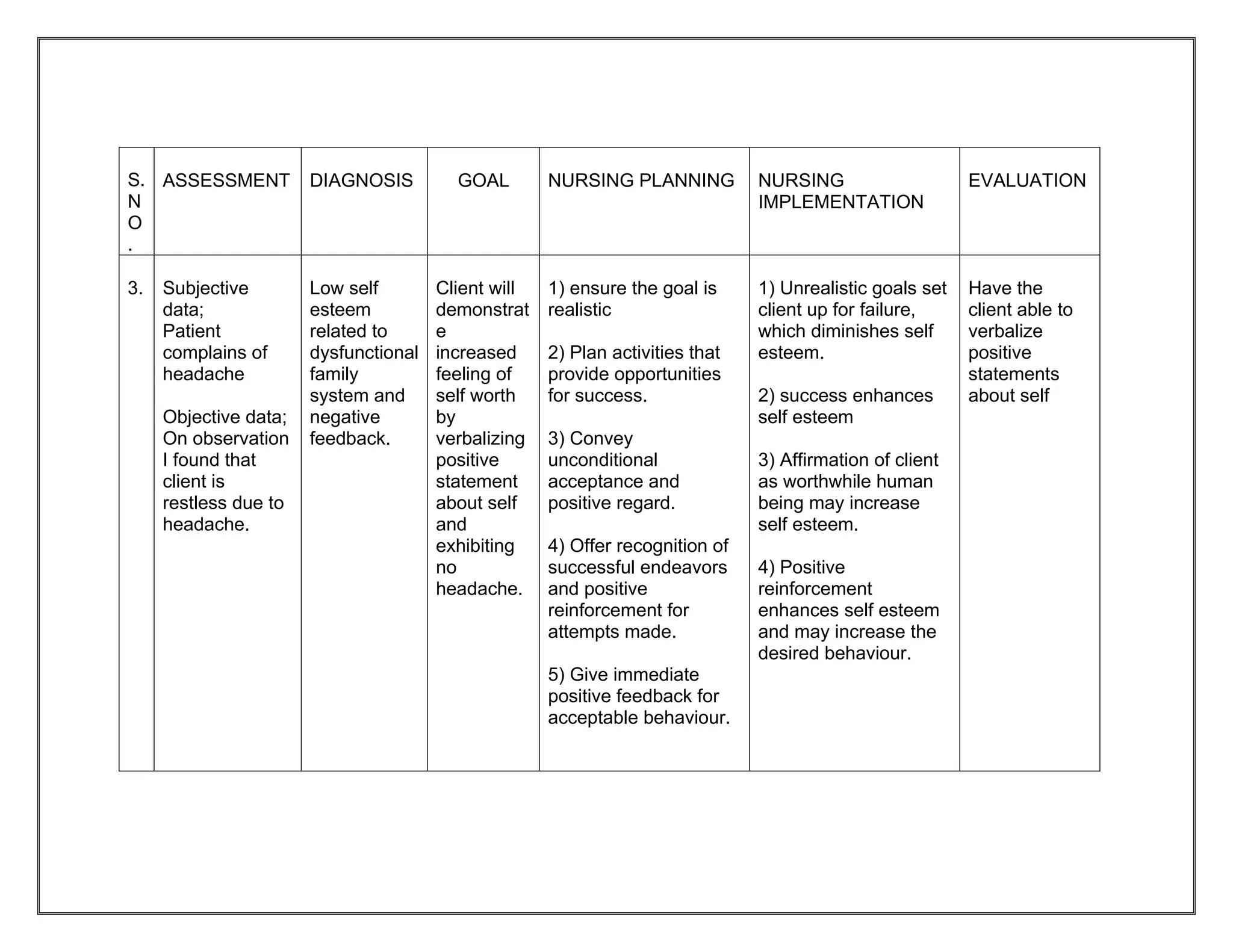
3.
S.
N
O
.
ASSESSMENT DIAGNOSIS GOALNURSING PLANNING NURSING
IMPLEMENTATION
EVALUATION
3. Subjective
data;
Patient
complains of
headache
Objective data;
On observation
I found that
client is
restless due to
headache.
Low self
esteem
related to
dysfunctional
family
system and
negative
feedback.
Client will
demonstrat
e
increased
feeling of
self worth
by
verbalizing
positive
statement
about self
and
exhibiting
no
headache.
1) ensure the goal is
realistic
2) Plan activities that
provide opportunities
for success.
3) Convey
unconditional
acceptance and
positive regard.
4) Offer recognition of
successful endeavors
and positive
reinforcement for
attempts made.
5) Give immediate
positive feedback for
acceptable behaviour.
1) Unrealistic goals set
client up for failure,
which diminishes self
esteem.
2) success enhances
self esteem
3) Affirmation of client
as worthwhile human
being may increase
self esteem.
4) Positive
reinforcement
enhances self esteem
and may increase the
desired behaviour.
Have the
client able to
verbalize
positive
statements
about self



![NURSING CARE PLAN.doc [PSYCHATRIC PATIENT]](https://cdn.slidesharecdn.com/ss_thumbnails/nursingcareplan-250325094815-f3ace806-thumbnail.jpg?width=640&height=640&fit=bounds)


![process 2.docx (FORMAT )[MENTAL HEALTH NURISNG ASSIGNMENT]](https://cdn.slidesharecdn.com/ss_thumbnails/process2-250325092750-d08f0852-thumbnail.jpg?width=640&height=640&fit=bounds)


![Genetic counselling.pptx [M.Sc Nursing I y]](https://cdn.slidesharecdn.com/ss_thumbnails/geneticcounselling-250311060616-f1112afb-thumbnail.jpg?width=640&height=640&fit=bounds)


![Chromosomes.pptx(Nursing) M.Sc [ Advance health Nurisng]](https://cdn.slidesharecdn.com/ss_thumbnails/chromosomes-250311055126-ad865c01-thumbnail.jpg?width=640&height=640&fit=bounds)


