T
h
a
N k
y
o
u
COGNITIVE DEVELOPMENT
About father
KEY CONCEPTS.
Schema
Adaptation
Stages
Stage 1
Stage 2
Stage 3
Stage 4
Educational Implication
content
T
h
a
N k
y
o
u
COGNITIVE DEVELOPMENT
Refers to the inner process and products of the mind
that lead of knowing. Its includes all mental activity –
remembering, symbolizing, categorizing, problem
solving, creating and even dreaming.
C
About father
KEY CONCEPTS.
Schema
Adaptation
Stage 1
Stage 2
Stage 3
Stage 4
Educational Implication
Stages
T
h
a
N k
y
o
u
COGNITIVE DEVELOPMENT
Refers to the inner process and products of the mind
that lead of knowing. Its includes all mental activity –
remembering, symbolizing, categorizing, problem
solving, creating and even dreaming.
About father of psychplogy
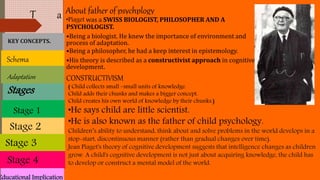
•Piaget was a SWISS BIOLOGIST, PHILOSOPHER AND A
PSYCHOLOGIST.
•Being a biologist. He knew the importance of environment and
process of adaptation.
•Being a philosopher, he had a keep interest in epistemology.
•His theory is described as a constructivist approach in cognitive
development.
CONSTRUCTIVISM
( Child collects small –small units of knowledge.
Child adds their chunks and makes a bigger concept.
Child creates his own world of knowledge by their chunks.)
•He says child are little scientist.
•He is also known as the father of child psychology.
Children’s ability to understand, think about and solve problems in the world develops in a
stop-start, discontinuous manner (rather than gradual changes over time).
Jean Piaget's theory of cognitive development suggests that intelligence changes as children
grow. A child's cognitive development is not just about acquiring knowledge, the child has
to develop or construct a mental model of the world.
KEY CONCEPTS.
Schema
Adaptation
Stage 1
Stage 2
Stage 3
Stage 4
Educational Implication
Stages
T
h
a
N k
y
o
u
COGNITIVE DEVELOPMENT
Refers to the inner process and products of the mind
that lead of knowing. Its includes all mental activity –
remembering, symbolizing, categorizing, problem
solving, creating and even dreaming.
About father of psychplogy
•Piaget was a SWISS BIOLOGIST, PHILOSOPHER AND A
PSYCHOLOGIST.
•Being a biologist. He knew the importance of environment and
process of adaptation.
•Being a philosopher, he had a keep interest in epistemology.
•His theory is described as a constructivist approach in cognitive
development.
CONSTRUCTIVISM
( Child collects small –small units of knowledge.
Child adds their chunks and makes a bigger concept.
Child creates his own world of knowledge by their chunks.)
•He says child are little scientist.
•He is also known as the father of child psychology.
Children’s ability to understand, think about and solve problems in the world develops in a
stop-start, discontinuous manner (rather than gradual changes over time).
Jean Piaget's theory of cognitive development suggests that intelligence changes as children
grow. A child's cognitive development is not just about acquiring knowledge, the child has
to develop or construct a mental model of the world.
KEY CONCEPTS……..
 Schema Animism
 Assimilation Conservation
 Equilibrium Deductive reasoning
 Accommodation Decentration
 Object permanence Decontextualization
 Ego – centrism Integration
Schema
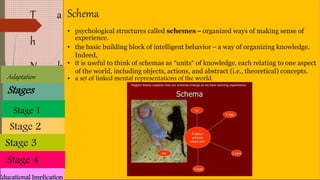
• psychological structures called schemes – organized ways of making sense of
experience.
• the basic building block of intelligent behavior – a way of organizing knowledge.
Indeed,
• it is useful to think of schemas as “units” of knowledge, each relating to one aspect
of the world, including objects, actions, and abstract (i.e., theoretical) concepts.
• a set of linked mental representations of the world.
Adaptation
Stage 1
Stage 2
Stage 3
Stage 4
Educational Implication
Stages
T
h
a
N k
y
o
u
KEY CONCEPTS……..
 Schema Animism
 Assimilation Conservation
 Equilibrium Deductive reasoning
 Accommodation Decentration
 Object permanence Decontextualization
 Ego – centrism Integration
Schema
• psychological structures called schemes – organized ways of making sense of
experience.
• the basic building block of intelligent behavior – a way of organizing knowledge.
Indeed,
• it is useful to think of schemas as “units” of knowledge, each relating to one aspect
of the world, including objects, actions, and abstract (i.e., theoretical) concepts.
• a set of linked mental representations of the world.
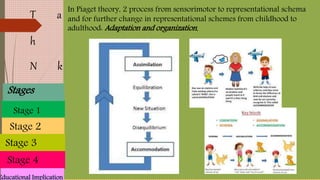
In Piaget theory, 2 process from sensorimotor to representational schema
and for further change in representational schemes from childhood to
adulthood: Adaptation and organization.
Stage 1
Stage 2
Stage 3
Stage 4
Educational Implication
Stages
T
h
a
N k
y
o
u
STAGE OF COGNITIVE DEVELOPMENT …
Stage 1
Stage 2
Stage 3
Stage 4
Educational Implication
T
h
a
N k
y
o
u
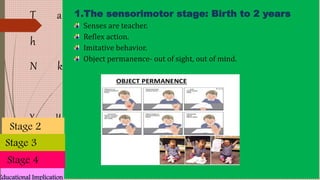
1.The sensorimotor stage: Birth to 2 years
Senses are teacher.
Reflex action.
Imitative behavior.
Object permanence- out of sight, out of mind.
Stage 2
Stage 3
Stage 4
Educational Implication
T
h
a
N k
y
o
u
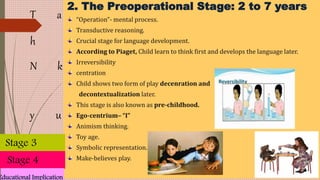
2. The Preoperational Stage: 2 to 7 years
“Operation”- mental process.
Transductive reasoning.
Crucial stage for language development.
According to Piaget, Child learn to think first and develops the language later.
Irreversibility
centration
Child shows two form of play decenration and
decontextualization later.
This stage is also known as pre-childhood.
Ego-centrium– “I”
Animism thinking.
Toy age.
Symbolic representation.
Make-believes play.
Stage 3
Stage 4
Educational Implication
T
h
a
N k
y
o
u
3. The Concrete Operational Stage:7 to 11 years
Stage of logical thinking & concrete operations.
Reversibility develops.
Transitivity develops.
Classification comes.
Seriation.
Child understands that quantity, area or volume does not change with change in form of
shape or size.
This stage is also known as later childhood or pre- gang age.
Stage 4
Educational Implication
T
h
a
N k
y
o
u
4. The Formal Operational Stage:11 years and older
In this stage child develops abstract thinking.
Also known as gang age .
Deductive reasoning comes.
Adolescents egocentrism.
Hypothetic-deductive reasoning.
Age of divergent/convergent/creative thinking.
Educational Implication
T
h
a
N k
y
o
u
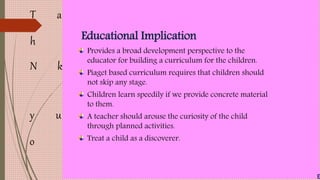
Educational Implication
Provides a broad development perspective to the
educator for building a curriculum for the children.
Piaget based curriculum requires that children should
not skip any stage.
Children learn speedily if we provide concrete material
to them.
A teacher should arouse the curiosity of the child
through planned activities.
Treat a child as a discoverer.
E
REFEReNCE
Laura E. Berk 9th edition the stage of cognitive development, definition of
assimilation and accommodation , retrieve pearson education 2018
McLeod, S. A. (2018, June 06). Jean Piaget's theory of cognitive
development. Simply Psychology.

PIAGET'S COGNITIVE DEVELOPMENT THEORY

  • 1.
    T h a N k y o u COGNITIVE DEVELOPMENT Aboutfather KEY CONCEPTS. Schema Adaptation Stages Stage 1 Stage 2 Stage 3 Stage 4 Educational Implication content
  • 2.
    T h a N k y o u COGNITIVE DEVELOPMENT Refersto the inner process and products of the mind that lead of knowing. Its includes all mental activity – remembering, symbolizing, categorizing, problem solving, creating and even dreaming. C About father KEY CONCEPTS. Schema Adaptation Stage 1 Stage 2 Stage 3 Stage 4 Educational Implication Stages
  • 3.
    T h a N k y o u COGNITIVE DEVELOPMENT Refersto the inner process and products of the mind that lead of knowing. Its includes all mental activity – remembering, symbolizing, categorizing, problem solving, creating and even dreaming. About father of psychplogy •Piaget was a SWISS BIOLOGIST, PHILOSOPHER AND A PSYCHOLOGIST. •Being a biologist. He knew the importance of environment and process of adaptation. •Being a philosopher, he had a keep interest in epistemology. •His theory is described as a constructivist approach in cognitive development. CONSTRUCTIVISM ( Child collects small –small units of knowledge. Child adds their chunks and makes a bigger concept. Child creates his own world of knowledge by their chunks.) •He says child are little scientist. •He is also known as the father of child psychology. Children’s ability to understand, think about and solve problems in the world develops in a stop-start, discontinuous manner (rather than gradual changes over time). Jean Piaget's theory of cognitive development suggests that intelligence changes as children grow. A child's cognitive development is not just about acquiring knowledge, the child has to develop or construct a mental model of the world. KEY CONCEPTS. Schema Adaptation Stage 1 Stage 2 Stage 3 Stage 4 Educational Implication Stages
  • 4.
    T h a N k y o u COGNITIVE DEVELOPMENT Refersto the inner process and products of the mind that lead of knowing. Its includes all mental activity – remembering, symbolizing, categorizing, problem solving, creating and even dreaming. About father of psychplogy •Piaget was a SWISS BIOLOGIST, PHILOSOPHER AND A PSYCHOLOGIST. •Being a biologist. He knew the importance of environment and process of adaptation. •Being a philosopher, he had a keep interest in epistemology. •His theory is described as a constructivist approach in cognitive development. CONSTRUCTIVISM ( Child collects small –small units of knowledge. Child adds their chunks and makes a bigger concept. Child creates his own world of knowledge by their chunks.) •He says child are little scientist. •He is also known as the father of child psychology. Children’s ability to understand, think about and solve problems in the world develops in a stop-start, discontinuous manner (rather than gradual changes over time). Jean Piaget's theory of cognitive development suggests that intelligence changes as children grow. A child's cognitive development is not just about acquiring knowledge, the child has to develop or construct a mental model of the world. KEY CONCEPTS……..  Schema Animism  Assimilation Conservation  Equilibrium Deductive reasoning  Accommodation Decentration  Object permanence Decontextualization  Ego – centrism Integration Schema • psychological structures called schemes – organized ways of making sense of experience. • the basic building block of intelligent behavior – a way of organizing knowledge. Indeed, • it is useful to think of schemas as “units” of knowledge, each relating to one aspect of the world, including objects, actions, and abstract (i.e., theoretical) concepts. • a set of linked mental representations of the world. Adaptation Stage 1 Stage 2 Stage 3 Stage 4 Educational Implication Stages
  • 5.
    T h a N k y o u KEY CONCEPTS…….. Schema Animism  Assimilation Conservation  Equilibrium Deductive reasoning  Accommodation Decentration  Object permanence Decontextualization  Ego – centrism Integration Schema • psychological structures called schemes – organized ways of making sense of experience. • the basic building block of intelligent behavior – a way of organizing knowledge. Indeed, • it is useful to think of schemas as “units” of knowledge, each relating to one aspect of the world, including objects, actions, and abstract (i.e., theoretical) concepts. • a set of linked mental representations of the world. In Piaget theory, 2 process from sensorimotor to representational schema and for further change in representational schemes from childhood to adulthood: Adaptation and organization. Stage 1 Stage 2 Stage 3 Stage 4 Educational Implication Stages
  • 6.
    T h a N k y o u STAGE OFCOGNITIVE DEVELOPMENT … Stage 1 Stage 2 Stage 3 Stage 4 Educational Implication
  • 7.
    T h a N k y o u 1.The sensorimotorstage: Birth to 2 years Senses are teacher. Reflex action. Imitative behavior. Object permanence- out of sight, out of mind. Stage 2 Stage 3 Stage 4 Educational Implication
  • 8.
    T h a N k y o u 2. ThePreoperational Stage: 2 to 7 years “Operation”- mental process. Transductive reasoning. Crucial stage for language development. According to Piaget, Child learn to think first and develops the language later. Irreversibility centration Child shows two form of play decenration and decontextualization later. This stage is also known as pre-childhood. Ego-centrium– “I” Animism thinking. Toy age. Symbolic representation. Make-believes play. Stage 3 Stage 4 Educational Implication
  • 9.
    T h a N k y o u 3. TheConcrete Operational Stage:7 to 11 years Stage of logical thinking & concrete operations. Reversibility develops. Transitivity develops. Classification comes. Seriation. Child understands that quantity, area or volume does not change with change in form of shape or size. This stage is also known as later childhood or pre- gang age. Stage 4 Educational Implication
  • 10.
    T h a N k y o u 4. TheFormal Operational Stage:11 years and older In this stage child develops abstract thinking. Also known as gang age . Deductive reasoning comes. Adolescents egocentrism. Hypothetic-deductive reasoning. Age of divergent/convergent/creative thinking. Educational Implication
  • 11.
    T h a N k y o u Educational Implication Providesa broad development perspective to the educator for building a curriculum for the children. Piaget based curriculum requires that children should not skip any stage. Children learn speedily if we provide concrete material to them. A teacher should arouse the curiosity of the child through planned activities. Treat a child as a discoverer. E
  • 12.
    REFEReNCE Laura E. Berk9th edition the stage of cognitive development, definition of assimilation and accommodation , retrieve pearson education 2018 McLeod, S. A. (2018, June 06). Jean Piaget's theory of cognitive development. Simply Psychology.