Cognitive & Behavior
Therapy (CBT)
LUBA RASCHEFF | EMP 35XXYY—PSYCHO-SPIRITUAL CARE AND THERAPY
PRACTICUM
A L L C I TAT I O N S ( U N L E S S S TAT E D OT H E R W I S E ) A R E TA K E N F R O M E D I TO R S M E S S E R & G U R M A N ’ S E S S E N T I A L
P S YC H OT H E R A P I E S , T H E O RY A N D P R AC T I C E , T H I R D E D I T I O N | G U I L FO R D P R E S S , 2 0 1 1
‘C’ stands for
Cognitive
Cognition has to do with
thoughts.
The goal of cognitive
therapies is to focus on
what the client believes or
thinks about themselves,
the world and the future.
(143)
Pathology
Some thoughts are healthy.
Cognitive therapies target pathological
thoughts, ‘maladaptive conditions’ that are
‘frequently automatic and ingrained,’ a.k.a.
‘maladaptive cognitions.’ (143)
‘B’ stands for
Behavior
Behavior is how the client
responds to cognitions or
thoughts. (153) Behaviors
can be either adaptive or
maladaptive. (111) Adaptive
behaviors are healthy.
Maladaptive behaviors are
pathological.
‘T’ stands for
Therapy
Both cognitive and behavioral—
cognitive-behavioral—models of
therapy help the client examine
how she views herself in the world
(thoughts, cognitions) and new
ways of responding (behaviors).
Therapy ‘attempts to identify
specific, measurable goals and to
move quickly and directly into
those areas that create the most
difficulty for [her].’ (153)
‘C’ + ‘B’ can
work together
in ‘T’ making
CBT
Cognitive therapies focus on the client’s beliefs
about herself, the world around her and her
future. Both source and target of therapy are
her thoughts—more precisely maladaptive
thoughts or cognitions ‘that are frequently
automatic and ingrained.’ (143)
On the other hand, ‘[b]ehavior therapy focuses
on learned behavior that arises from responses
to [the client’s] environment.’ The goal is for
her to unlearn problematic behaviors. (Ibid.)
CBT links the two approaches ‘by targeting both
problematic behaviors and maladaptive
cognitions.’ (Ibid.)
The History
of Cognitive
Therapy
‘Cognitive theory is founded on
intellectual traditions dating to Stoic
philosophers, such as Epictetus … , who
in the first century commented, “What
upsets people is not things themselves
but their judgments about things.” (p.
13).” (144)
The History
of Cognitive
Therapy
‘Contemporary cognitive psychotherapy
reflects the confluence of several schools
of thought and is an extension of the
earlier work of Adler (1968), Bowlby
(1985), Freud (1923), and Tolman
(1949).’ (145)
‘The development of cognitive therapy
accelerated during the 1970s.’ (Ibid.)
Aaron T. Beck, an American
psychiatrist, ‘is regarded as
the father of both cognitive
therapy and cognitive
behavioral therapy.’*
*Source: ‘Aaron T. Beck,’ Wikipedia, accessed online on 27 October 2019,
https://en.wikipedia.org/wiki/Aaron_T._Beck, last modified on 18 October 2019.,
Object
Relationships
‘More modern
psychodynamic theories
emphasize object
relationships, or internal
models of relationships,
that closely resemble
the cognitive concept of
a relationship schema.’
(145, my emphasis)
Schemas
Schemas (Kant’s original
idea) are what constitute
the client’s way, her
‘characteristic patterns,’ of
seeing the world.
‘Schemas play a central
role in the formation of
[the client’s] personality.’
(149)
Schemas
‘Schemas—cognitive-
emotional structures (149)—
are developed over the course
of [the client’s] infancy and
childhood.’ (150) She
maintains, elaborates and
consolidates them through
processes of assimilation, and
changes them by accepting
novel experiences. (Ibid.)
Faulty
Schemas or
Cognitive
Distortions
Aaron Beck used an information-processing
paradigm which incorporated ‘two critical
elements:’ cognitive structures (schemas
[assumptions] and automatic thoughts) and
cognitive mechanisms (cognitive distortions).’
(145, my emphasis)
Cognitive mechanisms were used to explain
‘faulty schemas about self (self-schemas), the
world, and others, which gave rise to and
sustained faulty information processing,
whereby clients distorted and filtered external
environmental stimuli.’ (Ibid.)
The Cognitive
Triad
‘The construct of the cognitive
triad was first proposed by
Beck (1963) as a means of
describing negativistic
thoughts of depressed
inpatients.’ (150) Beck
observed that these patients
had negative views about : (1)
the self; (2) the world and (3)
the future. (Ibid.)
The Goal of
Cognitive
Therapy
The goal of cognitive
therapy is to change
‘dysfunctional thought
patterns and their
underlying schemas.’ (145)
Cognitive Therapy In Action:
(154-157)
Discussion of events during the past week
A review of self-report scales
A review of the client’s homework
Development of specific skills
Examination of Dysfunctional Thoughts
Pharmacotherapy
Examining options
Decatastrophizing
Cognitive Therapy In Action:
(157-159)
Examination of advantages and disadvantages
Fantasized consequences (of a feared situation, for example)
Turning adversity to advantage
Paradoxical interventions (prescribe worrying to a worrier, for example)
Scaling
Externalization of client’s internal voices
Self-instruction
Thought stopping
Cognitive Therapy In Action:
(159-160)
Distraction
Direct disputation
Labeling of distortions
Developing replacement imagery (‘coping images’)
Bibliotherapy
ACT techniques (the client examines herself from a distance, look ‘at’ thoughts)
Change
your belief,
and your
behavior
will change
The ABC model (Antecedent, Belief, Behavior) coined
by Albert Ellis, an American psychologist who
developed Rational Emotive Behavior Therapy (REBT)
and was considered one of the founders of cognitive-
behavioral therapies,* ‘suggested that neurotic or
maladaptive behaviors are learned and directly related
to irrational beliefs … [and that] by identifying and
changing unrealistic … beliefs, it is possible for [the
client to alter her behavior] or emotional reactions to
events.’ (146)
* (‘Albert Ellis,’ Wikipedia, accessed online on 27 October 2019, https://en.wikipedia.org/wiki/Albert_Ellis, last
modified on 29 September 2019.)
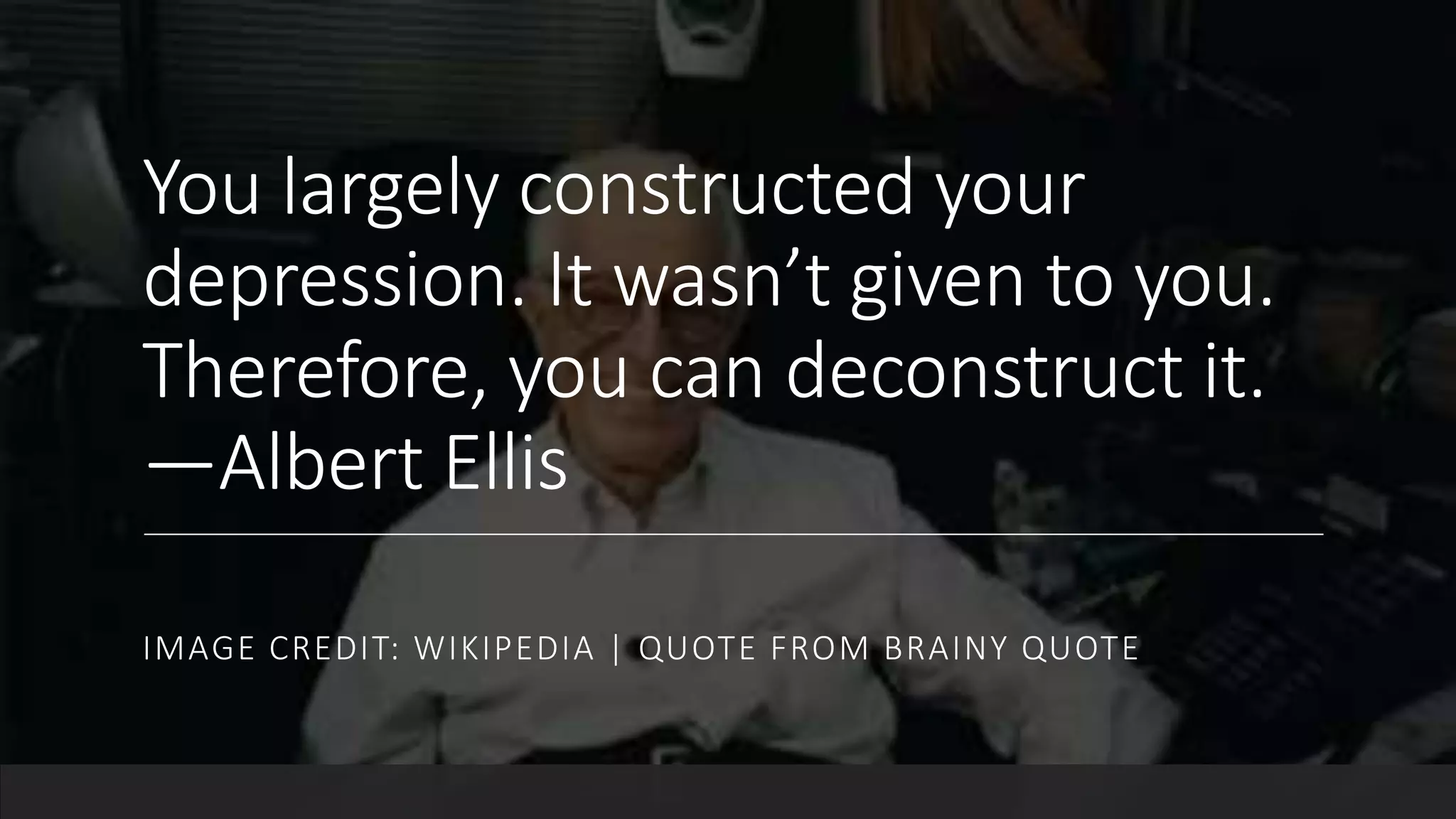
You largely constructed your
depression. It wasn’t given to you.
Therefore, you can deconstruct it.
—Albert Ellis
IMAGE CREDIT: WIKIPEDIA | QUOTE FROM BRAINY QUOTE
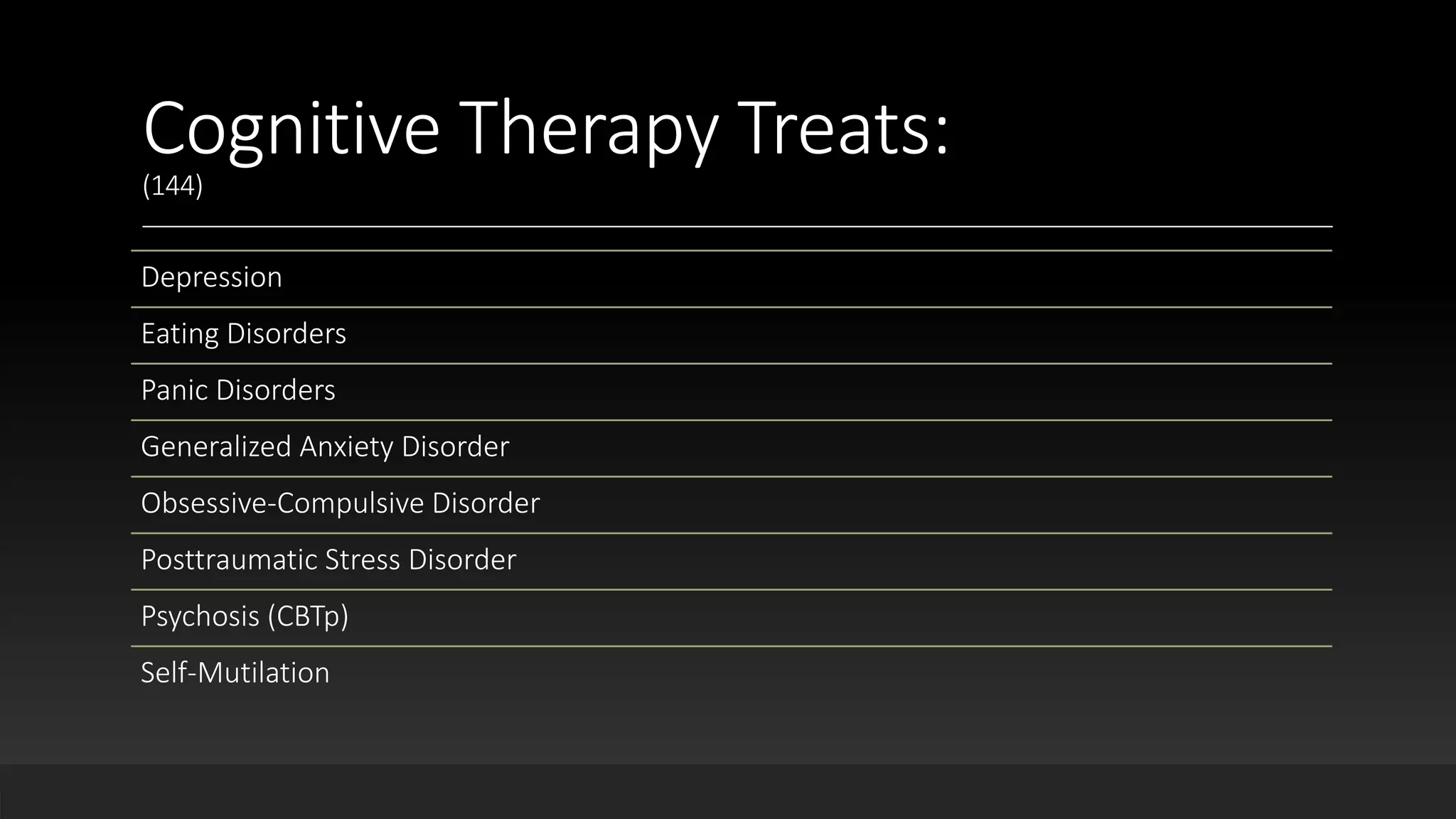
Cognitive Therapy Treats:
(144)
Depression
Eating Disorders
Panic Disorders
Generalized Anxiety Disorder
Obsessive-Compulsive Disorder
Posttraumatic Stress Disorder
Psychosis (CBTp)
Self-Mutilation
Third-Wave Cognitive-Behavioral
Therapies
Third-Wave CBT models are newer models of
therapy that shift the focus to mindfulness—
when thoughts are accepted without judgment—
and contextualism which focuses on appraising
emotions and regulating processes. (146)
Acceptance and Commitment
Therapy
‘ACT [derived from psychological inflexibility (e.g., anxious
feelings are ‘bad’] holds that [the client] should become
aware of and examine [her] thoughts, and, in essence,
change the relationship [she has] with [them]—not confuse
[her] thoughts with reality—and not to judge, evaluate or
attempt to modify [her] cognitions … but simply to observe
and accept [her] [thoughts] and feelings. (147)
Mindfulness-Based Cognitive
Therapy (MBCT)
MBCT, developed to treat chronic or long-standing depressive
order … builds upon Beck’s model of cognitive therapy … . [It]
incorporates mindfulness training, utilizing techniques drawn
from mindfulness-based stress management … .’ MBCT’s
major goal is to ‘reactivate adaptive patterns of thinking
through non-judgmental awareness of cognitions, emotions,
and bodily sensations … .’ (147)
Schema-Based Therapy
‘Schema therapy was developed to address more specifically
the needs of [clients] with characterological issues, such as
borderline personality disorder, and long-standing or relapsing
conditions, such as chronic depression or anxiety, eating
disorders, and long-standing relationship or intimacy problems
… .’ (147) Guided imagery, role play and reparenting techniques
are used to both explore and correct schemas. (Ibid.)
Behavior
Therapy
The principal goal of behavior therapy is to
change ‘those relatively immediate factors
that … maintain problematic behaviors.’
(107) ‘There are more than 150 different
behavior strategies for treating
psychological problems.’ (Ibid.)
Contrary to person-centered or
psychodynamic psychotherapy which is
nondirective, behavior therapy is ‘quite
directive,’ brief and rooted in empirical
research. (108)
The History
of Behavior
Therapy
Interest for behavior therapy blossomed
in the 1950s and 1960s as there was a
growing in interest in ‘basic research on
learning theory-based explanation for
clinical phenomena.’ (108-109)
And clinical researchers ‘were becoming
increasingly disenchanted with
psychoanalysis.’ (109)
These two conditions ‘set the stage for
the birth of behavior therapy.’ (109)
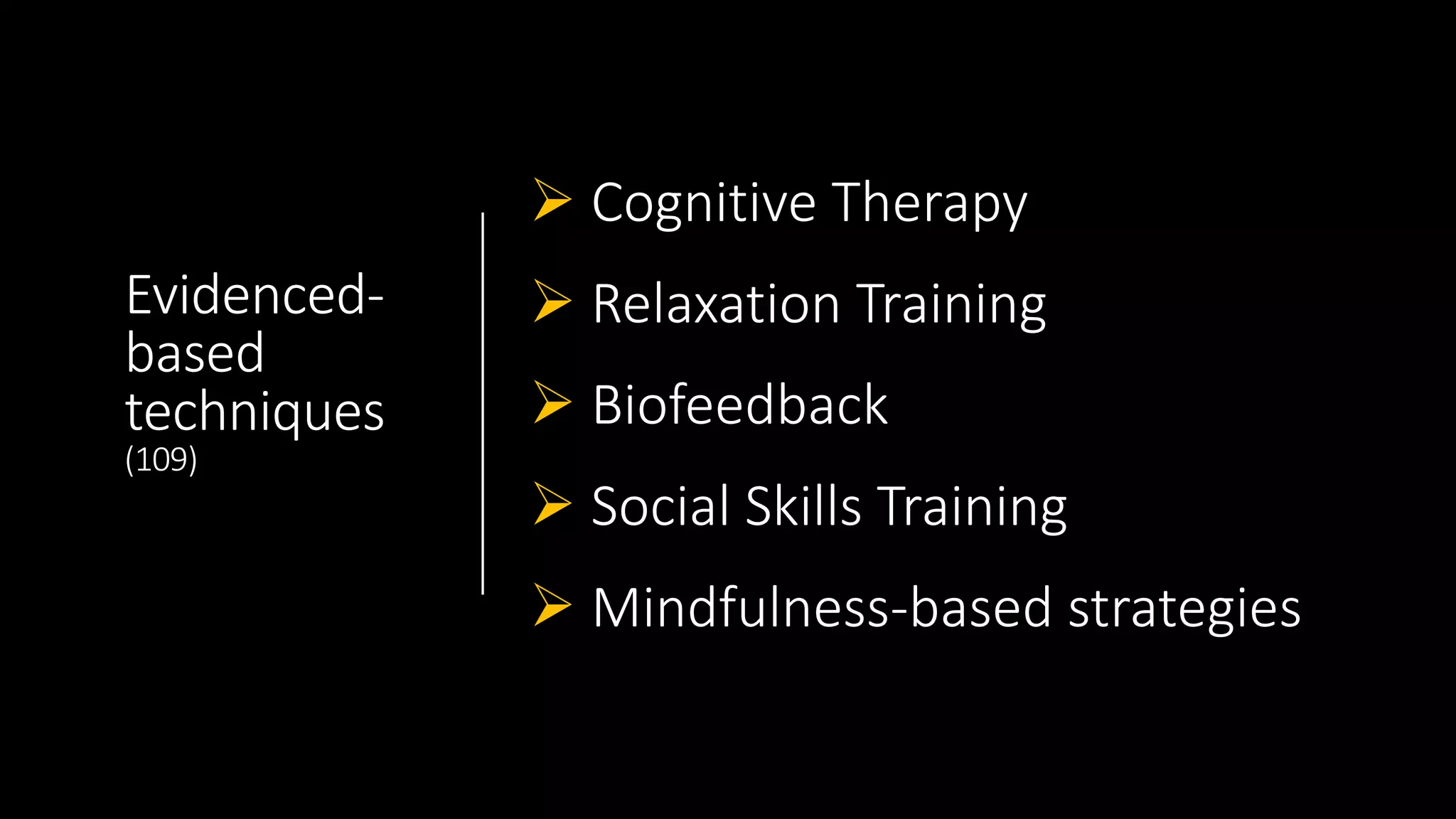
Evidenced-
based
techniques
(109)
 Cognitive Therapy
 Relaxation Training
 Biofeedback
 Social Skills Training
 Mindfulness-based strategies
‘… [T]he importance of using
treatments that are supported
by rigorous scientific study
remains a hallmark of
behavior therapy.’ (109, my
emphasis)
Photo by Moritz Kindler on Unsplash
The Concept
of
Personality
Behavior therapy understands personality—
in contrast to trait theories—as context or
situationally-based. (110)
‘From a behavioral perspective … it is the
situation that determines behavior—not
the presence or absence of particular
traits.’ (Ibid.)
From a behavioral perspective, personality
is defined in terms of [a client’s behavior],
and behaviors … occur … as a result of [her]
learning history.’ (Ibid.)
The Concept
of
Personality
‘Although classical conditioning may
contribute to the development of [her]
personality, operant conditioning …
[plays] an even larger role.’ (111, my
emphasis)
‘Cognitive-behavioral theorists [and
social learning theorists] emphasize the
causative role of [the client’s] beliefs and
assumptions in determining behavior … .’
(Ibid.)
Health vs.
Pathology
in
Behaviors
Some behaviors are adaptive.
Behavior therapy focuses on those
behaviors that are maladaptive ‘in a
particular cultural or social context.’ (Ibid.)
Clinical
Assessment
is a 3-step
Process
(112)
1. Understand the client’s
problem.
2. Plan treatment.
3. Measure change.
Establish a
Diagnosis
‘Over the past few decades, effective
behavioral treatments have been
developed for a number of psychological
disorders, and many of these have been
empirically validated in the context of
particular DSM-IV-TR diagnoses.’ (113)
Furthermore, insurance companies
require a diagnosis in order to be able to
reimburse the client. (Ibid.)
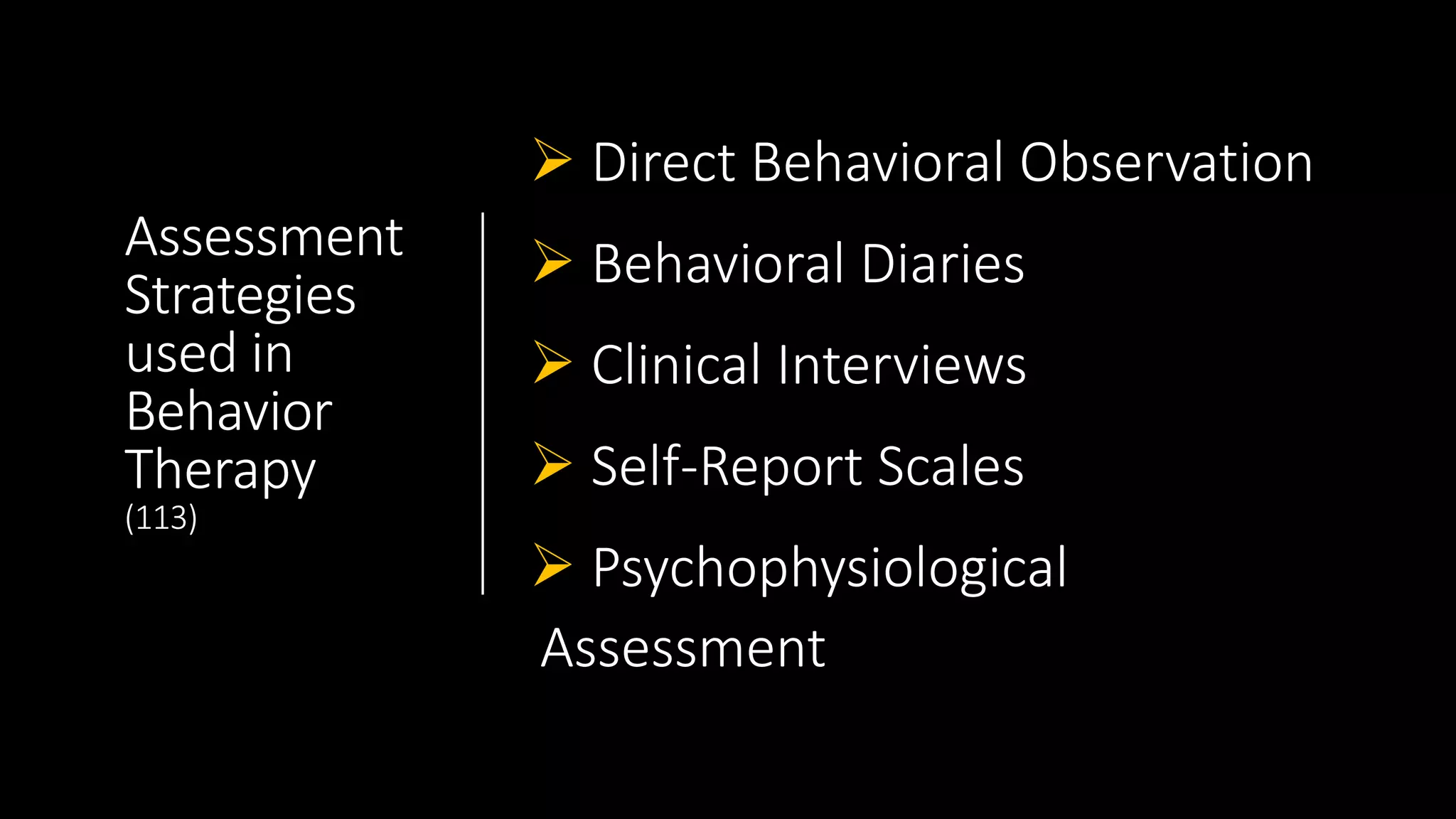
Assessment
Strategies
used in
Behavior
Therapy
(113)
 Direct Behavioral Observation
 Behavioral Diaries
 Clinical Interviews
 Self-Report Scales
 Psychophysiological
Assessment
Direct
Behavioral
Observation
This involves the therapist observing the
client to assess her symptoms directly. (113)
In some cases, the therapist can observe the
client in her natural environment. (Ibid.)
Behavioral Approach Tests (BATs) are used to
measure how afraid the client is in a feared
situation. This include subjective fear ratings
(0-100) measured via the Subjective Units of
Discomfort Scale (SUDS). (Ibid.)
Unobtrusive
Observation
Unobtrusive observation happens when
the client isn’t aware that she’s being
observed by the therapist. This will most
likely provide ‘a more typical sample’ of
her behavior, but is considered
‘impractical or unethical.’ (114)
Behavioral
Diaries
Behavioral Diaries or Monitoring Forms are
used to measure the client’s behavior (e.g.,
quantity (food) or frequency (panic attacks).
They can also be used to track whether or
how frequently she’s completed therapist-
assigned homework. (114)
Reactivity means that when the client
becomes aware of her behavior by using a
diary, she may reduce maladaptive behavior
thus not reflect her true baseline levels of
her symptoms. (Ibid.)
Clinical
Interviews
The therapist uses either a structured or
semi-structured (rather than
unstructured) clinical interview to collect
important information about the client
such as her problems, symptoms,
thoughts about her problem behavior,
consequences of the behavior and
treatment history. (115)
Self-Report
Scales
There are thousands of these self-report
questionnaires in existence. ‘Ideally, a
comprehensive behavioral assessment
should include some client-administered
measures to balance information
obtained from clinician administered
scales … .’ One such popular tool is the
Beck Depression Inventory (BDI-II). (Ibid.)
Psychophysiological
Assessment
‘Psychophysiological assessment involves
measuring aspects of [the client’s]
physiological functioning.’ Although this
type of assessment is generally not used,
it can be used, for example, to measure
the heart rate of an anxious client. (Ibid.)
‘Traditional behavior therapy
emphasizes an idiographic
approach to changing
behavior.’ This means that
every client gets ‘an
individually-tailored
plan.’ (116, my emphasis)
Photo by Noah Näf on Unsplash
‘Most behavioral
treatments include …
psychoeducation.’
This isn’t about
lecturing the client;
it’s about dialog.
(116-117)
Photo by Mael
Exposure-
Based
Strategies
‘Some of the earliest
behavioral treatments … were
based on the notion that
exposure to feared objects
and situations leads to a
reduction in fear.’
(117, my emphasis)
4 Exposure
Modalities
(117-118)
 In Vivo Exposure
 Imaginal Exposure
 Interoceptive Exposure (to feared
sensations)
 Virtual Reality
Example
To reduce OCD, combine
exposure to the trigger
combined with ritual
prevention. (120)
Photo by Moritz Kindler on Unsplash
Operant
Strategies
‘Behavior is … determined by
environmental cues … known
as discriminative stimuli that
indicate whether a behavior
will be rewarded or punished
… in a given context.’
(120)
Operant
Strategies
The Operant Strategies
model involves having
contingency management in
place: a given response will
be followed by a different
consequence.
(Ibid.)
Operant
Strategies
Pay particular attention to
contingencies that reinforce
bad behavior, and eliminate
reinforcement of said
problematic behavior.
(Ibid.)
Operant
Strategies
In addition to the ‘extinction’
of reinforcers (positive
rewards for undesirable
behavior), ‘negative
punishment’ is most
commonly used.
(121)
Behavioral
Activation
(BA)
BA therapy’s aim is to help a
depressed client increase
external contacts and
decrease patterns of isolation
or avoidance. ‘… BA is
comparable to medication
and cognitive therapy … .’
(121-122)
Social and
Communication
Skills Training
This approach trains or teaches the
client to better communicate by
learning basic skills like ‘making eye
contact, ordering food in a
restaurant, standing [at] an
appropriate distance from others,
and allowing others to speak
without interrupting.’ When the
therapist models behavior in front
of the client, it’s called modeling.
(123)
5 More
Strategies
(123-126)
 Problem-Solving Training
 Relaxation-Based Strategies
 Mindfulness- and Acceptance-
Based Strategies
 Emotion Regulation Skills
Training
The Therapeutic
Relationship and
the Stance of the
Therapist
(127)
Photo by Mael
Changes in
Environmental
Contingencies
‘A central factor thought to
underlie change in behavior
therapy involves the
relationship between
behavior and the
environment.’
(128)
Example
During in vivo therapy, the
environment may or may not
change, but new, learned skills will
help the client to, for example,
enjoy parties whereas before she
had anxiety. (128-129)
Photo by Moritz Kindler on Unsplash
Emotional
Processing and
Inhibitory
Learning
‘According to Foa and Kozak
… fearful responses are
altered when [the client] fully
accesses the fear network …
and incorporates new,
nonthreatening information.’
(129)
Cognitive
Models
‘Many researchers [note] that
exposure-based treatments ...
lead to cognitive changes in
the [client]. ’
(129)
Cognitive
Models
‘In other words, [the client’s]
experience when engaging in
previously avoided activities
may challenge [her] beliefs
that such behaviors are
dangerous or impossible. ’
(129)
Behavior
Therapy
Functional-
Contextual
Approaches
‘The philosophy of
behavioral psychotherapy
and behavioral clinical
psychology has generally
followed one of two
traditions[:]’ (1) The
machine metaphor and (2)
pragmatism or
contextualism. (185)
Analysis
‘The criterion by which an analysis
is judged is whether or not it
allows one to accomplish the goals
set forth at the beginning of the
analysis.’ (186)
Photo by Moritz Kindler on Unsplash
Personality
‘Functional contextualism does
not find the concept of
personality to be a very useful
heuristic.’
…
‘From our perspective, behavior
is selected over time because of
environmental consequences.’
(186, my emphasis)
DSM-V
According to functional
contextualism, the DSM-V
represents ‘largely invented
disorders’ that will grow ‘as
the DSM enterprise
continues.’
(188)
Functional
Analysis in Brief
‘Ultimately, the goal of a
functional analysis … is to
understand the ABC’s of
behaviorism—the
antecedents, the
behaviors, and the
consequences.’
(192, my emphasis)
Function
‘We seek to understand behavior
not by how it may appear more
superficially, but by its function
(hence the term functional
analysis).’ (192)
Photo by Moritz Kindler on Unsplash
Example
Self-injury is important.
Understanding what self-injury
serves (its function) is more
important.
(192)
Photo by Moritz Kindler on Unsplash
Functional
Analysis in Brief
‘At its broadest conceptual
level, a functional analysis
attempts to make clear the
function of important, …
causal, … and alterable
variables.’
(193)
Functional Autonomy
Functional autonomy refers to
variables that, in the past, were
once significant but are no longer
relevant; and variables that play a
role in the problematic behavior.
(192)
Photo by Moritz Kindler on Unsplash
Client
Resistance,
Therapist’s
Role and
Repertoires
In functional contextualism, resistance
by the client is interpreted as her
inability to decrease the undesired
behavior. The therapist’s role is to be as
precise as possible in the assessment
process. Repertoires are seen as
strengths or weaknesses that either
move the client toward her goal or take
her away from it.
(193-194)
FAP and ACT
‘The basic structure of most
contemporary contextual behavior
therapies is similar to most traditional
therapies.’ The goal of FAP and ACT,
however, is not to eliminate symptoms,
but to discover context (history and skills)
to help the client develop behaviors that
allow her to reach her goals. (195)
Photo by Moritz Kindler on Unsplash
FIAT
The Functional Idiographic
assessment Template (FIAT)
was designed to help the
client more readily
conceptualize her problems.
(198-199)
The Stance of
the Therapist
In FAP, the nature of the
relationship between
the therapist and the
client is intense.
(205)
The Stance of
the Therapist
‘That intense
relationship … coupled
with a strong functional
analysis, can produce
striking results.’
(208)
END

Cognitive & Behavior Therapy (CBT)

  • 1.
    Cognitive & Behavior Therapy(CBT) LUBA RASCHEFF | EMP 35XXYY—PSYCHO-SPIRITUAL CARE AND THERAPY PRACTICUM A L L C I TAT I O N S ( U N L E S S S TAT E D OT H E R W I S E ) A R E TA K E N F R O M E D I TO R S M E S S E R & G U R M A N ’ S E S S E N T I A L P S YC H OT H E R A P I E S , T H E O RY A N D P R AC T I C E , T H I R D E D I T I O N | G U I L FO R D P R E S S , 2 0 1 1
  • 2.
    ‘C’ stands for Cognitive Cognitionhas to do with thoughts. The goal of cognitive therapies is to focus on what the client believes or thinks about themselves, the world and the future. (143)
  • 3.
    Pathology Some thoughts arehealthy. Cognitive therapies target pathological thoughts, ‘maladaptive conditions’ that are ‘frequently automatic and ingrained,’ a.k.a. ‘maladaptive cognitions.’ (143)
  • 4.
    ‘B’ stands for Behavior Behavioris how the client responds to cognitions or thoughts. (153) Behaviors can be either adaptive or maladaptive. (111) Adaptive behaviors are healthy. Maladaptive behaviors are pathological.
  • 5.
    ‘T’ stands for Therapy Bothcognitive and behavioral— cognitive-behavioral—models of therapy help the client examine how she views herself in the world (thoughts, cognitions) and new ways of responding (behaviors). Therapy ‘attempts to identify specific, measurable goals and to move quickly and directly into those areas that create the most difficulty for [her].’ (153)
  • 6.
    ‘C’ + ‘B’can work together in ‘T’ making CBT Cognitive therapies focus on the client’s beliefs about herself, the world around her and her future. Both source and target of therapy are her thoughts—more precisely maladaptive thoughts or cognitions ‘that are frequently automatic and ingrained.’ (143) On the other hand, ‘[b]ehavior therapy focuses on learned behavior that arises from responses to [the client’s] environment.’ The goal is for her to unlearn problematic behaviors. (Ibid.) CBT links the two approaches ‘by targeting both problematic behaviors and maladaptive cognitions.’ (Ibid.)
  • 7.
    The History of Cognitive Therapy ‘Cognitivetheory is founded on intellectual traditions dating to Stoic philosophers, such as Epictetus … , who in the first century commented, “What upsets people is not things themselves but their judgments about things.” (p. 13).” (144)
  • 9.
    The History of Cognitive Therapy ‘Contemporarycognitive psychotherapy reflects the confluence of several schools of thought and is an extension of the earlier work of Adler (1968), Bowlby (1985), Freud (1923), and Tolman (1949).’ (145) ‘The development of cognitive therapy accelerated during the 1970s.’ (Ibid.)
  • 10.
    Aaron T. Beck,an American psychiatrist, ‘is regarded as the father of both cognitive therapy and cognitive behavioral therapy.’* *Source: ‘Aaron T. Beck,’ Wikipedia, accessed online on 27 October 2019, https://en.wikipedia.org/wiki/Aaron_T._Beck, last modified on 18 October 2019.,
  • 11.
    Object Relationships ‘More modern psychodynamic theories emphasizeobject relationships, or internal models of relationships, that closely resemble the cognitive concept of a relationship schema.’ (145, my emphasis)
  • 12.
    Schemas Schemas (Kant’s original idea)are what constitute the client’s way, her ‘characteristic patterns,’ of seeing the world. ‘Schemas play a central role in the formation of [the client’s] personality.’ (149)
  • 13.
    Schemas ‘Schemas—cognitive- emotional structures (149)— aredeveloped over the course of [the client’s] infancy and childhood.’ (150) She maintains, elaborates and consolidates them through processes of assimilation, and changes them by accepting novel experiences. (Ibid.)
  • 14.
    Faulty Schemas or Cognitive Distortions Aaron Beckused an information-processing paradigm which incorporated ‘two critical elements:’ cognitive structures (schemas [assumptions] and automatic thoughts) and cognitive mechanisms (cognitive distortions).’ (145, my emphasis) Cognitive mechanisms were used to explain ‘faulty schemas about self (self-schemas), the world, and others, which gave rise to and sustained faulty information processing, whereby clients distorted and filtered external environmental stimuli.’ (Ibid.)
  • 15.
    The Cognitive Triad ‘The constructof the cognitive triad was first proposed by Beck (1963) as a means of describing negativistic thoughts of depressed inpatients.’ (150) Beck observed that these patients had negative views about : (1) the self; (2) the world and (3) the future. (Ibid.)
  • 16.
    The Goal of Cognitive Therapy Thegoal of cognitive therapy is to change ‘dysfunctional thought patterns and their underlying schemas.’ (145)
  • 17.
    Cognitive Therapy InAction: (154-157) Discussion of events during the past week A review of self-report scales A review of the client’s homework Development of specific skills Examination of Dysfunctional Thoughts Pharmacotherapy Examining options Decatastrophizing
  • 18.
    Cognitive Therapy InAction: (157-159) Examination of advantages and disadvantages Fantasized consequences (of a feared situation, for example) Turning adversity to advantage Paradoxical interventions (prescribe worrying to a worrier, for example) Scaling Externalization of client’s internal voices Self-instruction Thought stopping
  • 19.
    Cognitive Therapy InAction: (159-160) Distraction Direct disputation Labeling of distortions Developing replacement imagery (‘coping images’) Bibliotherapy ACT techniques (the client examines herself from a distance, look ‘at’ thoughts)
  • 20.
    Change your belief, and your behavior willchange The ABC model (Antecedent, Belief, Behavior) coined by Albert Ellis, an American psychologist who developed Rational Emotive Behavior Therapy (REBT) and was considered one of the founders of cognitive- behavioral therapies,* ‘suggested that neurotic or maladaptive behaviors are learned and directly related to irrational beliefs … [and that] by identifying and changing unrealistic … beliefs, it is possible for [the client to alter her behavior] or emotional reactions to events.’ (146) * (‘Albert Ellis,’ Wikipedia, accessed online on 27 October 2019, https://en.wikipedia.org/wiki/Albert_Ellis, last modified on 29 September 2019.)
  • 21.
    You largely constructedyour depression. It wasn’t given to you. Therefore, you can deconstruct it. —Albert Ellis IMAGE CREDIT: WIKIPEDIA | QUOTE FROM BRAINY QUOTE
  • 22.
    Cognitive Therapy Treats: (144) Depression EatingDisorders Panic Disorders Generalized Anxiety Disorder Obsessive-Compulsive Disorder Posttraumatic Stress Disorder Psychosis (CBTp) Self-Mutilation
  • 23.
    Third-Wave Cognitive-Behavioral Therapies Third-Wave CBTmodels are newer models of therapy that shift the focus to mindfulness— when thoughts are accepted without judgment— and contextualism which focuses on appraising emotions and regulating processes. (146)
  • 24.
    Acceptance and Commitment Therapy ‘ACT[derived from psychological inflexibility (e.g., anxious feelings are ‘bad’] holds that [the client] should become aware of and examine [her] thoughts, and, in essence, change the relationship [she has] with [them]—not confuse [her] thoughts with reality—and not to judge, evaluate or attempt to modify [her] cognitions … but simply to observe and accept [her] [thoughts] and feelings. (147)
  • 25.
    Mindfulness-Based Cognitive Therapy (MBCT) MBCT,developed to treat chronic or long-standing depressive order … builds upon Beck’s model of cognitive therapy … . [It] incorporates mindfulness training, utilizing techniques drawn from mindfulness-based stress management … .’ MBCT’s major goal is to ‘reactivate adaptive patterns of thinking through non-judgmental awareness of cognitions, emotions, and bodily sensations … .’ (147)
  • 26.
    Schema-Based Therapy ‘Schema therapywas developed to address more specifically the needs of [clients] with characterological issues, such as borderline personality disorder, and long-standing or relapsing conditions, such as chronic depression or anxiety, eating disorders, and long-standing relationship or intimacy problems … .’ (147) Guided imagery, role play and reparenting techniques are used to both explore and correct schemas. (Ibid.)
  • 27.
    Behavior Therapy The principal goalof behavior therapy is to change ‘those relatively immediate factors that … maintain problematic behaviors.’ (107) ‘There are more than 150 different behavior strategies for treating psychological problems.’ (Ibid.) Contrary to person-centered or psychodynamic psychotherapy which is nondirective, behavior therapy is ‘quite directive,’ brief and rooted in empirical research. (108)
  • 28.
    The History of Behavior Therapy Interestfor behavior therapy blossomed in the 1950s and 1960s as there was a growing in interest in ‘basic research on learning theory-based explanation for clinical phenomena.’ (108-109) And clinical researchers ‘were becoming increasingly disenchanted with psychoanalysis.’ (109) These two conditions ‘set the stage for the birth of behavior therapy.’ (109)
  • 29.
    Evidenced- based techniques (109)  Cognitive Therapy Relaxation Training  Biofeedback  Social Skills Training  Mindfulness-based strategies
  • 30.
    ‘… [T]he importanceof using treatments that are supported by rigorous scientific study remains a hallmark of behavior therapy.’ (109, my emphasis) Photo by Moritz Kindler on Unsplash
  • 31.
    The Concept of Personality Behavior therapyunderstands personality— in contrast to trait theories—as context or situationally-based. (110) ‘From a behavioral perspective … it is the situation that determines behavior—not the presence or absence of particular traits.’ (Ibid.) From a behavioral perspective, personality is defined in terms of [a client’s behavior], and behaviors … occur … as a result of [her] learning history.’ (Ibid.)
  • 32.
    The Concept of Personality ‘Although classicalconditioning may contribute to the development of [her] personality, operant conditioning … [plays] an even larger role.’ (111, my emphasis) ‘Cognitive-behavioral theorists [and social learning theorists] emphasize the causative role of [the client’s] beliefs and assumptions in determining behavior … .’ (Ibid.)
  • 33.
    Health vs. Pathology in Behaviors Some behaviorsare adaptive. Behavior therapy focuses on those behaviors that are maladaptive ‘in a particular cultural or social context.’ (Ibid.)
  • 34.
    Clinical Assessment is a 3-step Process (112) 1.Understand the client’s problem. 2. Plan treatment. 3. Measure change.
  • 35.
    Establish a Diagnosis ‘Over thepast few decades, effective behavioral treatments have been developed for a number of psychological disorders, and many of these have been empirically validated in the context of particular DSM-IV-TR diagnoses.’ (113) Furthermore, insurance companies require a diagnosis in order to be able to reimburse the client. (Ibid.)
  • 36.
    Assessment Strategies used in Behavior Therapy (113)  DirectBehavioral Observation  Behavioral Diaries  Clinical Interviews  Self-Report Scales  Psychophysiological Assessment
  • 37.
    Direct Behavioral Observation This involves thetherapist observing the client to assess her symptoms directly. (113) In some cases, the therapist can observe the client in her natural environment. (Ibid.) Behavioral Approach Tests (BATs) are used to measure how afraid the client is in a feared situation. This include subjective fear ratings (0-100) measured via the Subjective Units of Discomfort Scale (SUDS). (Ibid.)
  • 38.
    Unobtrusive Observation Unobtrusive observation happenswhen the client isn’t aware that she’s being observed by the therapist. This will most likely provide ‘a more typical sample’ of her behavior, but is considered ‘impractical or unethical.’ (114)
  • 39.
    Behavioral Diaries Behavioral Diaries orMonitoring Forms are used to measure the client’s behavior (e.g., quantity (food) or frequency (panic attacks). They can also be used to track whether or how frequently she’s completed therapist- assigned homework. (114) Reactivity means that when the client becomes aware of her behavior by using a diary, she may reduce maladaptive behavior thus not reflect her true baseline levels of her symptoms. (Ibid.)
  • 40.
    Clinical Interviews The therapist useseither a structured or semi-structured (rather than unstructured) clinical interview to collect important information about the client such as her problems, symptoms, thoughts about her problem behavior, consequences of the behavior and treatment history. (115)
  • 41.
    Self-Report Scales There are thousandsof these self-report questionnaires in existence. ‘Ideally, a comprehensive behavioral assessment should include some client-administered measures to balance information obtained from clinician administered scales … .’ One such popular tool is the Beck Depression Inventory (BDI-II). (Ibid.)
  • 42.
    Psychophysiological Assessment ‘Psychophysiological assessment involves measuringaspects of [the client’s] physiological functioning.’ Although this type of assessment is generally not used, it can be used, for example, to measure the heart rate of an anxious client. (Ibid.)
  • 43.
    ‘Traditional behavior therapy emphasizesan idiographic approach to changing behavior.’ This means that every client gets ‘an individually-tailored plan.’ (116, my emphasis) Photo by Noah Näf on Unsplash
  • 44.
    ‘Most behavioral treatments include… psychoeducation.’ This isn’t about lecturing the client; it’s about dialog. (116-117) Photo by Mael
  • 45.
    Exposure- Based Strategies ‘Some of theearliest behavioral treatments … were based on the notion that exposure to feared objects and situations leads to a reduction in fear.’ (117, my emphasis)
  • 46.
    4 Exposure Modalities (117-118)  InVivo Exposure  Imaginal Exposure  Interoceptive Exposure (to feared sensations)  Virtual Reality
  • 47.
    Example To reduce OCD,combine exposure to the trigger combined with ritual prevention. (120) Photo by Moritz Kindler on Unsplash
  • 48.
    Operant Strategies ‘Behavior is …determined by environmental cues … known as discriminative stimuli that indicate whether a behavior will be rewarded or punished … in a given context.’ (120)
  • 49.
    Operant Strategies The Operant Strategies modelinvolves having contingency management in place: a given response will be followed by a different consequence. (Ibid.)
  • 50.
    Operant Strategies Pay particular attentionto contingencies that reinforce bad behavior, and eliminate reinforcement of said problematic behavior. (Ibid.)
  • 51.
    Operant Strategies In addition tothe ‘extinction’ of reinforcers (positive rewards for undesirable behavior), ‘negative punishment’ is most commonly used. (121)
  • 52.
    Behavioral Activation (BA) BA therapy’s aimis to help a depressed client increase external contacts and decrease patterns of isolation or avoidance. ‘… BA is comparable to medication and cognitive therapy … .’ (121-122)
  • 53.
    Social and Communication Skills Training Thisapproach trains or teaches the client to better communicate by learning basic skills like ‘making eye contact, ordering food in a restaurant, standing [at] an appropriate distance from others, and allowing others to speak without interrupting.’ When the therapist models behavior in front of the client, it’s called modeling. (123)
  • 54.
    5 More Strategies (123-126)  Problem-SolvingTraining  Relaxation-Based Strategies  Mindfulness- and Acceptance- Based Strategies  Emotion Regulation Skills Training
  • 55.
    The Therapeutic Relationship and theStance of the Therapist (127) Photo by Mael
  • 56.
    Changes in Environmental Contingencies ‘A centralfactor thought to underlie change in behavior therapy involves the relationship between behavior and the environment.’ (128)
  • 57.
    Example During in vivotherapy, the environment may or may not change, but new, learned skills will help the client to, for example, enjoy parties whereas before she had anxiety. (128-129) Photo by Moritz Kindler on Unsplash
  • 58.
    Emotional Processing and Inhibitory Learning ‘According toFoa and Kozak … fearful responses are altered when [the client] fully accesses the fear network … and incorporates new, nonthreatening information.’ (129)
  • 59.
    Cognitive Models ‘Many researchers [note]that exposure-based treatments ... lead to cognitive changes in the [client]. ’ (129)
  • 60.
    Cognitive Models ‘In other words,[the client’s] experience when engaging in previously avoided activities may challenge [her] beliefs that such behaviors are dangerous or impossible. ’ (129)
  • 61.
    Behavior Therapy Functional- Contextual Approaches ‘The philosophy of behavioralpsychotherapy and behavioral clinical psychology has generally followed one of two traditions[:]’ (1) The machine metaphor and (2) pragmatism or contextualism. (185)
  • 62.
    Analysis ‘The criterion bywhich an analysis is judged is whether or not it allows one to accomplish the goals set forth at the beginning of the analysis.’ (186) Photo by Moritz Kindler on Unsplash
  • 63.
    Personality ‘Functional contextualism does notfind the concept of personality to be a very useful heuristic.’ … ‘From our perspective, behavior is selected over time because of environmental consequences.’ (186, my emphasis)
  • 64.
    DSM-V According to functional contextualism,the DSM-V represents ‘largely invented disorders’ that will grow ‘as the DSM enterprise continues.’ (188)
  • 65.
    Functional Analysis in Brief ‘Ultimately,the goal of a functional analysis … is to understand the ABC’s of behaviorism—the antecedents, the behaviors, and the consequences.’ (192, my emphasis)
  • 66.
    Function ‘We seek tounderstand behavior not by how it may appear more superficially, but by its function (hence the term functional analysis).’ (192) Photo by Moritz Kindler on Unsplash
  • 67.
    Example Self-injury is important. Understandingwhat self-injury serves (its function) is more important. (192) Photo by Moritz Kindler on Unsplash
  • 68.
    Functional Analysis in Brief ‘Atits broadest conceptual level, a functional analysis attempts to make clear the function of important, … causal, … and alterable variables.’ (193)
  • 69.
    Functional Autonomy Functional autonomyrefers to variables that, in the past, were once significant but are no longer relevant; and variables that play a role in the problematic behavior. (192) Photo by Moritz Kindler on Unsplash
  • 70.
    Client Resistance, Therapist’s Role and Repertoires In functionalcontextualism, resistance by the client is interpreted as her inability to decrease the undesired behavior. The therapist’s role is to be as precise as possible in the assessment process. Repertoires are seen as strengths or weaknesses that either move the client toward her goal or take her away from it. (193-194)
  • 71.
    FAP and ACT ‘Thebasic structure of most contemporary contextual behavior therapies is similar to most traditional therapies.’ The goal of FAP and ACT, however, is not to eliminate symptoms, but to discover context (history and skills) to help the client develop behaviors that allow her to reach her goals. (195) Photo by Moritz Kindler on Unsplash
  • 72.
    FIAT The Functional Idiographic assessmentTemplate (FIAT) was designed to help the client more readily conceptualize her problems. (198-199)
  • 73.
    The Stance of theTherapist In FAP, the nature of the relationship between the therapist and the client is intense. (205)
  • 74.
    The Stance of theTherapist ‘That intense relationship … coupled with a strong functional analysis, can produce striking results.’ (208)
  • 75.