
INDIVIDUAL THERAPY
(ADLERIAN THERAPY)
By Claudia Chandler
&
Brocha Cohen
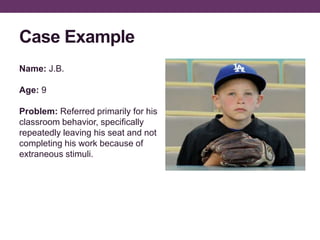
Case Example
Name: J.B.
Age: 9
Problem: Referred primarily for his
classroom behavior, specifically
repeatedly leaving his seat and not
completing his work because of
extraneous stimuli.
Case Example Cont.
• Academics: For the past year J.B. has become disruptive in class,
does not listen and follow instructions and academic performance is
lower than usual.
• Family: Lives with Father and Step-Mother. Placed here after foster
care. Prior Hx of abusive Mother.
• Social: Parents and teacher reports he has a friendly personality and
no know peer-relational issues.
Diagnosis
• Axis I - 314.00 Attention-Deficit/Hyperactivity Disorder,
Predominantly Inattentive Type
R/o 296.22 Major Depressive Disorder, Single episode, Moderate
R/o 309.81 Post Traumatic Stress Disorder
V61.20 Parent-child relational problem
V62.3 Academic problem
• Axis II - V71.09 No diagnosis
• Axis III - None
• Axis IV - 995.5 Neglect and Physical abuse of child
• Axis V - GAF = 60
Treatment Plan
Initial Phase
• Goal #1 - Decrease J.B.’s insecurities of himself and establish the
therapeutic relationship in order to increase his ability to manage his
symptoms of depression and his feelings of worthlessness.
• Intervention #1 - Use psychoeducation, discussing J.B.’s active role
in therapy to create an equal relationship with the Therapist in order
to build self esteem.
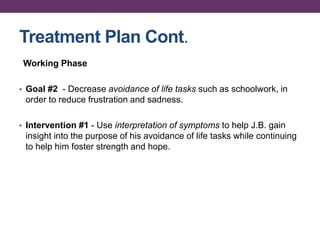
Treatment Plan Cont.
Working Phase
• Goal #2 - Decrease avoidance of life tasks such as schoolwork, in
order to reduce frustration and sadness.
• Intervention #1 - Use interpretation of symptoms to help J.B. gain
insight into the purpose of his avoidance of life tasks while continuing
to help him foster strength and hope.
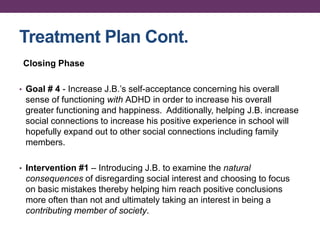
Treatment Plan Cont.
Closing Phase
• Goal # 4 - Increase J.B.’s self-acceptance concerning his overall
sense of functioning with ADHD in order to increase his overall
greater functioning and happiness. Additionally, helping J.B. increase
social connections to increase his positive experience in school will
hopefully expand out to other social connections including family
members.
• Intervention #1 – Introducing J.B. to examine the natural
consequences of disregarding social interest and choosing to focus
on basic mistakes thereby helping him reach positive conclusions
more often than not and ultimately taking an interest in being a
contributing member of society.
REFRENCES
• American Psychiatric Association. (2000). Diagnostic and statistical
manual of mental disorders (4th ed., Text Revision). Washington,
DC: Author.
• Gehart, D. (2013). Theory and Treatment Planning in Counseling and
Psychotherapy. Belmont, CA: Brooks/Cole Publications.
• Henderson, D. A., & Thompson, C. L. (2011). Counseling children.
(8th ed.). Hartford, CT: Brooks/Cole Cengage Learning.

Individual Therapy w/ Case Study

  • 1.
    INDIVIDUAL THERAPY (ADLERIAN THERAPY) ByClaudia Chandler & Brocha Cohen
  • 2.
    Case Example Name: J.B. Age:9 Problem: Referred primarily for his classroom behavior, specifically repeatedly leaving his seat and not completing his work because of extraneous stimuli.
  • 3.
    Case Example Cont. •Academics: For the past year J.B. has become disruptive in class, does not listen and follow instructions and academic performance is lower than usual. • Family: Lives with Father and Step-Mother. Placed here after foster care. Prior Hx of abusive Mother. • Social: Parents and teacher reports he has a friendly personality and no know peer-relational issues.
  • 4.
    Diagnosis • Axis I- 314.00 Attention-Deficit/Hyperactivity Disorder, Predominantly Inattentive Type R/o 296.22 Major Depressive Disorder, Single episode, Moderate R/o 309.81 Post Traumatic Stress Disorder V61.20 Parent-child relational problem V62.3 Academic problem • Axis II - V71.09 No diagnosis • Axis III - None • Axis IV - 995.5 Neglect and Physical abuse of child • Axis V - GAF = 60
  • 5.
    Treatment Plan Initial Phase •Goal #1 - Decrease J.B.’s insecurities of himself and establish the therapeutic relationship in order to increase his ability to manage his symptoms of depression and his feelings of worthlessness. • Intervention #1 - Use psychoeducation, discussing J.B.’s active role in therapy to create an equal relationship with the Therapist in order to build self esteem.
  • 6.
    Treatment Plan Cont. WorkingPhase • Goal #2 - Decrease avoidance of life tasks such as schoolwork, in order to reduce frustration and sadness. • Intervention #1 - Use interpretation of symptoms to help J.B. gain insight into the purpose of his avoidance of life tasks while continuing to help him foster strength and hope.
  • 7.
    Treatment Plan Cont. ClosingPhase • Goal # 4 - Increase J.B.’s self-acceptance concerning his overall sense of functioning with ADHD in order to increase his overall greater functioning and happiness. Additionally, helping J.B. increase social connections to increase his positive experience in school will hopefully expand out to other social connections including family members. • Intervention #1 – Introducing J.B. to examine the natural consequences of disregarding social interest and choosing to focus on basic mistakes thereby helping him reach positive conclusions more often than not and ultimately taking an interest in being a contributing member of society.
  • 8.
    REFRENCES • American PsychiatricAssociation. (2000). Diagnostic and statistical manual of mental disorders (4th ed., Text Revision). Washington, DC: Author. • Gehart, D. (2013). Theory and Treatment Planning in Counseling and Psychotherapy. Belmont, CA: Brooks/Cole Publications. • Henderson, D. A., & Thompson, C. L. (2011). Counseling children. (8th ed.). Hartford, CT: Brooks/Cole Cengage Learning.