LaTasha Smith, PhD., LCSW, CGP
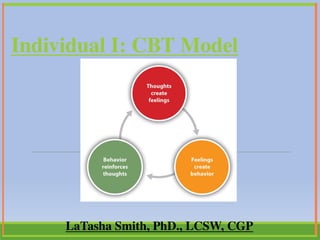
Individual I: CBT Model
AGENDA
1 Introduction to the Cognitive Behavioral
Approach
•Understand beginning concepts of CBT
•Define the cognitive model
•Identify skills of CBT goal formulation and
evaluation
2 Cognitive Conceptualization
• Aaron Beck – 1960s – Cognitive Therapy
• Structured, short-term, present-oriented, directed towards solving
current problems and modifying dysfunctional thinking and
behavior.
• Treatment is based on a conceptualization or understanding of
individual clients, their beliefs and patterns of behavior.
• What’s the core theory?:
• Dysfunctional thinking (influences mood and behavior) is
common to all psychological disturbances. When people
evaluate their thinking in a realistic and adaptive way, their
emotional state and behavior improves.
What is the Cognitive Model?
Principles of Cognitive Therapy
I. Cognitive Therapy is based on
the cognitive model:
Thoughts influence emotion.
II. Cognitive Therapy has the
following characteristics:
• Goal directed/Problem Oriented
• Structured/Time limited
• Present-oriented/Past aware
• Collaborative
• Educative (psychological model of
coping)
• Techniques are unlimited
(cog,beh,etc.)
• Modifying dysfunctional
thinking and behavior leads
to improvement in
symptoms.
• Modifying dysfunctional
beliefs which underlie
dysfunctional thinking leads
to more durable
improvement.
• Focus on examination of
cognitive beliefs and
developing rational
responses to negative
automatic thoughts.
Exercise
Exercise
• 1. I often worry that I _________ (fill in the blank)
• What physical sensations are you aware of?
6
•
2. If this worry of yours was indeed true, what does
it mean to you and why does it bother you so much?
• What thoughts and feelings are you experiencing
about it?
7
•
3. What's the worst thing that could possibly
happen? What do you fear most of all?
• What thoughts and feelings are you having about
it?
8
•
4. When you think of the worst thing that could
happen, do you really think that it's likely to
happen? If so, how could you learn to cope with
it?
• Be aware of physical sensations
9
Review
10
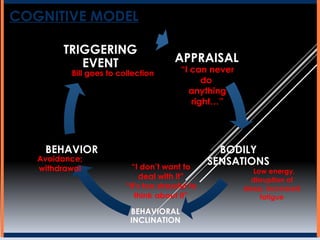
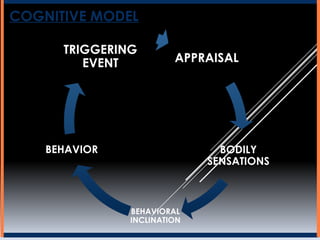
COGNITIVE MODEL
APPRAISAL
BODILY
SENSATIONS
BEHAVIORAL
INCLINATION
BEHAVIOR
TRIGGERING
EVENT “I can never
do
anything
right…”
Bill goes to collection
Low energy,
disruption of
sleep, increased
fatigue
“I don’t want to
deal with it”
“It’s too stressful to
think about it”
Avoidance;
withdrawal
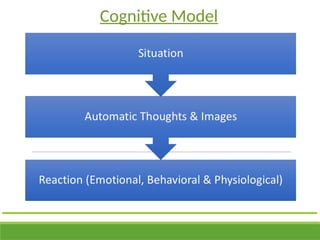
Cognitive Model
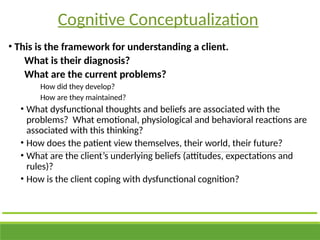
• This is the framework for understanding a client.
What is their diagnosis?
What are the current problems?
How did they develop?
How are they maintained?
• What dysfunctional thoughts and beliefs are associated with the
problems? What emotional, physiological and behavioral reactions are
associated with this thinking?
• How does the patient view themselves, their world, their future?
• What are the client’s underlying beliefs (attitudes, expectations and
rules)?
• How is the client coping with dysfunctional cognition?
Cognitive Conceptualization
• What stressors contribute to the development of his current
psychological problems?
• What early experiences may have contributed to client’s current
problems? What meaning was taken from these experiences?
What beliefs were strengthened by these experiences?
• If relevant, what cognitive, affective and behavioral mechanisms
(adaptive and maladaptive) did the patient develop to cope with
these dysfunctional beliefs.
Clients need to understand:
• Just because they believe something does not mean that it is
true.
• Changing thinking so that it is reality based will alleviate distress
and make progress towards their goals.
• Triggering events to core beliefs and automatic thoughts can be
varied!
• Automatic thoughts (situation specific and superficial) come from
BELIEFS. Core beliefs are so fundamental that they are not often
articulated. CBs are global, rigid and overgeneralized.
To Alleviate Symptom Distress
Break
WHAT ARE AUTOMATIC THOUGHTS?
• An automatic thought is a
brief stream of thought
about ourselves and others.
• Automatic thoughts largely
apply to specific situations
and/or events and occur
quickly throughout the day
as we appraise ourselves,
our environment, and our
future. We are often
unaware of these thoughts,
but are very familiar with
the emotions that they
create within us.
• Maladaptive automatic
thoughts are distorted
reflections of a situation,
which are often accepted
as true. Automatic
thoughts are the real-time
manifestations of
dysfunctional beliefs
about oneself, the world,
and the future that are
triggered by situations or
exaggerated by
psychiatric states, such as
anxiety or depression.
GOAL #1: IDENTIFYING AUTOMATIC THOUGHTS
• Everyone HAS automatic thoughts that we are
barely aware of.
• Very brief. Usually we can identity the feeling
(emotion) that comes with the thought rather
than the thought itself.
• These can be visual and these can be verbal.
• We can start to break down the automatic
thought when we probe for the meaning of the
thought.
• We need to evaluate this:
• Validity
• Utility
SPECIFIC QUESTIONS TO USE
• When to Ask:
When a client describes a problematic situation or stressor from the
time in between sessions.
OR when you notice a shift or intensified negative affect in real time
during the session.
• 1) What Was Going Through Your Mind?
Look for verbal and nonverbal cues.
When it happens in session it’s known as “hot cognition” which can
be triggers (impact therapeutic alliance, concentration or feeling
state).
Ask for associated emotion
Pause – give psychoeducation on it being an automatic
thought.
Often helps to write it down or use a white board for visual
support during this process.
GOAL #2: IDENTIFYING EMOTIONS
• PRIMARY GOAL: Decrease symptoms/negative emotions,
increase positive emotions.
• Helping connect thought, emotion, behavior will lead to
symptom amelioration. Always probe when an emotion
doesn’t seem to match the content of the automatic
thought.
• How to work with clients who struggle to identify emotions:
• Build or use an emotions chart!
• Once the emotion has been identified, you also need
to scale the intensity of it. What is the DEGREE of distress
they are in?
• Role Play– Discovering ANT’s
• Take a few minutes and think back over your
week, think about a situation (positive or
negative) that has been on your mind-
something that you have spent something that
has caused you some distress or that you have
some feeling/emotion about
• Please choose something mild enough that
you feel comfortable to disclose (does not
have to be a significant issue but you need to
be comfortable with your disclosure- you
choose- you are in charge of this process
COGNITIVE MODEL
APPRAISAL
BODILY
SENSATIONS
BEHAVIORAL
INCLINATION
BEHAVIOR
TRIGGERING
EVENT
GOAL #3: EVALUATE AUTOMATIC THOUGHTS
• Once you’ve identified the thought, it’s time to do some
triage.
• Ask yourself:
• Is this thought dysfunctional?
• Is this thought currently distressing?
• Is this thought likely to recur?
• You can ask:
• How much did you believe this thought at the time? How much
do you believe it now?
• How did you feel emotionally? How intense was the emotion
then?
• How intense is the emotion now?
• What did you do when you had this thought?
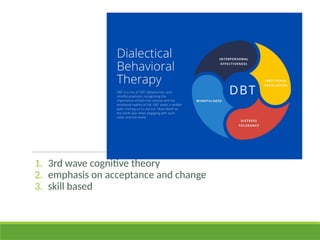
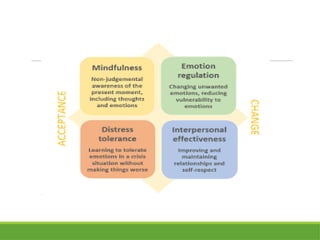
1. 3rd wave cognitive theory
2. emphasis on acceptance and change
3. skill based
Practice
1. Recall the distress you were experiencing earlier in our CBT thought
practice
2. choose one of the skills in either the accepts or the change category
3. Take a minute and Practice using this skill
4. Discuss with a partner how this skill might be helpful as it applied to
your emotional reaction regarding this issue.

DBT Introduction and CBT Introduction. Thoughts

  • 1.
    LaTasha Smith, PhD.,LCSW, CGP Individual I: CBT Model
  • 2.
    AGENDA 1 Introduction tothe Cognitive Behavioral Approach •Understand beginning concepts of CBT •Define the cognitive model •Identify skills of CBT goal formulation and evaluation 2 Cognitive Conceptualization
  • 3.
    • Aaron Beck– 1960s – Cognitive Therapy • Structured, short-term, present-oriented, directed towards solving current problems and modifying dysfunctional thinking and behavior. • Treatment is based on a conceptualization or understanding of individual clients, their beliefs and patterns of behavior. • What’s the core theory?: • Dysfunctional thinking (influences mood and behavior) is common to all psychological disturbances. When people evaluate their thinking in a realistic and adaptive way, their emotional state and behavior improves. What is the Cognitive Model?
  • 4.
    Principles of CognitiveTherapy I. Cognitive Therapy is based on the cognitive model: Thoughts influence emotion. II. Cognitive Therapy has the following characteristics: • Goal directed/Problem Oriented • Structured/Time limited • Present-oriented/Past aware • Collaborative • Educative (psychological model of coping) • Techniques are unlimited (cog,beh,etc.) • Modifying dysfunctional thinking and behavior leads to improvement in symptoms. • Modifying dysfunctional beliefs which underlie dysfunctional thinking leads to more durable improvement. • Focus on examination of cognitive beliefs and developing rational responses to negative automatic thoughts.
  • 5.
  • 6.
    Exercise • 1. Ioften worry that I _________ (fill in the blank) • What physical sensations are you aware of? 6
  • 7.
    • 2. If thisworry of yours was indeed true, what does it mean to you and why does it bother you so much? • What thoughts and feelings are you experiencing about it? 7
  • 8.
    • 3. What's theworst thing that could possibly happen? What do you fear most of all? • What thoughts and feelings are you having about it? 8
  • 9.
    • 4. When youthink of the worst thing that could happen, do you really think that it's likely to happen? If so, how could you learn to cope with it? • Be aware of physical sensations 9
  • 10.
  • 11.
    COGNITIVE MODEL APPRAISAL BODILY SENSATIONS BEHAVIORAL INCLINATION BEHAVIOR TRIGGERING EVENT “Ican never do anything right…” Bill goes to collection Low energy, disruption of sleep, increased fatigue “I don’t want to deal with it” “It’s too stressful to think about it” Avoidance; withdrawal
  • 13.
  • 14.
    • This isthe framework for understanding a client. What is their diagnosis? What are the current problems? How did they develop? How are they maintained? • What dysfunctional thoughts and beliefs are associated with the problems? What emotional, physiological and behavioral reactions are associated with this thinking? • How does the patient view themselves, their world, their future? • What are the client’s underlying beliefs (attitudes, expectations and rules)? • How is the client coping with dysfunctional cognition? Cognitive Conceptualization
  • 15.
    • What stressorscontribute to the development of his current psychological problems? • What early experiences may have contributed to client’s current problems? What meaning was taken from these experiences? What beliefs were strengthened by these experiences? • If relevant, what cognitive, affective and behavioral mechanisms (adaptive and maladaptive) did the patient develop to cope with these dysfunctional beliefs.
  • 16.
    Clients need tounderstand: • Just because they believe something does not mean that it is true. • Changing thinking so that it is reality based will alleviate distress and make progress towards their goals. • Triggering events to core beliefs and automatic thoughts can be varied! • Automatic thoughts (situation specific and superficial) come from BELIEFS. Core beliefs are so fundamental that they are not often articulated. CBs are global, rigid and overgeneralized. To Alleviate Symptom Distress
  • 17.
  • 18.
    WHAT ARE AUTOMATICTHOUGHTS? • An automatic thought is a brief stream of thought about ourselves and others. • Automatic thoughts largely apply to specific situations and/or events and occur quickly throughout the day as we appraise ourselves, our environment, and our future. We are often unaware of these thoughts, but are very familiar with the emotions that they create within us. • Maladaptive automatic thoughts are distorted reflections of a situation, which are often accepted as true. Automatic thoughts are the real-time manifestations of dysfunctional beliefs about oneself, the world, and the future that are triggered by situations or exaggerated by psychiatric states, such as anxiety or depression.
  • 19.
    GOAL #1: IDENTIFYINGAUTOMATIC THOUGHTS • Everyone HAS automatic thoughts that we are barely aware of. • Very brief. Usually we can identity the feeling (emotion) that comes with the thought rather than the thought itself. • These can be visual and these can be verbal. • We can start to break down the automatic thought when we probe for the meaning of the thought. • We need to evaluate this: • Validity • Utility
  • 20.
    SPECIFIC QUESTIONS TOUSE • When to Ask: When a client describes a problematic situation or stressor from the time in between sessions. OR when you notice a shift or intensified negative affect in real time during the session. • 1) What Was Going Through Your Mind? Look for verbal and nonverbal cues. When it happens in session it’s known as “hot cognition” which can be triggers (impact therapeutic alliance, concentration or feeling state). Ask for associated emotion Pause – give psychoeducation on it being an automatic thought. Often helps to write it down or use a white board for visual support during this process.
  • 21.
    GOAL #2: IDENTIFYINGEMOTIONS • PRIMARY GOAL: Decrease symptoms/negative emotions, increase positive emotions. • Helping connect thought, emotion, behavior will lead to symptom amelioration. Always probe when an emotion doesn’t seem to match the content of the automatic thought. • How to work with clients who struggle to identify emotions: • Build or use an emotions chart! • Once the emotion has been identified, you also need to scale the intensity of it. What is the DEGREE of distress they are in?
  • 22.
    • Role Play–Discovering ANT’s • Take a few minutes and think back over your week, think about a situation (positive or negative) that has been on your mind- something that you have spent something that has caused you some distress or that you have some feeling/emotion about • Please choose something mild enough that you feel comfortable to disclose (does not have to be a significant issue but you need to be comfortable with your disclosure- you choose- you are in charge of this process
  • 23.
  • 24.
    GOAL #3: EVALUATEAUTOMATIC THOUGHTS • Once you’ve identified the thought, it’s time to do some triage. • Ask yourself: • Is this thought dysfunctional? • Is this thought currently distressing? • Is this thought likely to recur? • You can ask: • How much did you believe this thought at the time? How much do you believe it now? • How did you feel emotionally? How intense was the emotion then? • How intense is the emotion now? • What did you do when you had this thought?
  • 25.
    1. 3rd wavecognitive theory 2. emphasis on acceptance and change 3. skill based
  • 27.
    Practice 1. Recall thedistress you were experiencing earlier in our CBT thought practice 2. choose one of the skills in either the accepts or the change category 3. Take a minute and Practice using this skill 4. Discuss with a partner how this skill might be helpful as it applied to your emotional reaction regarding this issue.

Editor's Notes

  • #2 gone over various assessment, some DSM conditions, use of self-- now we will shift to talk about treatment modalities beginning with CBT This week and next For the next we will walk thru the principles of CBT today we are covering the 3.9 and 3.23 of CBT material on your syllabus and also incorporating Mood disorders from the week before spring break. So next week, 3/30 follow the syllabus for that day-its our last readings on CBT. Ensure you have read all of CBT infor for the 3 weeks on the syllabus because 4/6 will be roleplay of CBT practice
  • #3 So lets shift, talking about a theoretical framework What did you find from your lit review? You also had much reading about CBT- you know some schools have entire classes on tx models like CBT- we are covering it in 4 weeks, so we will hit the highlights and what you need to know but it is impossible to go into depth with the time we have. That’s part of the reason you are reading a number of chapters on it each week so as to cover what we don’t get to. That said, the book is pretty user friendly and overlaps the material in multiple chapters Social positioning- what was happening in the 60’s historically? So that gives us info as to who may have been excluded at this theories outset
  • #4 Educative, aims to teach the patient to be their own therapist and emphasizes relapse prevention. So there’s a lot of education involved on recognizing thoughts, challenging thoughts and beliefs—teaching how to do this
  • #6 ask students to take out a piece of paper and write at the top of it, "The Way I Think." I then pose to them, one by one, the series of questions listed below. It helps to present the questions in a visual format, On their papers, students write out their responses to each question. I pause for a few minutes between each question so students have time to complete their responses. Each question illustrates a different type of cognitive aspect of anxiety –cognition invovled and tune into the physicality After we complete the exercise, we go back over the questions and discuss the intended purpose of that technique and their reactions to it. 
  • #7 After they finish, I repeat the question, "If what you JUST wrote was indeed true, what does it mean to you and why does it bother you so much?" Once they finish writing, I AGAIN repeat the question, ""If what you JUST wrote was indeed true, what does it mean to you and why does it bother you so much?" Repeating this question helps uncover various layers or clusters of beliefs that may be "irrational," "faulty," or "pathogenic" (the term varying according to the specific theory). I then say, "Look back over the various things you wrote so far and answer this question:"
  • #9 5. What do I (perhaps "secretly") get out of thinking like this? How does it work to my advantage? Take a moment- and take a couple of deep breathes
  • #10  What was your exp? What did you notice in your thoughts, in your body? Did you feel your fight/flight/freeze mechanisms kick in Were you able to access the thinking/reasonsing brain or was emotional brain in charge Now think about the likelihood of what you are worried about actually happening? Maybe its possible but are there other possibilities So we just practiced getting in touch with some of your thoughts, worries fears--some aspect maybe--the discomfort you may have exp is what our clients exp all day every day mostly Practiced paying attention to body and thoughts This is why CBT is helpful for many diff conditions including mood disorders, anxiety, ptsd,--- some of the key experiences of those conditions all have to do with thoughts--impacting emotion---impacting actions
  • #11 Can anyone provide an example?
  • #12 CBT focused on behavior and thinking
  • #13 so lets dive in Zoom in on the behavior. Behaviorally and cogntively focused primarily Automatic thoughts and images are?
  • #14 Starts with the conceptualization
  • #18 Happen spontaneously in response to situation Occur in shorthand: words or images Do not arise from reasoning No logical sequence Hard to turn off May be hard to articulate Show video https://www.youtube.com/watch?v=m2zRA5zCA6M
  • #19 Time is 4:15
  • #20 Use the youtube example to describe Once the thought has been identified, keep probing because other automatic thoughts will come to light…. Look for the point when the client became the MOST distressed. Was it BEFORE, DURING or AFTER the situation.
  • #21 So the first goal we’ve just covered is discovering the ANTs Second goal is to identify emotions related So identifiying thoughts attached to the triggering event and then the emotions
  • #22 Give 4 minutes to think of something—shar that we will role play a first interview/session where the therapist is trying to help the client get to the ANT’s https://www.youtube.com/watch?v=NQKC24th90U light music We will pair up and switch off so that everyone has an opportunityy Show slides 9-13 in the break out Were you able to discover the ANT’s?
  • #23 Can anyone provide an example? What came up for you in this exercise
  • #25 Marsha Linehan developed DBT in the 1980s to help people with suicidal thoughts who often had a diagnosis of borderline personality disorder (BPD). Individuals with BPD often experience the following symptoms: Experience intense emotions Have difficulties with their relationships Their actions can be very impulsive Their thinking can be very black and white Has since evovled to be a treatment approach for many conditions
  • #26 Mindfulness--Focuses on improving the ability to accept and be present in the current moment Distress Tolerance--strives to increase tolerance of negative emotions rather than trying to escape from them with problematic behavior Emotion Regulation--Covers strategies to understand, manage and change intense emotions that are causing problems in a person’s life Interpersonal effectiveness--consists of techniques to communicate with others in a way that is assertive, maintains self respect and strengthens relationships Given this explanation- why might this have been a treatment for those with borderline personality disorder? hint: think about the characteristics of the condition and match the skills with the characteristics