THE AVENGER

Coenzyme Q10: Ubiquinone
          BY
 DR. ABDULRAB SHAIKH
History
   1957 - Coenzyme Q10 was first isolated from beef
    heart mitochondria by Dr. Frederick Crane
   1958 - The precise chemical structure of
    Coenzyme Q10 was determined by professor Karl
    Folkers and collaborators at Merck, Inc.
   1961 - Coenzyme Q10 was considered as a
    potential treatment for cancer.
   1964 – Coenzyme Q10 demonstrated its
    usefulness for the treatment of congestive heart
    failure.
   1970 – Coenzyme Q10 demonstrated its
    effectiveness as an anti-oxidant.
Biosynthesis of Coenzyme Q
1. Synthesis of the benzoquinone structure from either tyrosine
  or phenylalanine

2. Synthesis of the isoprene side chain from acetyl-
   coenzyme A via the mevalonate pathway.

3. Condensation by the HMG-CoA reductase
Coenzyme Q10: Ubiquinone

   lipophilic, water-insoluble substances
   benzoquinone “head” and terpinoid “tail”
   various coenzymes Q relate to the number of isoprenoid units (5-carbon
    structure) in the tail
   Can be one to 12 isoprenoid units
   10 isoprenoid units are the prevalent form in humans
   Solid-waxlike substance
   present in most tissues
     §   The highest concentrations is found in the heart, the liver, the kidneys, and
         the pancreas.
     §   The lowest concentration is found in the lungs.
Oxidation States of Coenzyme Q10:
            Ubiquinone
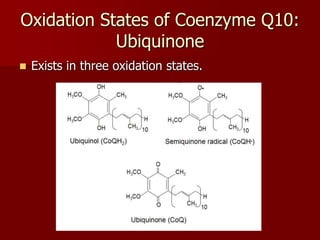
   Exists in three oxidation states.
Functions of Coenzyme Q10:
        Mitochondrial ATP Synthesis
 transfer electrons from complex I or complex II  complex
III.
 initially is reduced to the semi-ubiquinone radical and then
ubiquinone by transfering electrons one at a time to complex
III
 At the same time, transfers the protons outside the inner
mitochondrial membrane, generates a proton gradient across
the membrane.
 The energy released when the protons flow back into the
mitochondrial interior is used to form ATP.
Plays an integral role in supplying energy to chemical reactions in the body
Functions of Coenzyme Q10:
                  Antioxidant
   neutralize free-radical
      an effective lipid-soluble antioxidant
      continuously go through an oxidation-reduction state
      hold electrons loosely in its reduced form

   regenerate α-tocopherol from the α-tocopheroxyl radical.
   interact with dihydrolipoic acid.
      Dihydrolipoic acid reduces ubiquinone to ubiquinol

   inhibit lipid peroxidation
      occurs when cell membranes and low-density lipoproteins (LDL)
     are oxidized ex vivo
May prevent signs of skin aging
Functions of Coenzyme Q10:
          Lysosomal Function

    transport protons across lysosomal
    membranes

    help to maintain the optimal pH for
    cellular recycling
Disease Treatment of Coenzyme
            Q10: Ubiquinone
   Reliable and relatively consistent scientific data showing a substantial health benefit
    for Angina and Hypertension
     –   Singh et. al. – double-blind, placebo-controlled study
              59 men already on hypertension medications had 120mg Coenzyme Q10 daily for 8 week
              Blood pressure reduced by about 9% as compared to placebo
     –   Burke et. al – double-blind, placebo-controlled study
              83 people with isolated systolic hypertension had 60mg Coenzyme Q10 daily for 12 week
              Blood pressure reduced


   Contradictory, insufficient, or preliminary studies suggesting a health benefit or
    minimal health benefit for Cardiomyopathy, Cerebellar ataxia (familial), Congestive heart
    failure, Diabetes, Gingivitis (periodontal disease), Halitosis (if gum disease), Migraine
    headaches, Parkinson's disease, Renal (kidney) failure
     –   Baggio et al. – open marketing study
              2500 Class II or III patients had 100mg Coenzyme Q10 for 3 months with
              Signs of heart failure were reduced: 77% in edema, 54% in dyspnea, 82% in jugular venous pressure.
     –   Khatta et al. – double-blind, placebo-controlled study
              85 CHF patients had Coenzyme Q10 treatment
              Failed to find any evidence of benefit the patients with coenzyme Q treatment.


   For an herb, supported by traditional use but minimal or no scientific evidence. For a
    supplement, little scientific support and/or minimal health benefit for Alzheimer’s
    disease, Athletic performance, Breast cancer, Chronic obstructive pulmonary disease
    (COPD), HIV support, Infertility (male), Insulin resistance syndrome (Syndrome X), Lung
    cancer, Muscular dystrophy, Prostate cancer
Efficacy Data
   A lot of studies in the literature (70+)
     – Laboratory/Animal/Preclinical studies
           Laboratory – Coenzyme’ structures and function in cell respiration
           Animal – pretreatment
     – Human/Clinical studies
           Disease treatment


   For Heart disease:
     – Some large trials (up to 360 patients)
     – Some long term (up to 30 months)
     – Double-blind placebo-controlled trial, or meta-analysis


   Others:
     –   Small trials (usually less than 100 people)
     –   Short term (up to 12 week)
     –   Most are double-blind randomized placebo-controlled trial
     –   Few are non-double blind, or non-randomized
Coenzyme Q10: Ubiquinone
   By definition not a vitamin

   Produced endogenously in all tissues (~0.5g/day
    regenerated, with a body pool of ~2g)

    Naturally present in small amounts in a wide varied of foods

    Rich sources can be found in organ meats such as heart, liver and
    kidney, as well as beef, soy oil, sardines, mackerel and peanuts

    1 pound of sardines = 30 mg
    2 pounds of beef = 30 mg
    2.5 pounds of peanuts = 30 mg

    50 times more antioxidant power than Vitamin E

    Found to sustain vitamin E’s antioxidant effects
Coenzyme Q10: Ubiquinone
Endogenous synthesis decreases after age 20

Believed to fall off rapidly in middle age, accelerating the
aging process

Exercise increases catabolism of and need for CoQ10

Disease or other stress impairs intake and absorption of
the substrate
Drug Action of Coenzyme Q10:
             Ubiquinone
Absorption
  Absorbed in the small intestines directly into the lymphatic
  system, followed by absorption into the blood stream

  Absorption tends to be poor (lipophilicity)

  ~60% or more of oral dosage forms are excreted in the feces

  Can be highly variable, depending upon dosage form and on food
  intake at time of CoQ ingestion

  Absorption is lower if taken on an empty stomach and higher if
  taken with foods, especially those with a high lipid content
Drug Action of Coenzyme Q10:
              Ubiquinone
Distribution/Metabolism
  In the blood, CoQ10 is partitioned into various lipoproteins:
  VLDL, LDL and HDL, with peak blood levels occurring in 5 to 10
  hours

  It is found in all cells of the body and is distributed to the various
  tissues of the body (important to know that is able to enter the
  brain)

  Takes roughly 3 weeks of daily dosing to reach the maximum serum
  concentrations
Excretion

  Of what is absorbed elimination occurs through the bodies bile

  Low plasma clearance

  Elimination half-life of 34 hours
Dosage Forms of Coenzyme Q10:
              Ubiquinone
   Capsules (10 mg, 30 mg, 75 mg, 100 mg, 150 mg)

   Chewable Tablets (100 mg, 200 mg)

   Liquid softgel (30 mg/5 ml)

   Tablets (25 mg, 50 mg, 60 mg, 200 mg)

   Wafers (60 mg, 200 mg)

   Vcaps (bio-grown CoQ10; 22mg)

   Can also be found in a number of skin products on the
    market
Dosage Forms of Coenzyme Q10:
              Ubiquinone
   CoEnzyme Q10, 300mg (60 caps): $84.96 WholeHealth.com
   Pure Encapsulated CoQ10 60mg (250caps): $132.00; 30mg
    (250caps): $76.80 Graceful Earth.com
   Coenzyme Q-10 30 mg (60 chewable tabs): $9.09
   CoEnzyme Q10, 50 mg (200 Softgels): $44.18
   Co-Q-10-Plus, 50 mg (60 tabs): $41.50 Cybervitamins.com
   CoQ10 Vitaline, Enzymatic Therapy, 100 mg (30 Chocolate Flavored
    Chewable Wafers): $25.88 iherb.com
   New Chapter Organics Bio-Grown CoQ10, 22mg (30 Vcaps): $23.24
    drugstore.com
   Nivea Visage Q10 Advanced Wrinkle Reducer Lotion SPF 15: $10.99
    drugstore.com
   Nivea Visage Q10 Advanced Wrinkle Reducer Night Crème: $10.99
    drugstore.com
   Nivea Visage Q10 Advanced Wrinkle Reducer Plus Eye Creme SPF 4 0.5
    oz (14 g): $10.99 drugstore.com
Recommended Dosage Amounts
     for Coenzyme Q: Ubiquinone
   No known toxic dose
   For Hypertension: 30 mg, 2 times a day
   For Angina: 50 mg, 3 times a day
   For Congestive Heart Failure
        Mild: 30 mg a day
        Severe: 30 mg, 3 times a day
   For Cardiomyopathy: 50 mg, 2 times a day
   As an Antioxidant: 30 mg to 60 mg a day
   Mitral Valve Prolapse in Children: 2 mg/kg/day
Dietary Supplement Health and
          Education Act of 1994
   The term "dietary supplement“ under Section 201 (21 U.S.C. 321)

(1) means a product (other than tobacco) intended to supplement the diet that
    bears or contains one or more of the following dietary ingredients:
     (A) a vitamin;
     (B) a mineral;
     (C) an herb or other botanical;
     (D) an amino acid;
     (E) a dietary substance for use by man to supplement the diet by increasing the
        total dietary intake; or
     (F) a concentrate, metabolite, constituent, extract, or combination of any ingredient
        described in clause (A), (B), (C), (D), or (E);

(2) means a product that
    (A)(i) is intended for ingestion in a form described in section 411(c)(1)(B)(i); or
     (ii) complies with section 411(c)(1)(B)(ii);
     (B) is not represented for use as a conventional food or as a sole item of a meal or
          the diet; and
     (C) is labeled as a dietary supplement; and
FDA: Laws and regulations
   No determined state regulations on this product
   Violations of the Dietary Supplement Health and Education
    Act of 1994 (amendment to the Federal Food, Drug, and
    Cosmetic Act) occur when claims are made that a supplement are
    intended for the use in the diagnosis, cure, mitigation, treatment or
    prevention of disease
   Why is this important?
   Because the above statement is the FDA’s definition of a drug
   And a new drug may not be legally marketed in the United States
    without an approved New Drug Application (NDA)
T.J. Clark Liquid Co-Q10 Advanced Formula:
“[A] very beneficial supplement for individuals who suffer
   from disorders of the cardiovascular system....“
“Revive failing hearts... Lower blood pressure”
References
   Anne Keogh, Steve Fenton, Christina Leslie, et. al. Randomised Double-Blind, Placebo-Controlled Trial of
    Coenzyme Q10 Therapy in Class II and III Systolic Heart Failure. Heart Lung & Circulation. 2003;12:135-41.
   Baggio E, Gandini R, Plancher A, et. al. Italian multicentre study on the safety and efficacy of Coenzyme Q10 as
    adjunctive therapy in heart failure. The Coenzyme Q10 Drug Survellance Investigators. Clin. Invest.
    1993;71:S145-9.
   Burke BE, Neuenschwander R, Olson RD. Randomized, double-blind, placebo-controlled trial of coenzyme Q10 in
    isolated systolic hypertension. South Med Journal. 2001;94:1112-7.
   Flint Beal, Clifford Shults. Effects of Coenzyme Q10 in Huntington’s disease and early Parkinson’s disease.
    BioFactors 18. 2003;18:153-161.
   Franklin Rosenfield, Deborah Hilton, Salvatore Pepe, et. al. Systematic review of effect of coenzyme Q10 in
    physical exercise, hypertension and heart failure. BioFactors. 2003;18:91-100.
   Kenneth Jones, Kerry Hughs, Laurie Mischley, et. al. Coenzyme Q-10 and Cardiovascular Health. Alternative
    therapies. 2004;10(1):22-30.
   Langsjoen PH, Langsjoen PH, Folkers K. A six year clinical study of therapy
    of cardiomyopathy with coenzyme Q10. Int J Tissue React(Swtizerland), 1990;12(3):169-71.
   Singh R, Niaz MA, Rastogi SS, et. al. Effect of hydrosoluble coenzyme Q10 on blood pressures and insulin
    resistance in hypertensive patients with coronary artery disease. J Human Hypertens. 1999:13:203-8.
   Ely, JTA and Krone, CA. A Brief Update on Ubiquinone (Coenzyme Q10). Journal of Orthomolecular Medicine
    2000; 15(2):63-68. Retrived from the web on May 8, 2005 at http://faculty.washington.edu/~ely/JOM5.html
   Langsjoen, PH. Introduction to Coenzyme Q10. Retrieved from the web on May 8, 2005 at
    http://faculty.washington.edu/~ely/coenzq10.html#FAQ
   Facts and Comparisons: The review of Natural Products. Aug 1997
   Physicians Desk Reference. 2005. Retrieved from the web on May 6, 2005 at
    http://www.pdrhealth.com/drug_info/nmdrugprofiles/nutsupdrugs/coe_0084.shtml
   Micromedix. 2005. OSU subscription
   National Cancer Institute (NCI) and National Center for Complementary and Alternative Medicine (NCAM).
    Retrieved from the web on May 8, 2005 at http://cis.nci.nih.gov/fact/9_16.htm
   Dietary Supplement Health and Education Act of 1994, Public Law 103-417, 103rd Congress. Retrieved from the
    web on May 8, 2005 at http://www.fda.gov/opacom/laws/dshea.html
   Federal Food, Drug and Cosmetic Act, Title 21, Chapter 9. Retrieved from the web on May 8, 2005 at
    http://www.access.gpo.gov/uscode/title21/chapter9_.html
   Walgreens.com
   Drugstore.com
Coenzymeq10ppt1844

Coenzymeq10ppt1844

  • 1.
    THE AVENGER Coenzyme Q10:Ubiquinone BY DR. ABDULRAB SHAIKH
  • 2.
    History  1957 - Coenzyme Q10 was first isolated from beef heart mitochondria by Dr. Frederick Crane  1958 - The precise chemical structure of Coenzyme Q10 was determined by professor Karl Folkers and collaborators at Merck, Inc.  1961 - Coenzyme Q10 was considered as a potential treatment for cancer.  1964 – Coenzyme Q10 demonstrated its usefulness for the treatment of congestive heart failure.  1970 – Coenzyme Q10 demonstrated its effectiveness as an anti-oxidant.
  • 4.
    Biosynthesis of CoenzymeQ 1. Synthesis of the benzoquinone structure from either tyrosine or phenylalanine 2. Synthesis of the isoprene side chain from acetyl- coenzyme A via the mevalonate pathway. 3. Condensation by the HMG-CoA reductase
  • 5.
    Coenzyme Q10: Ubiquinone  lipophilic, water-insoluble substances  benzoquinone “head” and terpinoid “tail”  various coenzymes Q relate to the number of isoprenoid units (5-carbon structure) in the tail  Can be one to 12 isoprenoid units  10 isoprenoid units are the prevalent form in humans  Solid-waxlike substance  present in most tissues § The highest concentrations is found in the heart, the liver, the kidneys, and the pancreas. § The lowest concentration is found in the lungs.
  • 6.
    Oxidation States ofCoenzyme Q10: Ubiquinone  Exists in three oxidation states.
  • 7.
    Functions of CoenzymeQ10: Mitochondrial ATP Synthesis  transfer electrons from complex I or complex II  complex III.  initially is reduced to the semi-ubiquinone radical and then ubiquinone by transfering electrons one at a time to complex III  At the same time, transfers the protons outside the inner mitochondrial membrane, generates a proton gradient across the membrane.  The energy released when the protons flow back into the mitochondrial interior is used to form ATP. Plays an integral role in supplying energy to chemical reactions in the body
  • 8.
    Functions of CoenzymeQ10: Antioxidant  neutralize free-radical  an effective lipid-soluble antioxidant  continuously go through an oxidation-reduction state  hold electrons loosely in its reduced form  regenerate α-tocopherol from the α-tocopheroxyl radical.  interact with dihydrolipoic acid.  Dihydrolipoic acid reduces ubiquinone to ubiquinol  inhibit lipid peroxidation  occurs when cell membranes and low-density lipoproteins (LDL) are oxidized ex vivo May prevent signs of skin aging
  • 9.
    Functions of CoenzymeQ10: Lysosomal Function  transport protons across lysosomal membranes  help to maintain the optimal pH for cellular recycling
  • 10.
    Disease Treatment ofCoenzyme Q10: Ubiquinone  Reliable and relatively consistent scientific data showing a substantial health benefit for Angina and Hypertension – Singh et. al. – double-blind, placebo-controlled study  59 men already on hypertension medications had 120mg Coenzyme Q10 daily for 8 week  Blood pressure reduced by about 9% as compared to placebo – Burke et. al – double-blind, placebo-controlled study  83 people with isolated systolic hypertension had 60mg Coenzyme Q10 daily for 12 week  Blood pressure reduced  Contradictory, insufficient, or preliminary studies suggesting a health benefit or minimal health benefit for Cardiomyopathy, Cerebellar ataxia (familial), Congestive heart failure, Diabetes, Gingivitis (periodontal disease), Halitosis (if gum disease), Migraine headaches, Parkinson's disease, Renal (kidney) failure – Baggio et al. – open marketing study  2500 Class II or III patients had 100mg Coenzyme Q10 for 3 months with  Signs of heart failure were reduced: 77% in edema, 54% in dyspnea, 82% in jugular venous pressure. – Khatta et al. – double-blind, placebo-controlled study  85 CHF patients had Coenzyme Q10 treatment  Failed to find any evidence of benefit the patients with coenzyme Q treatment.  For an herb, supported by traditional use but minimal or no scientific evidence. For a supplement, little scientific support and/or minimal health benefit for Alzheimer’s disease, Athletic performance, Breast cancer, Chronic obstructive pulmonary disease (COPD), HIV support, Infertility (male), Insulin resistance syndrome (Syndrome X), Lung cancer, Muscular dystrophy, Prostate cancer
  • 11.
    Efficacy Data  A lot of studies in the literature (70+) – Laboratory/Animal/Preclinical studies  Laboratory – Coenzyme’ structures and function in cell respiration  Animal – pretreatment – Human/Clinical studies  Disease treatment  For Heart disease: – Some large trials (up to 360 patients) – Some long term (up to 30 months) – Double-blind placebo-controlled trial, or meta-analysis  Others: – Small trials (usually less than 100 people) – Short term (up to 12 week) – Most are double-blind randomized placebo-controlled trial – Few are non-double blind, or non-randomized
  • 12.
    Coenzyme Q10: Ubiquinone  By definition not a vitamin  Produced endogenously in all tissues (~0.5g/day regenerated, with a body pool of ~2g) Naturally present in small amounts in a wide varied of foods Rich sources can be found in organ meats such as heart, liver and kidney, as well as beef, soy oil, sardines, mackerel and peanuts 1 pound of sardines = 30 mg 2 pounds of beef = 30 mg 2.5 pounds of peanuts = 30 mg 50 times more antioxidant power than Vitamin E Found to sustain vitamin E’s antioxidant effects
  • 13.
    Coenzyme Q10: Ubiquinone Endogenoussynthesis decreases after age 20 Believed to fall off rapidly in middle age, accelerating the aging process Exercise increases catabolism of and need for CoQ10 Disease or other stress impairs intake and absorption of the substrate
  • 14.
    Drug Action ofCoenzyme Q10: Ubiquinone Absorption Absorbed in the small intestines directly into the lymphatic system, followed by absorption into the blood stream Absorption tends to be poor (lipophilicity) ~60% or more of oral dosage forms are excreted in the feces Can be highly variable, depending upon dosage form and on food intake at time of CoQ ingestion Absorption is lower if taken on an empty stomach and higher if taken with foods, especially those with a high lipid content
  • 15.
    Drug Action ofCoenzyme Q10: Ubiquinone Distribution/Metabolism In the blood, CoQ10 is partitioned into various lipoproteins: VLDL, LDL and HDL, with peak blood levels occurring in 5 to 10 hours It is found in all cells of the body and is distributed to the various tissues of the body (important to know that is able to enter the brain) Takes roughly 3 weeks of daily dosing to reach the maximum serum concentrations Excretion Of what is absorbed elimination occurs through the bodies bile Low plasma clearance Elimination half-life of 34 hours
  • 16.
    Dosage Forms ofCoenzyme Q10: Ubiquinone  Capsules (10 mg, 30 mg, 75 mg, 100 mg, 150 mg)  Chewable Tablets (100 mg, 200 mg)  Liquid softgel (30 mg/5 ml)  Tablets (25 mg, 50 mg, 60 mg, 200 mg)  Wafers (60 mg, 200 mg)  Vcaps (bio-grown CoQ10; 22mg)  Can also be found in a number of skin products on the market
  • 17.
    Dosage Forms ofCoenzyme Q10: Ubiquinone  CoEnzyme Q10, 300mg (60 caps): $84.96 WholeHealth.com  Pure Encapsulated CoQ10 60mg (250caps): $132.00; 30mg (250caps): $76.80 Graceful Earth.com  Coenzyme Q-10 30 mg (60 chewable tabs): $9.09  CoEnzyme Q10, 50 mg (200 Softgels): $44.18  Co-Q-10-Plus, 50 mg (60 tabs): $41.50 Cybervitamins.com  CoQ10 Vitaline, Enzymatic Therapy, 100 mg (30 Chocolate Flavored Chewable Wafers): $25.88 iherb.com  New Chapter Organics Bio-Grown CoQ10, 22mg (30 Vcaps): $23.24 drugstore.com  Nivea Visage Q10 Advanced Wrinkle Reducer Lotion SPF 15: $10.99 drugstore.com  Nivea Visage Q10 Advanced Wrinkle Reducer Night Crème: $10.99 drugstore.com  Nivea Visage Q10 Advanced Wrinkle Reducer Plus Eye Creme SPF 4 0.5 oz (14 g): $10.99 drugstore.com
  • 18.
    Recommended Dosage Amounts for Coenzyme Q: Ubiquinone  No known toxic dose  For Hypertension: 30 mg, 2 times a day  For Angina: 50 mg, 3 times a day  For Congestive Heart Failure Mild: 30 mg a day Severe: 30 mg, 3 times a day  For Cardiomyopathy: 50 mg, 2 times a day  As an Antioxidant: 30 mg to 60 mg a day  Mitral Valve Prolapse in Children: 2 mg/kg/day
  • 19.
    Dietary Supplement Healthand Education Act of 1994  The term "dietary supplement“ under Section 201 (21 U.S.C. 321) (1) means a product (other than tobacco) intended to supplement the diet that bears or contains one or more of the following dietary ingredients: (A) a vitamin; (B) a mineral; (C) an herb or other botanical; (D) an amino acid; (E) a dietary substance for use by man to supplement the diet by increasing the total dietary intake; or (F) a concentrate, metabolite, constituent, extract, or combination of any ingredient described in clause (A), (B), (C), (D), or (E); (2) means a product that (A)(i) is intended for ingestion in a form described in section 411(c)(1)(B)(i); or (ii) complies with section 411(c)(1)(B)(ii); (B) is not represented for use as a conventional food or as a sole item of a meal or the diet; and (C) is labeled as a dietary supplement; and
  • 20.
    FDA: Laws andregulations  No determined state regulations on this product  Violations of the Dietary Supplement Health and Education Act of 1994 (amendment to the Federal Food, Drug, and Cosmetic Act) occur when claims are made that a supplement are intended for the use in the diagnosis, cure, mitigation, treatment or prevention of disease  Why is this important?  Because the above statement is the FDA’s definition of a drug  And a new drug may not be legally marketed in the United States without an approved New Drug Application (NDA) T.J. Clark Liquid Co-Q10 Advanced Formula: “[A] very beneficial supplement for individuals who suffer from disorders of the cardiovascular system....“ “Revive failing hearts... Lower blood pressure”
  • 21.
    References  Anne Keogh, Steve Fenton, Christina Leslie, et. al. Randomised Double-Blind, Placebo-Controlled Trial of Coenzyme Q10 Therapy in Class II and III Systolic Heart Failure. Heart Lung & Circulation. 2003;12:135-41.  Baggio E, Gandini R, Plancher A, et. al. Italian multicentre study on the safety and efficacy of Coenzyme Q10 as adjunctive therapy in heart failure. The Coenzyme Q10 Drug Survellance Investigators. Clin. Invest. 1993;71:S145-9.  Burke BE, Neuenschwander R, Olson RD. Randomized, double-blind, placebo-controlled trial of coenzyme Q10 in isolated systolic hypertension. South Med Journal. 2001;94:1112-7.  Flint Beal, Clifford Shults. Effects of Coenzyme Q10 in Huntington’s disease and early Parkinson’s disease. BioFactors 18. 2003;18:153-161.  Franklin Rosenfield, Deborah Hilton, Salvatore Pepe, et. al. Systematic review of effect of coenzyme Q10 in physical exercise, hypertension and heart failure. BioFactors. 2003;18:91-100.  Kenneth Jones, Kerry Hughs, Laurie Mischley, et. al. Coenzyme Q-10 and Cardiovascular Health. Alternative therapies. 2004;10(1):22-30.  Langsjoen PH, Langsjoen PH, Folkers K. A six year clinical study of therapy of cardiomyopathy with coenzyme Q10. Int J Tissue React(Swtizerland), 1990;12(3):169-71.  Singh R, Niaz MA, Rastogi SS, et. al. Effect of hydrosoluble coenzyme Q10 on blood pressures and insulin resistance in hypertensive patients with coronary artery disease. J Human Hypertens. 1999:13:203-8.  Ely, JTA and Krone, CA. A Brief Update on Ubiquinone (Coenzyme Q10). Journal of Orthomolecular Medicine 2000; 15(2):63-68. Retrived from the web on May 8, 2005 at http://faculty.washington.edu/~ely/JOM5.html  Langsjoen, PH. Introduction to Coenzyme Q10. Retrieved from the web on May 8, 2005 at http://faculty.washington.edu/~ely/coenzq10.html#FAQ  Facts and Comparisons: The review of Natural Products. Aug 1997  Physicians Desk Reference. 2005. Retrieved from the web on May 6, 2005 at http://www.pdrhealth.com/drug_info/nmdrugprofiles/nutsupdrugs/coe_0084.shtml  Micromedix. 2005. OSU subscription  National Cancer Institute (NCI) and National Center for Complementary and Alternative Medicine (NCAM). Retrieved from the web on May 8, 2005 at http://cis.nci.nih.gov/fact/9_16.htm  Dietary Supplement Health and Education Act of 1994, Public Law 103-417, 103rd Congress. Retrieved from the web on May 8, 2005 at http://www.fda.gov/opacom/laws/dshea.html  Federal Food, Drug and Cosmetic Act, Title 21, Chapter 9. Retrieved from the web on May 8, 2005 at http://www.access.gpo.gov/uscode/title21/chapter9_.html  Walgreens.com  Drugstore.com