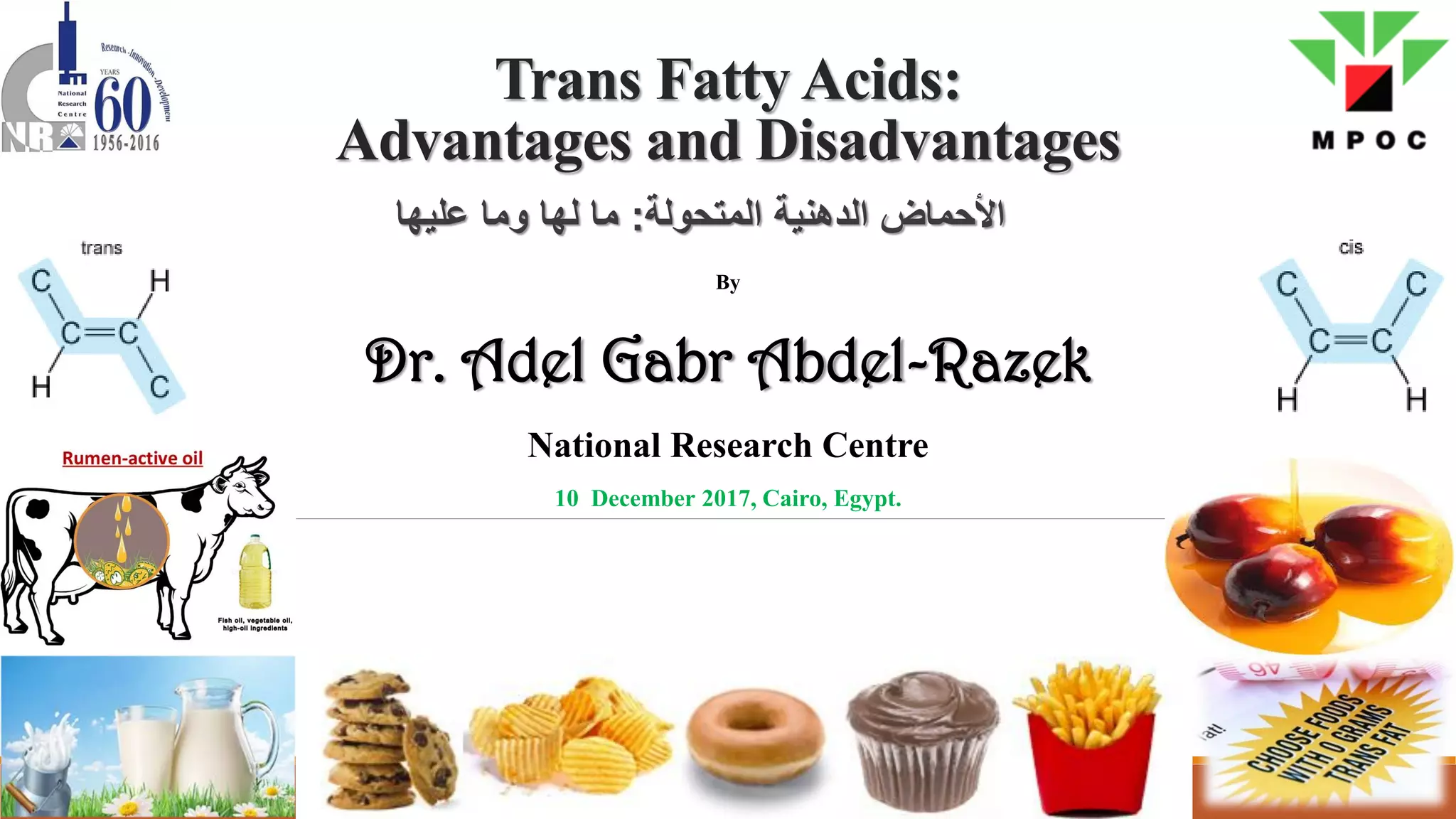
Trans Fatty Acids:
Advantages and Disadvantages
‫المتحولة‬ ‫الدهنية‬ ‫األحماض‬:‫عليها‬ ‫وما‬ ‫لها‬ ‫ما‬
By
Dr. Adel Gabr Abdel-Razek
National Research Centre
10 December 2017, Cairo, Egypt.
Introduction
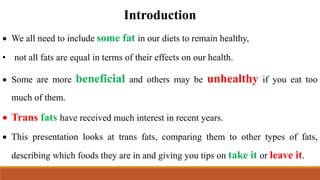
 We all need to include some fat in our diets to remain healthy,
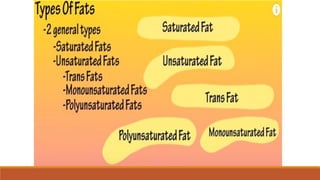
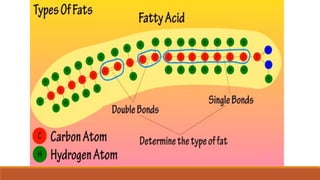
• not all fats are equal in terms of their effects on our health.
 Some are more beneficial and others may be unhealthy if you eat too
much of them.
 Trans fats have received much interest in recent years.
 This presentation looks at trans fats, comparing them to other types of fats,
describing which foods they are in and giving you tips on take it or leave it.
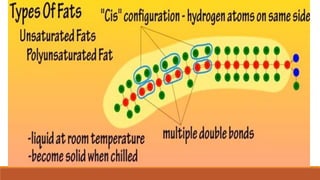
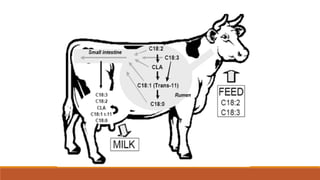
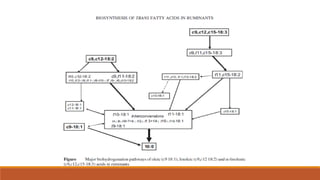
• The major isomer in milk fat is cis-9, trans-11 CLA (18:2) represents
about 75-90% of the total CLA in milk fat.
• This is of special importance because the cis-9, trans-11 CLA isomer
has been shown to be anti-carcinogenic in biomedical studies.
• Indeed, utilizing a breast cancer model, a recent study demonstrated
that rats fed a diet containing butter that was naturally enriched with
cis-9, trans-11 CLA had a lower mammary tumor incidence and fewer
tumors than rats consuming the control diet.
• The second most prevalent CLA isomer in milk fat is trans-7, cis-9
and its concentration is about 10% of that for cis-9, trans-11.
• To date, the specific biological effects of trans-7, cis-9 CLA have not
been investigated because of its limited availability.
• In addition, milk fat content of trans-10, cis-12 CLA can be markedly
increased under certain dietary situations, but even in this instance the
amount is less than 2% of the cis-9, trans-11 CLA content.
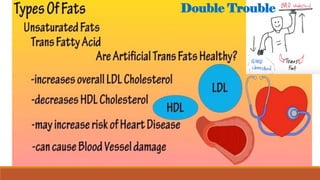
Double Trouble
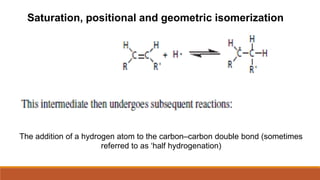
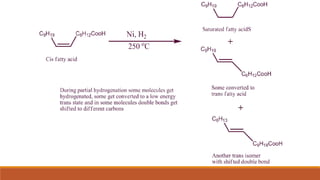
Saturation, positional and geometric isomerization
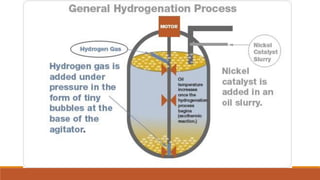
The addition of a hydrogen atom to the carbon–carbon double bond (sometimes
referred to as ‘half hydrogenation)
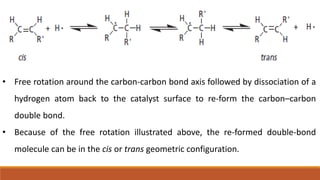
• Free rotation around the carbon-carbon bond axis followed by dissociation of a
hydrogen atom back to the catalyst surface to re-form the carbon–carbon
double bond.
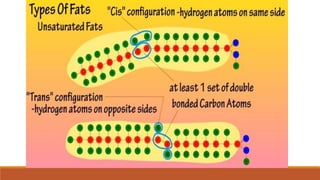
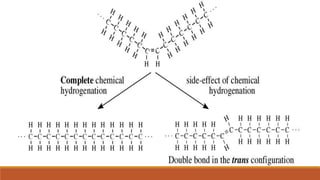
• Because of the free rotation illustrated above, the re-formed double-bond
molecule can be in the cis or trans geometric configuration.
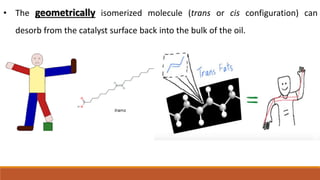
• The geometrically isomerized molecule (trans or cis configuration) can
desorb from the catalyst surface back into the bulk of the oil.
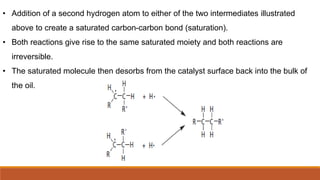
• Addition of a second hydrogen atom to either of the two intermediates illustrated
above to create a saturated carbon-carbon bond (saturation).
• Both reactions give rise to the same saturated moiety and both reactions are
irreversible.
• The saturated molecule then desorbs from the catalyst surface back into the bulk of
the oil.
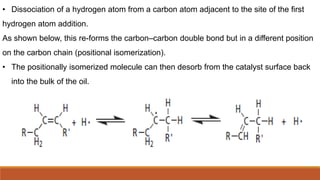
• Dissociation of a hydrogen atom from a carbon atom adjacent to the site of the first
hydrogen atom addition.
As shown below, this re-forms the carbon–carbon double bond but in a different position
on the carbon chain (positional isomerization).
• The positionally isomerized molecule can then desorb from the catalyst surface back
into the bulk of the oil.
How much Trans Fat Is Recommended?
• Researchers agree that it is important to keep the intake of trans fat to a
minimum.
• In fact, the American Heart Association recommends that consumers limit
the total amount of trans fat and saturated fat combined to less than 10
percent of total calories everyday.
• Just remember, the less trans fat, the better.
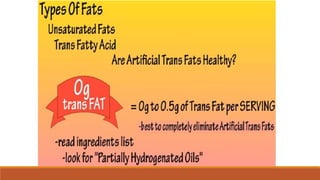
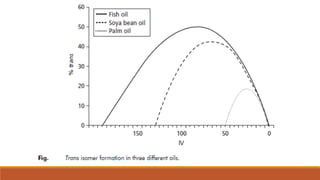
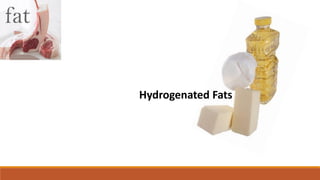
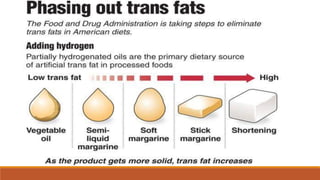
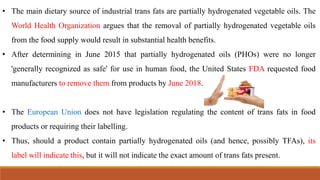
• The main dietary source of industrial trans fats are partially hydrogenated vegetable oils. The
World Health Organization argues that the removal of partially hydrogenated vegetable oils
from the food supply would result in substantial health benefits.
• After determining in June 2015 that partially hydrogenated oils (PHOs) were no longer
'generally recognized as safe' for use in human food, the United States FDA requested food
manufacturers to remove them from products by June 2018.
• The European Union does not have legislation regulating the content of trans fats in food
products or requiring their labelling.
• Thus, should a product contain partially hydrogenated oils (and hence, possibly TFAs), its
label will indicate this, but it will not indicate the exact amount of trans fats present.
Hydrogenated Fats
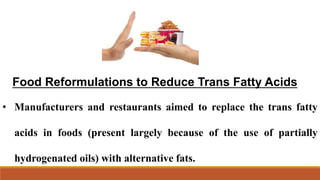
Food Reformulations to Reduce Trans Fatty Acids
• Manufacturers and restaurants aimed to replace the trans fatty
acids in foods (present largely because of the use of partially
hydrogenated oils) with alternative fats.
 Choosing solid shortenings for food applications is more complicated
than liquid oils, as the shortening’s structure impacts its function, such
as flaky texture in pastry and smooth mouthfeel in breads.
 Solid shortenings range from very hard and highly saturated to very
soft and plastic with a high degree of unsaturation.
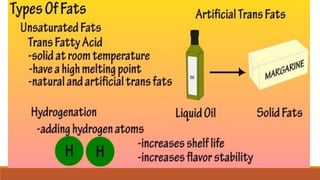
• For many years, much of this functionality was achieved through the use of
trans fats.
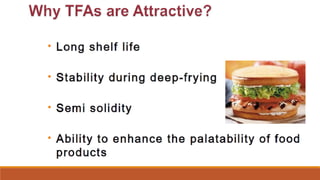
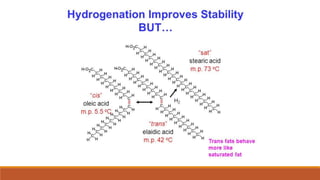
• Trans fats are unique, in that they are unsaturated lipids that function much like
their saturated counterparts.
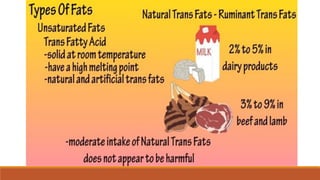
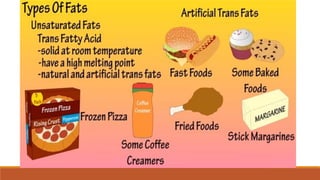
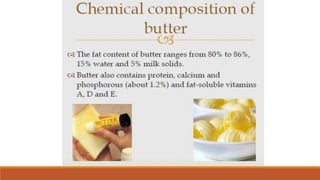
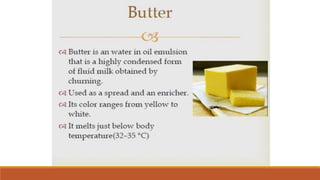
• While small amounts of trans fats are naturally occurring in some foods, such as
butter, they primarily are produced through partial hydrogenation of unsaturated
oils, such as soybean oil.
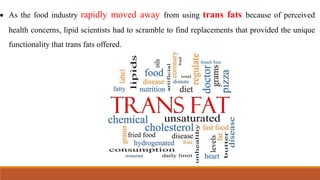
 As the food industry rapidly moved away from using trans fats because of perceived
health concerns, lipid scientists had to scramble to find replacements that provided the unique
functionality that trans fats offered.
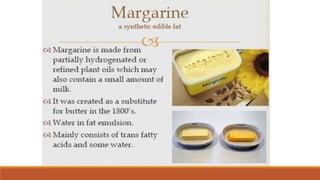
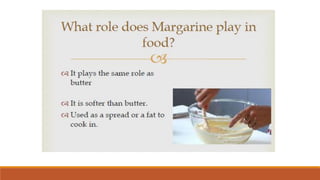
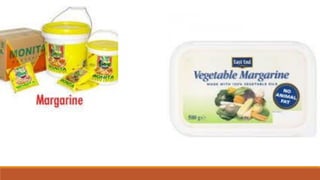
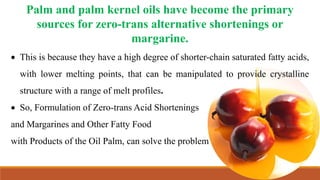
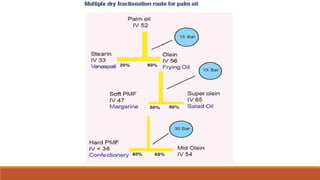
Palm and palm kernel oils have become the primary
sources for zero-trans alternative shortenings or
margarine.
 This is because they have a high degree of shorter-chain saturated fatty acids,
with lower melting points, that can be manipulated to provide crystalline
structure with a range of melt profiles.
 So, Formulation of Zero-trans Acid Shortenings
and Margarines and Other Fatty Food
with Products of the Oil Palm, can solve the problem
 The move to palm-based shortenings and margarine:
fats and oils manufacturers now have built much of the functionality into
palm-based shortenings, to the point that they are now comparable to their
trans counterparts.
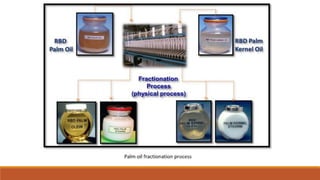
 This has been done through fractionation and recombination of the
triglycerides, along with rearrangement of the fatty acids on the
triglyceride molecules.
• While palm-based shortenings now are working well in foods, there
continue to be concerns around their saturated fat content.
 Recently, palm-based shortenings are being transformed from
containing as much as 64-69% saturated fat to as low as 24-46%
saturated fat with equal functionality.
 This is being done by using unsaturated fractions of soybean and
canola oils in combination with inter esterified palm fats.
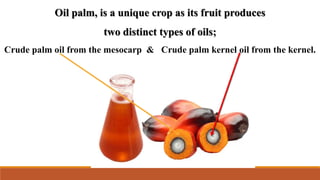
Oil palm, is a unique crop as its fruit produces
two distinct types of oils;
Crude palm oil from the mesocarp & Crude palm kernel oil from the kernel.
Trans Fatty Acids:Advantages and Disadvantages

Trans Fatty Acids:Advantages and Disadvantages

  • 1.
    Trans Fatty Acids: Advantagesand Disadvantages ‫المتحولة‬ ‫الدهنية‬ ‫األحماض‬:‫عليها‬ ‫وما‬ ‫لها‬ ‫ما‬ By Dr. Adel Gabr Abdel-Razek National Research Centre 10 December 2017, Cairo, Egypt.
  • 2.
    Introduction  We allneed to include some fat in our diets to remain healthy, • not all fats are equal in terms of their effects on our health.  Some are more beneficial and others may be unhealthy if you eat too much of them.  Trans fats have received much interest in recent years.  This presentation looks at trans fats, comparing them to other types of fats, describing which foods they are in and giving you tips on take it or leave it.
  • 15.
    • The majorisomer in milk fat is cis-9, trans-11 CLA (18:2) represents about 75-90% of the total CLA in milk fat. • This is of special importance because the cis-9, trans-11 CLA isomer has been shown to be anti-carcinogenic in biomedical studies. • Indeed, utilizing a breast cancer model, a recent study demonstrated that rats fed a diet containing butter that was naturally enriched with cis-9, trans-11 CLA had a lower mammary tumor incidence and fewer tumors than rats consuming the control diet.
  • 16.
    • The secondmost prevalent CLA isomer in milk fat is trans-7, cis-9 and its concentration is about 10% of that for cis-9, trans-11. • To date, the specific biological effects of trans-7, cis-9 CLA have not been investigated because of its limited availability. • In addition, milk fat content of trans-10, cis-12 CLA can be markedly increased under certain dietary situations, but even in this instance the amount is less than 2% of the cis-9, trans-11 CLA content.
  • 22.
  • 25.
    Saturation, positional andgeometric isomerization The addition of a hydrogen atom to the carbon–carbon double bond (sometimes referred to as ‘half hydrogenation)
  • 26.
    • Free rotationaround the carbon-carbon bond axis followed by dissociation of a hydrogen atom back to the catalyst surface to re-form the carbon–carbon double bond. • Because of the free rotation illustrated above, the re-formed double-bond molecule can be in the cis or trans geometric configuration.
  • 27.
    • The geometricallyisomerized molecule (trans or cis configuration) can desorb from the catalyst surface back into the bulk of the oil.
  • 28.
    • Addition ofa second hydrogen atom to either of the two intermediates illustrated above to create a saturated carbon-carbon bond (saturation). • Both reactions give rise to the same saturated moiety and both reactions are irreversible. • The saturated molecule then desorbs from the catalyst surface back into the bulk of the oil.

  • 29.
    • Dissociation ofa hydrogen atom from a carbon atom adjacent to the site of the first hydrogen atom addition. As shown below, this re-forms the carbon–carbon double bond but in a different position on the carbon chain (positional isomerization). • The positionally isomerized molecule can then desorb from the catalyst surface back into the bulk of the oil.
  • 33.
    How much TransFat Is Recommended? • Researchers agree that it is important to keep the intake of trans fat to a minimum. • In fact, the American Heart Association recommends that consumers limit the total amount of trans fat and saturated fat combined to less than 10 percent of total calories everyday. • Just remember, the less trans fat, the better.
  • 34.
    • The maindietary source of industrial trans fats are partially hydrogenated vegetable oils. The World Health Organization argues that the removal of partially hydrogenated vegetable oils from the food supply would result in substantial health benefits. • After determining in June 2015 that partially hydrogenated oils (PHOs) were no longer 'generally recognized as safe' for use in human food, the United States FDA requested food manufacturers to remove them from products by June 2018. • The European Union does not have legislation regulating the content of trans fats in food products or requiring their labelling. • Thus, should a product contain partially hydrogenated oils (and hence, possibly TFAs), its label will indicate this, but it will not indicate the exact amount of trans fats present.
  • 41.
  • 42.
    Food Reformulations toReduce Trans Fatty Acids • Manufacturers and restaurants aimed to replace the trans fatty acids in foods (present largely because of the use of partially hydrogenated oils) with alternative fats.
  • 44.
     Choosing solidshortenings for food applications is more complicated than liquid oils, as the shortening’s structure impacts its function, such as flaky texture in pastry and smooth mouthfeel in breads.  Solid shortenings range from very hard and highly saturated to very soft and plastic with a high degree of unsaturation.
  • 45.
    • For manyyears, much of this functionality was achieved through the use of trans fats. • Trans fats are unique, in that they are unsaturated lipids that function much like their saturated counterparts. • While small amounts of trans fats are naturally occurring in some foods, such as butter, they primarily are produced through partial hydrogenation of unsaturated oils, such as soybean oil.
  • 46.
     As thefood industry rapidly moved away from using trans fats because of perceived health concerns, lipid scientists had to scramble to find replacements that provided the unique functionality that trans fats offered.
  • 49.
    Palm and palmkernel oils have become the primary sources for zero-trans alternative shortenings or margarine.  This is because they have a high degree of shorter-chain saturated fatty acids, with lower melting points, that can be manipulated to provide crystalline structure with a range of melt profiles.  So, Formulation of Zero-trans Acid Shortenings and Margarines and Other Fatty Food with Products of the Oil Palm, can solve the problem
  • 50.
     The moveto palm-based shortenings and margarine: fats and oils manufacturers now have built much of the functionality into palm-based shortenings, to the point that they are now comparable to their trans counterparts.  This has been done through fractionation and recombination of the triglycerides, along with rearrangement of the fatty acids on the triglyceride molecules. • While palm-based shortenings now are working well in foods, there continue to be concerns around their saturated fat content.
  • 51.
     Recently, palm-basedshortenings are being transformed from containing as much as 64-69% saturated fat to as low as 24-46% saturated fat with equal functionality.  This is being done by using unsaturated fractions of soybean and canola oils in combination with inter esterified palm fats.
  • 52.
    Oil palm, isa unique crop as its fruit produces two distinct types of oils; Crude palm oil from the mesocarp & Crude palm kernel oil from the kernel.