Antioxidants and their therapeutic implications
  Although oxygen is essential for life, excess
  oxygen can have harmful effects. When
  oxygen is metabolised by the body it creates
  substances called free radicals which cause
  damage to our cells.

  Free radicals can also be created by exposure
  to pollution, cigarette smoke and fatty foods.
Excessive amounts of free radicals are thought
to be related to the development of conditions
such as:-

 Heart and liver disease
 Some cancers,
 Arthritis,
 Accelerated ageing
 Eyesight deterioration.
   The body has its own natural defences
    against free radicals, but these systems
    can sometimes be overwhelmed.

   Antioxidants      are     naturally    occurring
    nutrients in food or chemical compounds
    which help destroy free radicals and
    minimise damage to our cells. they can delay
    the start or slow the rate of lipid per oxidation
    reaction in food systems.
SOURCES OF ANTIOXIDANTS


       VITAMIN-E
       VITAMIN-C
       BETA-CAROTENE
       SELENIUM
       PHYTONUTRIENTS
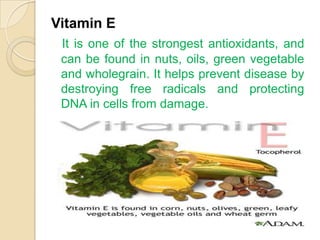
Vitamin E
 It is one of the strongest antioxidants, and
 can be found in nuts, oils, green vegetable
 and wholegrain. It helps prevent disease by
 destroying free radicals and protecting
 DNA in cells from damage.
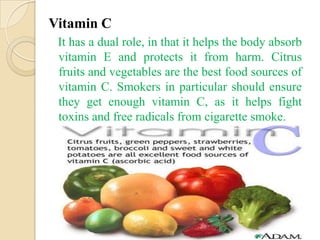
Vitamin C
 It has a dual role, in that it helps the body absorb
 vitamin E and protects it from harm. Citrus
 fruits and vegetables are the best food sources of
 vitamin C. Smokers in particular should ensure
 they get enough vitamin C, as it helps fight
 toxins and free radicals from cigarette smoke.
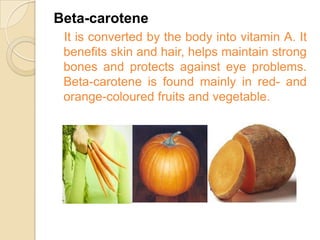
Beta-carotene
 It is converted by the body into vitamin A. It
 benefits skin and hair, helps maintain strong
 bones and protects against eye problems.
 Beta-carotene is found mainly in red- and
 orange-coloured fruits and vegetable.
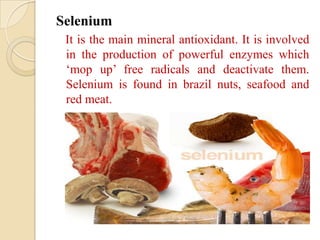
Selenium
 It is the main mineral antioxidant. It is involved
 in the production of powerful enzymes which
 ‘mop up’ free radicals and deactivate them.
 Selenium is found in brazil nuts, seafood and
 red meat.
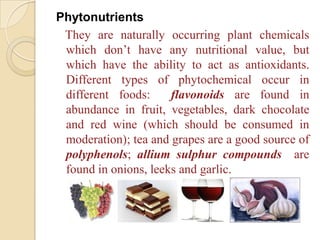
Phytonutrients
 They are naturally occurring plant chemicals
 which don’t have any nutritional value, but
 which have the ability to act as antioxidants.
 Different types of phytochemical occur in
 different foods:     flavonoids are found in
 abundance in fruit, vegetables, dark chocolate
 and red wine (which should be consumed in
 moderation); tea and grapes are a good source of
 polyphenols; allium sulphur compounds are
 found in onions, leeks and garlic.
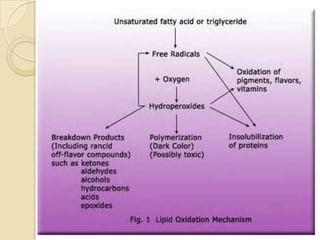
lipid per oxidation:

   Lipid     per    oxidation      refers      to    the
    oxidative degradation of lipids. It is the process in
    which free radicals "steal" electrons from the
    lipids in cell membranes are formed resulting in
    cell damage.
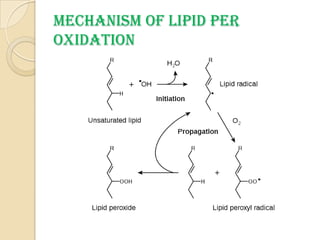
Mechanism of lipid per
oxidation
PROCESS INVOLVED IN THE MECHANISM OF
LIPID PER OXIDATION

     Initiation: Initiation is the step in which a fatty
      acid radical is produced. The most notable
      initiators in living cells are reactive oxygen
      species(ROS), such as OH· and HO2, which
      combines with a hydrogen atom to make water
      and a fatty acid radical.

     Propagation: The fatty acid radical is not a very
      stable molecule, so it reacts readily with
      molecular oxygen, thereby creating a peroxyl fatty
      acid radical. This too is an unstable species that
      reacts with another free fatty acid, producing a
      different fatty acid radical and a lipid peroxide.
   Termination: When a radical reacts with a
    non-radical, it always produces another radical,
    which is why the process is called a "chain
    reaction mechanism." The radical reaction stops
    when two radicals react and produce a non-
    radical species. Living organisms have evolved
    different molecules that speed up termination by
    catching free radicals and, therefore, protecting
    the     cell    membrane.      One     important
    such antioxidant is vitamin E. Other anti-
    oxidants made within the body include the
    enzymes superoxide dismutase, catalase,
    and peroxidase.
EFFECTS OF LIPID PER OXIDATION:
    Flavour Quality Loss:
         Rancid flavour
         Changes of colour and texture
         Consumer Acceptance
         Economic loss
    Nutritional Quality Loss:
       Essential Fatty Acids
       Vitamins
    Health Risks:
       Toxic Compounds
       Growth Retardation
       Heart Diseases
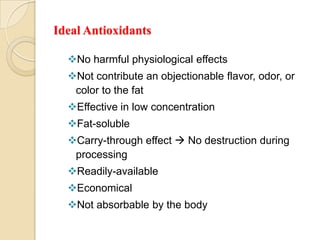
Ideal Antioxidants

  No harmful physiological effects
  Not contribute an objectionable flavor, odor, or
   color to the fat
  Effective in low concentration
  Fat-soluble
  Carry-through effect  No destruction during
   processing
  Readily-available
  Economical
  Not absorbable by the body
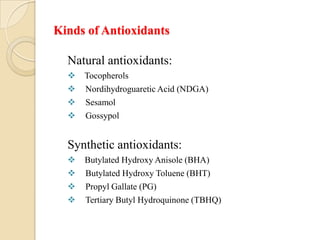
Kinds of Antioxidants

  Natural antioxidants:
     Tocopherols
     Nordihydroguaretic Acid (NDGA)
     Sesamol
     Gossypol


  Synthetic antioxidants:
     Butylated Hydroxy Anisole (BHA)
     Butylated Hydroxy Toluene (BHT)
     Propyl Gallate (PG)
     Tertiary Butyl Hydroquinone (TBHQ)
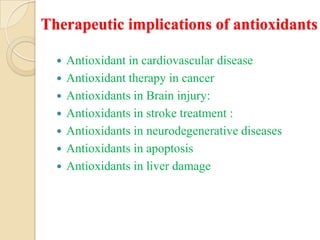
Therapeutic implications of antioxidants

     Antioxidant in cardiovascular disease
     Antioxidant therapy in cancer
     Antioxidants in Brain injury:
     Antioxidants in stroke treatment :
     Antioxidants in neurodegenerative diseases
     Antioxidants in apoptosis
     Antioxidants in liver damage
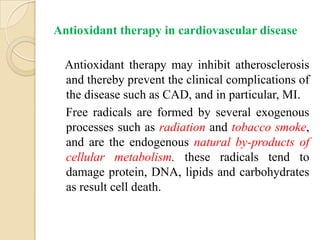
Antioxidant therapy in cardiovascular disease

  Antioxidant therapy may inhibit atherosclerosis
  and thereby prevent the clinical complications of
  the disease such as CAD, and in particular, MI.
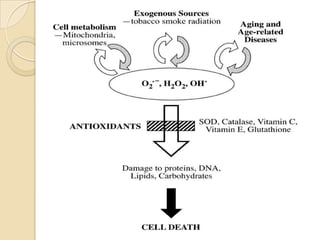
  Free radicals are formed by several exogenous
  processes such as radiation and tobacco smoke,
  and are the endogenous natural by-products of
  cellular metabolism. these radicals tend to
  damage protein, DNA, lipids and carbohydrates
  as result cell death.
Antioxidant therapy in cancer

The following is a list of common antioxidants
  used in cancer programs.
 Beta carotene
 Vitamin C
 Vitamin E
 Selenium
 Lipoic acid
 Poly MVA
Beta carotene
Beta-carotene is a form of vitamin A. Vitamin A
is a strong immune booster. It stimulates the
activity of immune cells against tumor cells. Has
been shown to inhibit the promotion of caner,
while beta carotene (precursor to vitamin A)
inhibits the initiation of cancer. Beta-carotene
can decrease the amount of damage free radicals
do to a cell's DNA. Such DNA damage is
thought to be one mechanism that causes cancer,
and indeed, some early studies suggested that
beta-carotene might reduce the risk of cancer.
Vitamin C
It is known that vitamin C acts as an antioxidant
and free radical scavenger that reacts directly with
super oxide, hydroxyl radicals, and singlet oxygen
produced during normal cellular metabolism.
Oxygen is necessary for life. Oxygen also comes
in several radical forms that have been implicated
in both initiation and post initiation stages of the
carcinogenic process as well as in invasion and
metastatic processes. Aside from its antioxidant
properties, there is no single universal accepted
and proven explanation for vitamin C's cancer
fighting properties.
Vitamin E
    Vitamin E is an important fat-soluble
    antioxidant, vitamin E's preventive role in
    cancer has been well proven.
   Highly malignant melanoma cell in vitro has been
    shown to be converted into differentiated (normal) cell
    after 3 days of exposure to Vitamin E succinate.
   Ovarian and cervical cancer - vitamin E slow downs the
    mitotic activity of cancer cell but normal cell don't get
    affected.
   Glioma tumor cells (present in the brain) are also more
    effective attacked by vitamin E succinate, probably
    because of its better penetration of blood bran barrier.
   Vitamin E succinate enhances radiation in cancer cell
    and protects the normal cell.
Selenium
 It is a powerful antioxidant with a central role in
  the protection of tissues from the damaging
  effects of oxygen free radicals. The use of
  selenium compounds as a cancer treatment
  predates most conventional treatments currently
  in use.
 200 mcg of selenium a day has been shown to
  reduce cancer death by 50% and prostate cancer
  by 62% after 4 years. Cancer patients are often
  found to be deficient in selenium. Selenium
  works synergistically with vitamin E.
Lipoic acid
It is called the universal antioxidant for its
ability to dissolve well in water and in fat
environment, Lipoic acid increase the
effectiveness or potency in other antioxidants. It
can cross the blood brain barrier while others
cannot .One of the most beneficial effects of
alpha Lipoic acid is its ability to regenerate
other essential antioxidants such as vitamins C
and E, coenzyme, and glutathione.
Poly MVA
 This is an alpha Lipoic acid complex with
  palladium. It is a non-toxic polynucleotide
  reductase named POLYDOX (USA trials),
  Poly-MVA (Canada and Mexico) or LAPd by
  some researchers.
 The element platinum is very lethal to cancer
  cells, but also very toxic to humans.
 It's close relative: palladium, however, is
  nontoxic in its present form.
 The MVA stands for minerals, vitamins, and
  amino acids. LAPd stands for Lipoic
  acid/Palladium complex.
Antioxidants in Brain injury:
  Antioxidants     are      commonly      used
 as medications to treat various forms of brain
 injury. Here, superoxide dismutase mimetics,
 sodium thiopental and propofol are used to
 treat reperfusion injury and traumatic brain
 injury.

Antioxidants in stroke treatment :
 Experimental drug NXY-059 and ebselen are
 being applied in the treatment of stroke.
Antioxidants in neurodegenerative diseases

  Antioxidants are also being investigated as
  possible treatments for neurodegenerative
  diseases such as Alzheimer's disease ,
  Parkinson's disease, and amyotrophic
  lateral sclerosis.
Others:
   These compounds appear to prevent
    oxidative stress in neurons and prevent
    apoptosis and neurological damage.

   They may prevent damage to the liver
    caused by excessive alcohol.
Submitted By:

            Manish Kumar
            M.Pharm
            Pharmacology
            Mangalayatan
            university


Thank you

Antioxidants and their therapeutic implications

  • 1.
    Antioxidants and theirtherapeutic implications Although oxygen is essential for life, excess oxygen can have harmful effects. When oxygen is metabolised by the body it creates substances called free radicals which cause damage to our cells. Free radicals can also be created by exposure to pollution, cigarette smoke and fatty foods.
  • 2.
    Excessive amounts offree radicals are thought to be related to the development of conditions such as:-  Heart and liver disease  Some cancers,  Arthritis,  Accelerated ageing  Eyesight deterioration.
  • 3.
    The body has its own natural defences against free radicals, but these systems can sometimes be overwhelmed.  Antioxidants are naturally occurring nutrients in food or chemical compounds which help destroy free radicals and minimise damage to our cells. they can delay the start or slow the rate of lipid per oxidation reaction in food systems.
  • 4.
    SOURCES OF ANTIOXIDANTS  VITAMIN-E  VITAMIN-C  BETA-CAROTENE  SELENIUM  PHYTONUTRIENTS
  • 5.
    Vitamin E Itis one of the strongest antioxidants, and can be found in nuts, oils, green vegetable and wholegrain. It helps prevent disease by destroying free radicals and protecting DNA in cells from damage.
  • 6.
    Vitamin C Ithas a dual role, in that it helps the body absorb vitamin E and protects it from harm. Citrus fruits and vegetables are the best food sources of vitamin C. Smokers in particular should ensure they get enough vitamin C, as it helps fight toxins and free radicals from cigarette smoke.
  • 7.
    Beta-carotene It isconverted by the body into vitamin A. It benefits skin and hair, helps maintain strong bones and protects against eye problems. Beta-carotene is found mainly in red- and orange-coloured fruits and vegetable.
  • 8.
    Selenium It isthe main mineral antioxidant. It is involved in the production of powerful enzymes which ‘mop up’ free radicals and deactivate them. Selenium is found in brazil nuts, seafood and red meat.
  • 9.
    Phytonutrients They arenaturally occurring plant chemicals which don’t have any nutritional value, but which have the ability to act as antioxidants. Different types of phytochemical occur in different foods: flavonoids are found in abundance in fruit, vegetables, dark chocolate and red wine (which should be consumed in moderation); tea and grapes are a good source of polyphenols; allium sulphur compounds are found in onions, leeks and garlic.
  • 10.
    lipid per oxidation:  Lipid per oxidation refers to the oxidative degradation of lipids. It is the process in which free radicals "steal" electrons from the lipids in cell membranes are formed resulting in cell damage.
  • 11.
    Mechanism of lipidper oxidation
  • 13.
    PROCESS INVOLVED INTHE MECHANISM OF LIPID PER OXIDATION  Initiation: Initiation is the step in which a fatty acid radical is produced. The most notable initiators in living cells are reactive oxygen species(ROS), such as OH· and HO2, which combines with a hydrogen atom to make water and a fatty acid radical.  Propagation: The fatty acid radical is not a very stable molecule, so it reacts readily with molecular oxygen, thereby creating a peroxyl fatty acid radical. This too is an unstable species that reacts with another free fatty acid, producing a different fatty acid radical and a lipid peroxide.
  • 14.
    Termination: When a radical reacts with a non-radical, it always produces another radical, which is why the process is called a "chain reaction mechanism." The radical reaction stops when two radicals react and produce a non- radical species. Living organisms have evolved different molecules that speed up termination by catching free radicals and, therefore, protecting the cell membrane. One important such antioxidant is vitamin E. Other anti- oxidants made within the body include the enzymes superoxide dismutase, catalase, and peroxidase.
  • 15.
    EFFECTS OF LIPIDPER OXIDATION:  Flavour Quality Loss:  Rancid flavour  Changes of colour and texture  Consumer Acceptance  Economic loss  Nutritional Quality Loss:  Essential Fatty Acids  Vitamins  Health Risks:  Toxic Compounds  Growth Retardation  Heart Diseases
  • 16.
    Ideal Antioxidants No harmful physiological effects Not contribute an objectionable flavor, odor, or color to the fat Effective in low concentration Fat-soluble Carry-through effect  No destruction during processing Readily-available Economical Not absorbable by the body
  • 17.
    Kinds of Antioxidants Natural antioxidants:  Tocopherols  Nordihydroguaretic Acid (NDGA)  Sesamol  Gossypol Synthetic antioxidants:  Butylated Hydroxy Anisole (BHA)  Butylated Hydroxy Toluene (BHT)  Propyl Gallate (PG)  Tertiary Butyl Hydroquinone (TBHQ)
  • 18.
    Therapeutic implications ofantioxidants  Antioxidant in cardiovascular disease  Antioxidant therapy in cancer  Antioxidants in Brain injury:  Antioxidants in stroke treatment :  Antioxidants in neurodegenerative diseases  Antioxidants in apoptosis  Antioxidants in liver damage
  • 19.
    Antioxidant therapy incardiovascular disease Antioxidant therapy may inhibit atherosclerosis and thereby prevent the clinical complications of the disease such as CAD, and in particular, MI. Free radicals are formed by several exogenous processes such as radiation and tobacco smoke, and are the endogenous natural by-products of cellular metabolism. these radicals tend to damage protein, DNA, lipids and carbohydrates as result cell death.
  • 21.
    Antioxidant therapy incancer The following is a list of common antioxidants used in cancer programs.  Beta carotene  Vitamin C  Vitamin E  Selenium  Lipoic acid  Poly MVA
  • 22.
    Beta carotene Beta-carotene isa form of vitamin A. Vitamin A is a strong immune booster. It stimulates the activity of immune cells against tumor cells. Has been shown to inhibit the promotion of caner, while beta carotene (precursor to vitamin A) inhibits the initiation of cancer. Beta-carotene can decrease the amount of damage free radicals do to a cell's DNA. Such DNA damage is thought to be one mechanism that causes cancer, and indeed, some early studies suggested that beta-carotene might reduce the risk of cancer.
  • 23.
    Vitamin C It isknown that vitamin C acts as an antioxidant and free radical scavenger that reacts directly with super oxide, hydroxyl radicals, and singlet oxygen produced during normal cellular metabolism. Oxygen is necessary for life. Oxygen also comes in several radical forms that have been implicated in both initiation and post initiation stages of the carcinogenic process as well as in invasion and metastatic processes. Aside from its antioxidant properties, there is no single universal accepted and proven explanation for vitamin C's cancer fighting properties.
  • 24.
    Vitamin E Vitamin E is an important fat-soluble antioxidant, vitamin E's preventive role in cancer has been well proven.  Highly malignant melanoma cell in vitro has been shown to be converted into differentiated (normal) cell after 3 days of exposure to Vitamin E succinate.  Ovarian and cervical cancer - vitamin E slow downs the mitotic activity of cancer cell but normal cell don't get affected.  Glioma tumor cells (present in the brain) are also more effective attacked by vitamin E succinate, probably because of its better penetration of blood bran barrier.  Vitamin E succinate enhances radiation in cancer cell and protects the normal cell.
  • 25.
    Selenium  It isa powerful antioxidant with a central role in the protection of tissues from the damaging effects of oxygen free radicals. The use of selenium compounds as a cancer treatment predates most conventional treatments currently in use.  200 mcg of selenium a day has been shown to reduce cancer death by 50% and prostate cancer by 62% after 4 years. Cancer patients are often found to be deficient in selenium. Selenium works synergistically with vitamin E.
  • 26.
    Lipoic acid It iscalled the universal antioxidant for its ability to dissolve well in water and in fat environment, Lipoic acid increase the effectiveness or potency in other antioxidants. It can cross the blood brain barrier while others cannot .One of the most beneficial effects of alpha Lipoic acid is its ability to regenerate other essential antioxidants such as vitamins C and E, coenzyme, and glutathione.
  • 27.
    Poly MVA  Thisis an alpha Lipoic acid complex with palladium. It is a non-toxic polynucleotide reductase named POLYDOX (USA trials), Poly-MVA (Canada and Mexico) or LAPd by some researchers.  The element platinum is very lethal to cancer cells, but also very toxic to humans.  It's close relative: palladium, however, is nontoxic in its present form.  The MVA stands for minerals, vitamins, and amino acids. LAPd stands for Lipoic acid/Palladium complex.
  • 28.
    Antioxidants in Braininjury: Antioxidants are commonly used as medications to treat various forms of brain injury. Here, superoxide dismutase mimetics, sodium thiopental and propofol are used to treat reperfusion injury and traumatic brain injury. Antioxidants in stroke treatment : Experimental drug NXY-059 and ebselen are being applied in the treatment of stroke.
  • 29.
    Antioxidants in neurodegenerativediseases Antioxidants are also being investigated as possible treatments for neurodegenerative diseases such as Alzheimer's disease , Parkinson's disease, and amyotrophic lateral sclerosis.
  • 30.
    Others:  These compounds appear to prevent oxidative stress in neurons and prevent apoptosis and neurological damage.  They may prevent damage to the liver caused by excessive alcohol.
  • 31.
    Submitted By: Manish Kumar M.Pharm Pharmacology Mangalayatan university Thank you