Expenden L-C 1500 mg
Expenden L.C 1500 mg
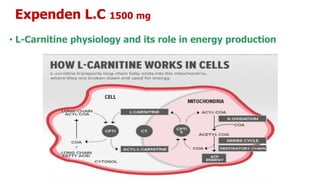
• L-Carnitine physiology and its role in energy production
L-carnitine
• L-carnitine is an amino acid (a building block for proteins) that is naturally
produced in the body.
• categorized as an amino acid, L-carnitine isn't technically an amino. It is
considered a "vitamin-like" and "amino acid-like" compound that is
related to the B vitamins.
• Its name is derived from the Latin carnus or flesh, as the compound was
isolated from meat.
L-carnitine
• Carnitine plays a critical role in energy production.
• It transports long-chain fatty acids into the mitochondria so they can be
oxidized ("burned") to produce energy.
• It also transports the toxic compounds generated out of this cellular
organelle to prevent their accumulation.
• Given these key functions, carnitine is concentrated in tissues like skeletal
and cardiac muscle that utilize fatty acids as a dietary fuel.
L-carnitine
• In the body, L-carnitine is formed in the liver and kidneys from the
amino acids lysine and methionine.
• However, it is stored elsewhere, primarily in muscle (including the
heart), the brain, and even in sperm. In the diet, it mainly comes
from meat and other animal products. You can get some from plant
products like avocado and soybeans, but as a rule, meat is the best
source—and the redder the better...
L-carnitine
• The body makes sufficient Carnitine to meet the needs of most people.
• For genetic or medical reasons, some individuals (such as preterm
infants), cannot make enough, so for them Carnitine is a conditionally
essential nutrient.
• Most (54–86%) dietary Carnitine is absorbed in the small intestine and
enters the bloodstream..
L-carnitine
• The kidneys efficiently conserve carnitine, so even carnitine-poor
diets have little impact on the body's total carnitine content .
• Rather than being metabolized, excess carnitine is excreted in the
urine as needed via the kidneys to maintain stable blood
concentrations.
Carnitine deficiency
Primary Carnitine deficiency is a genetic disorder of the cellular
Carnitine transporter system that usually manifests itself by five years
of age with symptoms of cardiomyopathy, skeletal-muscle weakness,
and hypoglycemia.
Carnitine deficiency
Secondary Carnitine deficiencies may occur due to certain
disorders (such as chronic renal failure) or under particular conditions
(e.g., use of certain antibiotics) that reduce Carnitine absorption or
increase its excretion .
There is scientific agreement on carnitine's value as a prescription
product for treating such deficiencies.
L-carnitine
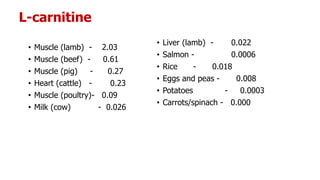
• Muscle (lamb) - 2.03
• Muscle (beef) - 0.61
• Muscle (pig) - 0.27
• Heart (cattle) - 0.23
• Muscle (poultry)- 0.09
• Milk (cow) - 0.026
• Liver (lamb) - 0.022
• Salmon - 0.0006
• Rice - 0.018
• Eggs and peas - 0.008
• Potatoes - 0.0003
• Carrots/spinach - 0.000
L-Carnitine indicated in:-
Male infertility
Aging
Physical performance
End-stage renal disease
Type 2 diabetes
Cancer
Cardiovascular and peripheral arterial disease
Product Knowledge
Expenden L-C 1500 mg
Roles of L-Carnitine in the body
• Convert fat into energy.
• Helps manage weight loss in dogs and cats.
• Cardio-vascular system
• Heart energy comes mostly from fat and L-Carnitine
• Antioxidant support
• Serves as an antioxidant
• Cognitive function
• cerebral absorption of Fat soluble vitamins; protect from oxidative decay
• Maintaining muscle integrity
• provide blood flow to smooth muscles
Expenden L-C 1500 mg
Aging
A decline in mitochondrial function is thought to contribute to the aging
process.
Carnitine may be involved because its concentration in tissues declines with
age and thereby reduces the integrity of the mitochondrial membrane .
Expenden L-C 1500 mg
In these studies, subjects took 1.5–3.0 grams/day of acetyl-L-carnitine for 3–
12 months.
Research in aged rats found supplementation with high doses of acetyl-L-
carnitine and alpha-lipoic acid (an antioxidant) to reduce mitochondrial
decay . The animals also moved about more and improved their
performance on memory-requiring tasks.
acetyl-L-carnitine improves mental function and reduces deterioration in
older adults with mild cognitive impairment and Alzheimer's disease .
Expenden L-C 1500 mg
Physical performance
Some athletes take Carnitine to improve performance.
at doses ranging from 2–6 grams/day administered for 1 to 28 days . (The
total body content of carnitine is about 20 grams in a man weighing 155
pounds, almost all of it in the skeletal muscle) For example, carnitine
supplements do not appear to increase the body's use of oxygen or improve
metabolic status when exercising, nor do they necessarily increase the
amount of carnitine in muscle .
Expenden L-C 1500 mg
L-Carnitine to be effective in case of:-
Muscles
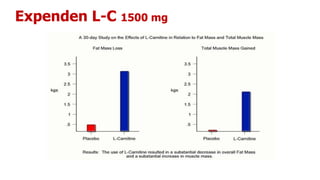
• Increases strength and endurance
• Relieves physical and mental fatigue
• Promotes and maintains new development of muscle mass
• Reduces muscle injuries and sore muscles
• Accelerates regeneration
Expenden L-C 1500 mg
Male infertility
The Carnitine content of seminal fluid is directly related to sperm count and motility ,
suggesting that the compound might be of value in treating male infertility.
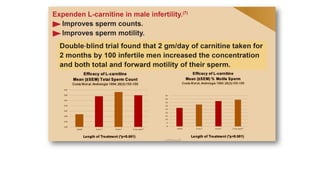
Several studies indicates that carnitine supplementation (2–3 grams/day for 3–4 months)
may improve sperm quality , and one randomized, double-blind crossover trial found that
2 grams/day of Carnitine taken for 2 months by 100 infertile men increased the
concentration and both total and forward motility of their sperm .
Expenden L-C 1500 mg
L-Carnitine to be effective in case of:-
Sperm
• Improves activity of sperm
• Enlarges amount and number of sperm
• Increases fertility of sperm
Expenden L-C 1500 mg
Cardiovascular and peripheral arterial disease
Several studies have examined the effectiveness of supplemental Carnitine in
the management of cardiac ischemia (restriction of blood flow to the heart)
and peripheral arterial disease (whose most important symptom is poor
circulation in the legs, known as intermittent claudication).
Because levels of Carnitine are low in the failing heart muscle, supplemental
amounts might counteract the toxic effects of free fatty acids and improve
carbohydrate metabolism.
Expenden L-C 1500 mg
Claudication results from an inadequate supply of oxygen-rich blood to the legs
and leads to an accumulation of acetylcarnitine in muscle due to its incomplete
utilization.
Patients with peripheral arterial disease who develop claudication have significant
impairments in exercise performance and have difficulty walking even short
distances at a slow speed.
Research indicates that Carnitine improves the performance of skeletal muscles in
the leg. .
Expenden L-C 1500 mg
Type 2 diabetes
Insulin resistance, which plays an important role in the development of type
2 diabetes, may be associated with a defect in fatty-acid oxidation in muscle .
Early research suggests that supplementation with L-carnitine intravenously
may improve insulin sensitivity in diabetics by decreasing fat levels in muscle
and may lower glucose levels in the blood by more promptly increasing its
oxidation in cells.
Expenden L-C 1500 mg
End-stage renal disease and hemodialysis
Carnitine homeostasis (balance within the body) among individuals with renal
diseases can be substantially impaired by several factors, particularly reduced
synthesis and increased elimination of the compound by the kidneys as well as
reduced intake from food due to poor appetite and consumption of fewer animal
products .
Many patients with end-stage renal disease, particularly those on hemodialysis,
become carnitine insufficient.
Expenden L-C 1500 mg
L-Carnitine to be effective in case of:-
Recovery from Surgeries
Experts recommend L-Carnitine for surgeries that may be accompanied by
blood loss because it promotes formation of red blood cells and strengthens
your immune system, aiding recovery.
Expenden L-C 1500 mg
L-Carnitine to be effective in case of:-
Brain Nerves
Slows aging of brain, dementia, Alzheimer's disease
Improves cognitive abilities like concentration, memory, and ability to learn
Accelerates renewal of tissue
l-carnitine Side Effects & Safety
• L-carnitine is LIKELY SAFE for most people when taken by mouth and when used as
an injection, with the approval of a healthcare provider. It can cause side effects
such as nausea, vomiting, stomach upset, heartburn, diarrhea, and seizures. It can
also cause the urine, breath, and sweat to have a "fishy" odor.
• Special Precautions & Warnings:
• Pregnancy and breast-feeding: There is not enough reliable information about the
safety of using L-carnitine if you are pregnant. Stay on the safe side and avoid use.
Taking L-carnitine is POSSIBLY SAFEin breast-feeding women when taken by mouth
in the amounts recommended. Small amounts of L-carnitine have been given to
infants in breast milk and formula with no reported side effects. The effects of
large amounts taken by a breast-feeding mother are unknown.
Children: L-carnitine is POSSIBLY SAFE when used appropriately by mouth or
intravenously (by IV), short-term.
Under-active thyroid (hypothyroidism): Taking L-carnitine might make symptoms
of hypothyroidism worse.
l-carnitine Interactions
• Moderate Interaction Be cautious with this combination
• Acenocoumarol (Sintrom) interacts with L-CARNITINE
Acenocoumarol (Sintrom) is used to slow blood clotting. L-carnitine might increase the
effectiveness of acenocoumarol (Sintrom). Increasing the effectiveness of acenocoumarol
(Sintrom) might slow blood clotting too much. The dose of your acenocoumarol (Sintrom)
might need to be changed.
• Thyroid hormone interacts with L-CARNITINE
L-carnitine seems to decrease how well thyroid hormone works in the body. Taking L-
carnitine with thyroid hormone might decrease the effectiveness of the thyroid hormone.
• Warfarin (Coumadin) interacts with L-CARNITINE
Warfarin (Coumadin) is used to slow blood clotting. L-carnitine might increase the effects
of warfarin (Coumadin) and increase the chances of bruising and bleeding. Be sure to have
your blood checked regularly. The dose of your warfarin (Coumadin) might need to be
changed.
Selling Points
• L-Carnitine the most effective ingredient that provide healthy Mitochondria.
• L-Carnitine improve general health conditions, brain nerves, liver function .
• L-Carnitine has potent pain relieving action against physical fatigue.
• L-Carnitine improve anti-oxidant capacity and activity against ROS.
• L-Carnitine decrease risk of developing type II diabetes.
• L-Carnitine Patient compliance with Palatable taste.
L-Carnitine 1500 mg
• Positioning:- for patient whom suffering from L-Carnitine deficiency that
cause fatigue, weakness, cell oxygen deficiency and men infertility.
Expenden L-Carnitine is the best suitable form for long term use of L-
Carnitine .
• Indications:-
Primary carnitine deficiency ,Secondary carnitine deficiency
Target Audience:-
-Gp/IM
-Andrology
-Cardiology
-Gynecology
-Neurology
-Hepatology
L-Carnitine dosage :
• BY MOUTH:
• For L-carnitine deficiencies in adults: 990 mg two to three times per day in tablets or as
an oral solution.
• For preventing side effects caused by valproic acid (Depacon, Depakene, Depakote, VPA):
50 to 100 mg/kg/day in three or four divided doses, to a maximum of 3 grams/day.
• For chest pain and congestive heart failure (CHF): 1 gram twice daily.
• Following heart attack: 2 to 6 grams daily.
• For symptoms of overactive thyroid: 1-2 grams twice daily.
• For male infertility: 2 grams of L-carnitine plus 1 gram of L-acetyl-carnitine daily.
L-Carnitine 1500 mg
Competitors
L-Carnitine 1500 mg
Composition: Each film coated
tablet contains:
L-Carnitine L-Tartrate 441.6
mg (equivalent to 300 mg L-
Carnitine
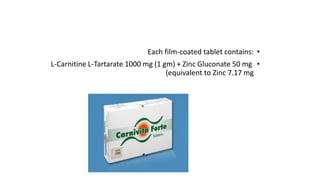
•Each film-coated tablet contains:
•L-Carnitine L-Tartarate 1000 mg (1 gm) + Zinc Gluconate 50 mg
(equivalent to Zinc 7.17 mg
L-Carnitine 1500 mg
* Composition: Each
capsule contains:
500 mg L-Carnitine
tartrate equivalent to
330 mg L-Carnitine.
L-Carnitine 1500 mg
Thank you
Dr Ahmad Ali
Infinity.ahmad1802@gmail.com

L-Carnitin Brochure

  • 1.
  • 2.
    Expenden L.C 1500mg • L-Carnitine physiology and its role in energy production
  • 3.
    L-carnitine • L-carnitine isan amino acid (a building block for proteins) that is naturally produced in the body. • categorized as an amino acid, L-carnitine isn't technically an amino. It is considered a "vitamin-like" and "amino acid-like" compound that is related to the B vitamins. • Its name is derived from the Latin carnus or flesh, as the compound was isolated from meat.
  • 4.
    L-carnitine • Carnitine playsa critical role in energy production. • It transports long-chain fatty acids into the mitochondria so they can be oxidized ("burned") to produce energy. • It also transports the toxic compounds generated out of this cellular organelle to prevent their accumulation. • Given these key functions, carnitine is concentrated in tissues like skeletal and cardiac muscle that utilize fatty acids as a dietary fuel.
  • 5.
    L-carnitine • In thebody, L-carnitine is formed in the liver and kidneys from the amino acids lysine and methionine. • However, it is stored elsewhere, primarily in muscle (including the heart), the brain, and even in sperm. In the diet, it mainly comes from meat and other animal products. You can get some from plant products like avocado and soybeans, but as a rule, meat is the best source—and the redder the better...
  • 6.
    L-carnitine • The bodymakes sufficient Carnitine to meet the needs of most people. • For genetic or medical reasons, some individuals (such as preterm infants), cannot make enough, so for them Carnitine is a conditionally essential nutrient. • Most (54–86%) dietary Carnitine is absorbed in the small intestine and enters the bloodstream..
  • 7.
    L-carnitine • The kidneysefficiently conserve carnitine, so even carnitine-poor diets have little impact on the body's total carnitine content . • Rather than being metabolized, excess carnitine is excreted in the urine as needed via the kidneys to maintain stable blood concentrations.
  • 8.
    Carnitine deficiency Primary Carnitinedeficiency is a genetic disorder of the cellular Carnitine transporter system that usually manifests itself by five years of age with symptoms of cardiomyopathy, skeletal-muscle weakness, and hypoglycemia.
  • 9.
    Carnitine deficiency Secondary Carnitinedeficiencies may occur due to certain disorders (such as chronic renal failure) or under particular conditions (e.g., use of certain antibiotics) that reduce Carnitine absorption or increase its excretion . There is scientific agreement on carnitine's value as a prescription product for treating such deficiencies.
  • 10.
    L-carnitine • Muscle (lamb)- 2.03 • Muscle (beef) - 0.61 • Muscle (pig) - 0.27 • Heart (cattle) - 0.23 • Muscle (poultry)- 0.09 • Milk (cow) - 0.026 • Liver (lamb) - 0.022 • Salmon - 0.0006 • Rice - 0.018 • Eggs and peas - 0.008 • Potatoes - 0.0003 • Carrots/spinach - 0.000
  • 11.
    L-Carnitine indicated in:- Maleinfertility Aging Physical performance End-stage renal disease Type 2 diabetes Cancer Cardiovascular and peripheral arterial disease
  • 12.
  • 13.
    Expenden L-C 1500mg Roles of L-Carnitine in the body • Convert fat into energy. • Helps manage weight loss in dogs and cats. • Cardio-vascular system • Heart energy comes mostly from fat and L-Carnitine • Antioxidant support • Serves as an antioxidant • Cognitive function • cerebral absorption of Fat soluble vitamins; protect from oxidative decay • Maintaining muscle integrity • provide blood flow to smooth muscles
  • 14.
    Expenden L-C 1500mg Aging A decline in mitochondrial function is thought to contribute to the aging process. Carnitine may be involved because its concentration in tissues declines with age and thereby reduces the integrity of the mitochondrial membrane .
  • 15.
    Expenden L-C 1500mg In these studies, subjects took 1.5–3.0 grams/day of acetyl-L-carnitine for 3– 12 months. Research in aged rats found supplementation with high doses of acetyl-L- carnitine and alpha-lipoic acid (an antioxidant) to reduce mitochondrial decay . The animals also moved about more and improved their performance on memory-requiring tasks. acetyl-L-carnitine improves mental function and reduces deterioration in older adults with mild cognitive impairment and Alzheimer's disease .
  • 16.
    Expenden L-C 1500mg Physical performance Some athletes take Carnitine to improve performance. at doses ranging from 2–6 grams/day administered for 1 to 28 days . (The total body content of carnitine is about 20 grams in a man weighing 155 pounds, almost all of it in the skeletal muscle) For example, carnitine supplements do not appear to increase the body's use of oxygen or improve metabolic status when exercising, nor do they necessarily increase the amount of carnitine in muscle .
  • 17.
    Expenden L-C 1500mg L-Carnitine to be effective in case of:- Muscles • Increases strength and endurance • Relieves physical and mental fatigue • Promotes and maintains new development of muscle mass • Reduces muscle injuries and sore muscles • Accelerates regeneration
  • 18.
  • 19.
    Expenden L-C 1500mg Male infertility The Carnitine content of seminal fluid is directly related to sperm count and motility , suggesting that the compound might be of value in treating male infertility. Several studies indicates that carnitine supplementation (2–3 grams/day for 3–4 months) may improve sperm quality , and one randomized, double-blind crossover trial found that 2 grams/day of Carnitine taken for 2 months by 100 infertile men increased the concentration and both total and forward motility of their sperm .
  • 20.
    Expenden L-C 1500mg L-Carnitine to be effective in case of:- Sperm • Improves activity of sperm • Enlarges amount and number of sperm • Increases fertility of sperm
  • 21.
    Expenden L-C 1500mg Cardiovascular and peripheral arterial disease Several studies have examined the effectiveness of supplemental Carnitine in the management of cardiac ischemia (restriction of blood flow to the heart) and peripheral arterial disease (whose most important symptom is poor circulation in the legs, known as intermittent claudication). Because levels of Carnitine are low in the failing heart muscle, supplemental amounts might counteract the toxic effects of free fatty acids and improve carbohydrate metabolism.
  • 22.
    Expenden L-C 1500mg Claudication results from an inadequate supply of oxygen-rich blood to the legs and leads to an accumulation of acetylcarnitine in muscle due to its incomplete utilization. Patients with peripheral arterial disease who develop claudication have significant impairments in exercise performance and have difficulty walking even short distances at a slow speed. Research indicates that Carnitine improves the performance of skeletal muscles in the leg. .
  • 23.
    Expenden L-C 1500mg Type 2 diabetes Insulin resistance, which plays an important role in the development of type 2 diabetes, may be associated with a defect in fatty-acid oxidation in muscle . Early research suggests that supplementation with L-carnitine intravenously may improve insulin sensitivity in diabetics by decreasing fat levels in muscle and may lower glucose levels in the blood by more promptly increasing its oxidation in cells.
  • 24.
    Expenden L-C 1500mg End-stage renal disease and hemodialysis Carnitine homeostasis (balance within the body) among individuals with renal diseases can be substantially impaired by several factors, particularly reduced synthesis and increased elimination of the compound by the kidneys as well as reduced intake from food due to poor appetite and consumption of fewer animal products . Many patients with end-stage renal disease, particularly those on hemodialysis, become carnitine insufficient.
  • 25.
    Expenden L-C 1500mg L-Carnitine to be effective in case of:- Recovery from Surgeries Experts recommend L-Carnitine for surgeries that may be accompanied by blood loss because it promotes formation of red blood cells and strengthens your immune system, aiding recovery.
  • 26.
    Expenden L-C 1500mg L-Carnitine to be effective in case of:- Brain Nerves Slows aging of brain, dementia, Alzheimer's disease Improves cognitive abilities like concentration, memory, and ability to learn Accelerates renewal of tissue
  • 34.
    l-carnitine Side Effects& Safety • L-carnitine is LIKELY SAFE for most people when taken by mouth and when used as an injection, with the approval of a healthcare provider. It can cause side effects such as nausea, vomiting, stomach upset, heartburn, diarrhea, and seizures. It can also cause the urine, breath, and sweat to have a "fishy" odor. • Special Precautions & Warnings: • Pregnancy and breast-feeding: There is not enough reliable information about the safety of using L-carnitine if you are pregnant. Stay on the safe side and avoid use. Taking L-carnitine is POSSIBLY SAFEin breast-feeding women when taken by mouth in the amounts recommended. Small amounts of L-carnitine have been given to infants in breast milk and formula with no reported side effects. The effects of large amounts taken by a breast-feeding mother are unknown. Children: L-carnitine is POSSIBLY SAFE when used appropriately by mouth or intravenously (by IV), short-term. Under-active thyroid (hypothyroidism): Taking L-carnitine might make symptoms of hypothyroidism worse.
  • 35.
    l-carnitine Interactions • ModerateInteraction Be cautious with this combination • Acenocoumarol (Sintrom) interacts with L-CARNITINE Acenocoumarol (Sintrom) is used to slow blood clotting. L-carnitine might increase the effectiveness of acenocoumarol (Sintrom). Increasing the effectiveness of acenocoumarol (Sintrom) might slow blood clotting too much. The dose of your acenocoumarol (Sintrom) might need to be changed. • Thyroid hormone interacts with L-CARNITINE L-carnitine seems to decrease how well thyroid hormone works in the body. Taking L- carnitine with thyroid hormone might decrease the effectiveness of the thyroid hormone. • Warfarin (Coumadin) interacts with L-CARNITINE Warfarin (Coumadin) is used to slow blood clotting. L-carnitine might increase the effects of warfarin (Coumadin) and increase the chances of bruising and bleeding. Be sure to have your blood checked regularly. The dose of your warfarin (Coumadin) might need to be changed.
  • 36.
    Selling Points • L-Carnitinethe most effective ingredient that provide healthy Mitochondria. • L-Carnitine improve general health conditions, brain nerves, liver function . • L-Carnitine has potent pain relieving action against physical fatigue. • L-Carnitine improve anti-oxidant capacity and activity against ROS. • L-Carnitine decrease risk of developing type II diabetes. • L-Carnitine Patient compliance with Palatable taste.
  • 37.
    L-Carnitine 1500 mg •Positioning:- for patient whom suffering from L-Carnitine deficiency that cause fatigue, weakness, cell oxygen deficiency and men infertility. Expenden L-Carnitine is the best suitable form for long term use of L- Carnitine . • Indications:- Primary carnitine deficiency ,Secondary carnitine deficiency
  • 38.
  • 39.
    L-Carnitine dosage : •BY MOUTH: • For L-carnitine deficiencies in adults: 990 mg two to three times per day in tablets or as an oral solution. • For preventing side effects caused by valproic acid (Depacon, Depakene, Depakote, VPA): 50 to 100 mg/kg/day in three or four divided doses, to a maximum of 3 grams/day. • For chest pain and congestive heart failure (CHF): 1 gram twice daily. • Following heart attack: 2 to 6 grams daily. • For symptoms of overactive thyroid: 1-2 grams twice daily. • For male infertility: 2 grams of L-carnitine plus 1 gram of L-acetyl-carnitine daily.
  • 40.
  • 41.
    L-Carnitine 1500 mg Composition:Each film coated tablet contains: L-Carnitine L-Tartrate 441.6 mg (equivalent to 300 mg L- Carnitine
  • 42.
    •Each film-coated tabletcontains: •L-Carnitine L-Tartarate 1000 mg (1 gm) + Zinc Gluconate 50 mg (equivalent to Zinc 7.17 mg
  • 43.
    L-Carnitine 1500 mg *Composition: Each capsule contains: 500 mg L-Carnitine tartrate equivalent to 330 mg L-Carnitine.
  • 44.
  • 45.
    Thank you Dr AhmadAli Infinity.ahmad1802@gmail.com