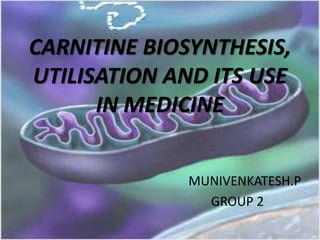
CARNITINE BIOSYNTHESIS,
UTILISATION AND ITS USE
IN MEDICINE
MUNIVENKATESH.P
GROUP 2
Carnitine
Carnitine is a quaternary ammonium
compound.
In living cells, it is required for the transport
of fatty acids from the cytosol into the
mitochondria during the breakdown
of lipids (fats) for the generation of metabolic
energy
 It is widely available as a nutritional
supplement
Carnitine was originally found as a growth
factor for mealworms and labelled
vitamin BT, although carnitine is not a
proper vitamin
Carnitine exists in two stereo isomers: Its
biologically active form is L-carnitine, whereas
its enantiomer, D-carnitine, is biologically
inactive
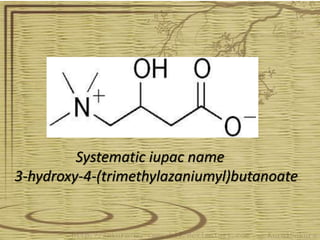
Systematic iupac name
3-hydroxy-4-(trimethylazaniumyl)butanoate
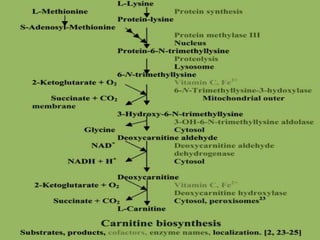
In animals, the biosynthesis of carnitine occurs
primarily in the liver and kidneys from the
amino acids lysine (via trimethyllysine) and
methionine
It is a method for the endogenous production
of L-carnitine, a molecule that is essential
for energy metabolism
Carnitine biosynthesis
Utilization of carnitine
Carnitine transports long-chain acyl groups
from fatty acids into the mitochondrial matrix,
so they can be broken down through β-
oxidation to acetyl CoA to obtain usable
energy via the citric acid cycle
Fatty acids must be activated before binding
to the carnitine molecule to form
'acylcarnitine'.
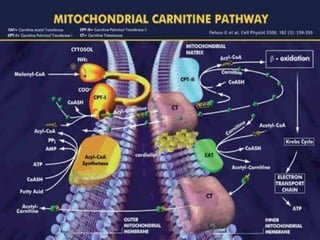
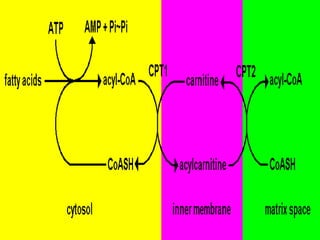
The free fatty acid in the cytosol is attached
with a thioester bond to coenzyme A (CoA).
This reaction is catalyzed by the enzyme fatty
acyl-CoA synthetase
The acyl group on CoA can now be transferred
to carnitine and the resulting acylcarnitine
transported into the mitochondrial matrix.
This occurs via a series of similar steps
• Acyl CoA is transferred to the hydroxyl group
of carnitine by carnitine acyltransferase
I (palmitoyltransferase) located on the outer
mitochondrial membrane
• Acylcarnitine is shuttled inside by a carnitine-
acylcarnitine translocase
• Acylcarnitine is converted to acyl CoA
by carnitine acyltransferase
II (palmitoyltransferase) located on the inner
mitochondrial membrane. The liberated
carnitine returns to the cytosol.
Uses of carnitine
Heart conditions
Kidney disease and dialysis
Effect in male infertility
As a weight loss supplement
As an antidote in valproic acid poisoning
To improve symptoms in moderate asthmatics
To improve fatigue resulting from ifosfamide
cancer chemotherapy
To treat symptoms of hyperthyroidism
Heart conditions
Carnitine is primarily used for heart-related conditions.
Several clinical trials show that L-carnitine and propionyl-
L-carnitine can be used along with conventional
treatment for angina to reduce medication needs and
improve the ability of those with angina to exercise
without chest pain. There are conflicting studies
concerning the use of carnitine after a heart attack. While
some studies suggest people taking L-carnitine may be
less likely to suffer a subsequent heart attack or
experience chest pain and abnormal heart rhythms, other
studies have not found similar benefits.
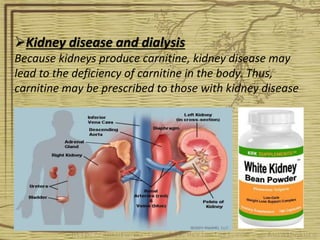
Kidney disease and dialysis
Because kidneys produce carnitine, kidney disease may
lead to the deficiency of carnitine in the body. Thus,
carnitine may be prescribed to those with kidney disease
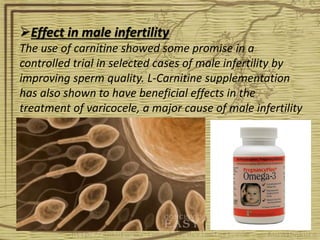
Effect in male infertility
The use of carnitine showed some promise in a
controlled trial in selected cases of male infertility by
improving sperm quality. L-Carnitine supplementation
has also shown to have beneficial effects in the
treatment of varicocele, a major cause of male infertility
As a weight loss supplement
There is no scientific evidence to show it improves weight
lose, still some studies show that, oral carnitine reduces
fat mass, increases muscle mass and reduces fatigue
All these effects indirectly lead to weight lose
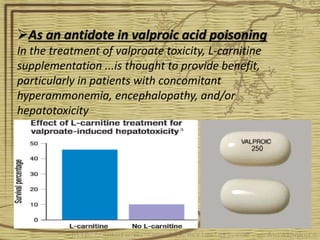
As an antidote in valproic acid poisoning
In the treatment of valproate toxicity, L-carnitine
supplementation ...is thought to provide benefit,
particularly in patients with concomitant
hyperammonemia, encephalopathy, and/or
hepatotoxicity
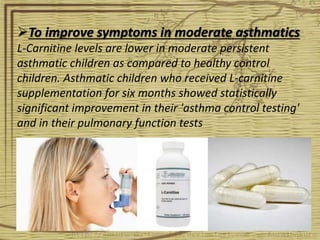
To improve symptoms in moderate asthmatics
L-Carnitine levels are lower in moderate persistent
asthmatic children as compared to healthy control
children. Asthmatic children who received L-carnitine
supplementation for six months showed statistically
significant improvement in their 'asthma control testing'
and in their pulmonary function tests
To improve fatigue resulting from ifosfamide
cancer chemotherapy
High doses of the chemotherapy agent ifosfamide, due to
its potential nephrotoxicity, may cause urinary loss of
carnitine. One study suggests, as it is essential for energy
production by mitochondria, L-carnitine may have a role
in reducing ifosfamide-associated fatigue
To treat symptoms of hyperthyroidism
L-Carnitine is a peripheral antagonist of thyroid hormone
action. It inhibits the entry of triiodothyronine and
thyroxine into the cell nuclei. In a randomized trial it was
shown that 2–4 g of oral L-carnitine per day could
reverse hyperthyroid symptoms even in the most serious
form of hyperthyroidism, thyroid storm. Since
hyperthyroidism impoverishes the tissue deposits of
carnitine, there is a rationale for using L-carnitine at
least in certain clinical settings. Incidentally, the fact that
carnitine failed to prevent relapses of hyperthyroidism
further supports the concept that carnitine action is in
the periphery and not in the thyroid gland.
Carnitine

Carnitine

  • 1.
    CARNITINE BIOSYNTHESIS, UTILISATION ANDITS USE IN MEDICINE MUNIVENKATESH.P GROUP 2
  • 2.
    Carnitine Carnitine is aquaternary ammonium compound. In living cells, it is required for the transport of fatty acids from the cytosol into the mitochondria during the breakdown of lipids (fats) for the generation of metabolic energy  It is widely available as a nutritional supplement
  • 3.
    Carnitine was originallyfound as a growth factor for mealworms and labelled vitamin BT, although carnitine is not a proper vitamin Carnitine exists in two stereo isomers: Its biologically active form is L-carnitine, whereas its enantiomer, D-carnitine, is biologically inactive
  • 4.
  • 5.
    In animals, thebiosynthesis of carnitine occurs primarily in the liver and kidneys from the amino acids lysine (via trimethyllysine) and methionine It is a method for the endogenous production of L-carnitine, a molecule that is essential for energy metabolism Carnitine biosynthesis
  • 7.
    Utilization of carnitine Carnitinetransports long-chain acyl groups from fatty acids into the mitochondrial matrix, so they can be broken down through β- oxidation to acetyl CoA to obtain usable energy via the citric acid cycle Fatty acids must be activated before binding to the carnitine molecule to form 'acylcarnitine'.
  • 9.
    The free fattyacid in the cytosol is attached with a thioester bond to coenzyme A (CoA). This reaction is catalyzed by the enzyme fatty acyl-CoA synthetase The acyl group on CoA can now be transferred to carnitine and the resulting acylcarnitine transported into the mitochondrial matrix. This occurs via a series of similar steps
  • 10.
    • Acyl CoAis transferred to the hydroxyl group of carnitine by carnitine acyltransferase I (palmitoyltransferase) located on the outer mitochondrial membrane • Acylcarnitine is shuttled inside by a carnitine- acylcarnitine translocase • Acylcarnitine is converted to acyl CoA by carnitine acyltransferase II (palmitoyltransferase) located on the inner mitochondrial membrane. The liberated carnitine returns to the cytosol.
  • 13.
    Uses of carnitine Heartconditions Kidney disease and dialysis Effect in male infertility As a weight loss supplement As an antidote in valproic acid poisoning To improve symptoms in moderate asthmatics To improve fatigue resulting from ifosfamide cancer chemotherapy To treat symptoms of hyperthyroidism
  • 14.
    Heart conditions Carnitine isprimarily used for heart-related conditions. Several clinical trials show that L-carnitine and propionyl- L-carnitine can be used along with conventional treatment for angina to reduce medication needs and improve the ability of those with angina to exercise without chest pain. There are conflicting studies concerning the use of carnitine after a heart attack. While some studies suggest people taking L-carnitine may be less likely to suffer a subsequent heart attack or experience chest pain and abnormal heart rhythms, other studies have not found similar benefits.
  • 15.
    Kidney disease anddialysis Because kidneys produce carnitine, kidney disease may lead to the deficiency of carnitine in the body. Thus, carnitine may be prescribed to those with kidney disease
  • 16.
    Effect in maleinfertility The use of carnitine showed some promise in a controlled trial in selected cases of male infertility by improving sperm quality. L-Carnitine supplementation has also shown to have beneficial effects in the treatment of varicocele, a major cause of male infertility
  • 17.
    As a weightloss supplement There is no scientific evidence to show it improves weight lose, still some studies show that, oral carnitine reduces fat mass, increases muscle mass and reduces fatigue All these effects indirectly lead to weight lose
  • 18.
    As an antidotein valproic acid poisoning In the treatment of valproate toxicity, L-carnitine supplementation ...is thought to provide benefit, particularly in patients with concomitant hyperammonemia, encephalopathy, and/or hepatotoxicity
  • 19.
    To improve symptomsin moderate asthmatics L-Carnitine levels are lower in moderate persistent asthmatic children as compared to healthy control children. Asthmatic children who received L-carnitine supplementation for six months showed statistically significant improvement in their 'asthma control testing' and in their pulmonary function tests
  • 20.
    To improve fatigueresulting from ifosfamide cancer chemotherapy High doses of the chemotherapy agent ifosfamide, due to its potential nephrotoxicity, may cause urinary loss of carnitine. One study suggests, as it is essential for energy production by mitochondria, L-carnitine may have a role in reducing ifosfamide-associated fatigue
  • 21.
    To treat symptomsof hyperthyroidism L-Carnitine is a peripheral antagonist of thyroid hormone action. It inhibits the entry of triiodothyronine and thyroxine into the cell nuclei. In a randomized trial it was shown that 2–4 g of oral L-carnitine per day could reverse hyperthyroid symptoms even in the most serious form of hyperthyroidism, thyroid storm. Since hyperthyroidism impoverishes the tissue deposits of carnitine, there is a rationale for using L-carnitine at least in certain clinical settings. Incidentally, the fact that carnitine failed to prevent relapses of hyperthyroidism further supports the concept that carnitine action is in the periphery and not in the thyroid gland.

Editor's Notes

  • #12 Carnitine acyltransferase I undergoes allosteric inhibition as a result of malonyl-CoA, an intermediate in fatty acid biosynthesis, to prevent futile cycling between β-oxidation and fatty acid synthesis.