FERMENTED VEGETABLES
PRATHAMESH KUDALKAR
13FET1011
FERMENTED VEGETABLES
 Vegetable fermentation originated in the early years of human civilization and, even
now, is widely used by many cultures.
 Almost all vegetables can be fermented through natural processes because they
harbor many types of lactic acid bacteria.
 Worldwide, most of the vegetable fermentation is done domestically.
 The fermentation process for vegetables can result in nutritious foods that may be
stored for extended periods, 1 year or more, without refrigeration.
 Examples of some fermented products and vegetables used currently for
fermentation are sauerkraut and kimchi,(from cabbage), olives, cucumbers, carrots,
celery, beans, peas, corn, okra, tomatoes, cauliflower, peppers, onions, citron, beets,
turnips, radishes, chard, Brussels sprouts, and their blends.
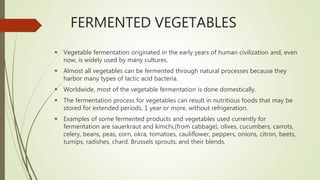
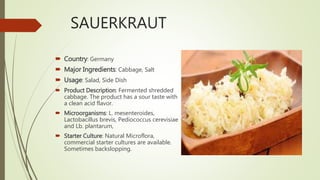
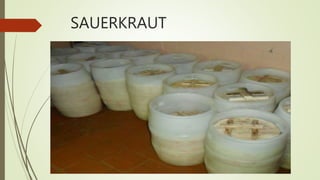
SAUERKRAUT
 Country: Germany
 Major Ingredients: Cabbage, Salt
 Usage: Salad, Side Dish
 Product Description: Fermented shredded
cabbage. The product has a sour taste with
a clean acid flavor.
 Microorganisms: L. mesenteroides,
Lactobacillus brevis, Pediococcus cerevisiae
and Lb. plantarum,
 Starter Culture: Natural Microflora,
commercial starter cultures are available.
Sometimes backslopping.
SAUERKRAUT
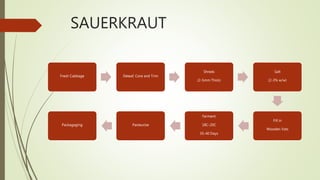
Fresh Cabbage Deleaf, Core and Trim
Shreds
(2-5mm Thick)
Salt
(2-3% w/w)
Fill in
Wooden Vats
Ferment
18C-20C
35-40 Days
PasteurizePackagaging
SAUERKRAUT
SAUERKRAUT
SAUERKRAUT
 Salting
 The level of salting is critical to obtaining a satisfactory product, it must be within the
range 2–3% w/w and is normally about 2.25%.
 Too little salt (<2%) and the product softens unacceptably, too much salt (>3%) and the
correct microbial sequence is not obtained.
 The salt serves a number of purposes:
 (i) it extracts moisture from the shredded cabbage by osmosis to form the brine in which
the fermentation will take place;
 (ii) it helps to inhibit some of the natural microflora of the cabbage such as
pseudomonads which would otherwise cause spoilage and helps to select for the lactic
acid bacteria;
 (iii) it helps maintain the crisp texture of the cabbage by withdrawing water and inhibiting
endogenous pectolytic enzymes which cause the product to soften;
 (iv) finally, salt contributes to the flavour of the product.
SAUERKRAUT
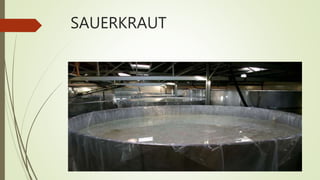
 Fermentation
 The starter for sauerkraut production is usually the normal mixed flora of cabbage.
 The raw material has a large number of undesirable organisms and a small
population of lactic acid bacteria (<1%)
 Among the lactic acid bacteria, most are Lactococcus spp. and Leuconostoc spp., and
a small fraction is Lactobacillus spp. and Pediococcus spp.
 During fermentation, sequential growth of these lactic acid bacteria occurs.
 The presence of 2.25% salt, large amounts of fermentable sugars (sucrose, hexoses,
pentoses), an absence of oxygen, and a low fermentation temperature facilitate
Leuconostoc spp., primarily Leu. mesenteroides, to grow rapidly
SAUERKRAUT
 Fermentation
 When the acidity has reached approximately 1% (as lactic acid), growth of Leu.
mesenteroides slows down.
 Then Lab. brevis starts growing rapidly until acid production reaches
approximately 1.5%.
 Then Ped. pentosaceus takes over and increases the acidity to approximately
1.8%.
 Finally, Lab. plantarum starts growing and brings the acid level to
approximately 2%.
SAUERKRAUT
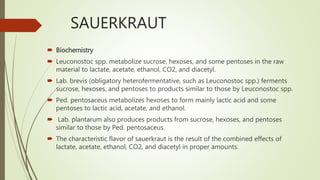
 Biochemistry
 Leuconostoc spp. metabolize sucrose, hexoses, and some pentoses in the raw
material to lactate, acetate, ethanol, CO2, and diacetyl.
 Lab. brevis (obligatory heterofermentative, such as Leuconostoc spp.) ferments
sucrose, hexoses, and pentoses to products similar to those by Leuconostoc spp.
 Ped. pentosaceus metabolizes hexoses to form mainly lactic acid and some
pentoses to lactic acid, acetate, and ethanol.
 Lab. plantarum also produces products from sucrose, hexoses, and pentoses
similar to those by Ped. pentosaceus.
 The characteristic flavor of sauerkraut is the result of the combined effects of
lactate, acetate, ethanol, CO2, and diacetyl in proper amounts.
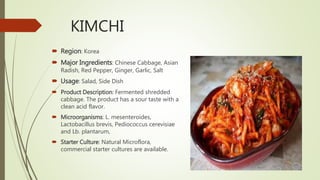
KIMCHI
 Region: Korea
 Major Ingredients: Chinese Cabbage, Asian
Radish, Red Pepper, Ginger, Garlic, Salt
 Usage: Salad, Side Dish
 Product Description: Fermented shredded
cabbage. The product has a sour taste with a
clean acid flavor.
 Microorganisms: L. mesenteroides,
Lactobacillus brevis, Pediococcus cerevisiae
and Lb. plantarum,
 Starter Culture: Natural Microflora,
commercial starter cultures are available.
KIMCHI
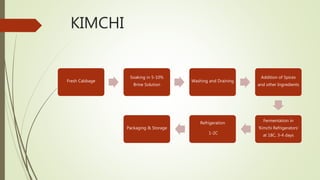
Fresh Cabbage
Soaking in 5-10%
Brine Solution
Washing and Draining
Addition of Spices
and other Ingredients
Fermentation in
‘Kimchi Refrigerators’
at 18C, 3-4 days
Refrigeration
1-2C
Packaging & Storage
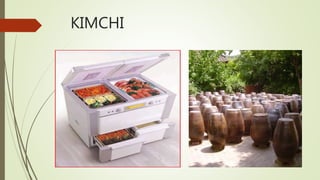
KIMCHI
KIMCHI
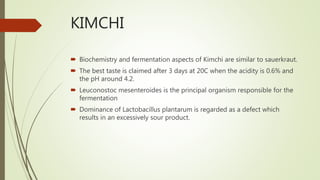
 Biochemistry and fermentation aspects of Kimchi are similar to sauerkraut.
 The best taste is claimed after 3 days at 20C when the acidity is 0.6% and
the pH around 4.2.
 Leuconostoc mesenteroides is the principal organism responsible for the
fermentation
 Dominance of Lactobacillus plantarum is regarded as a defect which
results in an excessively sour product.
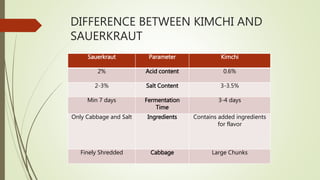
DIFFERENCE BETWEEN KIMCHI AND
SAUERKRAUT
Sauerkraut Parameter Kimchi
2% Acid content 0.6%
2-3% Salt Content 3-3.5%
Min 7 days Fermentation
Time
3-4 days
Only Cabbage and Salt Ingredients Contains added ingredients
for flavor
Finely Shredded Cabbage Large Chunks
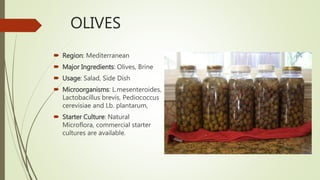
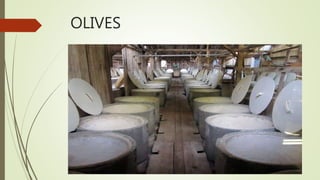
OLIVES
 Region: Mediterranean
 Major Ingredients: Olives, Brine
 Usage: Salad, Side Dish
 Microorganisms: L.mesenteroides,
Lactobacillus brevis, Pediococcus
cerevisiae and Lb. plantarum,
 Starter Culture: Natural
Microflora, commercial starter
cultures are available.
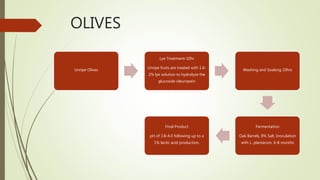
OLIVES
Unripe Olives
Lye Treatment-10hr
Unripe fruits are treated with 1.6-
2% lye solution to hydrolyze the
glucoside oleuropein
Washing and Soaking 10hrs
Fermentation
Oak Barrels, 8% Salt, Inoculation
with L. plantarum, 6-8 months
Final Product
pH of 3.8-4.0 following up to a
1% lactic acid production.
OLIVES
OLIVES
 Fermentation
 The initial pH of the fermentation can be above 7 depending on how much
washing was done after the NaOH treatment.
 As a consequence, the initial microflora during fermentation can include a
variety of gram-positive bacilli (Bacillus species) and gram-negative enteric
bacteria (Enterobacter, Citrobacter, Klebsiella, and Escherichia).
 As organic acids accumulate and the pH decreases below 6, the LAB,
principally Lb. plantarum, dominate the fermentation to the exclusion of the
other gram-positive and gram-negative microbes.
 Yeast species may also be present (Candida, Pichia, Saccharomyces, and others)
and contribute desirable flavor characteristics to the brined olives.
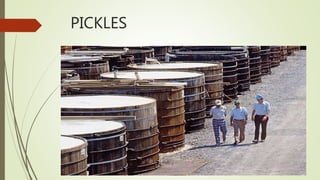
PICKLES
 Region: North America, Germany
 Major Ingredients: Cucumber, Spices,
Dill etc
 Usage: Salad, Side Dish
 Microorganisms: Lactobacillus brevis,
Pediococcus cerevisiae and Lb.
plantarum,
 Starter Culture: Natural Microflora,
commercial starter cultures are
available. Sometimes backslopping.
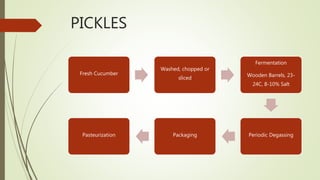
PICKLES
Fresh Cucumber
Washed, chopped or
sliced
Fermentation
Wooden Barrels, 23-
24C, 8-10% Salt
Periodic DegassingPackagingPasteurization
PICKLES
THANK YOU!