By: Dr. Mohit Kulmi
• Coenzyme Q10 is a member of the ubiquinone family 
of compounds. 
• All animals and humans, can synthesize ubiquinones. 
• The name ubiquinone refers to the ubiquitous 
presence of these compounds in living organisms and 
their chemical structure, which contains a functional 
group known as a benzoquinone.
• Coenzyme Q10 is also a micronutrient. 
• Coenzyme Q10 is soluble in lipids (fats) and is found 
in virtually all cell membranes, as well as lipoproteins. 
• The ability of the benzoquinone head group of 
Coenzyme Q10 to accept and donate electrons is a 
critical feature in its biochemical functions. 
• Reduced form can act as an antioxidant. Rich sources 
of dietary Coenzyme Q10 include mainly meat, 
poultry, and fish.
• Other relatively rich sources include soybean and 
canola oils, and nuts. 
• Fruits, vegetables, eggs, and dairy products are 
moderate sources of Coenzyme Q10 . 
• Coenzyme Q10 was first isolated from beef heart 
mitochondria by Dr. Frederick Crane in 1957. 
• The precise chemical structure of Coenzyme Q10 was 
determined by professor Karl Folkers and 
collaborators in 1958.
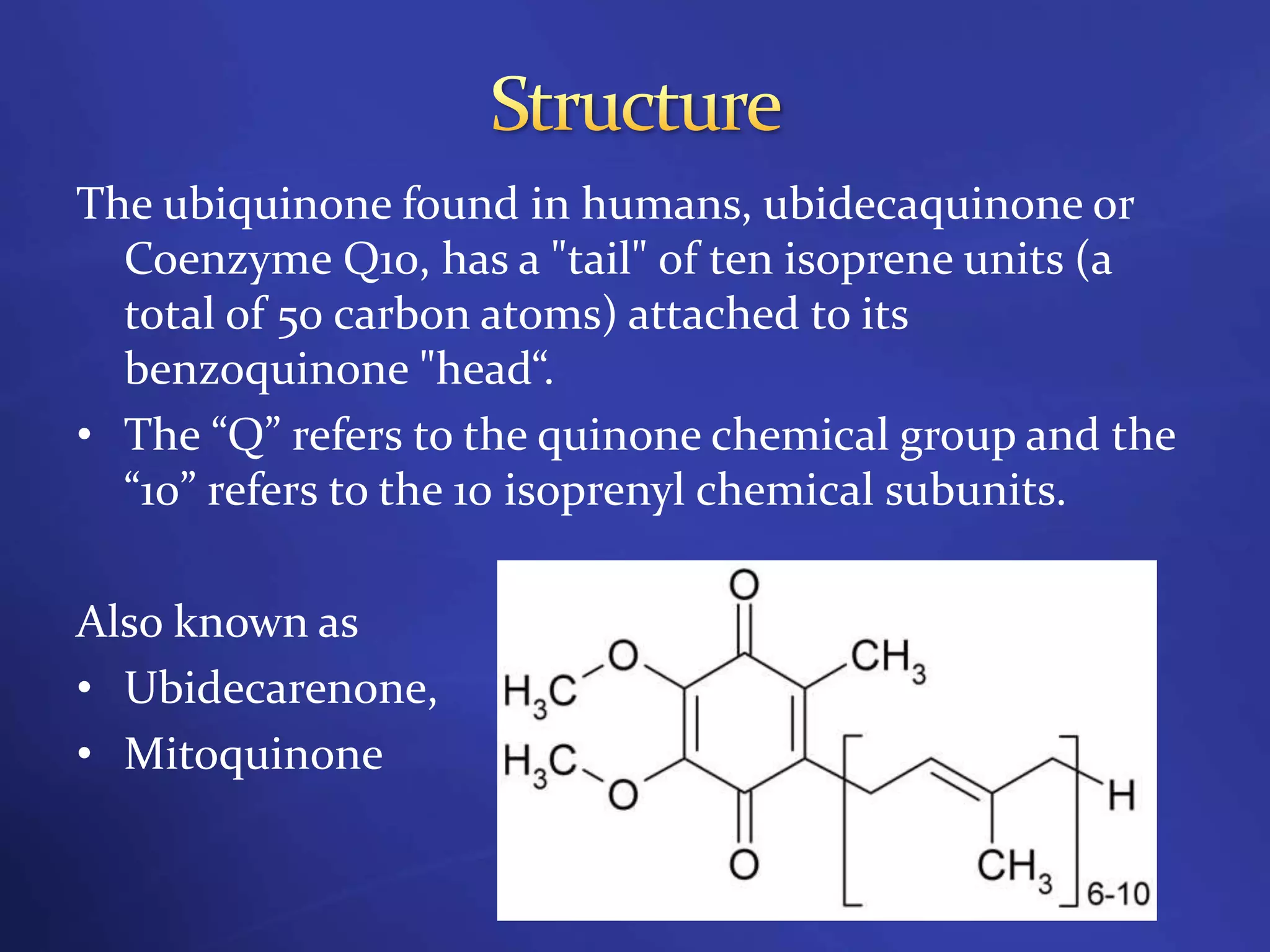
The ubiquinone found in humans, ubidecaquinone or 
Coenzyme Q10, has a "tail" of ten isoprene units (a 
total of 50 carbon atoms) attached to its 
benzoquinone "head“. 
• The “Q” refers to the quinone chemical group and the 
“10” refers to the 10 isoprenyl chemical subunits. 
Also known as 
• Ubidecarenone, 
• Mitoquinone
Coenzyme Q10 can exist 
in three states : 
1. The fully reduced 
ubiquinol form 
(Coenzyme Q10 H2) 
2. The radical 
semiquinone 
intermediate 
(Coenzyme Q10 H·), 
and 
3. The fully oxidized 
ubiquin one form 
(Coenzyme Q10 ).
• Coenzyme Q10 is synthesized intracellularly using 
tyrosine. This first step requires vitamin B6 as a 
cofactor. 
• Adequate vitamin B6 is essential for Coenzyme Q10 
biosynthesis. 
• Cells and tissues that are metabolically active have the 
highest Coenzyme Q10 requirements (such as the 
heart, immune system, and gingiva) and as such are 
most susceptible to Coenzyme Q10 deficiency.
• Within the cell, coenzyme Q-10 is mostly present in 
the mitochondria (inner membrane) (40-50%). 
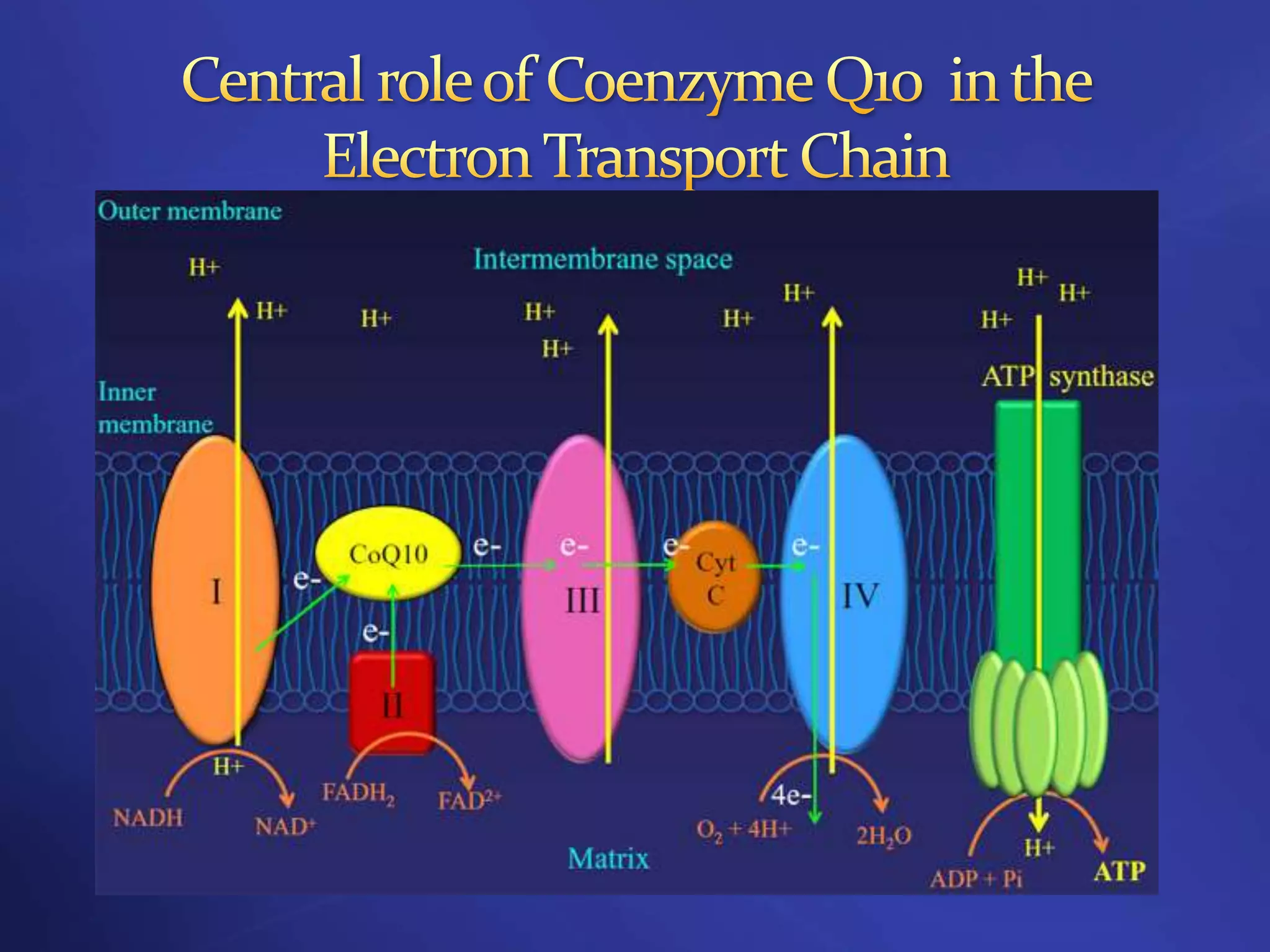
• The primary biochemical action of Coenzyme Q10 is 
as a cofactor in the electron-transport chain. 
• The conversion of energy from carbohydrates and fats 
to ATP, requires the presence of Coenzyme Q10 in the 
inner mitochondrial membrane. 
Coenzyme Q10 : 
• Accepts electrons from reducing equivalents and 
• transfers them to electron acceptors.
• As an antioxidant and its role in ATP generation, 
Coenzyme Q10 offers many therapeutic benefits. 
• Coenzyme Q10 has been shown to help preserve 
myocardial sodium-potassium ATPase activity and 
stabilize myocardial calcium dependent ion channels. 
• Since most cellular functions are dependent on an 
adequate supply of ATP, Coenzyme Q10 is essential for 
the health of virtually all human tissues and organs.
Lysosomal Function: 
• Transports protons across lysosomal membranes, 
• thus help to maintain the optimal pH for cellular 
recycling. 
Neutralize free-radicals: 
– an effective lipid-soluble antioxidant 
– continuously go through an oxidation-reduction 
state
• Regenerate α-tocopherol from the α-tocopheroxyl 
radical. 
• Interact with dihydrolipoic acid. 
– Dihydrolipoic acid reduces ubiquinone to 
ubiquinol. 
• Inhibit lipid peroxidation 
– Occurs when cell membranes and low-density 
lipoproteins (LDL) are oxidized.
Absorption: 
• Same process as that of lipids. 
• Absorption is lower on an empty stomach and higher 
with foods, with high lipid content. 
Distribution/Metabolism: 
• Partitioned into various lipoproteins, with peak blood 
levels occurring in 5 to 10 hours. 
• Total body pool of Coenzyme Q10 is approx. 0.5 – 1.5 
gms. 
 Able to enter the brain. 
Excretion: 
• Elimination occurs through the bile, Elimination half-life 
is 34 hours.
A Coenzyme Q10 deficiency could result from: 
1. Impaired Coenzyme Q10 synthesis due to 
nutritional deficiencies - such as vitamin B6 
deficiency. 
2. A genetic or acquired defect in Coenzyme Q10 
synthesis or utilization. 
3. Increased tissue needs resulting from a particular 
illness. 
4. Coenzyme Q10 levels decline with advancing age, 
and this decline might contribute in part to some of 
the manifestations of aging.
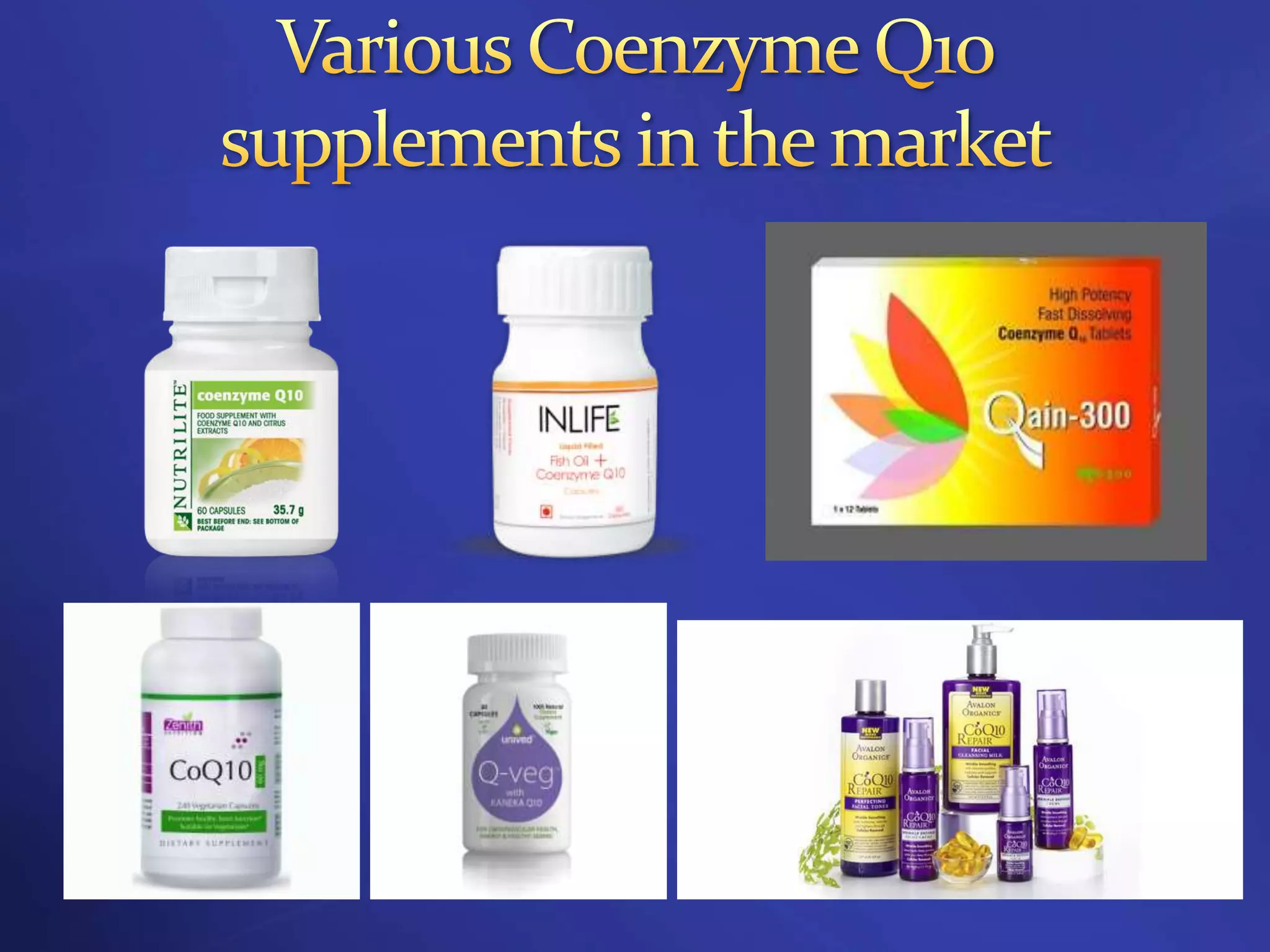
• Capsules, 
• Chewable Tablets, 
• Liquid softgel, 
• Tablets, 
• Can also be found in a number of skin products on the 
market .
Typical dose for most conditions is 60-200 mg daily in 
divided doses. 
Some have experienced gastrointestinal symptoms: 
• Nausea, 
• Diarrhea, 
• Appetite suppression, 
• Heartburn, and 
• Abdominal discomfort.
• There have been no reports of significant adverse side 
effects of oral Coenzyme Q10 supplementation at 
doses as high as 1,200 mg/day . 
• These adverse effects may be minimized if daily doses 
are divided into two or three doses. 
• Because controlled safety studies in pregnant and 
lactating women are not available, the use of 
Coenzyme Q10 supplements by pregnant or breast-feeding 
women should be avoided.
Warfarin: 
• Concomitant use of warfarin (Coumadin) and 
Coenzyme Q10 supplements has been reported to 
decrease the anticoagulant effect of warfarin. 
• If warfarin and Coenzyme Q10 are to be used 
concomitantly, blood tests to assess clotting time 
(prothrombin time; PT/INR) should be monitored 
frequently, especially in the first two weeks.
HMG-CoA reductase inhibitors (statins): 
• HMG-CoA reductase plays a critical role in the 
regulation of cholesterol synthesis as well as 
Coenzyme Q10 synthesis. 
• Use of simvastatin ,pravastatin, lovastatin , 
rosuvastatin and atorvastatin has been shown to 
decrease blood plasma levels of Coenzyme Q10 . 
• Supplementing with Coenzyme Q10 is highly 
recommended to prevent the myopathic side effects 
associated with the statin drugs.
• Beta blockers - propranolol metoprolol, 
• Phenothiazines and 
• Tricyclic antidepressants have been shown to inhibit 
Coenzyme Q10 -dependent enzymes.
Cardiovascular diseases: 
• Numerous studies have investigated the benefit of 
Coenzyme Q10 supplementation for improving 
cardiovascular function via – 
1. Enhanced energy production, 
2. Improved contractility of cardiac muscle, and its 
3. Potent antioxidant activity – particularly prevention 
of LDL oxidation.
• A number of small intervention trials and a 2006 
meta-analysis showed improvements in some cardiac 
functions with supplemental administration of 
Coenzyme Q10 in patients of CCF with significant, 
improvement in left ventricular ejection fraction 
along with conventional medical therapy. 
• Pretreatment with Coenzyme Q10 provided some 
benefit after CABG surgery . 
• Coenzyme Q10 supplementation showed improved 
exercise tolerance and reduced or delayed ECG 
changes associated with myocardial ischemia.
Hypertension: 
• Reduces blood levels of epinephrine and other 
catecholamines – reduction of B.P. and protect the 
vascular endothelium from free radical induced 
damage. 
Mitochondrial encephalomyopathies : 
• Coenzyme Q10 supplementation has resulted in 
clinical and metabolic improvement in some patients 
with various types of mitochondrial 
encephalomyopathies.
Cancer: 
• Individuals with lung, pancreas, breast cancer , 
cervical intraepithelial neoplasia and cervical cancer 
were more likely to have low plasma Coenzyme Q10 
levels. 
• Coenzyme Q10 supplementation may be beneficial as 
an adjunct to conventional therapy for breast cancer. 
• Coenzyme Q10 provides protection against 
cardiotoxicity and liver toxicity in patients receiving 
anthracycline chemotherapy drugs, doxorubicin.
Diabetes: 
• Serum Coenzyme Q10 levels in type 2 diabetic 
patients are often decreased and may be associated 
with diabetic cardiomyopathy, reversible by 
Coenzyme Q10 supplementation. 
• Coenzyme Q10 shown to improve HBA1c . 
Parkinson's disease : 
• Coenzyme Q10 supplementation was associated with 
slower deterioration of function in Parkinson's disease 
patients compared to placebo.
Muscular Dystrophy: 
• Deficiency of Coenzyme Q10 has been found in 
muscle mitochondria of humans with muscular 
dystrophy. 
• Coenzyme Q10 treatment resulted in significant 
improvements in cardiac output and stroke volume, as 
well as increased physical well being. 
Renal Failure: 
• Coenzyme Q10 therapy reduced serum creatinine and 
blood urea nitrogen (BUN) values and increased 
creatinine clearance and urinary output in patients 
with renal failure.
HIV/AIDS: 
• Because Coenzyme Q10 enhances phagocytic activity 
of macrophages and increases granulocyte 
proliferation, its supplementation may be of benefit in 
these patients. 
• Coenzyme Q10’s antioxidant activity may also help 
prevent AIDS-related diseases such as 
cardiomyopathy and lipodystrophy that can be caused 
by oxidative stress.
Other uses: 
• Peridontal diseases, 
• Radiation injuries, 
• Gastric ulcers, 
• Allergies, 
• Migraine, 
• Male infertility, 
• Useful for weight loss in obese peoples.
• Coenzyme Q10 is an essential element of food that can 
now be used medicinally to support the sick host in 
conditions where nutritional depletion and cellular 
dysfunction occur like cancer. 
• Roles for Coenzyme Q10 supplementation in 
cardiovascular diseases, neurodegenerative diseases, 
cancer, and diabetes require further research. 
• In keeping with the free radical theory of aging, these 
antioxidant properties of Coenzyme Q10 have clear 
implications in the slowing of aging and age related 
degenerative diseases.
• Coenzyme Q10 is lipid-soluble antioxidant that is 
synthesized in our bodies. 
• It functions as a cofactor for ATP synthesis. 
• It has antioxidants properties also. 
• Helps in the prevention of lipid peroxidation and the 
damage it causes. 
• Due to its antioxidant properties it has a promising 
role in the management of cardiovascular conditions, 
neurodegenerative diseases, diabetes, mitochondrial 
myopathies , HIV, Muscle dystrophies. 
• Still more research and data is needed to validate its 
definite beneficial effects in aforementioned 
conditions.
Coenzyme Q10 - Ubiquinone

Coenzyme Q10 - Ubiquinone

  • 1.
  • 2.
    • Coenzyme Q10is a member of the ubiquinone family of compounds. • All animals and humans, can synthesize ubiquinones. • The name ubiquinone refers to the ubiquitous presence of these compounds in living organisms and their chemical structure, which contains a functional group known as a benzoquinone.
  • 3.
    • Coenzyme Q10is also a micronutrient. • Coenzyme Q10 is soluble in lipids (fats) and is found in virtually all cell membranes, as well as lipoproteins. • The ability of the benzoquinone head group of Coenzyme Q10 to accept and donate electrons is a critical feature in its biochemical functions. • Reduced form can act as an antioxidant. Rich sources of dietary Coenzyme Q10 include mainly meat, poultry, and fish.
  • 4.
    • Other relativelyrich sources include soybean and canola oils, and nuts. • Fruits, vegetables, eggs, and dairy products are moderate sources of Coenzyme Q10 . • Coenzyme Q10 was first isolated from beef heart mitochondria by Dr. Frederick Crane in 1957. • The precise chemical structure of Coenzyme Q10 was determined by professor Karl Folkers and collaborators in 1958.
  • 5.
    The ubiquinone foundin humans, ubidecaquinone or Coenzyme Q10, has a "tail" of ten isoprene units (a total of 50 carbon atoms) attached to its benzoquinone "head“. • The “Q” refers to the quinone chemical group and the “10” refers to the 10 isoprenyl chemical subunits. Also known as • Ubidecarenone, • Mitoquinone
  • 6.
    Coenzyme Q10 canexist in three states : 1. The fully reduced ubiquinol form (Coenzyme Q10 H2) 2. The radical semiquinone intermediate (Coenzyme Q10 H·), and 3. The fully oxidized ubiquin one form (Coenzyme Q10 ).
  • 7.
    • Coenzyme Q10is synthesized intracellularly using tyrosine. This first step requires vitamin B6 as a cofactor. • Adequate vitamin B6 is essential for Coenzyme Q10 biosynthesis. • Cells and tissues that are metabolically active have the highest Coenzyme Q10 requirements (such as the heart, immune system, and gingiva) and as such are most susceptible to Coenzyme Q10 deficiency.
  • 8.
    • Within thecell, coenzyme Q-10 is mostly present in the mitochondria (inner membrane) (40-50%). • The primary biochemical action of Coenzyme Q10 is as a cofactor in the electron-transport chain. • The conversion of energy from carbohydrates and fats to ATP, requires the presence of Coenzyme Q10 in the inner mitochondrial membrane. Coenzyme Q10 : • Accepts electrons from reducing equivalents and • transfers them to electron acceptors.
  • 10.
    • As anantioxidant and its role in ATP generation, Coenzyme Q10 offers many therapeutic benefits. • Coenzyme Q10 has been shown to help preserve myocardial sodium-potassium ATPase activity and stabilize myocardial calcium dependent ion channels. • Since most cellular functions are dependent on an adequate supply of ATP, Coenzyme Q10 is essential for the health of virtually all human tissues and organs.
  • 11.
    Lysosomal Function: •Transports protons across lysosomal membranes, • thus help to maintain the optimal pH for cellular recycling. Neutralize free-radicals: – an effective lipid-soluble antioxidant – continuously go through an oxidation-reduction state
  • 12.
    • Regenerate α-tocopherolfrom the α-tocopheroxyl radical. • Interact with dihydrolipoic acid. – Dihydrolipoic acid reduces ubiquinone to ubiquinol. • Inhibit lipid peroxidation – Occurs when cell membranes and low-density lipoproteins (LDL) are oxidized.
  • 13.
    Absorption: • Sameprocess as that of lipids. • Absorption is lower on an empty stomach and higher with foods, with high lipid content. Distribution/Metabolism: • Partitioned into various lipoproteins, with peak blood levels occurring in 5 to 10 hours. • Total body pool of Coenzyme Q10 is approx. 0.5 – 1.5 gms.  Able to enter the brain. Excretion: • Elimination occurs through the bile, Elimination half-life is 34 hours.
  • 14.
    A Coenzyme Q10deficiency could result from: 1. Impaired Coenzyme Q10 synthesis due to nutritional deficiencies - such as vitamin B6 deficiency. 2. A genetic or acquired defect in Coenzyme Q10 synthesis or utilization. 3. Increased tissue needs resulting from a particular illness. 4. Coenzyme Q10 levels decline with advancing age, and this decline might contribute in part to some of the manifestations of aging.
  • 15.
    • Capsules, •Chewable Tablets, • Liquid softgel, • Tablets, • Can also be found in a number of skin products on the market .
  • 17.
    Typical dose formost conditions is 60-200 mg daily in divided doses. Some have experienced gastrointestinal symptoms: • Nausea, • Diarrhea, • Appetite suppression, • Heartburn, and • Abdominal discomfort.
  • 18.
    • There havebeen no reports of significant adverse side effects of oral Coenzyme Q10 supplementation at doses as high as 1,200 mg/day . • These adverse effects may be minimized if daily doses are divided into two or three doses. • Because controlled safety studies in pregnant and lactating women are not available, the use of Coenzyme Q10 supplements by pregnant or breast-feeding women should be avoided.
  • 19.
    Warfarin: • Concomitantuse of warfarin (Coumadin) and Coenzyme Q10 supplements has been reported to decrease the anticoagulant effect of warfarin. • If warfarin and Coenzyme Q10 are to be used concomitantly, blood tests to assess clotting time (prothrombin time; PT/INR) should be monitored frequently, especially in the first two weeks.
  • 20.
    HMG-CoA reductase inhibitors(statins): • HMG-CoA reductase plays a critical role in the regulation of cholesterol synthesis as well as Coenzyme Q10 synthesis. • Use of simvastatin ,pravastatin, lovastatin , rosuvastatin and atorvastatin has been shown to decrease blood plasma levels of Coenzyme Q10 . • Supplementing with Coenzyme Q10 is highly recommended to prevent the myopathic side effects associated with the statin drugs.
  • 21.
    • Beta blockers- propranolol metoprolol, • Phenothiazines and • Tricyclic antidepressants have been shown to inhibit Coenzyme Q10 -dependent enzymes.
  • 22.
    Cardiovascular diseases: •Numerous studies have investigated the benefit of Coenzyme Q10 supplementation for improving cardiovascular function via – 1. Enhanced energy production, 2. Improved contractility of cardiac muscle, and its 3. Potent antioxidant activity – particularly prevention of LDL oxidation.
  • 23.
    • A numberof small intervention trials and a 2006 meta-analysis showed improvements in some cardiac functions with supplemental administration of Coenzyme Q10 in patients of CCF with significant, improvement in left ventricular ejection fraction along with conventional medical therapy. • Pretreatment with Coenzyme Q10 provided some benefit after CABG surgery . • Coenzyme Q10 supplementation showed improved exercise tolerance and reduced or delayed ECG changes associated with myocardial ischemia.
  • 24.
    Hypertension: • Reducesblood levels of epinephrine and other catecholamines – reduction of B.P. and protect the vascular endothelium from free radical induced damage. Mitochondrial encephalomyopathies : • Coenzyme Q10 supplementation has resulted in clinical and metabolic improvement in some patients with various types of mitochondrial encephalomyopathies.
  • 25.
    Cancer: • Individualswith lung, pancreas, breast cancer , cervical intraepithelial neoplasia and cervical cancer were more likely to have low plasma Coenzyme Q10 levels. • Coenzyme Q10 supplementation may be beneficial as an adjunct to conventional therapy for breast cancer. • Coenzyme Q10 provides protection against cardiotoxicity and liver toxicity in patients receiving anthracycline chemotherapy drugs, doxorubicin.
  • 26.
    Diabetes: • SerumCoenzyme Q10 levels in type 2 diabetic patients are often decreased and may be associated with diabetic cardiomyopathy, reversible by Coenzyme Q10 supplementation. • Coenzyme Q10 shown to improve HBA1c . Parkinson's disease : • Coenzyme Q10 supplementation was associated with slower deterioration of function in Parkinson's disease patients compared to placebo.
  • 27.
    Muscular Dystrophy: •Deficiency of Coenzyme Q10 has been found in muscle mitochondria of humans with muscular dystrophy. • Coenzyme Q10 treatment resulted in significant improvements in cardiac output and stroke volume, as well as increased physical well being. Renal Failure: • Coenzyme Q10 therapy reduced serum creatinine and blood urea nitrogen (BUN) values and increased creatinine clearance and urinary output in patients with renal failure.
  • 28.
    HIV/AIDS: • BecauseCoenzyme Q10 enhances phagocytic activity of macrophages and increases granulocyte proliferation, its supplementation may be of benefit in these patients. • Coenzyme Q10’s antioxidant activity may also help prevent AIDS-related diseases such as cardiomyopathy and lipodystrophy that can be caused by oxidative stress.
  • 29.
    Other uses: •Peridontal diseases, • Radiation injuries, • Gastric ulcers, • Allergies, • Migraine, • Male infertility, • Useful for weight loss in obese peoples.
  • 30.
    • Coenzyme Q10is an essential element of food that can now be used medicinally to support the sick host in conditions where nutritional depletion and cellular dysfunction occur like cancer. • Roles for Coenzyme Q10 supplementation in cardiovascular diseases, neurodegenerative diseases, cancer, and diabetes require further research. • In keeping with the free radical theory of aging, these antioxidant properties of Coenzyme Q10 have clear implications in the slowing of aging and age related degenerative diseases.
  • 31.
    • Coenzyme Q10is lipid-soluble antioxidant that is synthesized in our bodies. • It functions as a cofactor for ATP synthesis. • It has antioxidants properties also. • Helps in the prevention of lipid peroxidation and the damage it causes. • Due to its antioxidant properties it has a promising role in the management of cardiovascular conditions, neurodegenerative diseases, diabetes, mitochondrial myopathies , HIV, Muscle dystrophies. • Still more research and data is needed to validate its definite beneficial effects in aforementioned conditions.