DEHYDRATION OF MILK
PRATHAMESH KUDALKAR
13FET1011
INTRODUCTION
• Milk is extremely perishable, yet for a number of reasons it is
desirable to preserve it for later consumption.
• Drying is the most important method of preservation.
• The advantage is that using modern techniques, it is possible to
convert the milk to powder without any loss in nutritive value,
i.e. milk made from powder has the same food value as fresh
milk.
• The disadvantage is that drying consumes a lot of energy; in
fact, no other process in the dairy industry has a higher energy
demand per tonne of finished product.
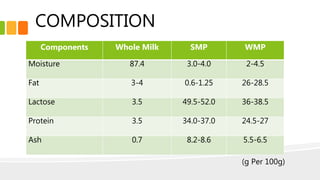
COMPOSITION
Components Whole Milk SMP WMP
Moisture 87.4 3.0-4.0 2-4.5
Fat 3-4 0.6-1.25 26-28.5
Lactose 3.5 49.5-52.0 36-38.5
Protein 3.5 34.0-37.0 24.5-27
Ash 0.7 8.2-8.6 5.5-6.5
(g Per 100g)
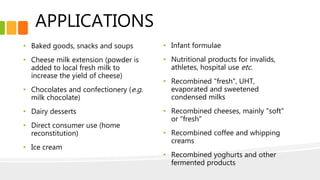
APPLICATIONS
• Baked goods, snacks and soups
• Cheese milk extension (powder is
added to local fresh milk to
increase the yield of cheese)
• Chocolates and confectionery (e.g.
milk chocolate)
• Dairy desserts
• Direct consumer use (home
reconstitution)
• Ice cream
• Infant formulae
• Nutritional products for invalids,
athletes, hospital use etc.
• Recombined "fresh", UHT,
evaporated and sweetened
condensed milks
• Recombined cheeses, mainly "soft"
or "fresh"
• Recombined coffee and whipping
creams
• Recombined yoghurts and other
fermented products
DEHYDRATION
OF
MILK
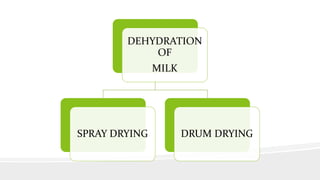
SPRAY DRYING DRUM DRYING
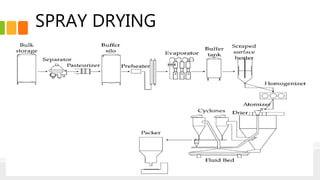
SPRAY DRYING
SPRAY DRYING
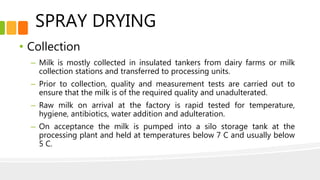
• Collection
– Milk is mostly collected in insulated tankers from dairy farms or milk
collection stations and transferred to processing units.
– Prior to collection, quality and measurement tests are carried out to
ensure that the milk is of the required quality and unadulterated.
– Raw milk on arrival at the factory is rapid tested for temperature,
hygiene, antibiotics, water addition and adulteration.
– On acceptance the milk is pumped into a silo storage tank at the
processing plant and held at temperatures below 7 C and usually below
5 C.
SPRAY DRYING
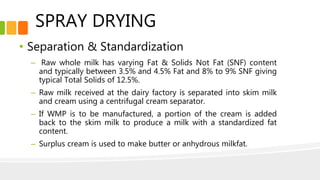
• Separation & Standardization
– Raw whole milk has varying Fat & Solids Not Fat (SNF) content
and typically between 3.5% and 4.5% Fat and 8% to 9% SNF giving
typical Total Solids of 12.5%.
– Raw milk received at the dairy factory is separated into skim milk
and cream using a centrifugal cream separator.
– If WMP is to be manufactured, a portion of the cream is added
back to the skim milk to produce a milk with a standardized fat
content.
– Surplus cream is used to make butter or anhydrous milkfat.
SPRAY DRYING
• Pasteurization
– The milk is high temperature short-time pasteurized (HTST) by heating to at
least 72 C, and holding at or above this temperature for at least 15 seconds.
• Preheating
– In Preheating, standardized milk is heated to temperatures between 75 and
120C and held for a specified time from a few seconds up to several minutes.
– Preheating causes a controlled denaturation of the whey proteins in the milk
and it destroys bacteria, inactivates enzymes, generates natural antioxidants
and imparts heat stability.
– The exact heating/holding regime depends on the type of product and its
intended end-use.
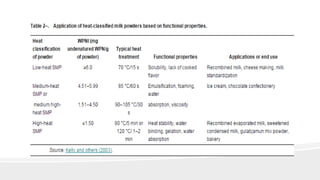
– High preheats in WMP are associated with improved keeping quality but
reduced solubility.
SPRAY DRYING
• Evaporation
– In the evaporator the preheated milk is concentrated in stages or "effects"
from around 9.0% total solids content for skim milk and 13% for whole
milk, up to 45-52% total solids.
– This is achieved by boiling the milk under a vacuum at temperatures
below 72C in a falling film on the inside of vertical tubes, and removing
the water as vapour.
– This vapour is then used to heat the milk in the next effect of the
evaporator which may be operated at a lower pressure and temperature
than the preceding effect.
– Modern plants may have up to seven effects for maximum energy
efficiency.
– The maximum boiling temperature accepted in a modem evaporator is
SPRAY DRYING
• Homogenization
– Homogenization is not a mandatory step in whole milk or buttermilk
processing, but is usually applied in order to decrease the free fat
content.
– Homogenization helps convert free fat into fat globules and
membranes are regenerated by protein adsorption on the globule
surfaces.
– There is no requirement to homogenize skimmed milk for powder
production because of its low fat content.
– Two stage homogenization is usually used as single stage can result in
fat globules coalescing into larger globules more readily.
SPRAY DRYING
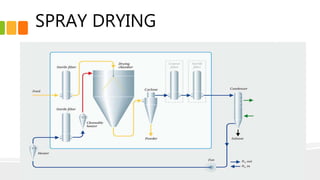
SPRAY DRYING
SPRAY DRYING
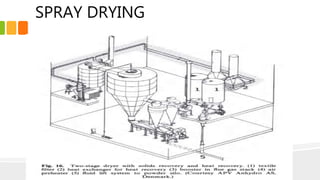
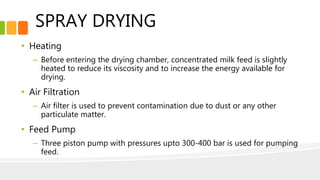
• Heating
– Before entering the drying chamber, concentrated milk feed is slightly
heated to reduce its viscosity and to increase the energy available for
drying.
• Air Filtration
– Air filter is used to prevent contamination due to dust or any other
particulate matter.
• Feed Pump
– Three piston pump with pressures upto 300-400 bar is used for pumping
feed.
SPRAY DRYING
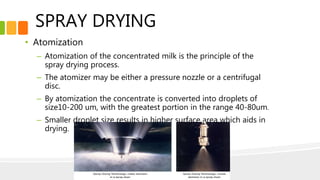
• Atomization
– Atomization of the concentrated milk is the principle of the
spray drying process.
– The atomizer may be either a pressure nozzle or a centrifugal
disc.
– By atomization the concentrate is converted into droplets of
size10-200 um, with the greatest portion in the range 40-80um.
– Smaller droplet size results in higher surface area which aids in
drying.
SPRAY DRYING
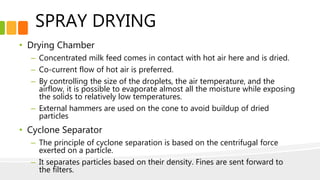
• Drying Chamber
– Concentrated milk feed comes in contact with hot air here and is dried.
– Co-current flow of hot air is preferred.
– By controlling the size of the droplets, the air temperature, and the
airflow, it is possible to evaporate almost all the moisture while exposing
the solids to relatively low temperatures.
– External hammers are used on the cone to avoid buildup of dried
particles
• Cyclone Separator
– The principle of cyclone separation is based on the centrifugal force
exerted on a particle.
– It separates particles based on their density. Fines are sent forward to
the filters.
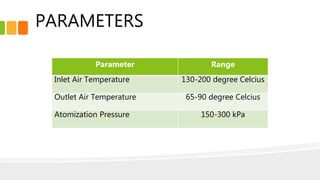
PARAMETERS
Parameter Range
Inlet Air Temperature 130-200 degree Celcius
Outlet Air Temperature 65-90 degree Celcius
Atomization Pressure 150-300 kPa
DRUM DRYING
DRUM DRYING
DRUM DRYING
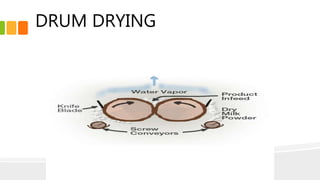
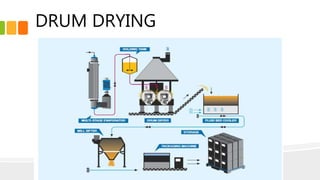
• Roller drying involves direct contact of a layer of concentrated milk with the
hot surface of rotating rollers or drums.
• The drum body of the drum dryer is heated on the inside by steam.
• Feed used for roller drying contains 45-50% solid content.
• Depending on the design of the drum dryer, the product is applied
continuously as a thin film at the bottom or top of the main drum.
• As the drum rotates and is heated on the inside, the product dries on the
outside of the drum surface.
• The moisture evaporates and leaves the process at the top. If necessary, the
vapor can also be removed by suction locally around the drum.
• The dried product film finally reaches the knife and is scraped off.
• It often causes irreversible changes such as lactose caramelization, Maillard
reaction and protein denaturation.
PACKAGING & STORAGE
• Milk powder is packed into either plastic-lined multi-wall bags (25 kg)
or air tight bulk bins (600 kg).
• WMPs are often packed under nitrogen gas to protect the product
from oxidation and to maintain their flavour and extend their keeping
quality.
• Packaging is chosen to provide a barrier to moisture, oxygen and light.
• Bags generally consist of several layers to provide strength and the
necessary barrier properties.
• Retail milk powder is usually packed in tin containers.
AGGLOMERATED POWDERS
• Standard powders, because of their fine dusty nature, do not
reconstitute well in water. "Agglomerated" and "instant" powders were
specifically developed to counter this.
• The manufacture of an agglomerated powder initially follows the
standard process of evaporation and drying, described earlier.
• However, during spray drying small particles of powder leaving the drier
(the "fines") are recovered in cyclones and returned to the drying
chamber in the close proximity of the atomiser.
• The wet concentrate droplets collide with the fines and stick together,
forming larger (0.1-0.3 mm), irregular shaped "agglomerates".
• Agglomerated powders disperse in water more rapidly and are less
dusty and easier to handle than standard powders.
INSTANT WMP
• For WMP, an extra step is required after agglomeration to
make the product truly "instant“ and overcome the
hydrophobic (water-hating) nature of traces of free fat on
the surface of the particles.
• This extra step consists of spraying minute quantities of
the natural surfactant or wetting agent, soy lecithin, on to
the powder in a fluid bed.
• Soy lecithin is extracted from soy bean oil.
PRODUCTS
THANK YOU!

Dehydration of Milk

  • 1.
  • 2.
    INTRODUCTION • Milk isextremely perishable, yet for a number of reasons it is desirable to preserve it for later consumption. • Drying is the most important method of preservation. • The advantage is that using modern techniques, it is possible to convert the milk to powder without any loss in nutritive value, i.e. milk made from powder has the same food value as fresh milk. • The disadvantage is that drying consumes a lot of energy; in fact, no other process in the dairy industry has a higher energy demand per tonne of finished product.
  • 3.
    COMPOSITION Components Whole MilkSMP WMP Moisture 87.4 3.0-4.0 2-4.5 Fat 3-4 0.6-1.25 26-28.5 Lactose 3.5 49.5-52.0 36-38.5 Protein 3.5 34.0-37.0 24.5-27 Ash 0.7 8.2-8.6 5.5-6.5 (g Per 100g)
  • 4.
    APPLICATIONS • Baked goods,snacks and soups • Cheese milk extension (powder is added to local fresh milk to increase the yield of cheese) • Chocolates and confectionery (e.g. milk chocolate) • Dairy desserts • Direct consumer use (home reconstitution) • Ice cream • Infant formulae • Nutritional products for invalids, athletes, hospital use etc. • Recombined "fresh", UHT, evaporated and sweetened condensed milks • Recombined cheeses, mainly "soft" or "fresh" • Recombined coffee and whipping creams • Recombined yoghurts and other fermented products
  • 5.
  • 6.
  • 7.
    SPRAY DRYING • Collection –Milk is mostly collected in insulated tankers from dairy farms or milk collection stations and transferred to processing units. – Prior to collection, quality and measurement tests are carried out to ensure that the milk is of the required quality and unadulterated. – Raw milk on arrival at the factory is rapid tested for temperature, hygiene, antibiotics, water addition and adulteration. – On acceptance the milk is pumped into a silo storage tank at the processing plant and held at temperatures below 7 C and usually below 5 C.
  • 8.
    SPRAY DRYING • Separation& Standardization – Raw whole milk has varying Fat & Solids Not Fat (SNF) content and typically between 3.5% and 4.5% Fat and 8% to 9% SNF giving typical Total Solids of 12.5%. – Raw milk received at the dairy factory is separated into skim milk and cream using a centrifugal cream separator. – If WMP is to be manufactured, a portion of the cream is added back to the skim milk to produce a milk with a standardized fat content. – Surplus cream is used to make butter or anhydrous milkfat.
  • 9.
    SPRAY DRYING • Pasteurization –The milk is high temperature short-time pasteurized (HTST) by heating to at least 72 C, and holding at or above this temperature for at least 15 seconds. • Preheating – In Preheating, standardized milk is heated to temperatures between 75 and 120C and held for a specified time from a few seconds up to several minutes. – Preheating causes a controlled denaturation of the whey proteins in the milk and it destroys bacteria, inactivates enzymes, generates natural antioxidants and imparts heat stability. – The exact heating/holding regime depends on the type of product and its intended end-use. – High preheats in WMP are associated with improved keeping quality but reduced solubility.
  • 10.
    SPRAY DRYING • Evaporation –In the evaporator the preheated milk is concentrated in stages or "effects" from around 9.0% total solids content for skim milk and 13% for whole milk, up to 45-52% total solids. – This is achieved by boiling the milk under a vacuum at temperatures below 72C in a falling film on the inside of vertical tubes, and removing the water as vapour. – This vapour is then used to heat the milk in the next effect of the evaporator which may be operated at a lower pressure and temperature than the preceding effect. – Modern plants may have up to seven effects for maximum energy efficiency. – The maximum boiling temperature accepted in a modem evaporator is
  • 11.
    SPRAY DRYING • Homogenization –Homogenization is not a mandatory step in whole milk or buttermilk processing, but is usually applied in order to decrease the free fat content. – Homogenization helps convert free fat into fat globules and membranes are regenerated by protein adsorption on the globule surfaces. – There is no requirement to homogenize skimmed milk for powder production because of its low fat content. – Two stage homogenization is usually used as single stage can result in fat globules coalescing into larger globules more readily.
  • 12.
  • 13.
  • 14.
    SPRAY DRYING • Heating –Before entering the drying chamber, concentrated milk feed is slightly heated to reduce its viscosity and to increase the energy available for drying. • Air Filtration – Air filter is used to prevent contamination due to dust or any other particulate matter. • Feed Pump – Three piston pump with pressures upto 300-400 bar is used for pumping feed.
  • 15.
    SPRAY DRYING • Atomization –Atomization of the concentrated milk is the principle of the spray drying process. – The atomizer may be either a pressure nozzle or a centrifugal disc. – By atomization the concentrate is converted into droplets of size10-200 um, with the greatest portion in the range 40-80um. – Smaller droplet size results in higher surface area which aids in drying.
  • 16.
    SPRAY DRYING • DryingChamber – Concentrated milk feed comes in contact with hot air here and is dried. – Co-current flow of hot air is preferred. – By controlling the size of the droplets, the air temperature, and the airflow, it is possible to evaporate almost all the moisture while exposing the solids to relatively low temperatures. – External hammers are used on the cone to avoid buildup of dried particles • Cyclone Separator – The principle of cyclone separation is based on the centrifugal force exerted on a particle. – It separates particles based on their density. Fines are sent forward to the filters.
  • 17.
    PARAMETERS Parameter Range Inlet AirTemperature 130-200 degree Celcius Outlet Air Temperature 65-90 degree Celcius Atomization Pressure 150-300 kPa
  • 19.
  • 20.
  • 21.
    DRUM DRYING • Rollerdrying involves direct contact of a layer of concentrated milk with the hot surface of rotating rollers or drums. • The drum body of the drum dryer is heated on the inside by steam. • Feed used for roller drying contains 45-50% solid content. • Depending on the design of the drum dryer, the product is applied continuously as a thin film at the bottom or top of the main drum. • As the drum rotates and is heated on the inside, the product dries on the outside of the drum surface. • The moisture evaporates and leaves the process at the top. If necessary, the vapor can also be removed by suction locally around the drum. • The dried product film finally reaches the knife and is scraped off. • It often causes irreversible changes such as lactose caramelization, Maillard reaction and protein denaturation.
  • 22.
    PACKAGING & STORAGE •Milk powder is packed into either plastic-lined multi-wall bags (25 kg) or air tight bulk bins (600 kg). • WMPs are often packed under nitrogen gas to protect the product from oxidation and to maintain their flavour and extend their keeping quality. • Packaging is chosen to provide a barrier to moisture, oxygen and light. • Bags generally consist of several layers to provide strength and the necessary barrier properties. • Retail milk powder is usually packed in tin containers.
  • 23.
    AGGLOMERATED POWDERS • Standardpowders, because of their fine dusty nature, do not reconstitute well in water. "Agglomerated" and "instant" powders were specifically developed to counter this. • The manufacture of an agglomerated powder initially follows the standard process of evaporation and drying, described earlier. • However, during spray drying small particles of powder leaving the drier (the "fines") are recovered in cyclones and returned to the drying chamber in the close proximity of the atomiser. • The wet concentrate droplets collide with the fines and stick together, forming larger (0.1-0.3 mm), irregular shaped "agglomerates". • Agglomerated powders disperse in water more rapidly and are less dusty and easier to handle than standard powders.
  • 24.
    INSTANT WMP • ForWMP, an extra step is required after agglomeration to make the product truly "instant“ and overcome the hydrophobic (water-hating) nature of traces of free fat on the surface of the particles. • This extra step consists of spraying minute quantities of the natural surfactant or wetting agent, soy lecithin, on to the powder in a fluid bed. • Soy lecithin is extracted from soy bean oil.
  • 25.
  • 26.