(Assistant Professor)
INTRODUCTIONINTRODUCTION
 Nowadays dietary supplements
are used widely.
 Among those dietary
supplements protein
supplements are mostly used by
the people.
DEFINITION OF DIETARYDEFINITION OF DIETARY
SUPPLEMENTSSUPPLEMENTS
A product (other than tobacco)
intended to supplement the diet that
bears or contains one or more of the
following dietary ingredients:
o Vitamins
o Minerals
o Herbs or other botanicals
o Amino acids
o Concentrate, metabolite,
constituent, extract or
combination of above listed
ingredients
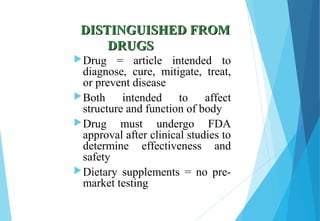
DISTINGUISHED FROMDISTINGUISHED FROM
DRUGSDRUGS
Drug = article intended to
diagnose, cure, mitigate, treat,
or prevent disease
Both intended to affect
structure and function of body
Drug must undergo FDA
approval after clinical studies to
determine effectiveness and
safety
Dietary supplements = no pre-
market testing
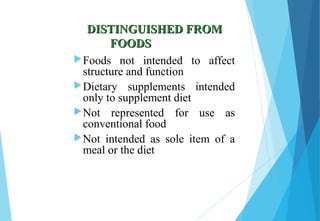
DISTINGUISHED FROMDISTINGUISHED FROM
FOODSFOODS
Foods not intended to affect
structure and function
Dietary supplements intended
only to supplement diet
Not represented for use as
conventional food
Not intended as sole item of a
meal or the diet
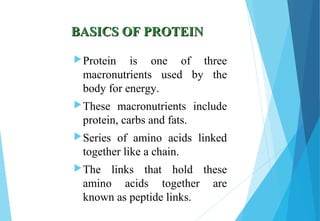
BASICS OF PROTEINBASICS OF PROTEIN
Protein is one of three
macronutrients used by the
body for energy.
These macronutrients include
protein, carbs and fats.
Series of amino acids linked
together like a chain.
The links that hold these
amino acids together are
known as peptide links.
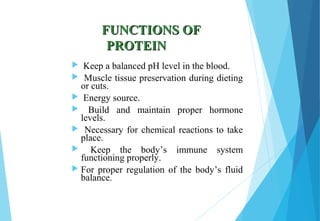
FUNCTIONS OFFUNCTIONS OF
PROTEINPROTEIN
 Keep a balanced pH level in the blood.
 Muscle tissue preservation during dieting
or cuts.
 Energy source.
 Build and maintain proper hormone
levels.
 Necessary for chemical reactions to take
place.
 Keep the body’s immune system
functioning properly.
 For proper regulation of the body’s fluid
balance.
PROTEIN FOODPROTEIN FOOD
Protein food are divided into two
categories:
•Complete protein: Food containing
all essential amino acids.
Eg: Animal proteins (meat).
•Incomplete protein: Food lacking
several essential amino acids.
Eg: vegetables
TYPES OF PROTIEN SOURCESTYPES OF PROTIEN SOURCES
 Slow Digesting: Provides a long
term stream of protein and amino
acids by keeping a positive nitrogen
balance for longer time.
 Fast Digesting: Helps in regulating
bodily nitrogen levels. Eg: whey
protein.
 Energy Bar: Provide a quick,
healthy and instant energy .
TYPES OF PROTEINTYPES OF PROTEIN
 Whey protein- fast absorbing, support lean
muscle, great post-workout
 Soya protein- low fat, low cholesterol, and
vegetarian source
 Hydrolyzed whey- digested and absorbed
faster then whey
 Whey isolate- low fat, low carb,
 Egg protein- high quality lactose-free
source (toned physique)
 Micellar casein- slow digesting great before
bed
HOW MUCH PROTEIN DOHOW MUCH PROTEIN DO
WE NEED?WE NEED?
The recommended dietary allowance
(RDA) for adults is 0.8 grams of protein
per kilogram of body weight.
Those involved with intense exercise, or
individuals looking to add muscle mass,
should consume at least twice the
RDA’s recommended minimums.
PROTEINPROTEIN
SUPPLEMENTSSUPPLEMENTS
 Defined as protein and nutrition sources,
and food products, that are utilized to
assist to achieve their desired daily protein
intake requirements.
Generally contain more then 20 to 30
grams of protein per serving, and are
fortified with vitamins and minerals.
Protein supplements also come in
numerous flavors.
TYPES OF PROTEINTYPES OF PROTEIN
SUPPLEMENTSSUPPLEMENTS
 Isolate- are 90% pure protein.
 Concentrate- is not as pure as an isolate,
and generally contains 70 to 85% of the
protein source.
 Blends- is combination of various protein
sources and purity levels.
 Weight Gainer- are high calorie protein
powders need for rapid weight gain and can
be used as meals.
 Meal Replacements- are considered to be
entire meals containing a formulated
nutritional and macronutrient blend.
 Recovery- contains any number of
additional, non-protein supplement products
meant to aid in post-workout recovery.
BENEFITS OF USINGBENEFITS OF USING
PROTEIN SUPPLEMENTSPROTEIN SUPPLEMENTS
 Generally a more complete and balanced
protein source.
 No Refrigeration & very portable.
 Can save our money.
 Proper protein timing is essential to
maximize muscle gains.
 Provide us with the ability to have a fast
digesting or slow digesting protein meal
 Often fortified with vitamins and minerals,
making them a multi-dimensional protein
food.
 Weight gainers offer high calorie foods that
are easily broken down, and less filling.
 Certain protein supplements have a higher
biological value as real foods.
 Protein foods are very thermogenic. For this
reason, a high protein diet boosts metabolism
and aids in fat loss.
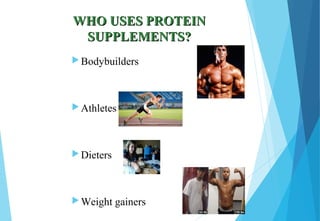
WHO USES PROTEINWHO USES PROTEIN
SUPPLEMENTS?SUPPLEMENTS?
 Bodybuilders
 Athletes
 Dieters
 Weight gainers
HOW PROTEINHOW PROTEIN
SUPPLEMENT HELPS INSUPPLEMENT HELPS IN
MUSCLE GROWTHMUSCLE GROWTH
Helps to increase lean muscle mass.
To maximize the repairing of muscle tissue,
one must maintain a protein positive nitrogen
balance.
In addition, other vital bodily functions are
compromised, such as hormone regulation and
blood pH balance.
Frequent protein feedings ensure a steady
stream of amino acids and help to maintain a
WHEN TO CONSUME FORWHEN TO CONSUME FOR
MAXIMUM RESULTS?MAXIMUM RESULTS?
 In the morning and after walking:
• Fast digesting protein powder
• Slow digesting protein powder
• e.g. whey protein drink with a solid protein
source such as eggs and cheese.
 Pre Workout meal:
• slow digesting protein powder that will keep
the body in a positive nitrogen balance as
you workout.
 Post Workout:
• as same as in the morning.
 Between Meals:
• Consists of slow digesting proteins, such as
casein or egg protein.
 Night Time:
• Consists of slow digesting protein
supplement before bed e.g. Casein protein is
a good choice.
SIDE EFFECTSSIDE EFFECTS
 High protein intake may displace
carbohydrate in the diet possibly affecting
performance.
 Increased urinary calcium loss.
 Contribute to dehydration.
 Due to the stress on the kidneys, individuals
with kidney disease should avoid high
protein diets.
CONCLUSIONCONCLUSION
 Protein supplements are becoming very popular
gradually.
 Some protein supplements which are available in
India are- Endura Mass, Accu Mass, Amway’s
Protein Powder etc.
 Nowadays it became a part of daily diet, not only
for the body builders but also for the common
peoples as it provides a definite amount of protein
daily basis.
REFERENCEREFERENCE
 Biolo, G., K. D. Tipton, S. Klein, and
R. R. Wolfe. An abundant supply of
amino acids enhances the metabolic
effect of exercise on muscle protein.
Am. J.Physiol. 273 (Endocrinol.
Metab. 36): E122-E129, 1997.
 Carraro, F., A. Naldini, J. M. Weber,
and R. R. Wolfe. Alanine kinetics in
humans during low-intensity
exercise. Med. Sci. Sports Exerc. 26:
348-353,1994.
 Tipton, K. D., A. A. Ferrando, S. M.
Phillips, D. Doyle, Jr., and R. R.
Protein Supplement as a Dietary Supplement

Protein Supplement as a Dietary Supplement

  • 1.
  • 2.
    INTRODUCTIONINTRODUCTION  Nowadays dietarysupplements are used widely.  Among those dietary supplements protein supplements are mostly used by the people.
  • 3.
    DEFINITION OF DIETARYDEFINITIONOF DIETARY SUPPLEMENTSSUPPLEMENTS A product (other than tobacco) intended to supplement the diet that bears or contains one or more of the following dietary ingredients: o Vitamins o Minerals o Herbs or other botanicals o Amino acids o Concentrate, metabolite, constituent, extract or combination of above listed ingredients
  • 4.
    DISTINGUISHED FROMDISTINGUISHED FROM DRUGSDRUGS Drug= article intended to diagnose, cure, mitigate, treat, or prevent disease Both intended to affect structure and function of body Drug must undergo FDA approval after clinical studies to determine effectiveness and safety Dietary supplements = no pre- market testing
  • 5.
    DISTINGUISHED FROMDISTINGUISHED FROM FOODSFOODS Foodsnot intended to affect structure and function Dietary supplements intended only to supplement diet Not represented for use as conventional food Not intended as sole item of a meal or the diet
  • 6.
    BASICS OF PROTEINBASICSOF PROTEIN Protein is one of three macronutrients used by the body for energy. These macronutrients include protein, carbs and fats. Series of amino acids linked together like a chain. The links that hold these amino acids together are known as peptide links.
  • 7.
    FUNCTIONS OFFUNCTIONS OF PROTEINPROTEIN Keep a balanced pH level in the blood.  Muscle tissue preservation during dieting or cuts.  Energy source.  Build and maintain proper hormone levels.  Necessary for chemical reactions to take place.  Keep the body’s immune system functioning properly.  For proper regulation of the body’s fluid balance.
  • 8.
    PROTEIN FOODPROTEIN FOOD Proteinfood are divided into two categories: •Complete protein: Food containing all essential amino acids. Eg: Animal proteins (meat). •Incomplete protein: Food lacking several essential amino acids. Eg: vegetables
  • 9.
    TYPES OF PROTIENSOURCESTYPES OF PROTIEN SOURCES  Slow Digesting: Provides a long term stream of protein and amino acids by keeping a positive nitrogen balance for longer time.  Fast Digesting: Helps in regulating bodily nitrogen levels. Eg: whey protein.  Energy Bar: Provide a quick, healthy and instant energy .
  • 10.
    TYPES OF PROTEINTYPESOF PROTEIN  Whey protein- fast absorbing, support lean muscle, great post-workout  Soya protein- low fat, low cholesterol, and vegetarian source  Hydrolyzed whey- digested and absorbed faster then whey  Whey isolate- low fat, low carb,  Egg protein- high quality lactose-free source (toned physique)  Micellar casein- slow digesting great before bed
  • 11.
    HOW MUCH PROTEINDOHOW MUCH PROTEIN DO WE NEED?WE NEED? The recommended dietary allowance (RDA) for adults is 0.8 grams of protein per kilogram of body weight. Those involved with intense exercise, or individuals looking to add muscle mass, should consume at least twice the RDA’s recommended minimums.
  • 12.
    PROTEINPROTEIN SUPPLEMENTSSUPPLEMENTS  Defined asprotein and nutrition sources, and food products, that are utilized to assist to achieve their desired daily protein intake requirements. Generally contain more then 20 to 30 grams of protein per serving, and are fortified with vitamins and minerals. Protein supplements also come in numerous flavors.
  • 13.
    TYPES OF PROTEINTYPESOF PROTEIN SUPPLEMENTSSUPPLEMENTS  Isolate- are 90% pure protein.  Concentrate- is not as pure as an isolate, and generally contains 70 to 85% of the protein source.  Blends- is combination of various protein sources and purity levels.
  • 14.
     Weight Gainer-are high calorie protein powders need for rapid weight gain and can be used as meals.  Meal Replacements- are considered to be entire meals containing a formulated nutritional and macronutrient blend.  Recovery- contains any number of additional, non-protein supplement products meant to aid in post-workout recovery.
  • 15.
    BENEFITS OF USINGBENEFITSOF USING PROTEIN SUPPLEMENTSPROTEIN SUPPLEMENTS  Generally a more complete and balanced protein source.  No Refrigeration & very portable.  Can save our money.  Proper protein timing is essential to maximize muscle gains.  Provide us with the ability to have a fast digesting or slow digesting protein meal
  • 16.
     Often fortifiedwith vitamins and minerals, making them a multi-dimensional protein food.  Weight gainers offer high calorie foods that are easily broken down, and less filling.  Certain protein supplements have a higher biological value as real foods.  Protein foods are very thermogenic. For this reason, a high protein diet boosts metabolism and aids in fat loss.
  • 17.
    WHO USES PROTEINWHOUSES PROTEIN SUPPLEMENTS?SUPPLEMENTS?  Bodybuilders  Athletes  Dieters  Weight gainers
  • 18.
    HOW PROTEINHOW PROTEIN SUPPLEMENTHELPS INSUPPLEMENT HELPS IN MUSCLE GROWTHMUSCLE GROWTH Helps to increase lean muscle mass. To maximize the repairing of muscle tissue, one must maintain a protein positive nitrogen balance. In addition, other vital bodily functions are compromised, such as hormone regulation and blood pH balance. Frequent protein feedings ensure a steady stream of amino acids and help to maintain a
  • 19.
    WHEN TO CONSUMEFORWHEN TO CONSUME FOR MAXIMUM RESULTS?MAXIMUM RESULTS?  In the morning and after walking: • Fast digesting protein powder • Slow digesting protein powder • e.g. whey protein drink with a solid protein source such as eggs and cheese.  Pre Workout meal: • slow digesting protein powder that will keep the body in a positive nitrogen balance as you workout.
  • 20.
     Post Workout: •as same as in the morning.  Between Meals: • Consists of slow digesting proteins, such as casein or egg protein.  Night Time: • Consists of slow digesting protein supplement before bed e.g. Casein protein is a good choice.
  • 21.
    SIDE EFFECTSSIDE EFFECTS High protein intake may displace carbohydrate in the diet possibly affecting performance.  Increased urinary calcium loss.  Contribute to dehydration.  Due to the stress on the kidneys, individuals with kidney disease should avoid high protein diets.
  • 22.
    CONCLUSIONCONCLUSION  Protein supplementsare becoming very popular gradually.  Some protein supplements which are available in India are- Endura Mass, Accu Mass, Amway’s Protein Powder etc.  Nowadays it became a part of daily diet, not only for the body builders but also for the common peoples as it provides a definite amount of protein daily basis.
  • 23.
    REFERENCEREFERENCE  Biolo, G.,K. D. Tipton, S. Klein, and R. R. Wolfe. An abundant supply of amino acids enhances the metabolic effect of exercise on muscle protein. Am. J.Physiol. 273 (Endocrinol. Metab. 36): E122-E129, 1997.  Carraro, F., A. Naldini, J. M. Weber, and R. R. Wolfe. Alanine kinetics in humans during low-intensity exercise. Med. Sci. Sports Exerc. 26: 348-353,1994.  Tipton, K. D., A. A. Ferrando, S. M. Phillips, D. Doyle, Jr., and R. R.