COACHING SKILLS
OBJECTIVE
Develop the skills and approach to coach
others in elevating their skills and/or
enhancing their performance
CRITICAL COACHING SKILLS
• Establishing Trust
• Asking the Right Questions
• Listening and Observing
• Giving Input and Guidance
• Giving Feedback
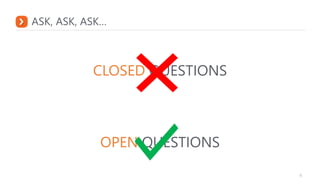
ASK, ASK, ASK…
CLOSED QUESTIONS
OPEN QUESTIONS
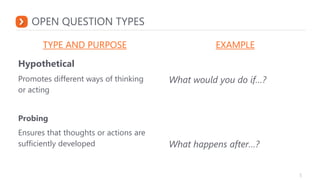
OPEN QUESTION TYPES
Hypothetical
Promotes different ways of thinking
or acting
Probing
Ensures that thoughts or actions are
sufficiently developed
What would you do if…?
What happens after…?
TYPE AND PURPOSE EXAMPLE
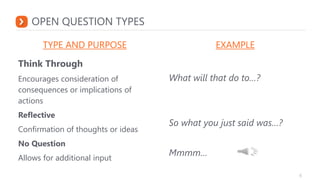
OPEN QUESTION TYPES
Think Through
Encourages consideration of
consequences or implications of
actions
Reflective
Confirmation of thoughts or ideas
No Question
Allows for additional input
What will that do to…?
So what you just said was…?
Mmmm…
TYPE AND PURPOSE EXAMPLE
ACTIVE LISTENING
Want To Become A Better Leader? Here’s How. Just Listen
https://youtu.be/cARuUGgSl7I?t=713
Catherine Rymsha at TEDxLowell
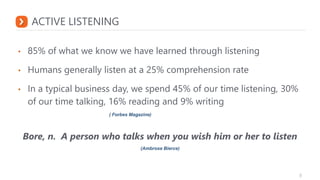
ACTIVE LISTENING
• 85% of what we know we have learned through listening
• Humans generally listen at a 25% comprehension rate
• In a typical business day, we spend 45% of our time listening, 30%
of our time talking, 16% reading and 9% writing
( Forbes Magazine)
Bore, n. A person who talks when you wish him or her to listen
(Ambrose Bierce)
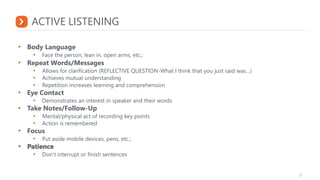
ACTIVE LISTENING
• Body Language
• Face the person, lean in, open arms, etc.;
• Repeat Words/Messages
• Allows for clarification (REFLECTIVE QUESTION-What I think that you just said was…)
• Achieves mutual understanding
• Repetition increases learning and comprehension
• Eye Contact
• Demonstrates an interest in speaker and their words
• Take Notes/Follow-Up
• Mental/physical act of recording key points
• Action is remembered
• Focus
• Put aside mobile devices, pens, etc.;
• Patience
• Don’t interrupt or finish sentences
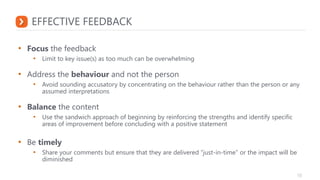
EFFECTIVE FEEDBACK
• Focus the feedback
• Limit to key issue(s) as too much can be overwhelming
• Address the behaviour and not the person
• Avoid sounding accusatory by concentrating on the behaviour rather than the person or any
assumed interpretations
• Balance the content
• Use the sandwich approach of beginning by reinforcing the strengths and identify specific
areas of improvement before concluding with a positive statement
• Be timely
• Share your comments but ensure that they are delivered “just-in-time” or the impact will be
diminished
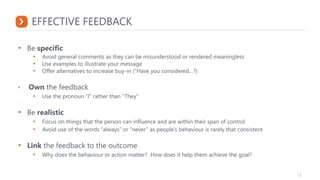
EFFECTIVE FEEDBACK
• Be specific
• Avoid general comments as they can be misunderstood or rendered meaningless
• Use examples to illustrate your message
• Offer alternatives to increase buy-in (“Have you considered…?)
• Own the feedback
• Use the pronoun “I” rather than “They”
• Be realistic
• Focus on things that the person can influence and are within their span of control
• Avoid use of the words “always” or “never” as people’s behaviour is rarely that consistent
• Link the feedback to the outcome
• Why does the behaviour or action matter? How does it help them achieve the goal?
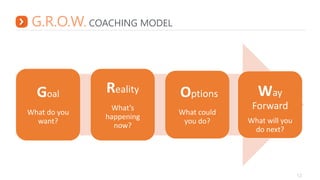
G.R.O.W. COACHING MODEL
Goal
What do you
want?
Reality
What’s
happening
now?
Options
What could
you do?
Way
Forward
What will you
do next?

Coaching Skills

  • 1.
  • 2.
    OBJECTIVE Develop the skillsand approach to coach others in elevating their skills and/or enhancing their performance
  • 3.
    CRITICAL COACHING SKILLS •Establishing Trust • Asking the Right Questions • Listening and Observing • Giving Input and Guidance • Giving Feedback
  • 4.
    ASK, ASK, ASK… CLOSEDQUESTIONS OPEN QUESTIONS
  • 5.
    OPEN QUESTION TYPES Hypothetical Promotesdifferent ways of thinking or acting Probing Ensures that thoughts or actions are sufficiently developed What would you do if…? What happens after…? TYPE AND PURPOSE EXAMPLE
  • 6.
    OPEN QUESTION TYPES ThinkThrough Encourages consideration of consequences or implications of actions Reflective Confirmation of thoughts or ideas No Question Allows for additional input What will that do to…? So what you just said was…? Mmmm… TYPE AND PURPOSE EXAMPLE
  • 7.
    ACTIVE LISTENING Want ToBecome A Better Leader? Here’s How. Just Listen https://youtu.be/cARuUGgSl7I?t=713 Catherine Rymsha at TEDxLowell
  • 8.
    ACTIVE LISTENING • 85%of what we know we have learned through listening • Humans generally listen at a 25% comprehension rate • In a typical business day, we spend 45% of our time listening, 30% of our time talking, 16% reading and 9% writing ( Forbes Magazine) Bore, n. A person who talks when you wish him or her to listen (Ambrose Bierce)
  • 9.
    ACTIVE LISTENING • BodyLanguage • Face the person, lean in, open arms, etc.; • Repeat Words/Messages • Allows for clarification (REFLECTIVE QUESTION-What I think that you just said was…) • Achieves mutual understanding • Repetition increases learning and comprehension • Eye Contact • Demonstrates an interest in speaker and their words • Take Notes/Follow-Up • Mental/physical act of recording key points • Action is remembered • Focus • Put aside mobile devices, pens, etc.; • Patience • Don’t interrupt or finish sentences
  • 10.
    EFFECTIVE FEEDBACK • Focusthe feedback • Limit to key issue(s) as too much can be overwhelming • Address the behaviour and not the person • Avoid sounding accusatory by concentrating on the behaviour rather than the person or any assumed interpretations • Balance the content • Use the sandwich approach of beginning by reinforcing the strengths and identify specific areas of improvement before concluding with a positive statement • Be timely • Share your comments but ensure that they are delivered “just-in-time” or the impact will be diminished
  • 11.
    EFFECTIVE FEEDBACK • Bespecific • Avoid general comments as they can be misunderstood or rendered meaningless • Use examples to illustrate your message • Offer alternatives to increase buy-in (“Have you considered…?) • Own the feedback • Use the pronoun “I” rather than “They” • Be realistic • Focus on things that the person can influence and are within their span of control • Avoid use of the words “always” or “never” as people’s behaviour is rarely that consistent • Link the feedback to the outcome • Why does the behaviour or action matter? How does it help them achieve the goal?
  • 12.
    G.R.O.W. COACHING MODEL Goal Whatdo you want? Reality What’s happening now? Options What could you do? Way Forward What will you do next?