Presentation  on  performance coaching & counseling
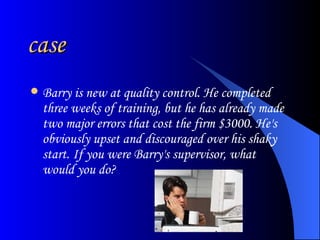
case Barry is new at quality control. He completed three weeks of training, but he has already made two major errors that cost the firm $3000. He's obviously upset and discouraged over his shaky start. If you were Barry's supervisor, what would you do?
coaching
coaching Coaching assists employees in getting from where they are now,  to where they want to be with their performance.  coaching - positive, solutions and future focused, and uses strategies from performance enhancing areas such as sports and performance psychology. Coaching is for anyone who wants to be performing at a higher level than they currently are. It is about enhancing and maximizing performance.   Coaching is about performing at your best through the individual and private assistance of someone who will challenge, stimulate and guide you to keep growing.
How does it work? The 5 Stage Coaching Process Identifying Specific Goals and Objectives – what do you want to achieve?  Assessing Current Performance Levels  - how are you performing right now?  Performance Improvement Plan – identifying areas where performance can be improved.  Personal Action Plan – developing specific action steps to take.  Execute and Evaluate – ongoing action, evaluation of progress, coaching, and re-setting of goals as they are achieved.
benefits of coaching Avoid making mistakes in both your business and personal life.  Accomplish more, in less time. Minimize problems and enable you to tackle those that remain.  Achieve lasting happiness with a better life . Climb the ladder in your career or personal development.  Helps to become more effective and influential.  Helps to be more attractive to others. Rapidly enhanced development of managers and leaders, decreasing the necessary development time between promotions.
Cont…. Learned leadership behaviors that result in higher levels of job satisfaction. Increased employee motivation and productivity. Decreased attrition and greater retention of managerial and executive talent. Improved ability to appropriately delegate and accomplish more through others. Increased ability to coach and develop direct reports. Improved communication and interpersonal relationships. Improved morale and motivation among employees. Significantly lowered expenses for severance recruitment and hiring.
Use of coaching: Support newly promoted executives  Fast track high-potential executives to the top  Accelerate the personal development of key executives and board members  Support individuals and teams during organizational change programmes  Reward and retain key staff
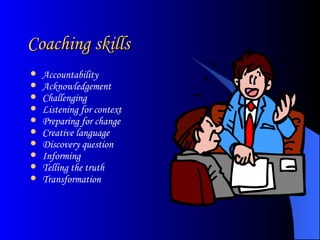
Coaching skills Accountability Acknowledgement Challenging Listening for context Preparing for change Creative language Discovery question Informing Telling the truth Transformation
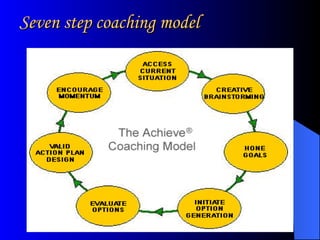
Seven step coaching model
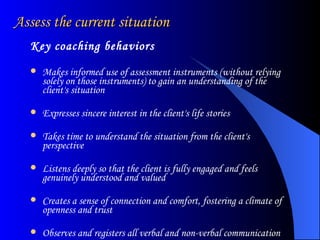
Assess the current situation  Key coaching behaviors Makes informed use of assessment instruments (without relying solely on those instruments) to gain an understanding of the client's situation  Expresses sincere interest in the client's life stories  Takes time to understand the situation from the client's perspective  Listens deeply so that the client is fully engaged and feels genuinely understood and valued  Creates a sense of connection and comfort, fostering a climate of openness and trust  Observes and registers all verbal and non-verbal communication
Creative brain storming Key coaching behaviors   Utilizes a variety of tools and techniques to interrupt the client's habitual patterns, thus breaking the "stuck state"  Surprises clients with creative, unexpected questions  Brainstorms a variety of alternatives to the current situation, probing beyond initial responses to unearth a broad spectrum of options
Hone goals Key coaching behaviors Encourages precise definition of goals (in positive terms)  Takes time to develop SMART goals  Works with the client to develop goal(s) with high personal meaning and relevance Ensures that the goals are, in fact, the client's  Develops a specific set of measurements with the client to provide clear evidence of goal achievement
Initiate option generation Key coaching behaviors Exhibits confidence in the process and works with the client to develop alternative pathways to the desired goal  Uses a broad spectrum of techniques and questioning styles to stimulate the client to generate options  Provides space and time for the client to think creatively  Ensures that the client  "owns" the options generated
Evaluate option Key coaching behavior Encourages the client to develop personally meaningful criteria for the evaluation of options, since these criteria form the basis for option selection  Probes the client to develop a comprehensive evaluation of each option  Ensures that the key options and their evaluation are fixed in writing for future reference
Valid action plan design Key coaching behavior Creates a detailed action plan with the client  Works with the client to check the feasibility and achievability of the plan  Fixes the action plan in writing  Ensures the client's commitment to the action plan
Encourage momentum Key coaching behavior Demonstrates continuing interest in the development of the client  Organizes regular "check-in/keep-on-track/follow-up" coaching sessions  Takes measures throughout the coaching program to avoid dependency, and knows when to end the partnership
Coaching core competencies A. SETTING THE FOUNDATION  1.  Meeting ethical guidelines and professional standards  2. Establishing the coaching agreement   B. CO-CREATING THE RELATIONSHIP  3.  Establishing trust and intimacy with the client 4. Coaching presence
Cont…. C. COMMUNICATING EFFECTIVELY  5. Active listening 6. Powerful questioning 7. Direct communication  D. FACILITATING LEARNING AND RESULTS  8. Creating awareness 9. Designing actions 10. Planning and goal setting 11. Managing progress and accountability
COUNSELLING…….
Human Need Many people go for career as counselor. Knowing the nature of the societal needs. Understanding the nature of responsibilities and responses.
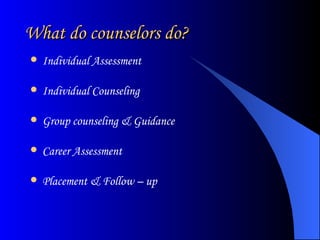
What do counselors do? Individual Assessment Individual Counseling Group counseling & Guidance Career Assessment Placement & Follow – up
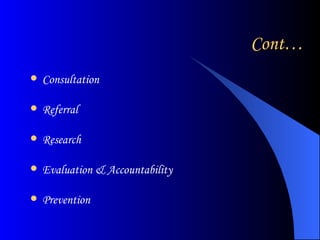
Cont… Consultation Referral Research Evaluation & Accountability Prevention
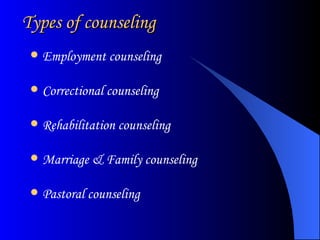
Types of counseling Employment counseling Correctional counseling Rehabilitation counseling Marriage & Family counseling Pastoral counseling
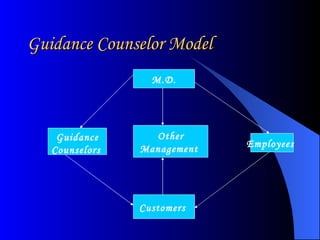
Guidance Counselor Model Employees  M.D. Guidance Counselors   Customers  Other Management
Counseling Competencies Counseling Skills Individual & group assessment skills Group counseling Development & use of Employment – Related Information Computer related skills Employment Plan Development, Implementation & Case Management
Cont…. Placement Skills Community relationship skills Workload management & Intra – Office relationship skills Professional development skills Ethical & legal issues
Importance Increasing standards for counselor preparation Increasing attention to specialty fields Increased use of technology Increasing focus on empirical results Updating the profession’s traditional theories
Cont….. Renewing attention as well as expanding career counseling parameters Increased attention to public communication and political activity Increased attention to program relevancy Increased multicultural sensitivity & activity Increased globalization of the profession
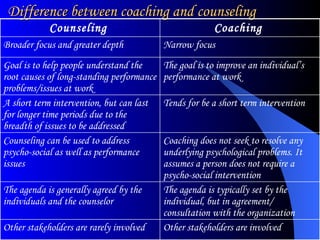
Difference between coaching and counseling Other stakeholders are involved Other stakeholders are rarely involved The agenda is typically set by the individual, but in agreement/ consultation with the organization  The agenda is generally agreed by the individuals and the counselor Coaching does not seek to resolve any underlying psychological problems. It assumes a person does not require a psycho-social intervention Counseling can be used to address psycho-social as well as performance issues Tends for be a short term intervention A short term intervention, but can last for longer time periods due to the breadth of issues to be addressed The goal is to improve an individual’s performance at work Goal is to help people understand the root causes of long-standing performance problems/issues at work Narrow focus Broader focus and greater depth Coaching  Counseling
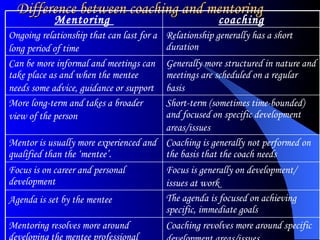
Difference between coaching and mentoring Coaching revolves more around specific development areas/issues   Mentoring resolves more around developing the mentee professional  The agenda is focused on achieving specific, immediate goals  Agenda is set by the mentee   Focus is generally on development/ issues at work   Focus is on career and personal development  Coaching is generally not performed on the basis that the coach needs  Mentor is usually more experienced and qualified than the ‘mentee’.  Short-term (sometimes time-bounded) and focused on specific development areas/issues   More long-term and takes a broader view of the person   Generally more structured in nature and meetings are scheduled on a regular basis   Can be more informal and meetings can take place as and when the mentee needs some advice, guidance or support   Relationship generally has a short duration   Ongoing relationship that can last for a long period of time   coaching Mentoring
conclusion After undergoing this theoretical part of coaching and counselling, Barry’s supervisor decided to send him for both coaching and counselling. It will help Barry to develop its performance in short term as well as in long term also.
thank you

Presentation On Coaching And Counselling

  • 1.
    Presentation on performance coaching & counseling
  • 2.
    case Barry isnew at quality control. He completed three weeks of training, but he has already made two major errors that cost the firm $3000. He's obviously upset and discouraged over his shaky start. If you were Barry's supervisor, what would you do?
  • 3.
  • 4.
    coaching Coaching assistsemployees in getting from where they are now,  to where they want to be with their performance.  coaching - positive, solutions and future focused, and uses strategies from performance enhancing areas such as sports and performance psychology. Coaching is for anyone who wants to be performing at a higher level than they currently are. It is about enhancing and maximizing performance. Coaching is about performing at your best through the individual and private assistance of someone who will challenge, stimulate and guide you to keep growing.
  • 5.
    How does itwork? The 5 Stage Coaching Process Identifying Specific Goals and Objectives – what do you want to achieve? Assessing Current Performance Levels  - how are you performing right now? Performance Improvement Plan – identifying areas where performance can be improved. Personal Action Plan – developing specific action steps to take. Execute and Evaluate – ongoing action, evaluation of progress, coaching, and re-setting of goals as they are achieved.
  • 6.
    benefits of coachingAvoid making mistakes in both your business and personal life. Accomplish more, in less time. Minimize problems and enable you to tackle those that remain. Achieve lasting happiness with a better life . Climb the ladder in your career or personal development. Helps to become more effective and influential. Helps to be more attractive to others. Rapidly enhanced development of managers and leaders, decreasing the necessary development time between promotions.
  • 7.
    Cont…. Learned leadershipbehaviors that result in higher levels of job satisfaction. Increased employee motivation and productivity. Decreased attrition and greater retention of managerial and executive talent. Improved ability to appropriately delegate and accomplish more through others. Increased ability to coach and develop direct reports. Improved communication and interpersonal relationships. Improved morale and motivation among employees. Significantly lowered expenses for severance recruitment and hiring.
  • 8.
    Use of coaching:Support newly promoted executives Fast track high-potential executives to the top Accelerate the personal development of key executives and board members Support individuals and teams during organizational change programmes Reward and retain key staff
  • 9.
    Coaching skills AccountabilityAcknowledgement Challenging Listening for context Preparing for change Creative language Discovery question Informing Telling the truth Transformation
  • 10.
  • 11.
    Assess the currentsituation Key coaching behaviors Makes informed use of assessment instruments (without relying solely on those instruments) to gain an understanding of the client's situation Expresses sincere interest in the client's life stories Takes time to understand the situation from the client's perspective Listens deeply so that the client is fully engaged and feels genuinely understood and valued Creates a sense of connection and comfort, fostering a climate of openness and trust Observes and registers all verbal and non-verbal communication
  • 12.
    Creative brain stormingKey coaching behaviors   Utilizes a variety of tools and techniques to interrupt the client's habitual patterns, thus breaking the "stuck state" Surprises clients with creative, unexpected questions Brainstorms a variety of alternatives to the current situation, probing beyond initial responses to unearth a broad spectrum of options
  • 13.
    Hone goals Keycoaching behaviors Encourages precise definition of goals (in positive terms) Takes time to develop SMART goals Works with the client to develop goal(s) with high personal meaning and relevance Ensures that the goals are, in fact, the client's Develops a specific set of measurements with the client to provide clear evidence of goal achievement
  • 14.
    Initiate option generationKey coaching behaviors Exhibits confidence in the process and works with the client to develop alternative pathways to the desired goal Uses a broad spectrum of techniques and questioning styles to stimulate the client to generate options Provides space and time for the client to think creatively Ensures that the client  "owns" the options generated
  • 15.
    Evaluate option Keycoaching behavior Encourages the client to develop personally meaningful criteria for the evaluation of options, since these criteria form the basis for option selection Probes the client to develop a comprehensive evaluation of each option Ensures that the key options and their evaluation are fixed in writing for future reference
  • 16.
    Valid action plandesign Key coaching behavior Creates a detailed action plan with the client Works with the client to check the feasibility and achievability of the plan Fixes the action plan in writing Ensures the client's commitment to the action plan
  • 17.
    Encourage momentum Keycoaching behavior Demonstrates continuing interest in the development of the client Organizes regular "check-in/keep-on-track/follow-up" coaching sessions Takes measures throughout the coaching program to avoid dependency, and knows when to end the partnership
  • 18.
    Coaching core competenciesA. SETTING THE FOUNDATION 1. Meeting ethical guidelines and professional standards 2. Establishing the coaching agreement B. CO-CREATING THE RELATIONSHIP 3. Establishing trust and intimacy with the client 4. Coaching presence
  • 19.
    Cont…. C. COMMUNICATINGEFFECTIVELY 5. Active listening 6. Powerful questioning 7. Direct communication D. FACILITATING LEARNING AND RESULTS 8. Creating awareness 9. Designing actions 10. Planning and goal setting 11. Managing progress and accountability
  • 20.
  • 21.
    Human Need Manypeople go for career as counselor. Knowing the nature of the societal needs. Understanding the nature of responsibilities and responses.
  • 22.
    What do counselorsdo? Individual Assessment Individual Counseling Group counseling & Guidance Career Assessment Placement & Follow – up
  • 23.
    Cont… Consultation ReferralResearch Evaluation & Accountability Prevention
  • 24.
    Types of counselingEmployment counseling Correctional counseling Rehabilitation counseling Marriage & Family counseling Pastoral counseling
  • 25.
    Guidance Counselor ModelEmployees M.D. Guidance Counselors Customers Other Management
  • 26.
    Counseling Competencies CounselingSkills Individual & group assessment skills Group counseling Development & use of Employment – Related Information Computer related skills Employment Plan Development, Implementation & Case Management
  • 27.
    Cont…. Placement SkillsCommunity relationship skills Workload management & Intra – Office relationship skills Professional development skills Ethical & legal issues
  • 28.
    Importance Increasing standardsfor counselor preparation Increasing attention to specialty fields Increased use of technology Increasing focus on empirical results Updating the profession’s traditional theories
  • 29.
    Cont….. Renewing attentionas well as expanding career counseling parameters Increased attention to public communication and political activity Increased attention to program relevancy Increased multicultural sensitivity & activity Increased globalization of the profession
  • 30.
    Difference between coachingand counseling Other stakeholders are involved Other stakeholders are rarely involved The agenda is typically set by the individual, but in agreement/ consultation with the organization The agenda is generally agreed by the individuals and the counselor Coaching does not seek to resolve any underlying psychological problems. It assumes a person does not require a psycho-social intervention Counseling can be used to address psycho-social as well as performance issues Tends for be a short term intervention A short term intervention, but can last for longer time periods due to the breadth of issues to be addressed The goal is to improve an individual’s performance at work Goal is to help people understand the root causes of long-standing performance problems/issues at work Narrow focus Broader focus and greater depth Coaching Counseling
  • 31.
    Difference between coachingand mentoring Coaching revolves more around specific development areas/issues Mentoring resolves more around developing the mentee professional The agenda is focused on achieving specific, immediate goals Agenda is set by the mentee Focus is generally on development/ issues at work Focus is on career and personal development Coaching is generally not performed on the basis that the coach needs Mentor is usually more experienced and qualified than the ‘mentee’. Short-term (sometimes time-bounded) and focused on specific development areas/issues More long-term and takes a broader view of the person Generally more structured in nature and meetings are scheduled on a regular basis Can be more informal and meetings can take place as and when the mentee needs some advice, guidance or support Relationship generally has a short duration Ongoing relationship that can last for a long period of time coaching Mentoring
  • 32.
    conclusion After undergoingthis theoretical part of coaching and counselling, Barry’s supervisor decided to send him for both coaching and counselling. It will help Barry to develop its performance in short term as well as in long term also.
  • 33.