Dr. Mac
For Radiology
Mycobacterium Tuberculosis
Pulmonary tuberculosis
Extra-pulmonary tuberculosis
 TB Lymphadenitis
 Pleural TB
 Skeletal TB (Bones & Joints)
 CNS TB – 1% of all Tuberculosis
 Abdominal TB
 Genitourinary TB
 Pericardial TB
CNS Tuberculosis
Leptomeningitis
Pachymeningitis
Cerebritis
Tuberculoma
TB Abscess
Intracranial tuberculoma
 CNS TB almost always secondary to hematogenous
spread
 Tuberculoma can occur either in association with
meningitis or separately
 Tuberculoma
 are well defined focal masses that result from
Mycobacterium Tuberculosis with central caseous necrotic
core
 Etiology / Pathophysiology
 Hematogenous spread (gray-white matter junction lesions)
 Extension of meningitis into parenchyma
Clinical feature
 Symptoms and signs are non-specific
 Include
 Headache
 Fever
 Vomiting
 Seizures
 Neurological deficits e.g. altered sensorium, hemiparesis
Location
 Parenchyma (Supra/Infratentorial)
 Dural
 Subarachnoid space
 Brainstem infrequent, 2.5-8 % of intracranial
tuberculomas.
 Size
 1mm-6cm
Pathology
 3 stages
 Area of cerebritis – focal non-caseating granuloma – caseation
occurs later
 Histologically it consists of a central core of caseating
necrosis with a surrounding wall of a florid granulomatous
reaction containing Langerhans giant cells, epithelioid,
histiocytes and lymphocytes
 Unlike tuberculous abscesses, organisms are uncommon or
absent
 Usually, tuberculomas have a solid granulomatous core and
some may undergo liquefaction
CSF Analysis
 Increased protein
 Increased lymphocyte count
 Low glucose
 May be negative for organisms
Imaging modalities
 CT Scan
 MRI
 MRS
CT Scan
 NECT
 Non-caseating granuloma –isodense or mildly
hyperdense, surrounded by perilesional low-
density edema.
 Caseating granuloma – isodense or slightly
hypodense, edema remains.
 CECT
 Non-caseating granuloma – dense nodular
enhancement
 Caseating granuloma – ring enhancement.
Target sign may be found in some cases, central
area of enhancement surrounded by area of low
attenuation then peripheral rim enhancement.
MRI
 T1WI
 Non-caseating – Iso/Hypointense
 Caseating granuloma
 Solid centre – hypo/isointense
 Necrotic centre – hypointense
 Rim – may be hyperintense
 T2WI
 Non-caseating – hyperintense
 Caseating granuloma
 Solid centre – hypointense
 Necrotic centre – hyperintense
 Rim - hypointense
Continue….
 FLAIR
 Same as T2WI
 DWI
 Usually shows no restriction
 May show hyperintense centre of tuberculoma
 Post-contrast
 Non-caseating granuloma – Nodular homogenous enhancement
 Caseating granuloma – Peripheral rim enhancement
 MRS
 Prominent lipid and lactate peaks
 Reduced NAA
 No amino acid
Case of 32 yrs. Old male with complaints of headache, vomiting,
seizures and blurred vision
T1WI
T2WI
FLAIR
Post-contrast
Case of Tuberculoma + Meningitis
31 yrs. Old with complaints fever & seizures for 15 days
FLAIR
POST-CONTRAST
Tuberculomas with both nodular and ring
enhancing lesions in same patient
6 yrs. Old girl
Complaints of headache & deterioration of consciousness
Dx- CNS military tuberculomas
T2
Axial Post-contrast
Coronal Post-contrast
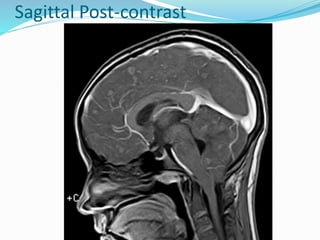
Sagittal Post-contrast
Natural history & prognosis of CNS Tuberculoma
 Long term morbidity
 Mental retardation
 Paralysis
 Seizures
 Rigidity
 Mortality high in immunocompromised patients
 Complications
 Hydrocephalus
 Stroke
 Cranial neuropathies
 Tuberculomas may take months to years to resolve
Tuberculoma Tubercular
Abscess
Central core Caseating necrosis
surrounded by
granulomatous
reaction.
No DWI restriction
Pus.
So DWI restriction.
Peripheral rim Comparatively thin Comparatively thicker
Mycobacterium
Tuberculosis
May or may not
present
Must be present
Differentials for ring-enhancing lesions in CNS
 Common
 Some primary brain tumor (e.g. anaplastic astrocytoma)
 Metastatic brain tumor
 Abscess
 Granuloma
 Resolving hematoma
 Subacute infarct
 Less common
 Thrombosed vascular malformation
 Demyelinating disease (e.g. multiple sclerosis)
 Uncommon
 Thrombosed aneurysm
 CNS lymphoma in AIDS
Differentials for CNS Tuberculomas
 Abscess
 Metastases
 Neurocysticercosis
 Meningioma (Dural tuberculomas)
Neurocysticercosis
 Common site – Subarachnoid> Parenchyma > Intraventricular
(GM-WM junction)
 4 pathological stages
 Vesicular
 Colloid vesicular
 Granular nodular
 Nodular calcified
 Variable time to progress through pathological stages = 1-9 yrs.
 Ring enhancing lesion with an eccentric hypodense dot (scolex)
is typical for NCC
 NCC lesions follow CSF density/intensity in vesicular & colloid
vesicular stages and are rim enhancing in granular nodular stage
and calcified in nodular calcified stage.
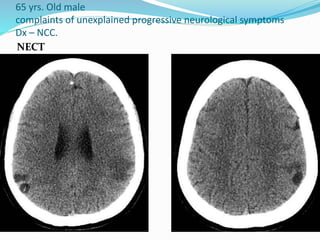
65 yrs. Old male
complaints of unexplained progressive neurological symptoms
Dx – NCC.
NECT
T1
FLAIR
Post-contrast
Vesicular & colloid vesicular stage
Brain Parenchymal metastases
 Patient may have known primary site
 Common location – GM-WM junction
 Metastases usually displace rather than infiltrate tissue
 Disproportionate edema and mass effect
 On DWI, most metastases do not restrict, but often
have a high nuclear to cytoplasm ratio and sometimes
show restricted diffusion
 Post-contrast
 Pattern varies = intense/punctate/nodular/ring enhancement.
 MRS
 Elevated choline
 Lipid/lactate peak often present
 80-85% lack Creatine peak
 Reduced NAA peak
Cerebral abscess
 Has 4 pathological stages
 Early cerebritis
 Late cerebritis
 Early capsule
 Late capsule
 T2WI
 Hypointense rim is typical (due to collagen)
 SWI
 Dual rim sign is typical
 Hyperintense inside & hypointense outside
 DWI
 Shows restriction
 MRS
 Central necrotic area may show peaks of amino acids,
lactate, acetate & succinate.
T1
T1 T2
FLA
IR
T1C+ T1C+
25 yrs. male with headache
Case of Cerebral Abscess
THANK YOU

Cns tuberculoma

  • 1.
  • 2.
    Mycobacterium Tuberculosis Pulmonary tuberculosis Extra-pulmonarytuberculosis  TB Lymphadenitis  Pleural TB  Skeletal TB (Bones & Joints)  CNS TB – 1% of all Tuberculosis  Abdominal TB  Genitourinary TB  Pericardial TB
  • 3.
  • 4.
    Intracranial tuberculoma  CNSTB almost always secondary to hematogenous spread  Tuberculoma can occur either in association with meningitis or separately  Tuberculoma  are well defined focal masses that result from Mycobacterium Tuberculosis with central caseous necrotic core  Etiology / Pathophysiology  Hematogenous spread (gray-white matter junction lesions)  Extension of meningitis into parenchyma
  • 5.
    Clinical feature  Symptomsand signs are non-specific  Include  Headache  Fever  Vomiting  Seizures  Neurological deficits e.g. altered sensorium, hemiparesis
  • 6.
    Location  Parenchyma (Supra/Infratentorial) Dural  Subarachnoid space  Brainstem infrequent, 2.5-8 % of intracranial tuberculomas.  Size  1mm-6cm
  • 7.
    Pathology  3 stages Area of cerebritis – focal non-caseating granuloma – caseation occurs later  Histologically it consists of a central core of caseating necrosis with a surrounding wall of a florid granulomatous reaction containing Langerhans giant cells, epithelioid, histiocytes and lymphocytes  Unlike tuberculous abscesses, organisms are uncommon or absent  Usually, tuberculomas have a solid granulomatous core and some may undergo liquefaction
  • 8.
    CSF Analysis  Increasedprotein  Increased lymphocyte count  Low glucose  May be negative for organisms
  • 9.
    Imaging modalities  CTScan  MRI  MRS
  • 10.
    CT Scan  NECT Non-caseating granuloma –isodense or mildly hyperdense, surrounded by perilesional low- density edema.  Caseating granuloma – isodense or slightly hypodense, edema remains.  CECT  Non-caseating granuloma – dense nodular enhancement  Caseating granuloma – ring enhancement. Target sign may be found in some cases, central area of enhancement surrounded by area of low attenuation then peripheral rim enhancement.
  • 11.
    MRI  T1WI  Non-caseating– Iso/Hypointense  Caseating granuloma  Solid centre – hypo/isointense  Necrotic centre – hypointense  Rim – may be hyperintense  T2WI  Non-caseating – hyperintense  Caseating granuloma  Solid centre – hypointense  Necrotic centre – hyperintense  Rim - hypointense
  • 12.
    Continue….  FLAIR  Sameas T2WI  DWI  Usually shows no restriction  May show hyperintense centre of tuberculoma  Post-contrast  Non-caseating granuloma – Nodular homogenous enhancement  Caseating granuloma – Peripheral rim enhancement  MRS  Prominent lipid and lactate peaks  Reduced NAA  No amino acid
  • 13.
    Case of 32yrs. Old male with complaints of headache, vomiting, seizures and blurred vision T1WI
  • 14.
  • 15.
  • 16.
  • 17.
    Case of Tuberculoma+ Meningitis 31 yrs. Old with complaints fever & seizures for 15 days FLAIR POST-CONTRAST
  • 18.
    Tuberculomas with bothnodular and ring enhancing lesions in same patient
  • 19.
    6 yrs. Oldgirl Complaints of headache & deterioration of consciousness Dx- CNS military tuberculomas T2
  • 20.
  • 21.
  • 22.
  • 23.
    Natural history &prognosis of CNS Tuberculoma  Long term morbidity  Mental retardation  Paralysis  Seizures  Rigidity  Mortality high in immunocompromised patients  Complications  Hydrocephalus  Stroke  Cranial neuropathies  Tuberculomas may take months to years to resolve
  • 24.
    Tuberculoma Tubercular Abscess Central coreCaseating necrosis surrounded by granulomatous reaction. No DWI restriction Pus. So DWI restriction. Peripheral rim Comparatively thin Comparatively thicker Mycobacterium Tuberculosis May or may not present Must be present
  • 25.
    Differentials for ring-enhancinglesions in CNS  Common  Some primary brain tumor (e.g. anaplastic astrocytoma)  Metastatic brain tumor  Abscess  Granuloma  Resolving hematoma  Subacute infarct  Less common  Thrombosed vascular malformation  Demyelinating disease (e.g. multiple sclerosis)  Uncommon  Thrombosed aneurysm  CNS lymphoma in AIDS
  • 26.
    Differentials for CNSTuberculomas  Abscess  Metastases  Neurocysticercosis  Meningioma (Dural tuberculomas)
  • 27.
    Neurocysticercosis  Common site– Subarachnoid> Parenchyma > Intraventricular (GM-WM junction)  4 pathological stages  Vesicular  Colloid vesicular  Granular nodular  Nodular calcified  Variable time to progress through pathological stages = 1-9 yrs.  Ring enhancing lesion with an eccentric hypodense dot (scolex) is typical for NCC  NCC lesions follow CSF density/intensity in vesicular & colloid vesicular stages and are rim enhancing in granular nodular stage and calcified in nodular calcified stage.
  • 28.
    65 yrs. Oldmale complaints of unexplained progressive neurological symptoms Dx – NCC. NECT
  • 29.
  • 30.
  • 31.
  • 32.
    Brain Parenchymal metastases Patient may have known primary site  Common location – GM-WM junction  Metastases usually displace rather than infiltrate tissue  Disproportionate edema and mass effect  On DWI, most metastases do not restrict, but often have a high nuclear to cytoplasm ratio and sometimes show restricted diffusion  Post-contrast  Pattern varies = intense/punctate/nodular/ring enhancement.  MRS  Elevated choline  Lipid/lactate peak often present  80-85% lack Creatine peak  Reduced NAA peak
  • 33.
    Cerebral abscess  Has4 pathological stages  Early cerebritis  Late cerebritis  Early capsule  Late capsule  T2WI  Hypointense rim is typical (due to collagen)  SWI  Dual rim sign is typical  Hyperintense inside & hypointense outside  DWI  Shows restriction  MRS  Central necrotic area may show peaks of amino acids, lactate, acetate & succinate.
  • 34.
    T1 T1 T2 FLA IR T1C+ T1C+ 25yrs. male with headache Case of Cerebral Abscess
  • 36.

Editor's Notes

  • #36 Culture showed gram positive cocci