2
Acknowledgement
This lectureuses some contents from:
Dr. Erik Poll : software security
Dr. Dawn Song: CS161: computer security
Buffer Overflow Prevention
Buffer Overflow
Dr. Ninghui Li: CS426: Computer Security
3.
3
The Problem
void foo(char*s) {
char buf[10];
strcpy(buf,s);
printf(“buf is %sn”,s);
}
…
foo(“thisstringistolongforfoo”);
4.
4
Exploitation
The generalidea is to give servers very large
strings that will overflow a buffer.
For a server with sloppy code – it’s easy to
crash the server by overflowing a buffer.
It’s sometimes possible to actually make the
server do whatever you want (instead of
crashing).
5.
5
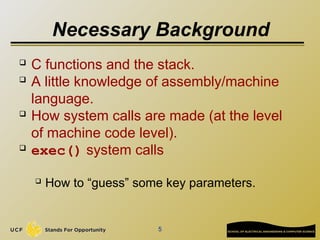
Necessary Background
Cfunctions and the stack.
A little knowledge of assembly/machine
language.
How system calls are made (at the level
of machine code level).
exec() system calls
How to “guess” some key parameters.
6.
6
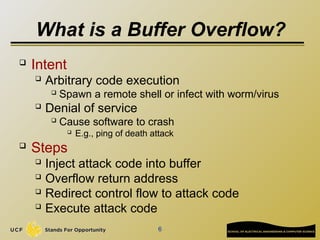
What is aBuffer Overflow?
Intent
Arbitrary code execution
Spawn a remote shell or infect with worm/virus
Denial of service
Cause software to crash
E.g., ping of death attack
Steps
Inject attack code into buffer
Overflow return address
Redirect control flow to attack code
Execute attack code
7.
7
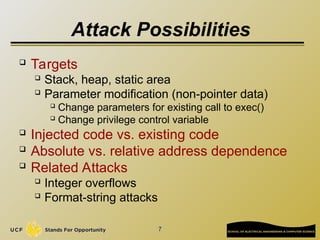
Attack Possibilities
Targets
Stack, heap, static area
Parameter modification (non-pointer data)
Change parameters for existing call to exec()
Change privilege control variable
Injected code vs. existing code
Absolute vs. relative address dependence
Related Attacks
Integer overflows
Format-string attacks
10
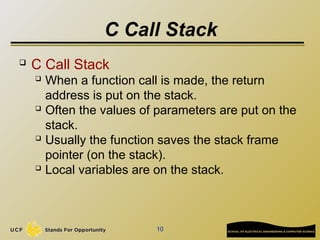
C Call Stack
C Call Stack
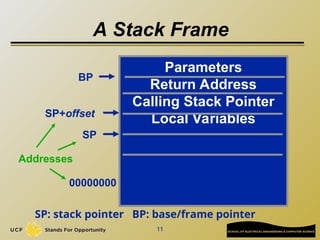
When a function call is made, the return
address is put on the stack.
Often the values of parameters are put on the
stack.
Usually the function saves the stack frame
pointer (on the stack).
Local variables are on the stack.
11.
11
A Stack Frame
Parameters
ReturnAddress
Calling Stack Pointer
Local Variables
00000000
Addresses
SP
SP+offset
SP: stack pointer BP: base/frame pointer
BP
13
“Smashing the Stack”*
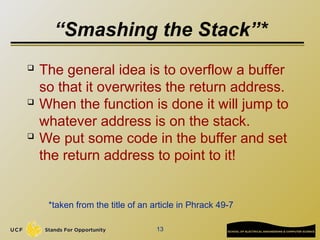
The general idea is to overflow a buffer
so that it overwrites the return address.
When the function is done it will jump to
whatever address is on the stack.
We put some code in the buffer and set
the return address to point to it!
*taken from the title of an article in Phrack 49-7
14.
14
Before and After
voidfoo(char *s) {
char buf[100];
strcpy(buf,s);
…
address of s
return-address
saved sp
buf
address of s
pointer to pgm
Small Program
17
Example: strcpy()
char dest[20];
strcpy(dest,src); // copies string src to
dest
strcpy assumes dest is long enough ,
and assumes src is null-terminated
Use strncpy(dest, src, size) instead
18.
18
Spot the defect!(1)
char buf[20];
char prefix[] = ”http://”;
...
strcpy(buf, prefix);
// copies the string prefix to buf
strncat(buf, path, sizeof(buf));
// concatenates path to the string buf
19.
19
Spot the defect!(1)
char buf[20];
char prefix[] = ”http://”;
...
strcpy(buf, prefix);
// copies the string prefix to buf
strncat(buf, path, sizeof(buf));
// concatenates path to the string buf
strncat’s 3rd parameter is number of
chars to copy, not the buffer size
Another common mistake is giving sizeof(path) as 3rd
argument...
20.
20
Spot the defect!(2)
char src[9];
char dest[9];
char base_url = ”www.ru.nl”;
strncpy(src, base_url, 9);
// copies base_url to src
strcpy(dest, src);
// copies src to dest
base_url is 10 chars long, incl. its
null terminator, so src won’t be
not null-terminated
so strcpy will overrun the buffer dest
21.
21
Example: strcpy andstrncpy
Don’t replace strcpy(dest, src) by
strncpy(dest, src, sizeof(dest))
but by
strncpy(dest, src, sizeof(dest)-1)
dest[sizeof(dest)-1] = `0`;
if dest should be null-terminated!
A strongly typed programming language could
of course enforce that strings are always null-
terminated...
22.
22
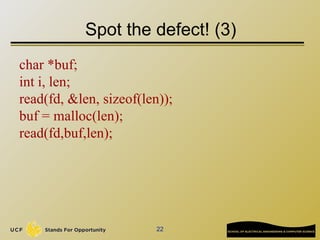
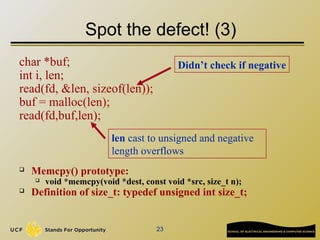
Spot the defect!(3)
char *buf;
int i, len;
read(fd, &len, sizeof(len));
buf = malloc(len);
read(fd,buf,len);
23.
23
Spot the defect!(3)
char *buf;
int i, len;
read(fd, &len, sizeof(len));
buf = malloc(len);
read(fd,buf,len);
Memcpy() prototype:
void *memcpy(void *dest, const void *src, size_t n);
Definition of size_t: typedef unsigned int size_t;
Didn’t check if negative
len cast to unsigned and negative
length overflows
24.
24
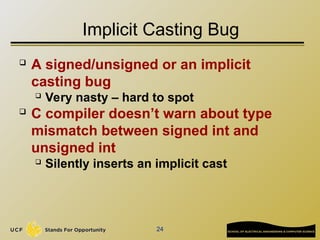
Implicit Casting Bug
A signed/unsigned or an implicit
casting bug
Very nasty – hard to spot
C compiler doesn’t warn about type
mismatch between signed int and
unsigned int
Silently inserts an implicit cast
25.
25
Spot the defect!(4)
char *buf;
int i, len;
read(fd, &len, sizeof(len));
if (len < 0)
{error ("negative length"); return; }
buf = malloc(len+5);
read(fd,buf,len);
buf[len] = '0'; // null terminate buf
May results in integer overflow
26.
26
Spot the defect!(5)
#define MAX_BUF = 256
void BadCode (char* input)
{ short len;
char buf[MAX_BUF];
len = strlen(input);
if (len < MAX_BUF) strcpy(buf,input);
} What if input is longer than 32K ?
len will be a negative number,
due to integer overflow
hence: potential buffer overflow
27.
27
Spot the defect!(6)
char buff1[MAX_SIZE], buff2[MAX_SIZE];
// make sure it’s a valid URL and will fit
if (! isValid(url)) return;
if (strlen(url) > MAX_SIZE – 1) return;
// copy url up to first separator, ie. first ’/’, to buff1
out = buff1;
do {
// skip spaces
if (*url != ’ ’) *out++ = *url;
} while (*url++ != ’/’);
strcpy(buff2, buff1);
...
what if there is no ‘/’ in the URL?
Loop termination (exploited by Blaster worm)
28.
28
Spot the defect!(7)
#include <stdio.h>
int main(int argc, char* argv[])
{ if (argc > 1)
printf(argv[1]);
return 0;
}
This program is vulnerable to format string attacks,
where calling the program with strings containing
special characters can result in a buffer overflow
attack.
29.
29
Format String Attacks
int printf(const char *format [, argument]…);
snprintf, wsprintf …
What may happen if we execute
printf(string);
Where string is user-supplied ?
If it contains special characters, eg %s, %x,
%n, %hn?
30.
Format String Attacks
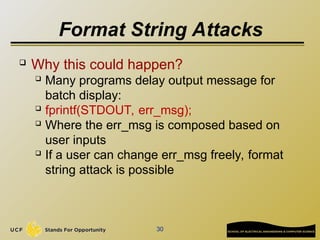
Why this could happen?
Many programs delay output message for
batch display:
fprintf(STDOUT, err_msg);
Where the err_msg is composed based on
user inputs
If a user can change err_msg freely, format
string attack is possible
30
31.
31
Format String Attacks
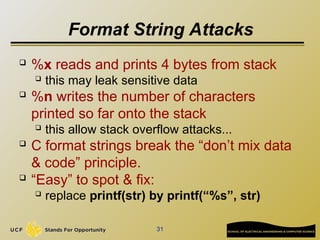
%x reads and prints 4 bytes from stack
this may leak sensitive data
%n writes the number of characters
printed so far onto the stack
this allow stack overflow attacks...
C format strings break the “don’t mix data
& code” principle.
“Easy” to spot & fix:
replace printf(str) by printf(“%s”, str)
32.
Use Unix Machinein Department
The Unix machine: eustis.eecs.ucf.edu
Must use SSH to connect
Find free SSH clients on Internet
E.g., Putty (command line based)
http://en.wikipedia.org/wiki/Ssh_client
Find a GUI-based SSH client
Username: NID
Default password:
the first initial of your last name in uppercase
and the last 5 digits of your PID
32
33.
33
Example of “%x”--- Memory leaking
#include <stdio.h>
void main(int argc, char **argv){
int a1=1; int a2=2;
int a3=3; int a4=4;
printf(argv[1]);
}
czou@:~$ ./test
czou@eustis:~$ ./test "what is this?"
what is this?czou@eustis:~$
czou@eustis:~$
czou@eustis:~$ ./test "%x %x %x %x %x %x"
4 3 2 1 bfc994b0 bfc99508czou@eustis:~$
czou@eustis:~$
Bfc994b0: saved stack pointer
Bfc99508: return address
34.
#include <stdio.h>
void foo(char*format){
int a1=11; int a2=12;
int a3=13; int a4=14;
printf(format);
}
void main(int argc, char **argv){
foo(argv[1]);
printf("n");
}
$./format-x-subfun "%x %x %x %x : %x, %x, %x "
80495bc e d c : b, bffff7e8, 80483f4
34
Return address
Four variables
35.
35
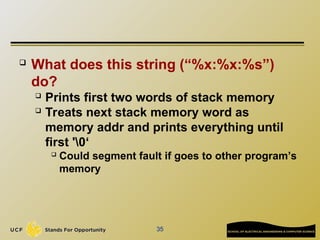
What doesthis string (“%x:%x:%s”)
do?
Prints first two words of stack memory
Treats next stack memory word as
memory addr and prints everything until
first '0‘
Could segment fault if goes to other program’s
memory
36.
36
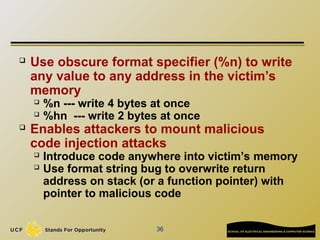
Use obscureformat specifier (%n) to write
any value to any address in the victim’s
memory
%n --- write 4 bytes at once
%hn --- write 2 bytes at once
Enables attackers to mount malicious
code injection attacks
Introduce code anywhere into victim’s memory
Use format string bug to overwrite return
address on stack (or a function pointer) with
pointer to malicious code
37.
Example of “%n”----write data in memory
#include <stdio.h>
void main(int argc, char **argv){
int bytes;
printf(“%s%nn”, argv[1], &bytes);
printf(“You input %d charactersn”, bytes);
}
czou@eustis:~$./test hello
hello
You input 5 characters
37
38.
Function Pointer Overwritten
Function pointers: (used in attack on PHP
4.0.2)
Overflowing buf will override function pointer.
Harder to defend than return-address
overflow attacks
38
High addr.
Of stack
buf[128] FuncPtr
39.
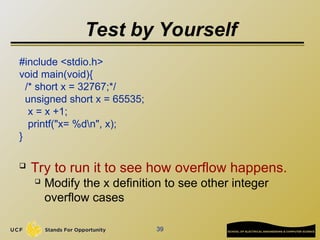
Test by Yourself
#include<stdio.h>
void main(void){
/* short x = 32767;*/
unsigned short x = 65535;
x = x +1;
printf("x= %dn", x);
}
Try to run it to see how overflow happens.
Modify the x definition to see other integer
overflow cases
39
40.
Two Techniques forGenerating
Stack Overflow Codes
They make attacking relatively easier
41.
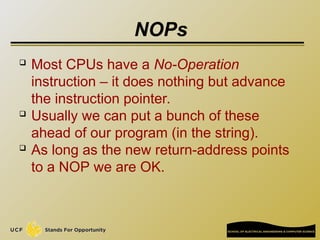
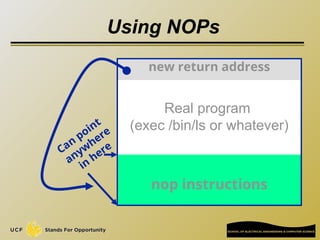
NOPs
Most CPUshave a No-Operation
instruction – it does nothing but advance
the instruction pointer.
Usually we can put a bunch of these
ahead of our program (in the string).
As long as the new return-address points
to a NOP we are OK.
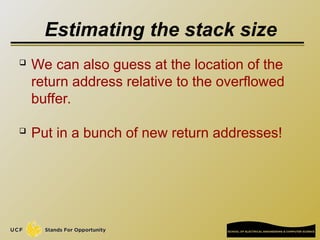
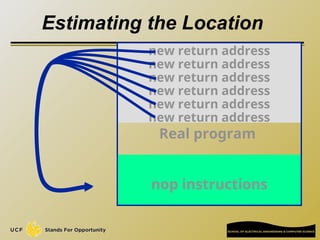
Estimating the stacksize
We can also guess at the location of the
return address relative to the overflowed
buffer.
Put in a bunch of new return addresses!
44.
Estimating the Location
Realprogram
new return address
nop instructions
new return address
new return address
new return address
new return address
new return address
45.
Attack Code inStack Overflow
45
Most Stack Overflow attacks use “shell code” as the
attacking code
Shell code is small (< 100 bytes)
Attacker will obtain a shell (remote login) for
arbitrary command executation
Remote login without password or account
Shell generated is mostly root previlieged (has the
same previlege as the compromised program)
Additional attacking codes can be downloaded from
the shell created
Most Internet worms use this way
![3
The Problem
void foo(char *s) {
char buf[10];
strcpy(buf,s);
printf(“buf is %sn”,s);
}
…
foo(“thisstringistolongforfoo”);](https://image.slidesharecdn.com/ch03-bufferoverflow-attack-251203011512-2147877f/85/Ch03-bufferOverFlow-attack-Ch03-bufferOverFlow-attack-ppt-ppt-3-320.jpg)

![12
Sample
Stack
18
addressof(y=3) return address
saved stack pointer
buf
y
x
x=2;
foo(18);
y=3;
void foo(int j) {
int x,y;
char buf[100];
x=j;
…
}](https://image.slidesharecdn.com/ch03-bufferoverflow-attack-251203011512-2147877f/85/Ch03-bufferOverFlow-attack-Ch03-bufferOverFlow-attack-ppt-ppt-12-320.jpg)
![14
Before and After
void foo(char *s) {
char buf[100];
strcpy(buf,s);
…
address of s
return-address
saved sp
buf
address of s
pointer to pgm
Small Program](https://image.slidesharecdn.com/ch03-bufferoverflow-attack-251203011512-2147877f/85/Ch03-bufferOverFlow-attack-Ch03-bufferOverFlow-attack-ppt-ppt-14-320.jpg)
![16
Example: gets()
char buf[20];
gets(buf); // read user input until
// first EoL or EoF character
Never use gets
Use fgets(buf, size, stdout) instead](https://image.slidesharecdn.com/ch03-bufferoverflow-attack-251203011512-2147877f/85/Ch03-bufferOverFlow-attack-Ch03-bufferOverFlow-attack-ppt-ppt-16-320.jpg)
![17
Example: strcpy()
char dest[20];
strcpy(dest, src); // copies string src to
dest
strcpy assumes dest is long enough ,
and assumes src is null-terminated
Use strncpy(dest, src, size) instead](https://image.slidesharecdn.com/ch03-bufferoverflow-attack-251203011512-2147877f/85/Ch03-bufferOverFlow-attack-Ch03-bufferOverFlow-attack-ppt-ppt-17-320.jpg)
![18
Spot the defect! (1)
char buf[20];
char prefix[] = ”http://”;
...
strcpy(buf, prefix);
// copies the string prefix to buf
strncat(buf, path, sizeof(buf));
// concatenates path to the string buf](https://image.slidesharecdn.com/ch03-bufferoverflow-attack-251203011512-2147877f/85/Ch03-bufferOverFlow-attack-Ch03-bufferOverFlow-attack-ppt-ppt-18-320.jpg)
![19
Spot the defect! (1)
char buf[20];
char prefix[] = ”http://”;
...
strcpy(buf, prefix);
// copies the string prefix to buf
strncat(buf, path, sizeof(buf));
// concatenates path to the string buf
strncat’s 3rd parameter is number of
chars to copy, not the buffer size
Another common mistake is giving sizeof(path) as 3rd
argument...](https://image.slidesharecdn.com/ch03-bufferoverflow-attack-251203011512-2147877f/85/Ch03-bufferOverFlow-attack-Ch03-bufferOverFlow-attack-ppt-ppt-19-320.jpg)
![20
Spot the defect! (2)
char src[9];
char dest[9];
char base_url = ”www.ru.nl”;
strncpy(src, base_url, 9);
// copies base_url to src
strcpy(dest, src);
// copies src to dest
base_url is 10 chars long, incl. its
null terminator, so src won’t be
not null-terminated
so strcpy will overrun the buffer dest](https://image.slidesharecdn.com/ch03-bufferoverflow-attack-251203011512-2147877f/85/Ch03-bufferOverFlow-attack-Ch03-bufferOverFlow-attack-ppt-ppt-20-320.jpg)
![21
Example: strcpy and strncpy
Don’t replace strcpy(dest, src) by
strncpy(dest, src, sizeof(dest))
but by
strncpy(dest, src, sizeof(dest)-1)
dest[sizeof(dest)-1] = `0`;
if dest should be null-terminated!
A strongly typed programming language could
of course enforce that strings are always null-
terminated...](https://image.slidesharecdn.com/ch03-bufferoverflow-attack-251203011512-2147877f/85/Ch03-bufferOverFlow-attack-Ch03-bufferOverFlow-attack-ppt-ppt-21-320.jpg)
![25
Spot the defect! (4)
char *buf;
int i, len;
read(fd, &len, sizeof(len));
if (len < 0)
{error ("negative length"); return; }
buf = malloc(len+5);
read(fd,buf,len);
buf[len] = '0'; // null terminate buf
May results in integer overflow](https://image.slidesharecdn.com/ch03-bufferoverflow-attack-251203011512-2147877f/85/Ch03-bufferOverFlow-attack-Ch03-bufferOverFlow-attack-ppt-ppt-25-320.jpg)
![26
Spot the defect! (5)
#define MAX_BUF = 256
void BadCode (char* input)
{ short len;
char buf[MAX_BUF];
len = strlen(input);
if (len < MAX_BUF) strcpy(buf,input);
} What if input is longer than 32K ?
len will be a negative number,
due to integer overflow
hence: potential buffer overflow](https://image.slidesharecdn.com/ch03-bufferoverflow-attack-251203011512-2147877f/85/Ch03-bufferOverFlow-attack-Ch03-bufferOverFlow-attack-ppt-ppt-26-320.jpg)
![27
Spot the defect! (6)
char buff1[MAX_SIZE], buff2[MAX_SIZE];
// make sure it’s a valid URL and will fit
if (! isValid(url)) return;
if (strlen(url) > MAX_SIZE – 1) return;
// copy url up to first separator, ie. first ’/’, to buff1
out = buff1;
do {
// skip spaces
if (*url != ’ ’) *out++ = *url;
} while (*url++ != ’/’);
strcpy(buff2, buff1);
...
what if there is no ‘/’ in the URL?
Loop termination (exploited by Blaster worm)](https://image.slidesharecdn.com/ch03-bufferoverflow-attack-251203011512-2147877f/85/Ch03-bufferOverFlow-attack-Ch03-bufferOverFlow-attack-ppt-ppt-27-320.jpg)
![28
Spot the defect! (7)
#include <stdio.h>
int main(int argc, char* argv[])
{ if (argc > 1)
printf(argv[1]);
return 0;
}
This program is vulnerable to format string attacks,
where calling the program with strings containing
special characters can result in a buffer overflow
attack.](https://image.slidesharecdn.com/ch03-bufferoverflow-attack-251203011512-2147877f/85/Ch03-bufferOverFlow-attack-Ch03-bufferOverFlow-attack-ppt-ppt-28-320.jpg)
![29
Format String Attacks
int printf(const char *format [, argument]…);
snprintf, wsprintf …
What may happen if we execute
printf(string);
Where string is user-supplied ?
If it contains special characters, eg %s, %x,
%n, %hn?](https://image.slidesharecdn.com/ch03-bufferoverflow-attack-251203011512-2147877f/85/Ch03-bufferOverFlow-attack-Ch03-bufferOverFlow-attack-ppt-ppt-29-320.jpg)
![33
Example of “%x” --- Memory leaking
#include <stdio.h>
void main(int argc, char **argv){
int a1=1; int a2=2;
int a3=3; int a4=4;
printf(argv[1]);
}
czou@:~$ ./test
czou@eustis:~$ ./test "what is this?"
what is this?czou@eustis:~$
czou@eustis:~$
czou@eustis:~$ ./test "%x %x %x %x %x %x"
4 3 2 1 bfc994b0 bfc99508czou@eustis:~$
czou@eustis:~$
Bfc994b0: saved stack pointer
Bfc99508: return address](https://image.slidesharecdn.com/ch03-bufferoverflow-attack-251203011512-2147877f/85/Ch03-bufferOverFlow-attack-Ch03-bufferOverFlow-attack-ppt-ppt-33-320.jpg)
![#include <stdio.h>
void foo(char *format){
int a1=11; int a2=12;
int a3=13; int a4=14;
printf(format);
}
void main(int argc, char **argv){
foo(argv[1]);
printf("n");
}
$./format-x-subfun "%x %x %x %x : %x, %x, %x "
80495bc e d c : b, bffff7e8, 80483f4
34
Return address
Four variables](https://image.slidesharecdn.com/ch03-bufferoverflow-attack-251203011512-2147877f/85/Ch03-bufferOverFlow-attack-Ch03-bufferOverFlow-attack-ppt-ppt-34-320.jpg)
![Example of “%n”---- write data in memory
#include <stdio.h>
void main(int argc, char **argv){
int bytes;
printf(“%s%nn”, argv[1], &bytes);
printf(“You input %d charactersn”, bytes);
}
czou@eustis:~$./test hello
hello
You input 5 characters
37](https://image.slidesharecdn.com/ch03-bufferoverflow-attack-251203011512-2147877f/85/Ch03-bufferOverFlow-attack-Ch03-bufferOverFlow-attack-ppt-ppt-37-320.jpg)
![Function Pointer Overwritten
Function pointers: (used in attack on PHP
4.0.2)
Overflowing buf will override function pointer.
Harder to defend than return-address
overflow attacks
38
High addr.
Of stack
buf[128] FuncPtr](https://image.slidesharecdn.com/ch03-bufferoverflow-attack-251203011512-2147877f/85/Ch03-bufferOverFlow-attack-Ch03-bufferOverFlow-attack-ppt-ppt-38-320.jpg)
![Linux Shell Code
46
Testshell.c:
static char shellcode[] =
"xebx1fx5ex89x76x08x31xc0x88x46x07x89x46x0cxb0
x0bx89xf3x8dx4ex08x8dx56x0cxcdx80x31xdbx89xd8x40
xcdx80xe8xdcxffxffxff/bin/sh";
int main(void)
{
void (*code)() = (void *)shellcode;
//printf("Shellcode length: %dn", strlen(shellcode));
code();
return 0;
}](https://image.slidesharecdn.com/ch03-bufferoverflow-attack-251203011512-2147877f/85/Ch03-bufferOverFlow-attack-Ch03-bufferOverFlow-attack-ppt-ppt-46-320.jpg)


