ENGINEERING
THERMODYNAMICS
Feel the heat…….
Unit – 1 Basic concept and first law
ENGINEERING THERMODYNAMICS?
ENGINEERING + THERMODYNAMICS
ENGINEERING-BRANCH OF SCIENCE- ENVIRONMENT
THERMODYNAMICS = THERMAL+ DYNAMICS
(HEAT) (POWER)
HEAT – Kind of energy transfer- Temp. difference
POWER- Capable to work
THERMODYNAMICS- Science of energy and energy transfer
2
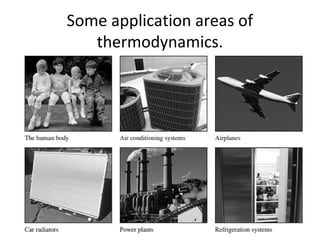
Some application areas of
thermodynamics.
3
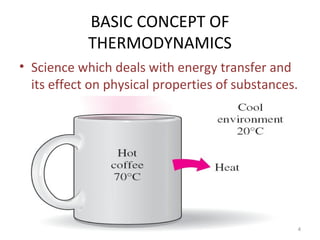
BASIC CONCEPT OF
THERMODYNAMICS
• Science which deals with energy transfer and
its effect on physical properties of substances.
4
• Macroscopic or Classical Approach:
• It is not concerned with the behavior of
individual molecules.
• These effects can be perceived by human senses
or measured by instruments
Eg: pressure, temperature
• Microscopic or Statistical Approach:
• Based on the average behavior of large groups
of individual particles.
• the effect of molecular motion is Considered.
5
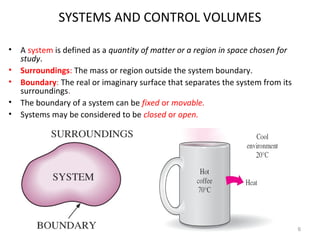
SYSTEMS AND CONTROL VOLUMES
• A system is defined as a quantity of matter or a region in space chosen for
study.
• Surroundings: The mass or region outside the system boundary.
• Boundary: The real or imaginary surface that separates the system from its
surroundings.
• The boundary of a system can be fixed or movable.
• Systems may be considered to be closed or open.
6
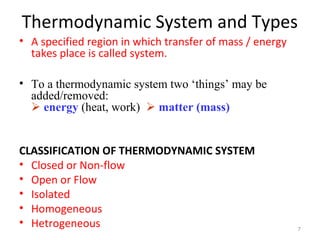
Thermodynamic System and Types
• A specified region in which transfer of mass / energy
takes place is called system.
• To a thermodynamic system two ‘things’ may be
added/removed:
 energy (heat, work)  matter (mass)
CLASSIFICATION OF THERMODYNAMIC SYSTEM
• Closed or Non-flow
• Open or Flow
• Isolated
• Homogeneous
• Hetrogeneous 7
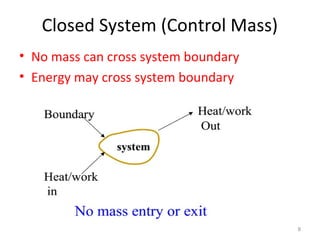
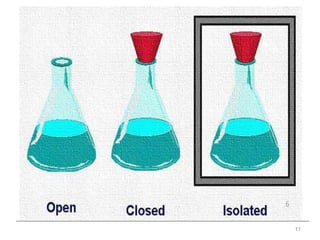
Closed System (Control Mass)
• No mass can cross system boundary
• Energy may cross system boundary
8
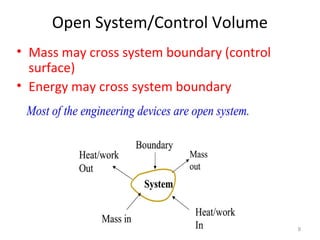
Open System/Control Volume
• Mass may cross system boundary (control
surface)
• Energy may cross system boundary
9
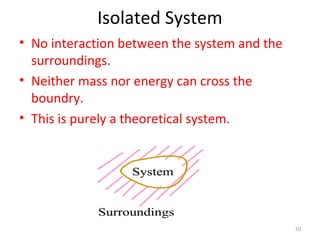
Isolated System
• No interaction between the system and the
surroundings.
• Neither mass nor energy can cross the
boundry.
• This is purely a theoretical system.
10
11
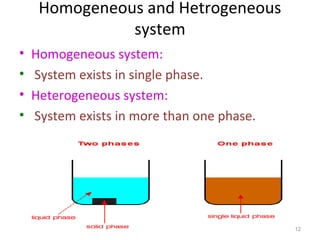
Homogeneous and Hetrogeneous
system
• Homogeneous system:
• System exists in single phase.
• Heterogeneous system:
• System exists in more than one phase.
12
THERMODYNAMIC PROPERTIES
• MASS – quantity of matter
• WEIGHT - force exerted on a body by gravity
• VOLUME – space occupied by matter
• SPECIFIC VOLUME – volume per unit mass
• SPECIFIC WEIGHT – weight per unit volume
• DENSITY – mass per volume of substance
• TEMPERATURE – degree of hotness or coldness
• PRESSURE - force exerted per unit area
• SPECIFIC HEAT – energy required to raise or lower temp.
of substance about 1 k or 1°C
• INTERNAL ENERGY – energy contain within system
• WORK – kind of energy transfer – acting force- flow
direction
• HEAT- kind of energy transfer – temp difference
• ENTHALPY – total energy of the system (I.E + F.W)
13
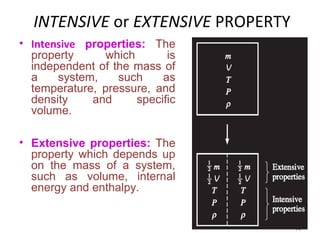
INTENSIVE or EXTENSIVE PROPERTY
• Intensive properties: The
property which is
independent of the mass of
a system, such as
temperature, pressure, and
density and specific
volume.
• Extensive properties: The
property which depends up
on the mass of a system,
such as volume, internal
energy and enthalpy.
14
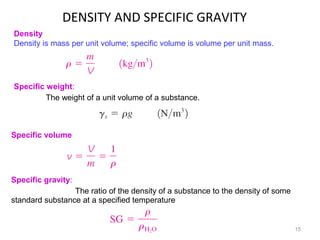
DENSITY AND SPECIFIC GRAVITY
15
Specific gravity:
The ratio of the density of a substance to the density of some
standard substance at a specified temperature
Density
Density is mass per unit volume; specific volume is volume per unit mass.
Specific weight:
The weight of a unit volume of a substance.
Specific volume
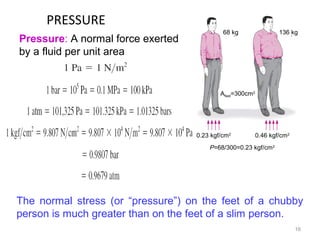
PRESSURE
16
The normal stress (or “pressure”) on the feet of a chubby
person is much greater than on the feet of a slim person.
Pressure: A normal force exerted
by a fluid per unit area
68 kg 136 kg
Afeet=300cm2
0.23 kgf/cm2
0.46 kgf/cm2
P=68/300=0.23 kgf/cm2
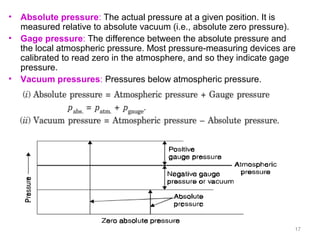
• Absolute pressure: The actual pressure at a given position. It is
measured relative to absolute vacuum (i.e., absolute zero pressure).
• Gage pressure: The difference between the absolute pressure and
the local atmospheric pressure. Most pressure-measuring devices are
calibrated to read zero in the atmosphere, and so they indicate gage
pressure.
• Vacuum pressures: Pressures below atmospheric pressure.
17
Conti…
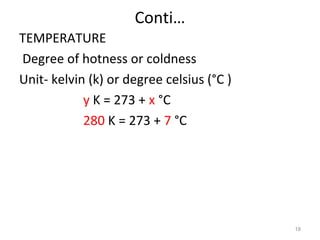
TEMPERATURE
Degree of hotness or coldness
Unit- kelvin (k) or degree celsius (°C )
y K = 273 + x °C
280 K = 273 + 7 °C
18
Specific Heat Capacity
• Quantity of heat required to raise the
temperature of unit mass of the material
through one degree celsius.
• Specific Heat at constant pressure( Cp)
• Specific Heat at constant volume (Cv)
• Cp=1.003 kJ/kg-K
• Cv= 0.71 kJ/kg-K for air.
UNIVERSAL RU = Cp - Cv
19
STATE, PROCESSES AND CYCLES
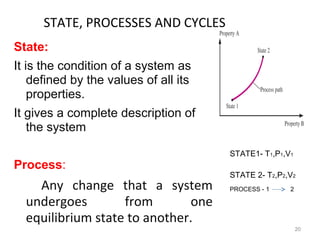
State:
It is the condition of a system as
defined by the values of all its
properties.
It gives a complete description of
the system
Process:
Any change that a system
undergoes from one
equilibrium state to another.
20
STATE1- T1,P1,V1
STATE 2- T2,P2,V2
PROCESS - 1 2
STATE AND EQUILIBRIUM
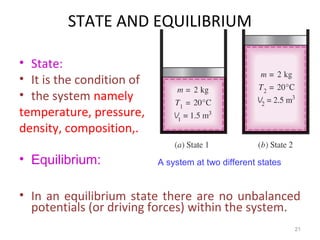
• State:
• It is the condition of
• the system namely
temperature, pressure,
density, composition,.
• Equilibrium:
• In an equilibrium state there are no unbalanced
potentials (or driving forces) within the system.
21
A system at two different states
STATE AND EQUILIBRIUM
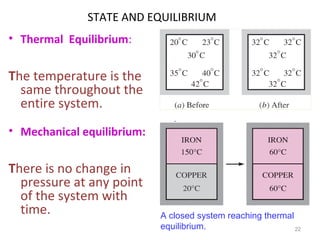
• Thermal Equilibrium:
The temperature is the
same throughout the
entire system.
• Mechanical equilibrium:
There is no change in
pressure at any point
of the system with
time.
22
A closed system reaching thermal
equilibrium.
.
STATE AND EQUILIBRIUM(Con…)
• Phase equilibrium:
• A system which is having two phases and
when the mass of each phase reaches an
equilibrium level.
• Chemical equilibrium:
• The chemical composition of a system does
not change with time, that is, no chemical
reactions occur.
23
Thermodynamic Cycle
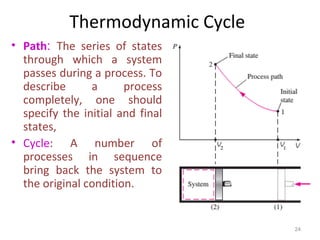
• Path: The series of states
through which a system
passes during a process. To
describe a process
completely, one should
specify the initial and final
states,
• Cycle: A number of
processes in sequence
bring back the system to
the original condition.
24
Quasistatic or quasi-equilibrium
process
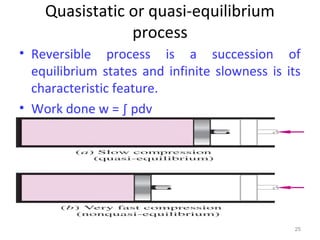
• Reversible process is a succession of
equilibrium states and infinite slowness is its
characteristic feature.
• Work done w = ∫ pdv
25
Zeroth Law
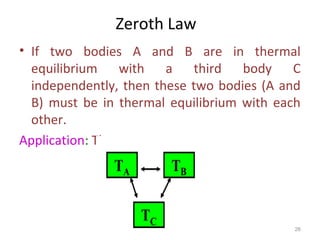
• If two bodies A and B are in thermal
equilibrium with a third body C
independently, then these two bodies (A and
B) must be in thermal equilibrium with each
other.
Application: Thermometer
26
Thermodynamic Work
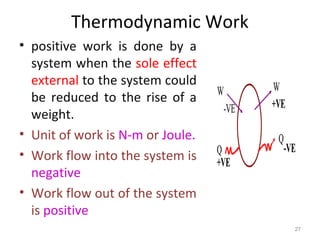
• positive work is done by a
system when the sole effect
external to the system could
be reduced to the rise of a
weight.
• Unit of work is N-m or Joule.
• Work flow into the system is
negative
• Work flow out of the system
is positive
27
Thermodynamic Heat
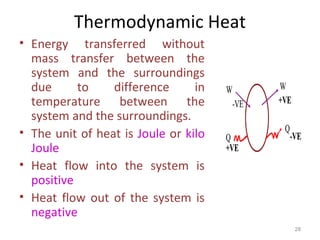
• Energy transferred without
mass transfer between the
system and the surroundings
due to difference in
temperature between the
system and the surroundings.
• The unit of heat is Joule or kilo
Joule
• Heat flow into the system is
positive
• Heat flow out of the system is
negative
28
Energy and Forms of Energy
• Energy:
• Capacity to do work
• Forms of Energy:
• Stored Energy
• Energy in transition form
29
Stored Energy(Con…)
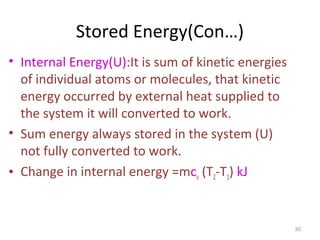
• Internal Energy(U):It is sum of kinetic energies
of individual atoms or molecules, that kinetic
energy occurred by external heat supplied to
the system it will converted to work.
• Sum energy always stored in the system (U)
not fully converted to work.
• Change in internal energy =mcv (T2-T1) kJ
30
Stored Energy(Con…)
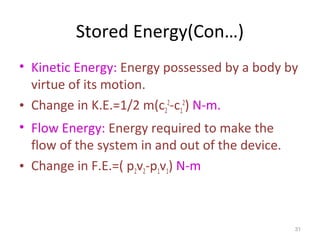
• Kinetic Energy: Energy possessed by a body by
virtue of its motion.
• Change in K.E.=1/2 m(c2
2
-c1
2
) N-m.
• Flow Energy: Energy required to make the
flow of the system in and out of the device.
• Change in F.E.=( p2v2-p1v1) N-m
31
Enthalpy(H)
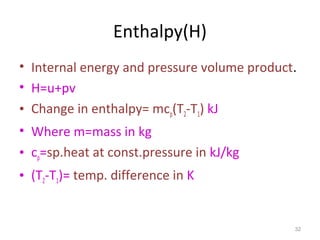
• Internal energy and pressure volume product.
• H=u+pv
• Change in enthalpy= mcp(T2-T1) kJ
• Where m=mass in kg
• cp=sp.heat at const.pressure in kJ/kg
• (T2-T1)= temp. difference in K
32
PATH and POINT FUNCTION
• If cyclic integral of a variable is not equal to
zero, then the variable is said to be a path
function.
• If cyclic integral of a variable is equal to zero,
then the variable is said to be a point
function.
33
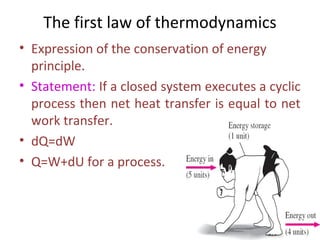
The first law of thermodynamics
• Expression of the conservation of energy
principle.
• Statement: If a closed system executes a cyclic
process then net heat transfer is equal to net
work transfer.
• dQ=dW
• Q=W+dU for a process.
34
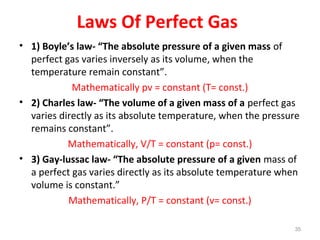
Laws Of Perfect Gas
• 1) Boyle’s law- “The absolute pressure of a given mass of
perfect gas varies inversely as its volume, when the
temperature remain constant”.
Mathematically pv = constant (T= const.)
• 2) Charles law- “The volume of a given mass of a perfect gas
varies directly as its absolute temperature, when the pressure
remains constant”.
Mathematically, V/T = constant (p= const.)
• 3) Gay-lussac law- “The absolute pressure of a given mass of
a perfect gas varies directly as its absolute temperature when
volume is constant.”
Mathematically, P/T = constant (v= const.)
35
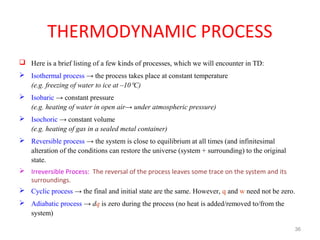
THERMODYNAMIC PROCESS
 Here is a brief listing of a few kinds of processes, which we will encounter in TD:
 Isothermal process → the process takes place at constant temperature
(e.g. freezing of water to ice at –10°C)
 Isobaric → constant pressure
(e.g. heating of water in open air→ under atmospheric pressure)
 Isochoric → constant volume
(e.g. heating of gas in a sealed metal container)
 Reversible process → the system is close to equilibrium at all times (and infinitesimal
alteration of the conditions can restore the universe (system + surrounding) to the original
state.
 Irreversible Process: The reversal of the process leaves some trace on the system and its
surroundings.
 Cyclic process → the final and initial state are the same. However, q and w need not be zero.
 Adiabatic process → dq is zero during the process (no heat is added/removed to/from the
system)
36
Thermodynamics processes
of Perfect Gas
1) Const. Volume/ isochoric process:
-Temperature and Pressure will increase
-No change in volume and No work done by gas
-Governed by Gay-Lussac law
2) Const. Pressure/ isobaric process:
- Temperature and volume will increase
- Increase in internal energy
- Governed by Charles law
3) Constant temperature/ isothermal process:
- No change in internal energy
- No change in Temperature
- Governed by Boyles law (p.v = constant)
37
Conti….
4) Adiabatic/ isentropic process:
- No heat leaves or enters the gas Q = 0,
- Temperature of the gas changes
- Change in internal energy is equal to the work done
5) isentropic process:
- Entropy remains constant dS = 0,
- Temperature of the gas changes
- Change in internal energy is equal to the work done
5) Polytropic process:
- It is general law of expansion and compression of the gases.
p.v^n = Constant
6) Free expansion:
- When a fluid Is allowed to expand suddenly into a vacuum chamber
through on orifice of large dimensions.
Q = 0, W = 0, and dU = 0.
38
Thank you
39

ENGINEERING THERMODYNAMICS-UNIT 1

  • 1.
  • 2.
    ENGINEERING THERMODYNAMICS? ENGINEERING +THERMODYNAMICS ENGINEERING-BRANCH OF SCIENCE- ENVIRONMENT THERMODYNAMICS = THERMAL+ DYNAMICS (HEAT) (POWER) HEAT – Kind of energy transfer- Temp. difference POWER- Capable to work THERMODYNAMICS- Science of energy and energy transfer 2
  • 3.
    Some application areasof thermodynamics. 3
  • 4.
    BASIC CONCEPT OF THERMODYNAMICS •Science which deals with energy transfer and its effect on physical properties of substances. 4
  • 5.
    • Macroscopic orClassical Approach: • It is not concerned with the behavior of individual molecules. • These effects can be perceived by human senses or measured by instruments Eg: pressure, temperature • Microscopic or Statistical Approach: • Based on the average behavior of large groups of individual particles. • the effect of molecular motion is Considered. 5
  • 6.
    SYSTEMS AND CONTROLVOLUMES • A system is defined as a quantity of matter or a region in space chosen for study. • Surroundings: The mass or region outside the system boundary. • Boundary: The real or imaginary surface that separates the system from its surroundings. • The boundary of a system can be fixed or movable. • Systems may be considered to be closed or open. 6
  • 7.
    Thermodynamic System andTypes • A specified region in which transfer of mass / energy takes place is called system. • To a thermodynamic system two ‘things’ may be added/removed:  energy (heat, work)  matter (mass) CLASSIFICATION OF THERMODYNAMIC SYSTEM • Closed or Non-flow • Open or Flow • Isolated • Homogeneous • Hetrogeneous 7
  • 8.
    Closed System (ControlMass) • No mass can cross system boundary • Energy may cross system boundary 8
  • 9.
    Open System/Control Volume •Mass may cross system boundary (control surface) • Energy may cross system boundary 9
  • 10.
    Isolated System • Nointeraction between the system and the surroundings. • Neither mass nor energy can cross the boundry. • This is purely a theoretical system. 10
  • 11.
  • 12.
    Homogeneous and Hetrogeneous system •Homogeneous system: • System exists in single phase. • Heterogeneous system: • System exists in more than one phase. 12
  • 13.
    THERMODYNAMIC PROPERTIES • MASS– quantity of matter • WEIGHT - force exerted on a body by gravity • VOLUME – space occupied by matter • SPECIFIC VOLUME – volume per unit mass • SPECIFIC WEIGHT – weight per unit volume • DENSITY – mass per volume of substance • TEMPERATURE – degree of hotness or coldness • PRESSURE - force exerted per unit area • SPECIFIC HEAT – energy required to raise or lower temp. of substance about 1 k or 1°C • INTERNAL ENERGY – energy contain within system • WORK – kind of energy transfer – acting force- flow direction • HEAT- kind of energy transfer – temp difference • ENTHALPY – total energy of the system (I.E + F.W) 13
  • 14.
    INTENSIVE or EXTENSIVEPROPERTY • Intensive properties: The property which is independent of the mass of a system, such as temperature, pressure, and density and specific volume. • Extensive properties: The property which depends up on the mass of a system, such as volume, internal energy and enthalpy. 14
  • 15.
    DENSITY AND SPECIFICGRAVITY 15 Specific gravity: The ratio of the density of a substance to the density of some standard substance at a specified temperature Density Density is mass per unit volume; specific volume is volume per unit mass. Specific weight: The weight of a unit volume of a substance. Specific volume
  • 16.
    PRESSURE 16 The normal stress(or “pressure”) on the feet of a chubby person is much greater than on the feet of a slim person. Pressure: A normal force exerted by a fluid per unit area 68 kg 136 kg Afeet=300cm2 0.23 kgf/cm2 0.46 kgf/cm2 P=68/300=0.23 kgf/cm2
  • 17.
    • Absolute pressure:The actual pressure at a given position. It is measured relative to absolute vacuum (i.e., absolute zero pressure). • Gage pressure: The difference between the absolute pressure and the local atmospheric pressure. Most pressure-measuring devices are calibrated to read zero in the atmosphere, and so they indicate gage pressure. • Vacuum pressures: Pressures below atmospheric pressure. 17
  • 18.
    Conti… TEMPERATURE Degree of hotnessor coldness Unit- kelvin (k) or degree celsius (°C ) y K = 273 + x °C 280 K = 273 + 7 °C 18
  • 19.
    Specific Heat Capacity •Quantity of heat required to raise the temperature of unit mass of the material through one degree celsius. • Specific Heat at constant pressure( Cp) • Specific Heat at constant volume (Cv) • Cp=1.003 kJ/kg-K • Cv= 0.71 kJ/kg-K for air. UNIVERSAL RU = Cp - Cv 19
  • 20.
    STATE, PROCESSES ANDCYCLES State: It is the condition of a system as defined by the values of all its properties. It gives a complete description of the system Process: Any change that a system undergoes from one equilibrium state to another. 20 STATE1- T1,P1,V1 STATE 2- T2,P2,V2 PROCESS - 1 2
  • 21.
    STATE AND EQUILIBRIUM •State: • It is the condition of • the system namely temperature, pressure, density, composition,. • Equilibrium: • In an equilibrium state there are no unbalanced potentials (or driving forces) within the system. 21 A system at two different states
  • 22.
    STATE AND EQUILIBRIUM •Thermal Equilibrium: The temperature is the same throughout the entire system. • Mechanical equilibrium: There is no change in pressure at any point of the system with time. 22 A closed system reaching thermal equilibrium. .
  • 23.
    STATE AND EQUILIBRIUM(Con…) •Phase equilibrium: • A system which is having two phases and when the mass of each phase reaches an equilibrium level. • Chemical equilibrium: • The chemical composition of a system does not change with time, that is, no chemical reactions occur. 23
  • 24.
    Thermodynamic Cycle • Path:The series of states through which a system passes during a process. To describe a process completely, one should specify the initial and final states, • Cycle: A number of processes in sequence bring back the system to the original condition. 24
  • 25.
    Quasistatic or quasi-equilibrium process •Reversible process is a succession of equilibrium states and infinite slowness is its characteristic feature. • Work done w = ∫ pdv 25
  • 26.
    Zeroth Law • Iftwo bodies A and B are in thermal equilibrium with a third body C independently, then these two bodies (A and B) must be in thermal equilibrium with each other. Application: Thermometer 26
  • 27.
    Thermodynamic Work • positivework is done by a system when the sole effect external to the system could be reduced to the rise of a weight. • Unit of work is N-m or Joule. • Work flow into the system is negative • Work flow out of the system is positive 27
  • 28.
    Thermodynamic Heat • Energytransferred without mass transfer between the system and the surroundings due to difference in temperature between the system and the surroundings. • The unit of heat is Joule or kilo Joule • Heat flow into the system is positive • Heat flow out of the system is negative 28
  • 29.
    Energy and Formsof Energy • Energy: • Capacity to do work • Forms of Energy: • Stored Energy • Energy in transition form 29
  • 30.
    Stored Energy(Con…) • InternalEnergy(U):It is sum of kinetic energies of individual atoms or molecules, that kinetic energy occurred by external heat supplied to the system it will converted to work. • Sum energy always stored in the system (U) not fully converted to work. • Change in internal energy =mcv (T2-T1) kJ 30
  • 31.
    Stored Energy(Con…) • KineticEnergy: Energy possessed by a body by virtue of its motion. • Change in K.E.=1/2 m(c2 2 -c1 2 ) N-m. • Flow Energy: Energy required to make the flow of the system in and out of the device. • Change in F.E.=( p2v2-p1v1) N-m 31
  • 32.
    Enthalpy(H) • Internal energyand pressure volume product. • H=u+pv • Change in enthalpy= mcp(T2-T1) kJ • Where m=mass in kg • cp=sp.heat at const.pressure in kJ/kg • (T2-T1)= temp. difference in K 32
  • 33.
    PATH and POINTFUNCTION • If cyclic integral of a variable is not equal to zero, then the variable is said to be a path function. • If cyclic integral of a variable is equal to zero, then the variable is said to be a point function. 33
  • 34.
    The first lawof thermodynamics • Expression of the conservation of energy principle. • Statement: If a closed system executes a cyclic process then net heat transfer is equal to net work transfer. • dQ=dW • Q=W+dU for a process. 34
  • 35.
    Laws Of PerfectGas • 1) Boyle’s law- “The absolute pressure of a given mass of perfect gas varies inversely as its volume, when the temperature remain constant”. Mathematically pv = constant (T= const.) • 2) Charles law- “The volume of a given mass of a perfect gas varies directly as its absolute temperature, when the pressure remains constant”. Mathematically, V/T = constant (p= const.) • 3) Gay-lussac law- “The absolute pressure of a given mass of a perfect gas varies directly as its absolute temperature when volume is constant.” Mathematically, P/T = constant (v= const.) 35
  • 36.
    THERMODYNAMIC PROCESS  Hereis a brief listing of a few kinds of processes, which we will encounter in TD:  Isothermal process → the process takes place at constant temperature (e.g. freezing of water to ice at –10°C)  Isobaric → constant pressure (e.g. heating of water in open air→ under atmospheric pressure)  Isochoric → constant volume (e.g. heating of gas in a sealed metal container)  Reversible process → the system is close to equilibrium at all times (and infinitesimal alteration of the conditions can restore the universe (system + surrounding) to the original state.  Irreversible Process: The reversal of the process leaves some trace on the system and its surroundings.  Cyclic process → the final and initial state are the same. However, q and w need not be zero.  Adiabatic process → dq is zero during the process (no heat is added/removed to/from the system) 36
  • 37.
    Thermodynamics processes of PerfectGas 1) Const. Volume/ isochoric process: -Temperature and Pressure will increase -No change in volume and No work done by gas -Governed by Gay-Lussac law 2) Const. Pressure/ isobaric process: - Temperature and volume will increase - Increase in internal energy - Governed by Charles law 3) Constant temperature/ isothermal process: - No change in internal energy - No change in Temperature - Governed by Boyles law (p.v = constant) 37
  • 38.
    Conti…. 4) Adiabatic/ isentropicprocess: - No heat leaves or enters the gas Q = 0, - Temperature of the gas changes - Change in internal energy is equal to the work done 5) isentropic process: - Entropy remains constant dS = 0, - Temperature of the gas changes - Change in internal energy is equal to the work done 5) Polytropic process: - It is general law of expansion and compression of the gases. p.v^n = Constant 6) Free expansion: - When a fluid Is allowed to expand suddenly into a vacuum chamber through on orifice of large dimensions. Q = 0, W = 0, and dU = 0. 38
  • 39.