Cloud Service ManagementCloud Service Management
Service managementA system integral of supply chain 
management that connects actual company sales and 
the customer.
 The goal of service management is to maximize 
service supply chains.
The purposes of service management is to 
reduce high costs by integrating products and services and 
keep inventory levels smaller.
Cloud Service ManagementCloud Service Management
 Cloud Service management
 Cloud monitoring and cloud service management tools allow cloud 
providers to ensure optimal performance, continuity and 
efficiency in virtualized, on-demand environments. 
 The delivery of dynamic, cloud-based infrastructure, platform and 
application services doesn't occur in a vacuum.
  In addition to best practices for effective administration of all the 
elements associated with cloud service delivery, cloud service 
management and cloud monitoring tools enable providers to keep 
up with the continually shifting capacity demands of a highly-
elastic environment.
Cloud Service ManagementCloud Service Management
Cloud service 
management system
Efficient cloud delivery
Visibility
Control
Automation
       Public 
implementation 
             
      Private 
implementation  
            
Cloud Service ManagementCloud Service Management
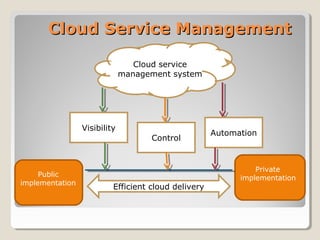
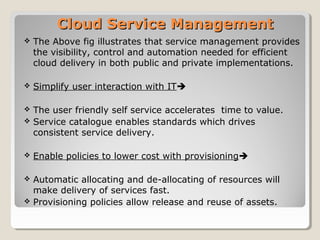
 The Above fig illustrates that service management provides
the visibility, control and automation needed for efficient
cloud delivery in both public and private implementations.
 Simplify user interaction with IT
 The user friendly self service accelerates time to value.
 Service catalogue enables standards which drives
consistent service delivery.
 Enable policies to lower cost with provisioning
 Automatic allocating and de-allocating of resources will
make delivery of services fast.
 Provisioning policies allow release and reuse of assets.
Cloud Service ManagementCloud Service Management
 Increase system admin productivity.
 Providing the benefits to the broker will probably become a
critical success factor in cloud computing.
 Due to the growth of service brokerage business will
increase the ability of cloud consumers to use services in a
trustworthy manner.
 These cloud mediators will help companies to choose the
right platform, deploy the apps across multiple clouds.
Cloud Service ManagementCloud Service Management
 Following are the opportunities for cloud brokers
 Cloud service intermediation The broker must need to
manage the additional securities or management
capabilities over the cloud.
 Cloud aggregation It includes the deployment of services
over multiple cloud platforms.
 The ability to group an application across multiple clouds
will become important i.e. if one service goes down the
another can be started.
Cloud Service ManagementCloud Service Management
 Key cloud solution characteristics the cloud architect
should maintain an index of resources for enabling the
scalability to scale across tens and thousands of machines
over multiple geographies.
 High availability the cloud architect must need to act as a
Big boss for availability and DR(Disaster recovery).
 Application Lifecycle The cloud architect should support
for the creation of infrastructure to installation,
configuration and launching an application to deletion or
expiration.
 Role based administration It allows fine grained control
of what each person can or can’t do in cloud features.
Cloud Service ManagementCloud Service Management
 Policies The cloud architect should provide a rich set of
policies .
 these policies can be modified or new ones can be created
to take effect at the global level .
 For example :- a policy can be created to allow an
application to flex up to 10 VMs during high load or
demand and to be reduced to only 2 running VMs during
low load or demand.
 This frees up to resources that can be used by other
applications that are experiencing high load.
Cloud Service ManagementCloud Service Management
 Alarms The cloud architect should provide pre defined
alarms that can be set at the global level for applications.
 These alarms can be used to notify individual users or
application owners regarding the application thresholds
being reached.
 Application awareness and policy based allocation
Cloud Service ManagementCloud Service Management
 Alarms The cloud architect should provide pre defined
alarms that can be set at the global level for applications.
 These alarms can be used to notify individual users or
application owners regarding the application thresholds
being reached.
 Application awareness and policy based allocation

Cloud service management

  • 1.
    Cloud Service ManagementCloudService Management Service managementA system integral of supply chain  management that connects actual company sales and  the customer.  The goal of service management is to maximize  service supply chains. The purposes of service management is to  reduce high costs by integrating products and services and  keep inventory levels smaller.
  • 2.
    Cloud Service ManagementCloudService Management  Cloud Service management  Cloud monitoring and cloud service management tools allow cloud  providers to ensure optimal performance, continuity and  efficiency in virtualized, on-demand environments.   The delivery of dynamic, cloud-based infrastructure, platform and  application services doesn't occur in a vacuum.   In addition to best practices for effective administration of all the  elements associated with cloud service delivery, cloud service  management and cloud monitoring tools enable providers to keep  up with the continually shifting capacity demands of a highly- elastic environment.
  • 3.
    Cloud Service ManagementCloudService Management Cloud service  management system Efficient cloud delivery Visibility Control Automation        Public  implementation                      Private  implementation               
  • 4.
    Cloud Service ManagementCloudService Management  The Above fig illustrates that service management provides the visibility, control and automation needed for efficient cloud delivery in both public and private implementations.  Simplify user interaction with IT  The user friendly self service accelerates time to value.  Service catalogue enables standards which drives consistent service delivery.  Enable policies to lower cost with provisioning  Automatic allocating and de-allocating of resources will make delivery of services fast.  Provisioning policies allow release and reuse of assets.
  • 5.
    Cloud Service ManagementCloudService Management  Increase system admin productivity.  Providing the benefits to the broker will probably become a critical success factor in cloud computing.  Due to the growth of service brokerage business will increase the ability of cloud consumers to use services in a trustworthy manner.  These cloud mediators will help companies to choose the right platform, deploy the apps across multiple clouds.
  • 6.
    Cloud Service ManagementCloudService Management  Following are the opportunities for cloud brokers  Cloud service intermediation The broker must need to manage the additional securities or management capabilities over the cloud.  Cloud aggregation It includes the deployment of services over multiple cloud platforms.  The ability to group an application across multiple clouds will become important i.e. if one service goes down the another can be started.
  • 7.
    Cloud Service ManagementCloudService Management  Key cloud solution characteristics the cloud architect should maintain an index of resources for enabling the scalability to scale across tens and thousands of machines over multiple geographies.  High availability the cloud architect must need to act as a Big boss for availability and DR(Disaster recovery).  Application Lifecycle The cloud architect should support for the creation of infrastructure to installation, configuration and launching an application to deletion or expiration.  Role based administration It allows fine grained control of what each person can or can’t do in cloud features.
  • 8.
    Cloud Service ManagementCloudService Management  Policies The cloud architect should provide a rich set of policies .  these policies can be modified or new ones can be created to take effect at the global level .  For example :- a policy can be created to allow an application to flex up to 10 VMs during high load or demand and to be reduced to only 2 running VMs during low load or demand.  This frees up to resources that can be used by other applications that are experiencing high load.
  • 9.
    Cloud Service ManagementCloudService Management  Alarms The cloud architect should provide pre defined alarms that can be set at the global level for applications.  These alarms can be used to notify individual users or application owners regarding the application thresholds being reached.  Application awareness and policy based allocation
  • 10.
    Cloud Service ManagementCloudService Management  Alarms The cloud architect should provide pre defined alarms that can be set at the global level for applications.  These alarms can be used to notify individual users or application owners regarding the application thresholds being reached.  Application awareness and policy based allocation