ON DEMAND PROVISIONING
DEFINE
On-demand computing is a delivery model in
which computing resources are made available
to the user as needed.
The resources may be maintained within the
user's enterprise, or made available by a cloud
service provider.
When the services are provided by a third-
party, the term cloud computing is often used
as a synonym for on-demand computing.
Effectively using of cloudcomputing
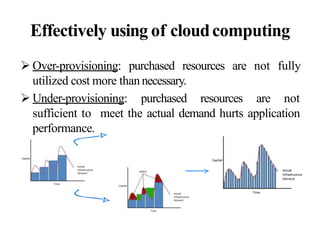
 Over-provisioning: purchased resources are not fully
utilized cost more thannecessary.
 Under-provisioning: purchased resources are not
sufficient to meet the actual demand hurts application
performance.
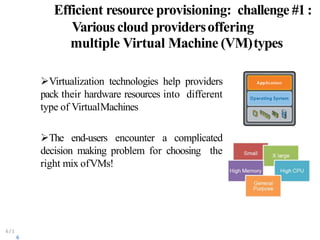
Efficient resource provisioning: challenge #1:
Various cloud providersoffering
multiple Virtual Machine (VM)types
Virtualization technologies help providers
pack their hardware resources into different
type of VirtualMachines
The end-users encounter a complicated
decision making problem for choosing the
right mix ofVMs!
6/1
6
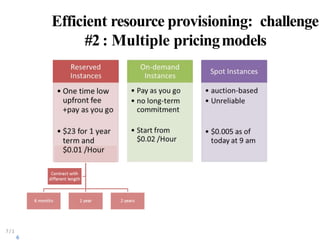
Efficient resource provisioning: challenge
#2 : Multiple pricingmodels
7/1
6
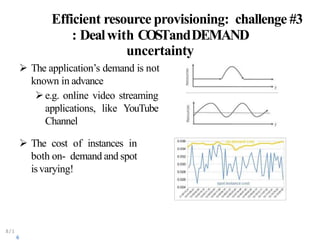
Efficient resource provisioning: challenge #3
: Dealwith COSTandDEMAND
uncertainty
 The application’s demand is not
known in advance
e.g. online video streaming
applications, like YouTube
Channel
 The cost of instances in
both on- demand and spot
isvarying!
8/1
6
Efficient resource provisioning: challenge #4:
Multi-objectiveproblem
9/1
6
 Costisnot the only objective forthis problem
 The trade-off among cost and QoS must also be
handled
 Forexampleresponsetime is very critical in latency
sensitive applications , online gaming services,as the users
tend to beveryimpatient
REFERENCE
• Mastering Cloud computing foundation and
application programming rajkumar
buyya,christian vecchiola,s.Tamarai selvi

On demand provisioning

  • 1.
  • 2.
    DEFINE On-demand computing isa delivery model in which computing resources are made available to the user as needed. The resources may be maintained within the user's enterprise, or made available by a cloud service provider. When the services are provided by a third- party, the term cloud computing is often used as a synonym for on-demand computing.
  • 3.
    Effectively using ofcloudcomputing  Over-provisioning: purchased resources are not fully utilized cost more thannecessary.  Under-provisioning: purchased resources are not sufficient to meet the actual demand hurts application performance.
  • 4.
    Efficient resource provisioning:challenge #1: Various cloud providersoffering multiple Virtual Machine (VM)types Virtualization technologies help providers pack their hardware resources into different type of VirtualMachines The end-users encounter a complicated decision making problem for choosing the right mix ofVMs! 6/1 6
  • 5.
    Efficient resource provisioning:challenge #2 : Multiple pricingmodels 7/1 6
  • 6.
    Efficient resource provisioning:challenge #3 : Dealwith COSTandDEMAND uncertainty  The application’s demand is not known in advance e.g. online video streaming applications, like YouTube Channel  The cost of instances in both on- demand and spot isvarying! 8/1 6
  • 7.
    Efficient resource provisioning:challenge #4: Multi-objectiveproblem 9/1 6  Costisnot the only objective forthis problem  The trade-off among cost and QoS must also be handled  Forexampleresponsetime is very critical in latency sensitive applications , online gaming services,as the users tend to beveryimpatient
  • 9.
    REFERENCE • Mastering Cloudcomputing foundation and application programming rajkumar buyya,christian vecchiola,s.Tamarai selvi