Cloningcloning by bacterial plasmids
PRESENTED BY
BUMBIM NO.20
FAH NO.32
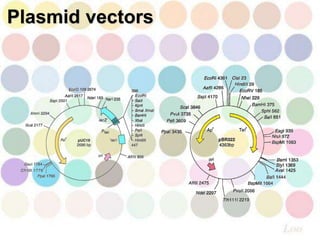
Plasmid vectors are double-stranded, circular, self-replicating,
extra-chromosomal DNA molecules.
 Advantages:
• Small, easy to handle
• Straightforward selection strategies
• Useful for cloning small DNA fragments
(< 10kbp)
 Disadvantages:
• Less useful for cloning large DNA
fragments
(> 10kbp)
Plasmid vectors
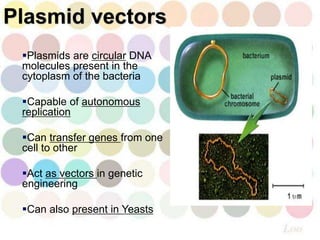
Plasmids are circular DNA
molecules present in the
cytoplasm of the bacteria
Capable of autonomous
replication
Can transfer genes from one
cell to other
Act as vectors in genetic
engineering
Can also present in Yeasts
Plasmid vectors
may encode genetic information for properties
1 Resitance to Antibiotics
2 Bacteriocins production
3 Enterotoxin production
4 Enhanced pathogen city
5 Reduced Sensitivity to mutagens
6 Degrade complex organic molecules
Plasmid vectors
Plasmid vector for cloning
1.Contains an origin of replication,
allowing for replication independent of
host’s genome.
2.Contains Selective markers: Selection of
cells containing a plasmid
twin antibiotic resistance
blue-white screening
3.Contains a multiple cloning site (MCS)
4.Easy to be isolated from the host cell.
Plasmid vectors
Cloning by bacterial plasmids

Cloning by bacterial plasmids

  • 1.
    Cloningcloning by bacterialplasmids PRESENTED BY BUMBIM NO.20 FAH NO.32
  • 2.
    Plasmid vectors aredouble-stranded, circular, self-replicating, extra-chromosomal DNA molecules.  Advantages: • Small, easy to handle • Straightforward selection strategies • Useful for cloning small DNA fragments (< 10kbp)  Disadvantages: • Less useful for cloning large DNA fragments (> 10kbp) Plasmid vectors
  • 3.
    Plasmids are circularDNA molecules present in the cytoplasm of the bacteria Capable of autonomous replication Can transfer genes from one cell to other Act as vectors in genetic engineering Can also present in Yeasts Plasmid vectors
  • 4.
    may encode geneticinformation for properties 1 Resitance to Antibiotics 2 Bacteriocins production 3 Enterotoxin production 4 Enhanced pathogen city 5 Reduced Sensitivity to mutagens 6 Degrade complex organic molecules Plasmid vectors
  • 5.
    Plasmid vector forcloning 1.Contains an origin of replication, allowing for replication independent of host’s genome. 2.Contains Selective markers: Selection of cells containing a plasmid twin antibiotic resistance blue-white screening 3.Contains a multiple cloning site (MCS) 4.Easy to be isolated from the host cell.
  • 6.