Presentation on
Vectors used in Molecular
Biology
A vector is a small piece of DNA taken from a virus or
a plasmid or the cell of a higher organism that can be
stably maintained in an organism and into which a
foreign DNA fragment can be inserted for cloning
purposes.
• Ability to promote autonomous replication.
• Contain a genetic marker(usually
dominant)for selection.
• Unique restriction sites to facilitate cloning
to insert DNA.
• Minimum amount of non-essential DNA to
optimize cloning.
• PLASMID
• BACTERIOPHAGE VECTOR
• COSMID
• PHAGEMID
• YAC (YEAST ARTIFICIAL CHROMOSOME)
• BAC (BACTERIAL ARTIFICIAL CHROMOSOME)
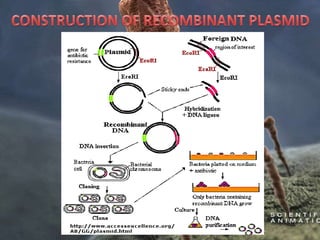
Plasmid is a circular, double stranded,
non-essential, extra-chromosomal DNA which co-
exist with chromosomal substances and can
replicate autonomously as a stable component of
cell’s genome.
• BASED ON FUNCTION
1. FERTILITY OR F PLASMID: They contain the tra gene. They
are capable of conjugation and result in the expression of
sex pilli.
2. RESISTANCE OR R PLASMID: They make the host cell
resistant to one or more antibiotics and many R plasmids
can transfer the resistance to cells lacking R.
3. COLICINOGENIC OR Col PLASMID: It synthesizes the protein
COLICIN, that can kill closely related bacterial strains that
lack a Col plasmid of the same type.
4. VIRULENCE PLASMID: They make the host of the plasmid
into a pathogen.
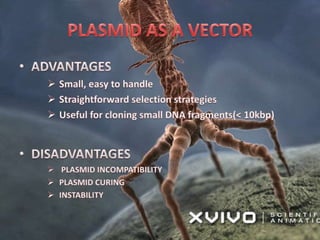
A plasmid can be considered a suitable cloning vehicle if it
possesses the following features:
• It can be really isolated from the cells,
• It possesses a single restriction site for one or more
restriction enzyme(s),
• Insertion of a linear molecule at one of these sites does
not alter its replication properties,
• It can be reintroduced into a bacterial cell and cells
carrying the plasmid with or without the insert can be
selected or identified (Bernard and Helinski, 1980),
• They do not occur free in nature but are found in
bacterial cells
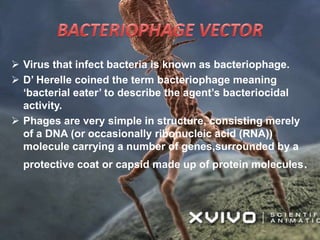
 Virus that infect bacteria is known as bacteriophage.
 D’ Herelle coined the term bacteriophage meaning
‘bacterial eater’ to describe the agent’s bacteriocidal
activity.
 Phages are very simple in structure, consisting merely
of a DNA (or occasionally ribonucleic acid (RNA))
molecule carrying a number of genes,surrounded by a
protective coat or capsid made up of protein molecules.
Bacteriophage vectors are used because they have
following advantages over the plasmids:
• DNA can be packed in vitro into phage particles and
transduced into E. coli with high efficiency.
• Foreign DNA upto 25 Kb in length can be inserted into
phage vector.
• Screening and storage of recombinant DNA is easier
(Dahl et al, 1981).
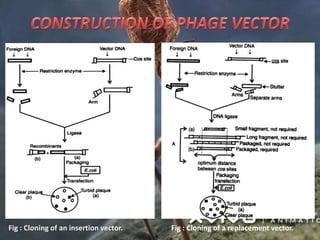
Fig : Cloning of an insertion vector. Fig : Cloning of a replacement vector.
• A particular gene can be isolated and its nucleotide
sequence be determined.
• Genomic library construction.
• Preparation of probes.
• Control sequences DNA can be identified and
analysed.
• Protein/enzyme/RNA function can be investigated.
• Mutations can be identified e.g: gene defects
related to specific diseases.
• Organism can be “engineered” for specific purposes
e.g: Insulin production.
• Improved Medicines
• Improved Livestock (resistance to disease)
• Improved Crops (resistance to disease, higher yields)
• Prevention of Genetic Diseases
• Lowering the cost of medicines (i.e. Insulin)
• Safer Medicines (i.e. Insulin)
• Treatment for pre-existing conditions
• http://highered.mheducation.com/sites/
0072556781/student_view0/chapter14/a
nimation_quiz_2.html
http://www.eplantscience.com/index/bio
technology/genes_genetic_engineering
/tools_of_genetic_engineering/biotech_
cloning_vector.php
• A Textbook of Biotechnology by R.C
Dubeey
Vector in molecular biology

Vector in molecular biology

  • 1.
    Presentation on Vectors usedin Molecular Biology
  • 2.
    A vector isa small piece of DNA taken from a virus or a plasmid or the cell of a higher organism that can be stably maintained in an organism and into which a foreign DNA fragment can be inserted for cloning purposes.
  • 3.
    • Ability topromote autonomous replication. • Contain a genetic marker(usually dominant)for selection. • Unique restriction sites to facilitate cloning to insert DNA. • Minimum amount of non-essential DNA to optimize cloning.
  • 4.
    • PLASMID • BACTERIOPHAGEVECTOR • COSMID • PHAGEMID • YAC (YEAST ARTIFICIAL CHROMOSOME) • BAC (BACTERIAL ARTIFICIAL CHROMOSOME)
  • 5.
    Plasmid is acircular, double stranded, non-essential, extra-chromosomal DNA which co- exist with chromosomal substances and can replicate autonomously as a stable component of cell’s genome.
  • 6.
    • BASED ONFUNCTION 1. FERTILITY OR F PLASMID: They contain the tra gene. They are capable of conjugation and result in the expression of sex pilli. 2. RESISTANCE OR R PLASMID: They make the host cell resistant to one or more antibiotics and many R plasmids can transfer the resistance to cells lacking R. 3. COLICINOGENIC OR Col PLASMID: It synthesizes the protein COLICIN, that can kill closely related bacterial strains that lack a Col plasmid of the same type. 4. VIRULENCE PLASMID: They make the host of the plasmid into a pathogen.
  • 7.
    A plasmid canbe considered a suitable cloning vehicle if it possesses the following features: • It can be really isolated from the cells, • It possesses a single restriction site for one or more restriction enzyme(s), • Insertion of a linear molecule at one of these sites does not alter its replication properties, • It can be reintroduced into a bacterial cell and cells carrying the plasmid with or without the insert can be selected or identified (Bernard and Helinski, 1980), • They do not occur free in nature but are found in bacterial cells
  • 11.
     Virus thatinfect bacteria is known as bacteriophage.  D’ Herelle coined the term bacteriophage meaning ‘bacterial eater’ to describe the agent’s bacteriocidal activity.  Phages are very simple in structure, consisting merely of a DNA (or occasionally ribonucleic acid (RNA)) molecule carrying a number of genes,surrounded by a protective coat or capsid made up of protein molecules.
  • 12.
    Bacteriophage vectors areused because they have following advantages over the plasmids: • DNA can be packed in vitro into phage particles and transduced into E. coli with high efficiency. • Foreign DNA upto 25 Kb in length can be inserted into phage vector. • Screening and storage of recombinant DNA is easier (Dahl et al, 1981).
  • 15.
    Fig : Cloningof an insertion vector. Fig : Cloning of a replacement vector.
  • 16.
    • A particulargene can be isolated and its nucleotide sequence be determined. • Genomic library construction. • Preparation of probes. • Control sequences DNA can be identified and analysed. • Protein/enzyme/RNA function can be investigated. • Mutations can be identified e.g: gene defects related to specific diseases. • Organism can be “engineered” for specific purposes e.g: Insulin production.
  • 17.
    • Improved Medicines •Improved Livestock (resistance to disease) • Improved Crops (resistance to disease, higher yields) • Prevention of Genetic Diseases • Lowering the cost of medicines (i.e. Insulin) • Safer Medicines (i.e. Insulin) • Treatment for pre-existing conditions
  • 18.