CLINICAL TRIAL PROCESS
1   Sunitha P.
CONTENTS
 Introduction to clinical trial process
 Study Plan

 Study Implementation

 Analysis

 Conclusion


                                           2
INTRODUCTION

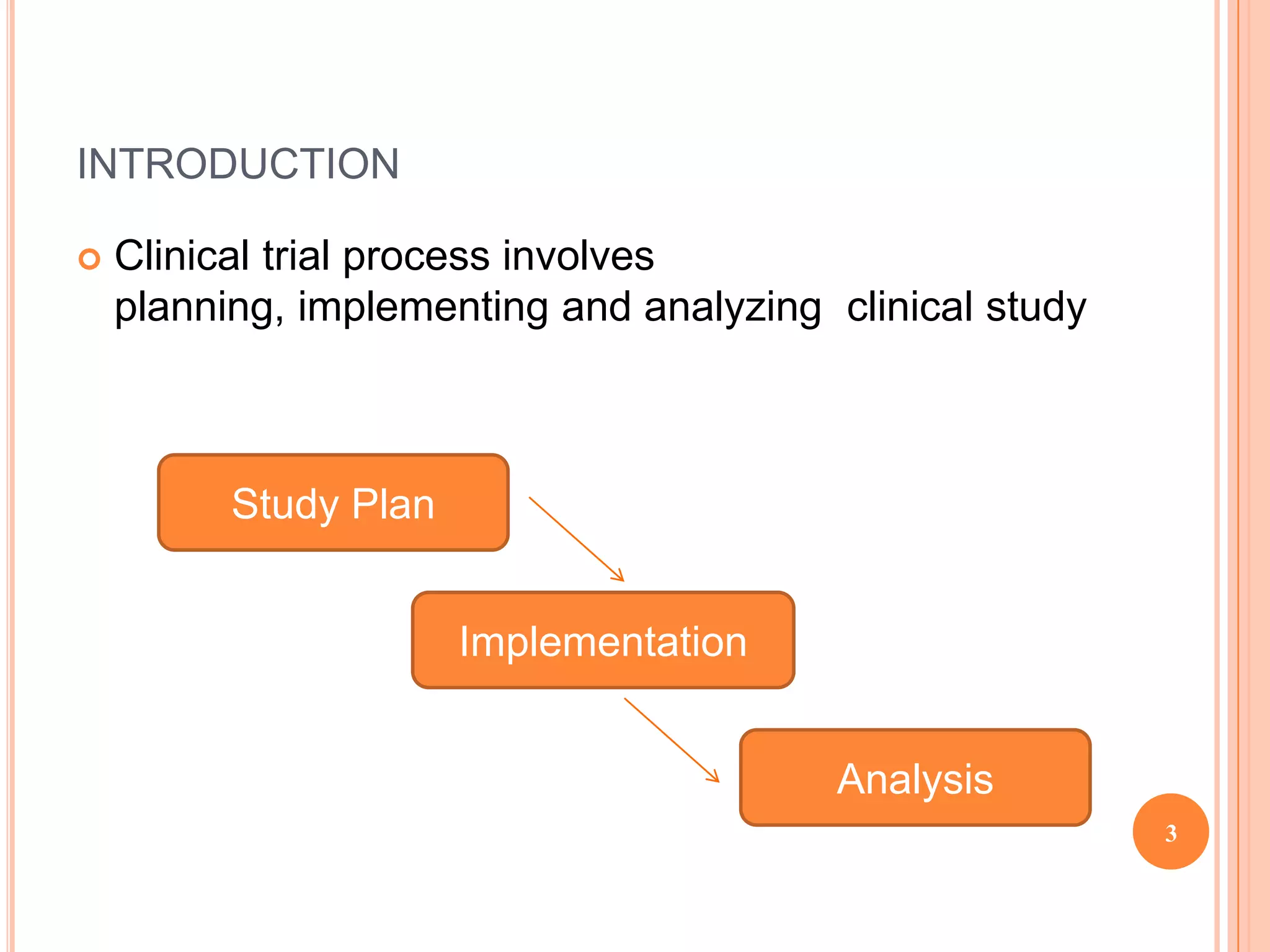
   Clinical trial process involves
    planning, implementing and analyzing clinical study


          Study Plan


                       Implementation


                                         Analysis
                                                          3
STUDY PLAN
4
PROTOCOL DEVELOPMENT
 Protocol development and finalization:
 Protocol is a document that describes the
  objectives, design, methodology and statistical
  considerations of a clinical trial
 An outline protocol to describe the basic details of
  the trial is initially prepared
 Written according to GCP standards

 After number of discussions and meetings, the
  protocol is finalized

                                                         5
INFORMED CONSENT FORM
   Informed consent form is the learning the key facts
    about a trial before deciding whether to participate.
       Research study purpose
       Risks/Benefits
       Alternative treatments
       Confidentiality of records
       Medical treatment available if injury occurs
       Whom to contact for answers to questions
       Statement that participation is voluntary
   Informed consent form is finalized before submitting
    to the IRB approval
                                                            6
CASE REPORT FORM
 Case report form is a data capture tool used in
  obtaining data about the subjects
 CRF is designed and finalized according to the
  protocol
 CRF can be paper based or electronic

 Data recorded on the CRFs is used to analyze the
  data according to statistical plan and interpret the
  results
 One study can have one or more number of case
  report forms
                                                         7
DATABASE DESIGN AND FINALIZATION
 Clinical data management encompasses the entry,
  verification, validation and quality control of data
  gathered during the conduct of the trial.
 The database is designed, tested and finalized
  before the initiation of the trial
 CSV(Computer system validation): All computer
  systems used in processing and management are
  validated
 CDISC (Clinical Data Interchange Standards
  Consortium) leads the development of global
  system independent data standards
                                                         8
SITE SELECTION PROCESS
   Site selection is based on
       Access to patient geographic distribution
       Past performance of site team
       Capability to recruit anticipated number of enrollment
       Availability of required equipment or specialized staff
 Confidential Disclosure Agreement (CDA) is sent to
  the sites
 Site Feasibility Questionnaire (SFQ)is sent to the
  site


                                                                  9
IRB/IEC APPROVAL
 IRB/IEC is an independent body constituted of
  medical, scientific and nonscientific members
 This committee has been designated to
  approve, monitor, and review biomedical and
  behavioral research involving humans with the aim
  to protect the rights and well-being of the subjects
 All clinical trials require favorable opinion from
  Ethics committee before site initiation


                                                         10

                                    INITIATION
STUDY DRUG SUPPLY FINALIZATION
   Before the initiation drug supply plan is finalized
       Matching placebo is also ready
       Shipment of drug
       Primary, secondary packing and labeling is ready
       Blindedness testing, stability testing
       Storage requirements
       Site SOP for the inventory, usage and return/disposal is
        ready


                                                                   11
STUDY IMPLEMENTATION
12
SITE ACTIVATION
 Conduct investigator meeting
 Contract negotiations/agreements

 Prepare regulatory documents
       FDA form 1572, CVs, financial disclosure etc.
   Provide sites with clinical supplies
       Lab kits, drug supply etc.


                        Ready

                                                        13

    ACTIVATION
INITIAL PATIENT SCREENING
 Patients are selected on the basis of inclusion and
  exclusion criteria
 I/E criteria is a screening questionnaire that
  evaluates the subject’s eligibility to participate in the
  study
 Informed consent form is signed by the subject after
  the screening questionnaire


                         Meets
                         Criteria

                                                              14
INFORMED CONSENT
 Eligible subjects are informed about the required
  information about the study
 Informed consent is signed by the subjects after
  decision


                                                      15
BASELINE EXAM AND ENROLLMENT
   Baseline examination is the assessment taken
    before the subject is given any treatment
     Demographic data
     Physical examination data
     Clinical data
     Lab data etc.

 The subject is enrolled and randomized into the
  study after the baseline parameters are taken
 The enrolled subject is given the treatment
  assigned to the study group.
                                                    16
DATA ACQUISION AND DATA ENTRY
   Data comes from various source documents
     From Subject - Diaries, self report, questionnaire
     Investigators - clinical findings
     Lab test reports – Urine, blood test, ECG etc.
     Other sources – previous medical records etc.

 Data from the source document is entered into the
  case report forms
 Events are coded using standard medical
  dictionaries


                                                           17
DATA VALIDATION
 Data validation plays key role in discrepancy
  management
 Validation is checking the data for discrepancies
  and outlier values
 Objective for data validation is to assure the validity
  and accuracy of the data
 In case of discrepancy, a DCF (Data Clarification
  Form) is raised and sent to the investigator

                  DCF

                                                            18
DATA CLEANING AND QUALITY CONTROL
 After the queries are resolved, the database is
  updated
 The updated database is now ready for the quality
  check
 Quality control procedure is run to assure that the
  database is clean with no discrepancies
 Data listings are reconciled with DCF and CRF

 Safety data is reconciled with pharmacovigilance
  SAE data

                           Quality
                                                        19
DATABASE LOCK
 The database is locked after all corrections are
  done
 A locked database means
     All discrepancies closed
     DCFs received and updated
     coding complete
     SAE Reconciliation complete

   The data is ready to be submitted for analysis


                                                     20
STATISTICAL ANALYSIS
21
STATISTICAL ANALYSIS AND REGULATORY
SUBMISSION

 Import study data for analysis
 Statistical analysis is done by SAP (Statistical
  Analysis Plan)
 Primary and secondary outcome measures are
  calculated using statistical analysis methods
       Eg: Mean, t-test and chi-square test etc.
 After the statistical analysis, the tables, listings and
  figures are published
 Clinical Study reports are generated for the
  regulatory submission
                                                             22
CONCLUSION
 Clinical trial process involves careful planning,
  implementing and analyzing a clinical trial with good
  practices
 A clinical trial must be planned in such a way that
  the prerequisites are ready in time
 After careful planning, the study must be
  implemented and data must be maintained with
  high accuracy for the subsequent analysis
 Unambiguous conclusion regarding the clinical
  outcome of the test treatment/device is ideal
 One must always strive for the ideal, but in most
                                                          23
  cases have to settle for the best comprise
QUESTIONS ?
24   Thank You

Clinical trial process

  • 1.
  • 2.
    CONTENTS  Introduction toclinical trial process  Study Plan  Study Implementation  Analysis  Conclusion 2
  • 3.
    INTRODUCTION  Clinical trial process involves planning, implementing and analyzing clinical study Study Plan Implementation Analysis 3
  • 4.
  • 5.
    PROTOCOL DEVELOPMENT  Protocoldevelopment and finalization:  Protocol is a document that describes the objectives, design, methodology and statistical considerations of a clinical trial  An outline protocol to describe the basic details of the trial is initially prepared  Written according to GCP standards  After number of discussions and meetings, the protocol is finalized 5
  • 6.
    INFORMED CONSENT FORM  Informed consent form is the learning the key facts about a trial before deciding whether to participate.  Research study purpose  Risks/Benefits  Alternative treatments  Confidentiality of records  Medical treatment available if injury occurs  Whom to contact for answers to questions  Statement that participation is voluntary  Informed consent form is finalized before submitting to the IRB approval 6
  • 7.
    CASE REPORT FORM Case report form is a data capture tool used in obtaining data about the subjects  CRF is designed and finalized according to the protocol  CRF can be paper based or electronic  Data recorded on the CRFs is used to analyze the data according to statistical plan and interpret the results  One study can have one or more number of case report forms 7
  • 8.
    DATABASE DESIGN ANDFINALIZATION  Clinical data management encompasses the entry, verification, validation and quality control of data gathered during the conduct of the trial.  The database is designed, tested and finalized before the initiation of the trial  CSV(Computer system validation): All computer systems used in processing and management are validated  CDISC (Clinical Data Interchange Standards Consortium) leads the development of global system independent data standards 8
  • 9.
    SITE SELECTION PROCESS  Site selection is based on  Access to patient geographic distribution  Past performance of site team  Capability to recruit anticipated number of enrollment  Availability of required equipment or specialized staff  Confidential Disclosure Agreement (CDA) is sent to the sites  Site Feasibility Questionnaire (SFQ)is sent to the site 9
  • 10.
    IRB/IEC APPROVAL  IRB/IECis an independent body constituted of medical, scientific and nonscientific members  This committee has been designated to approve, monitor, and review biomedical and behavioral research involving humans with the aim to protect the rights and well-being of the subjects  All clinical trials require favorable opinion from Ethics committee before site initiation 10 INITIATION
  • 11.
    STUDY DRUG SUPPLYFINALIZATION  Before the initiation drug supply plan is finalized  Matching placebo is also ready  Shipment of drug  Primary, secondary packing and labeling is ready  Blindedness testing, stability testing  Storage requirements  Site SOP for the inventory, usage and return/disposal is ready 11
  • 12.
  • 13.
    SITE ACTIVATION  Conductinvestigator meeting  Contract negotiations/agreements  Prepare regulatory documents  FDA form 1572, CVs, financial disclosure etc.  Provide sites with clinical supplies  Lab kits, drug supply etc. Ready 13 ACTIVATION
  • 14.
    INITIAL PATIENT SCREENING Patients are selected on the basis of inclusion and exclusion criteria  I/E criteria is a screening questionnaire that evaluates the subject’s eligibility to participate in the study  Informed consent form is signed by the subject after the screening questionnaire Meets Criteria 14
  • 15.
    INFORMED CONSENT  Eligiblesubjects are informed about the required information about the study  Informed consent is signed by the subjects after decision 15
  • 16.
    BASELINE EXAM ANDENROLLMENT  Baseline examination is the assessment taken before the subject is given any treatment  Demographic data  Physical examination data  Clinical data  Lab data etc.  The subject is enrolled and randomized into the study after the baseline parameters are taken  The enrolled subject is given the treatment assigned to the study group. 16
  • 17.
    DATA ACQUISION ANDDATA ENTRY  Data comes from various source documents  From Subject - Diaries, self report, questionnaire  Investigators - clinical findings  Lab test reports – Urine, blood test, ECG etc.  Other sources – previous medical records etc.  Data from the source document is entered into the case report forms  Events are coded using standard medical dictionaries 17
  • 18.
    DATA VALIDATION  Datavalidation plays key role in discrepancy management  Validation is checking the data for discrepancies and outlier values  Objective for data validation is to assure the validity and accuracy of the data  In case of discrepancy, a DCF (Data Clarification Form) is raised and sent to the investigator DCF 18
  • 19.
    DATA CLEANING ANDQUALITY CONTROL  After the queries are resolved, the database is updated  The updated database is now ready for the quality check  Quality control procedure is run to assure that the database is clean with no discrepancies  Data listings are reconciled with DCF and CRF  Safety data is reconciled with pharmacovigilance SAE data Quality 19
  • 20.
    DATABASE LOCK  Thedatabase is locked after all corrections are done  A locked database means  All discrepancies closed  DCFs received and updated  coding complete  SAE Reconciliation complete  The data is ready to be submitted for analysis 20
  • 21.
  • 22.
    STATISTICAL ANALYSIS ANDREGULATORY SUBMISSION  Import study data for analysis  Statistical analysis is done by SAP (Statistical Analysis Plan)  Primary and secondary outcome measures are calculated using statistical analysis methods  Eg: Mean, t-test and chi-square test etc.  After the statistical analysis, the tables, listings and figures are published  Clinical Study reports are generated for the regulatory submission 22
  • 23.
    CONCLUSION  Clinical trialprocess involves careful planning, implementing and analyzing a clinical trial with good practices  A clinical trial must be planned in such a way that the prerequisites are ready in time  After careful planning, the study must be implemented and data must be maintained with high accuracy for the subsequent analysis  Unambiguous conclusion regarding the clinical outcome of the test treatment/device is ideal  One must always strive for the ideal, but in most 23 cases have to settle for the best comprise
  • 24.
    QUESTIONS ? 24 Thank You