
BY- NEELAM PAWAR
CASE
REPORT
FORM(CRF)
Definition of CRF?
A printed, optical or electronic document designed to
record all of the protocol required information to be
reported to the Sponsor on each trial subject. ----
ICH/GCP
If we take care in the beginning, the end
will take care of itself !!
CRF
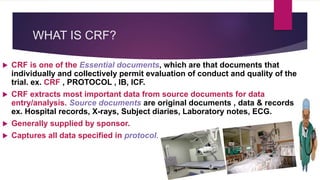
WHAT IS CRF?
 CRF is one of the Essential documents, which are that documents that
individually and collectively permit evaluation of conduct and quality of the
trial. ex. CRF , PROTOCOL , IB, ICF.
 CRF extracts most important data from source documents for data
entry/analysis. Source documents are original documents , data & records
ex. Hospital records, X-rays, Subject diaries, Laboratory notes, ECG.
 Generally supplied by sponsor.
 Captures all data specified in protocol.
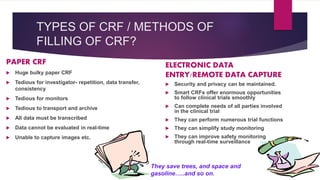
TYPES OF CRF / METHODS OF
FILLING OF CRF?
PAPER CRF
 Huge bulky paper CRF
 Tedious for investigator- repetition, data transfer,
consistency
 Tedious for monitors
 Tedious to transport and archive
 All data must be transcribed
 Data cannot be evaluated in real-time
 Unable to capture images etc.
ELECTRONIC DATA
ENTRY/REMOTE DATA CAPTURE
 Security and privacy can be maintained.
 Smart CRFs offer enormous opportunities
to follow clinical trials smoothly
 Can complete needs of all parties involved
in the clinical trial
 They can perform numerous trial functions
 They can simplify study monitoring
 They can improve safety monitoring
through real-time surveillance
They save trees, and space and
gasoline…..and so on.
INPUT TEAM….
INPUT BY:
SPONSERS TEAM UNDER SPONSER-
 Investigators
 Data manager
 Clinical investigation site staff
 Medical person
 Barcode readers (e.g., that are used to record medications or devices)
 Specialty role - related to particular organ or disease i.e. Consulting team (e.g.
radiologist reporting on a computed tomography (CT) scan)
OUTPUT TEAM…(APPROVAL)
OUTPUT TO:
 CRO
 Sponsor
 IRB/IEC
 FDA
REVIEW TEAM….
 PROJECT CLINICIAN
 LEAD CRA
 LEAD STATISTICIAN
 LEAD PROGRAMMER
 LEAD DATA MANAGER OTHERS,
finalized draft CRF or CRF book approved by IRB/IEC after approving
protocol and it is printed , accordingly stored and then distributed to
research sites.
Factoid…….!!!!!!!
 For every essential documents there is a master copy which is with
sponsor.
 Same way for preparing of CRF Sponsor has an original copy i.e. master
copy of the CRF this avoids duplication and violation of CRF.
 So Sponsor distributes the Draft copy to Review team and Reference copy
to auditor or Regulatory body with an authorized reference stamp on it to
investigator of the team.
 The Investigator appoints certain members of the team who can write, make
changes in CRF.
 Each of CRF is provided in triplicate or duplicate NCR (no carbon required)
copies, when data is transcribed on to the 1st page its gets automatically
copied on to the 2nd and 3rd .
 The 1st is usually stored by the sponsers, 2nd with the monitor and the 3rd at
the site,for future.
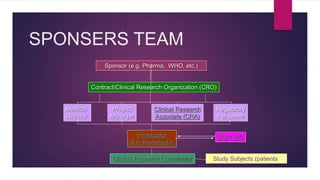
SPONSERS TEAM
Sponsor (e.g. Pharma, WHO, etc.)
Contract/Clinical Research Organization (CRO)
Medical
Director
Project
Manager
Clinical Research
Associate (CRA)
Regulatory
Personnel
Investigator
Sub-Investigator
IRB / IEC
Clinical Research Coordinator Study Subjects (patients)
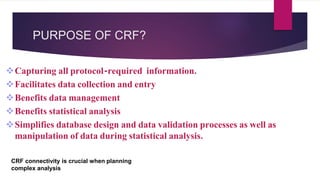
PURPOSE OF CRF?
Capturing all protocol-required information.
Facilitates data collection and entry
Benefits data management
Benefits statistical analysis
Simplifies database design and data validation processes as well as
manipulation of data during statistical analysis.
CRF connectivity is crucial when planning
complex analysis
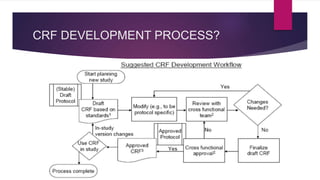
CRF DEVELOPMENT PROCESS?
CRF DEVELOPMENT GUIDELINES?
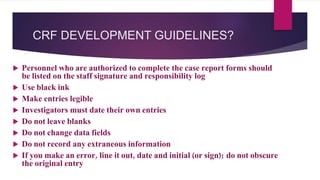
 Personnel who are authorized to complete the case report forms should
be listed on the staff signature and responsibility log
 Use black ink
 Make entries legible
 Investigators must date their own entries
 Do not leave blanks
 Do not change data fields
 Do not record any extraneous information
 If you make an error, line it out, date and initial (or sign); do not obscure
the original entry
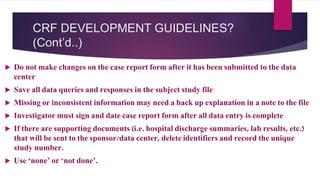
CRF DEVELOPMENT GUIDELINES?
(Cont’d..)
 Do not make changes on the case report form after it has been submitted to the data
center
 Save all data queries and responses in the subject study file
 Missing or inconsistent information may need a back up explanation in a note to the file
 Investigator must sign and date case report form after all data entry is complete
 If there are supporting documents (i.e. hospital discharge summaries, lab results, etc.)
that will be sent to the sponsor/data center, delete identifiers and record the unique
study number.
 Use ‘none’ or ‘not done’.
ELEMENTS OF CRF?
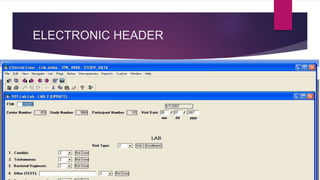
 HEADER
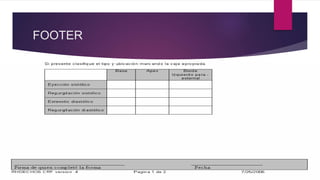
 FOOTER
 SAFETY MODULES
 EFFICACY MODULES
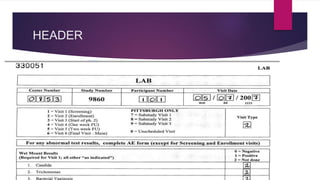
HEADER
ELECTRONIC HEADER
FOOTER
STANDARD TEMPLATES
Forms likely to use standard templates
 Inclusion/Exclusion criteria
 Adverse events
 Concomitant medications
 Protocol Violation Forms
 Final status
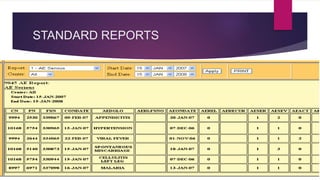
STANDARD REPORTS
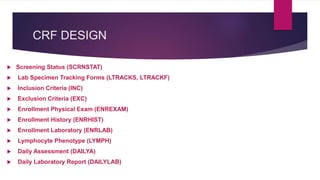
CRF DESIGN
 Screening Status (SCRNSTAT)
 Lab Specimen Tracking Forms (LTRACKS, LTRACKF)
 Inclusion Criteria (INC)
 Exclusion Criteria (EXC)
 Enrollment Physical Exam (ENREXAM)
 Enrollment History (ENRHIST)
 Enrollment Laboratory (ENRLAB)
 Lymphocyte Phenotype (LYMPH)
 Daily Assessment (DAILYA)
 Daily Laboratory Report (DAILYLAB)
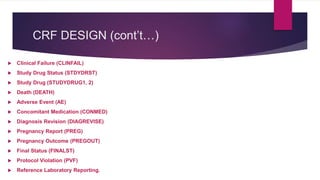
CRF DESIGN (cont’t…)
 Clinical Failure (CLINFAIL)
 Study Drug Status (STDYDRST)
 Study Drug (STUDYDRUG1, 2)
 Death (DEATH)
 Adverse Event (AE)
 Concomitant Medication (CONMED)
 Diagnosis Revision (DIAGREVISE)
 Pregnancy Report (PREG)
 Pregnancy Outcome (PREGOUT)
 Final Status (FINALST)
 Protocol Violation (PVF)
 Reference Laboratory Reporting.
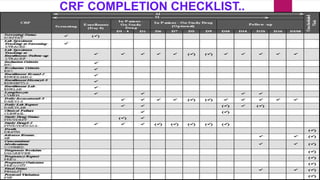
CRF COMPLETION CHECKLIST..
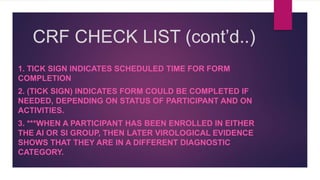
CRF CHECK LIST (cont’d..)
1. TICK SIGN INDICATES SCHEDULED TIME FOR FORM
COMPLETION
2. (TICK SIGN) INDICATES FORM COULD BE COMPLETED IF
NEEDED, DEPENDING ON STATUS OF PARTICIPANT AND ON
ACTIVITIES.
3. ***WHEN A PARTICIPANT HAS BEEN ENROLLED IN EITHER
THE AI OR SI GROUP, THEN LATER VIROLOGICAL EVIDENCE
SHOWS THAT THEY ARE IN A DIFFERENT DIAGNOSTIC
CATEGORY.
CRF DESIGN TOOLS
*WORD
*EXCEL
*ADOBE PAGE MAKER
*OTHER
RETENTION OF CRF AS AN
ESSENTIAL DOCUMENT
Essential documents should be retained until at least 2
years.
(Novartis requires 15 years)
It is the responsibility of the sponsor to inform the
investigator/institution about when these documents no
longer need to be retained…ICH GCP
If an investigator leaves an institution, he/she must transfer
responsibilities for record retention to another physician
and notify the sponsor in writing.
How do we use it?
 The CRA and Clinician will monitor the data recorded on the CRFs. Although the purpose of the
CRF is to collect data, it also helps the study site team to perform their jobs.
FOR WHAT IT IS USED?
 The CRF acts as a reminder to the investigator to perform specific evaluations and you can use the CRF to verify
that the protocol is being followed (i,e, correct evaluations are being conducted at the appropriate time) and
subject safety is being maintained.
 CRFs collect all subject data required by the protocol and are used for subject tracking and data analysis. The
data that is collected is very important, because it is the basis for making decisions about the drug, its benefits,
risks, and potential marketability.
 Biometricians/Statisticians and Data Management personnel analyze and report the data recorded on the CRFs
in the final study reports for the clinical trial. This data is used for reports to the FDA on subject safety (e.g.
serious adverse events, annual progress reports, is included in promotional materials and is submitted in NDAs.
 Additionally, the data from the clinical trial may be used to support labeling claims for the drug or may be
published in medical journals.
GCP CONNECTION
ALL CLINICAL TRIAL INFORMATION SHOULD BE RECORDED,
HANDLED, AND STORED IN A WAY THAT ALLOWS ITS ACCURATE
REPORTING, INTERPRETATION, AND VERIFICATION.
THANK YOU

Case Report Form (CRF)

  • 1.
  • 2.
    Definition of CRF? Aprinted, optical or electronic document designed to record all of the protocol required information to be reported to the Sponsor on each trial subject. ---- ICH/GCP If we take care in the beginning, the end will take care of itself !! CRF
  • 3.
    WHAT IS CRF? CRF is one of the Essential documents, which are that documents that individually and collectively permit evaluation of conduct and quality of the trial. ex. CRF , PROTOCOL , IB, ICF.  CRF extracts most important data from source documents for data entry/analysis. Source documents are original documents , data & records ex. Hospital records, X-rays, Subject diaries, Laboratory notes, ECG.  Generally supplied by sponsor.  Captures all data specified in protocol.
  • 4.
    TYPES OF CRF/ METHODS OF FILLING OF CRF? PAPER CRF  Huge bulky paper CRF  Tedious for investigator- repetition, data transfer, consistency  Tedious for monitors  Tedious to transport and archive  All data must be transcribed  Data cannot be evaluated in real-time  Unable to capture images etc. ELECTRONIC DATA ENTRY/REMOTE DATA CAPTURE  Security and privacy can be maintained.  Smart CRFs offer enormous opportunities to follow clinical trials smoothly  Can complete needs of all parties involved in the clinical trial  They can perform numerous trial functions  They can simplify study monitoring  They can improve safety monitoring through real-time surveillance They save trees, and space and gasoline…..and so on.
  • 5.
    INPUT TEAM…. INPUT BY: SPONSERSTEAM UNDER SPONSER-  Investigators  Data manager  Clinical investigation site staff  Medical person  Barcode readers (e.g., that are used to record medications or devices)  Specialty role - related to particular organ or disease i.e. Consulting team (e.g. radiologist reporting on a computed tomography (CT) scan)
  • 6.
    OUTPUT TEAM…(APPROVAL) OUTPUT TO: CRO  Sponsor  IRB/IEC  FDA
  • 7.
    REVIEW TEAM….  PROJECTCLINICIAN  LEAD CRA  LEAD STATISTICIAN  LEAD PROGRAMMER  LEAD DATA MANAGER OTHERS, finalized draft CRF or CRF book approved by IRB/IEC after approving protocol and it is printed , accordingly stored and then distributed to research sites.
  • 8.
    Factoid…….!!!!!!!  For everyessential documents there is a master copy which is with sponsor.  Same way for preparing of CRF Sponsor has an original copy i.e. master copy of the CRF this avoids duplication and violation of CRF.  So Sponsor distributes the Draft copy to Review team and Reference copy to auditor or Regulatory body with an authorized reference stamp on it to investigator of the team.  The Investigator appoints certain members of the team who can write, make changes in CRF.  Each of CRF is provided in triplicate or duplicate NCR (no carbon required) copies, when data is transcribed on to the 1st page its gets automatically copied on to the 2nd and 3rd .  The 1st is usually stored by the sponsers, 2nd with the monitor and the 3rd at the site,for future.
  • 9.
    SPONSERS TEAM Sponsor (e.g.Pharma, WHO, etc.) Contract/Clinical Research Organization (CRO) Medical Director Project Manager Clinical Research Associate (CRA) Regulatory Personnel Investigator Sub-Investigator IRB / IEC Clinical Research Coordinator Study Subjects (patients)
  • 10.
    PURPOSE OF CRF? Capturingall protocol-required information. Facilitates data collection and entry Benefits data management Benefits statistical analysis Simplifies database design and data validation processes as well as manipulation of data during statistical analysis. CRF connectivity is crucial when planning complex analysis
  • 11.
  • 12.
    CRF DEVELOPMENT GUIDELINES? Personnel who are authorized to complete the case report forms should be listed on the staff signature and responsibility log  Use black ink  Make entries legible  Investigators must date their own entries  Do not leave blanks  Do not change data fields  Do not record any extraneous information  If you make an error, line it out, date and initial (or sign); do not obscure the original entry
  • 13.
    CRF DEVELOPMENT GUIDELINES? (Cont’d..) Do not make changes on the case report form after it has been submitted to the data center  Save all data queries and responses in the subject study file  Missing or inconsistent information may need a back up explanation in a note to the file  Investigator must sign and date case report form after all data entry is complete  If there are supporting documents (i.e. hospital discharge summaries, lab results, etc.) that will be sent to the sponsor/data center, delete identifiers and record the unique study number.  Use ‘none’ or ‘not done’.
  • 14.
    ELEMENTS OF CRF? HEADER  FOOTER  SAFETY MODULES  EFFICACY MODULES
  • 15.
  • 16.
  • 17.
  • 18.
    STANDARD TEMPLATES Forms likelyto use standard templates  Inclusion/Exclusion criteria  Adverse events  Concomitant medications  Protocol Violation Forms  Final status
  • 19.
  • 20.
    CRF DESIGN  ScreeningStatus (SCRNSTAT)  Lab Specimen Tracking Forms (LTRACKS, LTRACKF)  Inclusion Criteria (INC)  Exclusion Criteria (EXC)  Enrollment Physical Exam (ENREXAM)  Enrollment History (ENRHIST)  Enrollment Laboratory (ENRLAB)  Lymphocyte Phenotype (LYMPH)  Daily Assessment (DAILYA)  Daily Laboratory Report (DAILYLAB)
  • 21.
    CRF DESIGN (cont’t…) Clinical Failure (CLINFAIL)  Study Drug Status (STDYDRST)  Study Drug (STUDYDRUG1, 2)  Death (DEATH)  Adverse Event (AE)  Concomitant Medication (CONMED)  Diagnosis Revision (DIAGREVISE)  Pregnancy Report (PREG)  Pregnancy Outcome (PREGOUT)  Final Status (FINALST)  Protocol Violation (PVF)  Reference Laboratory Reporting.
  • 22.
  • 23.
    CRF CHECK LIST(cont’d..) 1. TICK SIGN INDICATES SCHEDULED TIME FOR FORM COMPLETION 2. (TICK SIGN) INDICATES FORM COULD BE COMPLETED IF NEEDED, DEPENDING ON STATUS OF PARTICIPANT AND ON ACTIVITIES. 3. ***WHEN A PARTICIPANT HAS BEEN ENROLLED IN EITHER THE AI OR SI GROUP, THEN LATER VIROLOGICAL EVIDENCE SHOWS THAT THEY ARE IN A DIFFERENT DIAGNOSTIC CATEGORY.
  • 24.
  • 25.
    RETENTION OF CRFAS AN ESSENTIAL DOCUMENT Essential documents should be retained until at least 2 years. (Novartis requires 15 years) It is the responsibility of the sponsor to inform the investigator/institution about when these documents no longer need to be retained…ICH GCP If an investigator leaves an institution, he/she must transfer responsibilities for record retention to another physician and notify the sponsor in writing.
  • 26.
    How do weuse it?  The CRA and Clinician will monitor the data recorded on the CRFs. Although the purpose of the CRF is to collect data, it also helps the study site team to perform their jobs.
  • 27.
    FOR WHAT ITIS USED?  The CRF acts as a reminder to the investigator to perform specific evaluations and you can use the CRF to verify that the protocol is being followed (i,e, correct evaluations are being conducted at the appropriate time) and subject safety is being maintained.  CRFs collect all subject data required by the protocol and are used for subject tracking and data analysis. The data that is collected is very important, because it is the basis for making decisions about the drug, its benefits, risks, and potential marketability.  Biometricians/Statisticians and Data Management personnel analyze and report the data recorded on the CRFs in the final study reports for the clinical trial. This data is used for reports to the FDA on subject safety (e.g. serious adverse events, annual progress reports, is included in promotional materials and is submitted in NDAs.  Additionally, the data from the clinical trial may be used to support labeling claims for the drug or may be published in medical journals.
  • 28.
    GCP CONNECTION ALL CLINICALTRIAL INFORMATION SHOULD BE RECORDED, HANDLED, AND STORED IN A WAY THAT ALLOWS ITS ACCURATE REPORTING, INTERPRETATION, AND VERIFICATION.
  • 29.