Phases of Clinical Trial
Dr. Ashutosh Tiwari
IInd Yr. PG Resident
Pharmacology Department
SAIMS, Indore
30/10/2014
Overview
• Introduction: Clinical research
• Drug development phases
• Pre-Phase 1 activities
• Phases of Clinical trial
• Regulatory approvals: IND & NDA
• Summary of Clinical trial phases
Sunday, February 15, 2015
Introduction
• Clinical trial is a systematic investigation in human
subjects for evaluating the safety & efficacy of any
new drug.
• Clinical trials are a set of tests in medical
research and drug development that generate
safety and efficacy data for health interventions in
human beings.
Introduction
• Clinical trials are conducted only when
• satisfactory information has been gathered on the
quality of the nonclinical safety
• health authority/ethics committee approval is granted in
the country where approval of the drug is sought.
• Clinical Trial is the mainstay for bringing out New
Drugs to the Market.
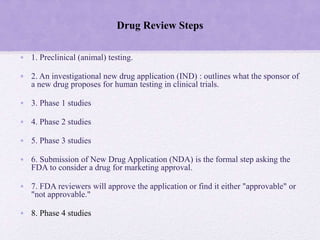
Drug Review Steps
• 1. Preclinical (animal) testing.
• 2. An investigational new drug application (IND) : outlines what the sponsor of
a new drug proposes for human testing in clinical trials.
• 3. Phase 1 studies
• 4. Phase 2 studies
• 5. Phase 3 studies
• 6. Submission of New Drug Application (NDA) is the formal step asking the
FDA to consider a drug for marketing approval.
• 7. FDA reviewers will approve the application or find it either "approvable" or
"not approvable."
• 8. Phase 4 studies
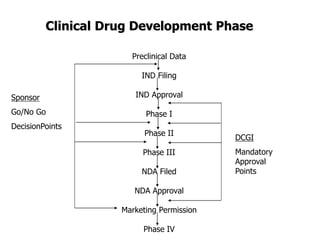
Clinical Drug Development Phase
Preclinical Data
IND Filing
IND Approval
Phase I
Phase II
Phase III
NDA Filed
NDA Approval
Marketing Permission
Phase IV
Sponsor
Go/No Go
DecisionPoints
DCGI
Mandatory
Approval
Points
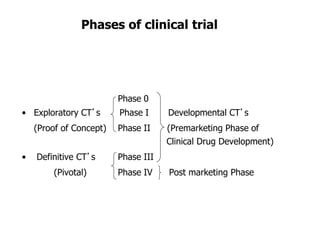
Phases of clinical trial
Phase 0
• Exploratory CT’s Phase I Developmental CT’s
(Proof of Concept) Phase II (Premarketing Phase of
Clinical Drug Development)
• Definitive CT’s Phase III
(Pivotal) Phase IV Post marketing Phase
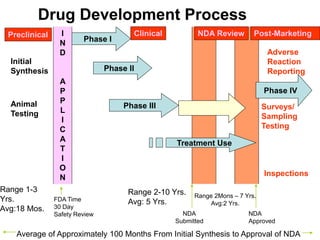
Drug Development Process
Initial
Synthesis
Animal
Testing
I
N
D
A
P
P
L
I
C
A
T
I
O
N
Phase I
Phase II
Phase III
Phase IV
Adverse
Reaction
Reporting
Surveys/
Sampling
Testing
Inspections
Range 1-3
Yrs.
Avg:18 Mos.
FDA Time
30 Day
Safety Review
Range 2-10 Yrs.
Avg: 5 Yrs.
NDA
Submitted
NDA
Approved
Range 2Mons – 7 Yrs.
Avg:2 Yrs.
Average of Approximately 100 Months From Initial Synthesis to Approval of NDA
Treatment Use
Preclinical Clinical NDA Review Post-Marketing
Drug review
• Before one can initiate testing in human beings, extensive pre-
clinical or laboratory research is required
• Research usually involves years of experiments in animal and
human cells.
• If this stage of testing is successful, the sponsor then provides
this data to the FDA requesting approval to begin testing in
humans.This is called an Investigational New Drug (IND)
Application
• If approved by the FDA, testing in humans begins. This is
done through a formally written and approved protocol.
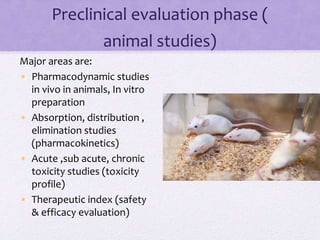
Preclinical evaluation phase (
animal studies)
Major areas are:
• Pharmacodynamic studies
in vivo in animals, In vitro
preparation
• Absorption, distribution ,
elimination studies
(pharmacokinetics)
• Acute ,sub acute, chronic
toxicity studies (toxicity
profile)
• Therapeutic index (safety
& efficacy evaluation)
Prephase I Activities
A - Preclinical Data Review: Drug Discovery Team
- Efficacy - Safety Pharmacology
- Toxicology - ADME
B - Preparation of Investigator’s Brochure
- Summaries of Preclinial data with clinical Extrapolation.
- Prediction of Clinical Effects & Safety
C – Filing of Investigational New Drug Application with DCGI.
IND Application Filing
• Once preclinical studies have indicated the safety and efficacy of
a drug an IND application has to be filed with the regulatory
authorities
• for obtaining regulatory Approval for Phase I, phase II and Phase
III clinical evaluation.
• Contents of IND application
• Preclinical Data (All data from animal studies)
• Information on composition and source of drug
• Chemical and manufacturing information
• Proposed clinical plans and protocol
• Ethical Committee Clearance
IND Application
• Clinical Evaluation needs Prior Regulatory and
IRB Clearance.
• Phase-wise clearances have to be obtained.
• The End Result of Phase I-III studies is the
filing of NDA (New Drug Application) for
obtaining Marketing Permission from DCGI.
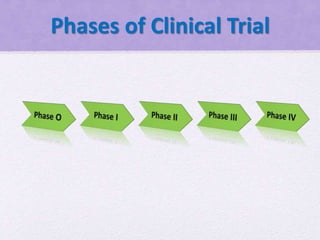
Phases of Clinical Trial
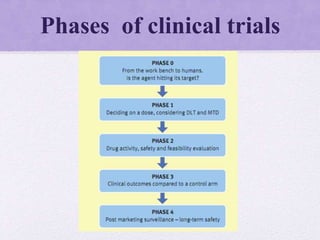
Phases of clinical trials
Phase 0 study / Microdosing
• Study of new drug in microdoses to derive PK
information in human before undertaking phase I
studies is called PHASE O
• Microdose: Less than 1/100 of the dose of a test
substance calculated to produce pharmacological
effect with a max dose ≤100 micrograms
• Objective: To obtain preliminary Pharmacokinetic data.
• Preclinical Data: Subacute toxicity study in one species
by two routes of administration.
Microdosing / Phase 0 study
• These are very early studies of the
pharmacodynamic and pharmacokinetic
properties of a potential drug in humans.
• Microdosing approach could ‘accelerate’ drug
development without compromising clinical
safety
• Microdosing helps researchers select better
drug candidates for clinical trials by providing
early human PK and bioavailability data.
Microdosing / Phase 0 study
• Advantages:
 Less chances of adverse effects
 Short duration
 Less no. of volunteers
 Reduced cost of development
 Reduced drug development time
• Limitations:
 Study mainly based on PK parameters - not efficacy and safety
based
 Agents having different kinetic characteristics between microdose
and full dose are not evaluated by phase 0 trials
 Of Limited use for agents having Non linear PKs
 The laboratory parameters are very limited and expensive,
researchers have to depend on BA/BE labs
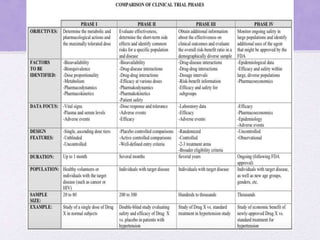
Phase I
• First stage of testing in human subjects
• Designed to assess the safety, tolerability, PK and PD
of drug.
• 20-25 healthy volunteers
• Patients: Anticancer drugs, AIDS therapy
• Duration: 6-12 months
• No blinding / Open labelled
Phase 1: Basic pre-requisites
• Preclinical data
• IND application
• Approval by the regulatory authority
• Protocol approval by the Ethics Committee
• Informed consent
• Adherence to Declaration of Helsinki /ICH-GCP
guidelines, at the start as well as from time to
time, during the study
Phase I Study/ Clinical trial
• The aim of a Phase I trial is to determine the
maximum tolerated dose (MTD) of the new
treatment.
• The MTD is found by escalating the treatment dose
until the dose-limiting toxicity (DLT) is reached.
• Kinds of Phase I
• SAD: single ascending dose studies
• MAD: multiple ascending dose studies
• Food Effect: investigates differences in absorption
caused by food
Single ascending dose studies (SAD)
• Small groups (3) of subjects are given a single
dose of the drug while they are observed and
tested for a period of time.
• If no adverse effects dose is escalated with 3
new healthy subjects
• If toxicity is observed then  3 more subjects are
given the same dose and
• if found toxic  the dose is considered as max.
tolerated dose (MTD).
Multiple ascending dose studies (MAD)
• conducted to understand the pharmacokinetics
and pharmacodynamics of multiple doses of the
drug.
• A group of patients receives multiple low doses of
the drug
• Samples (of blood, and other fluids) are collected
at various time points
• Analyzed: How the drug is processed within the
body.
Phase I studies: Need
• To make reliable and rapid Prediction of human response, from
Preclinical Data (PD, PK, Toxicity)
• Involves Extrapolation from Animal data to first human exposure.
 Phase I serves as an interface between Preclinical Research and
Clinical Drug development.
• Once Phase I is complete, Human beings become first-choice test
species (Human Guinea- pigs).
Phase I study: Objectives
1. Primary i. Tolerability and Safety
ii. Pharmacokinetics
2. Secondary iii. Pharmacodynamics
Phase I Studies: Subjects
• Healthy human volunteers: Most commonly used.
(Non-Therapeutic Research)
- Subjects receive no therapeutic benefit by
participation
- Ethical issue.
• Patient Volunteers: Cytotoxic drugs, AIDS therapy
- Patients in advanced stage of disease
Phase I: Reasons for Using Healthy Volunteers
• Large numbers available (vs. Patients)
• Rapid recruitment rate
• Potential risks are considerably reduced
• Results not confounded by presence of disease variables
• More homogenous group
• Greater compliance with Protocol
• In case of ADR’s Chances of Speedy and Complete recovery are better
• Advantages > Disadvantages
Phase I: Patient Volunteers
F Whenever Preclinical Toxicity Data indicates potential risks
for subjects & Ethical Concerns preclude use of healthy
human subjects e.g. Cancer/AIDs/Psychiatric patients
• Dose range of interest is appropriate to determine in
patients than in healthy volunteers
Phase I: Special Population Healthy Volunteers
 It is now a regulatory requirement to include
• Women of child bearing age
• Children, if NCE is proposed to be used in them.
• Elderly (>65 years) of age.
Limitations of Phase I
• Trial restricted to homogenous subjects
• Performance extrapolated to heterogeneous
market place
Phase II
• Therapeutic Exploratory Trial
• 20-300 Subjects
• To confirm effectiveness, monitor side effects, &
further evaluate safety
• First in patients (who have the disease that the
drug is expected to treat)
• Duration: 6 months to several years.
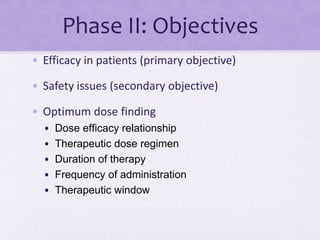
Phase II: Objectives
• Efficacy in patients (primary objective)
• Safety issues (secondary objective)
• Optimum dose finding
• Dose efficacy relationship
• Therapeutic dose regimen
• Duration of therapy
• Frequency of administration
• Therapeutic window
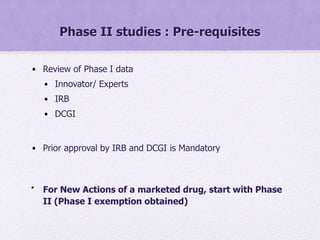
Phase II studies : Pre-requisites
• Review of Phase I data
• Innovator/ Experts
• IRB
• DCGI
• Prior approval by IRB and DCGI is Mandatory
* For New Actions of a marketed drug, start with Phase
II (Phase I exemption obtained)
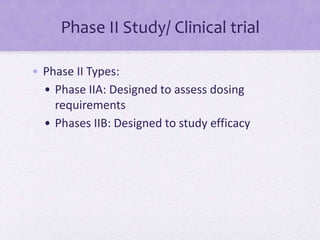
Phase II Study/ Clinical trial
• Phase II Types:
• Phase IIA: Designed to assess dosing
requirements
• Phases IIB: Designed to study efficacy
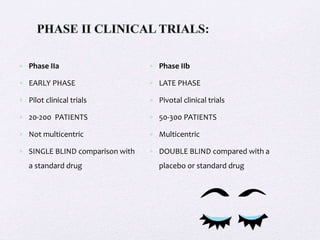
 Phase IIa
 EARLY PHASE
 Pilot clinical trials
 20-200 PATIENTS
 Not multicentric
 SINGLE BLIND comparison with
a standard drug
 Phase IIb
 LATE PHASE
 Pivotal clinical trials
 50-300 PATIENTS
 Multicentric
 DOUBLE BLIND compared with a
placebo or standard drug
Phase III
• Therapeutic confirmatory trials.
• Large scale, multicentre, Randomised, Controlled
trials .
• Target population: several 100’s to 3000 patients.
• Takes a long time: up to 5 years
• To establish efficacy of the drug against existing therapy
in larger number of patients, method of usage, & to
collect safety data etc.
Phase III: Objectives
• To assess overall and relative therapeutic value
of the new drug Efficacy, Safety and Special
Properties
• To determine optimal dosage schedule for use
in general
• The dosage schedule in C.T.’s should be as
close as possible to its anticipated clinical use
Phase III : Prerequisites
• Efficacy and dose schedule defined in Phase II studies
• No gross ADR’s
• Long term preclinical safety studies completed
• Chronic Toxicity
• Reproductive toxicity
• Carcinogenicity
• Marketing inputs favourable
• IRB and DCGI approval obtained
Phase III studies
• Subtypes
• Phase IIIA: to get sufficient and significant
data.
• Phase IIIB: allows patients to continue the
treatment, Label expansion, additional safety
data.
• Phase III B studies are known as "label expansion”
to show the drug works for additional types of
patients/diseases beyond the original use for which
the drug was approved for marketing
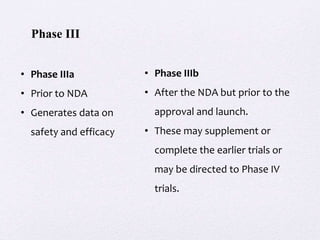
• Phase IIIa
• Prior to NDA
• Generates data on
safety and efficacy
• Phase IIIb
• After the NDA but prior to the
approval and launch.
• These may supplement or
complete the earlier trials or
may be directed to Phase IV
trials.
Phase III
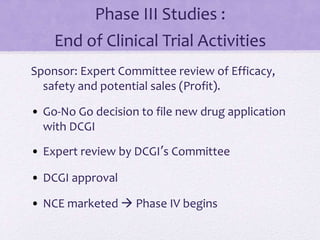
Phase III Studies :
End of Clinical Trial Activities
Sponsor: Expert Committee review of Efficacy,
safety and potential sales (Profit).
• Go-No Go decision to file new drug application
with DCGI
• Expert review by DCGI’s Committee
• DCGI approval
• NCE marketed  Phase IV begins
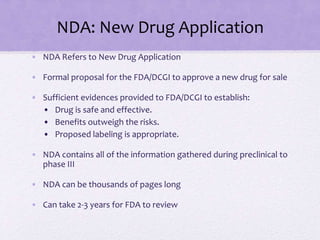
NDA: New Drug Application
• NDA Refers to New Drug Application
• Formal proposal for the FDA/DCGI to approve a new drug for sale
• Sufficient evidences provided to FDA/DCGI to establish:
• Drug is safe and effective.
• Benefits outweigh the risks.
• Proposed labeling is appropriate.
• NDA contains all of the information gathered during preclinical to
phase III
• NDA can be thousands of pages long
• Can take 2-3 years for FDA to review
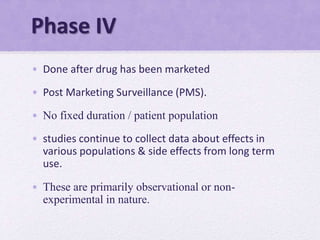
Phase IV
• Done after drug has been marketed
• Post Marketing Surveillance (PMS).
• No fixed duration / patient population
• studies continue to collect data about effects in
various populations & side effects from long term
use.
• These are primarily observational or non-
experimental in nature.
Phase IV Study / Clinical trial
• Helps to detect rare ADRs, Drug interactions
• Also to explore new uses for drugs [Sometimes called
Phase V]
• PERIODIC SAFETY UPDATE REPORTS
• To be submitted by the manufacturer every 6 months
for 2 yrs and then annually for next 2 yrs after
marketing approval
Phase IV Study / Clinical trial
• Harmful effects discovered may result in a drug
being no longer sold, or restricted to certain uses.
• On September 30, 2004, Merck withdrew
rofecoxib from the market because of concerns
about increased risk of heart attack and stroke
associated with long-term, high-dosage use.
Phase IV: Objectives
• Confirm the efficacy and safety profile in
large populations during practice
• Detect the unknown/rare adverse drug
reaction/s
• Evaluation of over-dosage
• Identifications of new indications
• Dose refinement: Evaluation of new
formulations, dosages, durations of
treatment
Phase IV: Objectives
• Evaluation in different age groups / types of
patients
• Comparative Benefit-Risk assessment
• Benefit-Cost assessment (Pharmaco-
economics)
• Drug usage in the community
• Quality Of Life assessment
REPORTING of ADR
• If Health care personal suspects that a particular
medication is associated with an adverse event observed
during the course of caring for a patient, he can report
the ADR to a formal reporting system.
Various reporting systems are:
WHO International System
USFDA –Medwatch
UK –Yellow card system
INDIA – National Pharmacovigilance Programme (CDSCO)
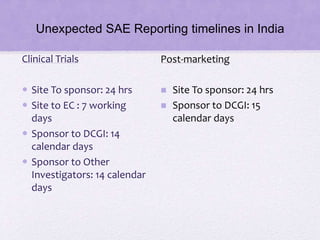
Unexpected SAE Reporting timelines in India
Clinical Trials
 Site To sponsor: 24 hrs
 Site to EC : 7 working
days
 Sponsor to DCGI: 14
calendar days
 Sponsor to Other
Investigators: 14 calendar
days
Post-marketing
 Site To sponsor: 24 hrs
 Sponsor to DCGI: 15
calendar days
Conclusion
• Clinical trial is a human experiment designed to study the
efficacy and safety of a new drug/intervention
• involves Phase 1-4 with specific objectives and end results
• Application to Regulatory authority:
• IND – Permission to conduct CT
• NDA – Permission to Market New drug
• Well designed and effectively executed clinical trials form the
base of therapeutic decisions
• CT must follow guidelines & protocol to ensure well-being of
participants
Ultimate Goal of Drug Development
-Drug Approval
Clinical Trial Phases

Clinical Trial Phases

  • 1.
    Phases of ClinicalTrial Dr. Ashutosh Tiwari IInd Yr. PG Resident Pharmacology Department SAIMS, Indore 30/10/2014
  • 2.
    Overview • Introduction: Clinicalresearch • Drug development phases • Pre-Phase 1 activities • Phases of Clinical trial • Regulatory approvals: IND & NDA • Summary of Clinical trial phases Sunday, February 15, 2015
  • 3.
    Introduction • Clinical trialis a systematic investigation in human subjects for evaluating the safety & efficacy of any new drug. • Clinical trials are a set of tests in medical research and drug development that generate safety and efficacy data for health interventions in human beings.
  • 4.
    Introduction • Clinical trialsare conducted only when • satisfactory information has been gathered on the quality of the nonclinical safety • health authority/ethics committee approval is granted in the country where approval of the drug is sought. • Clinical Trial is the mainstay for bringing out New Drugs to the Market.
  • 5.
    Drug Review Steps •1. Preclinical (animal) testing. • 2. An investigational new drug application (IND) : outlines what the sponsor of a new drug proposes for human testing in clinical trials. • 3. Phase 1 studies • 4. Phase 2 studies • 5. Phase 3 studies • 6. Submission of New Drug Application (NDA) is the formal step asking the FDA to consider a drug for marketing approval. • 7. FDA reviewers will approve the application or find it either "approvable" or "not approvable." • 8. Phase 4 studies
  • 6.
    Clinical Drug DevelopmentPhase Preclinical Data IND Filing IND Approval Phase I Phase II Phase III NDA Filed NDA Approval Marketing Permission Phase IV Sponsor Go/No Go DecisionPoints DCGI Mandatory Approval Points
  • 7.
    Phases of clinicaltrial Phase 0 • Exploratory CT’s Phase I Developmental CT’s (Proof of Concept) Phase II (Premarketing Phase of Clinical Drug Development) • Definitive CT’s Phase III (Pivotal) Phase IV Post marketing Phase
  • 8.
    Drug Development Process Initial Synthesis Animal Testing I N D A P P L I C A T I O N PhaseI Phase II Phase III Phase IV Adverse Reaction Reporting Surveys/ Sampling Testing Inspections Range 1-3 Yrs. Avg:18 Mos. FDA Time 30 Day Safety Review Range 2-10 Yrs. Avg: 5 Yrs. NDA Submitted NDA Approved Range 2Mons – 7 Yrs. Avg:2 Yrs. Average of Approximately 100 Months From Initial Synthesis to Approval of NDA Treatment Use Preclinical Clinical NDA Review Post-Marketing
  • 9.
    Drug review • Beforeone can initiate testing in human beings, extensive pre- clinical or laboratory research is required • Research usually involves years of experiments in animal and human cells. • If this stage of testing is successful, the sponsor then provides this data to the FDA requesting approval to begin testing in humans.This is called an Investigational New Drug (IND) Application • If approved by the FDA, testing in humans begins. This is done through a formally written and approved protocol.
  • 10.
    Preclinical evaluation phase( animal studies) Major areas are: • Pharmacodynamic studies in vivo in animals, In vitro preparation • Absorption, distribution , elimination studies (pharmacokinetics) • Acute ,sub acute, chronic toxicity studies (toxicity profile) • Therapeutic index (safety & efficacy evaluation)
  • 11.
    Prephase I Activities A- Preclinical Data Review: Drug Discovery Team - Efficacy - Safety Pharmacology - Toxicology - ADME B - Preparation of Investigator’s Brochure - Summaries of Preclinial data with clinical Extrapolation. - Prediction of Clinical Effects & Safety C – Filing of Investigational New Drug Application with DCGI.
  • 12.
    IND Application Filing •Once preclinical studies have indicated the safety and efficacy of a drug an IND application has to be filed with the regulatory authorities • for obtaining regulatory Approval for Phase I, phase II and Phase III clinical evaluation. • Contents of IND application • Preclinical Data (All data from animal studies) • Information on composition and source of drug • Chemical and manufacturing information • Proposed clinical plans and protocol • Ethical Committee Clearance
  • 13.
    IND Application • ClinicalEvaluation needs Prior Regulatory and IRB Clearance. • Phase-wise clearances have to be obtained. • The End Result of Phase I-III studies is the filing of NDA (New Drug Application) for obtaining Marketing Permission from DCGI.
  • 14.
  • 15.
  • 16.
    Phase 0 study/ Microdosing • Study of new drug in microdoses to derive PK information in human before undertaking phase I studies is called PHASE O • Microdose: Less than 1/100 of the dose of a test substance calculated to produce pharmacological effect with a max dose ≤100 micrograms • Objective: To obtain preliminary Pharmacokinetic data. • Preclinical Data: Subacute toxicity study in one species by two routes of administration.
  • 17.
    Microdosing / Phase0 study • These are very early studies of the pharmacodynamic and pharmacokinetic properties of a potential drug in humans. • Microdosing approach could ‘accelerate’ drug development without compromising clinical safety • Microdosing helps researchers select better drug candidates for clinical trials by providing early human PK and bioavailability data.
  • 18.
    Microdosing / Phase0 study • Advantages:  Less chances of adverse effects  Short duration  Less no. of volunteers  Reduced cost of development  Reduced drug development time • Limitations:  Study mainly based on PK parameters - not efficacy and safety based  Agents having different kinetic characteristics between microdose and full dose are not evaluated by phase 0 trials  Of Limited use for agents having Non linear PKs  The laboratory parameters are very limited and expensive, researchers have to depend on BA/BE labs
  • 19.
    Phase I • Firststage of testing in human subjects • Designed to assess the safety, tolerability, PK and PD of drug. • 20-25 healthy volunteers • Patients: Anticancer drugs, AIDS therapy • Duration: 6-12 months • No blinding / Open labelled
  • 20.
    Phase 1: Basicpre-requisites • Preclinical data • IND application • Approval by the regulatory authority • Protocol approval by the Ethics Committee • Informed consent • Adherence to Declaration of Helsinki /ICH-GCP guidelines, at the start as well as from time to time, during the study
  • 21.
    Phase I Study/Clinical trial • The aim of a Phase I trial is to determine the maximum tolerated dose (MTD) of the new treatment. • The MTD is found by escalating the treatment dose until the dose-limiting toxicity (DLT) is reached. • Kinds of Phase I • SAD: single ascending dose studies • MAD: multiple ascending dose studies • Food Effect: investigates differences in absorption caused by food
  • 22.
    Single ascending dosestudies (SAD) • Small groups (3) of subjects are given a single dose of the drug while they are observed and tested for a period of time. • If no adverse effects dose is escalated with 3 new healthy subjects • If toxicity is observed then  3 more subjects are given the same dose and • if found toxic  the dose is considered as max. tolerated dose (MTD).
  • 23.
    Multiple ascending dosestudies (MAD) • conducted to understand the pharmacokinetics and pharmacodynamics of multiple doses of the drug. • A group of patients receives multiple low doses of the drug • Samples (of blood, and other fluids) are collected at various time points • Analyzed: How the drug is processed within the body.
  • 24.
    Phase I studies:Need • To make reliable and rapid Prediction of human response, from Preclinical Data (PD, PK, Toxicity) • Involves Extrapolation from Animal data to first human exposure.  Phase I serves as an interface between Preclinical Research and Clinical Drug development. • Once Phase I is complete, Human beings become first-choice test species (Human Guinea- pigs).
  • 25.
    Phase I study:Objectives 1. Primary i. Tolerability and Safety ii. Pharmacokinetics 2. Secondary iii. Pharmacodynamics
  • 26.
    Phase I Studies:Subjects • Healthy human volunteers: Most commonly used. (Non-Therapeutic Research) - Subjects receive no therapeutic benefit by participation - Ethical issue. • Patient Volunteers: Cytotoxic drugs, AIDS therapy - Patients in advanced stage of disease
  • 27.
    Phase I: Reasonsfor Using Healthy Volunteers • Large numbers available (vs. Patients) • Rapid recruitment rate • Potential risks are considerably reduced • Results not confounded by presence of disease variables • More homogenous group • Greater compliance with Protocol • In case of ADR’s Chances of Speedy and Complete recovery are better • Advantages > Disadvantages
  • 28.
    Phase I: PatientVolunteers F Whenever Preclinical Toxicity Data indicates potential risks for subjects & Ethical Concerns preclude use of healthy human subjects e.g. Cancer/AIDs/Psychiatric patients • Dose range of interest is appropriate to determine in patients than in healthy volunteers
  • 29.
    Phase I: SpecialPopulation Healthy Volunteers  It is now a regulatory requirement to include • Women of child bearing age • Children, if NCE is proposed to be used in them. • Elderly (>65 years) of age.
  • 30.
    Limitations of PhaseI • Trial restricted to homogenous subjects • Performance extrapolated to heterogeneous market place
  • 31.
    Phase II • TherapeuticExploratory Trial • 20-300 Subjects • To confirm effectiveness, monitor side effects, & further evaluate safety • First in patients (who have the disease that the drug is expected to treat) • Duration: 6 months to several years.
  • 32.
    Phase II: Objectives •Efficacy in patients (primary objective) • Safety issues (secondary objective) • Optimum dose finding • Dose efficacy relationship • Therapeutic dose regimen • Duration of therapy • Frequency of administration • Therapeutic window
  • 33.
    Phase II studies: Pre-requisites • Review of Phase I data • Innovator/ Experts • IRB • DCGI • Prior approval by IRB and DCGI is Mandatory * For New Actions of a marketed drug, start with Phase II (Phase I exemption obtained)
  • 34.
    Phase II Study/Clinical trial • Phase II Types: • Phase IIA: Designed to assess dosing requirements • Phases IIB: Designed to study efficacy
  • 35.
     Phase IIa EARLY PHASE  Pilot clinical trials  20-200 PATIENTS  Not multicentric  SINGLE BLIND comparison with a standard drug  Phase IIb  LATE PHASE  Pivotal clinical trials  50-300 PATIENTS  Multicentric  DOUBLE BLIND compared with a placebo or standard drug
  • 36.
    Phase III • Therapeuticconfirmatory trials. • Large scale, multicentre, Randomised, Controlled trials . • Target population: several 100’s to 3000 patients. • Takes a long time: up to 5 years • To establish efficacy of the drug against existing therapy in larger number of patients, method of usage, & to collect safety data etc.
  • 37.
    Phase III: Objectives •To assess overall and relative therapeutic value of the new drug Efficacy, Safety and Special Properties • To determine optimal dosage schedule for use in general • The dosage schedule in C.T.’s should be as close as possible to its anticipated clinical use
  • 38.
    Phase III :Prerequisites • Efficacy and dose schedule defined in Phase II studies • No gross ADR’s • Long term preclinical safety studies completed • Chronic Toxicity • Reproductive toxicity • Carcinogenicity • Marketing inputs favourable • IRB and DCGI approval obtained
  • 39.
    Phase III studies •Subtypes • Phase IIIA: to get sufficient and significant data. • Phase IIIB: allows patients to continue the treatment, Label expansion, additional safety data. • Phase III B studies are known as "label expansion” to show the drug works for additional types of patients/diseases beyond the original use for which the drug was approved for marketing
  • 40.
    • Phase IIIa •Prior to NDA • Generates data on safety and efficacy • Phase IIIb • After the NDA but prior to the approval and launch. • These may supplement or complete the earlier trials or may be directed to Phase IV trials. Phase III
  • 41.
    Phase III Studies: End of Clinical Trial Activities Sponsor: Expert Committee review of Efficacy, safety and potential sales (Profit). • Go-No Go decision to file new drug application with DCGI • Expert review by DCGI’s Committee • DCGI approval • NCE marketed  Phase IV begins
  • 42.
    NDA: New DrugApplication • NDA Refers to New Drug Application • Formal proposal for the FDA/DCGI to approve a new drug for sale • Sufficient evidences provided to FDA/DCGI to establish: • Drug is safe and effective. • Benefits outweigh the risks. • Proposed labeling is appropriate. • NDA contains all of the information gathered during preclinical to phase III • NDA can be thousands of pages long • Can take 2-3 years for FDA to review
  • 43.
    Phase IV • Doneafter drug has been marketed • Post Marketing Surveillance (PMS). • No fixed duration / patient population • studies continue to collect data about effects in various populations & side effects from long term use. • These are primarily observational or non- experimental in nature.
  • 44.
    Phase IV Study/ Clinical trial • Helps to detect rare ADRs, Drug interactions • Also to explore new uses for drugs [Sometimes called Phase V] • PERIODIC SAFETY UPDATE REPORTS • To be submitted by the manufacturer every 6 months for 2 yrs and then annually for next 2 yrs after marketing approval
  • 45.
    Phase IV Study/ Clinical trial • Harmful effects discovered may result in a drug being no longer sold, or restricted to certain uses. • On September 30, 2004, Merck withdrew rofecoxib from the market because of concerns about increased risk of heart attack and stroke associated with long-term, high-dosage use.
  • 46.
    Phase IV: Objectives •Confirm the efficacy and safety profile in large populations during practice • Detect the unknown/rare adverse drug reaction/s • Evaluation of over-dosage • Identifications of new indications • Dose refinement: Evaluation of new formulations, dosages, durations of treatment
  • 47.
    Phase IV: Objectives •Evaluation in different age groups / types of patients • Comparative Benefit-Risk assessment • Benefit-Cost assessment (Pharmaco- economics) • Drug usage in the community • Quality Of Life assessment
  • 48.
    REPORTING of ADR •If Health care personal suspects that a particular medication is associated with an adverse event observed during the course of caring for a patient, he can report the ADR to a formal reporting system. Various reporting systems are: WHO International System USFDA –Medwatch UK –Yellow card system INDIA – National Pharmacovigilance Programme (CDSCO)
  • 49.
    Unexpected SAE Reportingtimelines in India Clinical Trials  Site To sponsor: 24 hrs  Site to EC : 7 working days  Sponsor to DCGI: 14 calendar days  Sponsor to Other Investigators: 14 calendar days Post-marketing  Site To sponsor: 24 hrs  Sponsor to DCGI: 15 calendar days
  • 51.
    Conclusion • Clinical trialis a human experiment designed to study the efficacy and safety of a new drug/intervention • involves Phase 1-4 with specific objectives and end results • Application to Regulatory authority: • IND – Permission to conduct CT • NDA – Permission to Market New drug • Well designed and effectively executed clinical trials form the base of therapeutic decisions • CT must follow guidelines & protocol to ensure well-being of participants
  • 52.
    Ultimate Goal ofDrug Development -Drug Approval