CAUSALITY
ASSESSMENT OF ADR
DR. RAMESH BHANDARI
ASST. PROFESSOR
DEPARTMENT OF PHARMACY PRACTICE
KLE COLLEGE OF PHARMACY, BELAGAVI
1
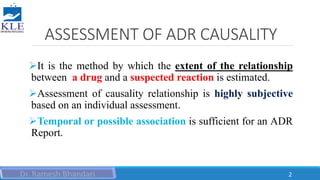
ASSESSMENT OF ADR CAUSALITY
It is the method by which the extent of the relationship
between a drug and a suspected reaction is estimated.
Assessment of causality relationship is highly subjective
based on an individual assessment.
Temporal or possible association is sufficient for an ADR
Report.
2
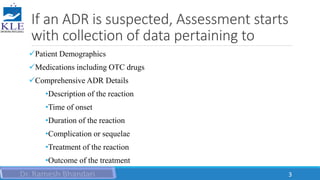
If an ADR is suspected, Assessment starts
with collection of data pertaining to
Patient Demographics
Medications including OTC drugs
Comprehensive ADR Details
•Description of the reaction
•Time of onset
•Duration of the reaction
•Complication or sequelae
•Treatment of the reaction
•Outcome of the treatment
3
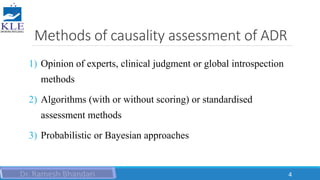
Methods of causality assessment of ADR
1) Opinion of experts, clinical judgment or global introspection
methods
2) Algorithms (with or without scoring) or standardised
assessment methods
3) Probabilistic or Bayesian approaches
4
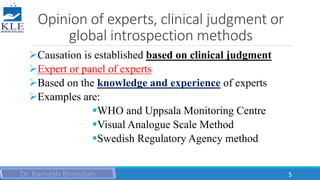
Opinion of experts, clinical judgment or
global introspection methods
Causation is established based on clinical judgment
Expert or panel of experts
Based on the knowledge and experience of experts
Examples are:
WHO and Uppsala Monitoring Centre
Visual Analogue Scale Method
Swedish Regulatory Agency method
5
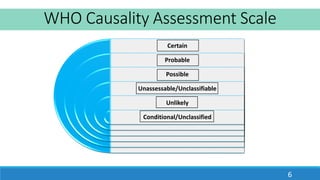
WHO Causality Assessment Scale
Certain
Probable
Possible
Unassessable/Unclassifiable
Unlikely
Conditional/Unclassified
6
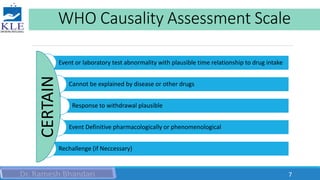
WHO Causality Assessment Scale
Event or laboratory test abnormality with plausible time relationship to drug intake
Cannot be explained by disease or other drugs
Response to withdrawal plausible
Event Definitive pharmacologically or phenomenological
Rechallenge (if Neccessary)
CERTAIN
7
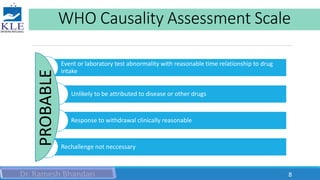
WHO Causality Assessment Scale
Event or laboratory test abnormality with reasonable time relationship to drug
intake
Unlikely to be attributed to disease or other drugs
Response to withdrawal clinically reasonable
Rechallenge not neccessary
PROBABLE
8
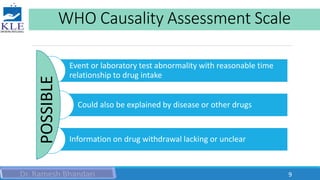
WHO Causality Assessment Scale
Event or laboratory test abnormality with reasonable time
relationship to drug intake
Could also be explained by disease or other drugs
Information on drug withdrawal lacking or unclear
POSSIBLE
9
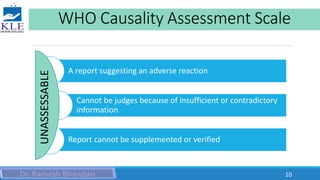
WHO Causality Assessment Scale
A report suggesting an adverse reaction
Cannot be judges because of insufficient or contradictory
information
Report cannot be supplemented or verified
UNASSESSABLE
10
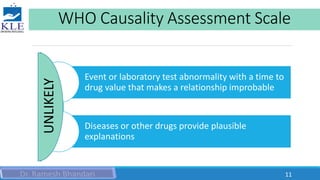
WHO Causality Assessment Scale
Event or laboratory test abnormality with a time to
drug value that makes a relationship improbable
Diseases or other drugs provide plausible
explanations
UNLIKELY
11
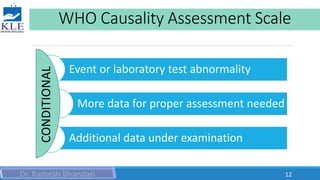
WHO Causality Assessment Scale
Event or laboratory test abnormality
More data for proper assessment needed
Additional data under examination
CONDITIONAL
12
Algorithms
Usually in the form of questionnaire
Not Accepted any method as “Gold Standard”
Examples are:
Naranjo’s causality assessment scale
Karch and Lasagna’s Scale
Kramer’s scale
13
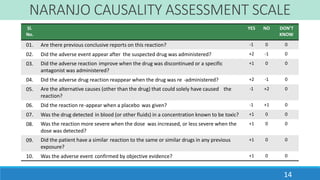
NARANJO CAUSALITY ASSESSMENT SCALE
14
Sl.
No.
YES NO DON’T
KNOW
01. Are there previous conclusive reports on this reaction? -1 0 0
02. Did the adverse event appear after the suspected drug was administered? +2 -1 0
03. Did the adverse reaction improve when the drug was discontinued or a specific
antagonist was administered?
+1 0 0
04. Did the adverse drug reaction reappear when the drug was re -administered? +2 -1 0
05. Are the alternative causes (other than the drug) that could solely have caused the
reaction?
-1 +2 0
06. Did the reaction re-appear when a placebo was given? -1 +1 0
07. Was the drug detected in blood (or other fluids) in a concentration known to be toxic? +1 0 0
08. Was the reaction more severe when the dose was increased, or less severe when the
dose was detected?
+1 0 0
09. Did the patient have a similar reaction to the same or similar drugs in any previous
exposure?
+1 0 0
10. Was the adverse event confirmed by objective evidence? +1 0 0
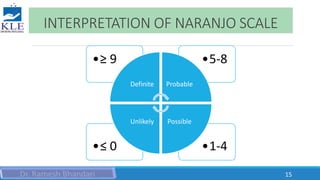
INTERPRETATION OF NARANJO SCALE
•1-4
•≤ 0
•5-8
•≥ 9
Definite Probable
Possible
Unlikely
15
Probabilistic or Bayesian Approaches
Involve the transformation of prior probability into
posterior probability of drug causation.
Examples are:
BARDI (Bayesian Adverse Reactions Diagnostic
Instrument)
 MacBARDI
16
17

Causality Assessment ADR.pdf

  • 1.
    CAUSALITY ASSESSMENT OF ADR DR.RAMESH BHANDARI ASST. PROFESSOR DEPARTMENT OF PHARMACY PRACTICE KLE COLLEGE OF PHARMACY, BELAGAVI 1
  • 2.
    ASSESSMENT OF ADRCAUSALITY It is the method by which the extent of the relationship between a drug and a suspected reaction is estimated. Assessment of causality relationship is highly subjective based on an individual assessment. Temporal or possible association is sufficient for an ADR Report. 2
  • 3.
    If an ADRis suspected, Assessment starts with collection of data pertaining to Patient Demographics Medications including OTC drugs Comprehensive ADR Details •Description of the reaction •Time of onset •Duration of the reaction •Complication or sequelae •Treatment of the reaction •Outcome of the treatment 3
  • 4.
    Methods of causalityassessment of ADR 1) Opinion of experts, clinical judgment or global introspection methods 2) Algorithms (with or without scoring) or standardised assessment methods 3) Probabilistic or Bayesian approaches 4
  • 5.
    Opinion of experts,clinical judgment or global introspection methods Causation is established based on clinical judgment Expert or panel of experts Based on the knowledge and experience of experts Examples are: WHO and Uppsala Monitoring Centre Visual Analogue Scale Method Swedish Regulatory Agency method 5
  • 6.
    WHO Causality AssessmentScale Certain Probable Possible Unassessable/Unclassifiable Unlikely Conditional/Unclassified 6
  • 7.
    WHO Causality AssessmentScale Event or laboratory test abnormality with plausible time relationship to drug intake Cannot be explained by disease or other drugs Response to withdrawal plausible Event Definitive pharmacologically or phenomenological Rechallenge (if Neccessary) CERTAIN 7
  • 8.
    WHO Causality AssessmentScale Event or laboratory test abnormality with reasonable time relationship to drug intake Unlikely to be attributed to disease or other drugs Response to withdrawal clinically reasonable Rechallenge not neccessary PROBABLE 8
  • 9.
    WHO Causality AssessmentScale Event or laboratory test abnormality with reasonable time relationship to drug intake Could also be explained by disease or other drugs Information on drug withdrawal lacking or unclear POSSIBLE 9
  • 10.
    WHO Causality AssessmentScale A report suggesting an adverse reaction Cannot be judges because of insufficient or contradictory information Report cannot be supplemented or verified UNASSESSABLE 10
  • 11.
    WHO Causality AssessmentScale Event or laboratory test abnormality with a time to drug value that makes a relationship improbable Diseases or other drugs provide plausible explanations UNLIKELY 11
  • 12.
    WHO Causality AssessmentScale Event or laboratory test abnormality More data for proper assessment needed Additional data under examination CONDITIONAL 12
  • 13.
    Algorithms Usually in theform of questionnaire Not Accepted any method as “Gold Standard” Examples are: Naranjo’s causality assessment scale Karch and Lasagna’s Scale Kramer’s scale 13
  • 14.
    NARANJO CAUSALITY ASSESSMENTSCALE 14 Sl. No. YES NO DON’T KNOW 01. Are there previous conclusive reports on this reaction? -1 0 0 02. Did the adverse event appear after the suspected drug was administered? +2 -1 0 03. Did the adverse reaction improve when the drug was discontinued or a specific antagonist was administered? +1 0 0 04. Did the adverse drug reaction reappear when the drug was re -administered? +2 -1 0 05. Are the alternative causes (other than the drug) that could solely have caused the reaction? -1 +2 0 06. Did the reaction re-appear when a placebo was given? -1 +1 0 07. Was the drug detected in blood (or other fluids) in a concentration known to be toxic? +1 0 0 08. Was the reaction more severe when the dose was increased, or less severe when the dose was detected? +1 0 0 09. Did the patient have a similar reaction to the same or similar drugs in any previous exposure? +1 0 0 10. Was the adverse event confirmed by objective evidence? +1 0 0
  • 15.
    INTERPRETATION OF NARANJOSCALE •1-4 •≤ 0 •5-8 •≥ 9 Definite Probable Possible Unlikely 15
  • 16.
    Probabilistic or BayesianApproaches Involve the transformation of prior probability into posterior probability of drug causation. Examples are: BARDI (Bayesian Adverse Reactions Diagnostic Instrument)  MacBARDI 16
  • 17.