Clinical Data Management
Overview Mission Responsibility Process Discrepancies Management Medical Coding and CTCAE CRF Filling Instructions Reminders
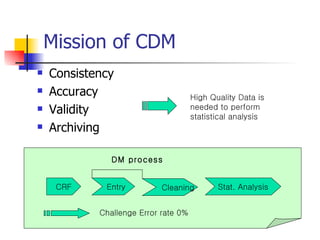
Mission of CDM Consistency Accuracy Validity Archiving High Quality Data is needed to perform statistical analysis CRF Entry Cleaning DM process Stat. Analysis Challenge Error rate 0%
Responsibilities of CDM Responsibilities Protocol Review CRF Design / Review Clinical DB Application Development Computer System Validation CRF tracking Data Entry / Verification Transformation to SAS data Medical Coding : AE, Medication, Medical condition
Responsibilities of CDM Responsibilities Audit trails - Transparency DB QA DB Security and Archiving Regular DB backup
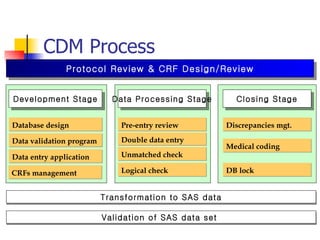
CDM Process Database design Protocol Review & CRF Design/Review Development Stage Data validation program Data entry application Pre-entry review Double data entry  Data Processing Stage Unmatched check Logical check Discrepancies mgt. Closing Stage Medical coding DB lock Validation of SAS data set  Transformation to SAS data CRFs management
CDM Flowchart Data Entry Approved Blank CRF  and Protocol  Quality Control of Database and Database go live Batch Validation Medical Coding QA/QC of data CRF Annotation,  Edit Specification  Document Preparation Database Lock & Statistical report generation Database Design  Setup  Test  Data Entry CRF’s  completed  at site. CRF Receipt and Tracking in Data Center Maintaining Missing & pending pages log Discrepancy Mgt. Pre-Data Entry Review
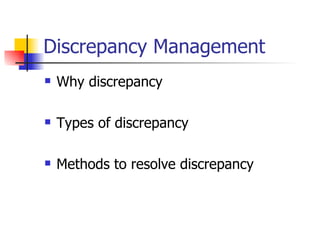
Discrepancy Management Why discrepancy Types of discrepancy Methods to resolve discrepancy
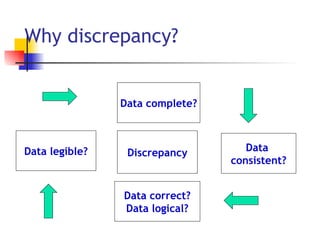
Why discrepancy? Data complete? Data  consistent? Discrepancy Data correct? Data logical? Data legible?
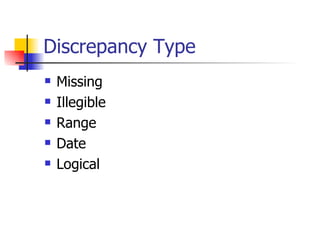
Discrepancy Type Missing Illegible Range  Date Logical
Discrepancy Resolve Methods Self Evident-  discrepancies which are resolved by Data Coordinator.  Ex: Details of concomitant medication are given but Yes/No field are not marked.   CRA/Medical Monitor-  discrepancies which are resolved by CRA or Medical Monitor.
Discrepancy Resolve Methods Query- Discrepancies which are resolved by Investigator. Ex: Start date of Adverse event not supply. Query has been send to investigator by Data Clarification Form (DCF)
Medical Coding Why Medical coding Different sites, Different culture, different time-zones, different physicians and various other factors leads to variation in the data entered in particular fields which cannot be effectively controlled. This varying fields require coding.   Methods  Auto-Coding Manually Combination of Both
MedDRA Med  = Medical   D  = Dictionary for   R  = Regulatory   A  = Activities FDA and EU mandated for  AE data coding
Objectives for MedDRA Development An international multi-lingual terminology  Standardized communication between industry and regulators  Support of electronic submissions Application through all phases of the development cycle
Objectives for MedDRA Development Classification for a wide range of clinical information Support for multiple medical product areas A terminology that saves time, resources, and money
MedDRA Is Designed For Coding: Signs (i.e. Redness) Symptoms (i.e. Dizzy) Diseases (i.e. AIDS) Diagnoses (i.e. Hepatic failure) Therapeutic indications (i.e. Congestive heart failure) Names and qualitative results of investigations (i.e. Increased SGOT) Surgical and medical procedures (i.e. Cholecystectomy) Medical, social, and family history (i.e. Alcoholism)
Not Code able Term A single event description contains multiple conditions. Ex: Leg red, swollen, and painful An event term contains a diagnosis and a symptom. Ex: Fever and Cold The event term can be interpreted more than one way. EX: Unable to focus The event term does not make sense. Ex: Left leg The event term is foreign  Event term contains a question mark Improvement of a condition is implied, but the term does not state it is a benefit. Ex: Sleep improved
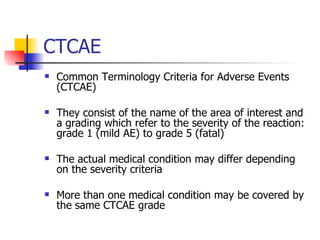
CTCAE Common Terminology Criteria for Adverse Events (CTCAE) They consist of the name of the area of interest and a grading which refer to the severity of the reaction: grade 1 (mild AE) to grade 5 (fatal)  The actual medical condition may differ depending on the severity criteria More than one medical condition may be covered by the same CTCAE grade
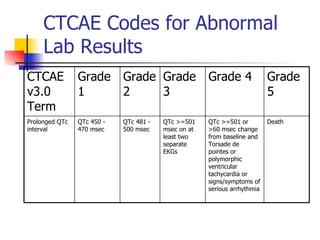
CTCAE Codes for Abnormal Lab Results QTc >=501 or >60 msec change from baseline and Torsade de pointes or polymorphic ventricular tachycardia or signs/symptoms of serious arrhythmia Grade 4 Death QTc >=501 msec on at least two separate EKGs QTc 481 - 500 msec QTc 450 - 470 msec Prolonged QTc interval Grade 5 Grade 3 Grade 2 Grade 1 CTCAE v3.0 Term
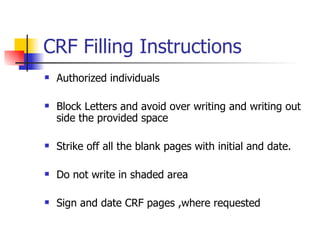
CRF Filling Instructions Authorized individuals Block Letters and avoid over writing and writing out side the provided space Strike off all the blank pages with initial and date. Do not write in shaded area Sign and date CRF pages ,where requested
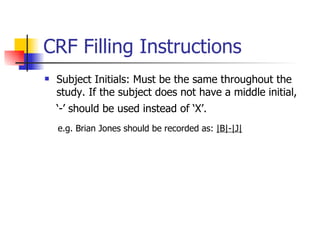
CRF Filling Instructions Subject Initials: Must be the same throughout the study. If the subject does not have a middle initial,  ‘-’ should be used instead of ‘X’.   e.g. Brian Jones should be recorded as:  |B|-|J|
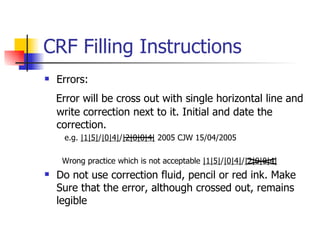
CRF Filling Instructions Errors: Error will be cross out with single horizontal line and write correction next to it. Initial and date the correction. e.g.  |1|5| / |0|4| / |2|0|0|4|  2005 CJW 15/04/2005  Wrong practice which is not acceptable  |1|5| / |0|4| / |2|0|0|4|   Do not use correction fluid, pencil or red ink. Make Sure that the error, although crossed out, remains legible
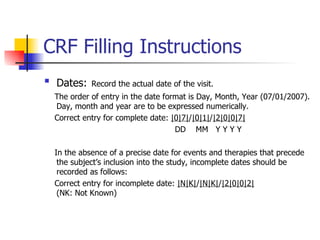
CRF Filling Instructions Dates:   Record the actual date of the visit. The order of entry in the date format is Day, Month, Year (07/01/2007). Day, month and year are to be expressed numerically.  Correct entry for complete date:  |0|7| / |0|1| / |2|0|0|7| DD  MM  Y Y Y Y In the absence of a precise date for events and therapies that precede the subject’s inclusion into the study, incomplete dates should be recorded as follows: Correct entry for incomplete date:  |N|K| / |N|K| / |2|0|0|2|   (NK: Not Known)
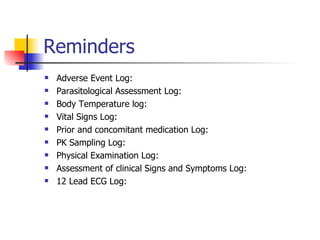
Reminders Adverse Event Log:  Parasitological Assessment Log:  Body Temperature log:  Vital Signs Log:  Prior and concomitant medication Log: PK Sampling Log:  Physical Examination Log:  Assessment of clinical Signs and Symptoms Log:  12 Lead ECG Log:
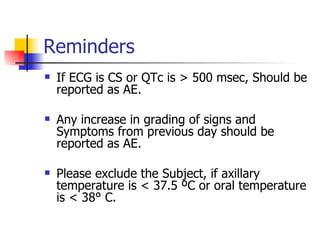
Reminders If ECG is CS or QTc is > 500 msec, Should be reported as AE. Any increase in grading of signs and Symptoms from previous day should be reported as AE. Please exclude the Subject, if axillary temperature is < 37.5 ºC or oral temperature is < 38° C.
Reminders In Clinical Signs and Symptoms, Please enter only One CTCAE Grade. Clinically significant (CS) abnormal laboratory tests must be followed up as described in the protocol.  Did the subject develop any sign or symptom of severe malaria? If Yes, the subject withdrawn from trial. If Pregnancy test is “positive” complete ‘Notification of Pregnancy’ report
Reminders Exclude the subject if QTc interval >450msec. Use Fridericia’s formula to calculate QTc   Please Exclude the Subject if weight is less than 35 kg.

Cdm

  • 1.
  • 2.
    Overview Mission ResponsibilityProcess Discrepancies Management Medical Coding and CTCAE CRF Filling Instructions Reminders
  • 3.
    Mission of CDMConsistency Accuracy Validity Archiving High Quality Data is needed to perform statistical analysis CRF Entry Cleaning DM process Stat. Analysis Challenge Error rate 0%
  • 4.
    Responsibilities of CDMResponsibilities Protocol Review CRF Design / Review Clinical DB Application Development Computer System Validation CRF tracking Data Entry / Verification Transformation to SAS data Medical Coding : AE, Medication, Medical condition
  • 5.
    Responsibilities of CDMResponsibilities Audit trails - Transparency DB QA DB Security and Archiving Regular DB backup
  • 6.
    CDM Process Databasedesign Protocol Review & CRF Design/Review Development Stage Data validation program Data entry application Pre-entry review Double data entry Data Processing Stage Unmatched check Logical check Discrepancies mgt. Closing Stage Medical coding DB lock Validation of SAS data set Transformation to SAS data CRFs management
  • 7.
    CDM Flowchart DataEntry Approved Blank CRF and Protocol Quality Control of Database and Database go live Batch Validation Medical Coding QA/QC of data CRF Annotation, Edit Specification Document Preparation Database Lock & Statistical report generation Database Design Setup Test Data Entry CRF’s completed at site. CRF Receipt and Tracking in Data Center Maintaining Missing & pending pages log Discrepancy Mgt. Pre-Data Entry Review
  • 8.
    Discrepancy Management Whydiscrepancy Types of discrepancy Methods to resolve discrepancy
  • 9.
    Why discrepancy? Datacomplete? Data consistent? Discrepancy Data correct? Data logical? Data legible?
  • 10.
    Discrepancy Type MissingIllegible Range Date Logical
  • 11.
    Discrepancy Resolve MethodsSelf Evident- discrepancies which are resolved by Data Coordinator. Ex: Details of concomitant medication are given but Yes/No field are not marked. CRA/Medical Monitor- discrepancies which are resolved by CRA or Medical Monitor.
  • 12.
    Discrepancy Resolve MethodsQuery- Discrepancies which are resolved by Investigator. Ex: Start date of Adverse event not supply. Query has been send to investigator by Data Clarification Form (DCF)
  • 13.
    Medical Coding WhyMedical coding Different sites, Different culture, different time-zones, different physicians and various other factors leads to variation in the data entered in particular fields which cannot be effectively controlled. This varying fields require coding. Methods Auto-Coding Manually Combination of Both
  • 14.
    MedDRA Med = Medical D = Dictionary for R = Regulatory A = Activities FDA and EU mandated for AE data coding
  • 15.
    Objectives for MedDRADevelopment An international multi-lingual terminology Standardized communication between industry and regulators Support of electronic submissions Application through all phases of the development cycle
  • 16.
    Objectives for MedDRADevelopment Classification for a wide range of clinical information Support for multiple medical product areas A terminology that saves time, resources, and money
  • 17.
    MedDRA Is DesignedFor Coding: Signs (i.e. Redness) Symptoms (i.e. Dizzy) Diseases (i.e. AIDS) Diagnoses (i.e. Hepatic failure) Therapeutic indications (i.e. Congestive heart failure) Names and qualitative results of investigations (i.e. Increased SGOT) Surgical and medical procedures (i.e. Cholecystectomy) Medical, social, and family history (i.e. Alcoholism)
  • 18.
    Not Code ableTerm A single event description contains multiple conditions. Ex: Leg red, swollen, and painful An event term contains a diagnosis and a symptom. Ex: Fever and Cold The event term can be interpreted more than one way. EX: Unable to focus The event term does not make sense. Ex: Left leg The event term is foreign Event term contains a question mark Improvement of a condition is implied, but the term does not state it is a benefit. Ex: Sleep improved
  • 19.
    CTCAE Common TerminologyCriteria for Adverse Events (CTCAE) They consist of the name of the area of interest and a grading which refer to the severity of the reaction: grade 1 (mild AE) to grade 5 (fatal) The actual medical condition may differ depending on the severity criteria More than one medical condition may be covered by the same CTCAE grade
  • 20.
    CTCAE Codes forAbnormal Lab Results QTc >=501 or >60 msec change from baseline and Torsade de pointes or polymorphic ventricular tachycardia or signs/symptoms of serious arrhythmia Grade 4 Death QTc >=501 msec on at least two separate EKGs QTc 481 - 500 msec QTc 450 - 470 msec Prolonged QTc interval Grade 5 Grade 3 Grade 2 Grade 1 CTCAE v3.0 Term
  • 21.
    CRF Filling InstructionsAuthorized individuals Block Letters and avoid over writing and writing out side the provided space Strike off all the blank pages with initial and date. Do not write in shaded area Sign and date CRF pages ,where requested
  • 22.
    CRF Filling InstructionsSubject Initials: Must be the same throughout the study. If the subject does not have a middle initial, ‘-’ should be used instead of ‘X’. e.g. Brian Jones should be recorded as: |B|-|J|
  • 23.
    CRF Filling InstructionsErrors: Error will be cross out with single horizontal line and write correction next to it. Initial and date the correction. e.g. |1|5| / |0|4| / |2|0|0|4| 2005 CJW 15/04/2005 Wrong practice which is not acceptable |1|5| / |0|4| / |2|0|0|4| Do not use correction fluid, pencil or red ink. Make Sure that the error, although crossed out, remains legible
  • 24.
    CRF Filling InstructionsDates: Record the actual date of the visit. The order of entry in the date format is Day, Month, Year (07/01/2007). Day, month and year are to be expressed numerically. Correct entry for complete date: |0|7| / |0|1| / |2|0|0|7| DD MM Y Y Y Y In the absence of a precise date for events and therapies that precede the subject’s inclusion into the study, incomplete dates should be recorded as follows: Correct entry for incomplete date: |N|K| / |N|K| / |2|0|0|2| (NK: Not Known)
  • 25.
    Reminders Adverse EventLog: Parasitological Assessment Log: Body Temperature log: Vital Signs Log: Prior and concomitant medication Log: PK Sampling Log: Physical Examination Log: Assessment of clinical Signs and Symptoms Log: 12 Lead ECG Log:
  • 26.
    Reminders If ECGis CS or QTc is > 500 msec, Should be reported as AE. Any increase in grading of signs and Symptoms from previous day should be reported as AE. Please exclude the Subject, if axillary temperature is < 37.5 ºC or oral temperature is < 38° C.
  • 27.
    Reminders In ClinicalSigns and Symptoms, Please enter only One CTCAE Grade. Clinically significant (CS) abnormal laboratory tests must be followed up as described in the protocol. Did the subject develop any sign or symptom of severe malaria? If Yes, the subject withdrawn from trial. If Pregnancy test is “positive” complete ‘Notification of Pregnancy’ report
  • 28.
    Reminders Exclude thesubject if QTc interval >450msec. Use Fridericia’s formula to calculate QTc Please Exclude the Subject if weight is less than 35 kg.