The Planet Earth
•Earth, our home, is the third planet from the
sun. It is the only planet known to have an
atmosphere containing free oxygen, oceans of
liquid water on its surface, and, of course, life.
• Earth is the fifth largest of the planets in the
solar system — smaller than the four gas
giants, Jupiter, Saturn,Uranusand Neptune, but
larger than the three other rocky
planets,Mercury, Marsand Venus.
Earth has a diameter of roughly 8,000
miles (13,000 kilometers), and is round
because gravity pulls matter into a ball,
although it is not perfectly round, instead
being more of an "oblate spheroid" whose
spin causes it to be squashed at its poles
and swollen at the equator.
Roughly 71 percent of Earth's surface is
covered by water, most of it in the oceans.
About a fifth of Earth's atmosphereis
made up of oxygen, produced by plants.
While scientists have been studying our
planet for centuries, much has been
learned in recent decades by
studying pictures of Earth from space
Orbital characteristics
•Earth spins on an imaginary line called an
axis that runs from the North Pole to the
South Pole, while also orbiting the sun. It
takes Earth 23.439 hours to complete a
rotation on its axis, and roughly 365.26
days to complete an orbit around the sun.
Earth's axis of rotation is tilted in relation
to the ecliptic plane, an imaginary surface
through Earth's orbit around the sun. This
means the northern and southern
hemispheres will sometimes point toward
or away from the sun depending on the
time of year, varying the amount of light
they receive and causing the seasons.
Earth's orbit is not a perfect circle, but is rather
an oval-shaped ellipse, like that of the orbits of
all the other planets. Earth is a bit closer to the
sun in early January and farther away in July,
although this variation has a much smaller
effect than the heating and cooling caused by
the tilt of Earth's axis. Earth happens to lie
within the so-called "Goldilocks zone" around
its star, where temperatures are just right to
maintain liquid water on its surface.
Orbit & rotation
Some statistics about Earth, according to NASA:
• Average distance from the sun: 92,956,050 miles (149,598,262 km)
• Perihelion (closest approach to the sun): 91,402,640 miles (147,098,291
km)
• Aphelion (farthest distance from the sun): 94,509,460 miles
(152,098,233 km)
• Length of solar day (single rotation on its axis): 23.934 hours
• Length of year (single revolution around the sun): 365.26 days
• Equatorial inclination to orbit: 23.4393 degrees
Earth's formation and evolution
•Scientists think Earth was formed at roughly
the same time as the sun and other planets
some 4.6 billion years ago, when the solar
system coalesced from a giant, rotating cloud
of gas and dust known as the solar nebula. As
the nebula collapsed because of its gravity, it
spun faster and flattened into a disk. Most of
the material was pulled toward the center to
form the sun.
Other particles within the disk collided and stuck
together to form ever-larger bodies, including
Earth. The solar wind from the sun was so
powerful that it swept away most of the lighter
elements, such as hydrogen and helium, from
the innermost worlds, rendering Earth and its
siblings into small, rocky planets.
Scientists think Earth started off as a waterless
mass of rock. Radioactive materials in the rock
and increasing pressure deep within the Earth
generated enough heat to melt Earth's interior,
causing some chemicals to rise to the surface
and form water, while others became the gases
of the atmosphere. Recent evidence suggests
that Earth's crust and oceans may have formed
within about 200 million years after the planet
had taken shape.
Composition & structure
Atmosphere
•Earth's atmosphere is roughly 78 percent
nitrogen, 21 percent oxygen, with trace
amounts of water, argon, carbon dioxide and
other gases. Nowhere else in the solar system
can one find an atmosphere loaded with free
oxygen, which ultimately proved vital to one of
the other unique features of Earth
Air surrounds Earth and becomes thinner farther
from the surface. Roughly 100 miles (160 km)
above Earth, the air is so thin that satellites can
zip through with little resistance. Still, traces of
atmosphere can be found as high as 370 miles
(600 km) above the surface.
Atmosphere layers
•Earth's atmosphere is divided into five main
layers, the exosphere, the thermosphere, the
mesosphere, the stratosphere and the
troposphere. The atmosphere thins out in each
higher layer until the gases dissipate in space.
There is no distinct boundary between the
atmosphere and space, but an imaginary line
about 68 miles (110 kilometers) from the
surface, called the Karman line, is usually
where scientists say atmosphere meets outer
space.
The troposphere is the layer closest to Earth's
surface. It is 4 to 12 miles (7 to 20 km) thick
and contains half of Earth's atmosphere. Air is
warmer near the ground and gets colder higher
up. Nearly all of the water vapor and dust in
the atmosphere are in this layer and that is why
clouds are found here.
The stratosphere is the second layer. It starts
above the troposphere and ends about 31
miles (50 km) above ground. Ozone is
abundant here and it heats the atmosphere
while also absorbing harmful radiation from
the sun. The air here is very dry, and it is about
a thousand times thinner here than it is at sea
level. Because of that, this is where jet
aircraft and weather balloons fly.
The mesosphere starts at 31 miles (50 km) and
extends to 53 miles (85 km) high. The top of
the mesosphere, called the mesopause, is the
coldest part of Earth's atmosphere with
temperatures averaging about minus 130
degrees F (minus 90 C). This layer is hard to
study. Jets and balloons don't go high enough,
and satellites and space shuttles orbit too high.
Scientists do know that meteors burn up in this
layer.
The thermosphere extends from about 56 miles (90 km) to between 310
and 620 miles (500 and 1,000 km). Temperatures can get up to 2,700
degrees F (1,500 C) at this altitude. The thermosphere is considered part
of Earth's atmosphere, but air density is so low that most of this layer is
what is normally thought of as outer space. In fact, this is where
the space shuttles flew and where the International Space Station orbits
Earth. This is also the layer where the auroras occur. Charged particles
from space collide with atoms and molecules in the thermosphere,
exciting them into higher states of energy. The atoms shed this excess
energy by emitting photons of light, which we see as the colorful Aurora
Borealis and Aurora Australis.
The exosphere, the highest layer, is extremely
thin and is where the atmosphere merges into
outer space. It is composed of very widely
dispersed particles of hydrogen and helium.
•Water vapor, carbon dioxide and other gases in
the atmosphere trap heat from the sun,
warming Earth. Without this so-called
"greenhouse effect," Earth would probably be
too cold for life to exist, although a runaway
greenhouse effect led to the hellish conditions
now seen on Venus.
•Earth-orbiting satellites have shown that the
upper atmosphere actually expands during the
day and contracts at night due to heating and
cooling.
Chemical composition
•Oxygen is the most abundant element in rocks
in Earth's crust, composing roughly 47 percent
of the weight of all rock. The second most
abundant element is silicon at 27 percent,
followed by aluminum at 8 percent, iron at 5
percent, calcium at 4 percent,
and sodium, potassium, and magnesium at
about 2 percent each.
Earth's core consists mostly of iron
and nickel and potentially smaller amounts of
lighter elements such as sulfur and oxygen. The
mantle is made of iron and magnesium-rich
silicate rocks. (The combination of silicon and
oxygen is known as silica, and minerals that
contain silica are known as silicate minerals.)
Climate and weather
Earth is able to support a wide variety of living beings because of its
diverse regional climates, which range from extreme cold at the poles to
tropical heat at the Equator. Regional climate is often described as the
average weather in a place over more than 30 years. A region's climate is
often described, for example, as sunny, windy, dry, or humid. These can
also describe the weather in a certain place, but while the weather can
change in just a few hours, climate changes over a longer span of time.
•Earth's global climate is an average of regional
climates. The global climate has cooled and warmed
throughout history. Today, we are seeing unusually
rapid warming. The scientific consensus is that
greenhouse gases, which are increasing because of
human activities, are trapping heat in the atmosphere.
•Earth is unique among the known planets: it has an
abundance of water. Other worlds — including a few
moons — have atmospheres, ice, and even oceans,
but only Earth has the right combination to sustain
life.
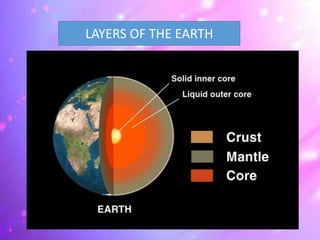
LAYERS OF THE EARTH
Crust
• Earth's crust is made up of several elements: oxygen, 47 percent; silicon,
27 percent; aluminum, 8 percent; iron, 5 percent; calcium, 4 percent;
magnesium, potassium and sodium, 2 percent.
• The crust is divided into huge plates that float on the mantle, the next
layer. The plates are constantly in motion; they move at about the same
rate as fingernails grow. Earthquakes occur when these plates grind
against each other. Mountains form when the plates collide and deep
trenches form when one plate slides under another plate. Plate
tectonics is the theory explaining the motion of these plates
Mantle
•The mantle under the crust is about 1,800
miles deep (2,890 km). It is composed mostly
of silicate rocks rich in magnesium and iron.
Intense heat causes the rocks to rise. They then
cool and sink back down to the core. This
convection — like a lava lamp — is believed to
be what causes the tectonic plates to move.
When the mantle pushes through the crust,
volcanoes erupt.
Core
•At the center of the Earth is the core, which has two
parts. The solid, inner core of iron has a radius of
about 760 miles (about 1,220 km). It is surrounded by
a liquid, outer core composed of a nickel-iron alloy. It
is about 1,355 miles (2,180 km) thick. The inner core
spins at a different speed than the rest of the planet.
This is thought to cause Earth's magnetic field. When
charged particles from the solar wind collide with air
molecules above Earth's magnetic poles, it causes the
air molecules to glow, causing the auroras — the
northern and southern lights.
The Planet Earth

The Planet Earth

  • 1.
  • 2.
    •Earth, our home,is the third planet from the sun. It is the only planet known to have an atmosphere containing free oxygen, oceans of liquid water on its surface, and, of course, life. • Earth is the fifth largest of the planets in the solar system — smaller than the four gas giants, Jupiter, Saturn,Uranusand Neptune, but larger than the three other rocky planets,Mercury, Marsand Venus.
  • 3.
    Earth has adiameter of roughly 8,000 miles (13,000 kilometers), and is round because gravity pulls matter into a ball, although it is not perfectly round, instead being more of an "oblate spheroid" whose spin causes it to be squashed at its poles and swollen at the equator.
  • 4.
    Roughly 71 percentof Earth's surface is covered by water, most of it in the oceans. About a fifth of Earth's atmosphereis made up of oxygen, produced by plants. While scientists have been studying our planet for centuries, much has been learned in recent decades by studying pictures of Earth from space
  • 5.
    Orbital characteristics •Earth spinson an imaginary line called an axis that runs from the North Pole to the South Pole, while also orbiting the sun. It takes Earth 23.439 hours to complete a rotation on its axis, and roughly 365.26 days to complete an orbit around the sun.
  • 6.
    Earth's axis ofrotation is tilted in relation to the ecliptic plane, an imaginary surface through Earth's orbit around the sun. This means the northern and southern hemispheres will sometimes point toward or away from the sun depending on the time of year, varying the amount of light they receive and causing the seasons.
  • 7.
    Earth's orbit isnot a perfect circle, but is rather an oval-shaped ellipse, like that of the orbits of all the other planets. Earth is a bit closer to the sun in early January and farther away in July, although this variation has a much smaller effect than the heating and cooling caused by the tilt of Earth's axis. Earth happens to lie within the so-called "Goldilocks zone" around its star, where temperatures are just right to maintain liquid water on its surface.
  • 8.
    Orbit & rotation Somestatistics about Earth, according to NASA: • Average distance from the sun: 92,956,050 miles (149,598,262 km) • Perihelion (closest approach to the sun): 91,402,640 miles (147,098,291 km) • Aphelion (farthest distance from the sun): 94,509,460 miles (152,098,233 km) • Length of solar day (single rotation on its axis): 23.934 hours • Length of year (single revolution around the sun): 365.26 days • Equatorial inclination to orbit: 23.4393 degrees
  • 9.
    Earth's formation andevolution •Scientists think Earth was formed at roughly the same time as the sun and other planets some 4.6 billion years ago, when the solar system coalesced from a giant, rotating cloud of gas and dust known as the solar nebula. As the nebula collapsed because of its gravity, it spun faster and flattened into a disk. Most of the material was pulled toward the center to form the sun.
  • 10.
    Other particles withinthe disk collided and stuck together to form ever-larger bodies, including Earth. The solar wind from the sun was so powerful that it swept away most of the lighter elements, such as hydrogen and helium, from the innermost worlds, rendering Earth and its siblings into small, rocky planets.
  • 11.
    Scientists think Earthstarted off as a waterless mass of rock. Radioactive materials in the rock and increasing pressure deep within the Earth generated enough heat to melt Earth's interior, causing some chemicals to rise to the surface and form water, while others became the gases of the atmosphere. Recent evidence suggests that Earth's crust and oceans may have formed within about 200 million years after the planet had taken shape.
  • 12.
    Composition & structure Atmosphere •Earth'satmosphere is roughly 78 percent nitrogen, 21 percent oxygen, with trace amounts of water, argon, carbon dioxide and other gases. Nowhere else in the solar system can one find an atmosphere loaded with free oxygen, which ultimately proved vital to one of the other unique features of Earth
  • 13.
    Air surrounds Earthand becomes thinner farther from the surface. Roughly 100 miles (160 km) above Earth, the air is so thin that satellites can zip through with little resistance. Still, traces of atmosphere can be found as high as 370 miles (600 km) above the surface.
  • 14.
    Atmosphere layers •Earth's atmosphereis divided into five main layers, the exosphere, the thermosphere, the mesosphere, the stratosphere and the troposphere. The atmosphere thins out in each higher layer until the gases dissipate in space. There is no distinct boundary between the atmosphere and space, but an imaginary line about 68 miles (110 kilometers) from the surface, called the Karman line, is usually where scientists say atmosphere meets outer space.
  • 15.
    The troposphere isthe layer closest to Earth's surface. It is 4 to 12 miles (7 to 20 km) thick and contains half of Earth's atmosphere. Air is warmer near the ground and gets colder higher up. Nearly all of the water vapor and dust in the atmosphere are in this layer and that is why clouds are found here.
  • 16.
    The stratosphere isthe second layer. It starts above the troposphere and ends about 31 miles (50 km) above ground. Ozone is abundant here and it heats the atmosphere while also absorbing harmful radiation from the sun. The air here is very dry, and it is about a thousand times thinner here than it is at sea level. Because of that, this is where jet aircraft and weather balloons fly.
  • 17.
    The mesosphere startsat 31 miles (50 km) and extends to 53 miles (85 km) high. The top of the mesosphere, called the mesopause, is the coldest part of Earth's atmosphere with temperatures averaging about minus 130 degrees F (minus 90 C). This layer is hard to study. Jets and balloons don't go high enough, and satellites and space shuttles orbit too high. Scientists do know that meteors burn up in this layer.
  • 18.
    The thermosphere extendsfrom about 56 miles (90 km) to between 310 and 620 miles (500 and 1,000 km). Temperatures can get up to 2,700 degrees F (1,500 C) at this altitude. The thermosphere is considered part of Earth's atmosphere, but air density is so low that most of this layer is what is normally thought of as outer space. In fact, this is where the space shuttles flew and where the International Space Station orbits Earth. This is also the layer where the auroras occur. Charged particles from space collide with atoms and molecules in the thermosphere, exciting them into higher states of energy. The atoms shed this excess energy by emitting photons of light, which we see as the colorful Aurora Borealis and Aurora Australis.
  • 19.
    The exosphere, thehighest layer, is extremely thin and is where the atmosphere merges into outer space. It is composed of very widely dispersed particles of hydrogen and helium.
  • 20.
    •Water vapor, carbondioxide and other gases in the atmosphere trap heat from the sun, warming Earth. Without this so-called "greenhouse effect," Earth would probably be too cold for life to exist, although a runaway greenhouse effect led to the hellish conditions now seen on Venus. •Earth-orbiting satellites have shown that the upper atmosphere actually expands during the day and contracts at night due to heating and cooling.
  • 21.
    Chemical composition •Oxygen isthe most abundant element in rocks in Earth's crust, composing roughly 47 percent of the weight of all rock. The second most abundant element is silicon at 27 percent, followed by aluminum at 8 percent, iron at 5 percent, calcium at 4 percent, and sodium, potassium, and magnesium at about 2 percent each.
  • 22.
    Earth's core consistsmostly of iron and nickel and potentially smaller amounts of lighter elements such as sulfur and oxygen. The mantle is made of iron and magnesium-rich silicate rocks. (The combination of silicon and oxygen is known as silica, and minerals that contain silica are known as silicate minerals.)
  • 23.
    Climate and weather Earthis able to support a wide variety of living beings because of its diverse regional climates, which range from extreme cold at the poles to tropical heat at the Equator. Regional climate is often described as the average weather in a place over more than 30 years. A region's climate is often described, for example, as sunny, windy, dry, or humid. These can also describe the weather in a certain place, but while the weather can change in just a few hours, climate changes over a longer span of time.
  • 24.
    •Earth's global climateis an average of regional climates. The global climate has cooled and warmed throughout history. Today, we are seeing unusually rapid warming. The scientific consensus is that greenhouse gases, which are increasing because of human activities, are trapping heat in the atmosphere. •Earth is unique among the known planets: it has an abundance of water. Other worlds — including a few moons — have atmospheres, ice, and even oceans, but only Earth has the right combination to sustain life.
  • 25.
  • 26.
    Crust • Earth's crustis made up of several elements: oxygen, 47 percent; silicon, 27 percent; aluminum, 8 percent; iron, 5 percent; calcium, 4 percent; magnesium, potassium and sodium, 2 percent. • The crust is divided into huge plates that float on the mantle, the next layer. The plates are constantly in motion; they move at about the same rate as fingernails grow. Earthquakes occur when these plates grind against each other. Mountains form when the plates collide and deep trenches form when one plate slides under another plate. Plate tectonics is the theory explaining the motion of these plates
  • 27.
    Mantle •The mantle underthe crust is about 1,800 miles deep (2,890 km). It is composed mostly of silicate rocks rich in magnesium and iron. Intense heat causes the rocks to rise. They then cool and sink back down to the core. This convection — like a lava lamp — is believed to be what causes the tectonic plates to move. When the mantle pushes through the crust, volcanoes erupt.
  • 28.
    Core •At the centerof the Earth is the core, which has two parts. The solid, inner core of iron has a radius of about 760 miles (about 1,220 km). It is surrounded by a liquid, outer core composed of a nickel-iron alloy. It is about 1,355 miles (2,180 km) thick. The inner core spins at a different speed than the rest of the planet. This is thought to cause Earth's magnetic field. When charged particles from the solar wind collide with air molecules above Earth's magnetic poles, it causes the air molecules to glow, causing the auroras — the northern and southern lights.