BUILDING : HIMURJA OFFICE BUILDING, SHIMLA,
INDIA.
ARCHITECT : ARVIND KRISHAN
What is Contemporary Architecture?
• Distinctive elements of contemporary architecture include free-flowing
form, creativity, and the extensive use of curved lines.
• One distinctive element of contemporary architecture is the
expressiveness of form and design. The buildings incorporate designs
which are meant to be noticed and appreciated.
• The aesthetic sense is very much emphasized in the design of
structures.
• Contemporary architects have a sense for sustainability.
This is achieved through design of buildings that are energy
efficient and that use recycled material for the most part
of the construction process. Such buildings could be
powered by solar panels .Most buildings have oversized
windows which allow for maximum natural light to pass
through.
INTRODUCTION
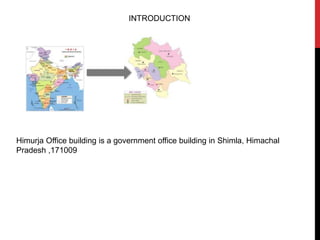
Himurja Office building is a government office building in Shimla, Himachal
Pradesh ,171009
Nature of climate
• Shimla comes under cold and cloudy climate zone.
• Temperatures ; Summers : Min 15 C Max 27 C
• Winters : Min 0 C Max 17 C
• Southern slopes are proffered for or orientation of the houses so as to maximize
penetration of the sun rays.
• The height of building varies at different altitudes and are designed in
accordance with the sun path.
• Rooms have low heights. (2.1 to 2.4M)
• Low surface to volume ratio reducing heat loss from surfaces.
• Have small window sizes with low ceiling.
• Roofs have proper slopes for efficient drainage of water.
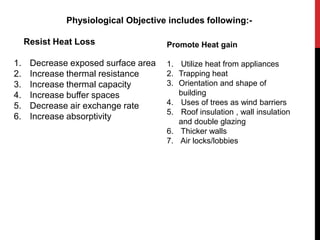
Physiological Objective includes following:-
Resist Heat Loss
1. Decrease exposed surface area
2. Increase thermal resistance
3. Increase thermal capacity
4. Increase buffer spaces
5. Decrease air exchange rate
6. Increase absorptivity
Promote Heat gain
1. Utilize heat from appliances
2. Trapping heat
3. Orientation and shape of
building
4. Uses of trees as wind barriers
5. Roof insulation , wall insulation
and double glazing
6. Thicker walls
7. Air locks/lobbies
Concept
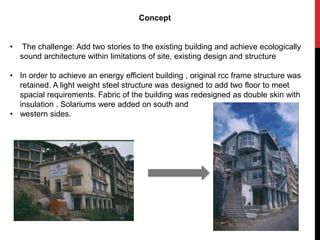
• The challenge: Add two stories to the existing building and achieve ecologically
sound architecture within limitations of site, existing design and structure
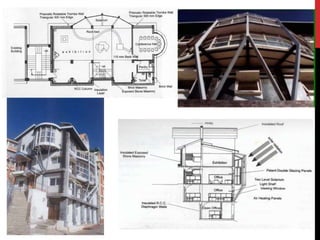
• In order to achieve an energy efficient building , original rcc frame structure was
retained. A light weight steel structure was designed to add two floor to meet
spacial requirements. Fabric of the building was redesigned as double skin with
insulation . Solariums were added on south and
• western sides.
Response to climate
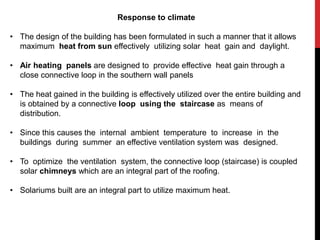
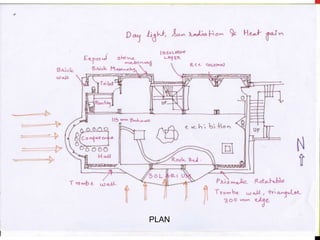
• The design of the building has been formulated in such a manner that it allows
maximum heat from sun effectively utilizing solar heat gain and daylight.
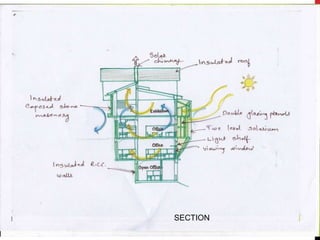
• Air heating panels are designed to provide effective heat gain through a
close connective loop in the southern wall panels
• The heat gained in the building is effectively utilized over the entire building and
is obtained by a connective loop using the staircase as means of
distribution.
• Since this causes the internal ambient temperature to increase in the
buildings during summer an effective ventilation system was designed.
• To optimize the ventilation system, the connective loop (staircase) is coupled
solar chimneys which are an integral part of the roofing.
• Solariums built are an integral part to utilize maximum heat.
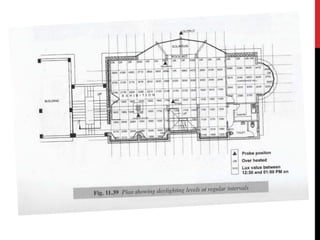
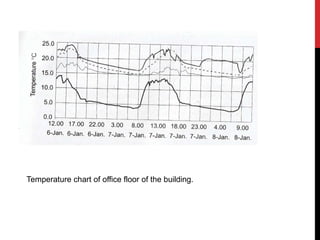
Temperature chart of office floor of the building.
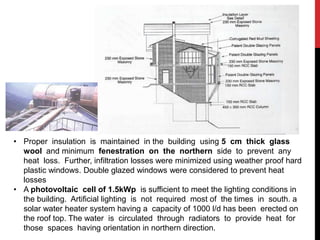
• Proper insulation is maintained in the building using 5 cm thick glass
wool and minimum fenestration on the northern side to prevent any
heat loss. Further, infiltration losses were minimized using weather proof hard
plastic windows. Double glazed windows were considered to prevent heat
losses
• A photovoltaic cell of 1.5kWp is sufficient to meet the lighting conditions in
the building. Artificial lighting is not required most of the times in south. a
solar water heater system having a capacity of 1000 l/d has been erected on
the roof top. The water is circulated through radiators to provide heat for
those spaces having orientation in northern direction.
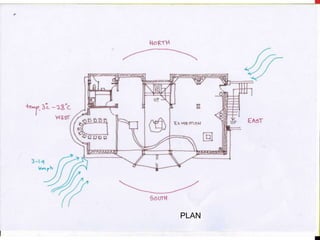
PLAN
PLAN
SECTION
CONCLUSION
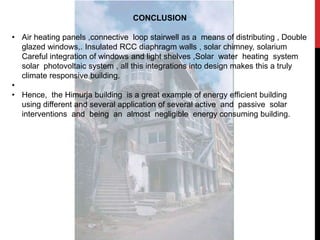
• Air heating panels ,connective loop stairwell as a means of distributing , Double
glazed windows,. Insulated RCC diaphragm walls , solar chimney, solarium
Careful integration of windows and light shelves ,Solar water heating system
solar photovoltaic system , all this integrations into design makes this a truly
climate responsive building.
•
• Hence, the Himurja building is a great example of energy efficient building
using different and several application of several active and passive solar
interventions and being an almost negligible energy consuming building.

Climate responsive Contemporary architecture

  • 1.
    BUILDING : HIMURJAOFFICE BUILDING, SHIMLA, INDIA. ARCHITECT : ARVIND KRISHAN
  • 2.
    What is ContemporaryArchitecture? • Distinctive elements of contemporary architecture include free-flowing form, creativity, and the extensive use of curved lines. • One distinctive element of contemporary architecture is the expressiveness of form and design. The buildings incorporate designs which are meant to be noticed and appreciated. • The aesthetic sense is very much emphasized in the design of structures. • Contemporary architects have a sense for sustainability. This is achieved through design of buildings that are energy efficient and that use recycled material for the most part of the construction process. Such buildings could be powered by solar panels .Most buildings have oversized windows which allow for maximum natural light to pass through.
  • 3.
    INTRODUCTION Himurja Office buildingis a government office building in Shimla, Himachal Pradesh ,171009
  • 4.
    Nature of climate •Shimla comes under cold and cloudy climate zone. • Temperatures ; Summers : Min 15 C Max 27 C • Winters : Min 0 C Max 17 C • Southern slopes are proffered for or orientation of the houses so as to maximize penetration of the sun rays. • The height of building varies at different altitudes and are designed in accordance with the sun path. • Rooms have low heights. (2.1 to 2.4M) • Low surface to volume ratio reducing heat loss from surfaces. • Have small window sizes with low ceiling. • Roofs have proper slopes for efficient drainage of water.
  • 5.
    Physiological Objective includesfollowing:- Resist Heat Loss 1. Decrease exposed surface area 2. Increase thermal resistance 3. Increase thermal capacity 4. Increase buffer spaces 5. Decrease air exchange rate 6. Increase absorptivity Promote Heat gain 1. Utilize heat from appliances 2. Trapping heat 3. Orientation and shape of building 4. Uses of trees as wind barriers 5. Roof insulation , wall insulation and double glazing 6. Thicker walls 7. Air locks/lobbies
  • 6.
    Concept • The challenge:Add two stories to the existing building and achieve ecologically sound architecture within limitations of site, existing design and structure • In order to achieve an energy efficient building , original rcc frame structure was retained. A light weight steel structure was designed to add two floor to meet spacial requirements. Fabric of the building was redesigned as double skin with insulation . Solariums were added on south and • western sides.
  • 7.
    Response to climate •The design of the building has been formulated in such a manner that it allows maximum heat from sun effectively utilizing solar heat gain and daylight. • Air heating panels are designed to provide effective heat gain through a close connective loop in the southern wall panels • The heat gained in the building is effectively utilized over the entire building and is obtained by a connective loop using the staircase as means of distribution. • Since this causes the internal ambient temperature to increase in the buildings during summer an effective ventilation system was designed. • To optimize the ventilation system, the connective loop (staircase) is coupled solar chimneys which are an integral part of the roofing. • Solariums built are an integral part to utilize maximum heat.
  • 9.
    Temperature chart ofoffice floor of the building.
  • 10.
    • Proper insulationis maintained in the building using 5 cm thick glass wool and minimum fenestration on the northern side to prevent any heat loss. Further, infiltration losses were minimized using weather proof hard plastic windows. Double glazed windows were considered to prevent heat losses • A photovoltaic cell of 1.5kWp is sufficient to meet the lighting conditions in the building. Artificial lighting is not required most of the times in south. a solar water heater system having a capacity of 1000 l/d has been erected on the roof top. The water is circulated through radiators to provide heat for those spaces having orientation in northern direction.
  • 11.
  • 12.
  • 13.
  • 15.
    CONCLUSION • Air heatingpanels ,connective loop stairwell as a means of distributing , Double glazed windows,. Insulated RCC diaphragm walls , solar chimney, solarium Careful integration of windows and light shelves ,Solar water heating system solar photovoltaic system , all this integrations into design makes this a truly climate responsive building. • • Hence, the Himurja building is a great example of energy efficient building using different and several application of several active and passive solar interventions and being an almost negligible energy consuming building.