MONAMA HOUSE
LOCATION:
HYDRABAD, INDIA
CLIMATE:
INLAND COMPOSITE
CONSTRUCTION AREA:
234.00 m2
BUILDING TYPE:
RESIDENTIAL BUILDING
OWNED BY:
RAMLALS
This house relies on energy
efficient design to reduce loads
and, where possible, reverts to
renewable energy to meet them.
The house was completed in 2001
A Low environmental impact:
The underlying ideology behind the building design was
to generate as low an
environmental impact as possible
Construction materials:
The upper floor and roof structure is made with
reinforced concrete,
which has low environmental impact. Natural materials
have been chosen for most internal finishes
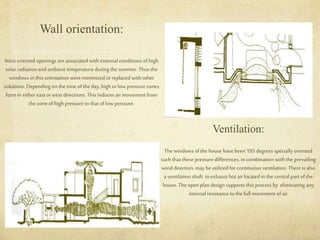
Wall orientation:
West oriented openings areassociated with external conditions ofhigh
solar radiationandambient temperature during the summer. Thus the
windows in this orientation were minimized orreplaced with other
solutions. Depending on the time ofthe day, high orlow pressure zones
form in either east or west directions. This induces airmovement from
the zone ofhigh pressure tothat of low pressure.
Ventilation:
The windows ofthe house have been 195 degrees specially oriented
such that these pressure differences, in combination with the prevailing
wind direction, may be utilized forcontinuous ventilation. There is also
a ventilation shaft toexhaust hot airlocated in the central part of the
house. The open plan design supports this process by eliminating any
internal resistance tothe full movement ofair
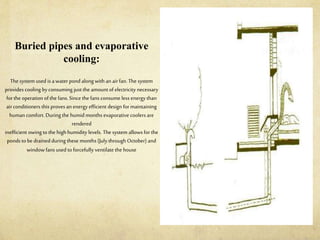
Buried pipes and evaporative
cooling:
The system used is a water pond alongwith an airfan. The system
provides cooling by consuming justthe amount of electricity necessary
forthe operation ofthe fans. Since the fans consume less energy than
airconditioners this proves an energy efficient design formaintaining
human comfort. Duringthe humid months evaporative coolers are
rendered
inefficient owing to the high humidity levels. The system allows for the
ponds tobe drainedduring these months (July through October) and
window fans used toforcefully ventilate the house
Renewable energy:
In Hyderabad there are four hours of power cut each day. The client
specifications were to design a system thatworks as a photovoltaic stand
alone system during power cuts, and asa regular grid connected system
when the grid is working. The battery chosen for this design allows for
four days of autonomy, making unlikelythat the client hasto use the
utility power to charge the battery.
Solar hot water collector:
Thesystem chosen in this house was the free flow system known as a thermosiphon
system. Thesystem has no pump orcontrols and is fully automatic in operation.
In the thermosiphon system the tank is positioned above the collector. As the water in
the
collector is heated by the sun, it rises into the tank mounted above the collector. This
causes the cold water in the tank to flow into the collector, where it is heated. In this
way,
flow is createdand the tank is filled with hotwater
THANK YOU

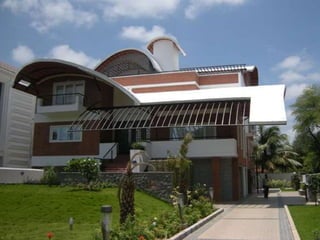
Monama house

  • 1.
  • 2.
    LOCATION: HYDRABAD, INDIA CLIMATE: INLAND COMPOSITE CONSTRUCTIONAREA: 234.00 m2 BUILDING TYPE: RESIDENTIAL BUILDING OWNED BY: RAMLALS
  • 4.
    This house relieson energy efficient design to reduce loads and, where possible, reverts to renewable energy to meet them. The house was completed in 2001
  • 5.
    A Low environmentalimpact: The underlying ideology behind the building design was to generate as low an environmental impact as possible Construction materials: The upper floor and roof structure is made with reinforced concrete, which has low environmental impact. Natural materials have been chosen for most internal finishes
  • 6.
    Wall orientation: West orientedopenings areassociated with external conditions ofhigh solar radiationandambient temperature during the summer. Thus the windows in this orientation were minimized orreplaced with other solutions. Depending on the time ofthe day, high orlow pressure zones form in either east or west directions. This induces airmovement from the zone ofhigh pressure tothat of low pressure. Ventilation: The windows ofthe house have been 195 degrees specially oriented such that these pressure differences, in combination with the prevailing wind direction, may be utilized forcontinuous ventilation. There is also a ventilation shaft toexhaust hot airlocated in the central part of the house. The open plan design supports this process by eliminating any internal resistance tothe full movement ofair
  • 7.
    Buried pipes andevaporative cooling: The system used is a water pond alongwith an airfan. The system provides cooling by consuming justthe amount of electricity necessary forthe operation ofthe fans. Since the fans consume less energy than airconditioners this proves an energy efficient design formaintaining human comfort. Duringthe humid months evaporative coolers are rendered inefficient owing to the high humidity levels. The system allows for the ponds tobe drainedduring these months (July through October) and window fans used toforcefully ventilate the house
  • 8.
    Renewable energy: In Hyderabadthere are four hours of power cut each day. The client specifications were to design a system thatworks as a photovoltaic stand alone system during power cuts, and asa regular grid connected system when the grid is working. The battery chosen for this design allows for four days of autonomy, making unlikelythat the client hasto use the utility power to charge the battery.
  • 9.
    Solar hot watercollector: Thesystem chosen in this house was the free flow system known as a thermosiphon system. Thesystem has no pump orcontrols and is fully automatic in operation. In the thermosiphon system the tank is positioned above the collector. As the water in the collector is heated by the sun, it rises into the tank mounted above the collector. This causes the cold water in the tank to flow into the collector, where it is heated. In this way, flow is createdand the tank is filled with hotwater
  • 10.