CASE STUDY ON PASSIVE COOLING AND
HEATING SYSTEM
SUBMITTED TO:- SUBMITTED BY:-
AR. EKTA SHARMA SHUBHAM
75176013
B.ARCH (6thSEM.)
PASSIVE COOLING SYSTEM:- Passive cooling refers to
technologies and design features used to cool the building without use of any
Mechanical device.
PURPOSE OF PASSIVE COOLING:-
• Provide indoor comfort
• Low maintenance
• Zero/low energy consumption
• Low running cost
• Provide healthy environment
PASSIVE HEATING SYSTEM:- Passive heating refers to
technologies and design features used to heat the building without use of
power.
Building design attempt to integrate the principle of physics into building.
THE DRUK WHITE LOTUSE SCHOOL
LEHA ,LADAKH
BUILDING TYPE:- EDUCATIONAL BUILDING
• High altitude desert:- 3700 meter
• Main source of water:- snowfall
• Average temp. In summer between 10c to 20c
• Lack of oxygen because lack of vegetation
• Site area :- 13 hectare
• Ground floor area:- 1200 sq. Meter
SUSTAINABLE FEATURES:-
• Use locally available material , have low
impact on environment.
• Exploiting natural ventilation and passive
heating
• Minimize energy use and emission
• Minimize water use
WATER DISTRIBUTION SYSTEM:-
• Water distribution system reuse
water for irrigation and directs any rainfall
to
planted area
• Sloppy site has been utilized for water
supply
In school.
• solar pumps are used to pump the water
From borewells to the water tank.
• Roof are design to bring in additional
daylight
Through clearstory windows.
• Small window are set in north facing.
Use solar panel to generate
electricity
• Roof is made of
combination of mud and
local wood. Rock wool
and felt are used to
insulate.
• On top of this they have
added corrugated
aluminum sheet and sand
cover to the felt.
TROMBE WALL:-
Seismic design and safety:-
• Drunk white lotus building structure use
timber frame to resist seismic load and
ensure life safety in the event of an
earthquake.
• Timber frames are independent of walls
and steel connection.
• Cross bracing provide earthquake
stability.
INDIRA PARYAVARAN BHAWAN
DELHI
•Plot area:- 95650sq. M.
•Maximum ground coverage :-
30%
•F.A.R:- 200
•Height :- 35m
•Built-up area : 3,1400 m2
• 40% SAVINGS IN ENERGY
• 55% SAVINGS IN WATER
•Largest roof top solar power
system in any multi-storey
building.
•930KWP
•Targeted for both rating green
building and leed.
• EFFECTIVE VENTILATION BY ORIENTATING THE BUILDING E-W
AND BY OPTIMUM INTEGRATION WITH NATURE BY SEPARATING
OUT DIFFERENT BLOCKS WITH CONNECTING CORRIDORS AND A
HUGE CENTRAL COURT YARD.
• More than 50% area outside the building is soft with plantation and
grassing.
• circulation roads and pathways soft with grass paver blocks to enable
ground water recharge
BUILDING PLANNING AND
CONSTRUCTION
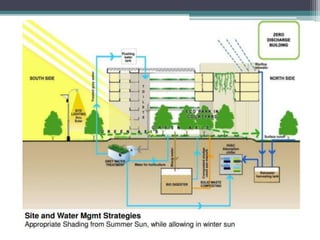
MEASURES Reduce landscape water requirement
•Drip irrigation
•Use of native species of shrubs and trees having low water demand in
landscaping
•Low lawn area so as to reduce water demand.
•Reuse of treated water for irrigation
Reduce water use in the building-
•Low discharge fixtures
•Dual Flushing cistern
•Waste water treatment
•Reuse of treated water for irrigation and cooling towers for HVAC
•Rain water harvesting
•Use of curing compound
GEOTHERMAL HEAT EXCHANGE AT SITE
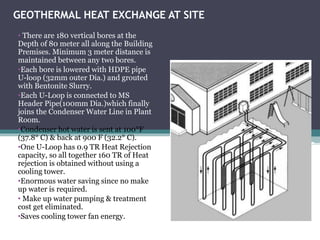
• There are 180 vertical bores at the
Depth of 80 meter all along the Building
Premises. Minimum 3 meter distance is
maintained between any two bores.
•Each bore is lowered with HDPE pipe
U-loop (32mm outer Dia.) and grouted
with Bentonite Slurry.
•Each U-Loop is connected to MS
Header Pipe(100mm Dia.)which finally
joins the Condenser Water Line in Plant
Room.
•Condenser hot water is sent at 100°F
(37.8° C) & back at 900 F (32.2° C).
•One U-Loop has 0.9 TR Heat Rejection
capacity, so all together 160 TR of Heat
rejection is obtained without using a
cooling tower.
•Enormous water saving since no make
up water is required.
• Make up water pumping & treatment
cost get eliminated.
•Saves cooling tower fan energy.
MATERIALS :-
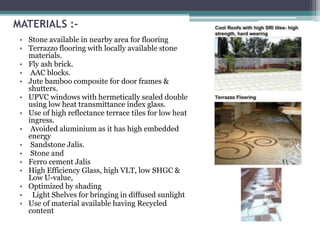
• Stone available in nearby area for flooring
• Terrazzo flooring with locally available stone
materials.
• Fly ash brick.
• AAC blocks.
• Jute bamboo composite for door frames &
shutters.
• UPVC windows with hermetically sealed double
using low heat transmittance index glass.
• Use of high reflectance terrace tiles for low heat
ingress.
• Avoided aluminium as it has high embedded
energy
• Sandstone Jalis.
• Stone and
• Ferro cement Jalis
• High Efficiency Glass, high VLT, low SHGC &
Low U-value,
• Optimized by shading
• Light Shelves for bringing in diffused sunlight
• Use of material available having Recycled
content
SOS TIBETAN
CHILDRE
VILLAGE:-
• The site of SOS measures 14,300 sq.m.
• it comprising of 15 family cottages, small nursery school, dispensary,
community house, residences for the director and co-workers, recreation
room and place of worship.
• Provide home and education to 225 children.
• The site has the entrances from the north - west direction from mussoorie
Dehradun 30’ wide steep road.
ARCHITECTURAL ENERGY EFFICIENT DESIGN FEATURES :-
• The concept of design is based on simple low-cost, low – maintenance
construction , environment friendly techniques , design taking the advantage
of climatic condition , recycling of water ( use of rain water) , use of natural
forests, air and carefully designed out building envelop.
• The primary strategy is to provide protection from harsh winds from the
north-east and to provide solar access.
• The outdoor, used commonly by all the residents, is also designed as a
habitable space.
• The planning of the village is based on clusters are open from all sides.
• Orientation of building is such that maximize solar access in the winters and
ventilation in the summer.
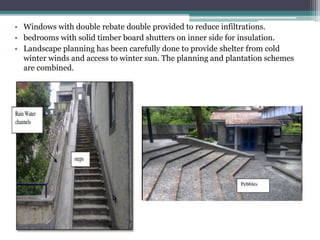
• A large number of straight flight of stairs go down, the water drainage are
built on both side of steps so that the rain water will runs directly into the
plants.
• Combination of steps and ramp.
• The toilet block in north-east corner family homes acts as a buffer against
cold winter winds.
• terracotta tiles are used at roofs for insulation.
• Windows with double rebate double provided to reduce infiltrations.
• bedrooms with solid timber board shutters on inner side for insulation.
• Landscape planning has been carefully done to provide shelter from cold
winter winds and access to winter sun. The planning and plantation schemes
are combined.
TERI CAMPUS ,BANGLORE
• The office block is kept towards the east, close to the main road for high
visibility and guest house is located towards the west side.
• In moderate climate zone like Bangalore where temperature are not very high,
a good ventilation system can easily provide comfortable living condition.
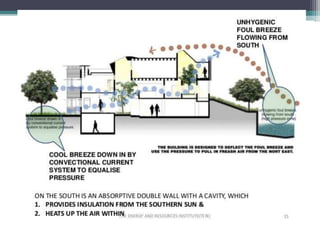
•OPEN DRAIN ON
SOUTHERN EDGE
•Building open from north
•Thick brick wall use in
Sothern side
•Natural light come from
north side.
•Use local materials
•Southern wall cover with kadappa stone.
THANKYOU

Case study on passive cooling and heating

  • 1.
    CASE STUDY ONPASSIVE COOLING AND HEATING SYSTEM SUBMITTED TO:- SUBMITTED BY:- AR. EKTA SHARMA SHUBHAM 75176013 B.ARCH (6thSEM.)
  • 2.
    PASSIVE COOLING SYSTEM:-Passive cooling refers to technologies and design features used to cool the building without use of any Mechanical device. PURPOSE OF PASSIVE COOLING:- • Provide indoor comfort • Low maintenance • Zero/low energy consumption • Low running cost • Provide healthy environment PASSIVE HEATING SYSTEM:- Passive heating refers to technologies and design features used to heat the building without use of power. Building design attempt to integrate the principle of physics into building.
  • 3.
    THE DRUK WHITELOTUSE SCHOOL LEHA ,LADAKH BUILDING TYPE:- EDUCATIONAL BUILDING • High altitude desert:- 3700 meter • Main source of water:- snowfall • Average temp. In summer between 10c to 20c • Lack of oxygen because lack of vegetation • Site area :- 13 hectare • Ground floor area:- 1200 sq. Meter
  • 4.
    SUSTAINABLE FEATURES:- • Uselocally available material , have low impact on environment. • Exploiting natural ventilation and passive heating • Minimize energy use and emission • Minimize water use WATER DISTRIBUTION SYSTEM:- • Water distribution system reuse water for irrigation and directs any rainfall to planted area • Sloppy site has been utilized for water supply In school. • solar pumps are used to pump the water From borewells to the water tank.
  • 5.
    • Roof aredesign to bring in additional daylight Through clearstory windows. • Small window are set in north facing.
  • 6.
    Use solar panelto generate electricity
  • 7.
    • Roof ismade of combination of mud and local wood. Rock wool and felt are used to insulate. • On top of this they have added corrugated aluminum sheet and sand cover to the felt. TROMBE WALL:-
  • 8.
    Seismic design andsafety:- • Drunk white lotus building structure use timber frame to resist seismic load and ensure life safety in the event of an earthquake. • Timber frames are independent of walls and steel connection. • Cross bracing provide earthquake stability.
  • 9.
    INDIRA PARYAVARAN BHAWAN DELHI •Plotarea:- 95650sq. M. •Maximum ground coverage :- 30% •F.A.R:- 200 •Height :- 35m •Built-up area : 3,1400 m2 • 40% SAVINGS IN ENERGY • 55% SAVINGS IN WATER •Largest roof top solar power system in any multi-storey building. •930KWP •Targeted for both rating green building and leed.
  • 11.
    • EFFECTIVE VENTILATIONBY ORIENTATING THE BUILDING E-W AND BY OPTIMUM INTEGRATION WITH NATURE BY SEPARATING OUT DIFFERENT BLOCKS WITH CONNECTING CORRIDORS AND A HUGE CENTRAL COURT YARD.
  • 12.
    • More than50% area outside the building is soft with plantation and grassing. • circulation roads and pathways soft with grass paver blocks to enable ground water recharge
  • 13.
    BUILDING PLANNING AND CONSTRUCTION MEASURESReduce landscape water requirement •Drip irrigation •Use of native species of shrubs and trees having low water demand in landscaping •Low lawn area so as to reduce water demand. •Reuse of treated water for irrigation Reduce water use in the building- •Low discharge fixtures •Dual Flushing cistern •Waste water treatment •Reuse of treated water for irrigation and cooling towers for HVAC •Rain water harvesting •Use of curing compound
  • 16.
    GEOTHERMAL HEAT EXCHANGEAT SITE • There are 180 vertical bores at the Depth of 80 meter all along the Building Premises. Minimum 3 meter distance is maintained between any two bores. •Each bore is lowered with HDPE pipe U-loop (32mm outer Dia.) and grouted with Bentonite Slurry. •Each U-Loop is connected to MS Header Pipe(100mm Dia.)which finally joins the Condenser Water Line in Plant Room. •Condenser hot water is sent at 100°F (37.8° C) & back at 900 F (32.2° C). •One U-Loop has 0.9 TR Heat Rejection capacity, so all together 160 TR of Heat rejection is obtained without using a cooling tower. •Enormous water saving since no make up water is required. • Make up water pumping & treatment cost get eliminated. •Saves cooling tower fan energy.
  • 19.
    MATERIALS :- • Stoneavailable in nearby area for flooring • Terrazzo flooring with locally available stone materials. • Fly ash brick. • AAC blocks. • Jute bamboo composite for door frames & shutters. • UPVC windows with hermetically sealed double using low heat transmittance index glass. • Use of high reflectance terrace tiles for low heat ingress. • Avoided aluminium as it has high embedded energy • Sandstone Jalis. • Stone and • Ferro cement Jalis • High Efficiency Glass, high VLT, low SHGC & Low U-value, • Optimized by shading • Light Shelves for bringing in diffused sunlight • Use of material available having Recycled content
  • 20.
  • 21.
    • The siteof SOS measures 14,300 sq.m. • it comprising of 15 family cottages, small nursery school, dispensary, community house, residences for the director and co-workers, recreation room and place of worship. • Provide home and education to 225 children. • The site has the entrances from the north - west direction from mussoorie Dehradun 30’ wide steep road.
  • 22.
    ARCHITECTURAL ENERGY EFFICIENTDESIGN FEATURES :- • The concept of design is based on simple low-cost, low – maintenance construction , environment friendly techniques , design taking the advantage of climatic condition , recycling of water ( use of rain water) , use of natural forests, air and carefully designed out building envelop. • The primary strategy is to provide protection from harsh winds from the north-east and to provide solar access. • The outdoor, used commonly by all the residents, is also designed as a habitable space. • The planning of the village is based on clusters are open from all sides. • Orientation of building is such that maximize solar access in the winters and ventilation in the summer. • A large number of straight flight of stairs go down, the water drainage are built on both side of steps so that the rain water will runs directly into the plants. • Combination of steps and ramp. • The toilet block in north-east corner family homes acts as a buffer against cold winter winds. • terracotta tiles are used at roofs for insulation.
  • 23.
    • Windows withdouble rebate double provided to reduce infiltrations. • bedrooms with solid timber board shutters on inner side for insulation. • Landscape planning has been carefully done to provide shelter from cold winter winds and access to winter sun. The planning and plantation schemes are combined.
  • 26.
    TERI CAMPUS ,BANGLORE •The office block is kept towards the east, close to the main road for high visibility and guest house is located towards the west side. • In moderate climate zone like Bangalore where temperature are not very high, a good ventilation system can easily provide comfortable living condition.
  • 28.
    •OPEN DRAIN ON SOUTHERNEDGE •Building open from north •Thick brick wall use in Sothern side •Natural light come from north side.
  • 29.
    •Use local materials •Southernwall cover with kadappa stone.
  • 33.