Class: ADP II Semester QAU Islamabad
Syed Abbas Hyder Shah
Lecturer in Geography
IMCG, Humak, Model Town Islamabad
Rotation & Revolution of Earth
 The earth undergoes one complete rotation along
its axis in 24 hours.
 For one complete rotation, the earth passes
through 360 degrees of longitude.
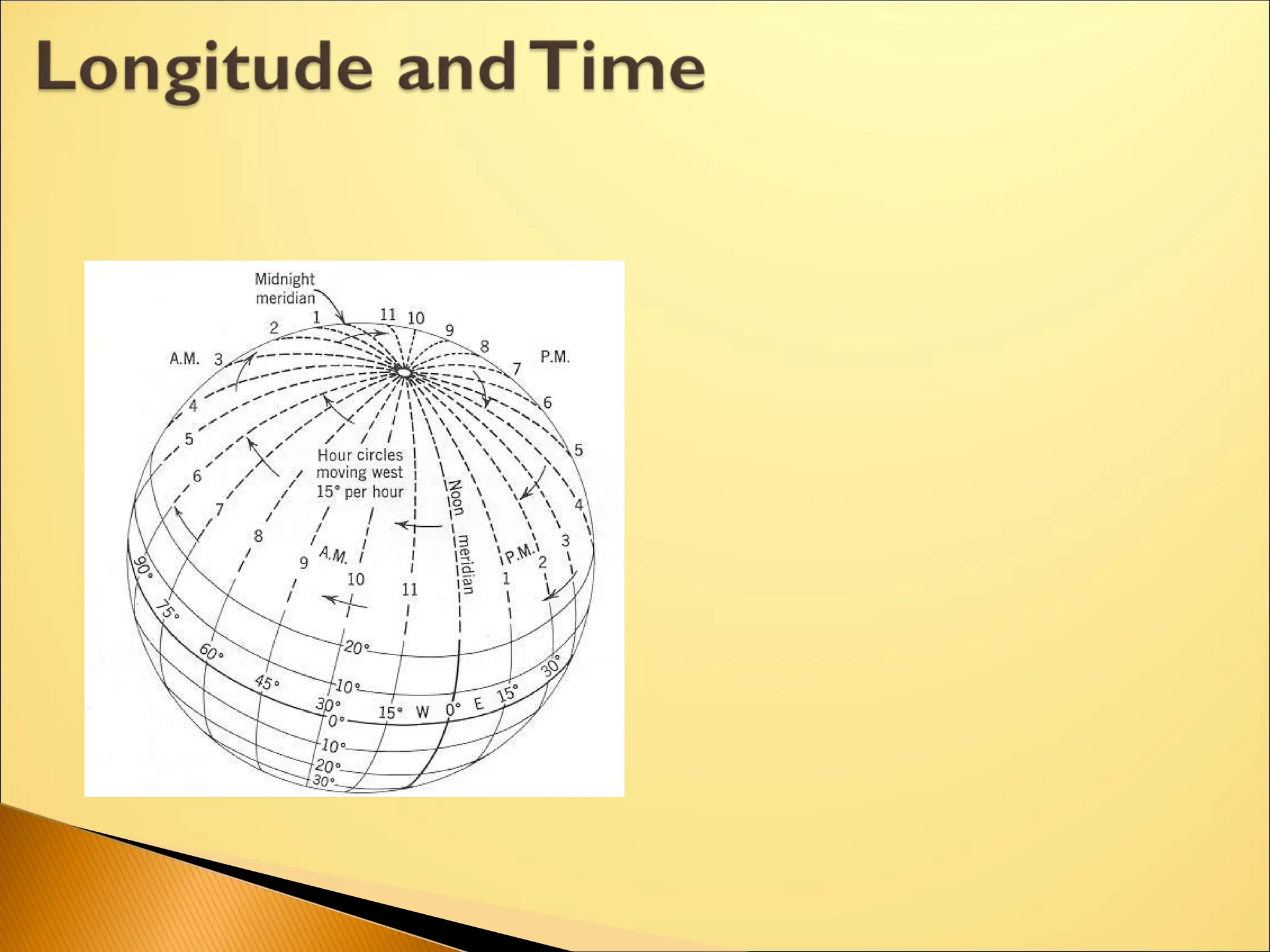
 For every one-hour time, a point on the earth
moves through 15 degrees of longitude (360/24
hours = 15o
).
 For every 4 minutes, a point on the earth passes
through 1 degree of longitude
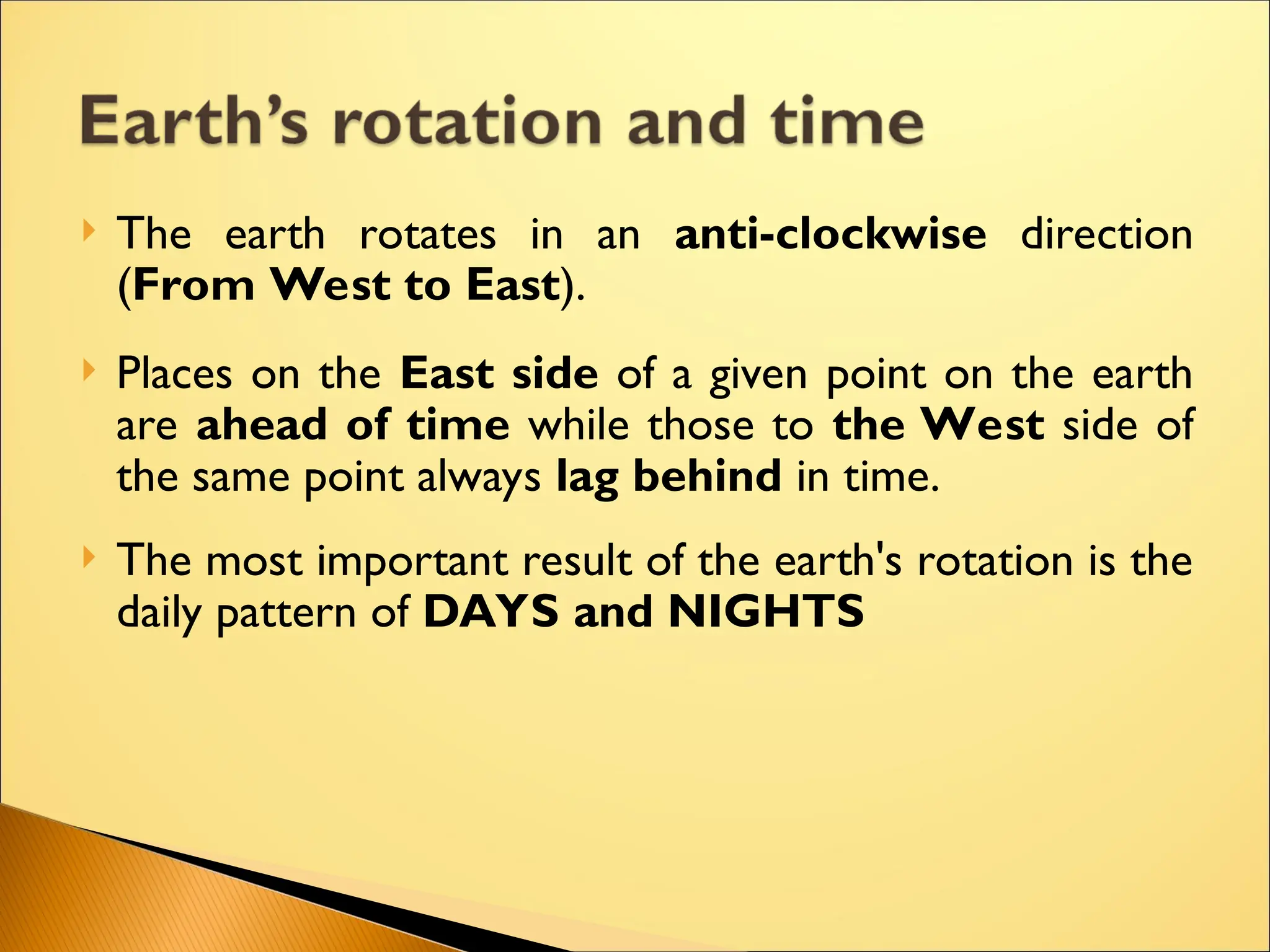
 The earth rotates in an anti-clockwise direction
(From West to East).
 Places on the East side of a given point on the earth
are ahead of time while those to the West side of
the same point always lag behind in time.
 The most important result of the earth's rotation is the
daily pattern of DAYS and NIGHTS
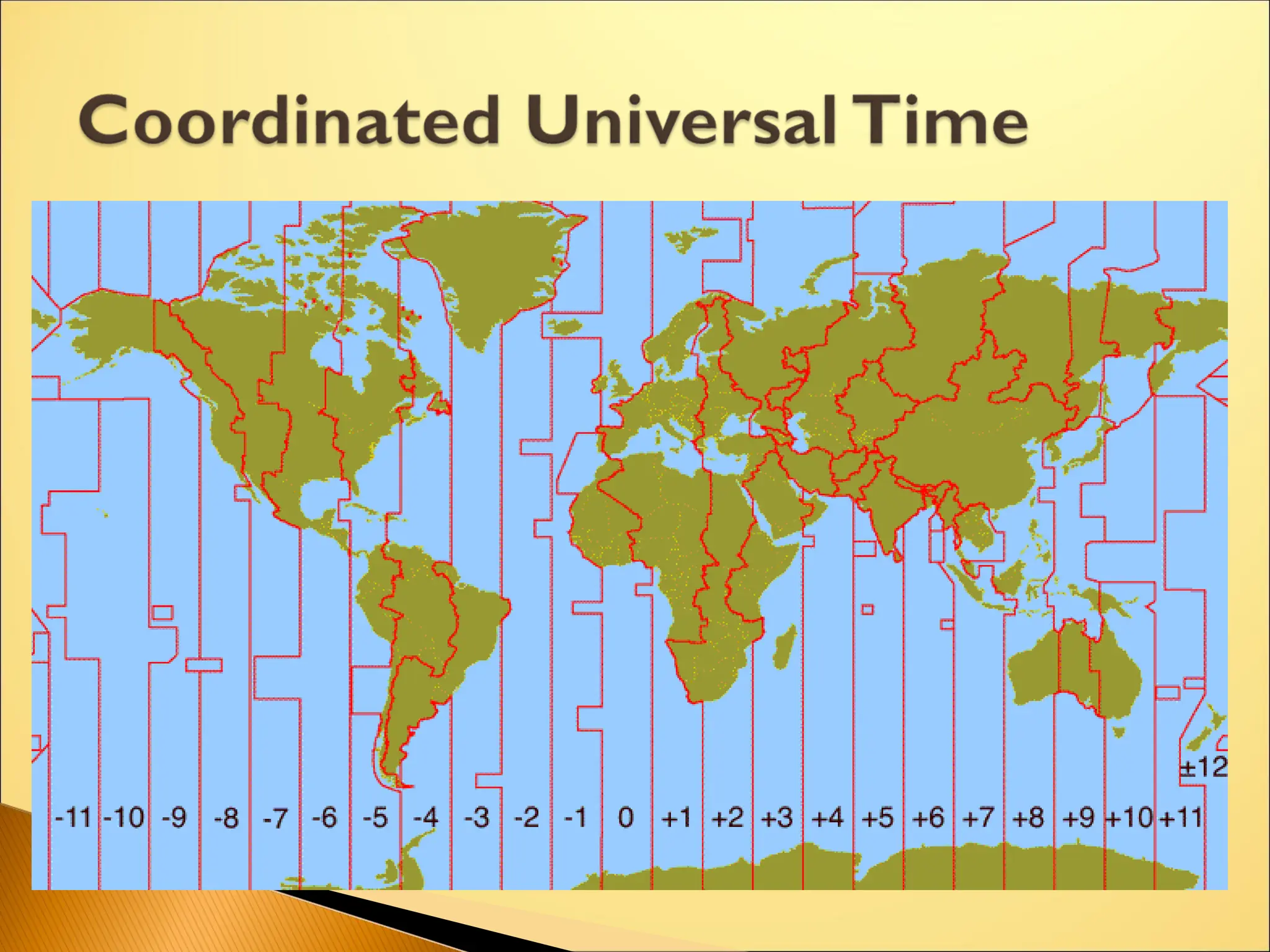
 In 1878, Canadian Sir Sanford Fleming suggested a
system of worldwide time zones.
 Fleming proposed that the globe be divided into 24
time zones, each 15 degrees of longitude in width.
 Railroad companies in Canada and the United States
began using Fleming's time zones in 1883.
 In 1884, an International Prime Meridian Conference in
Washington D.C. accepted it.
Pakistan Time Line/Longitude
750
East, passing from
Shakargarh Sialkot
 Each new calendar day begins at midnight on the
International Date Line (Longitude 180o
).
 Crossing the date line causes adjustments to clocks &
dates.
 Traveling from West toward East (Hawaii to Japan)
one jumps into a new day on crossing the Date line.
 From East towards West (Japan to Hawaii), one
looses a day after crossing the line
 The Imposition of Day/Night rhythm
 The redirection of the flow paths of both air and
water that flows over the earth’s surface.
◦ Flows in the Northern Hemisphere – Right
◦ Flows in the Southern Hemisphere - Left
 Rise and fall in Tidal Waves over the oceans.
 The earth revolves around the Sun on its own
ORBIT (oval-shaped path).
 Perihelion: A point on the orbit where the earth
is closest to the sun - January 3rd
 Aphelion: A point where the sun is farthest away
from the SUN - July 4th.
 On its orbit round the sun, the earth moves
through a plane called the PLANE OF THE
ECLIPTIC.
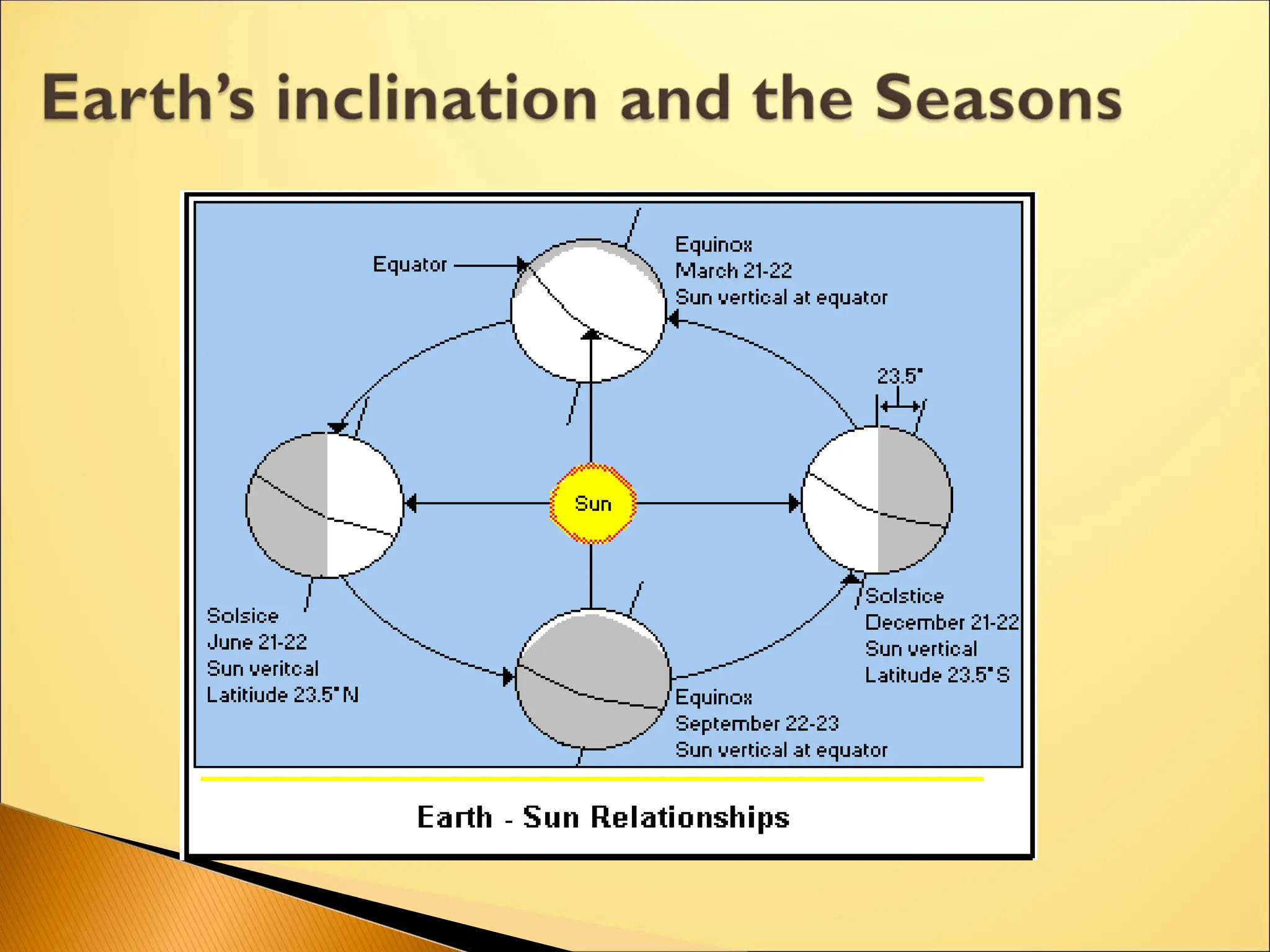
 The earth's axis is inclined to the orbit at an angle of
23.50
 Inclination of the earth’s axis during the movement
round the Sun results in the following:
1. different positions of the noon Sun
2. different positions of Sun rise and sun set
3. different length of days & nights in a year
4. different shadow lengths during the seasons
 March 21 is Spring Equinox and…
 September 21 is Autumnal Equinox.
 On these days, the noon Sun is points directly on the
equator so…
 ALL PLACES on the earth’s surface receive
approximately 12 hours of daylight and 12 hours of
darkness.
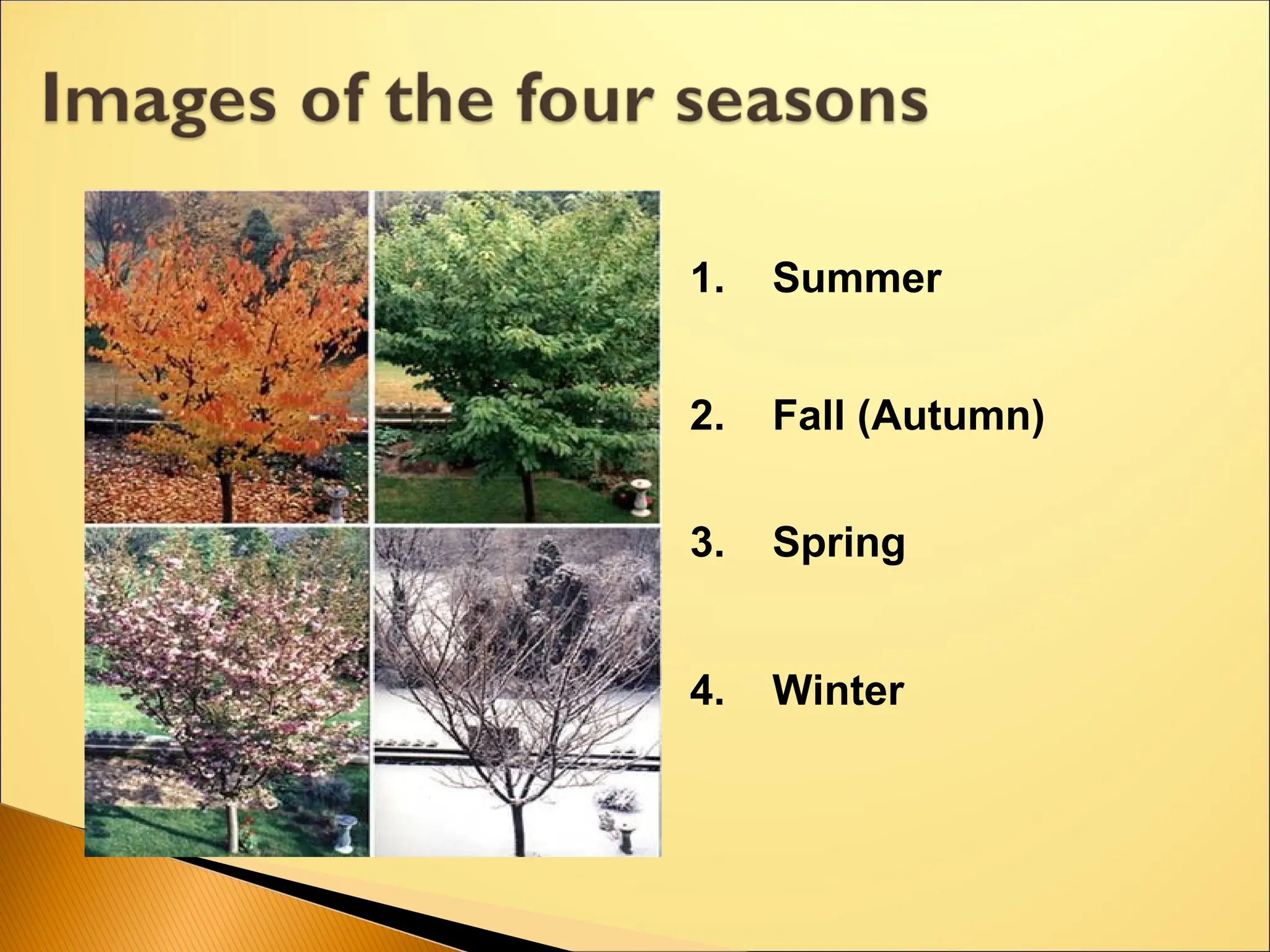
1. Summer
3. Spring
2. Fall (Autumn)
4. Winter
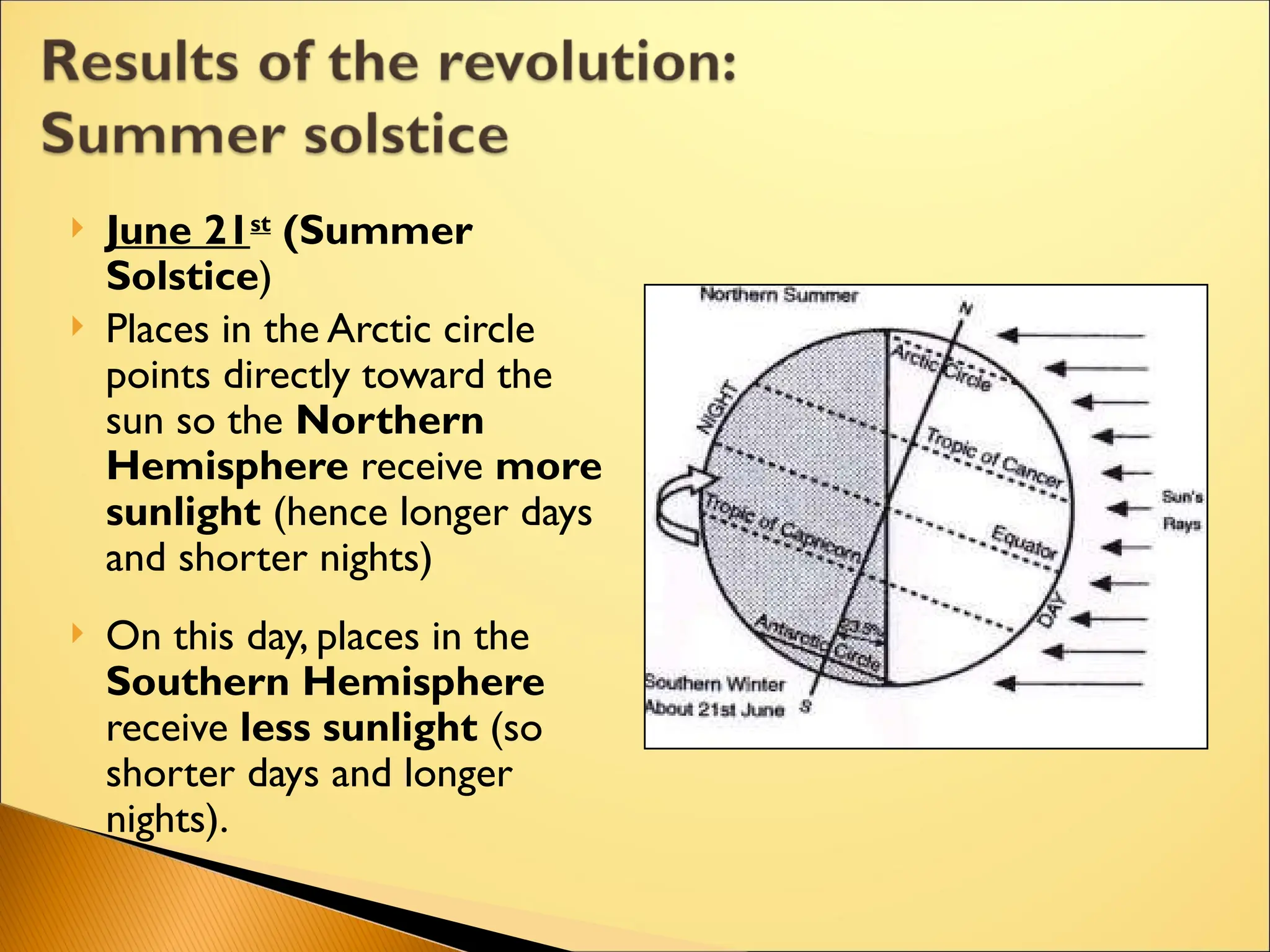
 June 21st
(Summer
Solstice)
 Places in the Arctic circle
points directly toward the
sun so the Northern
Hemisphere receive more
sunlight (hence longer days
and shorter nights)
 On this day, places in the
Southern Hemisphere
receive less sunlight (so
shorter days and longer
nights).
 In summer the earth’s axis lean toward the sun so the
energy we receive from the sun is more direct
 The sun also remains in the sky for longer periods and
as such the earth’s surface absorbs more solar energy
 The high temperatures produce summer conditions.
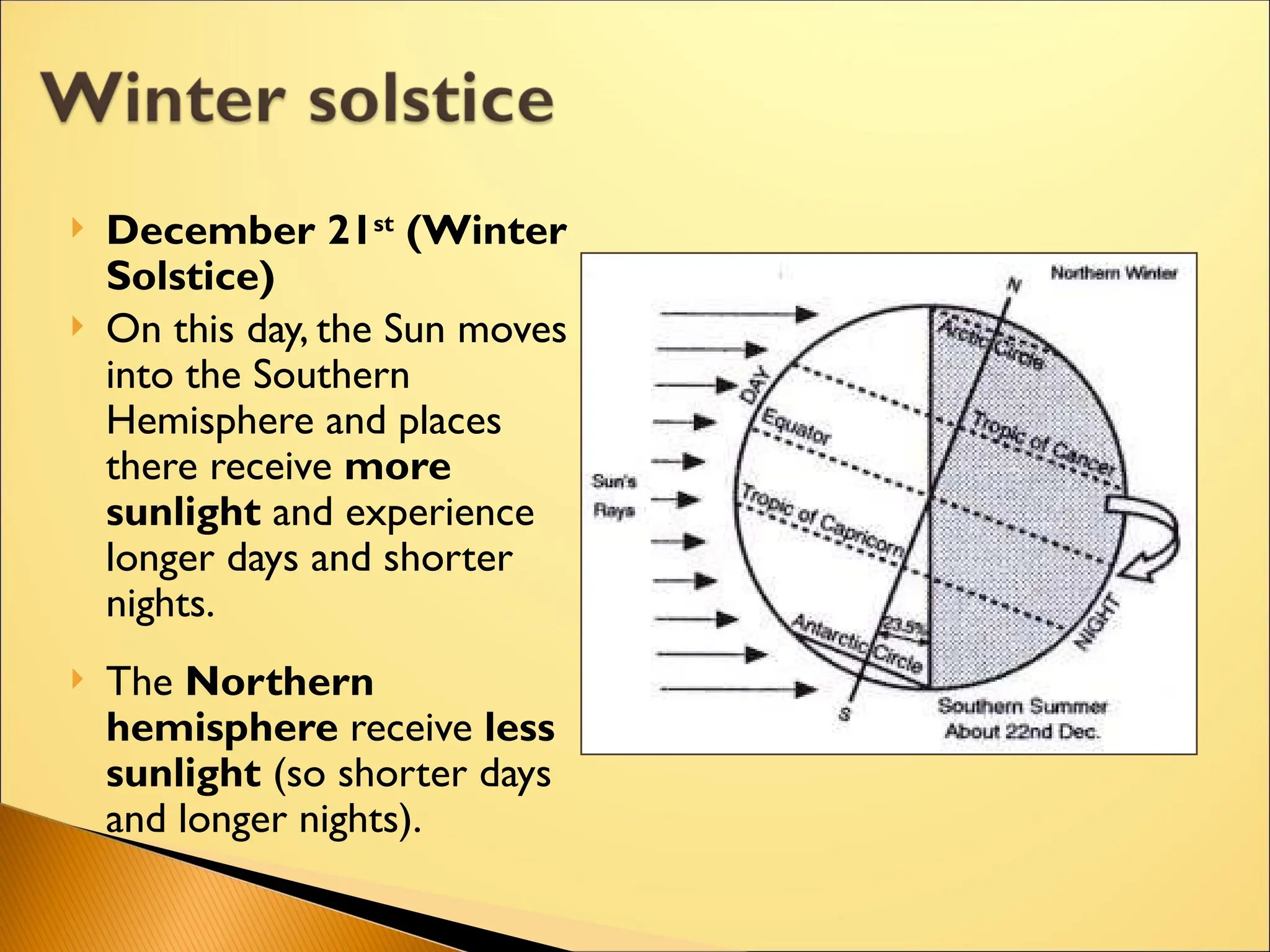
 December 21st
(Winter
Solstice)
 On this day, the Sun moves
into the Southern
Hemisphere and places
there receive more
sunlight and experience
longer days and shorter
nights.
 The Northern
hemisphere receive less
sunlight (so shorter days
and longer nights).
 Because the earth’s axis point to the same direction
toward the North Star, the Northern hemisphere
leans back on the Sun during winter
 The Sun is lower in the sky and its energy is more
widely distributed
 The Sun is also visible for a much shorter time giving
off little energy so temperature goes down producing
winter conditions
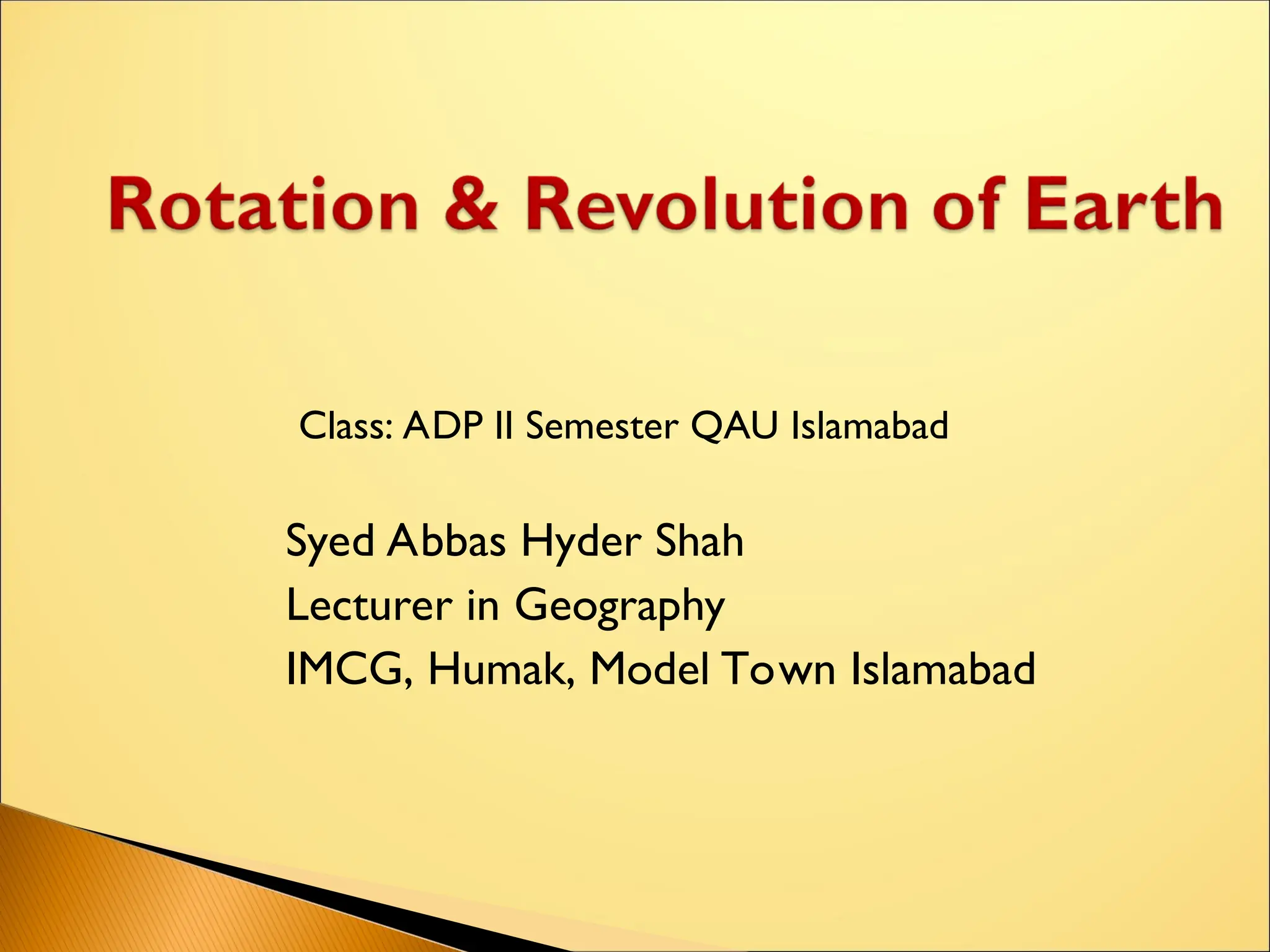
NORTHERN SUMMER NORTHERN WINTER
Lec 3 Rotation and Revolution of Earth(Additional Material).ppt

Lec 3 Rotation and Revolution of Earth(Additional Material).ppt

  • 1.
    Class: ADP IISemester QAU Islamabad Syed Abbas Hyder Shah Lecturer in Geography IMCG, Humak, Model Town Islamabad
  • 2.
  • 3.
     The earthundergoes one complete rotation along its axis in 24 hours.  For one complete rotation, the earth passes through 360 degrees of longitude.  For every one-hour time, a point on the earth moves through 15 degrees of longitude (360/24 hours = 15o ).  For every 4 minutes, a point on the earth passes through 1 degree of longitude
  • 4.
     The earthrotates in an anti-clockwise direction (From West to East).  Places on the East side of a given point on the earth are ahead of time while those to the West side of the same point always lag behind in time.  The most important result of the earth's rotation is the daily pattern of DAYS and NIGHTS
  • 7.
     In 1878,Canadian Sir Sanford Fleming suggested a system of worldwide time zones.  Fleming proposed that the globe be divided into 24 time zones, each 15 degrees of longitude in width.  Railroad companies in Canada and the United States began using Fleming's time zones in 1883.  In 1884, an International Prime Meridian Conference in Washington D.C. accepted it.
  • 8.
    Pakistan Time Line/Longitude 750 East,passing from Shakargarh Sialkot
  • 9.
     Each newcalendar day begins at midnight on the International Date Line (Longitude 180o ).  Crossing the date line causes adjustments to clocks & dates.  Traveling from West toward East (Hawaii to Japan) one jumps into a new day on crossing the Date line.  From East towards West (Japan to Hawaii), one looses a day after crossing the line
  • 10.
     The Impositionof Day/Night rhythm  The redirection of the flow paths of both air and water that flows over the earth’s surface. ◦ Flows in the Northern Hemisphere – Right ◦ Flows in the Southern Hemisphere - Left  Rise and fall in Tidal Waves over the oceans.
  • 11.
     The earthrevolves around the Sun on its own ORBIT (oval-shaped path).  Perihelion: A point on the orbit where the earth is closest to the sun - January 3rd  Aphelion: A point where the sun is farthest away from the SUN - July 4th.  On its orbit round the sun, the earth moves through a plane called the PLANE OF THE ECLIPTIC.
  • 13.
     The earth'saxis is inclined to the orbit at an angle of 23.50  Inclination of the earth’s axis during the movement round the Sun results in the following: 1. different positions of the noon Sun 2. different positions of Sun rise and sun set 3. different length of days & nights in a year 4. different shadow lengths during the seasons
  • 14.
     March 21is Spring Equinox and…  September 21 is Autumnal Equinox.  On these days, the noon Sun is points directly on the equator so…  ALL PLACES on the earth’s surface receive approximately 12 hours of daylight and 12 hours of darkness.
  • 15.
    1. Summer 3. Spring 2.Fall (Autumn) 4. Winter
  • 16.
     June 21st (Summer Solstice) Places in the Arctic circle points directly toward the sun so the Northern Hemisphere receive more sunlight (hence longer days and shorter nights)  On this day, places in the Southern Hemisphere receive less sunlight (so shorter days and longer nights).
  • 17.
     In summerthe earth’s axis lean toward the sun so the energy we receive from the sun is more direct  The sun also remains in the sky for longer periods and as such the earth’s surface absorbs more solar energy  The high temperatures produce summer conditions.
  • 18.
     December 21st (Winter Solstice) On this day, the Sun moves into the Southern Hemisphere and places there receive more sunlight and experience longer days and shorter nights.  The Northern hemisphere receive less sunlight (so shorter days and longer nights).
  • 19.
     Because theearth’s axis point to the same direction toward the North Star, the Northern hemisphere leans back on the Sun during winter  The Sun is lower in the sky and its energy is more widely distributed  The Sun is also visible for a much shorter time giving off little energy so temperature goes down producing winter conditions
  • 20.