Classification	Algorithms	in	
Apache	SystemML
Prithviraj	Sen
Overview
• Supervised	Learning	and	Classification
• Training	Discriminative	Classifiers
• Representer Theorem
• Support	Vector	Machines
• Logistic	Regression
• Generative	Classifiers:	Naïve	Bayes
• Deep	Learning
• Tree	Ensembles
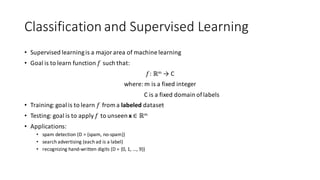
Classification	and	Supervised	Learning
• Supervised	learning	is	a	major	area	of	machine	learning
• Goal	is	to	learn	function	𝑓 such	that:
𝑓:	ℝm →	C
where:	m	is	a	fixed	integer
C	is	a	fixed	domain	of	labels
• Training:	goal	is	to	learn	𝑓 from	a	labeled dataset
• Testing:	goal	is	to	apply	𝑓 to	unseen	x	∈ ℝm
• Applications:	
• spam	detection	(D	=	{spam,	no-spam})
• search	advertising	(each	ad	is	a	label)
• recognizing	hand-written	digits	(D	=	{0,	1,	…,	9})
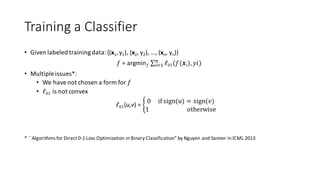
Training	a	Classifier
• Given	labeled	training	data:	{(x1,	y1),	(x2,	y2),	…,	(xn,	yn)}
𝑓	=	argmin 𝑓 ∑ ℓ01(𝑓(𝒙𝑖), 𝑦𝑖)	/
012
• Multiple	issues*:
• We	have	not	chosen	a	form	for	𝑓
• ℓ01 is	not	convex
ℓ01(u,v)	=	3
0					if	sign(𝑢) = sign(𝑣)
1																										otherwise
*	``Algorithms	for	Direct	0-1	Loss	Optimization	in	Binary	Classification”	by	Nguyen	and	Sanner in	ICML	2013
Training	Discriminative	Classifiers
𝑓	=	argmin 𝑓 ∑ ℓ(𝑓(𝒙𝑖), 𝑦𝑖)	+	ℊ(∥ 𝑓 ∥)/
012
• The	second	term	is	``regularization”
• A	common	form	for	𝑓(𝒙) is	𝐰′𝒙 (linear	classifier)
• ℓ(w’x,y)	is	``convexified”	loss
• Besides	discriminative	classifiers,	generative	classifiers	also	exist
• e.g.,	naïve	Bayes
Classifier Loss	function	(y	∈ {±1})
support	vector	machine max(0,	1	- y	w’x)
logistic	regression log[1	+	exp(-y	w’x)]
adaboost exp(-y	w’x)
square loss (1	– y	w’x)2
Algorithms for Direct 0–1 Loss Optim
−1.5 −1 −0.5 0 0.5 1 1.5 2
0
1
2
3
4
5
6
7
8
margin (m)
LossValue
0−1 Loss
Hinge Loss
Log Loss
Squared Loss
T
ar
is
W
in
(w
fw
as
th
T
{x
t
cl
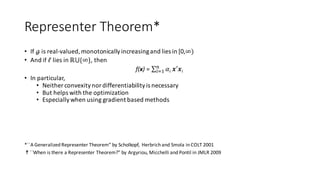
Representer Theorem*
• If	ℊ is	real-valued,	monotonically	increasing	and	lies	in	[0,∞)
• And	if	ℓ lies	in	ℝ⋃{∞},	then
f(x) =	∑ 𝛼𝑖	
𝒙′𝒙𝑖	/
012
• In	particular,
• Neither	convexity	nor	differentiability	is	necessary
• But	helps	with	the	optimization
• Especially	when	using	gradient	based	methods
*``A	Generalized	Representer Theorem”	by	Scholkopf,	Herbrich and	Smola in	COLT	2001
☨``When	is	there	a	Representer Theorem?”	by	Argyriou,	Micchelli and	Pontil in	JMLR	2009
Binary	Class	Support	Vector	Machines
minw	∑ max 0,1 − 𝑦𝑖𝒘S 𝒙𝑖 	+	
T
U
𝒘S 𝒘	/
012
• Expressed	in	standard	form:
minw ∑ ξi	+	
T
U
𝒘S 𝒘	0
s.t. 	𝑦𝑖 𝒘S 𝒙𝑖 ≥ 1 − ξi	
∀𝑖
ξi ≥ 0	∀𝑖
• Lagrangian (𝛼𝑖, 𝛽𝑖 ≥ 0):
ℒ = 	∑ ξi	+	
T
U
𝒘S 𝒘	 + ∑ 𝛼𝑖(1 − 𝑦𝑖 𝒘S 𝒙𝑖 − ξi00 ) − ∑ 𝛽𝑖 𝜉𝑖0
]ℒ
𝝏w
:	w =	
2
_
∑ 𝛼𝑖 𝑦𝑖 𝒙𝑖0
]ℒ
𝝏`i
:						1	=	𝛼𝑖+𝛽𝑖		∀
𝑖
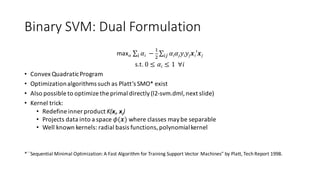
Binary	SVM:	Dual	Formulation
max 𝛼 ∑ 𝛼𝑖	0 −
2
U
∑ 𝛼𝑖 𝛼𝑗 𝑦𝑖 𝑦𝑗 𝒙𝑖′𝒙𝑗0b
s.t. 0 ≤ 𝛼𝑖 ≤ 1		∀𝑖
• Convex	Quadratic	Program
• Optimization	algorithms	such	as	Platt’s	SMO*	exist
• Also	possible	to	optimize	the	primal	directly	(l2-svm.dml,	next	slide)
• Kernel	trick:
• Redefine	inner	product	K(xi,	xj)
• Projects	data	into	a	space	𝜙(𝒙) where	classes	may	be	separable
• Well	known	kernels:	radial	basis	functions,	polynomial	kernel
*``Sequential	Minimal	Optimization:	A	Fast	Algorithm	for	Training	Support	Vector	Machines”	by	Platt,	Tech	Report	1998.
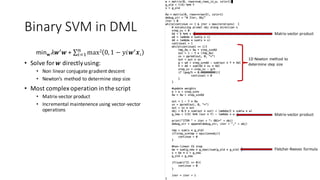
Binary	SVM	in	DML
minw 𝜆𝒘S 𝒘	+ ∑ max2 0,1 − 𝑦𝑖𝒘S 𝒙𝑖 	/
012
• Solve	for	𝒘 directly	using:
• Non	linear	conjugate	gradient	descent
• Newton’s	method	to	determine	step	size
• Most	complex	operation	in	the	script
• Matrix-vector	product
• Incremental	maintenence using	vector-vector	
operations
Matrix-vector	product
Fletcher-Reeves	 formula
1D	Newton	method	to
determine	step	size
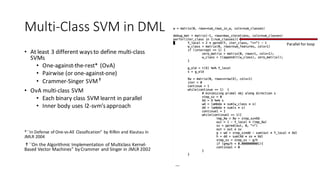
Multi-Class	SVM	in	DML
• At	least	3	different	ways	to	define	multi-class	
SVMs
• One-against-the-rest*	(OvA)
• Pairwise (or	one-against-one)
• Crammer-Singer	SVM☨
• OvA multi-class	SVM
• Each	binary	class	SVM	learnt	in	parallel
• Inner	body	uses	l2-svm’s	approach
*``In	Defense	of	One-vs-All	 Classification”	by	Rifkin	and	Klautau in	
JMLR	2004
☨``On	the	Algorithmic	Implementation	of	Multiclass	Kernel-
Based	Vector	Machines”	by	Crammer	and	Singer	in	JMLR	2002
…
Parallel	for	loop
Logistic	Regression
maxw -∑ log 1 + 𝑒hi0 𝒘j 𝒙0 	−	
T
U
𝒘S 𝒘	/
012
• To	derive	the	dual	form	use	the	following	bound*:
log
2
2klmn𝒘j 𝒙
≤ min 𝛼	
𝛼𝑦𝒘′𝒙 − 𝐻(𝛼)	
where	0 ≤ 𝛼 ≤ 1 and	𝐻(𝛼)	=	−𝛼log(𝛼) − (1 − 𝛼)log(1 − 𝛼)
• Substituting:
maxw min 𝛼 ∑ 𝛼𝑖 𝑦𝑖 𝒘′𝒙𝑖0 − 𝐻(𝛼𝑖)	−	
T
U
𝒘S 𝒘	s.t. 0 ≤ 𝛼𝑖 ≤ 1	∀𝑖
]ℒ
𝝏w
:	w =	
2
_
∑ 𝛼𝑖 𝑦𝑖 𝒙𝑖0
• Dual	form:
min 𝛼
2
UT
∑ 𝛼𝑖 𝛼𝑗 𝑦𝑖 𝑦𝑗 𝒙𝑖′𝒙𝑗0b − ∑ 𝐻(𝛼𝑖)0 s.t.	0 ≤ 𝛼𝑖 ≤ 1	∀𝑖
• Apply	kernel	trick	to	obtain	kernelized logistic	regression	
*``Probabilistic	Kernel	Regression	Models”	by	Jaakkola and	Haussler	in	AISTATS	1999
Multiclass	Logistic	Regression
• Also	called	softmax regression	or	multinomial	logistic	regression
• W	is	now	a	matrix	of	weights,	jth column	contains	the	jth class’s	weights
Pr(y|x)	=	
lp
j
qn
∑ lp
j
qn
n
minW
_
U
∥ 𝑊 ∥ 2 + ∑ [log(Zi)0 − 𝑥𝑖′𝑊𝑦𝑖]	where	𝑍𝑖 = 1S 𝑒wjx0	
• The	DML	script	is	called	MultiLogReg.dml
• Uses	trust-region	Newton	method	to	learn	the	weights*
• Care	needs	to	be	taken	because	softmax is	an	over-parameterized	function
*See	regression	class’s	slides	on	ibm.biz/AlmadenML
Generative	Classifiers:	Naïve	Bayes
• Generative	models	“explain”	the	generation	of	the	data
• Naïve	Bayes	assumes,	each	feature	is	independent	given	class	label
Pr(x,y)	=		py ∏ (𝑝𝑦𝑗b )nj
• A conjugate	prior	is	used	to	avoid	0	probabilities
Pr({(xi,yi)})	=	∏ [
{|
(_)
{(|_)
∏ 𝑝 𝑦𝑗
𝜆]bi ∏ [𝑝𝑦𝑖∏ 𝑝 𝑦𝑖𝑗
𝑛𝑖𝑗]b0
s.t. 𝑝 𝑦	∀	𝑦, 𝑝𝑦𝑗	∀𝑦	∀𝑗 form	legal	distributions
• Maximum	is	obtained	when:
𝑝 𝑦 =	
𝑛 𝑦
∑ 𝑛 𝑦i
∀𝑦, 𝑝𝑦𝑗 =
𝜆 + ∑ 𝑛𝑖𝑗0:i01i
𝑚𝜆 + ∑ ∑ 𝑛𝑖𝑗b0:i01i
∀𝑦∀𝑗
• This	is	multinomial	naïve	Bayes,	other	forms	include	multivariate	Bernoulli*
*	``A	Comparison	of	Event	Models	for	Naïve	Bayes	Text	Classification”	by	McCallum	and	Nigam	in	AAAI/ICML-98	Workshop	 on	Learning for	Text	
Categorization
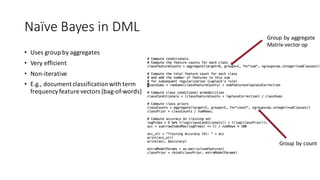
Naïve	Bayes	in	DML
• Uses	group	by	aggregates
• Very	efficient
• Non-iterative
• E.g.,	document	classification	with	term	
frequency	feature	vectors	(bag-of-words)
Group	by	aggregate
Matrix-vector	op
Group	by	count
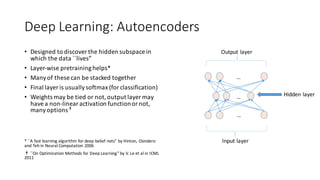
Deep	Learning:	Autoencoders
• Designed	to	discover	the	hidden	subspace	in	
which	the	data	``lives”
• Layer-wise	pretraininghelps*
• Many	of	these	can	be	stacked	together
• Final	layer	is	usually	softmax (for	classification)
• Weights	may	be	tied	or	not,	output	layer	may	
have	a	non-linear	activation	function	or	not,	
many	options☨
*``A	fast	learning	algorithm	for	deep	belief	nets”	by	Hinton,	Osindero
and	Teh in	Neural	Computation	2006
☨ ``On	Optimization	Methods	for	Deep	Learning”	by	V.	Le	et	al	in	ICML	
2011
…
…
…
Input	layer
Output	layer
Hidden	layer
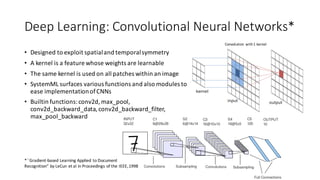
Deep	Learning:	Convolutional	Neural	Networks*
• Designed	to	exploit	spatial	and	temporal	symmetry
• A	kernel	is	a	feature	whose	weights	are	learnable
• The	same	kernel	is	used	on	all	patches	within	an	image
• SystemML surfaces	various	functions	and	also	modules	to	
ease	implementation	of	CNNs
• Builtin functions:	conv2d,	max_pool,	
conv2d_backward_data,	conv2d_backward_filter,	
max_pool_backward
Convolution	 with	1	kernel
*``Gradient-based	Learning	Applied	to	Document	
Recognition”	by	LeCun et	al	in	Proceedings	of	the	IEEE,	1998
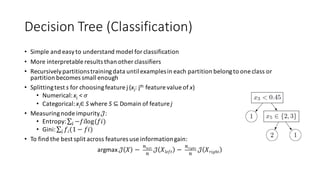
Decision	Tree	(Classification)
• Simple	and	easy	to	understand	model	for	classification
• More	interpretable	results	than	other	classifiers
• Recursively	partitions	training	data	until	examples	in	each	partition	belong	to	one	class	or	
partition	becomes	small	enough
• Splitting	test	s for	choosing	feature	j	(xj:	jth feature	value	of	x)
• Numerical:	xj <	𝜎
• Categorical:	xj∈ S where	S ⊆ Domain	of	feature	j
• Measuring	node	impurity	𝒥:
• Entropy:	∑ −𝑓𝑖log(𝑓𝑖)0
• Gini:	∑ 𝑓𝑖(1 − 𝑓𝑖)0
• To	find	the	best	split	across	features	use	information	gain:
argmax 𝒥 𝑋 −	
/…l†‡
/
𝒥 𝑋𝑙𝑒𝑓𝑡 − 	
/Š0‹Œ‡
/
𝒥 𝑋 𝑟𝑖𝑔ℎ𝑡
Decision	Tree	in	DML
• Tree	construction*:
• Breadth-first	expansion	for	nodes	in	top	level
• Depth-first	expansion	for	nodes	in	lower	levels
• Input	data	needs	to	be	transformed	(dummy	coded)
• Can	control	complexity	of	the	tree	(pruning,	early	stopping)
*``PLANET:	Massively	Parallel	Learning	of	Tree	Ensembles	with	MapReduce”	by	Panda,	Herbach,	Basu,	Bayardoin	VLDB	2009
Random	Forest	(Classification)
• Ensemble	of	trees
• Each	tree	is	learnt	from	a	bootstrapped	training	set	sampled	with	replacement
• At	each	node,	we	sample	for	a	random	subset	of	features	to	choose	from
• Prediction	is	by	majority	voting
• In	the	script,	we	sample	using	Poisson	distribution
• By	default,	each	tree	is:
• Trained	using	2/3	training	data	
• Tested	on	the	remaining	1/3	(out-of-bag	error	estimation)

Classification using Apache SystemML by Prithviraj Sen

  • 1.
  • 2.
    Overview • Supervised Learning and Classification • Training Discriminative Classifiers •Representer Theorem • Support Vector Machines • Logistic Regression • Generative Classifiers: Naïve Bayes • Deep Learning • Tree Ensembles
  • 3.
    Classification and Supervised Learning • Supervised learning is a major area of machine learning • Goal is to learn function 𝑓such that: 𝑓: ℝm → C where: m is a fixed integer C is a fixed domain of labels • Training: goal is to learn 𝑓 from a labeled dataset • Testing: goal is to apply 𝑓 to unseen x ∈ ℝm • Applications: • spam detection (D = {spam, no-spam}) • search advertising (each ad is a label) • recognizing hand-written digits (D = {0, 1, …, 9})
  • 4.
    Training a Classifier • Given labeled training data: {(x1, y1), (x2, y2), …, (xn, yn)} 𝑓 = argmin 𝑓∑ ℓ01(𝑓(𝒙𝑖), 𝑦𝑖) / 012 • Multiple issues*: • We have not chosen a form for 𝑓 • ℓ01 is not convex ℓ01(u,v) = 3 0 if sign(𝑢) = sign(𝑣) 1 otherwise * ``Algorithms for Direct 0-1 Loss Optimization in Binary Classification” by Nguyen and Sanner in ICML 2013
  • 5.
    Training Discriminative Classifiers 𝑓 = argmin 𝑓 ∑ℓ(𝑓(𝒙𝑖), 𝑦𝑖) + ℊ(∥ 𝑓 ∥)/ 012 • The second term is ``regularization” • A common form for 𝑓(𝒙) is 𝐰′𝒙 (linear classifier) • ℓ(w’x,y) is ``convexified” loss • Besides discriminative classifiers, generative classifiers also exist • e.g., naïve Bayes Classifier Loss function (y ∈ {±1}) support vector machine max(0, 1 - y w’x) logistic regression log[1 + exp(-y w’x)] adaboost exp(-y w’x) square loss (1 – y w’x)2 Algorithms for Direct 0–1 Loss Optim −1.5 −1 −0.5 0 0.5 1 1.5 2 0 1 2 3 4 5 6 7 8 margin (m) LossValue 0−1 Loss Hinge Loss Log Loss Squared Loss T ar is W in (w fw as th T {x t cl
  • 6.
    Representer Theorem* • If ℊis real-valued, monotonically increasing and lies in [0,∞) • And if ℓ lies in ℝ⋃{∞}, then f(x) = ∑ 𝛼𝑖 𝒙′𝒙𝑖 / 012 • In particular, • Neither convexity nor differentiability is necessary • But helps with the optimization • Especially when using gradient based methods *``A Generalized Representer Theorem” by Scholkopf, Herbrich and Smola in COLT 2001 ☨``When is there a Representer Theorem?” by Argyriou, Micchelli and Pontil in JMLR 2009
  • 7.
    Binary Class Support Vector Machines minw ∑ max 0,1− 𝑦𝑖𝒘S 𝒙𝑖 + T U 𝒘S 𝒘 / 012 • Expressed in standard form: minw ∑ ξi + T U 𝒘S 𝒘 0 s.t. 𝑦𝑖 𝒘S 𝒙𝑖 ≥ 1 − ξi ∀𝑖 ξi ≥ 0 ∀𝑖 • Lagrangian (𝛼𝑖, 𝛽𝑖 ≥ 0): ℒ = ∑ ξi + T U 𝒘S 𝒘 + ∑ 𝛼𝑖(1 − 𝑦𝑖 𝒘S 𝒙𝑖 − ξi00 ) − ∑ 𝛽𝑖 𝜉𝑖0 ]ℒ 𝝏w : w = 2 _ ∑ 𝛼𝑖 𝑦𝑖 𝒙𝑖0 ]ℒ 𝝏`i : 1 = 𝛼𝑖+𝛽𝑖 ∀ 𝑖
  • 8.
    Binary SVM: Dual Formulation max 𝛼 ∑𝛼𝑖 0 − 2 U ∑ 𝛼𝑖 𝛼𝑗 𝑦𝑖 𝑦𝑗 𝒙𝑖′𝒙𝑗0b s.t. 0 ≤ 𝛼𝑖 ≤ 1 ∀𝑖 • Convex Quadratic Program • Optimization algorithms such as Platt’s SMO* exist • Also possible to optimize the primal directly (l2-svm.dml, next slide) • Kernel trick: • Redefine inner product K(xi, xj) • Projects data into a space 𝜙(𝒙) where classes may be separable • Well known kernels: radial basis functions, polynomial kernel *``Sequential Minimal Optimization: A Fast Algorithm for Training Support Vector Machines” by Platt, Tech Report 1998.
  • 9.
    Binary SVM in DML minw 𝜆𝒘S 𝒘 +∑ max2 0,1 − 𝑦𝑖𝒘S 𝒙𝑖 / 012 • Solve for 𝒘 directly using: • Non linear conjugate gradient descent • Newton’s method to determine step size • Most complex operation in the script • Matrix-vector product • Incremental maintenence using vector-vector operations Matrix-vector product Matrix-vector product Fletcher-Reeves formula 1D Newton method to determine step size
  • 10.
    Multi-Class SVM in DML • At least 3 different ways to define multi-class SVMs • One-against-the-rest* (OvA) •Pairwise (or one-against-one) • Crammer-Singer SVM☨ • OvA multi-class SVM • Each binary class SVM learnt in parallel • Inner body uses l2-svm’s approach *``In Defense of One-vs-All Classification” by Rifkin and Klautau in JMLR 2004 ☨``On the Algorithmic Implementation of Multiclass Kernel- Based Vector Machines” by Crammer and Singer in JMLR 2002 … Parallel for loop
  • 11.
    Logistic Regression maxw -∑ log1 + 𝑒hi0 𝒘j 𝒙0 − T U 𝒘S 𝒘 / 012 • To derive the dual form use the following bound*: log 2 2klmn𝒘j 𝒙 ≤ min 𝛼 𝛼𝑦𝒘′𝒙 − 𝐻(𝛼) where 0 ≤ 𝛼 ≤ 1 and 𝐻(𝛼) = −𝛼log(𝛼) − (1 − 𝛼)log(1 − 𝛼) • Substituting: maxw min 𝛼 ∑ 𝛼𝑖 𝑦𝑖 𝒘′𝒙𝑖0 − 𝐻(𝛼𝑖) − T U 𝒘S 𝒘 s.t. 0 ≤ 𝛼𝑖 ≤ 1 ∀𝑖 ]ℒ 𝝏w : w = 2 _ ∑ 𝛼𝑖 𝑦𝑖 𝒙𝑖0 • Dual form: min 𝛼 2 UT ∑ 𝛼𝑖 𝛼𝑗 𝑦𝑖 𝑦𝑗 𝒙𝑖′𝒙𝑗0b − ∑ 𝐻(𝛼𝑖)0 s.t. 0 ≤ 𝛼𝑖 ≤ 1 ∀𝑖 • Apply kernel trick to obtain kernelized logistic regression *``Probabilistic Kernel Regression Models” by Jaakkola and Haussler in AISTATS 1999
  • 12.
    Multiclass Logistic Regression • Also called softmax regression or multinomial logistic regression •W is now a matrix of weights, jth column contains the jth class’s weights Pr(y|x) = lp j qn ∑ lp j qn n minW _ U ∥ 𝑊 ∥ 2 + ∑ [log(Zi)0 − 𝑥𝑖′𝑊𝑦𝑖] where 𝑍𝑖 = 1S 𝑒wjx0 • The DML script is called MultiLogReg.dml • Uses trust-region Newton method to learn the weights* • Care needs to be taken because softmax is an over-parameterized function *See regression class’s slides on ibm.biz/AlmadenML
  • 13.
    Generative Classifiers: Naïve Bayes • Generative models “explain” the generation of the data • Naïve Bayes assumes, each feature is independent given class label Pr(x,y) = py∏ (𝑝𝑦𝑗b )nj • A conjugate prior is used to avoid 0 probabilities Pr({(xi,yi)}) = ∏ [ {| (_) {(|_) ∏ 𝑝 𝑦𝑗 𝜆]bi ∏ [𝑝𝑦𝑖∏ 𝑝 𝑦𝑖𝑗 𝑛𝑖𝑗]b0 s.t. 𝑝 𝑦 ∀ 𝑦, 𝑝𝑦𝑗 ∀𝑦 ∀𝑗 form legal distributions • Maximum is obtained when: 𝑝 𝑦 = 𝑛 𝑦 ∑ 𝑛 𝑦i ∀𝑦, 𝑝𝑦𝑗 = 𝜆 + ∑ 𝑛𝑖𝑗0:i01i 𝑚𝜆 + ∑ ∑ 𝑛𝑖𝑗b0:i01i ∀𝑦∀𝑗 • This is multinomial naïve Bayes, other forms include multivariate Bernoulli* * ``A Comparison of Event Models for Naïve Bayes Text Classification” by McCallum and Nigam in AAAI/ICML-98 Workshop on Learning for Text Categorization
  • 14.
    Naïve Bayes in DML • Uses group by aggregates • Very efficient •Non-iterative • E.g., document classification with term frequency feature vectors (bag-of-words) Group by aggregate Matrix-vector op Group by count
  • 15.
    Deep Learning: Autoencoders • Designed to discover the hidden subspace in which the data ``lives” • Layer-wise pretraininghelps* •Many of these can be stacked together • Final layer is usually softmax (for classification) • Weights may be tied or not, output layer may have a non-linear activation function or not, many options☨ *``A fast learning algorithm for deep belief nets” by Hinton, Osindero and Teh in Neural Computation 2006 ☨ ``On Optimization Methods for Deep Learning” by V. Le et al in ICML 2011 … … … Input layer Output layer Hidden layer
  • 16.
    Deep Learning: Convolutional Neural Networks* • Designed to exploit spatial and temporal symmetry • A kernel is a feature whose weights are learnable •The same kernel is used on all patches within an image • SystemML surfaces various functions and also modules to ease implementation of CNNs • Builtin functions: conv2d, max_pool, conv2d_backward_data, conv2d_backward_filter, max_pool_backward Convolution with 1 kernel *``Gradient-based Learning Applied to Document Recognition” by LeCun et al in Proceedings of the IEEE, 1998
  • 17.
    Decision Tree (Classification) • Simple and easy to understand model for classification • More interpretable results than other classifiers •Recursively partitions training data until examples in each partition belong to one class or partition becomes small enough • Splitting test s for choosing feature j (xj: jth feature value of x) • Numerical: xj < 𝜎 • Categorical: xj∈ S where S ⊆ Domain of feature j • Measuring node impurity 𝒥: • Entropy: ∑ −𝑓𝑖log(𝑓𝑖)0 • Gini: ∑ 𝑓𝑖(1 − 𝑓𝑖)0 • To find the best split across features use information gain: argmax 𝒥 𝑋 − /…l†‡ / 𝒥 𝑋𝑙𝑒𝑓𝑡 − /Š0‹Œ‡ / 𝒥 𝑋 𝑟𝑖𝑔ℎ𝑡
  • 18.
    Decision Tree in DML • Tree construction*: • Breadth-first expansion for nodes in top level •Depth-first expansion for nodes in lower levels • Input data needs to be transformed (dummy coded) • Can control complexity of the tree (pruning, early stopping) *``PLANET: Massively Parallel Learning of Tree Ensembles with MapReduce” by Panda, Herbach, Basu, Bayardoin VLDB 2009
  • 19.
    Random Forest (Classification) • Ensemble of trees • Each tree is learnt from a bootstrapped training set sampled with replacement •At each node, we sample for a random subset of features to choose from • Prediction is by majority voting • In the script, we sample using Poisson distribution • By default, each tree is: • Trained using 2/3 training data • Tested on the remaining 1/3 (out-of-bag error estimation)