MLlib: Scalable Machine Learning on Spark
Xiangrui Meng
1
Collaborators: Ameet Talwalkar, Evan Sparks, Virginia Smith, Xinghao
Pan, Shivaram Venkataraman, Matei Zaharia, Rean Griffith, John Duchi,
Joseph Gonzalez, Michael Franklin, Michael I. Jordan, Tim Kraska, etc.
What is MLlib?
2
What is MLlib?
MLlib is a Spark subproject providing machine learning
primitives:
• initial contribution from AMPLab, UC Berkeley
• shipped with Spark since version 0.8
• 33 contributors (March 2014)
3
What is MLlib?
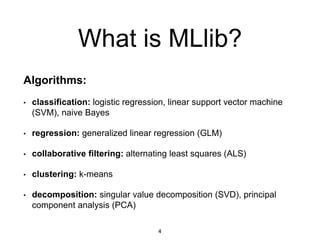
Algorithms:
• classification: logistic regression, linear support vector machine
(SVM), naive Bayes
• regression: generalized linear regression (GLM)
• collaborative filtering: alternating least squares (ALS)
• clustering: k-means
• decomposition: singular value decomposition (SVD), principal
component analysis (PCA)
4
Why MLlib?
5
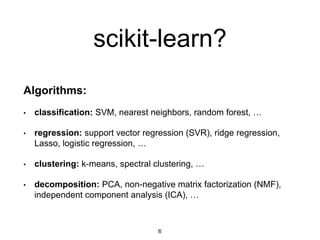
scikit-learn?
Algorithms:
• classification: SVM, nearest neighbors, random forest, …
• regression: support vector regression (SVR), ridge regression,
Lasso, logistic regression, …
• clustering: k-means, spectral clustering, …
• decomposition: PCA, non-negative matrix factorization (NMF),
independent component analysis (ICA), …
6
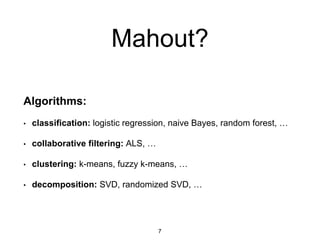
Mahout?
Algorithms:
• classification: logistic regression, naive Bayes, random forest, …
• collaborative filtering: ALS, …
• clustering: k-means, fuzzy k-means, …
• decomposition: SVD, randomized SVD, …
7
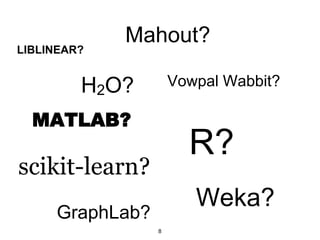
Vowpal Wabbit?H2O?
R?
MATLAB?
Mahout?
Weka?
scikit-learn?
LIBLINEAR?
8
GraphLab?
Why MLlib?
9
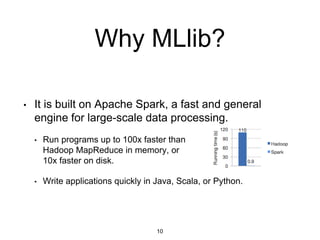
• It is built on Apache Spark, a fast and general
engine for large-scale data processing.
• Run programs up to 100x faster than
Hadoop MapReduce in memory, or
10x faster on disk.
• Write applications quickly in Java, Scala, or Python.
Why MLlib?
10
Word count
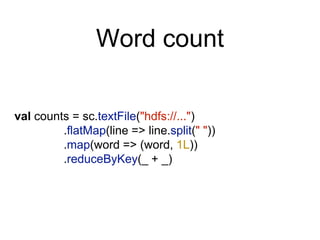
val counts = sc.textFile("hdfs://...")
.flatMap(line => line.split(" "))
.map(word => (word, 1L))
.reduceByKey(_ + _)
Gradient descent
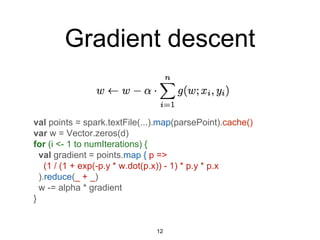
val points = spark.textFile(...).map(parsePoint).cache()
var w = Vector.zeros(d)
for (i <- 1 to numIterations) {
val gradient = points.map { p =>
(1 / (1 + exp(-p.y * w.dot(p.x)) - 1) * p.y * p.x
).reduce(_ + _)
w -= alpha * gradient
}
12
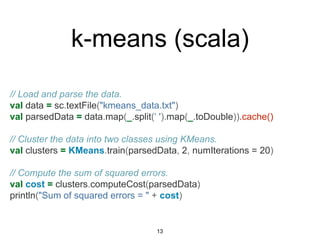
// Load and parse the data.
val data = sc.textFile("kmeans_data.txt")
val parsedData = data.map(_.split(‘ ').map(_.toDouble)).cache()
// Cluster the data into two classes using KMeans.
val clusters = KMeans.train(parsedData, 2, numIterations = 20)
// Compute the sum of squared errors.
val cost = clusters.computeCost(parsedData)
println("Sum of squared errors = " + cost)
k-means (scala)
13
k-means (python)
# Load and parse the data
data = sc.textFile("kmeans_data.txt")
parsedData = data.map(lambda line:
array([float(x) for x in line.split(' ‘)])).cache()
# Build the model (cluster the data)
clusters = KMeans.train(parsedData, 2, maxIterations = 10,
runs = 1, initialization_mode = "kmeans||")
# Evaluate clustering by computing the sum of squared errors
def error(point):
center = clusters.centers[clusters.predict(point)]
return sqrt(sum([x**2 for x in (point - center)]))
cost = parsedData.map(lambda point: error(point))
.reduce(lambda x, y: x + y)
print("Sum of squared error = " + str(cost))
14
Dimension reduction
+ k-means
// compute principal components
val points: RDD[Vector] = ...
val mat = RowMatrix(points)
val pc = mat.computePrincipalComponents(20)
// project points to a low-dimensional space
val projected = mat.multiply(pc).rows
// train a k-means model on the projected data
val model = KMeans.train(projected, 10)
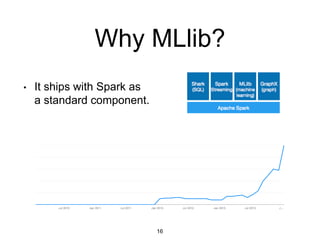
Why MLlib?
• It ships with Spark as
a standard component.
16
Spark community
One of the largest open source projects in big data:
• 170+ developers contributing
• 30+ companies contributing
• 400+ discussions per month on the mailing list
Out for dinner?
• Search for a restaurant and make a reservation.
• Start navigation.
• Food looks good? Take a photo and share.
18
Why smartphone?
Out for dinner?
• Search for a restaurant and make a reservation. (Yellow Pages?)
• Start navigation. (GPS?)
• Food looks good? Take a photo and share. (Camera?)
19
Why MLlib?
A special-purpose device may be better at one aspect
than a general-purpose device. But the cost of context
switching is high:
• different languages or APIs
• different data formats
• different tuning tricks
20
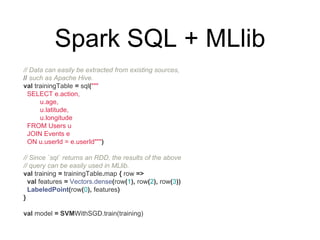
Spark SQL + MLlib
// Data can easily be extracted from existing sources,
// such as Apache Hive.
val trainingTable = sql("""
SELECT e.action,
u.age,
u.latitude,
u.longitude
FROM Users u
JOIN Events e
ON u.userId = e.userId""")
// Since `sql` returns an RDD, the results of the above
// query can be easily used in MLlib.
val training = trainingTable.map { row =>
val features = Vectors.dense(row(1), row(2), row(3))
LabeledPoint(row(0), features)
}
val model = SVMWithSGD.train(training)
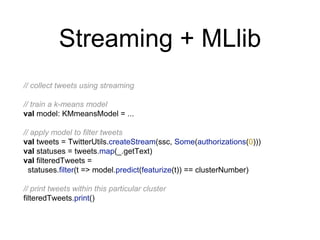
Streaming + MLlib
// collect tweets using streaming
// train a k-means model
val model: KMmeansModel = ...
// apply model to filter tweets
val tweets = TwitterUtils.createStream(ssc, Some(authorizations(0)))
val statuses = tweets.map(_.getText)
val filteredTweets =
statuses.filter(t => model.predict(featurize(t)) == clusterNumber)
// print tweets within this particular cluster
filteredTweets.print()
GraphX + MLlib
// assemble link graph
val graph = Graph(pages, links)
val pageRank: RDD[(Long, Double)] = graph.staticPageRank(10).vertices
// load page labels (spam or not) and content features
val labelAndFeatures: RDD[(Long, (Double, Seq((Int, Double)))] = ...
val training: RDD[LabeledPoint] =
labelAndFeatures.join(pageRank).map {
case (id, ((label, features), pageRank)) =>
LabeledPoint(label, Vectors.sparse(features ++ (1000, pageRank))
}
// train a spam detector using logistic regression
val model = LogisticRegressionWithSGD.train(training)
Why MLlib?
• Built on Spark’s lightweight yet powerful APIs.
• Spark’s open source community.
• Seamless integration with Spark’s other components.
24
• Comparable to or even better than other libraries
specialized in large-scale machine learning.
Logistic regression
25
Logistic regression - weak scaling
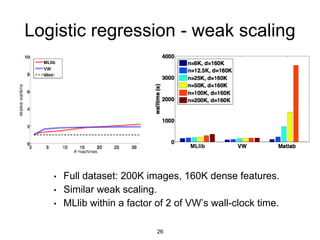
• Full dataset: 200K images, 160K dense features.
• Similar weak scaling.
• MLlib within a factor of 2 of VW’s wall-clock time.
MLlib
MLlib
26
Logistic regression - strong scaling
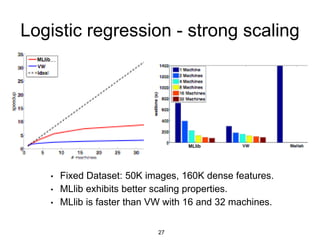
• Fixed Dataset: 50K images, 160K dense features.
• MLlib exhibits better scaling properties.
• MLlib is faster than VW with 16 and 32 machines.
MLlib
MLlib
27
Collaborative filtering
28
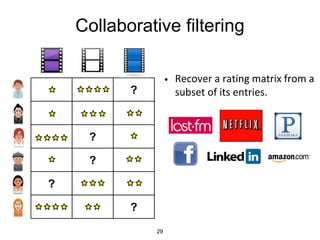
Collaborative filtering
• Recover a rating matrix from a
subset of its entries.?
?
?
?
?
29
30
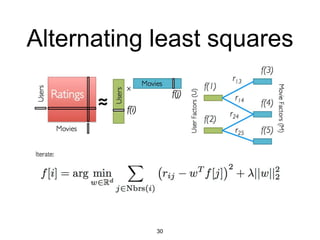
Alternating least squares
ALS - wall-clock time
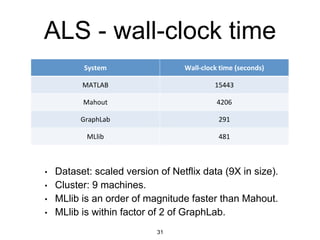
• Dataset: scaled version of Netflix data (9X in size).
• Cluster: 9 machines.
• MLlib is an order of magnitude faster than Mahout.
• MLlib is within factor of 2 of GraphLab.
System Wall-clock time (seconds)
MATLAB 15443
Mahout 4206
GraphLab 291
MLlib 481
31
Implementation of ALS
• broadcast everything
• data parallel
• fully parallel
32
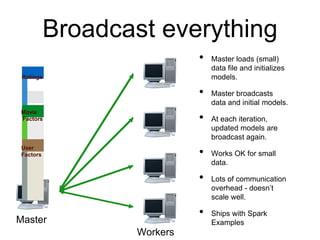
Broadcast everything
• Master loads (small)
data file and initializes
models.
• Master broadcasts
data and initial models.
• At each iteration,
updated models are
broadcast again.
• Works OK for small
data.
• Lots of communication
overhead - doesn’t
scale well.
• Ships with Spark
ExamplesMaster
Workers
Ratings
Movie
Factors
User
Factors
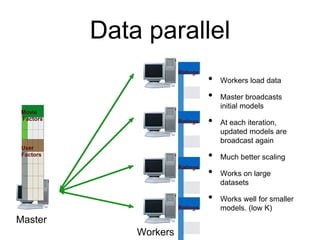
Data parallel
• Workers load data
• Master broadcasts
initial models
• At each iteration,
updated models are
broadcast again
• Much better scaling
• Works on large
datasets
• Works well for smaller
models. (low K)
Master
Workers
Ratings
Movie
Factors
User
Factors
Ratings
Ratings
Ratings
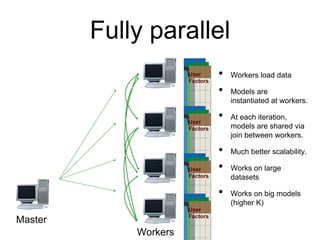
Fully parallel
• Workers load data
• Models are
instantiated at workers.
• At each iteration,
models are shared via
join between workers.
• Much better scalability.
• Works on large
datasets
• Works on big models
(higher K)
Master
Workers
RatingsMovie
FactorsUser
Factors
RatingsMovie
FactorsUser
Factors
RatingsMovie
FactorsUser
Factors
RatingsMovie
FactorsUser
Factors
Implementation of ALS
• broadcast everything
• data parallel
• fully parallel
• block-wise parallel
• Users/products are partitioned into blocks and join is
based on blocks instead of individual user/product.
36
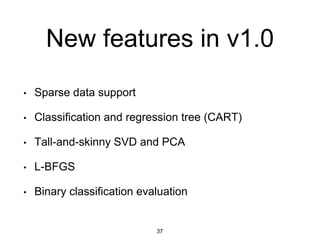
New features in v1.0
• Sparse data support
• Classification and regression tree (CART)
• Tall-and-skinny SVD and PCA
• L-BFGS
• Binary classification evaluation
37
Contributors
Ameet Talwalkar, Andrew Tulloch, Chen Chao, Nan Zhu, DB Tsai, Evan
Sparks, Frank Dai, Ginger Smith, Henry Saputra, Holden Karau, Hossein
Falaki, Jey Kottalam, Cheng Lian, Marek Kolodziej, Mark Hamstra,
Martin Jaggi, Martin Weindel, Matei Zaharia, Nick Pentreath, Patrick
Wendell, Prashant Sharma, Reynold Xin, Reza Zadeh, Sandy Ryza,
Sean Owen, Shivaram Venkataraman, Tor Myklebust, Xiangrui Meng,
Xinghao Pan, Xusen Yin, Jerry Shao, Ryan LeCompte
38
Interested?
• Website: http://spark.apache.org
• Tutorials: http://ampcamp.berkeley.edu
• Spark Summit: http://spark-summit.org
• Github: https://github.com/apache/spark
• Mailing lists: user@spark.apache.org
dev@spark.apache.org
39

MLconf NYC Xiangrui Meng

  • 1.
    MLlib: Scalable MachineLearning on Spark Xiangrui Meng 1 Collaborators: Ameet Talwalkar, Evan Sparks, Virginia Smith, Xinghao Pan, Shivaram Venkataraman, Matei Zaharia, Rean Griffith, John Duchi, Joseph Gonzalez, Michael Franklin, Michael I. Jordan, Tim Kraska, etc.
  • 2.
  • 3.
    What is MLlib? MLlibis a Spark subproject providing machine learning primitives: • initial contribution from AMPLab, UC Berkeley • shipped with Spark since version 0.8 • 33 contributors (March 2014) 3
  • 4.
    What is MLlib? Algorithms: •classification: logistic regression, linear support vector machine (SVM), naive Bayes • regression: generalized linear regression (GLM) • collaborative filtering: alternating least squares (ALS) • clustering: k-means • decomposition: singular value decomposition (SVD), principal component analysis (PCA) 4
  • 5.
  • 6.
    scikit-learn? Algorithms: • classification: SVM,nearest neighbors, random forest, … • regression: support vector regression (SVR), ridge regression, Lasso, logistic regression, … • clustering: k-means, spectral clustering, … • decomposition: PCA, non-negative matrix factorization (NMF), independent component analysis (ICA), … 6
  • 7.
    Mahout? Algorithms: • classification: logisticregression, naive Bayes, random forest, … • collaborative filtering: ALS, … • clustering: k-means, fuzzy k-means, … • decomposition: SVD, randomized SVD, … 7
  • 8.
  • 9.
  • 10.
    • It isbuilt on Apache Spark, a fast and general engine for large-scale data processing. • Run programs up to 100x faster than Hadoop MapReduce in memory, or 10x faster on disk. • Write applications quickly in Java, Scala, or Python. Why MLlib? 10
  • 11.
    Word count val counts= sc.textFile("hdfs://...") .flatMap(line => line.split(" ")) .map(word => (word, 1L)) .reduceByKey(_ + _)
  • 12.
    Gradient descent val points= spark.textFile(...).map(parsePoint).cache() var w = Vector.zeros(d) for (i <- 1 to numIterations) { val gradient = points.map { p => (1 / (1 + exp(-p.y * w.dot(p.x)) - 1) * p.y * p.x ).reduce(_ + _) w -= alpha * gradient } 12
  • 13.
    // Load andparse the data. val data = sc.textFile("kmeans_data.txt") val parsedData = data.map(_.split(‘ ').map(_.toDouble)).cache() // Cluster the data into two classes using KMeans. val clusters = KMeans.train(parsedData, 2, numIterations = 20) // Compute the sum of squared errors. val cost = clusters.computeCost(parsedData) println("Sum of squared errors = " + cost) k-means (scala) 13
  • 14.
    k-means (python) # Loadand parse the data data = sc.textFile("kmeans_data.txt") parsedData = data.map(lambda line: array([float(x) for x in line.split(' ‘)])).cache() # Build the model (cluster the data) clusters = KMeans.train(parsedData, 2, maxIterations = 10, runs = 1, initialization_mode = "kmeans||") # Evaluate clustering by computing the sum of squared errors def error(point): center = clusters.centers[clusters.predict(point)] return sqrt(sum([x**2 for x in (point - center)])) cost = parsedData.map(lambda point: error(point)) .reduce(lambda x, y: x + y) print("Sum of squared error = " + str(cost)) 14
  • 15.
    Dimension reduction + k-means //compute principal components val points: RDD[Vector] = ... val mat = RowMatrix(points) val pc = mat.computePrincipalComponents(20) // project points to a low-dimensional space val projected = mat.multiply(pc).rows // train a k-means model on the projected data val model = KMeans.train(projected, 10)
  • 16.
    Why MLlib? • Itships with Spark as a standard component. 16
  • 17.
    Spark community One ofthe largest open source projects in big data: • 170+ developers contributing • 30+ companies contributing • 400+ discussions per month on the mailing list
  • 18.
    Out for dinner? •Search for a restaurant and make a reservation. • Start navigation. • Food looks good? Take a photo and share. 18
  • 19.
    Why smartphone? Out fordinner? • Search for a restaurant and make a reservation. (Yellow Pages?) • Start navigation. (GPS?) • Food looks good? Take a photo and share. (Camera?) 19
  • 20.
    Why MLlib? A special-purposedevice may be better at one aspect than a general-purpose device. But the cost of context switching is high: • different languages or APIs • different data formats • different tuning tricks 20
  • 21.
    Spark SQL +MLlib // Data can easily be extracted from existing sources, // such as Apache Hive. val trainingTable = sql(""" SELECT e.action, u.age, u.latitude, u.longitude FROM Users u JOIN Events e ON u.userId = e.userId""") // Since `sql` returns an RDD, the results of the above // query can be easily used in MLlib. val training = trainingTable.map { row => val features = Vectors.dense(row(1), row(2), row(3)) LabeledPoint(row(0), features) } val model = SVMWithSGD.train(training)
  • 22.
    Streaming + MLlib //collect tweets using streaming // train a k-means model val model: KMmeansModel = ... // apply model to filter tweets val tweets = TwitterUtils.createStream(ssc, Some(authorizations(0))) val statuses = tweets.map(_.getText) val filteredTweets = statuses.filter(t => model.predict(featurize(t)) == clusterNumber) // print tweets within this particular cluster filteredTweets.print()
  • 23.
    GraphX + MLlib //assemble link graph val graph = Graph(pages, links) val pageRank: RDD[(Long, Double)] = graph.staticPageRank(10).vertices // load page labels (spam or not) and content features val labelAndFeatures: RDD[(Long, (Double, Seq((Int, Double)))] = ... val training: RDD[LabeledPoint] = labelAndFeatures.join(pageRank).map { case (id, ((label, features), pageRank)) => LabeledPoint(label, Vectors.sparse(features ++ (1000, pageRank)) } // train a spam detector using logistic regression val model = LogisticRegressionWithSGD.train(training)
  • 24.
    Why MLlib? • Builton Spark’s lightweight yet powerful APIs. • Spark’s open source community. • Seamless integration with Spark’s other components. 24 • Comparable to or even better than other libraries specialized in large-scale machine learning.
  • 25.
  • 26.
    Logistic regression -weak scaling • Full dataset: 200K images, 160K dense features. • Similar weak scaling. • MLlib within a factor of 2 of VW’s wall-clock time. MLlib MLlib 26
  • 27.
    Logistic regression -strong scaling • Fixed Dataset: 50K images, 160K dense features. • MLlib exhibits better scaling properties. • MLlib is faster than VW with 16 and 32 machines. MLlib MLlib 27
  • 28.
  • 29.
    Collaborative filtering • Recovera rating matrix from a subset of its entries.? ? ? ? ? 29
  • 30.
  • 31.
    ALS - wall-clocktime • Dataset: scaled version of Netflix data (9X in size). • Cluster: 9 machines. • MLlib is an order of magnitude faster than Mahout. • MLlib is within factor of 2 of GraphLab. System Wall-clock time (seconds) MATLAB 15443 Mahout 4206 GraphLab 291 MLlib 481 31
  • 32.
    Implementation of ALS •broadcast everything • data parallel • fully parallel 32
  • 33.
    Broadcast everything • Masterloads (small) data file and initializes models. • Master broadcasts data and initial models. • At each iteration, updated models are broadcast again. • Works OK for small data. • Lots of communication overhead - doesn’t scale well. • Ships with Spark ExamplesMaster Workers Ratings Movie Factors User Factors
  • 34.
    Data parallel • Workersload data • Master broadcasts initial models • At each iteration, updated models are broadcast again • Much better scaling • Works on large datasets • Works well for smaller models. (low K) Master Workers Ratings Movie Factors User Factors Ratings Ratings Ratings
  • 35.
    Fully parallel • Workersload data • Models are instantiated at workers. • At each iteration, models are shared via join between workers. • Much better scalability. • Works on large datasets • Works on big models (higher K) Master Workers RatingsMovie FactorsUser Factors RatingsMovie FactorsUser Factors RatingsMovie FactorsUser Factors RatingsMovie FactorsUser Factors
  • 36.
    Implementation of ALS •broadcast everything • data parallel • fully parallel • block-wise parallel • Users/products are partitioned into blocks and join is based on blocks instead of individual user/product. 36
  • 37.
    New features inv1.0 • Sparse data support • Classification and regression tree (CART) • Tall-and-skinny SVD and PCA • L-BFGS • Binary classification evaluation 37
  • 38.
    Contributors Ameet Talwalkar, AndrewTulloch, Chen Chao, Nan Zhu, DB Tsai, Evan Sparks, Frank Dai, Ginger Smith, Henry Saputra, Holden Karau, Hossein Falaki, Jey Kottalam, Cheng Lian, Marek Kolodziej, Mark Hamstra, Martin Jaggi, Martin Weindel, Matei Zaharia, Nick Pentreath, Patrick Wendell, Prashant Sharma, Reynold Xin, Reza Zadeh, Sandy Ryza, Sean Owen, Shivaram Venkataraman, Tor Myklebust, Xiangrui Meng, Xinghao Pan, Xusen Yin, Jerry Shao, Ryan LeCompte 38
  • 39.
    Interested? • Website: http://spark.apache.org •Tutorials: http://ampcamp.berkeley.edu • Spark Summit: http://spark-summit.org • Github: https://github.com/apache/spark • Mailing lists: user@spark.apache.org dev@spark.apache.org 39