Data	Preparation	and	
Descriptive	Statistics	in	
SystemML
1
Outline
• Data	pre-processing	and	transformation
• Training/Testing/Cross	Validation
• Descriptive	statistics
I. Univariate	statistics
II. Bivariate	statistics
III. Stratified	statistics
2
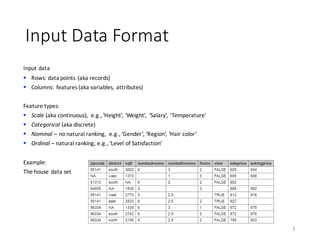
Input	Data	Format
3
Input	data		
§ Rows:	data	points	(aka	records)
§ Columns:	features	(aka	variables,	attributes)	
Feature	types:
§ Scale (aka	continuous),	 e.g.,	‘Height’,	‘Weight’,	 ‘Salary’,	‘Temperature’
§ Categorical (aka	discrete)
§ Nominal – no	natural	ranking,		e.g.,	‘Gender’,	‘Region’,	‘Hair	color’
§ Ordinal – natural	ranking,	e.g.,	‘Level	of	Satisfaction’	
Example:	
The	house	data	set
Data	Pre-Processing
Tabular	input	data	needs	to	be	transformed	into	a	matrix	– transform()	built-in	function
Categorical	features	need	special	treatment:
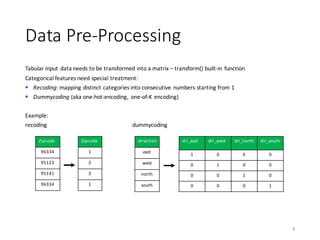
§ Recoding:	mapping	distinct	categories	into	consecutive	numbers	starting	from	1
§ Dummycoding (aka	one-hot-encoding,	 one-of-K	encoding)
Example:	
recoding dummycoding
4
Zipcode
96334
95123
95141
96334
Zipcode
1
2
3
1
direction
east
west
north
south
dir_east dir_west dir_north dir_south
1 0 0 0
0 1 0 0
0 0 1 0
0 0 0 1
transform() Built-in	Function
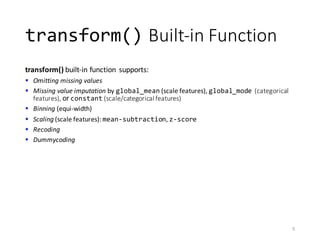
transform() built-in	function	 supports:
§ Omitting	missing	values
§ Missing	value	imputation by	global_mean (scale	features),	global_mode (categorical	
features),	or constant (scale/categorical	features)
§ Binning (equi-width)
§ Scaling (scale	features):	mean-subtraction,	z-score
§ Recoding
§ Dummycoding
5
Transform	Specification
§ Transformations	operate	on	individual	columns
§ All	required	transformations	specified	in	a	JSON	file
§ Property	na.strings in	the	mtd file	specifies	missing	values
Example:
data.spec.json data.csv.mtd
6
{
"data_type": "frame",
"format": "csv",
"sep": ",",
"header": true,
"na.strings": [ "NA", "" ]
}
{
“ids": true
, "omit": [ 1, 4, 5, 6, 7, 8, 9 ]
, "impute":
[ { “id": 2, "method": "constant",
"value": "south" }
,{ “id": 3, "method":
"global_mean" }
]
,"recode": [ 1, 2, 4, 5, 6, 7 ]
,"bin":
[ { “id": 8, "method": "equi-
width", "numbins": 3 } ]
,"dummycode": [ 2, 5, 6, 7, 8, 3 ]
}
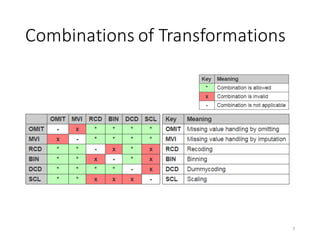
Combinations	of	Transformations
7
Signature	of	transform()
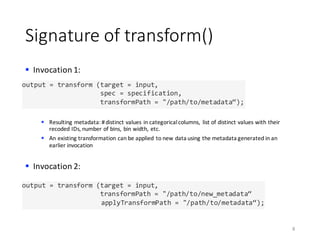
§ Invocation	1:
§ Resulting	metadata:	#	distinct	values	in	categorical	columns,	 list	of	distinct	values	with	their	
recoded	IDs,	number	of	bins,	bin	width,	etc.	
§ An	existing	transformation	can	be	applied	to	new	data	using	the	metadata	generated	in	an	
earlier	invocation
§ Invocation	2:
8
output = transform (target = input,
spec = specification,
transformPath = "/path/to/metadata“);
output = transform (target = input,
transformPath = "/path/to/new_metadata“
applyTransformPath = "/path/to/metadata“);
Outline
• Data	pre-processing	and	transformation
• Training/Testing/Cross	Validation
• Descriptive	statistics
I. Univariate	statistics
II. Bivariate	statistics
III. Stratified	statistics
9
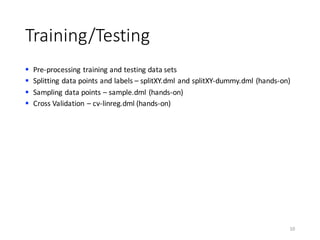
Training/Testing
§ Pre-processing	training	and	testing	data	sets
§ Splitting	data	points	and	labels	– splitXY.dml and	splitXY-dummy.dml (hands-on)
§ Sampling	data	points	– sample.dml (hands-on)
§ Cross	Validation	– cv-linreg.dml (hands-on)
10
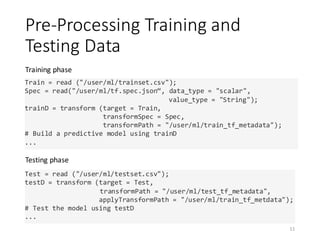
Pre-Processing	Training	and	
Testing	Data
Training	phase	
Testing	phase
11
Train = read ("/user/ml/trainset.csv");
Spec = read("/user/ml/tf.spec.json“, data_type = "scalar",
value_type = "String");
trainD = transform (target = Train,
transformSpec = Spec,
transformPath = "/user/ml/train_tf_metadata");
# Build a predictive model using trainD
...
Test = read ("/user/ml/testset.csv");
testD = transform (target = Test,
transformPath = "/user/ml/test_tf_metadata",
applyTransformPath = "/user/ml/train_tf_metdata");
# Test the model using testD
...
Cross	Validation
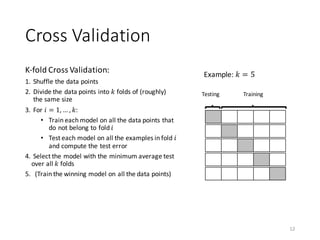
K-fold	Cross	Validation:
1. Shuffle	the	data	points	
2. Divide	the	data	points	into	𝑘 folds	of	(roughly)	
the	same	size
3. For	𝑖 = 1, … , 𝑘:	
• Train	each	model	on	all	the	data	points	that		
do	not	belong	to	fold	𝑖
• Test	each	model	on	all	the	examples	in	fold	𝑖
and	compute	the	test	error
4. Select	the	model	with	the	minimum	average	test	
over	all	𝑘 folds
5. (Train	the	winning	model	on	all	the	data	points)	
12
Testing Training
Example:	𝑘 = 5
Outline
• Data	pre-processing	and	transformation
• Training/Testing/Cross	Validation
• Descriptive	statistics
I. Univariate	statistics
II. Bivariate	statistics
III. Stratified	statistics
13
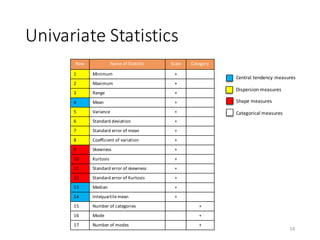
Univariate	Statistics
14
Row Name of	Statistic Scale Category
1 Minimum +
2 Maximum +
3 Range +
4 Mean +
5 Variance +
6 Standard	deviation +
7 Standard error	of	mean +
8 Coefficient	of	variation +
9 Skewness +
10 Kurtosis +
11 Standard	error	of	skewness +
12 Standard	error	of	Kurtosis +
13 Median +
14 Intequartilemean +
15 Number	of	categories +
16 Mode +
17 Number	of	modes +
Central	tendency	measures
Dispersion	measures
Shape	measures
Categorical	measures
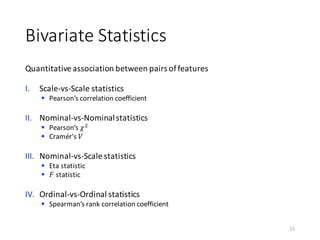
Bivariate	Statistics
Quantitative	association	between	pairs	of	features
I. Scale-vs-Scale	statistics
§ Pearson’s	correlation	coefficient	
II. Nominal-vs-Nominal	statistics
§ Pearson’s	𝜒)
§ Cramér's 𝑉
III. Nominal-vs-Scale	statistics
§ Eta	statistic
§ 𝐹 statistic
IV. Ordinal-vs-Ordinal	statistics
§ Spearman’s	rank	correlation	coefficient
15
Scale-vs-Scale	Statistics	
Pearson’s	correlation	coefficient
§ A	measure	of	linear	dependence	between	scale	features
§ 𝜌)
measures	accuracy	of	𝑥)	~	𝑥0
16
𝜌	 =
123(56,57)
9:69:7
,								𝜌	 ∈ [−1,+1]
1 − 𝜌)
=
∑ 𝑥A,) − 𝑥BA,)
)C
AD0
∑ 𝑥A,) − 𝑥̅A,)
)C
AD0
Residual	Sum	of	Squares	(RSS)
Total	Sum	of	Squares	(TSS)
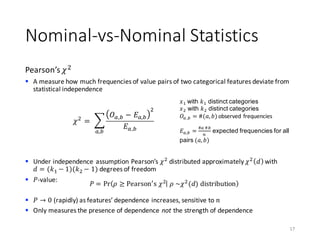
Nominal-vs-Nominal	Statistics
Pearson’s	𝜒)
§ A	measure	how	much	frequencies	of	value	pairs	of	two	categorical	features	deviate	from	
statistical	independence
§ Under	independence	assumption Pearson’s	𝜒)
distributed	approximately	𝜒)
𝑑 with
𝑑 = (𝑘0 − 1)(𝑘) − 1) degrees	of	freedom
§ 𝑃-value:
§ 𝑃 → 0 (rapidly)	as	features’	dependence	increases,	sensitive	to	𝑛
§ Only	measures	the	presence	of	dependence	not the	strength	of	dependence
17
𝜒)
=	 K
𝑂M,N − 𝐸M,N
)
𝐸M,NM,N
𝑥0 with 𝑘0 distinct categories
𝑥) with 𝑘) distinct categories
𝑂M ,N = #(𝑎, 𝑏) observed	frequencies
𝐸M,N =
#M	#N
C
expected frequencies for all
pairs (𝑎, 𝑏)
𝑃 = Pr 𝜌 ≥ Pearson[
s	𝜒)
	𝜌	~𝜒)
(𝑑)	distribution
Nominal-vs-Nominal	Statistics
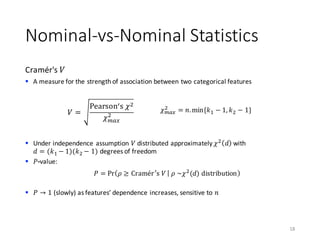
Cramér's	𝑉
§ A	measure	for	the	strength	of	association	between	two	categorical	features
§ Under	independence	assumption	𝑉 distributed	approximately	𝜒)
𝑑 with	
𝑑 = (𝑘0 − 1)(𝑘) − 1) degrees	of	freedom
§ 𝑃-value:
§ 𝑃 → 1 (slowly)	as	features’	dependence	increases,	sensitive	to	𝑛
18
𝑉 =
Pearson[s	𝜒)
𝜒aM5
)
𝜒aM5
)
= 𝑛.min	{ 𝑘0 − 1, 𝑘) − 1}
𝑃 = Pr 𝜌 ≥ Cramér[
s	𝑉	 	𝜌	~𝜒)
(𝑑)	distribution
Nominal-vs-Scale	Statistics
Eta	statistic
§ A	measure	for	the	strength	of	association	between	a	categorical	feature	and	a	scale	
feature
§ 𝜂)
measures	accuracy	of	𝑦	~	𝑥 similar	to	𝑅)
statistic	of	linear	regression
19
𝜂)
= 1 −
∑ 𝑦A − 𝑦B[𝑥A] )C
AD0
∑ 𝑦A − 𝑦k )C
AD0
RSS
TSS
𝑥 categorical
𝑦 scale
𝑦B[𝑥A]:	average	of	𝑦A among	all	records	with	
𝑥A = 𝑥
Nominal-vs-Scale	Statistics
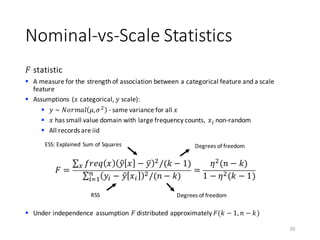
𝐹 statistic
§ A	measure	for	the	strength	of	association	between	a	categorical	feature	and	a	scale	
feature
§ Assumptions	(𝑥 categorical, 𝑦 scale):
§ 𝑦	~	𝑁𝑜𝑟𝑚𝑎𝑙 𝜇, 𝜎)
- same	variance	for	all	𝑥
§ 𝑥 has	small	value	domain	with	large	frequency	counts, 𝑥A non-random
§ All	records	are	iid
§ Under	independence	assumption	𝐹 distributed	approximately	𝐹(𝑘 − 1, 𝑛 − 𝑘)
20
𝐹 =
∑ 𝑓𝑟𝑒𝑞 𝑥 𝑦B 𝑥 − 𝑦k )/(𝑘 − 1)5
∑ 𝑦A − 𝑦B 𝑥A
)/(𝑛 − 𝑘)C
AD0
=
𝜂)(𝑛 − 𝑘)
1 − 𝜂)(𝑘 − 1)
ESS:	Explained	Sum	of	Squares
RSS
Degrees	of	freedom
Degrees	of	freedom
Ordinal-vs-Ordinal	Statistics
Spearman’s	rank	correlation	coefficient
§ A	measure	for	the	strength	of	association	between	two	ordinal	features
§ Pearson’s	correlation	efficient	applied	to	feature	with	values	replaced	by	their	ranks
Example:
21
8x
3)
11z
8{
5|
20
𝑥′
8
3
11
8
5
2
𝑥
4.5
2
6
4.5
3
1
𝑟
𝜌	 =
123	(•6,•7)
	9‚69‚7
𝜌	 ∈ [−1, +1]
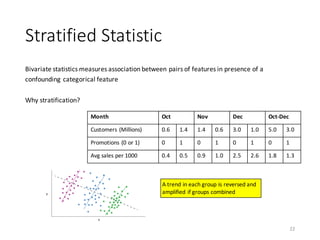
Stratified	Statistic
Bivariate	statistics	measures	association	between	pairs	of	features	in	presence	of	a	
confounding	categorical	feature
Why	stratification?
22
Month Oct Nov Dec Oct-Dec
Customers	(Millions) 0.6 1.4 1.4 0.6 3.0 1.0 5.0 3.0
Promotions	(0	or	1) 0 1 0 1 0 1 0 1
Avg sales	per	1000 0.4 0.5 0.9 1.0 2.5 2.6 1.8 1.3
A	trend	in	each	group	is	reversed	and	
amplified	if	groups	combined
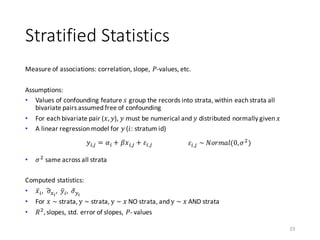
Stratified	Statistics
Measure	of	associations:	correlation,	slope,	𝑃-values,	etc.
Assumptions:
• Values	of	confounding	feature	𝑠 group	the	records	into	strata,	within	each	strata	all	
bivariate	pairs	assumed	free	of	confounding
• For	each	bivariate	pair	(𝑥, 𝑦),	𝑦 must	be	numerical	and	𝑦	distributed	normally	given	𝑥
• A	linear	regression	model	for	𝑦 (𝑖:	stratum	id)
• 𝜎)
same	across	all	strata
Computed	statistics:
• 𝑥̅A,		𝜎„5…
,		𝑦kA, 𝜎B†…
• For	𝑥	~ strata,	y	~ strata,	y	~	𝑥 NO	strata,	and	y	~	𝑥 AND	strata
• 𝑅)
, slopes,	std.	error	of	slopes,	𝑃- values
23
𝑦A,ˆ = 𝛼A + 𝛽𝑥A,ˆ + 𝜀A,ˆ 𝜀A,ˆ	~	𝑁𝑜𝑟𝑚𝑎𝑙(0, 𝜎)
)

Data preparation, training and validation using SystemML by Faraz Makari Manshadi